Recognition: unknown
Irreducible Gravitational Wave Background as a Particle Detector
Pith reviewed 2026-05-09 23:40 UTC · model grok-4.3
The pith
Spectral features in any primordial gravitational wave background directly determine the mass and decay rate of long-lived beyond-Standard-Model particles.
A machine-rendered reading of the paper's core claim, the machinery that carries it, and where it could break.
Core claim
Spectral features of primordial gravitational-wave backgrounds can directly reconstruct Lagrangian parameters of beyond-the-Standard-Model particles for any transient gravitational-wave production mechanism. Sufficiently long-lived particles generically induce a temporary period of early matter domination in the thermal history of the Universe, which imprints two characteristic frequencies in any primordial GWB corresponding to the onset and end of this epoch. These frequencies are determined by the initial abundance, mass, and decay rate of the species. Once the underlying model and initial abundance are specified, the observed spectral features directly determine the particle mass and the
What carries the argument
The pair of frequency breaks imprinted on a primordial gravitational wave spectrum by the beginning and end of an early matter-dominated epoch.
Load-bearing premise
Long-lived particles always produce a detectable temporary early matter domination that leaves two frequency features in any primordial gravitational wave background.
What would settle it
A measured primordial gravitational wave spectrum that shows no pair of frequency features even though long-lived particles with the required lifetime and abundance are known to have existed.
Figures


read the original abstract
We show that spectral features of primordial gravitational-wave backgrounds (GWB) can directly reconstruct \textit{Lagrangian} parameters of beyond-the-Standard-Model (BSM) particles, for any transient gravitational-wave production mechanism, independent of the specific source of gravitational waves. Sufficiently long-lived particles generically induce a temporary period of early matter domination in the thermal history of the Universe, which imprints two characteristic frequencies in any primordial GWB corresponding to the onset and end of this epoch. These frequencies are determined by the initial abundance, mass, and decay rate of the species. Once the underlying model and initial abundance are specified, the observed spectral features directly determine the particle mass and decay rate. We find that gravitational-wave observations probe regions of parameter space both complementary to and far beyond the reach of upcoming laboratory searches for long-lived particles. Remarkably, frequencies in the nanohertz band, where a stochastic signal has recently been reported by pulsar timing arrays, map directly onto decay lengths accessible in upcoming long-lived-particle (LLP) searches.
Editorial analysis
A structured set of objections, weighed in public.
Referee Report
Summary. The manuscript claims that spectral features of any primordial gravitational-wave background (GWB) encode the Lagrangian parameters (mass and decay rate) of long-lived BSM particles. Long-lived particles induce a temporary early matter-dominated era whose onset and end imprint two characteristic frequencies in the GWB spectrum; once the underlying model and initial abundance are fixed, these frequencies directly determine the particle parameters. The result is presented as independent of the specific transient GW production mechanism and is argued to probe parameter space complementary to and beyond upcoming LLP searches, with nanohertz frequencies mapping to decay lengths accessible in laboratory experiments.
Significance. If the central mapping holds, the work provides a novel, source-independent probe of BSM physics via GW observations. It would allow direct reconstruction of particle properties from spectral breaks and could link PTA signals to LLP phenomenology, extending sensitivity far beyond collider reach. The approach treats the irreducible GWB as a cosmological particle detector and supplies falsifiable frequency-to-parameter relations.
major comments (1)
- [Abstract and §1] Abstract and §1 (central claim): the assertion that the two characteristic frequencies appear 'in any primordial GWB' for 'any transient gravitational-wave production mechanism, independent of the specific source' is not generally valid. When GW production occurs after particle decay (t_prod > t_end), the relevant modes experience only standard radiation-dominated expansion and lack breaks at the frequencies tied to t_start and t_end. The imprint exists only for production preceding or overlapping the early MD epoch, requiring explicit qualification of the 'any' and 'independent' statements.
minor comments (2)
- [§2.2] §2.2: the mapping from observed frequencies to mass and decay rate assumes a fixed initial abundance; clarify how uncertainties in this parameter propagate into the reconstructed Lagrangian values and whether the reconstruction remains unique.
- [Figure 3] Figure 3: the plotted spectra would benefit from explicit annotation of the two break frequencies and the corresponding particle parameters for each curve to aid direct comparison with the analytic expressions.
Simulated Author's Rebuttal
We thank the referee for the careful reading and for identifying the need to qualify our central claim regarding the applicability of the spectral features. We agree that the imprint requires GW production to precede or overlap the early matter-dominated era and will revise the manuscript accordingly.
read point-by-point responses
-
Referee: [Abstract and §1] Abstract and §1 (central claim): the assertion that the two characteristic frequencies appear 'in any primordial GWB' for 'any transient gravitational-wave production mechanism, independent of the specific source' is not generally valid. When GW production occurs after particle decay (t_prod > t_end), the relevant modes experience only standard radiation-dominated expansion and lack breaks at the frequencies tied to t_start and t_end. The imprint exists only for production preceding or overlapping the early MD epoch, requiring explicit qualification of the 'any' and 'independent' statements.
Authors: We agree that the spectral breaks are imprinted only when GW production occurs before or during the temporary early matter-dominated era. Modes produced after particle decay (t_prod > t_end) evolve solely under radiation domination and do not exhibit the breaks at the frequencies set by t_start and t_end. We will revise the abstract and §1 to explicitly state that the result holds for any transient GW production mechanism with production preceding or overlapping the early MD epoch. Within this regime the frequency-to-parameter mapping remains independent of the specific source, since the features arise solely from the modified expansion history rather than the production details. This qualification preserves the source-independence of the probe while correcting the overstatement. revision: yes
Circularity Check
No circularity; derivation is self-contained in standard cosmology
full rationale
The paper derives that long-lived BSM particles induce a temporary early matter-dominated era whose onset and end imprint two characteristic frequencies on any primordial GWB spectrum. These frequencies are fixed by the particle's initial abundance, mass, and decay rate through the standard Friedmann equation and radiation-to-matter transition timing; the observed breaks then invert to recover the mass and decay rate. This chain uses only general-relativistic expansion history and does not fit parameters to the target GWB data, rename known results, or rely on self-citations for load-bearing uniqueness theorems. The claim of independence from the specific transient GW source follows from the fact that the MD epoch alters the scale-factor evolution for all modes that re-enter during or before that epoch, which is a direct consequence of the background cosmology rather than an ansatz or fitted input. No step reduces by construction to its own outputs.
Axiom & Free-Parameter Ledger
free parameters (1)
- initial abundance
axioms (2)
- domain assumption Long-lived particles generically induce a temporary period of early matter domination
- domain assumption The gravitational-wave background is primordial and contains measurable spectral features from the matter-dominated epoch
Forward citations
Cited by 1 Pith paper
-
Imprint of domain wall annihilation on induced gravitational waves
Domain wall annihilation imprints a two-peaked spectrum on induced gravitational waves via an early matter-dominated phase and entropy dilution.
Reference graph
Works this paper leans on
-
[1]
This factor is therefore 1 for radiation domination and early matter domination is 9/16 so is anO(1) correction to the am- plitude
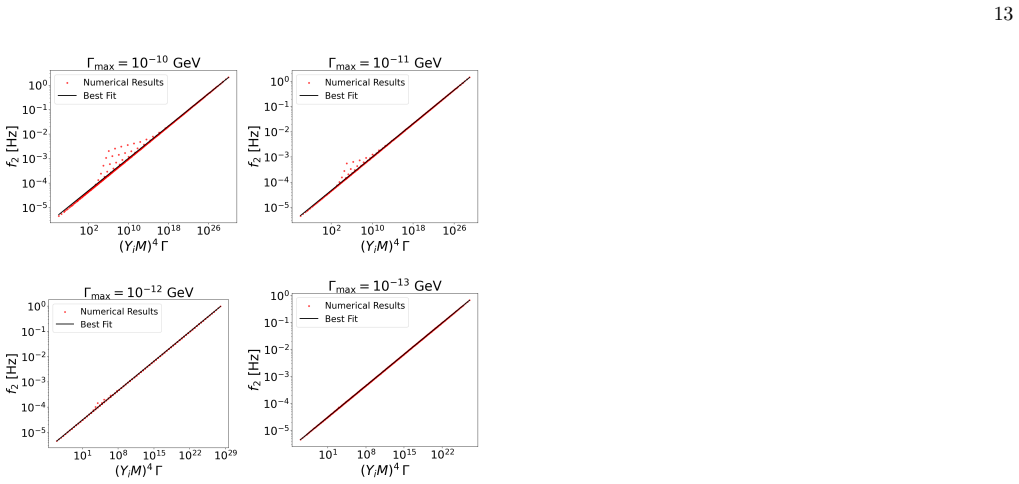
As the return to radiation domination occurs from decays this is an accurate approximation 78. This factor is therefore 1 for radiation domination and early matter domination is 9/16 so is anO(1) correction to the am- plitude. The final form of the equation is found by the addition of this factor to Eq 13, ΩGW (af , f) = Ω RD GW C(w)Exp "Z lna f lna ent(f...
-
[2]
Classical and Quantum Gravity , keywords =
C. Caprini and D. G. Figueroa, Classical and Quantum Gravity35, 163001 (2018), ISSN 1361-6382, URLhttp: //dx.doi.org/10.1088/1361-6382/aac608
-
[3]
P. Bin´ etruy, A. Boh´ e, C. Caprini, and J.-F. Dufaux, Journal of Cosmology and Astroparticle Physics2012, 027–027 (2012), ISSN 1475-7516, URLhttp://dx.doi. org/10.1088/1475-7516/2012/06/027
-
[4]
Roshan and G
R. Roshan and G. White, Rev. Mod. Phys.97, 015001 (2025), URLhttps://link.aps.org/doi/10. 1103/RevModPhys.97.015001
2025
-
[5]
N. van Remortel, K. Janssens, and K. Turbang, Progress in Particle and Nuclear Physics128, 104003 (2023), ISSN 0146-6410, URLhttp://dx.doi.org/10. 1016/j.ppnp.2022.104003
-
[6]
Reports on Progress in Physics , author =
N. Christensen, Reports on Progress in Physics82, 016903 (2018), ISSN 1361-6633, URLhttp://dx.doi. org/10.1088/1361-6633/aae6b5
-
[7]
B. P. Abbott et al. (LIGO Scientific, Virgo), Phys. Rev. Lett.116, 061102 (2016), 1602.03837
work page internal anchor Pith review arXiv 2016
- [8]
- [9]
- [10]
-
[11]
B. P. Abbott et al. (LIGO Scientific, Virgo), Phys. Rev. Lett.119, 141101 (2017), 1709.09660
work page Pith review arXiv 2017
-
[12]
B. P. Abbott et al. (LIGO Scientific, Virgo), Phys. Rev. Lett.119, 161101 (2017), 1710.05832
work page internal anchor Pith review arXiv 2017
-
[13]
L. Badurina, O. Buchmueller, J. Ellis, M. Lewicki, C. McCabe, and V. Vaskonen, Phil. Trans. A. Math. Phys. Eng. Sci.380, 20210060 (2021), 2108.02468
- [14]
- [15]
-
[16]
Badurina et al., JCAP05, 011 (2020), 1911.11755
L. Badurina et al., JCAP05, 011 (2020), 1911.11755
-
[17]
Punturo et al., Class
M. Punturo et al., Class. Quant. Grav.27, 194002 (2010)
2010
-
[18]
Hild et al.,Sensitivity Studies for Third-Generation Gravitational Wave Observatories,Class
S. Hild et al., Class. Quant. Grav.28, 094013 (2011), 1012.0908
- [19]
-
[20]
Cosmic Explorer: The U.S. Contribution to Gravitational-Wave Astronomy beyond LIGO
D. Reitze et al., Bull. Am. Astron. Soc.51, 035 (2019), 1907.04833
work page internal anchor Pith review arXiv 2019
-
[21]
and Berti, Emanuele and Caldwell, Robert and Camp, Jordan and Conklin, John W
J. Baker et al. (2019), 1907.06482
- [22]
-
[23]
Sesana et al.,Unveiling the gravitational universe at µ-Hz frequencies,Exper
A. Sesana et al., Exper. Astron.51, 1333 (2021), 1908.11391
-
[24]
J. Garcia-Bellido, H. Murayama, and G. White, JCAP 12, 023 (2021), 2104.04778
- [25]
-
[26]
Janssenet al., PoSAASKA14, 037 (2015), arXiv:1501.00127 [astro-ph.IM]
G. Janssen et al., PoSAASKA14, 037 (2015), 1501.00127
-
[27]
Weltman et al.,Fundamental physics with the Square Kilometre Array,Publ
A. Weltman et al., Publ. Astron. Soc. Austral.37, e002 (2020), 1810.02680
-
[28]
L. Lentati et al. (EPTA), Mon. Not. Roy. Astron. Soc. 453, 2576 (2015), 1504.03692
-
[29]
S. Babak et al. (EPTA), Mon. Not. Roy. Astron. Soc. 455, 1665 (2016), 1509.02165
-
[30]
arXiv , doi =:1801.02617 , keywords =
Z. Arzoumanian et al. (NANOGRAV), Astrophys. J. 859, 47 (2018), 1801.02617
-
[31]
K. Aggarwal et al., Astrophys. J.880, 2 (2019), 1812.11585
-
[32]
The NANOGrav 12.5 yr Data Set: Search for an Isotropic Stochastic Gravitational-wave Background,
Z. Arzoumanian et al. (NANOGrav), Astrophys. J. Lett. 905, L34 (2020), 2009.04496
-
[33]
The NANOGrav 15-year Data Set: Evidence for a Gravitational-Wave Background
G. Agazie et al. (NANOGrav), Astrophys. J. Lett.951, L8 (2023), 2306.16213
work page internal anchor Pith review arXiv 2023
-
[34]
Afzalet al.(NANOGrav), Astrophys
A. Afzal et al. (NANOGrav), Astrophys. J. Lett. 951, L11 (2023), [Erratum: Astrophys.J.Lett. 971, L27 (2024), Erratum: Astrophys.J. 971, L27 (2024)], 2306.16219
-
[35]
Caprini, M
C. Caprini, M. Hindmarsh, S. Huber, T. Konstandin, J. Kozaczuk, G. Nardini, J. M. No, A. Petiteau, P. Schwaller, G. Servant, et al., Journal of Cosmol- ogy and Astroparticle Physics2016, 001–001 (2016), 7 ISSN 1475-7516, URLhttp://dx.doi.org/10.1088/ 1475-7516/2016/04/001
2016
- [36]
-
[37]
L. A. Boyle and P. J. Steinhardt, Physical Review D77 (2008), ISSN 1550-2368, URLhttp://dx.doi.org/10. 1103/PhysRevD.77.063504
2008
- [38]
- [39]
-
[40]
M. Hindmarsh, S. J. Huber, K. Rummukainen, and D. J. Weir, Phys. Rev. D92, 123009 (2015), 1504.03291
-
[41]
Vilenkin, Phys
A. Vilenkin, Phys. Rev. D23, 852 (1981)
1981
-
[42]
Vachaspati and A
T. Vachaspati and A. Vilenkin, Phys. Rev. D31, 3052 (1985)
1985
-
[43]
J. J. Blanco-Pillado and K. D. Olum, Physical Review D 96(2017), ISSN 2470-0029, URLhttp://dx.doi.org/ 10.1103/PhysRevD.96.104046
-
[44]
Hiramatsu, M
T. Hiramatsu, M. Kawasaki, and K. Saikawa, Journal of Cosmology and Astroparticle Physics2010, 032–032 (2010), ISSN 1475-7516, URLhttp://dx.doi.org/10. 1088/1475-7516/2010/05/032
2010
-
[45]
M. Pearce, L. Pearce, G. White, and C. Bal´ azs, Jour- nal of Cosmology and Astroparticle Physics2024, 021 (2024), URLhttps://doi.org/10.1088/1475-7516/ 2024/06/021
-
[46]
Barenboim and W.-I
G. Barenboim and W.-I. Park, Physics Let- ters B759, 430 (2016), ISSN 0370-2693, URL https://www.sciencedirect.com/science/article/ pii/S037026931630260X
2016
-
[47]
Assadullahi and D
H. Assadullahi and D. Wands, Physical Review D79 (2009), ISSN 1550-2368, URLhttp://dx.doi.org/10. 1103/PhysRevD.79.083511
2009
-
[48]
L. Alabidi, K. Kohri, M. Sasaki, and Y. Sendouda, Journal of Cosmology and Astroparticle Physics2013, 033–033 (2013), ISSN 1475-7516, URLhttp://dx.doi. org/10.1088/1475-7516/2013/05/033
-
[49]
Kohri and T
K. Kohri and T. Terada, Physical Review D97(2018), ISSN 2470-0029, URLhttp://dx.doi.org/10.1103/ PhysRevD.97.123532
2018
-
[50]
K. Inomata, K. Kohri, T. Nakama, and T. Terada, Physical Review D100(2019), ISSN 2470-0029, URL http://dx.doi.org/10.1103/PhysRevD.100.043532
-
[51]
N. Seto and J. Yokoyama, J. Phys. Soc. Jap.72, 3082 (2003), gr-qc/0305096
- [52]
-
[53]
S. Kuroyanagi, T. Chiba, and N. Sugiyama, Phys. Rev. D79, 103501 (2009), 0804.3249
- [54]
-
[55]
S. Kuroyanagi, C. Ringeval, and T. Takahashi, Phys. Rev. D87, 083502 (2013), 1301.1778
- [56]
- [57]
- [58]
-
[59]
D. J. H. Chung, E. W. Kolb, and A. Riotto, Physical Review D60(1999), ISSN 1089-4918, URLhttp://dx. doi.org/10.1103/PhysRevD.60.063504
- [60]
- [61]
-
[62]
McDonald, Phys
J. McDonald, Phys. Rev. D43, 1063 (1991)
1991
-
[63]
T. Moroi and L. Randall, Nucl. Phys. B570, 455 (2000), hep-ph/9906527
-
[64]
L. Visinelli and P. Gondolo, Phys. Rev. D81, 063508 (2010), 0912.0015
- [65]
- [66]
- [67]
-
[68]
M. Cirelli, Y. Gouttenoire, K. Petraki, and F. Sala, JCAP02, 014 (2019), 1811.03608
-
[69]
BSM with Cosmic Strings: Heavy, up to EeV mass, Unstable Particles,
Y. Gouttenoire, G. Servant, and P. Simakachorn, JCAP 07, 016 (2020), 1912.03245
-
[70]
R. Allahverdi et al., Open J. Astrophys.4, as- tro.2006.16182 (2021), 2006.16182
-
[71]
R. Allahverdi and J. K. Osi´ nski, Phys. Rev. D105, 023502 (2022), 2108.13136
-
[72]
R. Allahverdi, N. P. D. Loc, and J. K. Osi´ nski, Phys. Rev. D107, 123510 (2023), 2212.11303
-
[73]
Gonzalez Suarez, Acta Physica Polonica B52, 953 (2021), ISSN 1509-5770, URLhttp://dx.doi.org/10
R. Gonzalez Suarez, Acta Physica Polonica B52, 953 (2021), ISSN 1509-5770, URLhttp://dx.doi.org/10. 5506/APhysPolB.52.953
2021
-
[74]
L. Jeanty and B. Shuve,Long-lived particles: theory and experimental probes(2025), 2511.17934, URLhttps: //arxiv.org/abs/2511.17934
-
[75]
L. Lee, C. Ohm, A. Soffer, and T.-T. Yu, Progress in Particle and Nuclear Physics106, 210–255 (2019), ISSN 0146-6410, URLhttp://dx.doi.org/10.1016/j.ppnp. 2019.02.006
-
[76]
Alimena et al., Journal of Physics G: Nuclear and Particle Physics47, 090501 (2020), URLhttps://doi
J. Alimena et al., Journal of Physics G: Nuclear and Particle Physics47, 090501 (2020), URLhttps://doi. org/10.1088/1361-6471/ab4574
-
[77]
C. B. Verhaaren et al., Frontiers in PhysicsVol- ume 10 - 2022(2022), ISSN 2296-424X, URL https://www.frontiersin.org/journals/physics/ articles/10.3389/fphy.2022.967881
- [78]
- [79]
- [80]
discussion (0)
Sign in with ORCID, Apple, or X to comment. Anyone can read and Pith papers without signing in.