Recognition: unknown
From Physical Difference to Meaning: A Constructor-Theoretic Framework for Prebiotic Information in Casimir-Lifshitz-Coupled Protocell Clusters
Pith reviewed 2026-05-10 07:50 UTC · model grok-4.3
The pith
Casimir-Lifshitz forces in protocell clusters turn physical differences into states that regulate prebiotic tasks.
A machine-rendered reading of the paper's core claim, the machinery that carries it, and where it could break.
Core claim
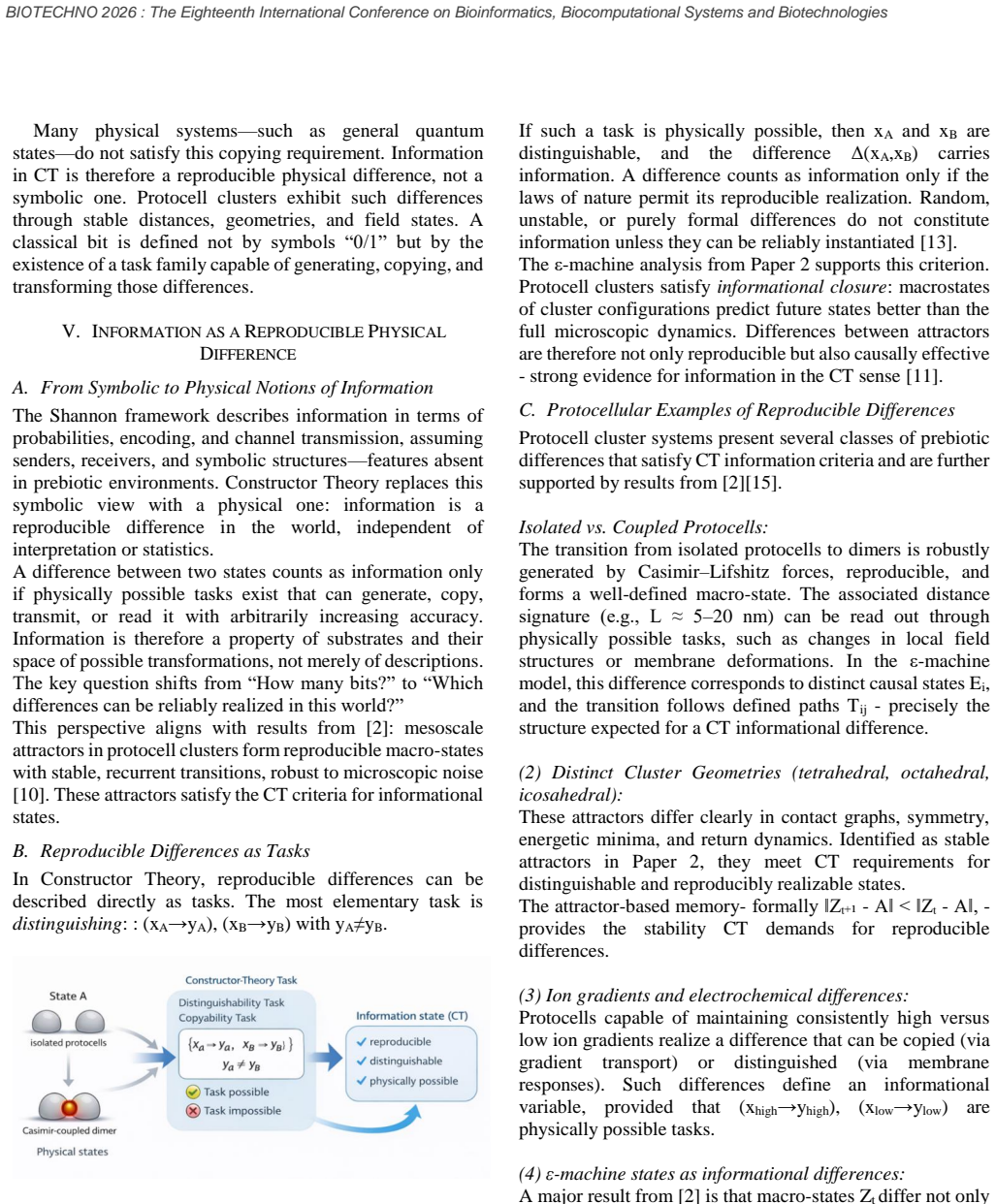
Using constructor theory, information is defined as a reproducible physical difference and meaning as a difference with stable functional consequences. Casimir-Lifshitz-coupled protocell clusters exhibit reproducible attractors and ordered transitions whose geometries and gradients directly regulate tasks such as approach, exchange, and stabilization, thereby carrying both informational and meaningful states from physical mechanisms alone.
What carries the argument
The constructor-theoretic mapping of reproducible physical differences (distances, geometries, gradients) onto functional task structures within Casimir-Lifshitz-coupled protocell clusters.
If this is right
- Clusters perform regulatory tasks through physical attractors alone.
- Physical vacuum forces suffice to generate proto-semantic distinctions.
- Prebiotic information formation can be modeled as computational mechanics of the cluster geometry.
Where Pith is reading between the lines
- The same vacuum-mediated coupling could be tested in other self-organizing colloidal systems for similar task regulation.
- If the framework holds, selection on meaningful states could be studied as a purely physical process prior to replication.
- Experimental variation of cluster size and separation would provide direct checks on whether attractor stability scales with functional outcomes.
Load-bearing premise
That Casimir-Lifshitz-coupled protocell clusters naturally produce reproducible attractors, ordered transitions, and autonomous task structures that can be read as informational and meaningful states without further mechanisms.
What would settle it
A demonstration that altering distances or geometries inside such clusters produces no consistent, repeatable changes in task outcomes such as stabilization or exchange would falsify the claim that the clusters carry meaningful states.
Figures
read the original abstract
This paper develops a physical framework for the prebiotic emergence of information and meaning. Building on Constructor Theory, we define information as a reproducible physical difference and meaning as a difference with stable functional consequences. Casimir-Lifshitz-coupled protocell clusters serve as a minimal model that exhibits reproducible attractors, ordered transitions, and autonomous task structures. We show that such clusters carry both informational states (e.g., distances, geometries, gradients) and meaningful states that regulate prebiotic tasks such as approach, exchange, or stabilization. This approach integrates physical mechanisms, computational mechanics, and early proto-semantic functions into a coherent account of information formation before biology.
Editorial analysis
A structured set of objections, weighed in public.
Referee Report
Summary. The paper develops a constructor-theoretic framework for prebiotic information and meaning, defining information as a reproducible physical difference and meaning as a difference with stable functional consequences. It uses Casimir-Lifshitz-coupled protocell clusters as a minimal model claimed to exhibit reproducible attractors, ordered transitions, and autonomous task structures, asserting that these clusters carry informational states (e.g., distances, geometries, gradients) and meaningful states that regulate prebiotic tasks such as approach, exchange, or stabilization.
Significance. If the physical mechanisms were shown to generate substrate-independent, reproducible differences enabling specific functional tasks without external assignment, the framework could offer a novel integration of quantum vacuum forces with computational mechanics and early proto-semantic functions in origins-of-life research. The approach is ambitious in bridging physics and semantics but currently lacks the derivations needed to substantiate the mapping.
major comments (3)
- [Abstract] Abstract: The central claim ('We show that such clusters carry both informational states... and meaningful states that regulate prebiotic tasks') is presented without derivations, equations, simulations, or data. This makes it impossible to evaluate whether the Casimir-Lifshitz force law plus protocell boundary conditions actually produce the required attractors and autonomous task structures.
- [Abstract] Abstract: The definitions of information ('reproducible physical difference') and meaning ('difference with stable functional consequences') are introduced axiomatically and then applied to interpret cluster properties (distances, geometries, gradients) as carrying informational and meaningful states. This creates circularity, as the functional stability and task regulation are asserted rather than derived from the physics.
- [Abstract] The manuscript does not provide a derivation showing how the Lifshitz force produces attractors whose functional use is independent of external assignment, as required by constructor theory for a difference to count as information or meaning. The mapping from physical attractors to 'autonomous task structures' remains definitional.
minor comments (1)
- [Abstract] The abstract would benefit from explicit references to prior constructor theory literature (e.g., Deutsch, Marletto) and any existing work on Casimir forces in biological or prebiotic contexts to clarify novelty.
Simulated Author's Rebuttal
We thank the referee for their constructive comments, which help clarify how our constructor-theoretic framework can be presented more rigorously. We address each major comment below and note the revisions we will make.
read point-by-point responses
-
Referee: [Abstract] Abstract: The central claim ('We show that such clusters carry both informational states... and meaningful states that regulate prebiotic tasks') is presented without derivations, equations, simulations, or data. This makes it impossible to evaluate whether the Casimir-Lifshitz force law plus protocell boundary conditions actually produce the required attractors and autonomous task structures.
Authors: The abstract summarizes the central results; the full manuscript develops the application of constructor theory to the Casimir-Lifshitz model and argues that the force law under protocell boundary conditions yields reproducible attractors. We agree that explicit equations would improve evaluability and will add a dedicated subsection deriving the attractors and task structures from the Lifshitz formula and boundary conditions. revision: yes
-
Referee: [Abstract] Abstract: The definitions of information ('reproducible physical difference') and meaning ('difference with stable functional consequences') are introduced axiomatically and then applied to interpret cluster properties (distances, geometries, gradients) as carrying informational and meaningful states. This creates circularity, as the functional stability and task regulation are asserted rather than derived from the physics.
Authors: These definitions are taken from constructor theory, where they are not arbitrary but follow from the requirement that information be substrate-independent and reproducible. We will revise the manuscript to derive the functional stability explicitly from the physical stability of the Casimir-Lifshitz attractors, showing how the dynamics themselves produce stable configurations capable of regulating tasks such as approach or stabilization. revision: partial
-
Referee: [Abstract] The manuscript does not provide a derivation showing how the Lifshitz force produces attractors whose functional use is independent of external assignment, as required by constructor theory for a difference to count as information or meaning. The mapping from physical attractors to 'autonomous task structures' remains definitional.
Authors: The attractors emerge solely from the quantum vacuum forces between the protocells; their reproducibility across instances supplies the independence from external assignment required by constructor theory. The autonomous task structures follow from the physical consequences of these configurations. We acknowledge that a more formal step-by-step derivation would strengthen the argument and will expand the relevant section accordingly. revision: yes
Circularity Check
Definitions of information and meaning map directly onto physical attractors by construction, reducing the central claim to the initial postulates.
specific steps
-
self definitional
[Abstract]
"Building on Constructor Theory, we define information as a reproducible physical difference and meaning as a difference with stable functional consequences. Casimir-Lifshitz-coupled protocell clusters serve as a minimal model that exhibits reproducible attractors, ordered transitions, and autonomous task structures. We show that such clusters carry both informational states (e.g., distances, geometries, gradients) and meaningful states that regulate prebiotic tasks such as approach, exchange, or stabilization."
The definitions are introduced first, then the physical features (attractors, distances, gradients, task structures) are labeled as informational and meaningful without deriving that they meet the constructor-theoretic criteria independently of the definitions. The demonstration therefore reduces to the initial postulates by construction.
full rationale
The paper's derivation chain begins by defining information and meaning in constructor-theoretic terms (reproducible physical difference; difference with stable functional consequences) and then asserts that the Casimir-Lifshitz protocell clusters exhibit exactly those properties via their attractors and task structures. No independent derivation from the force laws or boundary conditions is supplied to establish reproducibility by a constructor or substrate-independent functional stability; the mapping is therefore tautological. This is a clear instance of the self-definitional pattern with no external benchmarks or falsifiable steps separating input from output.
Axiom & Free-Parameter Ledger
axioms (3)
- ad hoc to paper Information can be defined as a reproducible physical difference
- ad hoc to paper Meaning is a difference with stable functional consequences
- domain assumption Constructor Theory provides an appropriate foundation for physical information
invented entities (1)
-
Meaningful states in Casimir-Lifshitz-coupled protocell clusters
no independent evidence
Reference graph
Works this paper leans on
-
[1]
Attractive Casimir-Lifshitz Forces as a Universal Driver of Prebiotic Protocell Aggregation and Cluster Formation,
M. Massoth, “Attractive Casimir-Lifshitz Forces as a Universal Driver of Prebiotic Protocell Aggregation and Cluster Formation,” BIOTECHNO, 2026
2026
-
[2]
Emergent Information Formation in Prebiotic Protocell Clusters: A Computational Mechanics Framework of ε-Machines and Attractor Memory,
M. Massoth, “Emergent Information Formation in Prebiotic Protocell Clusters: A Computational Mechanics Framework of ε-Machines and Attractor Memory,” BIOTECHNO, 2026
2026
-
[3]
F. E. Rosas, et al. , “Software in the natural world: A computational approach to hierarchical emergence,” arXiv preprint, 2024, doi:10.48550/arXiv.2402.09090
-
[4]
Construction theory of information,
M. Deutsch and C. Marletto, “Construction theory of information,” Proc. R. Soc. A , vol. 471, a rt. no. 20140540, 2015, doi:10.1098/rspa.2014.0540
-
[5]
On the attraction between two perfectly conducting plates,
H. B. G. Casimir, “On the attraction between two perfectly conducting plates,” Proc. K. Ned. Akad. Wet., vol. 51, pp. 793– 795, 1948
1948
-
[6]
The theory of molecular attractive forces between solids,
E. M. Lifshitz, “The theory of molecular attractive forces between solids,” Sov. Phys. JETP, vol. 2, pp. 73–83, 1956
1956
-
[7]
J. N. Israelachvili, Intermolecular and Surface Forces, 3rd ed., Academic Press, London, 2011
2011
-
[8]
Does quantum mechanics play a non -trivial role in life?
P. C. W. Davies, “Does quantum mechanics play a non -trivial role in life?” Biosystems, vol. 78, pp. 69–79, 2004
2004
-
[9]
Protocells: Milestones and recent advances,
I. Gözen, et al., “Protocells: Milestones and recent advances,” Small, vol. 18, art. no. 2106624, 2022
2022
-
[10]
J. P. Crutchfield, “Inferring statistical complexity,” Phys. Rev. Lett., vol. 63, no. 2, pp. 105 –108, 1989, doi:10.1103/PhysRevLett.63.105
-
[11]
E. P. Hoel, L. Albantakis, and G. Tononi, “Quantifying causal emergence,” Proc. Natl. Acad. Sci. U.S.A., vol. 110, no. 49, pp. 19790–19795, 2013, doi:10.1073/pnas.1314922110
-
[12]
S. A. Kauffman, The Origins of Order: Self-Organization and Selection in Evolution, Oxford Univ. Press, Oxford, 1993
1993
-
[13]
Computational Mechanics: Pattern and Prediction, Structure and Simplicity
C. R. Shalizi and J. P. Crutchfield, “Computational mechanics: Pattern and prediction, structure and simplicity,” J. Stat. Phys., vol. 104, nos. 3 –4, pp. 817 –879, 2001, doi:10.1023/A:1010388907793
-
[14]
Nicolis and I
G. Nicolis and I. Prigogine, Self-Organization in Nonequilibrium Systems, Wiley, New York, 1977
1977
-
[15]
Experimental models of primitive cellular compartments,
M. M. Hanczyc, S. M. Fujikawa, and J. W. Szostak, “Experimental models of primitive cellular compartments,” Science, vol. 302, no. 5645, pp. 618 –622, 2003, doi:10.1126/science.1089904
-
[16]
Deamer, Assembling Life: How Can Life Begin on Earth and Other Habitable Planets?, Oxford Univ
D. Deamer, Assembling Life: How Can Life Begin on Earth and Other Habitable Planets?, Oxford Univ. Press, Oxford, 2017
2017
-
[17]
Direct measurement of the van der Waals force between a pair of microspheres based on photonic force microscop y,
S. Pei, Z. Zhang, T. Li, et al., “Direct measurement of the van der Waals force between a pair of microspheres based on photonic force microscop y,” Opt. Eng. , vol. 60, art. no. 084101, 2021
2021
-
[18]
Ionic strength sensing in living cells,
B. Liu, B. Poolman, and A. J. Boersma, “Ionic strength sensing in living cells,” ACS Chem. Biol. , vol. 12, pp. 2510 –2514, 2017
2017
-
[19]
A sensor for quantification of macr omolecular crowding in living cells,
A. J. Boersma, I. S. Zuhorn, and B. Poolman, “A sensor for quantification of macr omolecular crowding in living cells,” Nat. Methods, vol. 12, pp. 227–229, 2015
2015
-
[20]
Nanometer -ranged attraction induced by multivalent ions between similar and dissimilar surfaces probed using an atomic force microscope,
M. Moazzami-Gudarzi, G. Trefalt, I. Szilagyi, P. Maroni, and M. Borkovec, “Nanometer -ranged attraction induced by multivalent ions between similar and dissimilar surfaces probed using an atomic force microscope,” Phys. Chem. Chem. Phys., vol. 18, pp. 8739–8751, 2016
2016
-
[21]
Forces between silica particles in the presence of multivalent cations,
V. Valmacco, G. Trefalt, P. Maroni, and M. Borkovec, “Forces between silica particles in the presence of multivalent cations,” J. Colloid Interface Sci., vol. 472, pp. 108–115, 2016
2016
-
[22]
Measuring electrostatic, van der Waals, and hydration forces in e lectrolyte solutions with an atomic force microscope,
H.-J. Butt, “Measuring electrostatic, van der Waals, and hydration forces in e lectrolyte solutions with an atomic force microscope,” Biophys. J., vol. 60, pp. 1438–1444, 1991. 30Copyright (c) IARIA, 2026. ISBN: 978-1-68558-361-3 Courtesy of IARIA Board and IARIA Press. Original source: ThinkMind Digital Library https://www.thinkmind.org BIOTECHNO 2026 : ...
1991
-
[23]
Semantic Information, Autonomous Agency and Non -Equilibrium Statistical Physics,
A. Kolchinsky and D. H. Wolpert, “Semantic information, autonomous agency and non -equilibrium statistical physics,” Interface Focus, vol. 8, no. 6, art. no. 2 0180041, 2018, doi:10.1098/rsfs.2018.0041
-
[24]
Synthetic Cells Extract Semantic Information From Their Environment,
B. Ruzzante, L. Del Moro, M. Magarini, and P. Stano, “Synthetic Cells Extract Semantic Information From Their Environment,” IEEE Transactions on Molecular, Biological and Multi -Scale Communications, vol. 9, no. 1, pp. 23 –36, 2023, doi:10.1109/TMBMC.2023.3244399
-
[25]
Physics of Life: Exploring Information as a Distinctive Feature of Living Systems,
S. Bartlett et al., “Physics of Life: Exploring Information as a Distinctive Feature of Living Systems,” PRX Life, vol. 3, 037003, 2025, doi:10.1103/rsx4-8x5f
-
[26]
Neural networks and physical systems with emergent collective computational abilities,
J. J. Hopfield, “Neural networks and physical systems with emergent collective computational abilities,” Proc. Natl. Acad. Sci. U.S.A., vol. 79, no. 8, pp. 2554–2558, 1982. 31Copyright (c) IARIA, 2026. ISBN: 978-1-68558-361-3 Courtesy of IARIA Board and IARIA Press. Original source: ThinkMind Digital Library https://www.thinkmind.org BIOTECHNO 2026 : The ...
1982
discussion (0)
Sign in with ORCID, Apple, or X to comment. Anyone can read and Pith papers without signing in.