pith. machine review for the scientific record. sign in

cs.GL

General Literature

Covers introductory material, survey material, predictions of future trends, biographies, and miscellaneous computer-science related material. Roughly includes all of ACM Subject Class A, except it does not include conference proceedings (which will be listed in the appropriate subject area).

0
cs.GL 2026-04-24

Fréchet distance history explains modern AI evaluation metric

A Brief History of Fr\'echet Distances: From Curves and Probability Laws to FID

Tracing from 1906 abstract sets through curve geometry and probability couplings shows FID as Wasserstein-2 distance between Gaussians in a

Figure from the paper full image
abstract click to expand
This note provides a chronological account of Fr\'echet distances, starting with Maurice Fr\'echet's 1906 doctoral thesis on distances in abstract sets and tracing the Fr\'echet distance between polygonal curves and its algorithmic computation in the 1990s. It then continues with his 1957 paper on a coupling-based distance between probability laws with a brief glimpse of Wasserstein distance and optimal transport. We further attempt to draw connections between the distributional, coupling-based facet of Fr\'echet distances on probability laws and the geometric facet on curves. The note ends with a modern use case, the Fr\'echet Inception Distance (FID) in the era of deep generative model evaluation, interpretable as the Wasserstein-2 distance between multivariate Gaussians in a learned feature space. An appendix includes \TeX{}ified faithful English translations of Fr\'echet's 1906 thesis and 1957 paper, and L\'evy's 1950 note for reader convenience.
0
0
cs.GL 2026-04-09 2 theorems

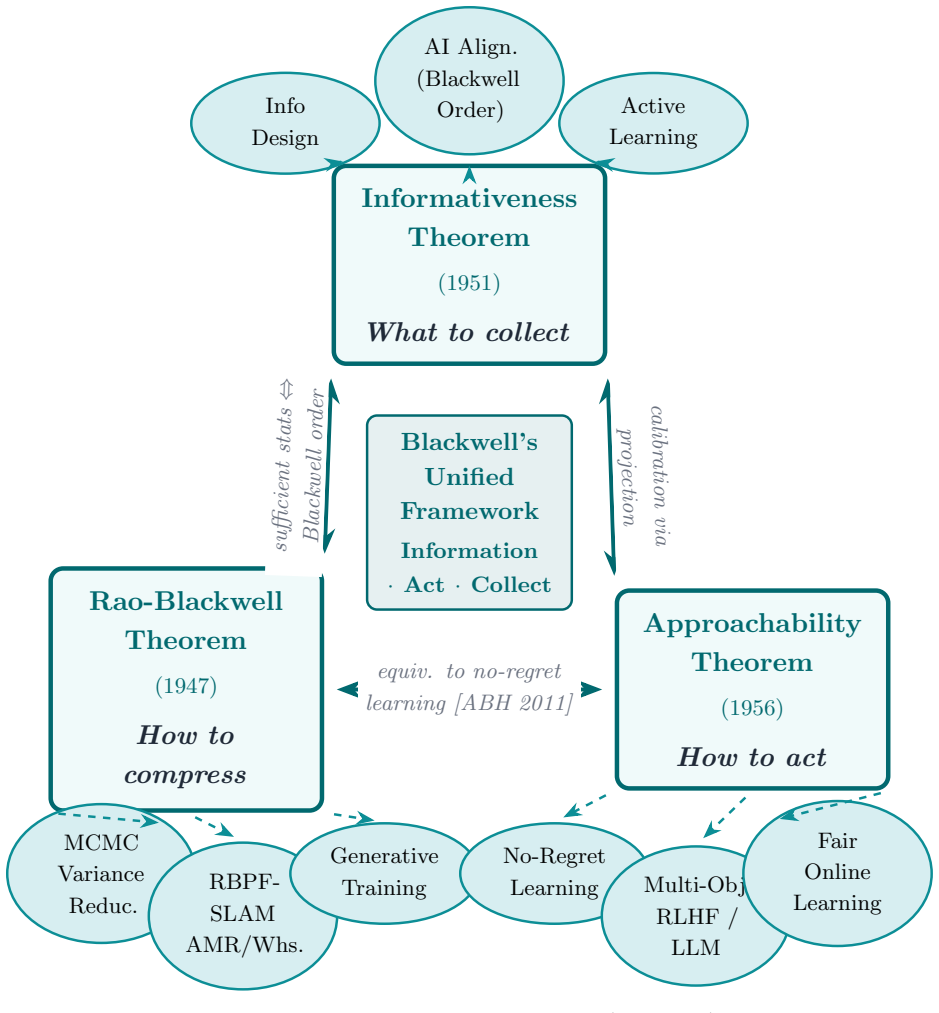
Blackwell theorems still guide core AI techniques

The Theorems of Dr. David Blackwell and Their Contributions to Artificial Intelligence

Results on variance reduction, approachability, and experiment comparison remain active in MCMC, SLAM, and RLHF today.

Figure from the paper full image
abstract click to expand
Dr. David Blackwell was a mathematician and statistician of the first rank, whose contributions to statistical theory, game theory, and decision theory predated many of the algorithmic breakthroughs that define modern artificial intelligence. This survey examines three of his most consequential theoretical results the Rao Blackwell theorem, the Blackwell Approachability theorem, and the Blackwell Informativeness theorem (comparison of experiments) and traces their direct influence on contemporary AI and machine learning. We show that these results, developed primarily in the 1940s and 1950s, remain technically live across modern subfields including Markov Chain Monte Carlo inference, autonomous mobile robot navigation (SLAM), generative model training, no-regret online learning, reinforcement learning from human feedback (RLHF), large language model alignment, and information design. NVIDIAs 2024 decision to name their flagship GPU architecture (Blackwell) provides vivid testament to his enduring relevance. We also document an emerging frontier: explicit Rao Blackwellized variance reduction in LLM RLHF pipelines, recently proposed but not yet standard practice. Together, Blackwell theorems form a unified framework addressing information compression, sequential decision making under uncertainty, and the comparison of information sources precisely the problems at the core of modern AI.
0

browse all of cs.GL → full archive · search · sub-categories