Recognition: unknown
Ternary Memristive Logic: Hardware for Reasoning Realized via Domain Algebra
Pith reviewed 2026-05-10 02:53 UTC · model grok-4.3
The pith
Memristive crossbar junctions store complete logical assertions in ternary states to realize domain-scoped reasoning directly in hardware.
A machine-rendered reading of the paper's core claim, the machinery that carries it, and where it could break.
Core claim
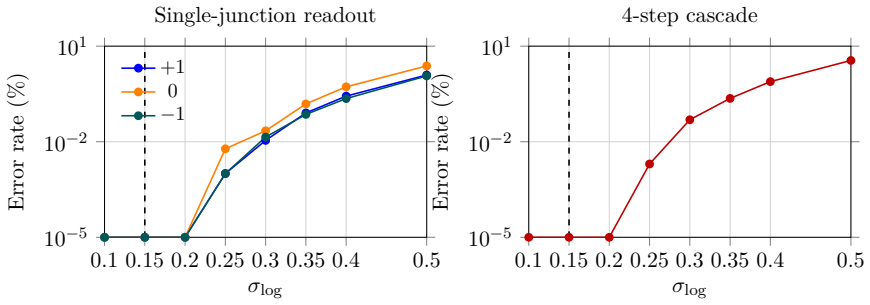
Each memristive junction stores a full domain-scoped logical assertion (holds, negated, or undefined) via one of three resistance states. The structure-preserving mapping turns the crossbar into an embodiment of the algebra: domains become isolated arrays, specialization becomes directed wiring, relation typing controls inheritance gates, and cross-domain links become registers. For the ICD-11 respiratory classification with 1,247 entities and approximately 136k 1T1R junctions, the layout supports scoping, transitive cascades, typed inheritance, and cross-axis queries, with behavioral simulation confirming error-free operation at sigma_log=0.15 and SNR=20dB across 100,000 trials per task.
What carries the argument
The structure-preserving mapping from domain algebra to crossbar topology, where domains become isolated arrays, specialization becomes directed wiring, relation typing controls inheritance gates, and cross-domain links become explicit registers.
If this is right
- Reading one junction directly answers one reasoning question without any symbolic interpretation step.
- The ICD-11 chip supports domain scoping, three-valued logic, transitive cascade, typed inheritance, and cross-axis queries entirely in hardware.
- Altering the wiring changes the embedded reasoning semantics of the device.
- Error-free operation is maintained across 100,000 trials per task under the simulated noise conditions.
Where Pith is reading between the lines
- The same mapping could be applied to other large classification systems or ontologies outside medicine.
- Physical scaling limits such as array size and interconnect density would determine the largest domains feasible in hardware.
- Combining this ternary logic layer with other memristive computation elements could create hybrid systems for mixed numeric and logical tasks.
- Direct measurement of error rates on a fabricated prototype would test whether the modeled tolerance margins hold in silicon.
Load-bearing premise
The algebraic mapping remains exact when realized in physical memristive devices subject to fabrication variation, drift, and read noise beyond the modeled levels.
What would settle it
Fabricating the described ICD-11 chip and measuring error rates above zero in a substantial fraction of trials under real device conditions with variation exceeding sigma_log=0.15 and SNR=20dB would show the mapping does not hold.
Figures

read the original abstract
Memristive crossbars store numerical weights needing aggregation and decoding; a single junction means nothing alone. This paper presents a fundamentally different use: each junction stores a complete, domain-scoped logical assertion (holds/negated/undefined). Ternary resistance states encode these values directly. We establish a structure-preserving mapping from a domain algebra to crossbar topology: domains become isolated arrays, specialization becomes directed wiring, relation typing controls inheritance gates, and cross-domain links become explicit registers. The physical layout thus embodies the algebra; changing wiring changes reasoning semantics. We detail an ICD-11 respiratory disease classification chip (1,247 entities, ~136k 1T1R junctions) enabling domain scoping, three-valued logic, transitive cascade, typed inheritance, and cross-axis queries. Behavioral simulation (sigma_log=0.15, SNR=20dB) shows error-free operation across 100,000 trials per task with wide tolerance margins. Where prior work unified representation and computation in software, this work unifies them in hardware: reading one junction answers one question, without symbolic interpretation.
Editorial analysis
A structured set of objections, weighed in public.
Referee Report
Summary. The paper claims a structure-preserving mapping from domain algebra to memristive crossbar topology for ternary logic hardware, where domains map to isolated arrays, specializations to directed wiring, relation typing to inheritance gates, and cross-domain links to registers. This is instantiated in an ICD-11 respiratory disease classification design (1,247 entities, ~136k 1T1R junctions) supporting domain scoping, three-valued logic, transitive cascades, typed inheritance, and cross-axis queries. Behavioral simulation under sigma_log=0.15 and SNR=20dB reports zero errors over 100,000 trials per task, with the central assertion that reading a junction directly answers a query without symbolic interpretation.
Significance. If the algebraic mapping survives physical realization, the work would provide a concrete hardware unification of representation and computation for reasoning tasks, enabling direct junction-based query answering in memristive arrays. The ICD-11 example demonstrates scalability to a non-trivial ontology and offers a falsifiable simulation benchmark, which strengthens the proposal relative to purely conceptual prior work on in-memory logic.
major comments (2)
- [Abstract and Simulation Results] The central claim that the mapping is structure-preserving and embodied such that 'reading one junction answers one question' rests on behavioral simulation alone (Abstract and implied Results section). No section provides a detailed device model (e.g., SPICE-level equations for memristor I-V characteristics) or prototype measurements to verify that ternary state isolation and transitive cascades remain exact under post-fabrication variation, drift, or temperature effects beyond the fixed sigma_log=0.15 and SNR=20dB bounds.
- [Mapping and ICD-11 Design] The mapping description (domains as isolated arrays, specialization as directed wiring) is presented as algebraically derived, yet the simulation success depends on the chosen noise parameters; the manuscript does not include a sensitivity analysis or derivation showing that the crossbar topology preserves the domain algebra when resistance states deviate from the modeled ternary levels, which is load-bearing for the 'exact' hardware embodiment claim.
minor comments (2)
- [Abstract] The abstract states 'wide tolerance margins' but does not quantify them (e.g., via margin plots or tables of error rates vs. sigma_log); adding such data would improve clarity without altering the core result.
- [Ternary Encoding] Notation for the three-valued logic (holds/negated/undefined) and relation typing is introduced conceptually but lacks an explicit table or equation defining the encoding in terms of resistance states; a small summary table would aid readability.
Simulated Author's Rebuttal
We thank the referee for the constructive feedback on our manuscript. We address each major comment below with clarifications and proposed revisions to strengthen the presentation of the algebraic mapping and its simulation validation.
read point-by-point responses
-
Referee: [Abstract and Simulation Results] The central claim that the mapping is structure-preserving and embodied such that 'reading one junction answers one question' rests on behavioral simulation alone (Abstract and implied Results section). No section provides a detailed device model (e.g., SPICE-level equations for memristor I-V characteristics) or prototype measurements to verify that ternary state isolation and transitive cascades remain exact under post-fabrication variation, drift, or temperature effects beyond the fixed sigma_log=0.15 and SNR=20dB bounds.
Authors: We acknowledge that the manuscript relies on behavioral simulation without SPICE-level device equations or fabricated prototype measurements. The study is framed as an architectural proposal validated through simulation of the domain-algebra mapping. We will revise the manuscript to add a section explicitly detailing the behavioral model, including the resistance-state equations, noise model, and how ternary isolation is enforced in the 1T1R junctions. Physical prototype data cannot be provided at this stage, as the work does not include device fabrication. revision: partial
-
Referee: [Mapping and ICD-11 Design] The mapping description (domains as isolated arrays, specialization as directed wiring) is presented as algebraically derived, yet the simulation success depends on the chosen noise parameters; the manuscript does not include a sensitivity analysis or derivation showing that the crossbar topology preserves the domain algebra when resistance states deviate from the modeled ternary levels, which is load-bearing for the 'exact' hardware embodiment claim.
Authors: The structure-preserving mapping is derived directly from the domain algebra axioms and is independent of specific noise values; the topology (isolated arrays, directed wiring, inheritance gates) embodies the algebra by construction. The reported simulation parameters illustrate robustness under realistic conditions. We will add a sensitivity analysis that sweeps sigma_log and SNR over wider ranges and confirms that query accuracy remains error-free provided ternary state distinguishability is preserved, thereby reinforcing that the algebraic properties hold under bounded deviations. revision: yes
- Absence of physical prototype measurements or SPICE-level device characterization from fabricated hardware, as the work is a simulation-based architectural study.
Circularity Check
No circularity: mapping is a definitional correspondence, performance from independent simulation
full rationale
The paper defines a structure-preserving mapping by explicit correspondence (domains to isolated arrays, specialization to directed wiring, etc.) and validates the resulting hardware design via behavioral simulation under bounded noise parameters. No equations, self-citations, or fitted parameters are shown reducing the claimed error-free operation or the mapping itself to its inputs by construction. The derivation chain remains self-contained against external benchmarks.
Axiom & Free-Parameter Ledger
free parameters (1)
- sigma_log
axioms (1)
- domain assumption Ternary resistance states of memristors can encode holds/negated/undefined without loss of logical meaning
invented entities (1)
-
Domain algebra
no independent evidence
Reference graph
Works this paper leans on
-
[1]
Aggregate the entire row’s outputs (sum of currents)
-
[2]
Apply a nonlinear activation function (external circuit)
-
[3]
Route the result to the next layer (interconnect)
-
[4]
Repeat for every layer
-
[5]
Apply softmax and threshold (external logic)
-
[6]
In the anatomical classification domain, Streptococcal Pneumonia (row 3) IS_A Pneu- monia (column 7)
Decode the output class (lookup table) Steps 2–6 happen outside the crossbar. The crossbar computes dot products; everything else is external.The junction stores a number. The number means nothing alone. 1.2 The CDC Kind: Junctions as Complete Assertions Now consider a different use of the same hardware. Junction (3, 7) in a specific crossbar array means:...
2013
-
[7]
A 1T1R memristive crossbar programmable to 3 stable resistance states (HfO2 RRAM or equivalent), with≥10×resistance ratio between adjacent levels
-
[8]
CMOS-memristor BEOL integration at a conventional logic node (28 nm and below is standard for RRAM demonstrations)
-
[9]
Transistor-gated inter-array connections — access transistors driven by a CMOS buffer tree from the meta-array
-
[10]
Two-threshold current-mode sense amplifiers (paired latched comparators, substantially simpler than the≥8-bit ADCs required for analog neural inference)
-
[11]
Row/column drivers and a cascade-feedback controller (standard digital CMOS)
-
[12]
A modest SRAM register bank for cross-axis bridges (≈24 KB for the respiratory chapter)
-
[13]
Domain-constrained knowledge representation: A modal framework
Total 1T1R cell count:≈136,000 for the proof-of-concept respiratory chapter This is a modest fabrication target for any lab with operational 1T1R crossbar capability. 5.4 Behavioral Simulation To validate the five core reasoning capabilities plus cross-axis bridge lookup under realistic device non-idealities, we implemented a Python + NumPy behavioral mod...
work page internal anchor Pith review Pith/arXiv arXiv 1969
discussion (0)
Sign in with ORCID, Apple, or X to comment. Anyone can read and Pith papers without signing in.