Recognition: unknown
Quantum-HPC Software Stacks and the openQSE Reference Architecture: A Survey
Pith reviewed 2026-05-10 01:09 UTC · model grok-4.3
The pith
A survey of nine quantum-HPC stacks identifies recurring patterns and proposes layer boundaries for interoperability and future-proofing.
A machine-rendered reading of the paper's core claim, the machinery that carries it, and where it could break.
Core claim
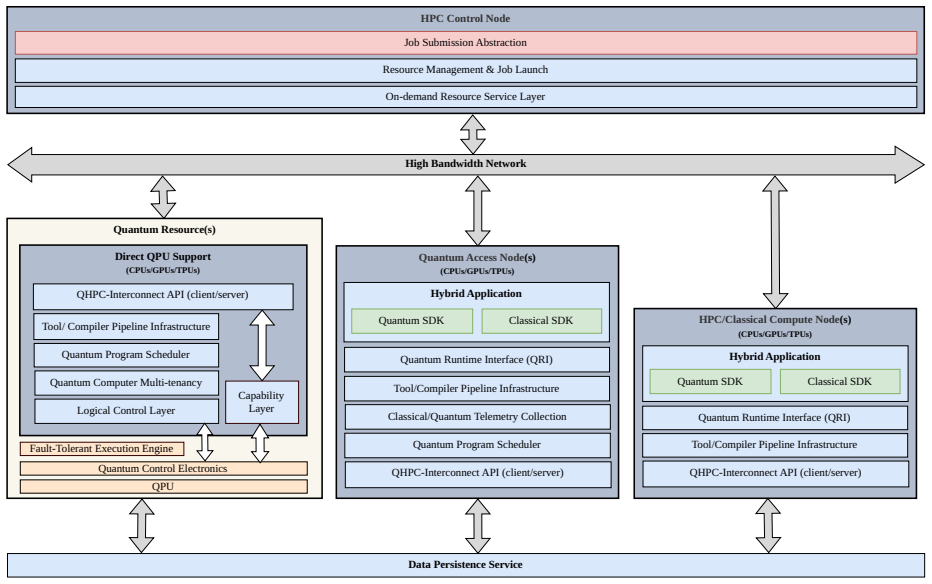
Analysis of nine production QHPC stacks reveals common design patterns and emerging requirements; these observations lead to the definition of the openQSE reference architecture, which specifies layer boundaries that permit different implementations to interoperate, preserve deployment flexibility, and support both NISQ workloads and future FTQC systems without changes to upper-layer application interfaces.
What carries the argument
The openQSE reference architecture, a set of layer boundaries that separate runtime abstraction, resource management, orchestration, and execution concerns to enable cross-implementation interoperability.
If this is right
- Different vendor implementations can interoperate at the defined runtime, resource, and orchestration layers.
- Upper-layer applications remain unchanged when stacks transition from noisy intermediate-scale to fault-tolerant quantum operation.
- Observability and interconnect requirements can be met through standardized interfaces at the identified boundaries.
- Deployment flexibility is retained because each layer can be realized by multiple concrete implementations.
Where Pith is reading between the lines
- Clear layer boundaries could encourage development of modular components that plug into multiple environments rather than requiring full-stack reinvention.
- The architecture might reduce vendor lock-in by letting users mix runtime or resource-management pieces from different sources.
- Validation against additional stacks beyond the original nine would test whether the identified patterns truly generalize.
- Standardized layers could ease integration of quantum resources into existing classical HPC schedulers and monitoring tools.
Load-bearing premise
The design patterns and requirements seen in the nine surveyed stacks are common enough and stable enough to define layer boundaries that will actually allow broad interoperability and will need no changes to applications when moving to fault-tolerant systems.
What would settle it
Two independent quantum-HPC stacks that each conform to the proposed layer boundaries and successfully exchange resources or execute a shared workload without modifying their upper-layer application code would support the claim; persistent inability to achieve such exchange after adaptation attempts would challenge it.
Figures

read the original abstract
Quantum resources are increasingly integrated into high-performance computing (HPC) and cloud environments, but quantum high-performance computing (QHPC) software stacks remain isolated, often proprietary, full-stack solutions lacking common interfaces across runtime, resource management, orchestration, and execution layers. This paper analyzes nine production QHPC stacks and identifies common design patterns and emerging requirements, covering deployment models, application interaction patterns, SDK support, and readiness for fault-tolerant operation. The survey exposes consistent needs in runtime abstraction, resource management, interconnect semantics, and observability. Based on these findings, we propose the open quantum-HPC software ecosystem ( openQSE) reference architecture as a first step toward unifying the state-of-the-practice. openQSE defines a set of layer boundaries that allow different implementations to interoperate while preserving deployment flexibility, and is structured to support both current noisy intermediate-scale quantum (NISQ) workloads and future fault-tolerant quantum computing (FTQC) systems without changes to upper-layer application interfaces.
Editorial analysis
A structured set of objections, weighed in public.
Referee Report
Summary. The paper surveys nine production quantum-HPC (QHPC) software stacks, identifies recurring design patterns and requirements across deployment models, application interaction, SDK support, and fault-tolerance readiness, and proposes the openQSE reference architecture. openQSE defines layer boundaries (runtime abstraction, resource management, interconnect semantics, observability) intended to enable interoperability among implementations while preserving deployment flexibility and supporting both NISQ workloads and future FTQC systems without upper-layer application changes.
Significance. If the extracted patterns prove representative and the layer boundaries stable, the work would offer a practical starting point for unifying currently isolated QHPC stacks and easing the transition to fault-tolerant systems. The survey itself supplies a useful catalog of current practice; the architectural proposal, however, remains a hypothesis whose impact depends on subsequent validation.
major comments (2)
- [Proposal of openQSE (likely §4–5)] The central claim that the nine surveyed stacks suffice to define stable, interoperable layer boundaries rests on observed common needs but provides no explicit per-stack mapping to the proposed openQSE layers, no cross-vendor prototype exercising the interfaces, and no concrete analysis of how FTQC mechanisms (error correction, logical-qubit interfaces, syndrome extraction) would be hidden from upper layers. This gap directly undermines the assertion that the boundaries will require no upper-layer changes when moving from NISQ to FTQC.
- [Survey methodology and analysis sections] The representativeness assumption—that patterns from the nine stacks generalize to broad vendor interoperability—is load-bearing yet untested; the manuscript does not report selection criteria for the stacks, quantitative coverage metrics, or a falsifiable test (e.g., implementing a minimal cross-stack workflow) that would confirm the boundaries are both necessary and sufficient.
minor comments (2)
- Clarify whether the nine stacks are named and tabulated with their key characteristics; a summary table would strengthen the survey presentation.
- The abstract states that openQSE supports FTQC 'without changes to upper-layer application interfaces,' but the manuscript should explicitly list which interfaces are claimed to remain invariant and why.
Simulated Author's Rebuttal
We thank the referee for the constructive feedback, which highlights important areas for strengthening the presentation of our survey and the openQSE proposal. We respond to each major comment below and specify the revisions planned for the next version of the manuscript.
read point-by-point responses
-
Referee: The central claim that the nine surveyed stacks suffice to define stable, interoperable layer boundaries rests on observed common needs but provides no explicit per-stack mapping to the proposed openQSE layers, no cross-vendor prototype exercising the interfaces, and no concrete analysis of how FTQC mechanisms (error correction, logical-qubit interfaces, syndrome extraction) would be hidden from upper layers. This gap directly undermines the assertion that the boundaries will require no upper-layer changes when moving from NISQ to FTQC.
Authors: We agree that an explicit per-stack mapping would improve clarity and verifiability. In the revised manuscript we will add a table in Section 4 that maps the components of each of the nine stacks onto the four openQSE layers. We will also expand the FTQC discussion in Section 5 to describe how the runtime-abstraction and interconnect-semantics layers encapsulate error-correction logic, logical-qubit interfaces, and syndrome extraction so that upper-layer applications remain unchanged; concrete examples drawn from the surveyed stacks will be included. A working cross-vendor prototype, however, lies outside the scope of the present survey paper; we will state this limitation explicitly and note it as planned future work. revision: partial
-
Referee: The representativeness assumption—that patterns from the nine stacks generalize to broad vendor interoperability—is load-bearing yet untested; the manuscript does not report selection criteria for the stacks, quantitative coverage metrics, or a falsifiable test (e.g., implementing a minimal cross-stack workflow) that would confirm the boundaries are both necessary and sufficient.
Authors: We accept that the selection criteria and coverage analysis should have been stated more explicitly. The revised manuscript will include a dedicated subsection under the survey methodology that lists the criteria used to select the nine stacks (production status, vendor diversity, and public availability at the time of writing) and provides a quantitative summary of how many stacks exhibit each identified pattern. A falsifiable cross-stack workflow test would require implementation effort beyond the scope of this survey; we will acknowledge this limitation and identify such validation as an important direction for subsequent research. revision: yes
- Absence of a cross-vendor prototype exercising the proposed openQSE interfaces.
- Empirical falsifiable test confirming that the layer boundaries are both necessary and sufficient.
Circularity Check
No circularity: openQSE layers derived from external survey patterns, not self-definition or fitted inputs
full rationale
The paper's chain consists of surveying nine independent production QHPC stacks, extracting recurring requirements (runtime abstraction, resource management, interconnect semantics, observability), and proposing openQSE layer boundaries as a unification step. No equations, fitted parameters, or self-citations are invoked to justify the boundaries; the architecture is presented as an organizational synthesis of observed external patterns rather than a reduction to author-defined quantities or prior self-work. The claim that the layers support NISQ-to-FTQC transition without upper-layer changes is an unproven assumption about future stability, but it does not create circularity because it is not derived by construction from the proposal itself.
Axiom & Free-Parameter Ledger
axioms (1)
- domain assumption Quantum resources are increasingly integrated into HPC and cloud environments
invented entities (1)
-
openQSE reference architecture
no independent evidence
Reference graph
Works this paper leans on
-
[1]
Scaling and networking a modular photonic quantum computer,
J. E. Bourassa, R. S. Chadwick, and et al., “Scaling and networking a modular photonic quantum computer,”Nature, vol. 638, pp. 912–919, Jan 2025. [Online]. Available: https://doi.org/10.1038/s41586-024-08406-9
-
[2]
Catalyst: a Python JIT compiler for auto-differentiable hybrid quantum programs,
D. Ittah, A. Asadi, E. O. Lopez, S. Mironov, S. Banning, R. Moyard, M. J. Peng, and J. Izaac, “Catalyst: a python jit compiler for auto-differentiable hybrid quantum programs,”Journal of Open Source Software, vol. 9, no. 99, p. 6720, 2024. [Online]. Available: https://doi.org/10.21105/joss.06720
-
[3]
jeff: bridging quantum compilers,
D. Ittah, “jeff: bridging quantum compilers,” Talk abstract, Quantum Software 2.1 Workshop. [Online]. Available: https://sites.google.com/view/quantum-software-workshop-2025, 2025, accessed: Mar. 6, 2026
2025
-
[4]
Guppy: pythonic quantum-classical programming.arXiv preprint arXiv:2510.12582, 2025
M. Koch, A. Lawrence, K. Singhal, S. Sivarajah, and R. Duncan, “Guppy: Pythonic quantum-classical programming,” inInformal Proceedings of the Fourth International Workshop on Programming Languages for Quantum Computing (PLanQC ’24), 2024. [Online]. Available: https://doi.org/10.48550/arXiv.2510.12582
-
[5]
Imperative quantum programming with ownership and borrowing in guppy,
M. Koch, A. Borgna, C. Roy, A. Lawrence, K. Singhal, S. Sivarajah, and R. Duncan, “Imperative quantum programming with ownership and borrowing in guppy,” inInformal Proceedings of the Fifth International Workshop on Programming Languages for Quantum Computing (PLanQC ’25), 2025. [Online]. Available: https://doi.org/10.48550/arXiv.2510.13082
-
[6]
Nature606(7912), 75–81 (2022) https://doi.org/ 10.1038/s41586-022-04725-x
L. S. Madsen, F. Laudenbach, M. F. Askarani, F. Rortais, T. Vincent, J. F. F. Bulmer, F. M. Miatto, L. Neuhaus, L. G. Helt, M. J. Collins, A. E. Lita, T. Gerrits, S. W. Nam, V. D. Vaidya, M. Menotti, I. Dhand, Z. Vernon, N. Quesada, and J. Lavoie, “Quantum computational advantage with a programmable photonic processor,”Nature, vol. 606, no. 7912, pp. 75–8...
-
[7]
E. Mansfield, S. Seegerer, P. Vesanen, J. Echavarria, M. N. Farooqi, B. Mete, and L. Schulz, “First practical experiences integrating quantum computers with hpc resources: A case study with a 20-qubit superconducting quantum computer,” inProceedings of the SC ’25 Workshops of the International Conference for High Performance Computing, Networking, Storage...
-
[8]
[Online]
QIR Specification, QIR Alliance: https://qir-alliance.org. [Online]. Available: https: //github.com/qir-alliance/qir-spec 18
-
[9]
K. Svore, A. Geller, M. Troyer, J. Azariah, C. Granade, B. Heim, V. Kliuchnikov, M. Mykhailova, A. Paz, and M. Roetteler, “Q#: Enabling Scalable Quantum Computing and Development with a High-level DSL,” inProceedings of the Real World Domain Specific Languages Workshop 2018, ser. RWDSL2018. ACM, Feb. 2018. [Online]. Available: http://dx.doi.org/10.1145/31...
-
[10]
Real-time feedback and active reset with OPX and QOP,
Quantum Machines Documentation, “Real-time feedback and active reset with OPX and QOP,” [Online]. Available: https://docs.quantum-machines.co/1.2.3/docs/Introduction/use_case/acti ve_reset/, 2026, accessed: Mar. 6, 2026
2026
-
[11]
Amazon EC2,
Amazon Web Services, “Amazon EC2,” [Online]. Available: https://aws.amazon.com/ec2/, 2026, accessed: Mar. 30, 2026
2026
-
[12]
Quantum circuits with many photons on a programmable nanophotonic chip,
J. M. Arrazola, V. Bergholm, K. Brádler, T. R. Bromley, M. J. Collins, I. Dhand, A. Fumagalli, T. Gerrits, A. Goussev, L. G. Heltet al., “Quantum circuits with many photons on a programmable nanophotonic chip,”Nature, vol. 591, no. 7848, pp. 54–60, 2021. [Online]. Available: https://doi.org/10.1038/s41586-021-03202-1
-
[13]
AWS Batch,
Amazon Web Services, “AWS Batch,” [Online]. Available: https://aws.amazon.com/batch/, 2026, accessed: Mar. 30, 2026
2026
-
[14]
AWS ParallelCluster,
——, “AWS ParallelCluster,” [Online]. Available: https://aws.amazon.com/hpc/parallelcluster /, 2026, accessed: Mar. 30, 2026
2026
-
[15]
AWS Parallel Computing Service,
——, “AWS Parallel Computing Service,” [Online]. Available: https://aws.amazon.com/pcs/, 2026, accessed: Mar. 30, 2026
2026
-
[16]
AWS Step Functions - workflow orchestration,
——, “AWS Step Functions - workflow orchestration,” [Online]. Available: https://aws.amazon .com/step-functions/, 2026, accessed: Mar. 30, 2026
2026
-
[17]
Working with Amazon Braket hybrid jobs,
Amazon Braket Developer Guide, “Working with Amazon Braket hybrid jobs,” [Online]. Available: https://docs.aws.amazon.com/braket/latest/developerguide/braket-build-jobs.html, 2025, accessed: Mar. 3, 2026
2025
-
[18]
Running hybrid jobs during a reservation,
——, “Running hybrid jobs during a reservation,” [Online]. Available: https://docs.aws.ama zon.com/braket/latest/developerguide/braket-run-hybrid-jobs-with-reservation.html, 2025, accessed: Mar. 3, 2026
2025
-
[19]
MQT Core: The backbone of the Munich Quantum Toolkit (MQT),
L. Burgholzer, Y. Stade, T. Peham, and R. Wille, “MQT Core: The backbone of the Munich Quantum Toolkit (MQT),”Journal of Open Source Software, vol. 10, no. 108, p. 7478, 2025. [Online]. Available: https://doi.org/10.21105/joss.07478
-
[20]
D. Camps, E. Rrapaj, K. Klymko, H. Kim, K. Gott, S. Darbha, J. Balewski, B. Austin, and N. J. Wright, “Quantum computing technology roadmaps and capability assessment for scientific computing–an analysis of use cases from the nersc workload,”arXiv preprint arXiv:2509.09882, 2025. [Online]. Available: https://doi.org/10.48550/arXiv.2509.09882
-
[21]
Catalyst quantum compilation dialects,
Xanadu, “Catalyst quantum compilation dialects,” GitHub repository. [Online]. Available: https://github.com/PennyLaneAI/catalyst/tree/main/mlir/lib, 2026, accessed: Mar. 23, 2026
2026
-
[22]
Cirq: A Python Framework for Creating, Editing, and Invoking Noisy Intermediate Scale Quantum (NISQ) Circuits,
Google Quantum AI, “Cirq: A Python Framework for Creating, Editing, and Invoking Noisy Intermediate Scale Quantum (NISQ) Circuits,” https://quantumai.google/cirq, 2024, accessed: 2026-04-03. 19
2024
-
[23]
T. Shirakawa, J. Robledo-Moreno, T. Itoko, V. Tripathi, K. Ueda, Y. Kawashima, L. Broers, W. Kirby, H. Pathak, H. Paik, M. Tsuji, Y. Kodama, M. Sato, C. Evangelinos, S. Seelam, R. Walkup, S. Yunoki, M. Motta, P. Jurcevic, H. Horii, and A. Mezzacapo, “Closed-loop calculations of electronic structure on a quantum processor and a classical supercomputer at f...
-
[24]
Conditional operations (QTM/QCM-RF II),
Qblox Documentation, “Conditional operations (QTM/QCM-RF II),” [Online]. Available: https://docs.qblox.com/en/main/cluster/q1_sequence_processor.html, 2026, accessed: Mar. 6, 2026
2026
-
[25]
A. Cross, A. Javadi-Abhari, T. Alexander, N. De Beaudrap, L. S. Bishop, S. Heidel, C. A. Ryan, P. Sivarajah, J. Smolin, J. M. Gambettaet al., “Openqasm 3: A broader and deeper quantum assembly language,”ACM Transactions on Quantum Computing, vol. 3, no. 3, pp. 1–50, 2022. [Online]. Available: https://doi.org/10.1145/3505636
-
[26]
CUDA-Q: A platform for hybrid quantum-classical computing,
NVIDIA Corporation, “CUDA-Q: A platform for hybrid quantum-classical computing,” [Online]. Available: https://developer.nvidia.com/cuda-q, 2026, accessed: Mar. 23, 2026
2026
-
[27]
A survey on integrating quantum computers into high performance computing systems,
P. Döbler and M. S. Jattana, “A survey on integrating quantum computers into high performance computing systems,” 2025. [Online]. Available: https://arxiv.org/abs/2507.03540
-
[28]
Hardware considerations and limitations for dynamic circuits,
IBM Quantum Documentation, “Hardware considerations and limitations for dynamic circuits,” [Online]. Available: https://docs.quantum.ibm.com/guides/dynamic-circuits-considerations, 2025, accessed: Mar. 6, 2026
2025
-
[29]
A. Elsharkawy, X.-T. M. To, P. Seitz, Y. Chen, Y. Stade, M. Geiger, Q. Huang, X. Guo, M. A. Ansari, C. B. Mendl, D. Kranzlmüller, and M. Schulz, “Integration of quantum accelerators with high performance computing—a review of quantum programming tools,” ACM Transactions on Quantum Computing, vol. 6, no. 3, Jul. 2025. [Online]. Available: https://doi.org/1...
-
[30]
The spack package manager: bringing order to hpc software chaos,
T. Gamblin, M. LeGendre, M. R. Collette, G. L. Lee, A. Moody, B. R. de Supinski, and S. Futral, “The spack package manager: bringing order to hpc software chaos,” inSC ’15: Proceedings of the International Conference for High Performance Computing, Networking, Storage and Analysis, 2015, pp. 1–12. [Online]. Available: https://doi.org/10.1145/2807591.2807623
-
[31]
grpc: A high performance, open source universal rpc framework,
gRPC Authors, “grpc: A high performance, open source universal rpc framework,” https: //grpc.io/, 2024, accessed: 2024-05-28
2024
-
[32]
Quantum computing with neutral atoms,
L. Henriet, L. Beguin, A. Signoles, T. Lahaye, A. Browaeys, G.-O. Reymond, and C. Jurczak, “Quantum computing with neutral atoms,”Quantum, vol. 4, p. 327, Sep. 2020. [Online]. Available: https://doi.org/10.22331/q-2020-09-21-327
-
[33]
What is HIP?
AMD ROCm Documentation, “What is HIP?” HIP 7.2 documentation. [Online]. Available: https://rocm.docs.amd.com/projects/HIP/en/develop/what_is_hip.html, 2025, accessed: Mar. 3, 2026
2025
-
[34]
Referencearchitectureofaquantum-centric supercomputer.arXiv preprint arXiv:2603.10970(2026)
S. Seelam, J. M. Chow, A. D. Corcoles, S. Sheldon, T. Mittal, A. Kandala, S. Dague, I. Hincks, H. Horii, B. Johnson, M. Le, H. Jamjoom, and J. M. Gambetta, “Reference architecture of a quantum-centric supercomputer,” 2026, arXiv:2603.10970. [Online]. Available: https://doi.org/10.48550/arXiv.2603.10970 20
-
[35]
Observability architecture for quantum-centric supercomputing workflows,
N. Kanazawa, Y. Morohoshi, H. Takahashi, Y. Kawashima, H. Horii, and K. Naka- jima, “Observability architecture for quantum-centric supercomputing workflows,” 2025, arXiv:2512.05484. [Online]. Available: https://doi.org/10.48550/arXiv.2512.05484
-
[36]
doi:10.22331/q-2024-11-07-1516 , url =
J.-S. Chenet al., “Benchmarking a trapped-ion quantum computer with 30 qubits,”Quantum, vol. 8, p. 1516, 2024. [Online]. Available: https://doi.org/10.22331/q-2024-11-07-1516
-
[37]
IonQ quantum cloud,
IonQ, Inc., “IonQ quantum cloud,” [Online]. Available: https://www.ionq.com/quantum-cloud, 2026, accessed: Mar. 23, 2026
2026
-
[38]
Euro-q-exa: Integrating quantum computers into hpc systems,
T. Häner, D. S. Steiger, J. Heinsooet al., “Euro-q-exa: Integrating quantum computers into hpc systems,”arXiv preprint arXiv:2509.12949, 2025. [Online]. Available: https://doi.org/10.48550/arXiv.2509.12949
-
[39]
JAX: composable transformations of Python+NumPy programs,
J. Bradbury, R. Frostig, P. Hawkins, M. J. Johnson, C. Leary, D. Maclaurin, G. Necula, A. Paszke, J. VanderPlas, S. Wanderman-Milne, and Q. Zhang, “JAX: composable transformations of Python+NumPy programs,” 2018. [Online]. Available: http://github.com/jax-ml/jax
2018
-
[40]
Annual report 2025 (JEFF section, collaboration with Xanadu and Quantinuum),
Unitary Foundation, “Annual report 2025 (JEFF section, collaboration with Xanadu and Quantinuum),” [Online]. Available: https://willzeng.com/shared/UF_Annual_Report_2025. pdf, Jan. 2026, accessed: Mar. 6, 2026
2025
-
[41]
LLVM: A Compilation Framework for Lifelong Program Analysis & Transformation
C. Lattner and V. Adve, “Llvm: A compilation framework for lifelong program analysis & transformation,” inProceedings of the International Symposium on Code Generation and Optimization (CGO). IEEE, 2004, pp. 75–86. [Online]. Available: https://doi.org/10.1109/CGO.2004.1281665
-
[42]
MLIR: A compiler in- frastructure for the end of Moore’s Law,
C. Lattneret al., “MLIR: A compiler infrastructure for the end of Moore’s Law,” arXiv:2002.11054, 2020. [Online]. Available: https://doi.org/10.48550/arXiv.2002.11054
-
[43]
L. Burgholzer, J. Echavarria, P. Hopf, Y. Stade, D. Rovara, L. Schmid, E. Kaya, B. Mete, M. N. Farooqi, M. Chung, M. De Pascale, L. Schulz, M. Schulz, and R. Wille, “The Munich Quantum Software Stack: Connecting End Users, Integrating Diverse Quantum Technologies, Accelerating HPC,” inSC/HPC Asia 2026. ACM, 2026, pp. 55–67. [Online]. Available: https://do...
-
[44]
The MQT handbook: A summary of design automation tools and software for quantum computing,
R. Wille, L. Berent, T. Forster, J. Kunasaikaran, K. Mato, T. Peham, N. Quetschlich, D. Rovara, A. Sander, L. Schmid, D. Schoenberger, Y. Stade, and L. Burgholzer, “The MQT handbook: A summary of design automation tools and software for quantum computing,” inInt’l Conf. on Quantum Software, 2024. [Online]. Available: https://doi.org/10.1109/QSW62656.2024.00013
-
[45]
NVIDIA CUDA Parallel Computing Platform,
NVIDIA Corporation, “NVIDIA CUDA Parallel Computing Platform,” https://developer.nvid ia.com/cuda-zone, 2024, accessed: 2026-04-03
2024
-
[46]
Platform architecture for tight coupling of high-performance computing with quantum processors,
S. A. Caldwellet al., “Platform architecture for tight coupling of high-performance computing with quantum processors,” arXiv:2510.25213, 2025. [Online]. Available: https://doi.org/10.48550/arXiv.2510.25213
-
[47]
Quantum task offloading with the openmp api,
J. K. Lee, O. T. Brown, M. Bull, M. Ruefenacht, J. Doerfert, M. Klemm, and M. Schulz, “Quantum task offloading with the openmp api,” inPosters at SC23, 2023. [Online]. Available: https://sc23.supercomputing.org/proceedings/tech_poster/poster_files/rpost177s3-file3.pdf 21
2023
-
[48]
openQSE workshops (architecture presentations and stack evaluations),
openQSE Initiative, “openQSE workshops (architecture presentations and stack evaluations),” GitHub repository. [Online]. Available: https://github.com/openQSE/Workshops, 2026, accessed: Mar. 3, 2026
2026
-
[49]
openqse working group: Quantum computing software ecosystem workshop notes,
openQSE Working Group, “openqse working group: Quantum computing software ecosystem workshop notes,” https://github.com/openQSE/Workshops/blob/main/OpenQSE-WG/open QSE-IonQ-20260309.pdf, 2026, accessed: 2026-04-04
2026
-
[50]
openqse working group: Quantum computing software ecosystem workshop notes,
——, “openqse working group: Quantum computing software ecosystem workshop notes,” https://github.com/openQSE/Workshops/blob/main/OpenQSE-WG/openQSE-RIKAN-202 60113.pdf, 2026, accessed: 2026-04-04
2026
-
[51]
openqse working group: Quantum computing software ecosystem workshop notes,
——, “openqse working group: Quantum computing software ecosystem workshop notes,” https://github.com/openQSE/Workshops/blob/main/OpenQSE-WG/openQSE-MQSC-202 60105.pdf, 2026, accessed: 2026-04-04
2026
-
[52]
openqse working group: Quantum computing software ecosystem workshop notes,
——, “openqse working group: Quantum computing software ecosystem workshop notes,” https://github.com/openQSE/Workshops/blob/main/OpenQSE-WG/openQSE-Pasqal-202 60119.pdf, 2026, accessed: 2026-04-04
2026
-
[53]
openqse working group: Quantum computing software ecosystem workshop notes,
——, “openqse working group: Quantum computing software ecosystem workshop notes,” https: //github.com/openQSE/Workshops/blob/main/OpenQSE-WG/openqSE-QB-20260219.pdf, 2026, accessed: 2026-04-04
2026
-
[54]
openqse working group: Quantum computing software ecosystem workshop notes,
——, “openqse working group: Quantum computing software ecosystem workshop notes,” https://github.com/openQSE/Workshops/blob/main/OpenQSE-WG/openQSE-Xanadu-202 60303.pdf, 2026, accessed: 2026-04-04
2026
-
[55]
A. Wennersteen, M. Moreau, A. Nober, and M. Beji, “Towards a user-centric HPC-QC environment,” inProc. SC ’25 Workshops, 2025. [Online]. Available: https://doi.org/10.1145/3731599.3767549
-
[56]
Hybrid quantum classical algorithms: A cloud on-demand viewpoint,
A. Wennersteen, K. Bidzhiev, M. D’Arcangelo, M. Moreau, A. Quelle, A. Dauphin, and M. Beji, “Hybrid quantum classical algorithms: A cloud on-demand viewpoint,” in Quantum Engineering Sciences and Technologies for Industry and Services, F. Barbaresco and F. Gerin, Eds. Cham: Springer Nature Switzerland, 2026, pp. 117–125. [Online]. Available: https://doi.o...
-
[57]
PennyLane: Automatic differentiation of hybrid quantum-classical computations
V. Bergholmet al., “Pennylane: Automatic differentiation of hybrid quantum-classical computations,” 2022. [Online]. Available: https://doi.org/10.48550/arXiv.1811.04968
work page internal anchor Pith review doi:10.48550/arxiv.1811.04968 2022
-
[58]
H. Silvério, S. Grijalva, C. Dalyac, L. Leclerc, P. J. Karalekas, N. Shammah, M. Beji, L.-P. Henry, and L. Henriet, “Pulser: An open-source package for the design of pulse sequences in programmable neutral-atom arrays,”Quantum, vol. 6, p. 629, Jan. 2022. [Online]. Available: https://doi.org/10.22331/q-2022-01-24-629
-
[59]
https://doi.org/10.5281/zenodo.2573505
Qiskit contributors, “Qiskit: An open-source framework for quantum computing,” [Online]. Available: https://github.com/Qiskit/qiskit, 2024. [Online]. Available: https://doi.org/10.5281/zenodo.2573505
-
[60]
E. Kaya, B. Mete, L. Schulz, M. N. Farooqi, J. Echavarria, and M. Schulz, “Qpi: A programming interface for quantum computers,” in2024 IEEE International Conference on 22 Quantum Computing and Engineering (QCE), vol. 02, 2024, pp. 286–291. [Online]. Available: https://doi.org/10.1109/QCE60285.2024.10293
-
[61]
Quantum resources in resource management systems,
U. Bacheret al., “Quantum resources in resource management systems,” arXiv:2506.10052,
-
[62]
Quantum resources in resource management systems,
[Online]. Available: https://doi.org/10.48550/arXiv.2506.10052
-
[63]
Quantinuum nexus,
Quantinuum, “Quantinuum nexus,” 2024. [Online]. Available: https://nexus.quantinuum.com/
2024
-
[64]
Mqt bench: Benchmarking software and design automation tools for quantum computing,
N. Quetschlich, L. Burgholzer, and R. Wille, “MQT Bench: Benchmarking Software and Design Automation Tools for Quantum Computing,”Quantum, vol. 7, p. 1062, 2023, MQT Bench is available at https://mqt-bench.app/. [Online]. Available: https://doi.org/10.22331/q-2023-07-20-1062
-
[65]
——, “MQT Predictor: Automatic Device Selection with Device-Specific Circuit Compilation for Quantum Computing,”ACM Transactions on Quantum Computing (TQC), 2025. [Online]. Available: https://doi.org/10.1145/3673241
-
[66]
A. B. Yoo, M. A. Jette, and M. Grondona, “Slurm: Simple linux utility for resource management,” inJob Scheduling Strategies for Parallel Processing, D. Feitelson, L. Rudolph, and U. Schwiegelshohn, Eds. Berlin, Heidelberg: Springer Berlin Heidelberg, 2003, pp. 44–60. [Online]. Available: https://doi.org/10.1007/10968987_3
-
[67]
scontrol (reservation and TRES semantics),
Slurm Workload Manager Documentation, “scontrol (reservation and TRES semantics),” [On- line]. Available: https://slurm.schedmd.com/scontrol.html, 2025, accessed: Mar. 3, 2026
2025
-
[68]
Wide quantum circuit optimization with topology aware synthesis
S. Sivarajah, L. Heidemann, A. Lawrence, and R. Duncan, “Tierkreis: a dataflow framework for hybrid quantum-classical computing,” in2022 IEEE/ACM Third International Workshop on Quantum Computing Software (QCS), 2022, pp. 12–21. [Online]. Available: https://doi.org/10.1109/QCS56647.2022.00007
-
[69]
MQT QMAP: Efficient quantum circuit mapping,
R. Wille and L. Burgholzer, “MQT QMAP: Efficient quantum circuit mapping,” inInternational Symp. on Physical Design, 2023. [Online]. Available: https://doi.org/10.1145/3569052.3578928
-
[70]
R. Wille, L. Schmid, Y. Stade, J. Echavarria, M. Schulz, L. Schulz, and L. Burgholzer, “QDMI – quantum device management interface: Hardware-software interface for the Munich Quantum Software Stack,” inProc. IEEE Int’l Conf. on Quantum Computing and Engineering (QCE), 2024, pp. 573–574. [Online]. Available: https://doi.org/10.1109/QCE60285.2024.10411
-
[71]
Quantum-hpc hybrid computation of biomolecular excited-state energies,
K. Yamamoto, R. Masui, T. Nakajima, M. Tsuji, M. Sato, P. Schow, L. Heidemann, M. Burke, P. Seitz, O. J. Backhouse, J. W. Pedersen, J. Children, C. Holliman, N. Lysne, D. Okuno, S. Sivarajah, D. M. Ramo, A. Chernoguzov, and R. Duncan, “Quantum-hpc hybrid computation of biomolecular excited-state energies,” 2026. [Online]. Available: https://doi.org/10.485...
-
[72]
L. Zhaoet al., “Quantum-classical auxiliary field quantum monte carlo with matchgate shadows on trapped ion quantum computers,” arXiv:2506.22408, 2025. [Online]. Available: https://doi.org/10.48550/arXiv.2506.22408 23
discussion (0)
Sign in with ORCID, Apple, or X to comment. Anyone can read and Pith papers without signing in.