Recognition: unknown
Revisiting radio synchrotron diagnostics in star-forming galaxies
Pith reviewed 2026-05-09 23:41 UTC · model grok-4.3
The pith
Advection in self-consistently driven galactic winds fails to reproduce the extended vertical radio intensity profiles observed in edge-on galaxies.
A machine-rendered reading of the paper's core claim, the machinery that carries it, and where it could break.
Core claim
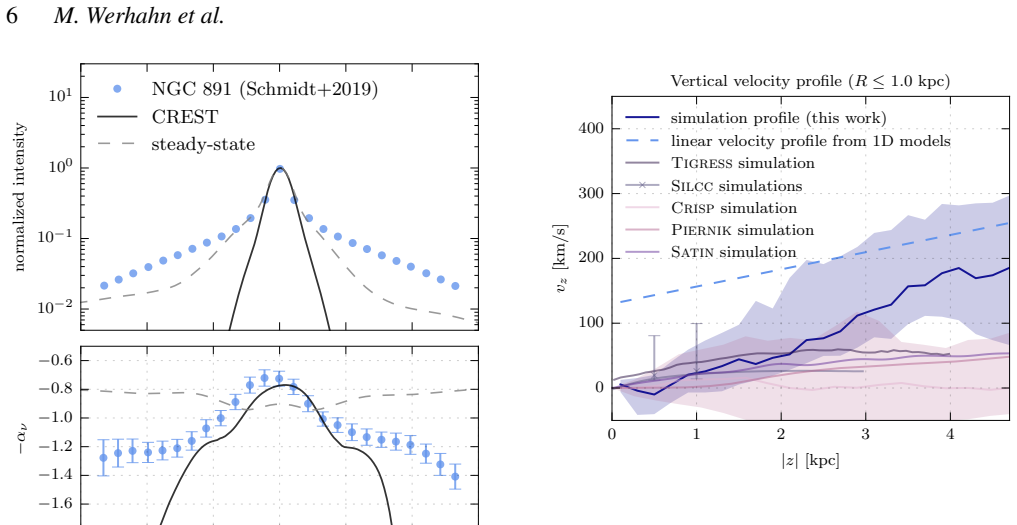
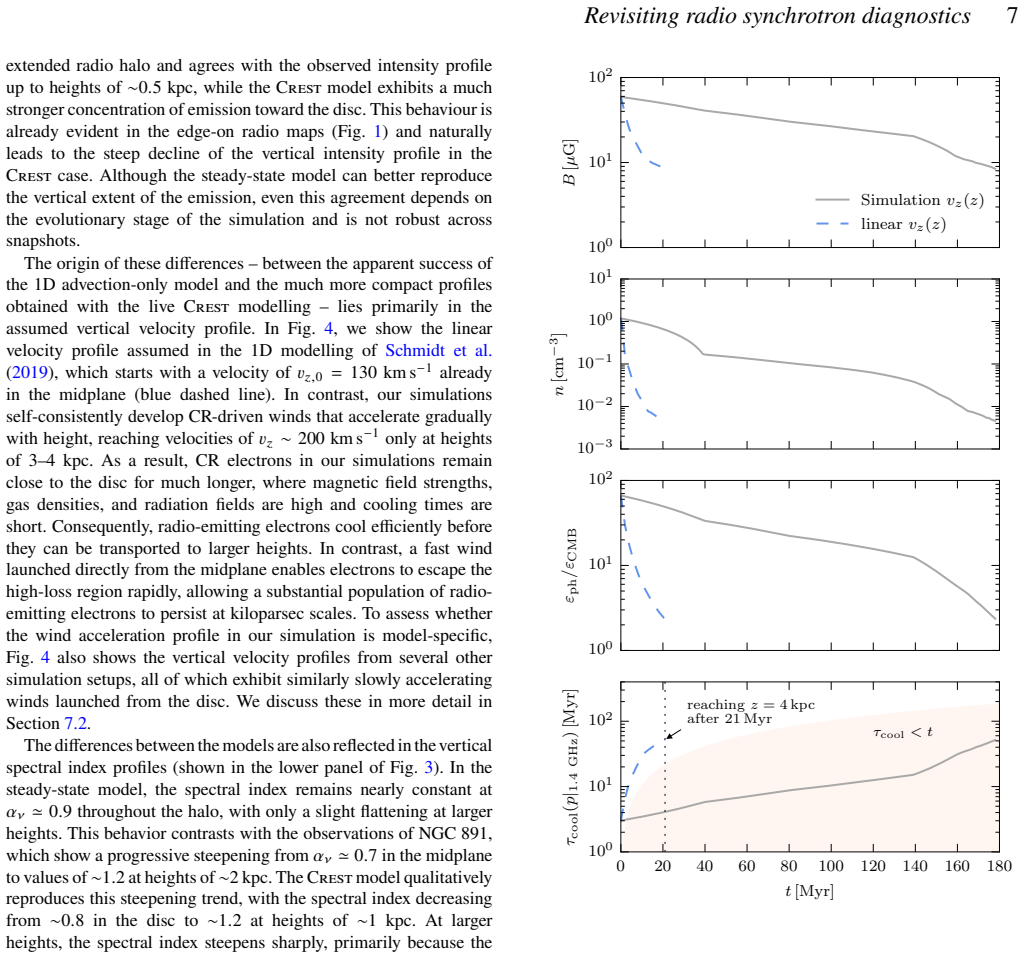
We model radio emission by evolving cosmic ray electron spectra self-consistently along Lagrangian tracer particles in a magnetohydrodynamical simulation of an isolated Milky Way-mass galaxy. This includes injection at supernova remnants, advection with the gas, and spatially and temporally varying radiative losses. Advection-only transport in the self-consistently driven galactic winds fails to reproduce the extended vertical radio intensity profiles observed in edge-on galaxies, despite reproducing the observed steepening of spectral indices with height. This failure occurs because slowly accelerating winds keep electrons in strong cooling environments for too long. Matching the observeded
What carries the argument
Self-consistent time-dependent evolution of cosmic ray electron spectra along Lagrangian tracers in an MHD simulation of a galaxy, incorporating injection, advection, and varying losses.
Load-bearing premise
The MHD simulation accurately captures the spatially and temporally varying wind acceleration, magnetic field structure, and CR electron injection and loss processes without missing key physics.
What would settle it
Radio observations of edge-on galaxies showing extended intensity profiles at heights where the measured wind speed is too low to allow electrons to reach those distances before cooling under the simulated conditions.
Figures




read the original abstract
Radio continuum observations are widely used to study cosmic ray (CR) electron populations and transport processes in star-forming galaxies, but their interpretation relies on several simplifying assumptions. Here, we revisit three common assumptions: that some vertical radio profiles can be explained by CR advection alone, that radio spectra directly trace the galaxy-wide CR electron spectrum, and that bremsstrahlung and Coulomb losses are negligible for radio-emitting electrons. We model radio emission using time-dependent CR electron evolution in a magnetohydrodynamical simulation of an isolated Milky Way-mass galaxy. CR electron spectra are evolved self-consistently along Lagrangian tracer particles with the CREST framework, including injection at supernova remnants, advection with the gas, and spatially and temporally varying radiative losses. We compare these results to commonly adopted steady-state models. We find that advection-only transport in self-consistently driven galactic winds fails to reproduce the extended vertical radio intensity profiles observed in edge-on galaxies, despite reproducing the observed steepening of spectral indices with height. This is because slowly accelerating winds keep electrons in strong cooling environments for too long. Matching observed radio haloes with advection alone requires unrealistically high midplane wind velocities, implying that additional transport or re-acceleration processes are required. Although galaxy-integrated CR electron spectra at radio-emitting energies are similar across models, the resulting synchrotron spectra differ systematically because radio emission is biased toward young electrons in dense, strongly magnetised regions. Finally, we show that bremsstrahlung and Coulomb losses significantly shape radio spectra even when their loss rate is subdominant and therefore cannot be neglected.
Editorial analysis
A structured set of objections, weighed in public.
Referee Report
Summary. The manuscript models radio synchrotron emission from cosmic ray electrons evolved self-consistently along Lagrangian tracers in an MHD simulation of an isolated Milky Way-mass galaxy using the CREST framework. It concludes that advection-only transport in self-consistently driven galactic winds cannot reproduce the extended vertical radio intensity profiles seen in edge-on galaxies (despite matching the observed spectral index steepening with height) because slowly accelerating winds keep electrons in strong cooling regions too long; matching observations requires unrealistically high midplane velocities. It further finds that galaxy-integrated CR electron spectra are similar across models but synchrotron spectra differ due to bias toward young electrons in dense, magnetized regions, and that bremsstrahlung and Coulomb losses shape radio spectra even when subdominant.
Significance. If the central results hold, the work is significant because it uses time-dependent, spatially varying losses and injection in a simulation to challenge three common simplifying assumptions in radio diagnostics of star-forming galaxies. The demonstration that pure advection fails for realistic wind profiles, combined with the emission bias finding, implies that additional transport or re-acceleration mechanisms are needed and that steady-state interpretations may be systematically biased. The Lagrangian tracer approach with full loss physics is a methodological strength that allows direct comparison to observations.
major comments (2)
- [Results on advection transport] Results section on vertical radio profiles: the conclusion that advection-only transport requires unrealistically high midplane wind velocities follows directly from the specific acceleration profile and time electrons spend in the dense midplane in this single MHD run. Without additional simulations varying the feedback prescription, resolution, or inclusion of CR pressure feedback to test robustness of the slow-acceleration regime, the claim that advection fails generally (and thus that extra processes are required) is not fully load-bearing.
- [Abstract and §4] Abstract and comparison to observations: no quantitative metrics (e.g., reduced chi-squared, fractional residuals, or exact intensity profile match values with uncertainties) are provided for how severely the advection model fails to reproduce observed edge-on radio halos, weakening the ability to assess the claimed mismatch.
minor comments (2)
- [Abstract and Methods] The CREST framework is referenced without a brief description or citation in the abstract or early methods; adding this would improve accessibility.
- [Figures] Figure captions for vertical profiles should explicitly state whether observational data points include error bars and how the model profiles were normalized for comparison.
Simulated Author's Rebuttal
We thank the referee for their positive assessment of the significance of our work and for the constructive major comments. We address each point below and propose revisions to strengthen the manuscript. Our responses aim to clarify the scope of our conclusions while maintaining the integrity of the presented results.
read point-by-point responses
-
Referee: Results section on vertical radio profiles: the conclusion that advection-only transport requires unrealistically high midplane wind velocities follows directly from the specific acceleration profile and time electrons spend in the dense midplane in this single MHD run. Without additional simulations varying the feedback prescription, resolution, or inclusion of CR pressure feedback to test robustness of the slow-acceleration regime, the claim that advection fails generally (and thus that extra processes are required) is not fully load-bearing.
Authors: We acknowledge that our analysis is based on a single MHD simulation of an isolated Milky Way-mass galaxy. The slow wind acceleration is indeed a feature of this particular setup, driven by supernova feedback without cosmic ray pressure. We will revise the manuscript to emphasize that our conclusions apply to advection in winds with this acceleration profile, which is typical in many non-CR-feedback simulations. We will add references to other works showing similar wind structures and include a discussion on how CR pressure feedback might change the results. This addresses the concern about generality without requiring new simulations at this stage. We believe the core point that pure advection struggles with realistic wind profiles holds, but we will adjust the language to avoid overgeneralization. revision: partial
-
Referee: Abstract and §4: no quantitative metrics (e.g., reduced chi-squared, fractional residuals, or exact intensity profile match values with uncertainties) are provided for how severely the advection model fails to reproduce observed edge-on radio halos, weakening the ability to assess the claimed mismatch.
Authors: We agree that quantitative metrics would improve the comparison. In the revised manuscript, we will add specific metrics in §4, such as the exponential scale heights of the radio intensity profiles for our models compared to observed values from edge-on galaxies (e.g., from the CHANG-ES survey or similar studies). We will also report the height where the intensity falls to a certain fraction of the midplane value and discuss the residuals. These will be included with references to the observational data. The abstract will be updated to reflect these quantitative aspects if feasible within the word limit. revision: yes
Circularity Check
No significant circularity; results from direct numerical evolution
full rationale
The paper evolves CR electron spectra self-consistently along Lagrangian tracers in an MHD simulation of an isolated galaxy using the CREST framework, incorporating injection, advection, and spatially varying losses. The central claim that advection-only transport fails to match extended radio halos follows from the simulated wind acceleration timescales and resulting cooling durations, which are outputs of the MHD run rather than inputs defined by the radio data or by construction. Comparisons to steady-state models and observations are explicit forward predictions without parameter fitting to the target profiles or spectra. No load-bearing self-citation reduces the derivation to prior author work; the numerical integration supplies independent content. The conclusion that additional transport or re-acceleration is needed is therefore not tautological.
Axiom & Free-Parameter Ledger
axioms (2)
- domain assumption Cosmic ray electrons are injected at supernova remnants with a power-law spectrum
- domain assumption Radiative losses (synchrotron, inverse Compton, bremsstrahlung, Coulomb) vary spatially and temporally with local gas density and magnetic field
Reference graph
Works this paper leans on
-
[1]
Robust magnetic field estimates in star-forming galaxies with the equipartition formula in the absence of equipartition. arXiv e-prints , keywords =. doi:10.48550/arXiv.2510.03229 , archivePrefix =. 2510.03229 , primaryClass =
-
[2]
Simulating cosmic ray electron spectra and radio emission from an AGN jet outburst in a cool-core cluster. arXiv e-prints , keywords =. doi:10.48550/arXiv.2601.10787 , archivePrefix =. 2601.10787 , primaryClass =
-
[3]
Zooming in on cluster radio relics: I. How density fluctuations explain the Mach number discrepancy, microgauss magnetic fields, and spectral index variations. , keywords =. doi:10.1051/0004-6361/202453002 , archivePrefix =. 2411.11947 , primaryClass =
-
[4]
Zooming in on radio relics -- II. How relic morphology probes density fluctuations at the edge of galaxy clusters. arXiv e-prints , keywords =. doi:10.48550/arXiv.2604.06302 , archivePrefix =. 2604.06302 , primaryClass =
work page internal anchor Pith review Pith/arXiv arXiv doi:10.48550/arxiv.2604.06302
-
[5]
Electron and proton spectra compared to Voyager-1 data
Cosmic rays and non-thermal emission in simulated galaxies - I. Electron and proton spectra compared to Voyager-1 data. , keywords =. doi:10.1093/mnras/stab1324 , archivePrefix =. 2105.10509 , primaryClass =
-
[6]
-ray maps, spectra, and the far-infrared- -ray relation
Cosmic rays and non-thermal emission in simulated galaxies - II. -ray maps, spectra, and the far-infrared- -ray relation. , keywords =. doi:10.1093/mnras/stab1325 , archivePrefix =. 2105.11463 , primaryClass =
-
[7]
Probing cosmic-ray calorimetry with radio spectra and the FIR-radio correlation
Cosmic rays and non-thermal emission in simulated galaxies - III. Probing cosmic-ray calorimetry with radio spectra and the FIR-radio correlation. , keywords =. doi:10.1093/mnras/stab2535 , archivePrefix =. 2105.12134 , primaryClass =
-
[8]
Simulating radio synchrotron emission in star-forming galaxies: small-scale magnetic dynamo and the origin of the far-infrared-radio correlation. , keywords =. doi:10.1093/mnras/stac1808 , archivePrefix =. 2105.12132 , primaryClass =
-
[9]
Rüdiger Pakmor and Federico Marinacci and Volker Springel , title =. The Astrophysical Journal Letters , abstract =. 2014 , month =. doi:10.1088/2041-8205/783/1/L20 , url =
-
[10]
Magnetic field formation in the Milky Way like disc galaxies of the Auriga project. , keywords =. doi:10.1093/mnras/stx1074 , archivePrefix =. 1701.07028 , primaryClass =
-
[11]
Faraday rotation maps of disc galaxies. , keywords =. doi:10.1093/mnras/sty2601 , archivePrefix =. 1807.02113 , primaryClass =
-
[12]
Magnetizing the circumgalactic medium of disc galaxies. , keywords =. doi:10.1093/mnras/staa2530 , archivePrefix =. 1911.11163 , primaryClass =
-
[13]
, keywords =
The correlation between radio and far-infrared emission for disk galaxies : a calorimeter theory. , keywords =
-
[14]
Simulations of Ion Acceleration at Non-relativistic Shocks. I. Acceleration Efficiency. , keywords =. doi:10.1088/0004-637X/783/2/91 , archivePrefix =. 1310.2943 , primaryClass =
-
[15]
The effect of cosmic ray acceleration on supernova blast wave dynamics. , keywords =. doi:10.1093/mnras/sty1410 , archivePrefix =. 1805.00128 , primaryClass =
-
[16]
Constraining the coherence scale of the interstellar magnetic field using TeV gamma-ray observations of supernova remnants. , keywords =. doi:10.1093/mnras/staa1678 , archivePrefix =. 1805.03216 , primaryClass =
-
[17]
Simulating TeV gamma-ray morphologies of shell-type supernova remnants. , keywords =. doi:10.1093/mnras/staa2827 , archivePrefix =. 2009.06649 , primaryClass =
-
[18]
2020, MNRAS, 499, 2785, doi: 10.1093/mnras/staa2989
Evolution and observational signatures of the cosmic ray electron spectrum in SN 1006. , keywords =. doi:10.1093/mnras/staa2989 , archivePrefix =. 2006.06683 , primaryClass =
-
[19]
Evolution of cosmic ray electron spectra in magnetohydrodynamical simulations. , keywords =. doi:10.1093/mnras/stz1792 , archivePrefix =. 1903.01467 , primaryClass =
-
[20]
, Keywords =. doi:10.1086/504035 , Eprint =
-
[21]
The Starburst Contribution to the Extragalactic -Ray Background. , keywords =. doi:10.1086/509068 , archivePrefix =. astro-ph/0606665 , primaryClass =
-
[22]
, Keywords =. doi:10.1086/321557 , Eprint =
-
[23]
arXiv , Author =:1004.3540 , Journal =
doi:10.1088/0004-637X/730/1/22 , Eid =. arXiv , Author =:1004.3540 , Journal =
-
[24]
doi:10.1051/0004-6361:20065294 , eprint =
, Keywords =. doi:10.1051/0004-6361:20065294 , Eprint =
-
[25]
Cosmic rays and particle physics
-
[26]
Binary collision rates of relativistic thermal plasmas. II - Spectra. ApJ , keywords =. doi:10.1086/164391 , adsurl =
-
[27]
Production spectrum of gamma rays in interstellar space through neutral pion decay. , keywords =. doi:10.1007/BF00651256 , adsurl =
-
[28]
ApJ , year =. doi:10.1086/305152 , eprint =
-
[29]
, keywords =
Secondary production of neutral pi-mesons and the diffuse galactic gamma radiation. , keywords =
-
[30]
Constraining the population of cosmic ray protons in cooling flow clusters with -ray and radio observations: Are radio mini-halos of hadronic origin?. , keywords =. doi:10.1051/0004-6361:20031464 , adsurl =
-
[31]
On the diffuse gamma radiation at ultra-high energies, E(gamma) greater than about 10 to the 14th eV. , keywords =. doi:10.1086/168348 , adsurl =
-
[32]
NASA Special Publication , keywords =
Cosmic gamma rays. NASA Special Publication , keywords =
-
[33]
Analytic representation of the proton-proton and proton-nucleus cross-sections and its application to the sea-level spectrum and charge ratio of muons. , keywords =. doi:10.1103/PhysRevD.15.820 , adsurl =
-
[34]
, year = 1970, month = mar, volume = 6, pages =
The Cosmic -Ray Spectrum from Secondary Particle Production in Cosmic-Ray Interactions. , year = 1970, month = mar, volume = 6, pages =. doi:10.1007/BF00653856 , adsurl =
-
[35]
Parametrizations of inclusive cross sections for pion production in proton-proton collisions. , eprint =. doi:10.1103/PhysRevD.62.094030 , adsurl =
-
[36]
Parameterization of , e ^ +/- , and Neutrino Spectra Produced by p-p Interaction in Astronomical Environments. , eprint =. doi:10.1086/505189 , adsurl =
-
[37]
Diffractive Interaction and Scaling Violation in pp-- ^ 0 Interaction and GeV Excess in Galactic Diffuse Gamma-Ray Spectrum of EGRET. , eprint =. doi:10.1086/426935 , adsurl =
-
[38]
Energy spectra of gamma rays, electrons, and neutrinos produced at proton-proton interactions in the very high energy regime. , eprint =. doi:10.1103/PhysRevD.74.034018 , adsurl =
-
[39]
ArXiv e-prints , archivePrefix = "arXiv", eprint =
On the shape of the gamma-ray spectrum around the `` ^0 -bump''. ArXiv e-prints , archivePrefix = "arXiv", eprint =
-
[40]
Exploring the shape of the -ray spectrum around the `` ^ 0 -bump''. , keywords =. doi:10.1051/0004-6361/201730908 , archivePrefix =. 1803.05072 , primaryClass =
-
[41]
Parametrization of gamma-ray production cross sections for p p interactions in a broad proton energy range from the kinematic threshold to PeV energies. , archivePrefix = "arXiv", eprint =. doi:10.1103/PhysRevD.90.123014 , adsurl =
-
[42]
, archivePrefix = "arXiv", eprint =
Parametrization of the nucleus-nucleus -ray production cross sections below 100 GeV/nucleon: Subthreshold pions and hard photons. , archivePrefix = "arXiv", eprint =. doi:10.1103/PhysRevC.94.064603 , adsurl =
- [43]
-
[44]
, eprint =
Broad-band diffuse gamma ray emission of the galactic disk. , eprint =
-
[45]
Physical Review , year = 1968, month = mar, volume = 167, pages =
Calculated Spectrum of Inverse-Compton-Scattered Photons. Physical Review , year = 1968, month = mar, volume = 167, pages =. doi:10.1103/PhysRev.167.1159 , adsurl =
-
[46]
Bremsstrahlung, Synchrotron Radiation, and Compton Scattering of High-Energy Electrons Traversing Dilute Gases. Reviews of Modern Physics , year = 1970, volume = 42, pages =. doi:10.1103/RevModPhys.42.237 , adsurl =
-
[47]
, archivePrefix = "arXiv", eprint =
Radio synchrotron emission from secondary electrons in interaction-powered supernovae. , archivePrefix = "arXiv", eprint =. doi:10.1093/mnras/stw920 , adsurl =
-
[48]
Radiative Processes in Astrophysics, by George B
Radiative Processes in Astrophysics. Radiative Processes in Astrophysics, by George B. Rybicki, Alan P. Lightman, pp. 400. ISBN 0-471-82759-2. Wiley-VCH , June 1986. , year = 1986, month = jun, adsurl =
1986
-
[49]
International Journal of Modern Physics A , archivePrefix = "arXiv", eprint =
Relativistic Non-Thermal Bremsstrahlung Radiation. International Journal of Modern Physics A , archivePrefix = "arXiv", eprint =. doi:10.1142/S0217751X13501418 , adsurl =
-
[50]
, keywords =
On the use of nonrelativistic bremsstrahlung cross sections in astrophysics. , keywords =
-
[51]
Reviews of Modern Physics , year = 1959, month = oct, volume = 31, pages =
Bremsstrahlung Cross-Section Formulas and Related Data. Reviews of Modern Physics , year = 1959, month = oct, volume = 31, pages =. doi:10.1103/RevModPhys.31.920 , adsurl =
-
[52]
1934, Proceedings of the Royal Society of London Series A, 146, 83, doi: 10.1098/rspa.1934.0140
On the Stopping of Fast Particles and on the Creation of Positive Electrons. Proceedings of the Royal Society of London Series A , year = 1934, month = aug, volume = 146, pages =. doi:10.1098/rspa.1934.0140 , adsurl =
-
[53]
, archivePrefix = "arXiv", eprint =
Strong evidence for hadron acceleration in Tycho's supernova remnant. , archivePrefix = "arXiv", eprint =. doi:10.1051/0004-6361/201117855 , adsurl =
-
[54]
2008b, Nature, 456, 617, doi: 10.1038/nature07608
Tycho Brahe's 1572 supernova as a standard typeIa as revealed by its light-echo spectrum. , archivePrefix = "arXiv", eprint =. doi:10.1038/nature07608 , adsurl =
-
[55]
Evolution of Nonradiative Supernova Remnants. , keywords =. doi:10.1086/313176 , adsurl =
-
[56]
Electron acceleration in Tycho's and Kepler's supernova remnants - Spectral evidence of Fermi shock acceleration. , keywords =. doi:10.1086/186610 , adsurl =
-
[57]
, archivePrefix = "arXiv", eprint =
Fermi Large Area Telescope Detection of the Young Supernova Remnant Tycho. , archivePrefix = "arXiv", eprint =. doi:10.1088/2041-8205/744/1/L2 , adsurl =
-
[58]
, archivePrefix = "arXiv", eprint =
Discovery of TeV Gamma-ray Emission from Tycho's Supernova Remnant. , archivePrefix = "arXiv", eprint =. doi:10.1088/2041-8205/730/2/L20 , adsurl =
-
[59]
Radio to Gamma-Ray Emission from Shell-Type Supernova Remnants: Predictions from Nonlinear Shock Acceleration Models. , eprint =. doi:10.1086/306829 , adsurl =
-
[60]
Contribution of electron-electron bremsstrahlung to solar hard X-radiation during flares. , keywords =. doi:10.1007/BF00158461 , adsurl =
-
[61]
Zeitschrift Naturforschung Teil A , keywords =
Bremsstrahlung and pair production in the field of free electrons. Zeitschrift Naturforschung Teil A , keywords =. doi:10.1515/zna-1975-0901 , adsurl =
-
[62]
Electron-Electron Bremsstrahlung from a Quantum Plasma ( Z=1 ) , author =. Phys. Rev. , volume =. 1967 , month =. doi:10.1103/PhysRev.163.156 , url =
-
[63]
Soviet Phys
Photon Bremsstrahlung in collision of high-energy electrons , author=. Soviet Phys. JETP , volume =. 1967 , month =
1967
-
[64]
High Energy Astrophysics, by Malcolm S
High Energy Astrophysics. High Energy Astrophysics, by Malcolm S. Longair, Cambridge, UK: Cambridge University Press, 2011 , year = 2011, month = feb, adsurl =
2011
-
[65]
1999 , series =
Classical electrodynamics , author =. 1999 , series =
1999
-
[66]
, year = 1959, month = jul, volume = 130, pages =
The Polarization of Synchrotron Radiation. , year = 1959, month = jul, volume = 130, pages =. doi:10.1086/146713 , adsurl =
-
[67]
The Origin of Cosmic Rays, New York: Macmillan, 1964 , publisher =
The Origin of Cosmic Rays. The Origin of Cosmic Rays, New York: Macmillan, 1964 , publisher =
1964
-
[68]
doi:10.1002/andp.19394260206 , url =
Verschaerfte Berechnung von Intensitaet und Polarisation im kontinuierlichen Roentgenspektrum , journal =. doi:10.1002/andp.19394260206 , url =
-
[69]
International Series of Monographs on Physics, Oxford: Clarendon, 1954, 3rd ed
Quantum theory of radiation. International Series of Monographs on Physics, Oxford: Clarendon, 1954, 3rd ed. , publisher =
1954
-
[70]
Physics of Atomic Nuclei , year = 2001, month = oct, volume = 64, pages =
Koba-Nielsen-Olesen Scaling in Isospin-Coupled Reactions. Physics of Atomic Nuclei , year = 2001, month = oct, volume = 64, pages =. doi:10.1134/1.1414933 , adsurl =
-
[71]
Review of Particle Physics , author =. Phys. Rev. D , volume =. 2012 , month =. doi:10.1103/PhysRevD.86.010001 , url =
-
[72]
, eprint =
Interactions of cosmic ray nuclei. , eprint =
-
[73]
Computer Physics Communications , eprint =
COSMOCR: A numerical code for cosmic ray studies in computational cosmology. Computer Physics Communications , eprint =. doi:10.1016/S0010-4655(01)00293-4 , adsurl =
-
[74]
, archivePrefix = "arXiv", eprint =
Simulating cosmic ray physics on a moving mesh. , archivePrefix = "arXiv", eprint =. doi:10.1093/mnras/stw2941 , adsurl =
-
[75]
, archivePrefix = "arXiv", eprint =
Simulating Gamma-Ray Emission in Star-forming Galaxies. , archivePrefix = "arXiv", eprint =. doi:10.3847/2041-8213/aa8bb1 , adsurl =
-
[76]
doi:10.1111/j.1365-2966.2009.15598.x , archivePrefix =
E pur si muove: Galilean-invariant cosmological hydrodynamical simulations on a moving mesh. , archivePrefix = "arXiv", eprint =. doi:10.1111/j.1365-2966.2009.15715.x , adsurl =
-
[77]
, archivePrefix = "arXiv", eprint =
Improving the convergence properties of the moving-mesh code AREPO. , archivePrefix = "arXiv", eprint =. doi:10.1093/mnras/stv2380 , adsurl =
-
[78]
2001, MNRAS, 322, 231, doi: 10.1046/j.1365-8711.2001.04022.x
On the variation of the initial mass function. , eprint =. doi:10.1046/j.1365-8711.2001.04022.x , adsurl =
-
[79]
R.J. Gould. Energy loss of fast electrons and positrons in a plasma. Physica. 1972. doi:https://doi.org/10.1016/0031-8914(72)90227-3
-
[80]
, archivePrefix = "arXiv", eprint =
Turbulence and particle acceleration in giant radio haloes: the origin of seed electrons. , archivePrefix = "arXiv", eprint =. doi:10.1093/mnras/stw3024 , adsurl =
discussion (0)
Sign in with ORCID, Apple, or X to comment. Anyone can read and Pith papers without signing in.