Recognition: unknown
Assessing Emulator Design and Training for Modal Aerosol Microphysics Parameterizations in E3SMv2
Pith reviewed 2026-05-08 13:22 UTC · model grok-4.3
The pith
A simple feedforward neural network with proper scaling and training convergence can accurately emulate key aerosol microphysics changes in E3SMv2.
A machine-rendered reading of the paper's core claim, the machinery that carries it, and where it could break.
Core claim
Optimization convergence, scaling strategy, and network complexity strongly influence emulation accuracy. When effective scaling is applied and convergence is achieved, the relatively simple architecture, used together with a moderate network size, can reproduce key features of the microphysics-induced aerosol concentration changes with promising accuracy. These findings supply practical guidance for further emulator development and broader insights for emulating other aerosol processes and multi-scale atmospheric physics.
What carries the argument
A feedforward neural network emulator for the 4-mode Modal Aerosol Module (MAM4) microphysics under cloud-free conditions, trained with variable normalization and monitored for optimization convergence.
If this is right
- Emulator development for this process can rely on relatively simple architectures once scaling and convergence are secured.
- The same design principles are expected to apply to emulating other aerosol processes and multi-scale atmospheric physics.
- Successful emulators of this kind can improve the numerical representation of aerosol processes inside global atmospheric models.
Where Pith is reading between the lines
- If the emulator remains accurate when inserted into the full model that includes clouds and other processes, it could substantially lower the computational cost of aerosol treatments in climate simulations.
- The emphasis on scaling and convergence monitoring may transfer to SciML emulators for other expensive sub-grid physics in earth system models.
- Coupling the emulator back into E3SMv2 and measuring overall model performance would provide a direct test of practical utility.
Load-bearing premise
That achieving convergence and effective scaling on the training dataset will make the emulator accurate for every condition encountered in full E3SMv2 runs.
What would settle it
Apply the trained emulator to input states drawn from a broader range of aerosol loadings, relative humidities, or temperatures than those used in training and compare its predicted aerosol concentration changes against the full MAM4 microphysics solver.
Figures




read the original abstract
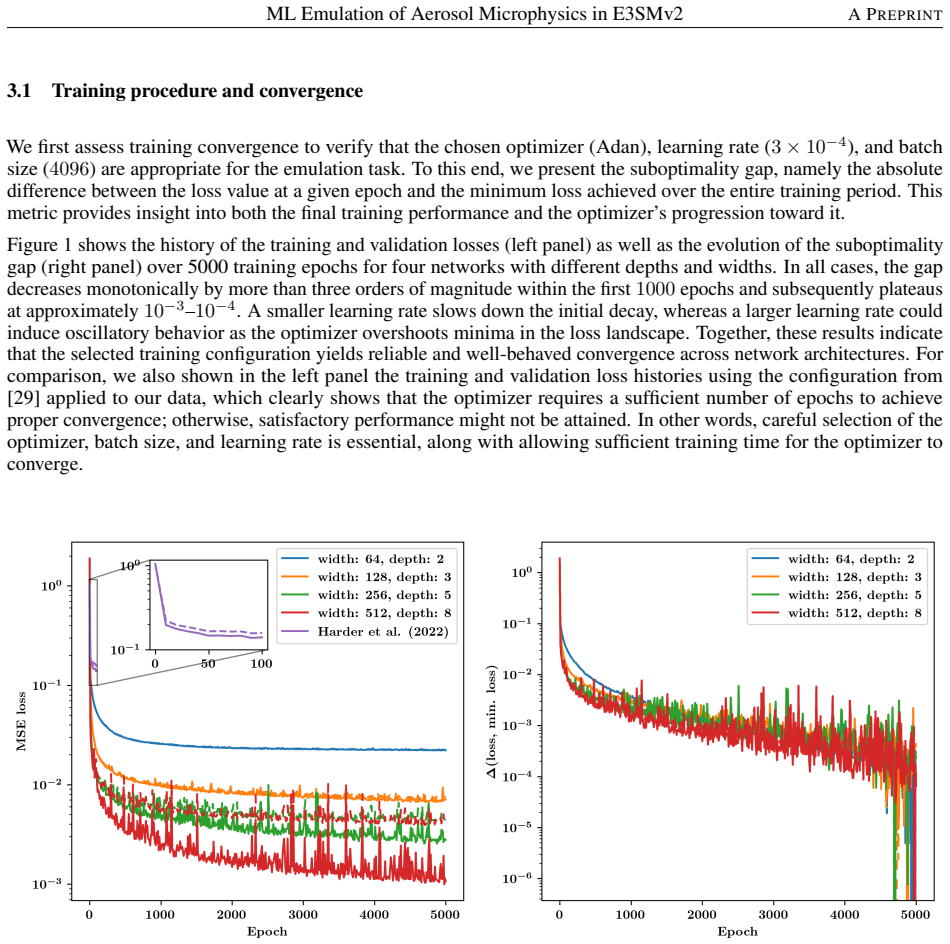
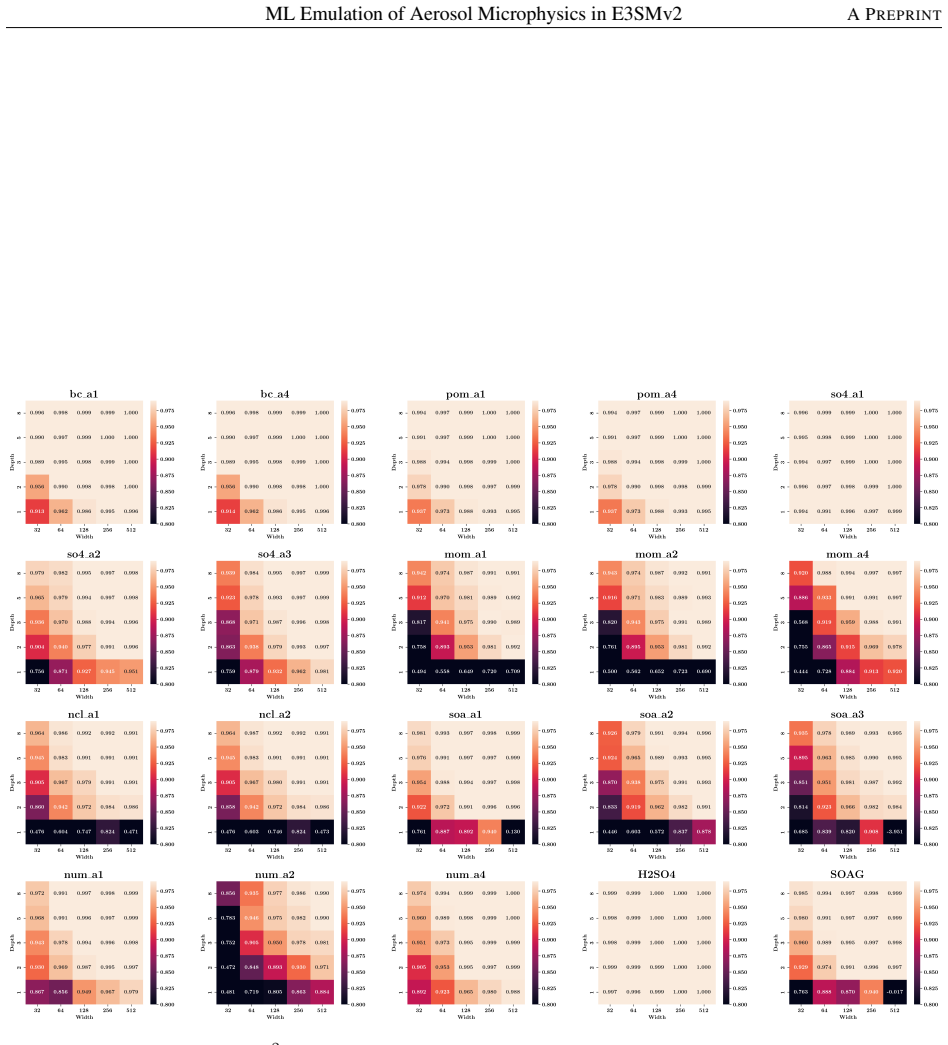
Toward the goal of using Scientific Machine Learning (SciML) emulators to improve the numerical representation of aerosol processes in global atmospheric models, we explore the emulation of aerosol microphysics processes under cloud-free conditions in the 4-mode Modal Aerosol Module (MAM4) within the Energy Exascale Earth System Model version 2 (E3SMv2). To develop an in-depth understanding of the challenges and opportunities in applying SciML to aerosol processes, we begin with a simple feedforward neural network architecture that has been used in earlier studies, but we systematically examine key emulator design choices, including architecture complexity and variable normalization, while closely monitoring training convergence behavior. Our results show that optimization convergence, scaling strategy, and network complexity strongly influence emulation accuracy. When effective scaling is applied and convergence is achieved, the relatively simple architecture, used together with a moderate network size, can reproduce key features of the microphysics-induced aerosol concentration changes with promising accuracy. These findings provide practical clues for the next stages of emulator development; they also provide general insights that are likely applicable to the emulation of other aerosol processes, as well as other atmospheric physics involving multi-scale variability.
Editorial analysis
A structured set of objections, weighed in public.
Referee Report
Summary. The paper explores emulation of aerosol microphysics processes (under cloud-free conditions) in the MAM4 module of E3SMv2 using a simple feedforward neural network. It systematically examines the influence of architecture complexity, variable normalization/scaling, and training convergence on accuracy, concluding that effective scaling plus convergence allows the moderate-sized network to reproduce key features of microphysics-induced aerosol concentration changes with promising accuracy. The work aims to provide practical guidance for SciML emulator development in atmospheric models.
Significance. If the empirical findings hold under proper validation, the paper supplies useful practical insights on design choices (scaling, convergence monitoring) for emulating multi-scale aerosol processes. This could inform more efficient parameterizations in global models like E3SM, with potential applicability to other atmospheric physics. The systematic empirical assessment of training behavior is a clear strength.
major comments (2)
- [Results] Results section: the central claim that the emulator reproduces 'key features ... with promising accuracy' when scaling and convergence are achieved is not supported by any quantitative error metrics (e.g., RMSE, mean relative error, or bias on aerosol number/mass concentrations) or direct comparisons against the native MAM4 solver on held-out data. This leaves the performance level unsubstantiated.
- [Validation and generalization discussion] Validation and generalization discussion: the claim that convergence plus effective scaling on the chosen dataset suffices for accurate representation 'across the full range of conditions encountered in E3SMv2 simulations' is untested. No out-of-sample validation on independent E3SMv2 trajectories, no analysis of training-data coverage (e.g., nucleation rates, coagulation kernels, modal parameters under varying T/RH), and no discussion of extrapolation risk are provided.
minor comments (2)
- [Abstract] Abstract: 'key features of the microphysics-induced aerosol concentration changes' is not defined; specify which species or moments (e.g., number concentration in Aitken/accumulation modes) are being emulated.
- [Methods] Methods: provide explicit details on the 'moderate network size' (layer count, neurons per layer) and the exact normalization/scaling formulas applied to inputs/outputs.
Simulated Author's Rebuttal
We thank the referee for their thoughtful and constructive review. The comments correctly identify areas where our claims require stronger quantitative support and more explicit discussion of limitations. We address each major comment below and will revise the manuscript accordingly.
read point-by-point responses
-
Referee: [Results] Results section: the central claim that the emulator reproduces 'key features ... with promising accuracy' when scaling and convergence are achieved is not supported by any quantitative error metrics (e.g., RMSE, mean relative error, or bias on aerosol number/mass concentrations) or direct comparisons against the native MAM4 solver on held-out data. This leaves the performance level unsubstantiated.
Authors: We agree that the Results section would benefit from explicit quantitative metrics. While the manuscript includes visual comparisons demonstrating that key features of aerosol concentration changes are reproduced, these do not substitute for numerical error measures. In the revised version we will add RMSE, mean relative error, and bias statistics computed on held-out data, together with direct side-by-side comparisons against the native MAM4 solver outputs. revision: yes
-
Referee: [Validation and generalization discussion] Validation and generalization discussion: the claim that convergence plus effective scaling on the chosen dataset suffices for accurate representation 'across the full range of conditions encountered in E3SMv2 simulations' is untested. No out-of-sample validation on independent E3SMv2 trajectories, no analysis of training-data coverage (e.g., nucleation rates, coagulation kernels, modal parameters under varying T/RH), and no discussion of extrapolation risk are provided.
Authors: The manuscript presents a controlled study under cloud-free conditions and does not claim that the emulator has been validated for the full range of E3SMv2 conditions. Nevertheless, the discussion section can be improved by explicitly addressing data coverage, extrapolation risks, and the absence of independent trajectory validation. We will add a limitations paragraph that covers these points, clarifies the intended scope of the current work, and notes that broader out-of-sample testing is planned for subsequent studies. revision: yes
Circularity Check
No circularity: empirical assessment of NN emulator training and accuracy
full rationale
The paper performs an empirical study of neural network design choices (architecture, scaling, convergence) for emulating MAM4 aerosol microphysics under cloud-free conditions. It reports observed training behavior and accuracy on key features without any derivation chain, uniqueness theorem, or fitted-parameter prediction that reduces to the inputs by construction. No self-definitional steps, no renaming of known results as new derivations, and no load-bearing self-citations that substitute for independent evidence. The central claim rests on experimental outcomes rather than tautological equivalence to the training data or prior author work.
Axiom & Free-Parameter Ledger
free parameters (2)
- network size (moderate)
- scaling/normalization strategy
axioms (1)
- domain assumption A feedforward neural network can approximate the mapping from aerosol state variables to microphysics-induced concentration changes.
Reference graph
Works this paper leans on
-
[1]
Pushing the frontiers in climate modelling and analysis with machine learning
Veronika Eyring, William D Collins, Pierre Gentine, Elizabeth A Barnes, Marcelo Barreiro, Tom Beucler, Marc Bocquet, Christopher S Bretherton, Hannah M Christensen, Katherine Dagon, et al. Pushing the frontiers in climate modelling and analysis with machine learning. Nature Climate Change, 14(9):916–928, 2024
2024
-
[2]
ACE: A fast, skillful learned global atmospheric model for climate prediction
Oliver Watt-Meyer, Gideon Dresdner, Jeremy McGibbon, Spencer K Clark, Brian Henn, James Duncan, Noah D Brenowitz, Karthik Kashinath, Michael S Pritchard, Boris Bonev, et al. ACE: A fast, skillful learned global atmospheric model for climate prediction. arXiv preprint arXiv:2310.02074, 2023
-
[3]
James PC Duncan, Elynn Wu, Jean-Christophe Golaz, Peter M Caldwell, Oliver Watt-Meyer, Spencer K Clark, Jeremy McGibbon, Gideon Dresdner, Karthik Kashinath, Boris Bonev, et al. Application of the AI2 climate emulator to E3SMv2’s global atmosphere model, with a focus on precipitation fidelity.Journal of Geophysical Research: Machine Learning and Computatio...
2024
-
[4]
Neural general circulation models for weather and climate
Dmitrii Kochkov, Janni Yuval, Ian Langmore, Peter Norgaard, Jamie Smith, Griffin Mooers, Milan Klöwer, James Lottes, Stephan Rasp, Peter Düben, et al. Neural general circulation models for weather and climate. Nature, 632 (8027):1060–1066, 2024. 13 ML Emulation of Aerosol Microphysics in E3SMv2A PREPRINT
2024
-
[5]
James PC Duncan, Elynn Wu, Surya Dheeshjith, Adam Subel, Troy Arcomano, Spencer K Clark, Brian Henn, Anna Kwa, Jeremy McGibbon, W Andre Perkins, et al. Samudrace: Fast and accurate coupled climate modeling with 3d ocean and atmosphere emulators. arXiv preprint arXiv:2509.12490, 2025
-
[6]
Deep learning to represent subgrid processes in climate models
Stephan Rasp, Michael S Pritchard, and Pierre Gentine. Deep learning to represent subgrid processes in climate models. Proceedings of the national academy of sciences, 115(39):9684–9689, 2018
2018
-
[7]
Could machine learning break the convection parameterization deadlock? Geophysical Research Letters, 45(11):5742–5751, 2018
Pierre Gentine, Mike Pritchard, Stephan Rasp, Gael Reinaudi, and Galen Yacalis. Could machine learning break the convection parameterization deadlock? Geophysical Research Letters, 45(11):5742–5751, 2018
2018
-
[8]
Machine learning for clouds and climate
Tom Beucler, Imme Ebert-Uphoff, Stephan Rasp, Michael Pritchard, and Pierre Gentine. Machine learning for clouds and climate. Clouds and their climatic impacts: Radiation, circulation, and precipitation, pages 325–345, 2023
2023
-
[9]
A moist physics parameterization based on deep learning
Yilun Han, Guang J Zhang, Xiaomeng Huang, and Yong Wang. A moist physics parameterization based on deep learning. Journal of Advances in Modeling Earth Systems, 12(9):e2020MS002076, 2020
2020
-
[10]
An ensemble of neural networks for moist physics processes, its generalizability and stable integration
Yilun Han, Guang J Zhang, and Yong Wang. An ensemble of neural networks for moist physics processes, its generalizability and stable integration. Journal of Advances in Modeling Earth Systems, 15(10):e2022MS003508, 2023
2023
-
[11]
ClimateBench v1
Duncan Watson-Parris, Yuhan Rao, Dirk Olivié, Øyvind Seland, Peer Nowack, Gustau Camps-Valls, Philip Stier, Shahine Bouabid, Maura Dewey, Emilie Fons, et al. ClimateBench v1. 0: A benchmark for data-driven climate projections. Journal of Advances in Modeling Earth Systems, 14(10):e2021MS002954, 2022
2022
-
[12]
ClimSim: A large multi-scale dataset for hybrid physics-ml climate emulation
Sungduk Yu, Walter Hannah, Liran Peng, Jerry Lin, Mohamed Aziz Bhouri, Ritwik Gupta, Björn Lütjens, Justus C Will, Gunnar Behrens, Julius Busecke, et al. ClimSim: A large multi-scale dataset for hybrid physics-ml climate emulation. Advances in neural information processing systems, 36:22070–22084, 2023
2023
-
[13]
Energy Exascale Earth System Model (E3SM).https://e3sm.org, 2025
E3SM Project. Energy Exascale Earth System Model (E3SM).https://e3sm.org, 2025. Accessed: 2025-09-15
2025
-
[14]
A. Geiss and P.-L. Ma. Neuralmie (v1.0): an aerosol optics emulator. Geoscientific Model Development, 18 (5):1809–1827, 2025. doi:10.5194/gmd-18-1809-2025. URL https://gmd.copernicus.org/articles/18/ 1809/2025/
-
[15]
S. J. Silva, P.-L. Ma, J. C. Hardin, and D. Rothenberg. Physically regularized machine learning emulators of aerosol activation. Geoscientific Model Development, 14(5):3067–3077, 2021. doi:10.5194/gmd-14-3067-2021. URLhttps://gmd.copernicus.org/articles/14/3067/2021/
-
[16]
Estimating submicron aerosol mixing state at the global scale with machine learning and earth system modeling
Zhonghua Zheng, Jeffrey H Curtis, Yu Yao, Jessica T Gasparik, Valentine G Anantharaj, Lei Zhao, Matthew West, and Nicole Riemer. Estimating submicron aerosol mixing state at the global scale with machine learning and earth system modeling. Earth and Space Science, 8(2):e2020EA001500, 2021
2021
-
[17]
Quantifying the structural uncertainty of the aerosol mixing state representation in a modal model
Zhonghua Zheng, Matthew West, Lei Zhao, Po-Lun Ma, Xiaohong Liu, and Nicole Riemer. Quantifying the structural uncertainty of the aerosol mixing state representation in a modal model. Atmospheric Chemistry and Physics, 21(23):17727–17741, 2021
2021
-
[18]
Matrix (multiconfiguration aerosol tracker of mixing state): an aerosol microphysical module for global atmospheric models
SE Bauer, DL Wright, D Koch, ER Lewis, R McGraw, L-S Chang, SE Schwartz, and R Ruedy. Matrix (multiconfiguration aerosol tracker of mixing state): an aerosol microphysical module for global atmospheric models. Atmospheric Chemistry and Physics, 8(20):6003–6035, 2008
2008
-
[19]
X. Liu, R. C. Easter, S. J. Ghan, R. Zaveri, P. Rasch, X. Shi, J.-F. Lamarque, A. Gettelman, H. Morrison, F. Vitt, A. Conley, S. Park, R. Neale, C. Hannay, A. M. L. Ekman, P. Hess, N. Mahowald, W. Collins, M. J. Iacono, C. S. Bretherton, M. G. Flanner, and D. Mitchell. Toward a minimal representation of aerosols in climate models: description and evaluati...
-
[20]
The global aerosol-climate model echam-ham, version 2: sensitivity to improvements in process representations
K Zhang, Declan O’Donnell, Jan Kazil, Philip Stier, Stefan Kinne, Ulrike Lohmann, Sylvaine Ferrachat, Betty Croft, Johannes Quaas, H Wan, et al. The global aerosol-climate model echam-ham, version 2: sensitivity to improvements in process representations. Atmospheric Chemistry and Physics, 12(19):8911–8949, 2012
2012
-
[21]
Aerosols in the E3SM version 1: New developments and their impacts on radiative forcing
Hailong Wang, Richard C Easter, Rudong Zhang, Po-Lun Ma, Balwinder Singh, Kai Zhang, Dilip Ganguly, Philip J Rasch, Susannah M Burrows, Steven J Ghan, et al. Aerosols in the E3SM version 1: New developments and their impacts on radiative forcing. Journal of Advances in Modeling Earth Systems, 12(1):e2019MS001851, 2020
2020
-
[22]
E. R. Whitby, P. McMurry, U. Shankar, and F. Binkowski. Modal aerosol dynamics modeling. Technical report, Computer Sciences Corp., Research Triangle Park, NC (USA), 1991. 14 ML Emulation of Aerosol Microphysics in E3SMv2A PREPRINT
1991
-
[23]
M7: An efficient size-resolved aerosol microphysics module for large-scale aerosol transport models
Elisabetta Vignati, Julian Wilson, and Philip Stier. M7: An efficient size-resolved aerosol microphysics module for large-scale aerosol transport models. Journal of Geophysical Research: Atmospheres, 109(D22), 2004. doi:https://doi.org/10.1029/2003JD004485. URL https://agupubs.onlinelibrary.wiley.com/doi/abs/ 10.1029/2003JD004485
-
[24]
Richard C. Easter, Steven J. Ghan, Yang Zhang, Rick D. Saylor, Elaine G. Chapman, Nels S. Laulainen, Hayder Abdul-Razzak, L. Ruby Leung, Xindi Bian, and Rahul A. Zaveri. MIRAGE: Model description and evaluation of aerosols and trace gases. Journal of Geophysical Research: Atmospheres, 109(D20), 2004. doi:https://doi.org/10.1029/2004JD004571. URL https://a...
-
[25]
Tropospheric aerosol size distributions simulated by three online global aerosol models using the M7 microphysics module
Kai Zhang, Hui Wan, Bin Wang, Meigen Zhang, J Feichter, and Xiaohong Liu. Tropospheric aerosol size distributions simulated by three online global aerosol models using the M7 microphysics module. Atmospheric Chemistry and Physics, 10(13):6409–6434, 2010
2010
-
[26]
Intercomparison and evalua- tion of global aerosol microphysical properties among AeroCom models of a range of complexity
Graham W Mann, Kenneth S Carslaw, Carly L Reddington, Kirsty J Pringle, Michael Schulz, Ari Asmi, Do- minick V Spracklen, David A Ridley, Matthew T Woodhouse, Lindsay A Lee, et al. Intercomparison and evalua- tion of global aerosol microphysical properties among AeroCom models of a range of complexity. Atmospheric chemistry and physics, 14(9):4679–4713, 2014
2014
-
[27]
Emulating aerosol microphysics with machine learning
Paula Harder, Duncan Watson-Parris, Dominik Strassel, Nicolas Gauger, Philip Stier, and Janis Keuper. Emulating aerosol microphysics with machine learning. arXiv preprint arXiv:2109.10593, 2021
-
[28]
The aerosol-climate model ECHAM5-HAM
Philip Stier, Johann Feichter, Stefan Kinne, Silvia Kloster, Elisabetta Vignati, Julian Wilson, Laurence Ganzeveld, Ina Tegen, Martin Werner, Yves Balkanski, et al. The aerosol-climate model ECHAM5-HAM. Atmospheric Chemistry and Physics, 5(4):1125–1156, 2005
2005
-
[29]
Physics-informed learning of aerosol microphysics
Paula Harder, Duncan Watson-Parris, Philip Stier, Dominik Strassel, Nicolas R Gauger, and Janis Keuper. Physics-informed learning of aerosol microphysics. Environmental Data Science, 1:e20, 2022
2022
-
[30]
Data-driven emulation of modal aerosol microphysics via neural operator-based modeling
Zhe Bai and Damian Rouson. Data-driven emulation of modal aerosol microphysics via neural operator-based modeling. Scientific Reports, 2025
2025
-
[31]
Easter, Rudong Zhang, Po-Lun Ma, Balwinder Singh, Kai Zhang, Dilip Ganguly, Philip J
Hailong Wang, Richard C. Easter, Rudong Zhang, Po-Lun Ma, Balwinder Singh, Kai Zhang, Dilip Ganguly, Philip J. Rasch, Susannah M. Burrows, Steven J. Ghan, Sijia Lou, Yun Qian, Yang Yang, Yan Feng, Mark Flanner, L. Ruby Leung, Xiaohong Liu, Manish Shrivastava, Jian Sun, Qi Tang, Shaocheng Xie, and Jin-Ho Yoon. Aerosols in the E3SM version 1: New developmen...
-
[32]
X. Liu, P.-L. Ma, H. Wang, S. Tilmes, B. Singh, R. C. Easter, S. J. Ghan, and P. J. Rasch. Description and evaluation of a new four-mode version of the modal aerosol module (MAM4) within version 5.3 of the Community Atmosphere Model. Geoscientific Model Development, 9(2):505–522, 2016. doi:10.5194/gmd-9-505-2016. URL https://www.geosci-model-dev.net/9/505/2016/
-
[33]
S. J. Ghan and R. C. Easter. Impact of cloud-borne aerosol representation on aerosol direct and indirect effects. Atmospheric Chemistry and Physics, 6(12):4163–4174, 2006. ISSN 1680-7316. URL http://www. atmos-chem-phys.net/6/4163/2006/
2006
-
[34]
Description and evaluation of glomap-mode: A modal global aerosol microphysics model for the UKCA composition-climate model
Graham W Mann, KS Carslaw, DV Spracklen, DA Ridley, PT Manktelow, MP Chipperfield, SJ Pickering, and CE Johnson. Description and evaluation of glomap-mode: A modal global aerosol microphysics model for the UKCA composition-climate model. Geoscientific Model Development, 3(2):519–551, 2010
2010
-
[35]
H. Wan, P. J. Rasch, K. Zhang, J. Kazil, and L. R. Leung. Numerical issues associated with compensating and competing processes in climate models: an example from echam-ham. Geoscientific Model Development, 6 (3):861–874, 2013. doi:10.5194/gmd-6-861-2013. URL https://gmd.copernicus.org/articles/6/861/ 2013/
-
[36]
Shaocheng Xie, Christopher R. Terai, Hailong Wang, Qi Tang, Jiwen Fan, Susannah Burrows, Wuyin Lin, Mingxuan Wu, Xiaoliang Song, Yuying Zhang, Mark A. Taylor, Jean-Christophe Golaz, James J. Benedict, Chih- Chieh-Jack Chen, Yan Feng, Walter M. Hannah, Ziming Ke, Yunpeng Shan, Vincent E. Larson, Xiaohong Liu, Michael J. Prather, Jadwiga H. Richter, Manish ...
-
[37]
Deep residual learning for image recognition
Kaiming He, Xiangyu Zhang, Shaoqing Ren, and Jian Sun. Deep residual learning for image recognition. In Proceedings of the IEEE conference on computer vision and pattern recognition, pages 770–778, 2016
2016
-
[38]
Identity mappings in deep residual networks
Kaiming He, Xiangyu Zhang, Shaoqing Ren, and Jian Sun. Identity mappings in deep residual networks. In European conference on computer vision, pages 630–645. Springer, 2016
2016
-
[39]
Data-driven medium-range weather prediction with a resnet pretrained on climate simulations: A new model for weatherbench
Stephan Rasp and Nils Thuerey. Data-driven medium-range weather prediction with a resnet pretrained on climate simulations: A new model for weatherbench. Journal of Advances in Modeling Earth Systems, 13(2): e2020MS002405, 2021
2021
-
[40]
On deep learning-based bias correction and downscaling of multiple climate models simulations
Fang Wang and Di Tian. On deep learning-based bias correction and downscaling of multiple climate models simulations. Climate Dynamics, 59(11):3451–3468, 2022
2022
-
[41]
Walter M. Hannah, Andrew M. Bradley, Oksana Guba, Qi Tang, Jean-Christophe Golaz, and Jon Wolfe. Separating physics and dynamics grids for improved computational efficiency in spectral ele- ment earth system models. Journal of Advances in Modeling Earth Systems, 13(7):e2020MS002419, 2021. doi:https://doi.org/10.1029/2020MS002419. URL https://agupubs.onlin...
-
[42]
P. J. Rasch, S. Xie, P.-L. Ma, W. Lin, H. Wang, Q. Tang, S. M. Burrows, P. Caldwell, K. Zhang, R. C. Easter, P. Cameron-Smith, B. Singh, H. Wan, J.-C. Golaz, B. E. Harrop, E. Roesler, J. Bacmeister, V . E. Larson, K. J. Evans, Y . Qian, M. Taylor, L. R. Leung, Y . Zhang, L. Brent, M. Branstetter, C. Hannay, S. Mahajan, A. Mametjanov, R. Neale, J. H. Richt...
-
[43]
URL https://agupubs.onlinelibrary.wiley.com/ doi/abs/10.1029/2019MS001629
doi:https://doi.org/10.1029/2019MS001629. URL https://agupubs.onlinelibrary.wiley.com/ doi/abs/10.1029/2019MS001629
-
[44]
Rasch, Po-Lun Ma, Richard Neale, Vincent E
Shaocheng Xie, Wuyin Lin, Philip J. Rasch, Po-Lun Ma, Richard Neale, Vincent E. Larson, Yun Qian, Peter A. Bogenschutz, Peter Caldwell, Philip Cameron-Smith, Jean-Christophe Golaz, Salil Mahajan, Balwinder Singh, Qi Tang, Hailong Wang, Jin-Ho Yoon, Kai Zhang, and Yuying Zhang. Understanding cloud and convective characteristics in version 1 of the E3SM atm...
discussion (0)
Sign in with ORCID, Apple, or X to comment. Anyone can read and Pith papers without signing in.