Recognition: unknown
ReaGeo: Reasoning-Enhanced End-to-End Geocoding with LLMs
Pith reviewed 2026-05-09 22:16 UTC · model grok-4.3
The pith
Large language models can perform accurate end-to-end geocoding by generating geohash sequences with spatial reasoning and distance-based reinforcement learning.
A machine-rendered reading of the paper's core claim, the machinery that carries it, and where it could break.
Core claim
ReaGeo converts geographic coordinates into geohash sequences to reframe coordinate prediction as a text generation task. It adds a Chain-of-Thought mechanism to improve reasoning over spatial relationships and applies reinforcement learning with a distance-deviation reward to optimize generation accuracy. Experiments confirm accurate single-point predictions for explicit addresses, effective handling of vague relative location queries, and strong performance on non-point geometric regions.
What carries the argument
The reformulation of coordinate prediction as geohash sequence generation, supported by Chain-of-Thought spatial reasoning and reinforcement learning tuned to minimize distance deviation.
Load-bearing premise
That geohash sequence generation combined with Chain-of-Thought reasoning and distance-deviation reinforcement learning lets LLMs overcome the workflow complexity and database dependence of traditional multi-stage geocoding.
What would settle it
A controlled test on a dataset of vague relative location queries where ReaGeo shows higher average distance errors than a standard multi-stage retrieval system would disprove the central claim.
Figures

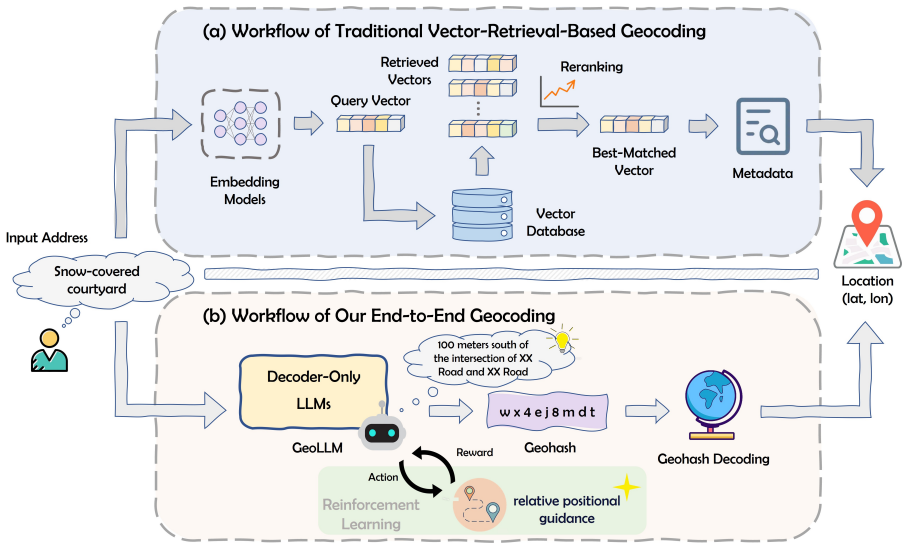


read the original abstract
This paper proposes ReaGeo, an end-to-end geocoding framework based on large language models, designed to overcome the limitations of traditional multi-stage approaches that rely on text or vector similarity retrieval over geographic databases, including workflow complexity, error propagation, and heavy dependence on structured geographic knowledge bases. The method converts geographic coordinates into geohash sequences, reformulating the coordinate prediction task as a text generation problem, and introduces a Chain-of-Thought mechanism to enhance the model's reasoning over spatial relationships. Furthermore, reinforcement learning with a distance-deviation-based reward is applied to optimize the generation accuracy. Comprehensive experiments show that ReaGeo can accurately handle explicit address queries in single-point predictions and effectively resolve vague relative location queries. In addition, the model demonstrates strong predictive capability for non-point geometric regions, highlighting its versatility and generalization ability in geocoding tasks.
Editorial analysis
A structured set of objections, weighed in public.
Referee Report
Summary. The paper proposes ReaGeo, an end-to-end geocoding framework based on large language models. It converts geographic coordinates into geohash sequences to reformulate coordinate prediction as a text generation task, augments this with Chain-of-Thought reasoning over spatial relationships, and applies reinforcement learning using a distance-deviation reward to optimize accuracy. The approach is positioned as overcoming limitations of traditional multi-stage geocoding methods (workflow complexity, error propagation, and dependence on structured geographic databases). Comprehensive experiments are claimed to demonstrate accurate handling of explicit address queries for single-point predictions, effective resolution of vague relative location queries, and strong predictive capability for non-point geometric regions.
Significance. If the experimental claims hold, the work could have moderate significance for geospatial AI by demonstrating an integrated LLM-based pipeline that reduces reliance on external databases and multi-stage error accumulation. The combination of geohash encoding, CoT reasoning, and distance-based RL reward provides a coherent technical path for handling both precise and ambiguous spatial queries, with potential for broader application in location-aware systems.
major comments (2)
- [Abstract and Experiments] The abstract asserts 'comprehensive experiments' and 'strong performance' on explicit addresses, vague relatives, and non-point regions, yet provides no quantitative metrics, baselines, datasets, or evaluation details (e.g., error distances, accuracy rates, or comparison to retrieval-based methods). This absence is load-bearing for the central claim of superiority and generalization; without them, the results cannot be assessed.
- [Method and Experiments] The core assumption that geohash sequence generation plus CoT and distance-deviation RL enables overcoming traditional limitations 'without heavy reliance on structured geographic knowledge bases' is stated but not supported by ablation studies or direct comparisons in the provided description. This needs explicit evidence in the method and results sections to substantiate the end-to-end advantage.
minor comments (2)
- [Method] Include specific LLM backbone, training hyperparameters, and reward function formulation (e.g., exact definition of distance deviation) for reproducibility.
- [Experiments] Clarify how non-point geometric regions are represented and evaluated (e.g., as geohash sets or polygons) and provide example outputs.
Simulated Author's Rebuttal
We thank the referee for the constructive comments, which help clarify how to strengthen the presentation of our results and evidence. We address each major comment point by point below.
read point-by-point responses
-
Referee: [Abstract and Experiments] The abstract asserts 'comprehensive experiments' and 'strong performance' on explicit addresses, vague relatives, and non-point regions, yet provides no quantitative metrics, baselines, datasets, or evaluation details (e.g., error distances, accuracy rates, or comparison to retrieval-based methods). This absence is load-bearing for the central claim of superiority and generalization; without them, the results cannot be assessed.
Authors: We agree that the abstract would be strengthened by including key quantitative metrics. The full manuscript contains a dedicated Experiments section with specific results on error distances, accuracy rates, datasets, and comparisons to retrieval-based baselines. We will revise the abstract to concisely report representative metrics (such as mean distance errors for point predictions and success rates for region predictions) while keeping it within length limits. This addresses the concern directly. revision: yes
-
Referee: [Method and Experiments] The core assumption that geohash sequence generation plus CoT and distance-deviation RL enables overcoming traditional limitations 'without heavy reliance on structured geographic knowledge bases' is stated but not supported by ablation studies or direct comparisons in the provided description. This needs explicit evidence in the method and results sections to substantiate the end-to-end advantage.
Authors: The manuscript describes the end-to-end workflow in which the LLM directly generates geohash sequences from queries, with CoT for spatial reasoning and distance-deviation RL for optimization, thereby avoiding intermediate retrieval stages and external databases. To provide stronger substantiation, we will add ablation studies (comparing variants with and without CoT or RL) and direct comparisons to multi-stage baselines in the revised results section. revision: yes
Circularity Check
No significant circularity in derivation chain
full rationale
The paper reformulates geocoding as LLM text generation over geohash sequences, augments with Chain-of-Thought reasoning, and optimizes via reinforcement learning using a distance-deviation reward. These steps are presented as standard extensions of existing LLM and RL techniques applied to a new task formulation. No equations or claims reduce by construction to fitted parameters renamed as predictions, self-citations that bear the central load, or ansatzes smuggled from prior author work. The experimental claims about point queries, vague relatives, and non-point regions follow directly from the described pipeline without self-referential loops. The framework remains self-contained against external benchmarks.
Axiom & Free-Parameter Ledger
axioms (1)
- domain assumption LLMs can effectively perform spatial reasoning via Chain-of-Thought prompting
Reference graph
Works this paper leans on
-
[1]
International journal of health geographics , volume=
Historical measures of social context in life course studies: retrospective linkage of addresses to decennial censuses , author=. International journal of health geographics , volume=. 2004 , publisher=
2004
-
[2]
2007 , publisher=
Geocoding health data: the use of geographic codes in cancer prevention and control, research and practice , author=. 2007 , publisher=
2007
-
[3]
URISA journal , volume=
From text to geographic coordinates: the current state of geocoding , author=. URISA journal , volume=. 2007 , publisher=
2007
-
[4]
arXiv preprint arXiv:2503.18888 , year=
Toward building next-generation Geocoding systems: a systematic review , author=. arXiv preprint arXiv:2503.18888 , year=
-
[5]
International Journal of Environmental Research and Public Health , volume=
Modeling spatiotemporal pattern of depressive symptoms caused by COVID-19 using social media data mining , author=. International Journal of Environmental Research and Public Health , volume=. 2020 , publisher=
2020
-
[6]
2024 IEEE 100th Vehicular Technology Conference (VTC2024-Fall) , pages=
Assessing urban safety: A digital twin approach using streetview and large language models , author=. 2024 IEEE 100th Vehicular Technology Conference (VTC2024-Fall) , pages=. 2024 , organization=
2024
-
[7]
Journal of Spatial Information Science , volume=
Geocoding location expressions in Twitter messages: A preference learning method , author=. Journal of Spatial Information Science , volume=
-
[8]
Social Sensing and Big Data Computing for Disaster Management , pages=
Social and geographical disparities in Twitter use during Hurricane Harvey , author=. Social Sensing and Big Data Computing for Disaster Management , pages=. 2020 , publisher=
2020
-
[9]
Proceedings of the AAAI Conference on Artificial Intelligence , volume=
Tagging address queries in maps search , author=. Proceedings of the AAAI Conference on Artificial Intelligence , volume=
-
[10]
Geography Compass , volume=
Geo-text data and data-driven geospatial semantics , author=. Geography Compass , volume=. 2018 , publisher=
2018
-
[11]
2020 , school=
Geocoding user queries , author=. 2020 , school=
2020
-
[12]
arXiv preprint arXiv:2107.00080 , year=
Regressing location on text for probabilistic geocoding , author=. arXiv preprint arXiv:2107.00080 , year=
-
[13]
Proceedings of the 2nd ACM SIGSPATIAL International Workshop on Searching and Mining Large Collections of Geospatial Data , pages=
Is ChatGPT a game changer for geocoding-a benchmark for geocoding address parsing techniques , author=. Proceedings of the 2nd ACM SIGSPATIAL International Workshop on Searching and Mining Large Collections of Geospatial Data , pages=
-
[14]
Electronics , volume=
Enex-fp: A bert-based address recognition model , author=. Electronics , volume=. 2023 , publisher=
2023
-
[15]
Transactions in GIS , volume=
Automated geocoding of textual documents: A survey of current approaches , author=. Transactions in GIS , volume=. 2017 , publisher=
2017
-
[16]
Proceedings of the 2019 2nd international conference on geoinformatics and data analysis , pages=
An NLP-based question answering framework for spatio-temporal analysis and visualization , author=. Proceedings of the 2019 2nd international conference on geoinformatics and data analysis , pages=
2019
-
[17]
Transactions in GIS , volume=
A deep learning approach for rooftop geocoding , author=. Transactions in GIS , volume=. 2019 , publisher=
2019
-
[18]
ACM Computing Surveys , volume=
Location reference recognition from texts: A survey and comparison , author=. ACM Computing Surveys , volume=. 2023 , publisher=
2023
-
[19]
Statistical Journal of the IAOS , volume=
Address matching using machine learning methods: An application to register-based census , author=. Statistical Journal of the IAOS , volume=. 2024 , publisher=
2024
-
[20]
Advances in neural information processing systems , volume=
Chain-of-thought prompting elicits reasoning in large language models , author=. Advances in neural information processing systems , volume=
-
[21]
European Conference on Computer Vision , pages=
Addressclip: Empowering vision-language models for city-wide image address localization , author=. European Conference on Computer Vision , pages=. 2024 , organization=
2024
-
[22]
Proceedings of the IEEE/CVF winter conference on applications of computer vision , pages=
Mixvpr: Feature mixing for visual place recognition , author=. Proceedings of the IEEE/CVF winter conference on applications of computer vision , pages=
-
[23]
Advances in Neural Information Processing Systems , volume=
G3: an effective and adaptive framework for worldwide geolocalization using large multi-modality models , author=. Advances in Neural Information Processing Systems , volume=
-
[24]
Proceedings of the IEEE/CVF Conference on Computer Vision and Pattern Recognition , pages=
Rethinking visual geo-localization for large-scale applications , author=. Proceedings of the IEEE/CVF Conference on Computer Vision and Pattern Recognition , pages=
-
[25]
IEEE Access , year=
Cross-view geo-localization: a survey , author=. IEEE Access , year=
-
[26]
International Journal of Computer Vision , volume=
Image and object geo-localization , author=. International Journal of Computer Vision , volume=. 2024 , publisher=
2024
-
[27]
Advances in neural information processing systems , volume=
Attention is all you need , author=. Advances in neural information processing systems , volume=
-
[28]
Bert: Pre-training of deep bidirectional transformers for language understanding , author=. Proceedings of the 2019 conference of the North American chapter of the association for computational linguistics: human language technologies, volume 1 (long and short papers) , pages=
2019
-
[29]
2018 , institution=
Improving language understanding by generative pre-training , author=. 2018 , institution=
2018
-
[30]
Advances in neural information processing systems , volume=
Language models are few-shot learners , author=. Advances in neural information processing systems , volume=
-
[31]
Advances in neural information processing systems , volume=
Training language models to follow instructions with human feedback , author=. Advances in neural information processing systems , volume=
-
[32]
Training a Helpful and Harmless Assistant with Reinforcement Learning from Human Feedback
Training a helpful and harmless assistant with reinforcement learning from human feedback , author=. arXiv preprint arXiv:2204.05862 , year=
-
[33]
Gpt-4 technical report , author=. arXiv preprint arXiv:2303.08774 , year=
work page internal anchor Pith review Pith/arXiv arXiv
-
[34]
Proximal Policy Optimization Algorithms
Proximal policy optimization algorithms , author=. arXiv preprint arXiv:1707.06347 , year=
work page internal anchor Pith review Pith/arXiv arXiv
-
[35]
DeepSeekMath: Pushing the Limits of Mathematical Reasoning in Open Language Models
Deepseekmath: Pushing the limits of mathematical reasoning in open language models , author=. arXiv preprint arXiv:2402.03300 , year=
work page internal anchor Pith review Pith/arXiv arXiv
-
[36]
LLaMA: Open and Efficient Foundation Language Models
Llama: Open and efficient foundation language models , author=. arXiv preprint arXiv:2302.13971 , year=
work page internal anchor Pith review Pith/arXiv arXiv
-
[37]
Qwen2 technical report , author=. arXiv preprint arXiv:2407.10671 , volume=
work page internal anchor Pith review arXiv
-
[38]
Qwen2.5 Technical Report , author=. arXiv preprint arXiv:2412.15115 , year=
work page internal anchor Pith review Pith/arXiv arXiv
-
[39]
Qwen3 technical report , author=. arXiv preprint arXiv:2505.09388 , year=
work page internal anchor Pith review Pith/arXiv arXiv
-
[40]
DeepSeek LLM: Scaling Open-Source Language Models with Longtermism
Deepseek llm: Scaling open-source language models with longtermism , author=. arXiv preprint arXiv:2401.02954 , year=
work page internal anchor Pith review arXiv
-
[41]
Proceedings of the 47th international ACM SIGIR conference on research and development in information retrieval , pages=
C-pack: Packed resources for general chinese embeddings , author=. Proceedings of the 47th international ACM SIGIR conference on research and development in information retrieval , pages=
-
[42]
2025 , note=
Geocoding API , author=. 2025 , note=
2025
discussion (0)
Sign in with ORCID, Apple, or X to comment. Anyone can read and Pith papers without signing in.