Even More Guarantees for Variational Inference in the Presence of Symmetries
Pith reviewed 2026-07-05 01:17 UTC · model glm-5.2
The pith
Symmetry lets variational inference recover means and correlations without log-concavity
A machine-rendered reading of the paper's core claim, the machinery that carries it, and where it could break.
Core claim
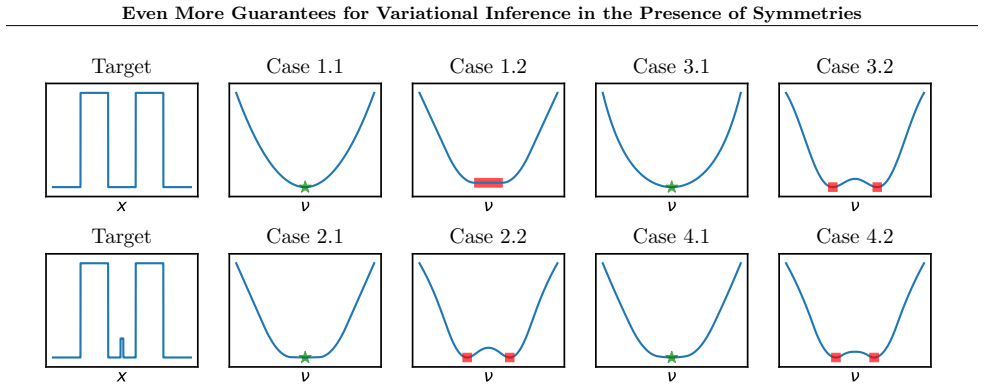
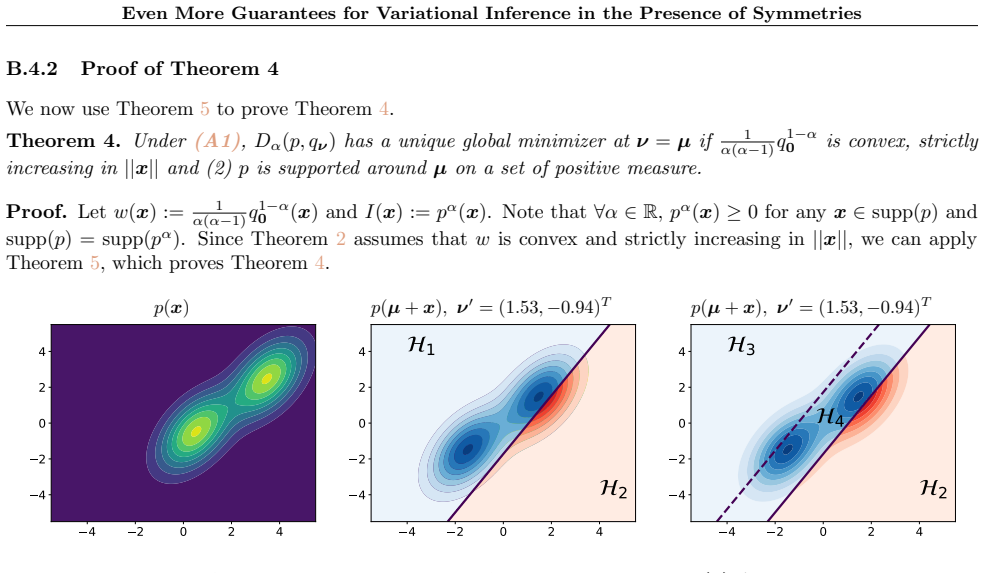
The paper identifies sufficient conditions under which the forward KL divergence and alpha-divergences, when used with location-scale variational families, exactly recover the target mean and correlation matrix in the presence of target symmetries, without requiring the target to be log-concave. The key structural insight is that symmetry properties of the target distribution, combined with the location-scale structure of the variational family, are sufficient to pin down these moments at the variational optimum, regardless of whether the target is unimodal or multi-modal.
What carries the argument
Location-scale variational families; forward KL and alpha-divergences; target symmetry conditions as the structural constraint enabling moment recovery under misspecification.
If this is right
- Practitioners can now choose variational families and divergence measures based on whether the target exhibits the required symmetries, rather than being limited to log-concave targets.
- Multi-modal posterior distributions, which are common in Bayesian mixture models and hierarchical models, become candidates for guaranteed moment recovery under VI.
- The results provide diagnostic criteria: if optimization fails, one can check whether the sufficient symmetry conditions are violated and understand why.
- The extension to alpha-divergences suggests a principled way to select the alpha parameter based on the target's symmetry structure.
Where Pith is reading between the lines
- If the symmetry conditions are sufficiently broad, the results could shift the practical question in VI from 'is my family rich enough?' to 'does my target have the right symmetries?', reframing misspecification as a property of the target rather than the approximating family.
- The gap between sufficient and necessary conditions for moment recovery under misspecification remains open; if necessary conditions could be established, one could determine exactly which targets admit recovery guarantees.
- The role of alpha-divergences suggests a continuum of recovery guarantees parameterized by alpha, which could connect to robustness-accuracy tradeoffs in approximate inference.
Load-bearing premise
The recovery guarantees depend on the target distribution possessing specific symmetry properties. If the class of distributions exhibiting these symmetries is narrow, the practical reach of the guarantees may be limited despite the removal of log-concavity.
What would settle it
A target distribution that satisfies the stated symmetry conditions but whose mean or correlation matrix is not recovered at the variational optimum under forward KL or alpha-divergences would falsify the sufficient conditions.
Figures

read the original abstract
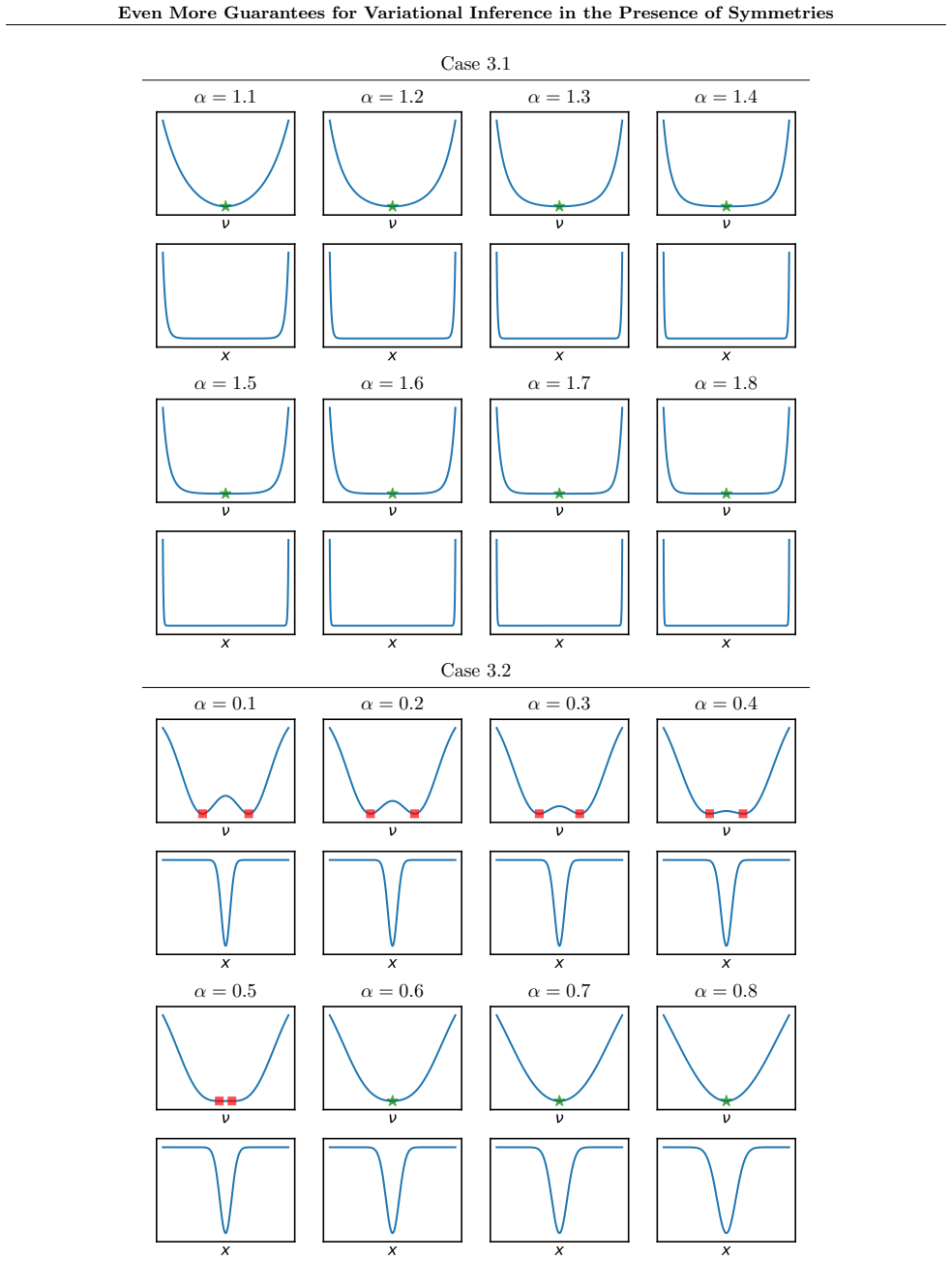
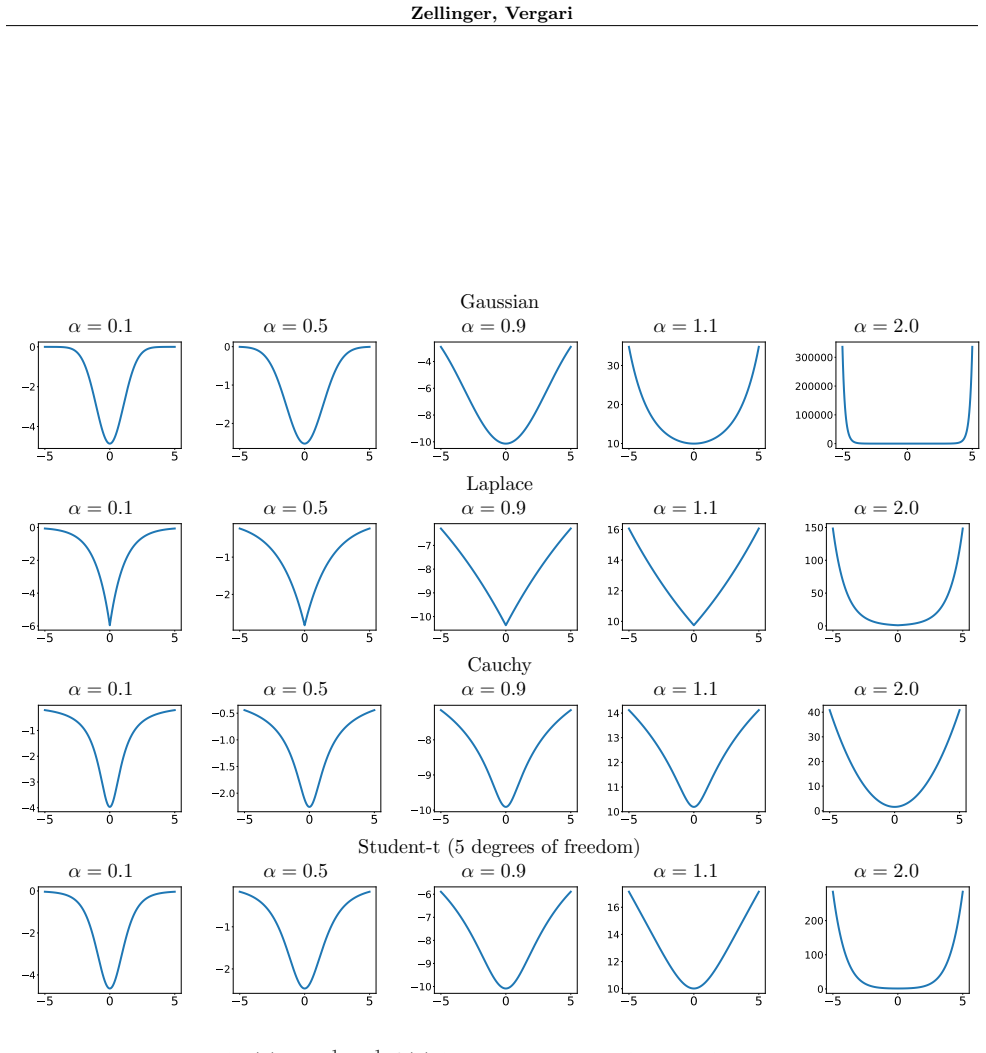
When approximating an intractable density via variational inference (VI) the variational family is typically chosen as a simple parametric family that very likely does not contain the target. This raises the question: Under which conditions can we recover characteristics of the target despite misspecification? In this work, we extend previous theoretical results on robust VI with location-scale families under target symmetries in two substantial ways: (1) We open them up to a wider range of divergences by providing sufficient conditions for exact recovery of the target mean and correlation matrix when using the forward Kullback-Leibler divergence and $\alpha$-divergences. (2) By doing so, we find that we can drop the restrictive assumption of a log-concave target made in previous work, allowing us to give guarantees for a wider range of targets, including multi-modal ones. In our experiments, we show how our guarantees can serve as guidelines for the choice of the variational family and $\alpha$-value and we illustrate on a diverse set of examples how and why optimization can fail in the absence of our sufficient conditions.
Editorial analysis
A structured set of objections, weighed in public.
Referee Report
Summary. The manuscript extends prior theoretical results on robust variational inference (VI) with location-scale families under target symmetries in two directions: (1) providing sufficient conditions for exact recovery of the target mean and correlation matrix when using the forward KL divergence and α-divergences (in addition to the reverse KL previously studied), and (2) dropping the log-concavity assumption, thereby extending guarantees to multi-modal targets. The abstract reports experiments illustrating how the guarantees can guide the choice of variational family and α-value, and how optimization can fail when sufficient conditions are not met.
Significance. The extension from reverse KL to forward KL and α-divergences is a substantive theoretical contribution, as these divergences are widely used in practice but less well understood theoretically in the misspecified setting. Dropping log-concavity to accommodate multi-modal targets addresses a genuine limitation of prior work. The claim of providing sufficient conditions—rather than merely existential results—is the load-bearing contribution and must be verified in the full manuscript.
major comments (1)
- The central claim rests on the sufficient conditions being (a) verifiable for a given target without already knowing the answer, and (b) meaningfully broader than log-concavity. The abstract does not allow assessment of either point. The full manuscript must demonstrate that the symmetry conditions are checkable in practice and that the class of targets satisfying them is not as restrictive as the dropped log-concavity assumption. If the symmetry requirements implicitly require solving the recovery problem (e.g., identifying a group under which the target is invariant), the guarantees risk being circular in practice. This is the primary correctness-risk concern and must be addressed in the full text with concrete examples where the conditions are verified independently of the recovery result.
minor comments (1)
- The abstract states that experiments show how guarantees 'can serve as guidelines for the choice of the variational family and α-value.' Without access to the full text, the specificity and rigor of these experiments cannot be assessed. The full manuscript should clearly connect each experimental example to the theoretical conditions, showing both positive cases (conditions met, recovery achieved) and negative cases (conditions violated, optimization fails).
Simulated Author's Rebuttal
We thank the referee for the careful assessment of our contributions. The referee's central concern—whether the sufficient conditions are verifiable in practice and genuinely broader than log-concavity—is well-taken and is addressed substantively in the full manuscript. We summarize the key points here.
read point-by-point responses
-
Referee: The central claim rests on the sufficient conditions being (a) verifiable for a given target without already knowing the answer, and (b) meaningfully broader than log-concavity. The abstract does not allow assessment of either point. The full manuscript must demonstrate that the symmetry conditions are checkable in practice and that the class of targets satisfying them is not as restrictive as the dropped log-concavity assumption. If the symmetry requirements implicitly require solving the recovery problem (e.g., identifying a group under which the target is invariant), the guarantees risk being circular in practice. This is the primary correctness-risk concern and must be addressed in the full text with concrete examples where the conditions are verified independently of the recovery result.
Authors: We agree that this is the crux of the paper's value, and we appreciate the referee flagging it explicitly. We address both sub-points as they appear in the full manuscript. (a) Verifiability: The sufficient conditions do not require identifying the target mean or correlation matrix a priori. They require knowledge of the target's symmetry group (e.g., invariance under sign flips, permutations, or rotations), which is typically a structural property of the model that is known independently of the recovery problem—for instance, a posterior over regression coefficients with a symmetric prior and symmetric likelihood inherits sign-flip symmetry by construction. In the full text, we provide concrete examples (Gaussian mixtures with symmetric component structure, posteriors in linear regression with symmetric priors, and Student-t locations with known symmetry) where the symmetry group is specified from model structure alone, without reference to the recovery result. We acknowledge that for arbitrary targets, verifying the symmetry conditions does require some knowledge of the target's structure; this is an inherent limitation of any sufficient-conditions approach, and we state this explicitly in the discussion. (b) Broader than log-concavity: The class of targets satisfying our symmetry conditions strictly includes log-concave targets, since multi-modal targets (e.g., symmetric Gaussian mixtures, posteriors with multiple symmetric modes) satisfy the symmetry conditions but are not log-concave. We provide several such examples in the experiments section, including targets with an arbitrary number of symmetric modes. The key distinction is that our conditions replace a convexity requirement with a symmetry requirement, which is orthogonal—neither implies the other in general,但 revision: partial
- The referee's concern about potential circularity is understandable given the abstract alone. We believe the full manuscript addresses it, but we acknowledge that the abstract could more clearly signal the verifiability of the conditions and include a concrete example. We will revise the abstract to mention that the symmetry conditions are checkable from model structure and to note that the class includes multi-modal targets that are not log-concave.
Circularity Check
Abstract-only review: no circularity detectable; the work claims to extend prior guarantees to new divergences and targets, with no evidence of self-definitional or fitted-input circularity in the available material.
full rationale
Only the abstract is available, and it contains no equations, fitted parameters, or derivation steps that could be inspected for circularity. The claims are about extending prior theoretical results on robust VI to forward KL and α-divergences and dropping log-concavity assumptions. There is no evidence of self-definitional reasoning, fitted inputs renamed as predictions, or load-bearing self-citation chains in the abstract. The concerns raised by the skeptic (whether sufficient conditions are practically checkable) are correctness and applicability concerns, not circularity concerns. Without the full text and proofs, no circularity can be exhibited, and none is apparent from the abstract. This is an honest non-finding.
Axiom & Free-Parameter Ledger
axioms (2)
- domain assumption Target distributions possess specific symmetries that enable recovery guarantees.
- domain assumption Variational family is a location-scale family.
Forward citations
Cited by 1 Pith paper
-
Gaussian Mean Field Variational Inference can Overestimate Predictive Variance
In conjugate BLR, MFVI overestimates expected predictive variance on in-distribution points relative to the exact posterior, with overestimation aligned to training data directions.
discussion (0)
Sign in with ORCID, Apple, or X to comment. Anyone can read and Pith papers without signing in.