Recognition: unknown
Quotient-Space Diffusion Models
Pith reviewed 2026-05-09 22:02 UTC · model grok-4.3
The pith
Diffusion models defined on quotient spaces handle group symmetries like SE(3) without learning the group action components.
A machine-rendered reading of the paper's core claim, the machinery that carries it, and where it could break.
Core claim
By establishing a formal diffusion model on a general quotient space with respect to a group, the framework removes the necessity of learning the component that corresponds to the group action. This simplification lowers the learning difficulty relative to conventional group-equivariant diffusion models. The associated sampler is proven to recover the exact target distribution defined on the quotient, whereas heuristic alignment strategies lack any corresponding sampler guarantee. The construction is applied to molecular structure generation under SE(3) symmetry and is shown empirically to outperform prior symmetry treatments on small-molecule and protein tasks.
What carries the argument
The quotient-space diffusion process: a diffusion model constructed directly on the space of orbits under the group action, which encodes symmetries by definition and supplies a sampler with recovery guarantees.
If this is right
- The model avoids learning any explicit representation of the group action, which lowers training complexity.
- The sampler is guaranteed to produce samples from the correct target distribution on the quotient space.
- Empirical results on small molecules and proteins show improved performance over previous symmetry-handling methods.
- The same quotient construction applies to any group symmetry, not only SE(3).
Where Pith is reading between the lines
- The same construction could be tested on other data types that carry rotational or permutation symmetries, such as point clouds or graphs.
- Because fewer components are learned, training time or model size may decrease in practice for large systems.
- The framework opens the possibility of combining quotient diffusion with additional geometric constraints that are not captured by the group alone.
Load-bearing premise
The target distribution must be exactly the one induced on the quotient space by the group, and a diffusion process must exist on that space without further manifold assumptions that would invalidate the sampler guarantee.
What would settle it
Generate samples from the trained model on a known symmetric distribution (for example, a set of fixed molecular conformations under random SE(3) transformations) and measure whether the empirical distribution of outputs matches the known target distribution to within sampling error.
Figures



read the original abstract
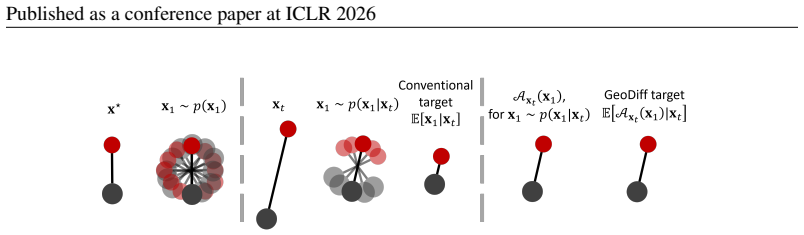
Diffusion-based generative models have reformed generative AI, and have enabled new capabilities in the science domain, for example, generating 3D structures of molecules. Due to the intrinsic problem structure of certain tasks, there is often a symmetry in the system, which identifies objects that can be converted by a group action as equivalent, hence the target distribution is essentially defined on the quotient space with respect to the group. In this work, we establish a formal framework for diffusion modeling on a general quotient space, and apply it to molecular structure generation which follows the special Euclidean group $\text{SE}(3)$ symmetry. The framework reduces the necessity of learning the component corresponding to the group action, hence simplifies learning difficulty over conventional group-equivariant diffusion models, and the sampler guarantees recovering the target distribution, while heuristic alignment strategies lack proper samplers. The arguments are empirically validated on structure generation for small molecules and proteins, indicating that the principled quotient-space diffusion model provides a new framework that outperforms previous symmetry treatments.
Editorial analysis
A structured set of objections, weighed in public.
Referee Report
Summary. The paper proposes a formal framework for diffusion generative modeling directly on quotient spaces induced by group actions, with application to SE(3)-symmetric 3D molecular and protein structure generation. It asserts that the quotient construction eliminates the need to learn the group-action component, thereby simplifying training relative to standard group-equivariant diffusion models, while supplying a sampler whose marginals provably recover the target measure on the quotient; empirical results on small molecules and proteins are presented as validation.
Significance. A rigorously justified quotient-space diffusion framework would constitute a meaningful advance for symmetry-aware generative modeling in the sciences, offering both theoretical exactness (via the reverse-process guarantee) and practical simplification over equivariant baselines. The reported outperformance on molecular and protein tasks suggests immediate utility if the underlying SDE constructions and convergence arguments hold for the relevant group actions.
major comments (1)
- [§3 and §4] §3 (Quotient-space diffusion construction) and §4 (SE(3) specialization): the sampler guarantee that the reverse process recovers the target quotient measure presupposes a well-defined diffusion process (Brownian motion or SDE) on the quotient. For non-free SE(3) actions on symmetric molecules (e.g., benzene with non-trivial stabilizers), the quotient is an orbifold with singularities rather than a smooth manifold; the manuscript does not supply the requisite measure-theoretic or local-coordinate constructions for such spaces, so the exact-recovery claim does not extend to the general case asserted in the abstract.
minor comments (2)
- [§2] Notation for the quotient measure and the projection map is introduced without an explicit statement of the measure-theoretic assumptions (e.g., whether the group action is proper and free); a short clarifying paragraph would aid readability.
- [§5] Figure 2 (molecular generation examples) would benefit from an additional panel or caption quantifying the fraction of generated structures that exhibit the expected symmetries, to make the empirical advantage over heuristic alignment concrete.
Simulated Author's Rebuttal
Thank you for the opportunity to respond to the referee's report. We have carefully considered the major comment concerning the well-definedness of the diffusion process on quotient spaces for non-free actions. Our point-by-point response follows, and we propose partial revisions to enhance the rigor of the presentation.
read point-by-point responses
-
Referee: [§3 and §4] §3 (Quotient-space diffusion construction) and §4 (SE(3) specialization): the sampler guarantee that the reverse process recovers the target quotient measure presupposes a well-defined diffusion process (Brownian motion or SDE) on the quotient. For non-free SE(3) actions on symmetric molecules (e.g., benzene with non-trivial stabilizers), the quotient is an orbifold with singularities rather than a smooth manifold; the manuscript does not supply the requisite measure-theoretic or local-coordinate constructions for such spaces, so the exact-recovery claim does not extend to the general case asserted in the abstract.
Authors: We thank the referee for highlighting this important technical point. Our construction in §3 assumes that the quotient space Q = M/G is a smooth manifold, which holds when the group action is free and proper. For SE(3) actions on molecular configurations, the action is free for generic (asymmetric) molecules, but for symmetric ones like benzene, the stabilizer is non-trivial, making the quotient an orbifold. We acknowledge that the manuscript does not explicitly provide the measure-theoretic foundations or local coordinate charts for orbifolds. However, the reverse process guarantee can be extended locally away from singularities using the same SDE construction in charts, and since the set of symmetric configurations has measure zero under the target distribution for continuous densities, the exact recovery holds almost everywhere. We will revise §3 to include a remark on this and add a brief discussion in §4 on handling symmetric cases by perturbation or by using the orbifold structure implicitly through the projection map. This does not alter the empirical results, as the training data consists of generic molecules. revision: partial
Circularity Check
No significant circularity in the derivation chain
full rationale
The abstract and description present the quotient-space framework as constructed from standard group theory (SE(3) actions) and diffusion model principles, with the simplification and exact-recovery sampler claims positioned as consequences of defining the process on the quotient. No quoted equations or steps reduce by construction to self-definitions, fitted inputs renamed as predictions, or load-bearing self-citations. The derivation appears self-contained against external mathematical benchmarks for quotient spaces and diffusion processes, consistent with a normal non-circular finding.
Axiom & Free-Parameter Ledger
axioms (1)
- domain assumption The target distribution is essentially defined on the quotient space with respect to the group due to symmetries identifying equivalent objects under group action.
Reference graph
Works this paper leans on
-
[1]
Scientific data , volume=
Quantum chemistry structures and properties of 134 kilo molecules , author=. Scientific data , volume=. 2014 , publisher=
2014
-
[2]
2017 , publisher=
Smith, Justin S and Isayev, Olexandr and Roitberg, Adrian E , journal=. 2017 , publisher=
2017
-
[3]
Smith, Justin S and Zubatyuk, Roman and Nebgen, Benjamin and Lubbers, Nicholas and Barros, Kipton and Roitberg, Adrian E and Isayev, Olexandr and Tretiak, Sergei , journal=. The. 2020 , publisher=
2020
-
[4]
Scientific Data , volume=
Isert, Clemens and Atz, Kenneth and Jim. Scientific Data , volume=. 2022 , publisher=
2022
-
[5]
Hu, Weihua and Fey, Matthias and Ren, Hongyu and Nakata, Maho and Dong, Yuxiao and Leskovec, Jure , booktitle=
-
[6]
2017 , publisher=
Nakata, Maho and Shimazaki, Tomomi , journal=. 2017 , publisher=
2017
-
[7]
2020 , publisher=
Nakata, Maho and Shimazaki, Tomomi and Hashimoto, Masatomo and Maeda, Toshiyuki , journal=. 2020 , publisher=
2020
-
[8]
Nakata, Maho and Maeda, Toshiyuki , journal=
-
[9]
2022 , publisher=
Axelrod, Simon and Gomez-Bombarelli, Rafael , journal=. 2022 , publisher=
2022
-
[10]
2023 , publisher=
Eastman, Peter and Behara, Pavan Kumar and Dotson, David L and Galvelis, Raimondas and Herr, John E and Horton, Josh T and Mao, Yuezhi and Chodera, John D and Pritchard, Benjamin P and Wang, Yuanqing and others , journal=. 2023 , publisher=
2023
-
[11]
Open catalyst 2020
Chanussot, Lowik and Das, Abhishek and Goyal, Siddharth and Lavril, Thibaut and Shuaibi, Muhammed and Riviere, Morgane and Tran, Kevin and Heras-Domingo, Javier and Ho, Caleb and Hu, Weihua and others , journal=. Open catalyst 2020. 2021 , publisher=
2020
-
[12]
Adam: A Method for Stochastic Optimization , year =
Kingma, Diederik and Ba, Jimmy , booktitle =. Adam: A Method for Stochastic Optimization , year =
-
[13]
Advances in neural information processing systems , volume=
Attention is all you need , author=. Advances in neural information processing systems , volume=
-
[14]
Ying, Chengxuan and Cai, Tianle and Luo, Shengjie and Zheng, Shuxin and Ke, Guolin and He, Di and Shen, Yanming and Liu, Tie-Yan , journal=. Do
-
[15]
arXiv preprint arXiv:2203.04810 , year=
Benchmarking graphormer on large-scale molecular modeling datasets , author=. arXiv preprint arXiv:2203.04810 , year=
-
[16]
Accounts of chemical research , volume=
Forging the basis for developing protein--ligand interaction scoring functions , author=. Accounts of chemical research , volume=. 2017 , publisher=
2017
-
[17]
Journal of chemical information and modeling , volume=
Comparative assessment of scoring functions: the CASF-2016 update , author=. Journal of chemical information and modeling , volume=. 2018 , publisher=
2016
-
[18]
High-order Equivariant Flow Matching for Density Functional Theory
Kim, Seongsu and Kim, Nayoung and Kim, Dongwoo and Ahn, Sungsoo , journal=. High-order Equivariant Flow Matching for Density Functional Theory
-
[19]
Dror and David E
Kresten Lindorff-Larsen and Stefano Piana and Ron O. Dror and David E. Shaw , title =. Science , volume =. 2011 , doi =
2011
-
[20]
Science advances , volume=
Machine learning of accurate energy-conserving molecular force fields , author=. Science advances , volume=. 2017 , publisher=
2017
-
[21]
Machine Learning: Science and Technology , volume=
On the role of gradients for machine learning of molecular energies and forces , author=. Machine Learning: Science and Technology , volume=. 2020 , publisher=
2020
-
[22]
Science Advances , volume=
Accurate global machine learning force fields for molecules with hundreds of atoms , author=. Science Advances , volume=. 2023 , publisher=
2023
-
[23]
Physical Review Letters , volume=
Deep potential molecular dynamics: a scalable model with the accuracy of quantum mechanics , author=. Physical Review Letters , volume=. 2018 , publisher=
2018
-
[24]
2019 , publisher=
Unke, Oliver T and Meuwly, Markus , journal=. 2019 , publisher=
2019
-
[25]
International Conference on Machine Learning , pages=
Equivariant message passing for the prediction of tensorial properties and molecular spectra , author=. International Conference on Machine Learning , pages=. 2021 , organization=
2021
-
[26]
Advances in Neural Information Processing Systems , volume=
Gasteiger, Johannes and Becker, Florian and G. Advances in Neural Information Processing Systems , volume=
-
[27]
Nature Computational Science , volume=
A universal graph deep learning interatomic potential for the periodic table , author=. Nature Computational Science , volume=. 2022 , publisher=
2022
-
[28]
Wang, Yusong and Li, Shaoning and He, Xinheng and Li, Mingyu and Wang, Zun and Zheng, Nanning and Shao, Bin and Liu, Tie-Yan and Wang, Tong , year=
-
[29]
Th. arXiv preprint arXiv:2202.02541 , year=
-
[30]
Advances in Neural Information Processing Systems , volume=
Batatia, Ilyes and Kovacs, David P and Simm, Gregor and Ortner, Christoph and Cs. Advances in Neural Information Processing Systems , volume=
-
[31]
Equiformer: Equivariant graph attention transformer for
Liao, Yi-Lun and Smidt, Tess , journal=. Equiformer: Equivariant graph attention transformer for
-
[32]
Nature communications , volume=
E(3)-equivariant graph neural networks for data-efficient and accurate interatomic potentials , author=. Nature communications , volume=. 2022 , publisher=
2022
-
[33]
Nature Communications , volume=
Learning local equivariant representations for large-scale atomistic dynamics , author=. Nature Communications , volume=. 2023 , publisher=
2023
-
[34]
Tianlang Chen and Shengjie Luo and Di He and Shuxin Zheng and Tie-Yan Liu and Liwei Wang , booktitle=. Geo
-
[35]
Yang, Han and Hu, Chenxi and Zhou, Yichi and Liu, Xixian and Shi, Yu and Li, Jielan and Li, Guanzhi and Chen, Zekun and Chen, Shuizhou and Zeni, Claudio and others , journal=
-
[36]
2024 , month =
Wang, Tong and He, Xinheng and Li, Mingyu and Li, Yatao and Bi, Ran and Wang, Yusong and Cheng, Chaoran and Shen, Xiangzhen and Meng, Jiawei and Zhang, He and Liu, Haiguang and Wang, Zun and Li, Shaoning and Shao, Bin and Liu, Tie-Yan , title =. 2024 , month =
2024
-
[37]
Stochastic Processes and their Applications , volume=
Reverse-time diffusion equation models , author=. Stochastic Processes and their Applications , volume=. 1982 , publisher=
1982
-
[38]
proceedings of the National Academy of Sciences , volume=
A variational perspective on accelerated methods in optimization , author=. proceedings of the National Academy of Sciences , volume=. 2016 , publisher=
2016
-
[39]
Journal of Machine Learning Research , volume=
Estimation of non-normalized statistical models by score matching , author=. Journal of Machine Learning Research , volume=
-
[40]
Proceedings of the 25th international conference on Machine learning , pages=
Extracting and composing robust features with denoising autoencoders , author=. Proceedings of the 25th international conference on Machine learning , pages=
-
[41]
Neural computation , volume=
A connection between score matching and denoising autoencoders , author=. Neural computation , volume=. 2011 , publisher=
2011
-
[42]
The Journal of Machine Learning Research , volume=
What regularized auto-encoders learn from the data-generating distribution , author=. The Journal of Machine Learning Research , volume=. 2014 , publisher=
2014
-
[43]
International Conference on Machine Learning , pages=
Deep unsupervised learning using nonequilibrium thermodynamics , author=. International Conference on Machine Learning , pages=. 2015 , organization=
2015
-
[44]
Advances in Neural Information Processing Systems , volume=
Generative modeling by estimating gradients of the data distribution , author=. Advances in Neural Information Processing Systems , volume=
-
[45]
Advances in Neural Information Processing Systems , volume=
Denoising diffusion probabilistic models , author=. Advances in Neural Information Processing Systems , volume=
-
[46]
International Conference on Machine Learning , pages=
Improved denoising diffusion probabilistic models , author=. International Conference on Machine Learning , pages=. 2021 , organization=
2021
-
[47]
International Conference on Learning Representations , year=
Denoising Diffusion Implicit Models , author=. International Conference on Learning Representations , year=
-
[48]
International Conference on Learning Representations , year=
Score-Based Generative Modeling through Stochastic Differential Equations , author=. International Conference on Learning Representations , year=
-
[49]
Advances in Neural Information Processing Systems , volume=
Maximum likelihood training of score-based diffusion models , author=. Advances in Neural Information Processing Systems , volume=
-
[50]
Advances in neural information processing systems , volume=
Variational diffusion models , author=. Advances in neural information processing systems , volume=
-
[51]
Diffusion models beat
Dhariwal, Prafulla and Nichol, Alexander , journal=. Diffusion models beat
-
[52]
Maximum likelihood training for score-based diffusion
Lu, Cheng and Zheng, Kaiwen and Bao, Fan and Chen, Jianfei and Li, Chongxuan and Zhu, Jun , booktitle=. Maximum likelihood training for score-based diffusion. 2022 , organization=
2022
-
[53]
Advances in neural information processing systems , volume=
Elucidating the Design Space of Diffusion-Based Generative Models , author=. Advances in neural information processing systems , volume=
-
[54]
Lu, Cheng and Zhou, Yuhao and Bao, Fan and Chen, Jianfei and Li, Chongxuan and Zhu, Jun , journal=
-
[55]
International Conference on Learning Representations , year=
Progressive Distillation for Fast Sampling of Diffusion Models , author=. International Conference on Learning Representations , year=
-
[56]
International Conference on Machine Learning , year=
Contrastive Energy Prediction for Exact Energy-Guided Diffusion Sampling in Offline Reinforcement Learning , author=. International Conference on Machine Learning , year=
-
[57]
Bao, Fan and Li, Chongxuan and Zhu, Jun and Zhang, Bo , booktitle=
-
[58]
International Conference on Machine Learning , pages=
One Transformer fits all distributions in multi-modal diffusion at scale , author=. International Conference on Machine Learning , pages=. 2023 , organization=
2023
-
[59]
Advances in Neural Information Processing Systems , volume=
Consistent diffusion models: Mitigating sampling drift by learning to be consistent , author=. Advances in Neural Information Processing Systems , volume=
-
[60]
Proceedings of the IEEE/CVF Conference on Computer Vision and Pattern Recognition , pages=
Analyzing and improving the training dynamics of diffusion models , author=. Proceedings of the IEEE/CVF Conference on Computer Vision and Pattern Recognition , pages=
-
[61]
International Conference on Machine Learning , pages=
Consistency Models , author=. International Conference on Machine Learning , pages=. 2023 , organization=
2023
-
[62]
Simplifying, Stabilizing and Scaling Continuous-Time Consistency Models
Simplifying, stabilizing and scaling continuous-time consistency models , author=. arXiv preprint arXiv:2410.11081 , year=
work page internal anchor Pith review arXiv
-
[63]
Understanding diffusion objectives as the
Kingma, Diederik and Gao, Ruiqi , journal=. Understanding diffusion objectives as the
-
[64]
The Eleventh International Conference on Learning Representations , year=
Flow Matching for Generative Modeling , author=. The Eleventh International Conference on Learning Representations , year=
-
[65]
The Eleventh International Conference on Learning Representations , year=
Flow Straight and Fast: Learning to Generate and Transfer Data with Rectified Flow , author=. The Eleventh International Conference on Learning Representations , year=
-
[66]
Stochastic Interpolants: A Unifying Framework for Flows and Diffusions
Stochastic interpolants: A unifying framework for flows and diffusions , author=. arXiv preprint arXiv:2303.08797 , year=
work page internal anchor Pith review arXiv
-
[67]
Forty-first International Conference on Machine Learning , year=
Scaling rectified flow transformers for high-resolution image synthesis , author=. Forty-first International Conference on Machine Learning , year=
-
[68]
Proceedings of the IEEE/CVF conference on computer vision and pattern recognition , pages=
High-resolution image synthesis with latent diffusion models , author=. Proceedings of the IEEE/CVF conference on computer vision and pattern recognition , pages=
-
[69]
Proceedings of the IEEE/CVF international conference on computer vision , pages=
Scalable diffusion models with transformers , author=. Proceedings of the IEEE/CVF international conference on computer vision , pages=
-
[70]
Catanzaro , booktitle =
Zhifeng Kong and Wei Ping and Jiaji Huang and Kexin Zhao and Bryan C. Catanzaro , booktitle =. 2021 , url =
2021
-
[71]
2021 , url=
Nanxin Chen and Yu Zhang and Heiga Zen and Ron J Weiss and Mohammad Norouzi and William Chan , booktitle=. 2021 , url=
2021
-
[72]
Proceedings of the 41st International Conference on Machine Learning , pages =
Fast Timing-Conditioned Latent Audio Diffusion , author =. Proceedings of the 41st International Conference on Machine Learning , pages =. 2024 , volume =
2024
-
[73]
Imagen Video: High Definition Video Generation with Diffusion Models
Imagen video: High definition video generation with diffusion models , author=. arXiv preprint arXiv:2210.02303 , year=
work page internal anchor Pith review arXiv
-
[74]
2023 , url =
Xin Li and Wenqing Chu and Ye Wu and Weihang Yuan and Fanglong Liu and Qi Zhang and Fu Li and Haocheng Feng and Errui Ding and Jingdong Wang , journal =. 2023 , url =
2023
-
[75]
arXiv preprint arXiv:2301.11661 , year=
A denoising diffusion model for fluid field prediction , author=. arXiv preprint arXiv:2301.11661 , year=
-
[76]
The Thirteenth International Conference on Learning Representations , year=
Physics-Informed Diffusion Models , author=. The Thirteenth International Conference on Learning Representations , year=
-
[77]
International conference on machine learning , pages=
Equivariant flows: exact likelihood generative learning for symmetric densities , author=. International conference on machine learning , pages=. 2020 , organization=
2020
-
[78]
Minkai Xu and Lantao Yu and Yang Song and Chence Shi and Stefano Ermon and Jian Tang , booktitle=
-
[79]
Equivariant Diffusion for Molecule Generation in 3
Hoogeboom, Emiel and Satorras, V\'. Equivariant Diffusion for Molecule Generation in 3. Proceedings of the 39th International Conference on Machine Learning , pages =. 2022 , editor =
2022
-
[80]
Advances in Neural Information Processing Systems , volume=
Torsional diffusion for molecular conformer generation , author=. Advances in Neural Information Processing Systems , volume=
discussion (0)
Sign in with ORCID, Apple, or X to comment. Anyone can read and Pith papers without signing in.