Recognition: unknown
Multi-Task Optimization over Networks of Tasks
Pith reviewed 2026-05-09 22:52 UTC · model grok-4.3
The pith
MONET models tasks as a connected graph so that crossover from parameter-space neighbors transfers solutions while mutation refines each task independently.
A machine-rendered reading of the paper's core claim, the machinery that carries it, and where it could break.
Core claim
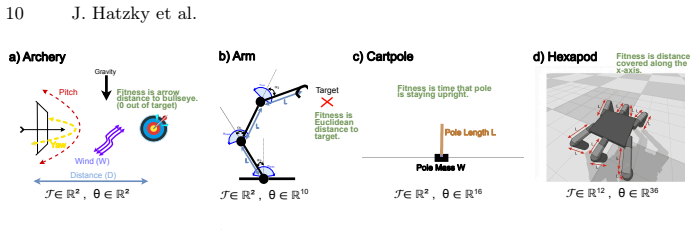
By representing the task space as a graph whose edges connect tasks according to their parameter-space proximity, MONET enables knowledge transfer through neighbor crossover while each task still undergoes independent mutation, producing results that match or exceed those of MAP-Elites-based methods on archery, arm, cartpole, and hexapod domains containing 2,000 to 5,000 tasks.
What carries the argument
The task network graph, whose edges connect tasks in parameter space so that crossover can move solutions between neighboring nodes.
If this is right
- The approach remains tractable for high-dimensional task spaces because it never builds an explicit archive grid.
- Knowledge transfer occurs only between tasks that are close in parameter space, preserving locality.
- Social and individual learning can be interleaved at each generation without requiring global population maintenance.
- The same graph construction works across continuous control and locomotion tasks without domain-specific tuning.
Where Pith is reading between the lines
- If parameter-space proximity fails to predict solution similarity in a new domain, the graph edges would need to be replaced by a learned similarity measure.
- The method could be extended to dynamically add or remove tasks by updating only the local neighborhood rather than rebuilding a global archive.
- Because the graph is explicit, it may support theoretical analysis of information flow rates between tasks that fixed-archive methods do not.
Load-bearing premise
Connecting tasks by their raw parameter-space distance creates useful opportunities for solution transfer via crossover.
What would settle it
Run MONET on one of the four domains after replacing the parameter-space edges with random edges; if performance drops below the MAP-Elites baseline, the topology assumption is falsified.
Figures




read the original abstract
Multi-task optimization is a powerful approach for solving a large number of tasks in parallel. However, existing algorithms face distinct limitations: Population-based methods scale poorly and remain underexplored for large task sets. Approaches that do scale beyond a thousand tasks are mostly MAP-Elites variants and rely on a fixed, discretized archive that disregards the topology of the task space. We introduce MONET (Multi-Task Optimization over Networks of Tasks), a multi-task optimization algorithm that models the task space as a graph: tasks are nodes, and edges connect tasks in the task parameter space. This representation enables knowledge transfer between tasks and remains tractable for high-dimensional problems while exploiting the topology of the task space. MONET combines social learning, which generates candidates from neighboring nodes via crossover, with individual learning, which refines a node's own solution independently via mutation. We evaluate MONET on four domains (archery, arm, and cartpole with 5,000 tasks each; hexapod with 2,000 tasks) and show that it matches or exceeds the performance of existing MAP-Elites-based baselines across all four domains.
Editorial analysis
A structured set of objections, weighed in public.
Referee Report
Summary. The paper introduces MONET, a multi-task optimization algorithm that models the task space as a graph with tasks as nodes and edges connecting tasks in parameter space. This enables knowledge transfer via social learning (crossover with neighboring nodes) combined with individual learning (mutation). The authors evaluate MONET on four domains (archery, arm, and cartpole with 5,000 tasks each; hexapod with 2,000 tasks) and claim it matches or exceeds the performance of existing MAP-Elites-based baselines across all four domains.
Significance. If the empirical claims are substantiated with detailed metrics and controls, this work could advance scalable multi-task optimization by replacing fixed discretized archives with a topology-exploiting graph representation, addressing scalability limits of population-based methods for large task sets in domains like robotics.
major comments (2)
- [Abstract] Abstract: The claim that MONET 'matches or exceeds the performance of existing MAP-Elites-based baselines across all four domains' supplies no quantitative metrics, error bars, statistical tests, or baseline implementation details. This is load-bearing for the central empirical contribution and prevents verification of whether the result holds.
- [Method] Method description: No ablation is reported that replaces parameter-space neighbor selection with random edges (or removes social learning) while holding the dual learning loop fixed. Without this isolation, performance gains cannot be attributed specifically to the task graph topology rather than general social+individual learning.
minor comments (1)
- [Abstract] Abstract: The domain list uses ambiguous shorthand ('arm') and provides no details on how the task parameter space is defined or how edges are constructed in the graph.
Simulated Author's Rebuttal
We thank the referee for their constructive comments, which will help improve the clarity and rigor of our work. We address the major comments point by point below.
read point-by-point responses
-
Referee: [Abstract] Abstract: The claim that MONET 'matches or exceeds the performance of existing MAP-Elites-based baselines across all four domains' supplies no quantitative metrics, error bars, statistical tests, or baseline implementation details. This is load-bearing for the central empirical contribution and prevents verification of whether the result holds.
Authors: We concur that the abstract would benefit from more quantitative backing to support the central claim. In the revised manuscript, we will modify the abstract to incorporate key quantitative metrics from our experiments, including average performance scores with standard deviations, and mention that statistical tests were conducted to compare against baselines. We will also briefly reference the implementation details of the MAP-Elites baselines used in the evaluation. revision: yes
-
Referee: [Method] Method description: No ablation is reported that replaces parameter-space neighbor selection with random edges (or removes social learning) while holding the dual learning loop fixed. Without this isolation, performance gains cannot be attributed specifically to the task graph topology rather than general social+individual learning.
Authors: The referee raises an important point regarding causal attribution. Our primary results compare MONET to established MAP-Elites methods, which lack the graph-based social learning mechanism. To further isolate the role of the task graph, we will include an additional ablation experiment in the revised paper. This will involve running MONET with random edge connections instead of parameter-space neighbors, while maintaining the crossover and mutation operations, to demonstrate that the topology-aware neighbor selection contributes to the observed performance. revision: yes
Circularity Check
No circularity; empirical algorithm evaluation is self-contained
full rationale
The paper defines MONET explicitly as a graph-based multi-task optimizer that connects tasks in parameter space and combines neighbor crossover (social learning) with per-node mutation (individual learning). The headline result is an empirical comparison showing MONET matches or exceeds MAP-Elites baselines on four fixed domains. No equations, uniqueness theorems, or first-principles derivations appear in the provided text; the task-graph topology is an input design choice rather than a quantity predicted from the algorithm itself. No fitted parameters are renamed as predictions, and no load-bearing step reduces to a self-citation chain. The central claim therefore rests on external experimental outcomes rather than internal tautology.
Axiom & Free-Parameter Ledger
axioms (1)
- domain assumption Tasks possess a topology in parameter space that can be represented as a graph with edges between similar tasks.
invented entities (1)
-
MONET algorithm
no independent evidence
Reference graph
Works this paper leans on
-
[1]
Alba, E., Dorronsoro, B.: Cellular Genetic Algorithms, Operations Re- search/Computer Science Interfaces Series, vol. 42. Springer US, Boston, MA (2008).https://doi.org/10.1007/978-0-387-77610-1
-
[2]
Proximal Policy Optimization Algorithms
and Filip Wolski and Prafulla Dhariwal and Alec Radford and Oleg Klimov, J.S.: Proximal policy optimization algorithms. CoRRabs/1707.06347(2017)
work page internal anchor Pith review Pith/arXiv arXiv 2017
-
[3]
In: Proceedings of the Companion Conference on Genetic and Evolutionary Computation
Anne, T., Mouret, J.B.: Multi-task multi-behavior MAP-elites. In: Proceedings of the Companion Conference on Genetic and Evolutionary Computation. pp. 111–
-
[4]
GECCO ’23 Companion, Association for Computing Machinery, New York, NY, USA (2023).https://doi.org/10.1145/3583133.3590730
-
[5]
In: Proceedings of the Ge- netic and Evolutionary Computation Conference
Anne, T., Mouret, J.B.: Parametric-Task MAP-Elites. In: Proceedings of the Ge- netic and Evolutionary Computation Conference. pp. 68–77 (Jul 2024).https: //doi.org/10.1145/3638529.3653993
-
[6]
Anne, T., Mouret, J.B.: Parametric-Task MAP-Elites.https://github.com/ hucebot/Parametric-Task_MAP-Elites(2024)
2024
-
[7]
IEEE Transactions on Cybernetics 51(4), 1784–1796 (2021).https://doi.org/10.1109/TCYB.2020.2981733
Bali, K.K., Gupta, A., Ong, Y.S., Tan, P.S.: Cognizant multitasking in multiob- jective multifactorial evolution: MO-MFEA-II. IEEE Transactions on Cybernetics 51(4), 1784–1796 (2021).https://doi.org/10.1109/TCYB.2020.2981733
-
[8]
IEEE Transactions on Evolu- tionaryComputation24(1),69–83(2020).https://doi.org/10.1109/TEVC.2019
Bali, K.K., Ong, Y.S., Gupta, A., Tan, P.S.: Multifactorial evolutionary algorithm with online transfer parameter estimation: MFEA-II. IEEE Transactions on Evolu- tionaryComputation24(1),69–83(2020).https://doi.org/10.1109/TEVC.2019. 2906927
-
[9]
Barto, A.G., Sutton, R.S., Anderson, C.W.: Neuronlike adaptive elements that can solve difficult learning control problems. IEEE Transactions on Systems, Man, and CyberneticsSMC-13(5), 834–846 (1983).https://doi.org/10.1109/TSMC. 1983.6313077
-
[10]
Bartz-Beielstein, T.: Optimization with spotoptim (2026),https://arxiv.org/ abs/2604.13672
work page internal anchor Pith review Pith/arXiv arXiv 2026
-
[11]
Communications of the ACM18(9), 509–517 (1975).https://doi.org/10.1145/ 361002.361007
Bentley, J.L.: Multidimensional binary search trees used for associative searching. Communications of the ACM18(9), 509–517 (1975).https://doi.org/10.1145/ 361002.361007
-
[12]
Science314(5802), 1118–1121 (2006).https://doi.org/10.1126/ science.1133687
Bongard, J., Zykov, V., Lipson, H.: Resilient machines through continuous self-modeling. Science314(5802), 1118–1121 (2006).https://doi.org/10.1126/ science.1133687
2006
-
[13]
In: Black Box Optimiza- tion, Machine Learning, and No-Free Lunch Theorems, pp
Chatzilygeroudis, K., Cully, A., Vassiliades, V., Mouret, J.B.: Quality-diversity optimization: A novel branch of stochastic optimization. In: Black Box Optimiza- tion, Machine Learning, and No-Free Lunch Theorems, pp. 109–135. Springer Optimization and Its Applications, Springer (2021).https://doi.org/10.1007/ 978-3-030-66515-9_4
2021
-
[14]
Coumans, E., Bai, Y.: PyBullet, a Python module for physics simulation for games, robotics and machine learning.http://pybullet.org(2021)
2021
-
[15]
Robots that can adapt like animals
Cully, A., Clune, J., Tarapore, D., Mouret, J.B.: Robots that can adapt like animals. Nature521(7553), 503–507 (2015).https://doi.org/10.1038/ nature14422,https://doi.org/10.1038/nature14422
-
[16]
Wiley, Chichester, UK (2001)
Deb, K.: Multi-Objective Optimization Using Evolutionary Algorithms. Wiley, Chichester, UK (2001)
2001
-
[17]
Complex Systems9(2), 115–148 (1995) 16 J
Deb, K., Agrawal, R.B.: Simulated binary crossover for continuous search space. Complex Systems9(2), 115–148 (1995) 16 J. Hatzky et al
1995
-
[18]
In: Proceedings of the Mathematics, Toronto
Delaunay, B.: Sur la sphere vide. In: Proceedings of the Mathematics, Toronto. pp. 695–700. Toronto (1928)
1928
-
[19]
Nature Communications15, 6267 (2024).https://doi.org/10.1038/s41467-024-50131-4
van Diggelen, F., Cambier, N., Ferrante, E., Eiben, A.E.: A model-free method to learn multiple skills in parallel on modular robots. Nature Communications15, 6267 (2024).https://doi.org/10.1038/s41467-024-50131-4
-
[20]
SIAM Review41(4), 637–676 (1999).https://doi.org/10.1137/ S0036144599352836
Du, Q., Faber, V., Gunzburger, M.: Centroidal voronoi tessellations: Applications and algorithms. SIAM Review41(4), 637–676 (1999).https://doi.org/10.1137/ S0036144599352836
1999
-
[21]
Dunn, O.J.: Multiple comparisons among means. Journal of the American Sta- tistical Association56(293), 52–64 (1961).https://doi.org/10.1080/01621459. 1961.10482090
-
[22]
Feller, W.: An Introduction to Probability Theory and Its Applications, vol. 1. Wiley, 3 edn. (1968)
1968
-
[23]
Feng, L., Huang, Y., Zhou, L., Zhong, J., Gupta, A., Tang, K., Tan, K.C.: Explicit evolutionary multitasking for combinatorial optimization: A case study on capaci- tatedvehicleroutingproblem.IEEETransactionsonCybernetics51(6),3143–3156 (2021).https://doi.org/10.1109/TCYB.2019.2962865
-
[24]
IEEE Transactions on Evolutionary Computation20(3), 343–357 (2016)
Gupta, A., Ong, Y.S., Feng, L.: Multifactorial evolution: Toward evolutionary mul- titasking. IEEE Transactions on Evolutionary Computation20(3), 343–357 (2016). https://doi.org/10.1109/TEVC.2015.2458037
-
[25]
Gupta, A., Zhou, L., Ong, Y.S., Chen, Z., Hou, Y.: Half a dozen real-world appli- cations of evolutionary multitasking, and more. IEEE Computational Intelligence Magazine17, 49–66 (May 2022).https://doi.org/10.1109/MCI.2022.3155332
-
[26]
Hatzky, J., Bartz-Beielstein, T., Eiben, A.E., Yaman, A.: Repository for MONET: Multi-Task Optimization over Networks of Tasks.https://github.com/ju2ez/ MONET/tree/PPSN-MONET-introduction(2026)
2026
-
[27]
Scandinavian Journal of Statistics6(2), 65–70 (1979)
Holm, S.: A simple sequentially rejective multiple test procedure. Scandinavian Journal of Statistics6(2), 65–70 (1979)
1979
-
[28]
Hou, Y., Yu, Z., Guo, Z., Pei, W., Wu, Y., Ge, H., Xue, B., Zhang, M.: A Group- Based Many-Task Collaborative Optimization Framework for Evolutionary Robots Design. IEEE Transactions on Systems, Man, and Cybernetics: Systems55(5), 3492–3505 (May 2025).https://doi.org/10.1109/TSMC.2025.3541002
-
[29]
In: Proceedings of the 31st International Conference on Machine Learning
Hutter, F., Hoos, H., Leyton-Brown, K.: An efficient approach for assessing hy- perparameter importance. In: Proceedings of the 31st International Conference on Machine Learning. Proceedings of Machine Learning Research, vol. 32, pp. 754–
-
[30]
Huynh Thi Thanh, B., Van Cuong, L., Thang, T.B., Long, N.H.: Ensemble Mul- tifactorial Evolution With Biased Skill-Factor Inheritance for Many-Task Opti- mization. IEEE Transactions on Evolutionary Computation27(6), 1735–1749 (Dec 2023).https://doi.org/10.1109/TEVC.2022.3227120
-
[31]
Liang, J., Qiao, K., Yuan, M., Yu, K., Qu, B., Ge, S., Li, Y., Chen, G.: Evolu- tionary multi-task optimization for parameters extraction of photovoltaic models. Energy Conversion and Management207, 112509 (Mar 2020).https://doi.org/ 10.1016/j.enconman.2020.112509
-
[32]
https://doi.org/10.1109/ACCESS.2020.3018484
Liu, J., Li, P., Wang, G., Zha, Y., Peng, J., Xu, G.: A multitasking electric power dispatch approach with multi-objective multifactorial optimization algo- rithm.IEEEaccess:practicalinnovations,opensolutions8,155902–155911(2020). https://doi.org/10.1109/ACCESS.2020.3018484
-
[33]
In: 2022 IEEE Congress on Evolutionary Computation (CEC)
Liu, P., Guo, Z., Yu, H., Linghu, H., Li, Y., Hou, Y., Ge, H., Zhang, Q.: A pre- liminary study of multi-task map-elites with knowledge transfer for robotic arm Multi-Task Optimization over Networks of Tasks 17 design. In: 2022 IEEE Congress on Evolutionary Computation (CEC). pp. 1–8 (2022).https://doi.org/10.1109/CEC55065.2022.9870374
-
[34]
Andrea Cristina McGlinchey and Peter J
Lundberg, S.M., Erion, G., Chen, H., DeGrave, A., Prutkin, J.M., Nair, B., Katz, R., Himmelfarb, J., Bansal, N., Lee, S.I.: From local explanations to global under- standing with explainable AI for trees. Nature Machine Intelligence2(1), 56–67 (2020).https://doi.org/10.1038/s42256-019-0138-9
-
[35]
In: Advances in Neural Information Processing Systems
Lundberg, S.M., Lee, S.I.: A unified approach to interpreting model predictions. In: Advances in Neural Information Processing Systems. vol. 30 (2017)
2017
-
[36]
The Annals of Mathematical Statistics , author =
Mann, H.B., Whitney, D.R.: On a test of whether one of two random variables is stochastically larger than the other. The Annals of Mathematical Statistics18(1), 50–60 (1947).https://doi.org/10.1214/aoms/1177730491
-
[37]
In: Dale, E., Michie, D
Michie, D., Chambers, R.A.: BOXES: An experiment in adaptive control. In: Dale, E., Michie, D. (eds.) Machine Intelligence 2, pp. 137–152. Oliver and Boyd, Edin- burgh (1968)
1968
-
[38]
Mouret, J.B.: pymap_elites: Python reference implementation of MAP-Elites and Multi-Task MAP-Elites.https://github.com/resibots/pymap_elites
-
[39]
Illuminating search spaces by mapping elites
Mouret, J., Clune, J.: Illuminating search spaces by mapping elites. CoRR abs/1504.04909(2015),http://arxiv.org/abs/1504.04909
work page Pith review arXiv 2015
-
[40]
In: Pro- ceedings of the 2020 Genetic and Evolutionary Computation Conference
Mouret, J.B., Maguire, G.: Quality diversity for multi-task optimization. In: Pro- ceedings of the 2020 Genetic and Evolutionary Computation Conference. pp. 121–129. ACM, Cancún Mexico (Jun 2020).https://doi.org/10.1145/3377930. 3390203
- [41]
-
[42]
European Journal of Operational Research270(3), 1074–1085 (2018)
Pearce, M., Branke, J.: Continuous multi-task bayesian optimisation with cor- relation. European Journal of Operational Research270(3), 1074–1085 (2018). https://doi.org/10.1016/j.ejor.2018.03.017
-
[43]
Science328(5975), 208–213 (2010)
Rendell, L., Boyd, R., Cownden, D., Enquist, M., Eriksson, K., Feldman, M.W., Fogarty, L., Ghirlanda, S., Lillicrap, T., Laland, K.N.: Why copy others? Insights from the social learning strategies tournament. Science328(5975), 208–213 (2010). https://doi.org/10.1126/science.1184719
-
[44]
In: 2016 IEEE Symposium Series on Computa- tional Intelligence (SSCI)
Sagarna, R., Ong, Y.S.: Concurrently searching branches in software tests genera- tion through multitask evolution. In: 2016 IEEE Symposium Series on Computa- tional Intelligence (SSCI). pp. 1–8 (2016).https://doi.org/10.1109/SSCI.2016. 7850040
-
[45]
Expert Systems with Applications201, 117060 (2022).https://doi.org/ 10.1016/j.eswa.2022.117060
Samarakoon, S.M.B.P., Muthugala, M.A.V.J., Elara, M.R.: Metaheuristic based navigation of a reconfigurable robot through narrow spaces with shape changing ability. Expert Systems with Applications201, 117060 (2022).https://doi.org/ 10.1016/j.eswa.2022.117060
-
[46]
doi: 10.1109/JPROC.2015.2494218
Shahriari, B., Swersky, K., Wang, Z., Adams, R.P., de Freitas, N.: Taking the human out of the loop: A review of bayesian optimization. Proceedings of the IEEE104(1), 148–175 (2016).https://doi.org/10.1109/JPROC.2015.2494218
-
[47]
In: Proceedings of the Genetic and Evolutionary Com- putation Conference
Triebold, C., Yaman, A.: Evolving generalist controllers to handle a wide range of morphological variations. In: Proceedings of the Genetic and Evolutionary Com- putation Conference. pp. 1137–1145 (2024)
2024
-
[48]
Vassiliades,V.,Mouret,J.B.:Discoveringtheelitehypervolumebyleveraginginter- species correlation. In: Proceedings of the Genetic and Evolutionary Computation Conference. pp. 149–156. Gecco ’18, Association for Computing Machinery, New York, NY, USA (2018).https://doi.org/10.1145/3205455.3205602 18 J. Hatzky et al
-
[49]
IEEE Transactions on Evolutionary ComputationPP, 1–1 (Aug 2017)
Vassiliades, V., Chatzilygeroudis, K., Mouret, J.B.: Using centroidal voronoi tes- sellations to scale up the multi-dimensional archive of phenotypic elites algo- rithm. IEEE Transactions on Evolutionary ComputationPP, 1–1 (Aug 2017). https://doi.org/10.1109/TEVC.2017.2735550
-
[50]
Neural networks regularization with graph- based local resampling
Wang, C., Liu, J., Wu, K., Wu, Z.: Solving Multitask Optimization Problems With Adaptive Knowledge Transfer via Anomaly Detection. IEEE Transactions on Evo- lutionary Computation26(2), 304–318 (Apr 2022).https://doi.org/10.1109/ TEVC.2021.3068157
-
[51]
PLoS computational biology18(2), e1009882 (2022)
Yaman, A., Bredeche, N., Çaylak, O., Leibo, J.Z., Lee, S.W.: Meta-control of social learning strategies. PLoS computational biology18(2), e1009882 (2022)
2022
-
[52]
Applied Soft Computing101, 106993 (2021)
Yaman, A., Iacca, G.: Distributed embodied evolution over networks. Applied Soft Computing101, 106993 (2021)
2021
-
[53]
IEEE Robotics & Au- tomation Magazine14(1), 43–52 (2007).https://doi.org/10.1109/MRA.2007
Yim, M., Shen, W.M., Salemi, B., Rus, D., Moll, M., Lipson, H., Klavins, E., Chirikjian, G.S.: Modular self-reconfigurable robot systems. IEEE Robotics & Au- tomation Magazine14(1), 43–52 (2007).https://doi.org/10.1109/MRA.2007. 339623
-
[54]
Applied Soft Computing145, 110545 (2023).https://doi.org/10.1016/j.asoc.2023.110545
Zhao, H., Ning, X., Liu, X., Wang, C., Liu, J.: What makes evolutionary multi- task optimization better: A comprehensive survey. Applied Soft Computing145, 110545 (2023).https://doi.org/10.1016/j.asoc.2023.110545
-
[55]
Zhong, J., Feng, L., Cai, W., Ong, Y.S.: Multifactorial genetic programming for symbolic regression problems. IEEE Transactions on Systems, Man, and Cyber- netics: Systems50(11), 4492–4505 (2020).https://doi.org/10.1109/TSMC.2018. 2853719 A Node Coverage Guarantees Under Random Sampling If we draw at each evaluation step a random node and perform an actio...
discussion (0)
Sign in with ORCID, Apple, or X to comment. Anyone can read and Pith papers without signing in.