Recognition: unknown
Electromagnetic Precursors to Binary Neutron Star Mergers: Kinetic Simulations of Magnetospheric Flaring
Pith reviewed 2026-05-09 20:13 UTC · model grok-4.3
The pith
Kinetic simulations of anti-aligned neutron star magnetospheres predict gamma-ray and radio precursor signals from reconnecting current sheets before merger.
A machine-rendered reading of the paper's core claim, the machinery that carries it, and where it could break.
Core claim
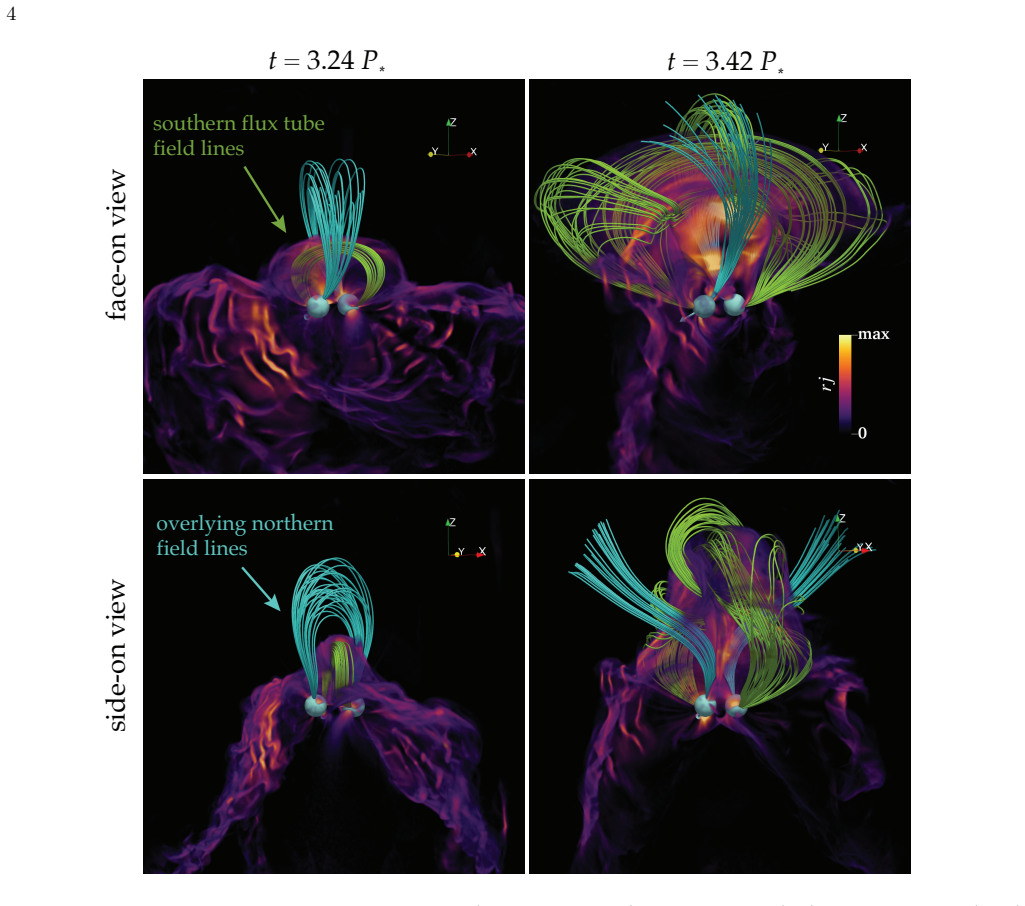
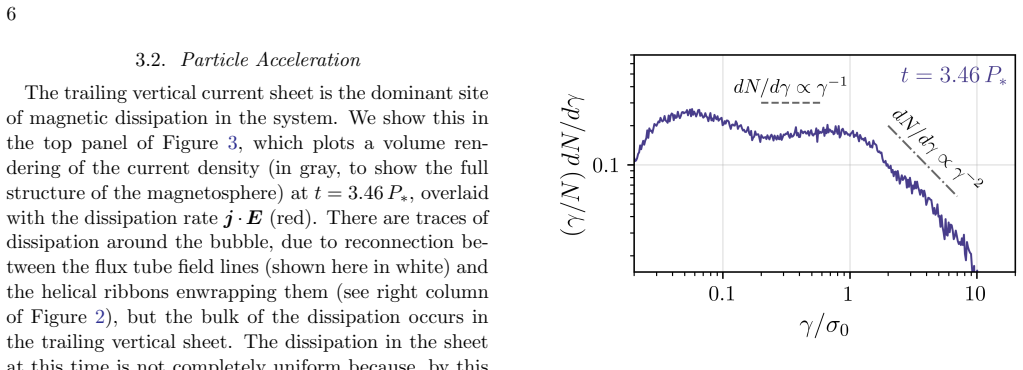
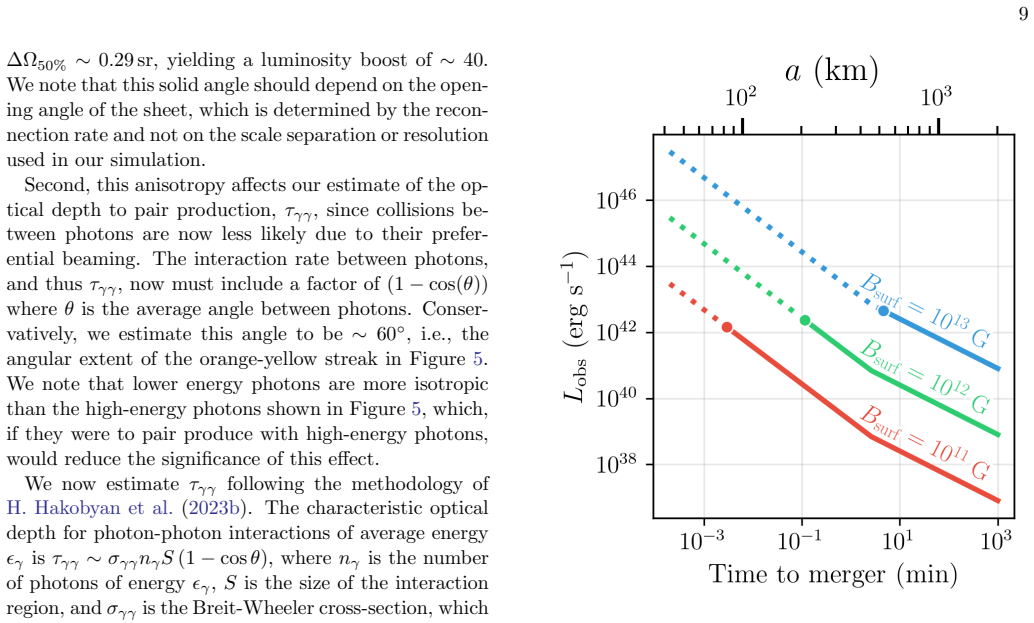
In the final minutes to seconds before merger, the twisting fields between anti-aligned neutron stars form periodically erupting flux tubes trailed by reconnecting current sheets; particle acceleration in the sheets produces nonthermal gamma-ray emission peaking at approximately 16 MeV with observed luminosities above 10^42 erg/s, while plasmoid mergers within the sheets can launch fast-radio-burst-like transients at 10^38-40 erg/s.
What carries the argument
Trailing reconnecting current sheets that form behind expanding magnetic flux tubes during periodic eruptions, dissipating magnetic energy through reconnection and plasmoid formation.
If this is right
- Gamma-ray signals remain observable only while the current sheets stay optically thin to pair production, limiting detection to nearby mergers.
- Fast radio burst-like transients appear in the final seconds before merger and could be caught by wide-field surveys or targeted follow-up of gravitational-wave alerts.
- Both classes of precursors are powered directly by the efficient release of magnetic energy stored in the reconnecting sheets.
- The signals precede the merger by minutes to seconds, providing a potential electromagnetic early warning channel.
Where Pith is reading between the lines
- Detection of these precursors could improve sky localization and timing for multi-messenger follow-up campaigns.
- The same current-sheet mechanism might operate in other compact-object binaries with misaligned fields, widening the range of systems worth monitoring.
- Simulations that vary the degree of misalignment or field strength would test how common such precursors are across the neutron-star population.
Load-bearing premise
The two stars must have anti-aligned magnetic moments so that orbital motion twists their connecting field lines into erupting structures that create the current sheets.
What would settle it
No gamma-ray or radio signals matching the predicted luminosities, energies, or timing would be seen in a nearby binary neutron star merger already localized by gravitational waves.
Figures




read the original abstract
We present the first 3D global kinetic simulations of the interacting magnetospheres of pre-merger binary neutron stars. The stars, whose magnetic moments are anti-aligned, twist the field lines connecting them, leading to periodic eruptions. Each eruption consists of an expanding magnetic flux tube with a reconnecting current sheet trailing behind it, topologically analogous to coronal mass ejections. We predict two novel classes of electromagnetic precursor signals powered by the efficient dissipation of magnetic energy in these periodically forming trailing current sheets. First, particles accelerated in the sheets produce nonthermal gamma-ray signals peaking at $\sim16\,\mathrm{MeV}$, which escape minutes to seconds before merger while the sheets are still optically thin to pair production, with modest characteristic luminosities of $L_\mathrm{obs}\gtrsim 10^{42}\,\mathrm{erg/s}$, detectable only for nearby mergers. Second, merging plasmoids in the sheets could produce fast radio burst-like transients in the final seconds before merger, with characteristic luminosities $L_\mathrm{radio}\sim 10^{38-40}\,\mathrm{erg/s}$. These coherent radio precursors would be detectable by upcoming instruments, either in untargeted surveys by wide-field instruments such as CHORD, or through targeted follow-up of gravitational-wave early-warning alerts with instruments such as DSA or SKA-mid.
Editorial analysis
A structured set of objections, weighed in public.
Referee Report
Summary. The manuscript presents the first 3D global kinetic (PIC) simulations of pre-merger binary neutron star magnetospheres with anti-aligned magnetic moments. The simulations demonstrate periodic magnetic eruptions accompanied by trailing reconnecting current sheets, from which the authors derive predictions for two electromagnetic precursor signals: nonthermal gamma-ray emission peaking at ~16 MeV with observed luminosities ≳10^42 erg/s (minutes to seconds before merger) and coherent fast radio burst-like transients with luminosities ~10^38-40 erg/s in the final seconds before merger.
Significance. If the simulation results are robust, the work is significant for providing the first self-consistent kinetic predictions of observable EM precursors to BNS mergers that could serve as early-warning signals or multi-messenger counterparts to gravitational-wave detections. The global 3D kinetic approach enables direct modeling of reconnection-driven particle acceleration and plasmoid dynamics without ad-hoc assumptions about particle spectra, which is a clear strength. The specific energy peak and luminosity ranges constitute falsifiable predictions that could be tested with instruments such as CHORD, DSA, or SKA-mid.
major comments (3)
- [Methods and results sections describing the current-sheet particle spectra] The quantitative gamma-ray peak energy of ~16 MeV and the associated luminosities are direct outputs of the particle acceleration in the trailing current sheets, but the manuscript provides no resolution study or convergence test demonstrating that the nonthermal particle spectra and energy dissipation rates are numerically converged (e.g., with respect to grid resolution or particle number per cell).
- [Discussion of gamma-ray precursor escape] The escape of the gamma-ray signal requires the current sheets to remain optically thin to pair production, yet no explicit calculation of the pair-production optical depth (using the simulated densities, temperatures, and magnetic field strengths) is presented to support the claim that the sheets satisfy this condition minutes to seconds before merger.
- [Section on radio precursor mechanism] The radio luminosities of 10^38-40 erg/s are attributed to merging plasmoids, but the manuscript does not quantify the fraction of dissipated magnetic energy converted into coherent radio emission or demonstrate that the simulated plasmoid sizes and velocities satisfy the coherence conditions required for FRB-like emission.
minor comments (2)
- [Abstract] The abstract states the magnetic moments are anti-aligned but does not specify the exact value of the magnetic moment strength or the initial binary separation used in the simulations; these parameters should be stated explicitly for reproducibility.
- [Figure captions] Figure captions for the simulation snapshots should include the simulation time in units of the orbital period and the spatial scale in neutron-star radii to allow direct comparison with the reported precursor timescales.
Simulated Author's Rebuttal
We thank the referee for their constructive and positive review of our manuscript. We address each major comment point by point below and have revised the manuscript to incorporate additional analyses where feasible.
read point-by-point responses
-
Referee: The quantitative gamma-ray peak energy of ~16 MeV and the associated luminosities are direct outputs of the particle acceleration in the trailing current sheets, but the manuscript provides no resolution study or convergence test demonstrating that the nonthermal particle spectra and energy dissipation rates are numerically converged (e.g., with respect to grid resolution or particle number per cell).
Authors: We agree that demonstrating numerical convergence is important for the robustness of the reported spectra. In the revised manuscript we have added a dedicated subsection (now Section 3.3) with resolution and particle-number convergence tests. These show that the nonthermal power-law index, the ~16 MeV spectral peak, and the magnetic-energy dissipation rate remain stable once the grid resolution exceeds 8 cells per skin depth and 50 particles per cell, consistent with the production-run parameters. revision: yes
-
Referee: The escape of the gamma-ray signal requires the current sheets to remain optically thin to pair production, yet no explicit calculation of the pair-production optical depth (using the simulated densities, temperatures, and magnetic field strengths) is presented to support the claim that the sheets satisfy this condition minutes to seconds before merger.
Authors: We have now performed the requested optical-depth calculation and included it as a new paragraph in Section 4.1. Using the time-dependent densities, temperatures, and magnetic-field strengths extracted directly from the current-sheet regions in the simulations, we find that the pair-production optical depth remains ≪ 1 for all times more than ~10 s before merger and rises only to ~0.3 in the final few seconds. This supports our statement that the gamma-ray signal can escape while the sheets are still optically thin. revision: yes
-
Referee: The radio luminosities of 10^38-40 erg/s are attributed to merging plasmoids, but the manuscript does not quantify the fraction of dissipated magnetic energy converted into coherent radio emission or demonstrate that the simulated plasmoid sizes and velocities satisfy the coherence conditions required for FRB-like emission.
Authors: We acknowledge that a quantitative conversion efficiency for coherent radio emission cannot be obtained directly from the PIC runs. In the revised discussion (Section 4.2) we now report the plasmoid sizes (~10^4–10^5 cm) and velocities (~0.1–0.3 c) measured in the simulations and compare them to the curvature-radiation coherence length and brightness-temperature requirements for FRB-like emission. We also cite literature values for the fraction of dissipated energy that can be radiated coherently in similar reconnection events (0.01–1 %) to arrive at the quoted luminosity range. A full radiative-transfer treatment of coherence lies beyond the present kinetic model and is flagged as future work. revision: partial
Circularity Check
No significant circularity; results emerge from direct kinetic simulations
full rationale
The paper's headline predictions for gamma-ray and radio precursors are outputs of 3D global kinetic PIC simulations of anti-aligned neutron-star magnetospheres that form periodic trailing current sheets. Particle acceleration, reconnection, plasmoid merging, and energy dissipation are computed numerically from the chosen initial conditions (anti-aligned moments, orbital separation, etc.); no analytic derivation chain reduces these luminosities or spectra to fitted parameters, self-citations, or renamed inputs. The optical-thinness assumption for escape is stated explicitly as a precondition for observability rather than a derived result. Absent any load-bearing step that equates a prediction to its own input by construction, the derivation remains self-contained.
Axiom & Free-Parameter Ledger
free parameters (1)
- neutron star magnetic moment strength and orientation
axioms (2)
- domain assumption Magnetic moments of the two stars are anti-aligned
- domain assumption Current sheets formed by reconnection remain optically thin to pair production during the pre-merger phase
Reference graph
Works this paper leans on
-
[1]
2017, PhRvL, 119, 161101, doi: 10.1103/PhysRevLett.119.161101
Abbott, B. P., Abbott, R., Abbott, T. D., et al. 2017a, PhRvL, 119, 161101, doi: 10.1103/PhysRevLett.119.161101
-
[2]
ApJ848(2), 13 (2017) https://doi.org/10.3847/2041-8213/aa920c arXiv:1710.05834 [astro-ph.HE]
Abbott, B. P., Abbott, R., Abbott, T. D., et al. 2017b, ApJL, 848, L13, doi: 10.3847/2041-8213/aa920c 13
-
[3]
Living Reviews in Relativity , keywords =
Abbott, B. P., Abbott, R., Abbott, T. D., et al. 2020, Living Reviews in Relativity, 23, 3, doi: 10.1007/s41114-020-00026-9
-
[4]
Beloborodov, A. M. 2021a, ApJ, 921, 92, doi: 10.3847/1538-4357/ac17e7
-
[5]
Beloborodov, A. M. 2021b, ApJL, 922, L7, doi: 10.3847/2041-8213/ac2fa0
-
[6]
Beloborodov, A. M. 2022, PhRvL, 128, 255003, doi: 10.1103/PhysRevLett.128.255003
-
[7]
Beloborodov, A. M. 2023, ApJ, 959, 34, doi: 10.3847/1538-4357/acf659
-
[8]
Bernardi, D., Yuan, Y., & Chen, A. Y. 2025, PhRvL, 135, 265201, doi: 10.1103/y9p7-1zms
-
[9]
Braun, R., Bonaldi, A., Bourke, T., Keane, E., & Wagg, J. 2019, arXiv e-prints, arXiv:1912.12699, doi: 10.48550/arXiv.1912.12699
-
[10]
Cerutti, B., Philippov, A. A., & Spitkovsky, A. 2016, MNRAS, 457, 2401, doi: 10.1093/mnras/stw124
-
[11]
Cerutti, B., Werner, G. R., Uzdensky, D. A., & Begelman, M. C. 2012, ApJL, 754, L33, doi: 10.1088/2041-8205/754/2/L33
-
[12]
Chen, A. Y., & Beloborodov, A. M. 2014, ApJL, 795, L22, doi: 10.1088/2041-8205/795/1/L22
-
[13]
2019, Physical Review X, 9, 031028, doi: 10.1103/PhysRevX.9.031028
Chen, H.-Y., Vitale, S., & Narayan, R. 2019, Physical Review X, 9, 031028, doi: 10.1103/PhysRevX.9.031028
-
[14]
Chen, P. F. 2011, Living Reviews in Solar Physics, 8, 1, doi: 10.12942/lrsp-2011-1
-
[15]
Cherkis, S. A., & Lyutikov, M. 2021, ApJ, 923, 13, doi: 10.3847/1538-4357/ac29b8
-
[16]
2023, ApJ, 959, 122, doi: 10.3847/1538-4357/acffc6
Chernoglazov, A., Hakobyan, H., & Philippov, A. 2023, ApJ, 959, 122, doi: 10.3847/1538-4357/acffc6
-
[17]
Science358, 1556 (2017) https://doi.org/10.1126/science.aap9811 arXiv:1710.05452 [astro- ph.HE]
Coulter, D. A., Foley, R. J., Kilpatrick, C. D., et al. 2017, Science, 358, 1556, doi: 10.1126/science.aap9811
-
[18]
2019, A&A, 622, A161, doi: 10.1051/0004-6361/201834610
Crinquand, B., Cerutti, B., & Dubus, G. 2019, A&A, 622, A161, doi: 10.1051/0004-6361/201834610
-
[19]
2023, ApJ, 957, 102, doi: 10.3847/1538-4357/acfa78
Golbraikh, E., & Lyubarsky, Y. 2023, ApJ, 957, 102, doi: 10.3847/1538-4357/acfa78
-
[20]
Goldreich, P., & Julian, W. H. 1969, ApJ, 157, 869, doi: 10.1086/150119
-
[21]
Gould, R. J., & Schr´ eder, G. P. 1967, Physical Review, 155, 1404, doi: 10.1103/PhysRev.155.1404
-
[22]
2023a, The Astrophysical Journal, 943, 105, doi: 10.3847/1538-4357/acab05
Hakobyan, H., Philippov, A., & Spitkovsky, A. 2023a, ApJ, 943, 105, doi: 10.3847/1538-4357/acab05
-
[23]
Hakobyan, H., Ripperda, B., & Philippov, A. A. 2023b, ApJL, 943, L29, doi: 10.3847/2041-8213/acb264
-
[24]
2023c, PrincetonUniversity/tristan-mp-v2: v2.6, Zenodo, doi: 10.5281/zenodo.7566725
Hakobyan, H., Spitkovsky, A., Chernoglazov, A., et al. 2024, in Zenodo, Vol. 75 (Zenodo), 7566725, doi: 10.5281/zenodo.7566725
-
[25]
The DSA-2000 -- A Radio Survey Camera
Hallinan, G., Ravi, V., Weinreb, S., et al. 2019, in Bulletin of the American Astronomical Society, Vol. 51, 255, doi: 10.48550/arXiv.1907.07648
work page internal anchor Pith review Pith/arXiv arXiv doi:10.48550/arxiv.1907.07648 2019
-
[26]
Hansen, B. M. S., & Lyutikov, M. 2001, MNRAS, 322, 695, doi: 10.1046/j.1365-8711.2001.04103.x
-
[27]
Hotan, A. W., Bunton, J. D., Chippendale, A. P., et al. 2021, PASA, 38, e009, doi: 10.1017/pasa.2021.1
-
[28]
Kaspi, V. M., & Beloborodov, A. M. 2017, ARA&A, 55, 261, doi: 10.1146/annurev-astro-081915-023329
-
[29]
2012, ApJL, 757, L3, doi: 10.1088/2041-8205/757/1/L3 Lemaˆ ıtre, G
Lai, D. 2012, ApJL, 757, L3, doi: 10.1088/2041-8205/757/1/L3
-
[30]
2015, PhRvL, 114, 095002, doi: 10.1103/PhysRevLett.114.095002
Liu, Y.-H., Guo, F., Daughton, W., Li, H., & Hesse, M. 2015, PhRvL, 114, 095002, doi: 10.1103/PhysRevLett.114.095002
-
[31]
2019, MNRAS, 483, 1731, doi: 10.1093/mnras/sty3233
Lyubarsky, Y. 2019, MNRAS, 483, 1731, doi: 10.1093/mnras/sty3233
-
[32]
2020, ApJ, 897, 1, doi: 10.3847/1538-4357/ab97b5
Lyubarsky, Y. 2020, ApJ, 897, 1, doi: 10.3847/1538-4357/ab97b5
-
[33]
2019, MNRAS, 483, 2766, doi: 10.1093/mnras/sty3303
Lyutikov, M. 2019, MNRAS, 483, 2766, doi: 10.1093/mnras/sty3303
-
[34]
2023, PhRvE, 107, 025205, doi: 10.1103/PhysRevE.107.025205
Lyutikov, M. 2023, PhRvE, 107, 025205, doi: 10.1103/PhysRevE.107.025205
-
[35]
2024, MNRAS, 529, 2180, doi: 10.1093/mnras/stae591
Lyutikov, M. 2024, MNRAS, 529, 2180, doi: 10.1093/mnras/stae591
-
[36]
2022, ApJ, 935, 139, doi: 10.3847/1538-4357/ac7f33
Magee, R., & Borhanian, S. 2022, ApJ, 935, 139, doi: 10.3847/1538-4357/ac7f33
-
[37]
Mahlmann, J. F., & Beloborodov, A. M. 2025, ApJL, 981, L17, doi: 10.3847/2041-8213/adb5fd
-
[38]
2022, ApJL, 932, L20, doi: 10.3847/2041-8213/ac7156
Spitkovsky, A., & Hakobyan, H. 2022, ApJL, 932, L20, doi: 10.3847/2041-8213/ac7156
-
[39]
Meegan, C., Lichti, G., Bhat, P. N., et al. 2009, ApJ, 702, 791, doi: 10.1088/0004-637X/702/1/791
-
[40]
Metzger, B. D., Margalit, B., & Sironi, L. 2019, MNRAS, 485, 4091, doi: 10.1093/mnras/stz700
-
[41]
Metzger, B. D., & Zivancev, C. 2016, MNRAS, 461, 4435, doi: 10.1093/mnras/stw1800
-
[42]
J., De Los Santos, R., Hernandez, R., et al
Morsony, B. J., De Los Santos, R., Hernandez, R., et al. 2024, MNRAS, 533, 510, doi: 10.1093/mnras/stae1638
-
[43]
Most, E. R., & Philippov, A. A. 2020, ApJL, 893, L6, doi: 10.3847/2041-8213/ab8196
-
[44]
Most, E. R., & Philippov, A. A. 2022, MNRAS, 515, 2710, doi: 10.1093/mnras/stac1909
-
[45]
Most, E. R., & Philippov, A. A. 2023, PhRvL, 130, 245201, doi: 10.1103/PhysRevLett.130.245201
-
[46]
2011, International Journal of Modern Physics D, 20, 989, doi: 10.1142/S0218271811019335
Nan, R., Li, D., Jin, C., et al. 2011, International Journal of Modern Physics D, 20, 989, doi: 10.1142/S0218271811019335
-
[47]
Palenzuela, C., Lehner, L., Liebling, S. L., et al. 2013a, PhRvD, 88, 043011, doi: 10.1103/PhysRevD.88.043011 14
-
[48]
2013, PhRvL, 111, 061105, doi: 10.1103/PhysRevLett.111.061105
Palenzuela, C., Lehner, L., Ponce, M., et al. 2013b, PhRvL, 111, 061105, doi: 10.1103/PhysRevLett.111.061105
-
[49]
2022, ARA&A, 60, 495, doi: 10.1146/annurev-astro-052920-112338
Philippov, A., & Kramer, M. 2022, ARA&A, 60, 495, doi: 10.1146/annurev-astro-052920-112338
-
[50]
A., Spitkovsky, A., & Cerutti, B
Philippov, A., Uzdensky, D. A., Spitkovsky, A., & Cerutti, B. 2019, ApJL, 876, L6, doi: 10.3847/2041-8213/ab1590
-
[51]
A., Spitkovsky, A., & Cerutti, B
Philippov, A. A., Spitkovsky, A., & Cerutti, B. 2015, ApJL, 801, L19, doi: 10.1088/2041-8205/801/1/L19
-
[52]
2017, Nature, 551, 67, doi: 10.1038/nature24298
Pian, E., D’Avanzo, P., Benetti, S., et al. 2017, Nature, 551, 67, doi: 10.1038/nature24298
-
[53]
2022, Monthly Notices of the Royal Astronomical Society, 515, 2020, doi: 10.1093/mnras/stac1910
Qu, Y., Kumar, P., & Zhang, B. 2022, MNRAS, 515, 2020, doi: 10.1093/mnras/stac1910
-
[54]
Sachdev, S., Magee, R., Hanna, C., et al. 2020, ApJL, 905, L25, doi: 10.3847/2041-8213/abc753
-
[55]
Sharma, P., Turyshev, S. G., Barkov, M. V., & Lyutikov, M. 2026, arXiv e-prints, arXiv:2602.14300, doi: 10.48550/arXiv.2602.14300
-
[56]
2014, ApJL, 783, L21, doi: 10.1088/2041-8205/783/1/L21
Sironi, L., & Spitkovsky, A. 2014, ApJL, 783, L21, doi: 10.1088/2041-8205/783/1/L21
-
[57]
2025, ApJ, 994, 131, doi: 10.3847/1538-4357/adfbee
Skiathas, D., Kalapotharakos, C., Wadiasingh, Z., et al. 2025, ApJ, 994, 131, doi: 10.3847/1538-4357/adfbee
-
[58]
2024, A&A, 690, A332, doi: 10.1051/0004-6361/202451725
Sobacchi, E., Iwamoto, M., Sironi, L., & Piran, T. 2024, A&A, 690, A332, doi: 10.1051/0004-6361/202451725
-
[59]
2006, ApJ, 648, L51, doi: 10.1086/507518
Spitkovsky, A. 2006, ApJL, 648, L51, doi: 10.1086/507518
-
[60]
GWTC-4.0: Population Properties of Merging Compact Binaries
Giannios, D. 2021, MNRAS, 501, 3184, doi: 10.1093/mnras/staa3794 The LIGO Scientific Collaboration, the Virgo Collaboration, the KAGRA Collaboration, et al. 2025, arXiv e-prints, arXiv:2508.18083, doi: 10.48550/arXiv.2508.18083
work page internal anchor Pith review Pith/arXiv arXiv doi:10.1093/mnras/staa3794 2021
-
[61]
A., Cerutti, B., & Begelman, M
Uzdensky, D. A., Cerutti, B., & Begelman, M. C. 2011, ApJL, 737, L40, doi: 10.1088/2041-8205/737/2/L40
-
[62]
2019, in Canadian Long Range Plan for Astronomy and Astrophysics White Papers, Vol
Vanderlinde, K., Liu, A., Gaensler, B., et al. 2019, in Canadian Long Range Plan for Astronomy and Astrophysics White Papers, Vol. 2020, 28, doi: 10.5281/zenodo.3765414
-
[63]
Wright, A. N., & Berger, M. A. 1989, J. Geophys. Res., 94, 1295, doi: 10.1029/JA094iA02p01295
-
[64]
2020b, The Astrophysical Journal Letters, 890, L24, doi: 10.3847/2041-8213/ab7244
Zhang, B. 2020, ApJL, 890, L24, doi: 10.3847/2041-8213/ab7244
-
[65]
2021, ApJ, 922, 261, doi: 10.3847/1538-4357/ac2e08
Zhang, H., Sironi, L., & Giannios, D. 2021, ApJ, 922, 261, doi: 10.3847/1538-4357/ac2e08
-
[66]
Zhong, Y., Spitkovsky, A., Mahlmann, J. F., & Hakobyan, H. 2024, ApJ, 973, 147, doi: 10.3847/1538-4357/ad6840
discussion (0)
Sign in with ORCID, Apple, or X to comment. Anyone can read and Pith papers without signing in.