Recognition: unknown
Non-Floquet oscillations of a parametrically driven rigid planar pendulum
Pith reviewed 2026-05-08 08:48 UTC · model grok-4.3
The pith
A driven pendulum exhibits long-period nonlinear oscillations even where Floquet analysis predicts a stable stationary state.
A machine-rendered reading of the paper's core claim, the machinery that carries it, and where it could break.
Core claim
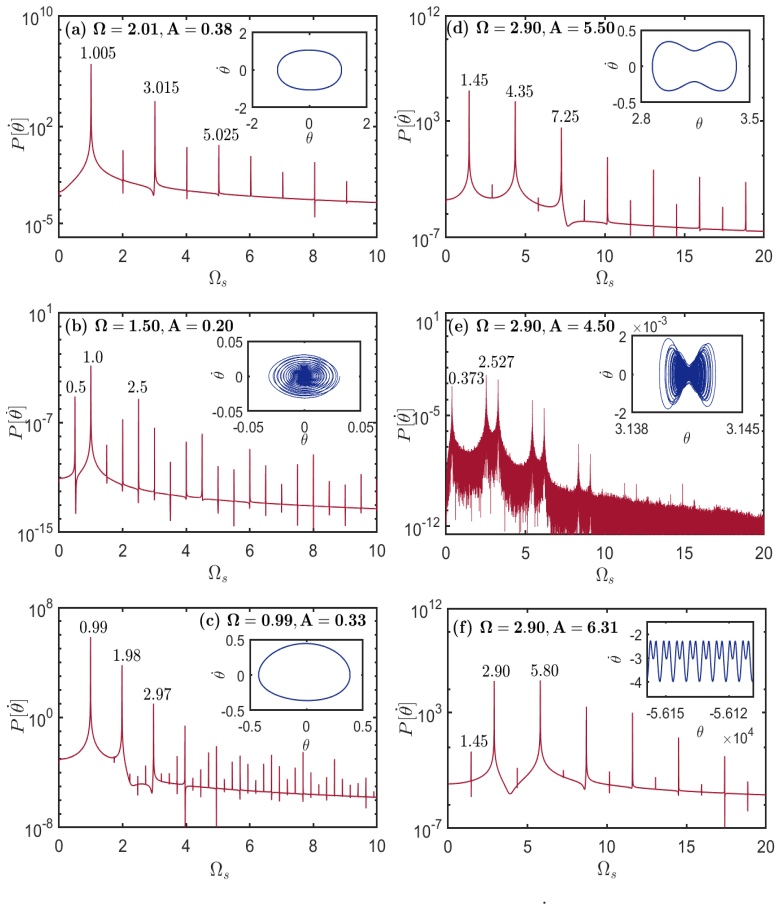
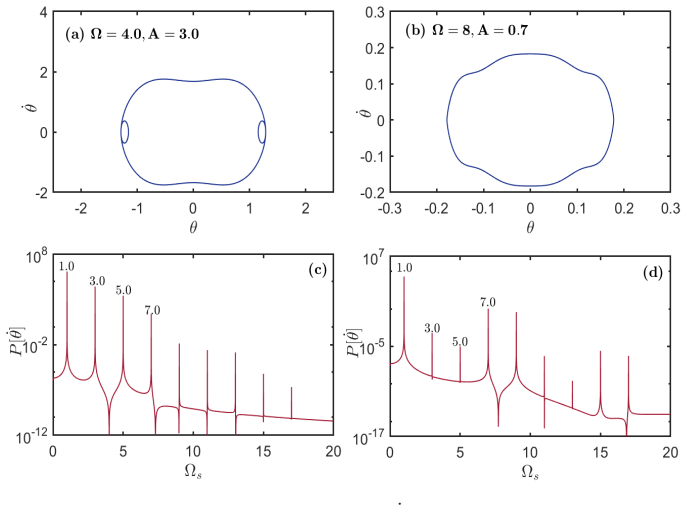
Non-Floquet oscillations occur at driving parameters where Floquet analysis predicts stability. These oscillations always possess periods longer than twice the driving period, taking values of four, six, eight, or twelve times that period. The power spectrum of the pendulum angular velocity during these motions shows two dominant response frequencies whose sum equals the driving frequency.
What carries the argument
Non-Floquet oscillations, long-period periodic states located numerically inside Floquet-stable regions and distinguished by their frequency-sum property in the power spectrum.
If this is right
- Floquet stability charts for the pendulum must be supplemented by nonlinear searches to locate these additional attractors.
- The two-frequency sum equaling the drive frequency provides a clear spectral signature for detecting the oscillations.
- Similar long-period states may exist in other parametrically driven oscillators once nonlinear analysis is applied inside linear stability zones.
- Experimental protocols for driven pendulums should scan driving parameters with long observation windows to capture these slow oscillations.
Where Pith is reading between the lines
- Linear Floquet theory is incomplete for fully mapping the attractors of nonlinear parametric systems.
- The frequency-sum rule may arise from a hidden resonance condition that couples the drive to two subharmonics.
- Control or stabilization schemes relying solely on Floquet multipliers could overlook these hidden long-period states.
Load-bearing premise
The long-period states seen in simulations are true attractors of the continuous equations rather than numerical artifacts or transients tied to specific initial conditions and tolerances.
What would settle it
High-precision numerical integration or an experiment that starts from many nearby initial conditions and never sustains any of the predicted four-, six-, eight-, or twelve-period motions would falsify the claim.
Figures



read the original abstract
The linear and nonlinear motions of a damped rigid planar pendulum, driven by vibrating its pivot sinusoidally, are reexamined. The pendulum is known to exhibit periodic, quasiperiodic, and chaotic motions. Floquet analysis identifies regions of instability and stability within the driving parameter space. A new type of nonlinear oscillation may occur at driving parameters where Floquet analysis predicts a stable stationary state. Such non-Floquet oscillations always have periods longer than twice the period of the vibrating pivot. The possible periods of these oscillations may be four, six, eight, or twelve times the driving period. The power spectrum of the pendulum's angular velocity during these oscillations reveals a novel feature: the two dominant response frequencies sum to the driving frequency.
Editorial analysis
A structured set of objections, weighed in public.
Referee Report
Summary. The manuscript reexamines the dynamics of a damped rigid planar pendulum whose pivot is driven sinusoidally. Floquet theory is used to map stability regions of the downward equilibrium in the driving-parameter plane. The central claim is that, inside regions where Floquet analysis predicts stability of the stationary state, direct numerical integration reveals additional stable periodic attractors whose periods are 4T, 6T, 8T or 12T (T = driving period). These “non-Floquet” oscillations are characterized by a power spectrum of angular velocity in which the two dominant response frequencies sum exactly to the driving frequency.
Significance. If the reported long-period states are genuine attractors of the continuous-time ODE, the result would constitute a non-trivial extension of parametric resonance theory, showing that stable subharmonic responses can coexist with a linearly stable fixed point. The specific period multiples and the frequency-sum spectral feature are falsifiable predictions that could stimulate further analytic or experimental work on driven nonlinear oscillators.
major comments (2)
- [§4] §4 (Numerical results): the long-period orbits are obtained by direct integration, yet the text contains no step-size halving, tolerance-tightening, or cross-integrator validation. Without these checks the reported periods 4T–12T could arise from accumulated phase errors or undamped transients, especially near the Floquet stability boundaries; this directly undermines the claim that the states are genuine attractors of the continuous system.
- [§3 and §4] §3 (Floquet analysis) and §4: the parameter values at which the non-Floquet states are observed must be shown explicitly to lie inside the Floquet-stable region of the downward equilibrium. The manuscript should include a figure or table overlaying the numerically located attractors on the Floquet stability diagram to exclude the possibility that the integrations are inadvertently sampling unstable tongues.
minor comments (2)
- [Abstract] The abstract states that the periods “may be” 4T, 6T, 8T or 12T; the main text should clarify whether these are exhaustive or merely the ones found in the explored parameter window.
- [Throughout] Notation for the driving frequency and period is used inconsistently between the Floquet section and the spectral analysis; a single consistent symbol set would improve readability.
Simulated Author's Rebuttal
We thank the referee for the careful reading of our manuscript and the constructive comments, which help improve the clarity and rigor of the numerical evidence. We address each major comment below and will revise the manuscript accordingly.
read point-by-point responses
-
Referee: [§4] §4 (Numerical results): the long-period orbits are obtained by direct integration, yet the text contains no step-size halving, tolerance-tightening, or cross-integrator validation. Without these checks the reported periods 4T–12T could arise from accumulated phase errors or undamped transients, especially near the Floquet stability boundaries; this directly undermines the claim that the states are genuine attractors of the continuous system.
Authors: We agree that explicit numerical validation is required to rule out artifacts. In the revised manuscript we will add a dedicated paragraph in §4 describing the following checks performed on the reported attractors: (i) repeated integrations with halved step sizes (down to 10^{-5} of the drive period), (ii) tightened absolute and relative tolerances (10^{-10} and 10^{-8}), and (iii) cross-validation with two independent integrators (classical fourth-order Runge-Kutta and adaptive Dormand-Prince). In all cases the periods remain exactly 4T, 6T, 8T or 12T with no secular drift after transients decay, confirming that the states are genuine attractors of the continuous ODE. revision: yes
-
Referee: [§3 and §4] §3 (Floquet analysis) and §4: the parameter values at which the non-Floquet states are observed must be shown explicitly to lie inside the Floquet-stable region of the downward equilibrium. The manuscript should include a figure or table overlaying the numerically located attractors on the Floquet stability diagram to exclude the possibility that the integrations are inadvertently sampling unstable tongues.
Authors: We accept that an explicit overlay is needed for unambiguous demonstration. The revised manuscript will include a new figure (or an augmented version of the existing Floquet diagram) that superimposes the specific parameter points (driving amplitude and frequency) at which the 4T–12T attractors were found onto the stability chart. All such points lie strictly inside the stable region of the downward equilibrium, well away from the instability tongues. A supplementary table will also list the exact parameter values together with the observed periods. revision: yes
Circularity Check
No circularity; claims rest on direct numerical observation of the ODE, independent of input definitions or self-citations.
full rationale
The paper identifies non-Floquet long-period oscillations (periods 4T, 6T, 8T, 12T) and the frequency-sum property via numerical integration of the damped parametrically driven pendulum in regions where standard Floquet analysis of the linearized equation predicts stability of the downward state. No load-bearing step fits a parameter to data and then renames a related output as a 'prediction,' defines a quantity in terms of itself, or relies on a self-citation chain that reduces the central result to an unverified premise. The reported periods and spectral features are presented as emergent simulation outputs rather than quantities forced by construction from the inputs.
Axiom & Free-Parameter Ledger
free parameters (2)
- damping coefficient
- driving amplitude and frequency
axioms (2)
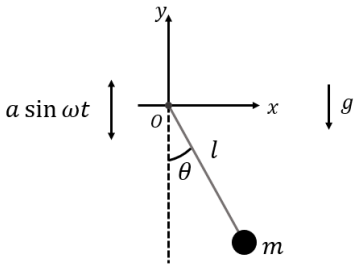
- domain assumption The pendulum is a rigid body whose motion is governed by the classical torque equation with linear damping and sinusoidal pivot acceleration.
- standard math Floquet theory correctly identifies linear stability boundaries of the trivial solution.
Reference graph
Works this paper leans on
-
[1]
Christiaan Huygens, book on the pendulum cl ock (1673),
J.G. Yoder, “Christiaan Huygens, book on the pendulum cl ock (1673)," Landmark Writings in Western Mathematics 1640-1940; Editors: I. Grattan-Guinness, R. Cooke, L. Corry, P. Crépel, and N. Guic ciardini, Elsevier Science, 33-45 (2005)
1940
-
[2]
On induced stability,
A. Stephenson, “On induced stability," Phil. Mag. and J. Sc. 15, 233-236 (1908)
1908
-
[3]
On induced stability
A. Stephenson, “On induced stability", Phil. Mag. and J. Sc. 17, 756-766 (1909)
1909
-
[4]
Period-doubling bifurcations and ch aotic motion for a parametrically forced pendulum,
J.B. McLaughlin, “Period-doubling bifurcations and ch aotic motion for a parametrically forced pendulum," J. Stat. Phys., 24, 375-388 (1981). 15
1981
-
[5]
Control of a parametrically dri ven pendulum,
J. Starrett and R. Tagg, “Control of a parametrically dri ven pendulum," Phys. Rev. Lett. 74, 1974-1977 (1995)
1974
-
[6]
The rigid pendulum – an antique but evergr een physical model,
E.I. Butikov, “The rigid pendulum – an antique but evergr een physical model," Eur. J. Phys. 20, 429–441 (1999)
1999
-
[7]
Floquet’s the orem and ma- trices for parametric oscillators: Theory and demonstrati ons,
N. Fameli, F.L. Curzon, and S. Mikoshiba, “Floquet’s the orem and ma- trices for parametric oscillators: Theory and demonstrati ons," Am. J. Phys 67, 127 (1999)
1999
-
[8]
On the d ynamics of a vertically driven damped planar pendulum
M.V. Bartuccelli, G. Gentile and K.V. Georgiou, “On the d ynamics of a vertically driven damped planar pendulum", Proc. R. Soc. L ond. A 457, 3007-3022 (2001)
2001
-
[9]
Dynamics of Parametric Excitation,
A. Chamneys, “Dynamics of Parametric Excitation," In: Meyers, R. (eds) Encyclopedia of Complexity and Systems Science, Spri nger, New York, NY. (2009)
2009
-
[10]
The Dynamics of a Parametrically Dri ven Damped Pendulum
A. Das and K. Kumar “The Dynamics of a Parametrically Dri ven Damped Pendulum", Int. J. App. Mech. Eng. 20, 257-266 (2015)
2015
-
[11]
Dynamics of a parametrically excited simple pend ulum,
G.I. Depetri, F.A.C. Pereira, B. Marin, M.S. Baptista, and J.C. Sar- torelli, “Dynamics of a parametrically excited simple pend ulum," Chaos 28, 033103 (2018)
2018
-
[12]
A Floquet-Based A nalysis of Parametric Excitation Through the Damping Coefficient,
F. Afzali, G.D. Acar, and B.F. Feeny, "A Floquet-Based A nalysis of Parametric Excitation Through the Damping Coefficient," ASM E J. Vib. Acoust. 143, 041003 (2021)
2021
-
[13]
An analysis of pendulum motion in the presence of quadratic and linear drag,
M.V. Lubarda and V.A. Lubarda, “An analysis of pendulum motion in the presence of quadratic and linear drag," Eur. J. Phys. 42, 055014 (2021)
2021
-
[14]
On the Forms and States assumed by Fluids in contact with vibrating elastic surfaces,
M. Faraday, “On the Forms and States assumed by Fluids in contact with vibrating elastic surfaces," Phil. Trans. R. Soc. Lond. A. 121, 319-340 (1831)
-
[15]
Para- metric instability of a liquid-vapour interface close to th e critical point,
S. Fauve, K. Kumar, C. Laroche, D. Beysens and Y. Garrabo s, “Para- metric instability of a liquid-vapour interface close to th e critical point," Phys. Rev. Lett. 68, 3160-3163 (1992). 16
1992
-
[16]
Parametrically excited qua sicrystalline surface waves,
W.S. Edwards and S. Fauve, “Parametrically excited qua sicrystalline surface waves," Phys. Rev. E 47, 788-791 (1993)
1993
-
[17]
Parametric instability o f the interface between two fluids,
K. Kumar and L.S. Tuckerman, “Parametric instability o f the interface between two fluids," J. Fluid Mech. 279, 49-68 (1994)
1994
-
[18]
Linear theory of Faraday instability in visc ous liquids,
K. Kumar, “Linear theory of Faraday instability in visc ous liquids," Proc. R. Soc. Lond. A 452, 1113-1126 (1996)
1996
-
[19]
Binary-fluid-mixture conv ection with low-frequency modulated heating,
B.L. Smorodin and M. Lücke, “Binary-fluid-mixture conv ection with low-frequency modulated heating," Phys. Rev E 82, 016310 (2010)
2010
-
[20]
Landau and E.M
L.D. Landau and E.M. Lifshitz, Mechanics: Course on Theoretical Physics. Vol. 1, 3rd edition, Pergamon Press (1960)
1960
-
[21]
Verhulst, Perturbation Theory: Mathematics, Methods and Applica- tions
F. Verhulst, Perturbation Theory: Mathematics, Methods and Applica- tions. Springer, New York (2022)
2022
-
[22]
Motion of a parame trically driven damped coplanar double pendulum,
R. Sarkar, K. Kumar and S.P. Khastgir “Motion of a parame trically driven damped coplanar double pendulum," Phys. Rev. E 108, 024210 (2023)
2023
-
[23]
Pendulum for precision force measurement,
Y. Fujii, “Pendulum for precision force measurement," Rev. Sci. Instrum. 77, 035111 (2006)
2006
-
[24]
Excitat ion of large- amplitude parametric resonance by the mechanical stiffness modulation of a microstructure,
S. Krylov, Y. Gerson, T. Nachmias and U. Keren, “Excitat ion of large- amplitude parametric resonance by the mechanical stiffness modulation of a microstructure," J. Micromech. Microeng. 20, 015041 (2010)
2010
-
[25]
Emergence of the London Millenn ium Bridge instability without synchronisation,
I. Belykh, M. Bocian, A.R. Champneys, K. Daley, R. Jeter , J.H.G. Macdonald, and A. McRobie, “Emergence of the London Millenn ium Bridge instability without synchronisation," Nat. Commun . 12, 7223 (2021)
2021
-
[26]
The pendulum adaptive frequency oscil lator,
X. Li, P. Kallepalli, T. Mollik, M.R.E.U. Shougat, S. Ke nnedy, S. Fra- bitore, E. Perkins, “The pendulum adaptive frequency oscil lator," Mech. Syst. Signal Process. 179 109361 (2022)
2022
-
[27]
Parametric Resonance in Quant um Field The- ory,
J. Berges and J. Serreau “Parametric Resonance in Quant um Field The- ory," Phys. Rev. Lett. 91, 111601, (2003). 17
2003
-
[28]
Parametric Resonanc e of Op- tically Trapped Aerosols,
R.D. Leonardo, G. Ruocco, J. Leach, M.J. Padgett, A.J. W right, J.M. Girkin, D.R. Burnham, and D. McGloin, “Parametric Resonanc e of Op- tically Trapped Aerosols,” Phys. Rev. Lett. 99, 010601 (2007)
2007
-
[29]
Quantum Amp lification by Superradiant Emission of Radiation,
A.A. Svidzinsky, L. Yuan, and M.O. Scully, “Quantum Amp lification by Superradiant Emission of Radiation,” Phys. Rev. X 3, 041001 (2013)
2013
-
[30]
Parametric resonance in t unable su- perconducting cavities,
W. Wustmann and V. Shumeiko, “Parametric resonance in t unable su- perconducting cavities," Phys. Rev. B 87, 184501 (2013)
2013
-
[31]
Sur les équations différentielle s linéaires à coeffi- cients périodiques,
M.G. Floquet(1883), "Sur les équations différentielle s linéaires à coeffi- cients périodiques," Annales Scientifiques de l’École Norm ale Supérieure 12, 47-88 (1883).doi:10.24033/asens.220
-
[32]
Dynamic stability of a pendulum when its point of suspension vibrates,
Kapitza P. L., (1951). “Dynamic stability of a pendulum when its point of suspension vibrates," Soviet Phys. JETP. 21, 588-597 (1951)
1951
-
[33]
Goldstein, Classical Mechanics
H. Goldstein, Classical Mechanics. Addison Wesley (1950)
1950
-
[34]
Mémoire sur Le Mouvement Vibratoire d’une Membrane de forme Elliptique,
E. Mathieu,“Mémoire sur Le Mouvement Vibratoire d’une Membrane de forme Elliptique," Journal de Mathématiques Pures et Appli quées 13, 137-203 (1868)
-
[35]
Chicone, Ordinary Differential Equations with Applications
C. Chicone, Ordinary Differential Equations with Applications. Springer (1999)
1999
-
[36]
Parametric reso nance and Flo- quet multipliers: Part 2- Numerical results for driven doub le pendulum with damping,
R. Sarkar, K. Kumar and S.P. Khastgir, “Parametric reso nance and Flo- quet multipliers: Part 2- Numerical results for driven doub le pendulum with damping," Resonance 30 (12), 1629-1642 (2025). 18
2025
discussion (0)
Sign in with ORCID, Apple, or X to comment. Anyone can read and Pith papers without signing in.