Recognition: unknown
How lonely are the Binary Compact Objects Detected by the LIGO-Virgo-KAGRA Collaboration?
Pith reviewed 2026-05-08 10:23 UTC · model grok-4.3
The pith
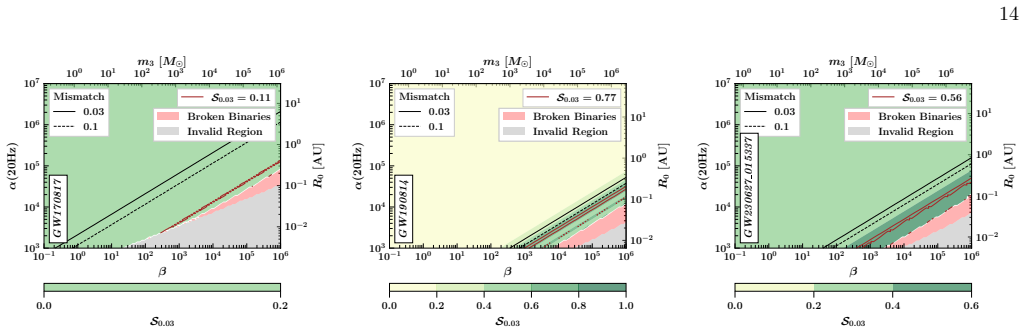
No statistically significant gravitational-wave distortions appear in three high-SNR LIGO-Virgo-KAGRA events, constraining intermediate-mass black holes above 100 solar masses within 0.1 AU of the binaries.
A machine-rendered reading of the paper's core claim, the machinery that carries it, and where it could break.
Core claim
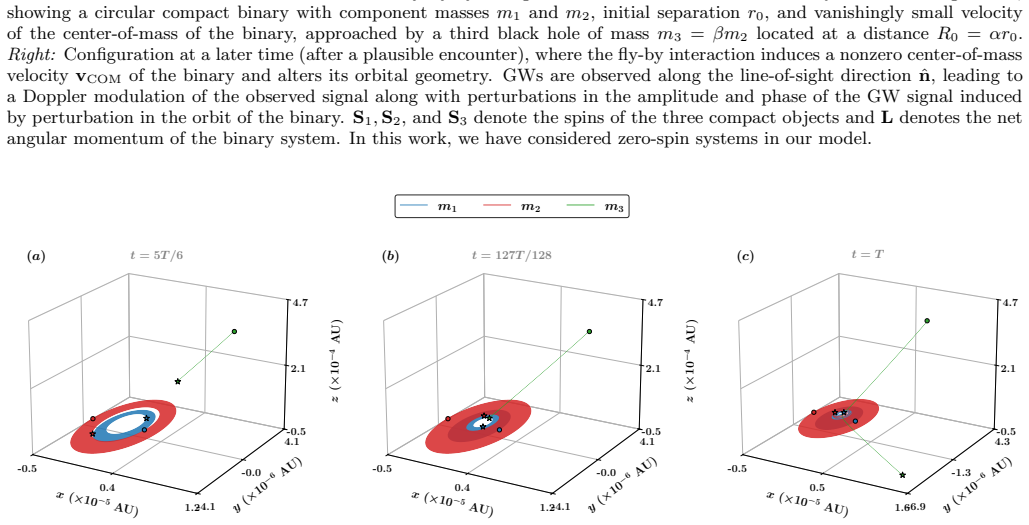
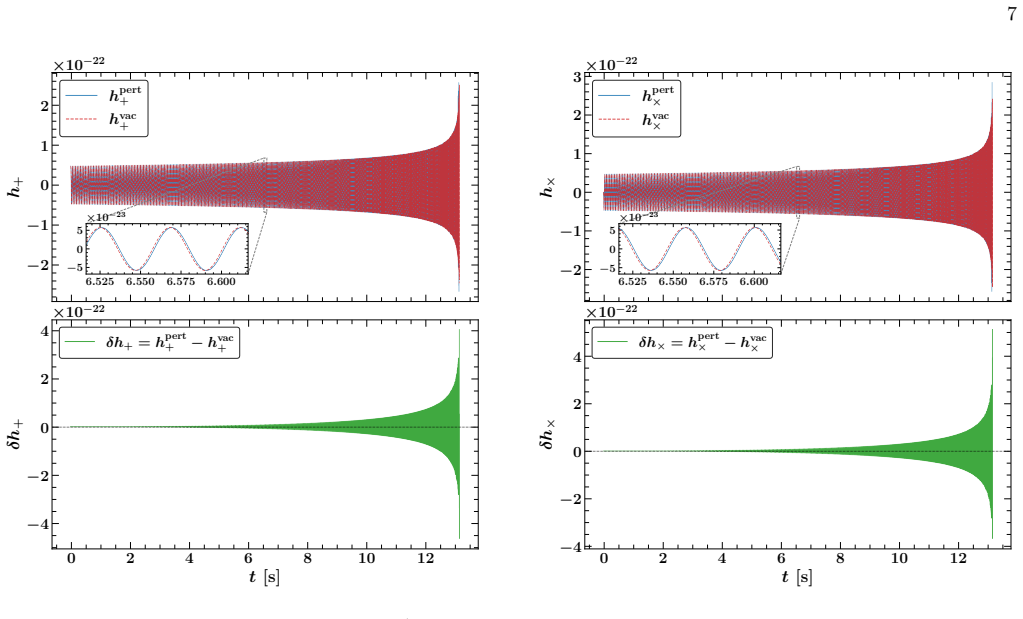
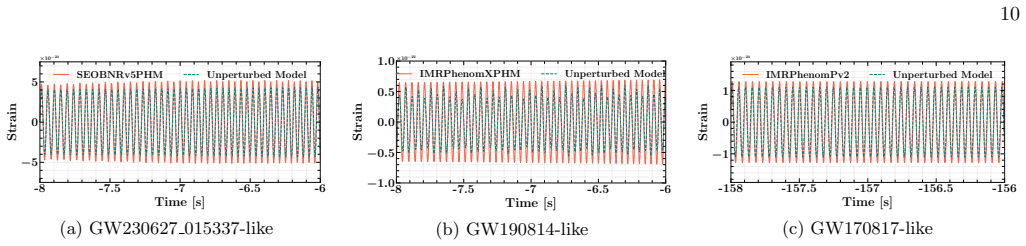
We develop a physically motivated model for such interactions, retaining Newtonian three-body dynamics supplemented by leading-order (2.5PN) radiation-reaction within the binary. We show that such encounters produce a distinctive morphology of dephasing and amplitude modulation in GWs. We search for this kind of distortion from the LIGO--Virgo--KAGRA (LVK) GW catalog GWTC-4 on three events: GW170817, GW190814, and GW230627_015337, chosen based on high SNR and in-band duration ≳10 s. We find no statistically significant deviation in the data, which translates into constraints on the absence of any intermediate-mass black hole in the mass range above ∼10² M⊙ in the vicinity of these binaries,
What carries the argument
the model of Newtonian three-body dynamics plus 2.5PN radiation reaction that produces a characteristic dephasing and amplitude-modulation morphology in gravitational waveforms
Load-bearing premise
The Newtonian three-body plus 2.5PN model fully captures the observable distortions and that non-detection of the predicted morphology rules out all possible encounters with intermediate-mass black holes in the stated mass and distance range.
What would settle it
A future gravitational-wave signal that exhibits the specific dephasing and amplitude modulation predicted by the three-body encounter model, or an independent detection of an intermediate-mass black hole within 0.1 AU of one of the merger locations.
Figures





read the original abstract
Gravitational-wave (GW) observations of compact binary coalescences (CBCs) are traditionally interpreted under the assumption that the binary evolves in isolation. However, in realistic astrophysical environments, brief three-body encounters may perturb the binary's orbital evolution and imprint deviations on the emitted GWs. We develop a physically motivated model for such interactions, retaining Newtonian three-body dynamics supplemented by leading-order ($2.5$PN) radiation-reaction within the binary. We show that such encounters produce a distinctive morphology of dephasing and amplitude modulation in GWs. We search for this kind of distortion from the LIGO--Virgo--KAGRA (LVK) GW catalog GWTC-4 on three events: GW170817, GW190814, and GW230627\_015337, chosen based on high SNR and in-band duration $\gtrsim 10~\mathrm{s}$. We find no statistically significant deviation in the data, which translates into constraints on the absence of any intermediate-mass black hole in the mass range above $\sim 10^2$ M$_\odot$ in the vicinity of these binaries of radius approximately $10^{-1}~\mathrm{AU}$. This arises from robust exclusions arising from fly-by interactions that would dynamically disrupt the binary and are directly ruled out independent of waveform modelling, placing the first upper bound on intermediate-mass black holes near these GW events. In future, with the availability of long-duration GW signals, this new avenue can probe encounters of the binary GW sources with compact objects of lighter masses at distances farther away than 1 AU and hence opens a new window to probe the population of individual compact objects of both astrophysical and primordial origin in astrophysical systems of dense environments ranging from galactic centers to dense globular clusters.
Editorial analysis
A structured set of objections, weighed in public.
Referee Report
Summary. The manuscript develops a model for three-body encounters perturbing compact binary coalescences, using Newtonian three-body dynamics plus 2.5PN radiation reaction within the binary. It searches for the resulting dephasing and amplitude modulations in three high-SNR, long-duration events from GWTC-4 (GW170817, GW190814, GW230627_015337). No statistically significant deviations are found, which is interpreted as constraints excluding IMBHs ≳100 M⊙ within ~0.1 AU of these binaries (via both non-disruption and non-detection of waveform distortions), with prospects noted for future longer signals.
Significance. If validated, this introduces a new probe of individual compact objects near GW sources using waveform morphology, complementing population studies and potentially constraining IMBHs or primordial objects in dense environments. Positive elements include direct application to real LVK catalog events, separation of dynamical disruption (independent of waveform modeling) from the distortion search, and forward-looking discussion of extended signals.
major comments (2)
- [§2 (model)] §2 (model): The central mapping from non-detection to IMBH exclusion assumes the Newtonian three-body + 2.5PN model fully captures observable distortions. For perturber masses ≳100 M⊙ at ~0.1 AU, encounter velocities enter regimes where 3.5PN terms, spin-orbit coupling, or strong-field three-body effects can modify phase accumulation and amplitude envelope. No quantitative check (e.g., comparison of retained vs. omitted contributions to the residual) is shown that these corrections would not suppress the signal below the search threshold, undermining the constraint claim.
- [§4 (search and results)] §4 (search and results): The statement of 'no statistically significant deviation' and the derived constraints lack explicit reporting of the detection threshold (e.g., Bayes factor or p-value cutoff), the precise waveform implementation in the likelihood, and treatment of degeneracies between encounter parameters and binary intrinsic parameters. These details are required to verify that the null result supports the quoted mass-distance bounds.
minor comments (2)
- [Abstract] Abstract: The title is informal for a journal; a descriptive alternative would improve clarity.
- [§2] Notation: Parameters distinguishing the inner binary from the perturber could be defined more explicitly in the model equations to aid readability.
Simulated Author's Rebuttal
We thank the referee for their careful and constructive review of our manuscript. Their comments highlight important aspects that will improve the rigor and clarity of our work. We respond to each major comment in turn, indicating the changes we plan to implement in the revised version.
read point-by-point responses
-
Referee: §2 (model): The central mapping from non-detection to IMBH exclusion assumes the Newtonian three-body + 2.5PN model fully captures observable distortions. For perturber masses ≳100 M⊙ at ~0.1 AU, encounter velocities enter regimes where 3.5PN terms, spin-orbit coupling, or strong-field three-body effects can modify phase accumulation and amplitude envelope. No quantitative check (e.g., comparison of retained vs. omitted contributions to the residual) is shown that these corrections would not suppress the signal below the search threshold, undermining the constraint claim.
Authors: We thank the referee for pointing out the need for validation of our model's approximations. The Newtonian three-body plus 2.5PN framework is intended as a first-order physically motivated model to capture the essential features of the encounter-induced distortions. We note that the exclusion of IMBHs is supported in part by the dynamical disruption argument, which is independent of waveform modeling and relies solely on the three-body dynamics leading to binary breakup. For the waveform morphology search, to address the concern regarding higher-order effects, we will include in the revised manuscript a quantitative estimate comparing the phase contributions from the included 2.5PN terms to those from omitted 3.5PN and spin-orbit terms over the relevant encounter timescales. This will demonstrate that the retained terms dominate the observable dephasing for the masses and distances considered. We will also discuss the regime of validity and the potential impact of strong-field effects as a limitation of the current study. revision: partial
-
Referee: §4 (search and results): The statement of 'no statistically significant deviation' and the derived constraints lack explicit reporting of the detection threshold (e.g., Bayes factor or p-value cutoff), the precise waveform implementation in the likelihood, and treatment of degeneracies between encounter parameters and binary intrinsic parameters. These details are required to verify that the null result supports the quoted mass-distance bounds.
Authors: We agree that these details are crucial for the reader to assess the strength of the null result. In the revised manuscript, we will expand §4 to explicitly report the statistical threshold used to determine 'no statistically significant deviation' (such as the specific Bayes factor cutoff or p-value), provide a detailed description of the waveform model implementation used in the likelihood analysis, and include an examination of degeneracies. Specifically, we will show that the parameters describing the three-body encounter are largely orthogonal to the binary's intrinsic parameters in the posterior distributions, ensuring that the constraints on the perturber mass and separation are not compromised by such degeneracies. These revisions will make the analysis fully transparent and reproducible. revision: yes
Circularity Check
No circularity: model-data comparison yields independent constraints
full rationale
The derivation develops an independent Newtonian three-body plus 2.5PN model, identifies a specific dephasing/amplitude morphology, and performs a direct search against three LVK events. The null result is translated to IMBH exclusion limits via the model's predictions and via separate dynamical-disruption arguments that do not rely on the waveform fit. No step reduces the claimed bound to a parameter fitted from the same events, no self-citation chain is load-bearing, and no ansatz or uniqueness theorem is smuggled in. The central claim therefore remains a genuine (if model-dependent) inference rather than a tautology.
Axiom & Free-Parameter Ledger
axioms (1)
- domain assumption Newtonian three-body dynamics supplemented by 2.5PN radiation-reaction accurately describes brief encounters
Reference graph
Works this paper leans on
-
[1]
We briefly describe below the expected length scale over which we can expect three-body inter- actions on these systems
Astrophysical systems The other astrophysical systems where three-body fly- by interactions can be important are the dense environ- ments such as globular clusters, nuclear star clusters, and galactic center. We briefly describe below the expected length scale over which we can expect three-body inter- actions on these systems. Globular clusters and Nucle...
-
[2]
Since the inspiral duration scales as T∝f −8/3 0 , the accessible separation scales correspond- ingly
Future prospects from upcoming detectors The way to astrophysically relevant dynamical sepa- rations requires substantially longer in-band durations, which future detectors will provide through lower fre- quency thresholds. Since the inspiral duration scales as T∝f −8/3 0 , the accessible separation scales correspond- ingly. We discuss below briefly the a...
-
[3]
Einstein, Approximative Integration of the Field Equations of Gravitation, Sitzungsber
A. Einstein, Approximative Integration of the Field Equations of Gravitation, Sitzungsber. Preuss. Akad. Wiss. Berlin (Math. Phys. )1916, 688 (1916)
1916
-
[4]
P. C. Peters, Gravitational radiation and the motion of two point masses, Phys. Rev.136, B1224 (1964)
1964
-
[5]
Cutler and E
C. Cutler and E. E. Flanagan, Gravitational waves from merging compact binaries: How accurately can one ex- tract the binary’s parameters from the inspiral wave- form?, Phys. Rev. D49, 2658 (1994)
1994
-
[6]
B. P. Abbottet al.(LIGO Scientific, Virgo), Obser- vation of Gravitational Waves from a Binary Black Hole Merger, Phys. Rev. Lett.116, 061102 (2016), arXiv:1602.03837 [gr-qc]
work page internal anchor Pith review arXiv 2016
-
[7]
J. Aasiet al.(LIGO Scientific), Advanced LIGO, Class. Quant. Grav.32, 074001 (2015), arXiv:1411.4547 [gr- qc]
work page internal anchor Pith review arXiv 2015
-
[8]
Advanced Virgo: a 2nd generation interferometric gravitational wave detector
F. Acerneseet al.(VIRGO), Advanced Virgo: a second- generation interferometric gravitational wave detector, Class. Quant. Grav.32, 024001 (2015), arXiv:1408.3978 [gr-qc]
work page internal anchor Pith review arXiv 2015
- [9]
-
[10]
A. G. Abacet al.(LIGO Scientific, VIRGO, KAGRA), GWTC-4.0: Updating the Gravitational-Wave Tran- sient Catalog with Observations from the First Part of the Fourth LIGO-Virgo-KAGRA Observing Run, (2025), arXiv:2508.18082 [gr-qc]
work page internal anchor Pith review arXiv 2025
-
[11]
A. G. Abacet al.(LIGO Scientific, Virgo, KAGRA), GW250114: Testing Hawking’s Area Law and the Kerr Nature of Black Holes, Phys. Rev. Lett.135, 111403 (2025), arXiv:2509.08054 [gr-qc]. 21
work page internal anchor Pith review arXiv 2025
- [12]
-
[13]
A. G. Abacet al.(LIGO Scientific, VIRGO, KAGRA), GWTC-4.0: Population Properties of Merging Compact Binaries, (2025), arXiv:2508.18083 [astro-ph.HE]
work page internal anchor Pith review arXiv 2025
- [14]
-
[15]
L. A. Wainstein and V. D. Zubakov,Extraction of Sig- nals from Noise(1970)
1970
-
[16]
B. S. Sathyaprakash and S. V. Dhurandhar, Choice of filters for the detection of gravitational waves from co- alescing binaries, Phys. Rev. D44, 3819 (1991)
1991
-
[17]
S. V. Dhurandhar and B. S. Sathyaprakash, Choice of filters for the detection of gravitational waves from co- alescing binaries. 2. Detection in colored noise, Phys. Rev. D49, 1707 (1994)
1994
- [18]
-
[19]
K. Gultekin, M. Coleman Miller, and D. P. Hamilton, Three-body dynamics with gravitational wave emission, Astrophys. J.640, 156 (2006), arXiv:astro-ph/0509885
-
[20]
E. Barausse, V. Cardoso, and P. Pani, Environmental Effects for Gravitational-wave Astrophysics, J. Phys. Conf. Ser.610, 012044 (2015), arXiv:1404.7140 [astro- ph.CO]
-
[21]
V. Cardoso and A. Maselli, Constraints on the as- trophysical environment of binaries with gravitational- wave observations, Astron. Astrophys.644, A147 (2020), arXiv:1909.05870 [astro-ph.HE]
-
[22]
J. Tak´ atsy, L. Zwick, K. Hendriks, P. Saini, G. Fabj, and J. Samsing, The construction and use of dephasing prescriptions for environmental effects in gravitational wave astronomy, Class. Quant. Grav.42, 215006 (2025), arXiv:2505.09513 [astro-ph.HE]
- [23]
-
[24]
Codazzo, M
E. Codazzo, M. Di Giovanni, J. Harms, M. Dall’Amico, and M. Mapelli, Study on the detectability of gravita- tional radiation from single-binary encounters between black holes in nuclear star clusters: The case of hyper- bolic flybys, Phys. Rev. D107, 023023 (2023)
2023
-
[25]
K. Hendriks, D. Atallah, M. Martinez, M. Zevin, L. Zwick, A. A. Trani, P. Saini, J. Tak´ atsy, and J. Sams- ing, Large Gravitational Wave Phase Shifts from Strong 3-body Interactions in Dense Stellar Clusters, (2024), arXiv:2411.08572 [astro-ph.HE]
- [26]
- [27]
-
[28]
A. Tiwari, A. Vijaykumar, S. J. Kapadia, G. Fragione, and S. Chatterjee, Accelerated binary black holes in globular clusters: forecasts and detectability in the era of space-based gravitational-wave detectors, Mon. Not. Roy. Astron. Soc.527, 8586 (2023), arXiv:2307.00930 [astro-ph.HE]
-
[29]
S. Torniamenti, S. Rastello, M. Mapelli, U. N. Di Carlo, A. Ballone, and M. Pasquato, Dynamics of binary black holes in young star clusters: the impact of cluster mass and long-term evolution, MNRAS517, 2953 (2022), arXiv:2203.08163 [astro-ph.GA]
-
[30]
M. Mapelli, Y. Bouffanais, F. Santoliquido, M. A. Sedda, and M. C. Artale, The cosmic evolution of binary black holes in young, globular, and nuclear star clusters: rates, masses, spins, and mixing fractions, Mon. Not. Roy. Astron. Soc.511, 5797 (2022), arXiv:2109.06222 [astro-ph.HE]
- [31]
-
[32]
A. Vijaykumar, A. Tiwari, S. J. Kapadia, K. G. Arun, and P. Ajith, Waltzing Binaries: Probing the Line-of- sight Acceleration of Merging Compact Objects with Gravitational Waves, Astrophys. J.954, 105 (2023), arXiv:2302.09651 [astro-ph.HE]
- [33]
- [34]
-
[35]
P. L. Biermann, M. Chirvasa, H. Falcke, S. Markoff, and C. Zier, Single and binary black holes and their active environment, (2002), arXiv:astro-ph/0211503
work page internal anchor Pith review arXiv 2002
- [36]
- [37]
-
[38]
F. van Die, I. Rapoport, Y. B. Ginat, and V. Desjacques, Detection prospects for the GW background of galactic (sub)solar mass primordial black holes, JCAP05, 036, arXiv:2410.04522 [astro-ph.CO]
- [39]
-
[40]
J. Garc´ ıa-Bellido, S. Jaraba, and S. Kuroyanagi, The stochastic gravitational wave background from close hyperbolic encounters of primordial black holes in dense clusters, Phys. Dark Univ.36, 101009 (2022), arXiv:2109.11376 [gr-qc]
-
[41]
S. Afroz and S. Mukherjee, Gravitational Wave Burst from Bremsstrahlung in Milky Way Can Discover Sub-Solar Dark Matter in Near Future, (2025), arXiv:2507.22126 [astro-ph.CO]
-
[42]
Chandrasekhar, The Maximum Mass of Ideal White Dwarfs, ApJ74, 81 (1931)
S. Chandrasekhar, The Maximum Mass of Ideal White Dwarfs, ApJ74, 81 (1931)
1931
-
[43]
R. C. Tolman, Static solutions of Einstein’s field equa- tions for spheres of fluid, Phys. Rev.55, 364 (1939)
1939
-
[44]
J. R. Oppenheimer and G. M. Volkoff, On massive neu- 22 tron cores, Phys. Rev.55, 374 (1939)
1939
-
[45]
Hawking, Gravitationally collapsed objects of very low mass, Mon
S. Hawking, Gravitationally collapsed objects of very low mass, Mon. Not. Roy. Astron. Soc.152, 75 (1971)
1971
-
[46]
C. Kouvaris, P. Tinyakov, and M. H. G. Tytgat, NonPri- mordial Solar Mass Black Holes, Phys. Rev. Lett.121, 221102 (2018), arXiv:1804.06740 [astro-ph.HE]
-
[47]
J. Samsing, K. Hendriks, L. Zwick, D. J. D’Orazio, and B. Liu, Gravitational-wave Phase Shifts in Eccen- tric Black Hole Mergers as a Probe of Dynamical For- mation Environments, Astrophys. J.990, 211 (2025), arXiv:2403.05625 [astro-ph.HE]
-
[48]
K. Hendriks, L. Zwick, and J. Samsing, Eccentric Fea- tures in the Gravitational-wave Phase of Dynamically Formed Black Hole Binaries, Astrophys. J.985, 252 (2025), arXiv:2408.04603 [gr-qc]
-
[49]
L. Zwick, J. Tak´ atsy, P. Saini, K. Hendriks, J. Samsing, C. Tiede, C. Rowan, and A. A. Trani, Environmental Ef- fects in Stellar Mass Gravitational-wave Sources. I. Ex- pected Fraction of Signals with Significant Dephasing in the Dynamical and Active Galactic Nucleus Chan- nels, Astrophys. J.991, 131 (2025), arXiv:2503.24084 [astro-ph.HE]
- [50]
-
[51]
A. Bahramian, C. O. Heinke, G. R. Sivakoff, and J. C. Gladstone, Stellar Encounter Rate in Galac- tic Globular Clusters, Astrophys. J.766, 136 (2013), arXiv:1302.2549 [astro-ph.HE]
-
[52]
N. Neumayer, A. Seth, and T. B¨ oker, Nuclear star clus- ters, A&A Rev.28, 4 (2020), arXiv:2001.03626 [astro- ph.GA]
-
[53]
T. B¨ oker, Nuclear star clusters, inStar Clusters: Basic Galactic Building Blocks Throughout Time and Space, IAU Symposium, Vol. 266, edited by R. de Grijs and J. R. D. L´ epine (2010) pp. 58–63, arXiv:0910.4863 [astro-ph.CO]
- [54]
-
[55]
J. N. Bahcall and R. A. Wolf, Star distribution around a massive black hole in a globular cluster, Astrophys. J. 209, 214 (1976)
1976
-
[56]
M. Campanelli, M. Dettwyler, M. Hannam, and C. O. Lousto, Relativistic three-body effects in black hole co- alescence, Phys. Rev. D74, 087503 (2006), arXiv:astro- ph/0509814
- [57]
-
[58]
K. Gultekin, M. C. Miller, and D. P. Hamilton, Three- body encounters of black holes in globular clusters, AIP Conf. Proc.686, 135 (2003), arXiv:astro-ph/0306204
-
[59]
A. A. Trani, S. Quaini, and M. Colpi, Three-body encounters in black hole discs around a supermassive black hole - The disc velocity dispersion and the Ke- plerian tidal field determine the eccentricity and spin- orbit alignment of gravitational wave mergers, Astron. Astrophys.683, A135 (2024), arXiv:2312.13281 [astro- ph.HE]
-
[60]
A. Laeuger, B. Seymour, Y. Chen, and H. Yu, Mea- suring supermassive black hole properties via gravita- tional radiation from eccentrically orbiting stellar mass black hole binaries, Phys. Rev. D109, 064086 (2024), arXiv:2310.16799 [gr-qc]
-
[61]
Amaro-Seoane, Relativistic dynamics and extreme mass ra- tio inspirals, Living Rev
P. Amaro-Seoane, Relativistic dynamics and extreme mass ratio inspirals, Living Rev. Rel.21, 4 (2018), arXiv:1205.5240 [astro-ph.CO]
-
[62]
L. M. Ozernoy, R. Genzel, and V. V. Usov, Colliding winds in the stellar core at the galactic center: some implications, (1997), arXiv:astro-ph/9706196
work page internal anchor Pith review arXiv 1997
-
[63]
T. Ottet al., Inward bound: Studying the Galactic center with NAOS / CONICA, The Messenger111, 1 (2003), arXiv:astro-ph/0303408
work page internal anchor Pith review arXiv 2003
-
[64]
B. Willems, V. Kalogera, A. Vecchio, N. Ivanova, F. A. Rasio, J. M. Fregeau, and K. Belczynski, Eccentric dou- ble white dwarfs as LISA sources in globular clusters, Astrophys. J. Lett.665, L59 (2007), arXiv:0705.4287 [astro-ph]
-
[65]
N. Ivanova, K. Belczynski, J. M. Fregeau, and F. A. Ra- sio, On the maximum binary fraction in globular cluster cores, (2003), arXiv:astro-ph/0312497
work page internal anchor Pith review arXiv 2003
- [66]
-
[67]
H. Baumgardt and M. Hilker, A catalogue of masses, structural parameters, and velocity dispersion profiles of 112 Milky Way globular clusters, MNRAS478, 1520 (2018), arXiv:1804.08359 [astro-ph.GA]
-
[68]
J. F. Navarro, C. S. Frenk, and S. D. M. White, The Structure of cold dark matter halos, Astrophys. J.462, 563 (1996), arXiv:astro-ph/9508025
work page Pith review arXiv 1996
-
[69]
Particle Dark Matter: Evidence, Candidates and Constraints
G. Bertone, D. Hooper, and J. Silk, Particle dark mat- ter: Evidence, candidates and constraints, Phys. Rept. 405, 279 (2005), arXiv:hep-ph/0404175
work page Pith review arXiv 2005
- [70]
- [71]
-
[72]
Y. Sofue, Grand Rotation Curve and Dark Matter Halo in the Milky Way Galaxy, PASJ64, 75 (2012), arXiv:1110.4431 [astro-ph.GA]
- [73]
-
[74]
M. Branchesiet al., Science with the Einstein Tele- scope: a comparison of different designs, JCAP07, 068, arXiv:2303.15923 [gr-qc]
-
[75]
A Horizon Study for Cosmic Explorer: Science, Observatories, and Community
M. Evanset al., A Horizon Study for Cosmic Ex- plorer: Science, Observatories, and Community, (2021), arXiv:2109.09882 [astro-ph.IM]
work page internal anchor Pith review arXiv 2021
-
[76]
Current status of space gravitational wave antenna DECIGO and B-DECIGO,
S. Kawamuraet al., Current status of space gravita- tional wave antenna DECIGO and B-DECIGO, PTEP 2021, 05A105 (2021), arXiv:2006.13545 [gr-qc]
-
[78]
2025, arXiv preprint arXiv:2508.11631
K. Janiet al., Laser Interferometer Lunar Antenna (LILA): Advancing the U.S. Priorities in Gravitational- wave and Lunar Science, (2025), arXiv:2508.11631 [gr- qc]. 23
-
[79]
2026, arXiv e-prints, arXiv:2602.05923, doi:10.48550/arXiv.2602.05923
E. Bertiet al., deci-Hz Gravitational Wave Observations on the Moon and Beyond, (2026), arXiv:2602.05923 [gr- qc]
-
[80]
M. Colpiet al.(LISA), LISA Definition Study Report, (2024), arXiv:2402.07571 [astro-ph.CO]
work page internal anchor Pith review arXiv 2024
- [81]
discussion (0)
Sign in with ORCID, Apple, or X to comment. Anyone can read and Pith papers without signing in.