Recognition: unknown
Exploring the diversity of kilonovae with 3D radiative transfer I. The polar direction
Pith reviewed 2026-05-08 10:08 UTC · model grok-4.3
The pith
Dynamical ejecta alone can reproduce many spectral properties of AT2017gfo in the polar direction at earlier times than observed.
A machine-rendered reading of the paper's core claim, the machinery that carries it, and where it could break.
Core claim
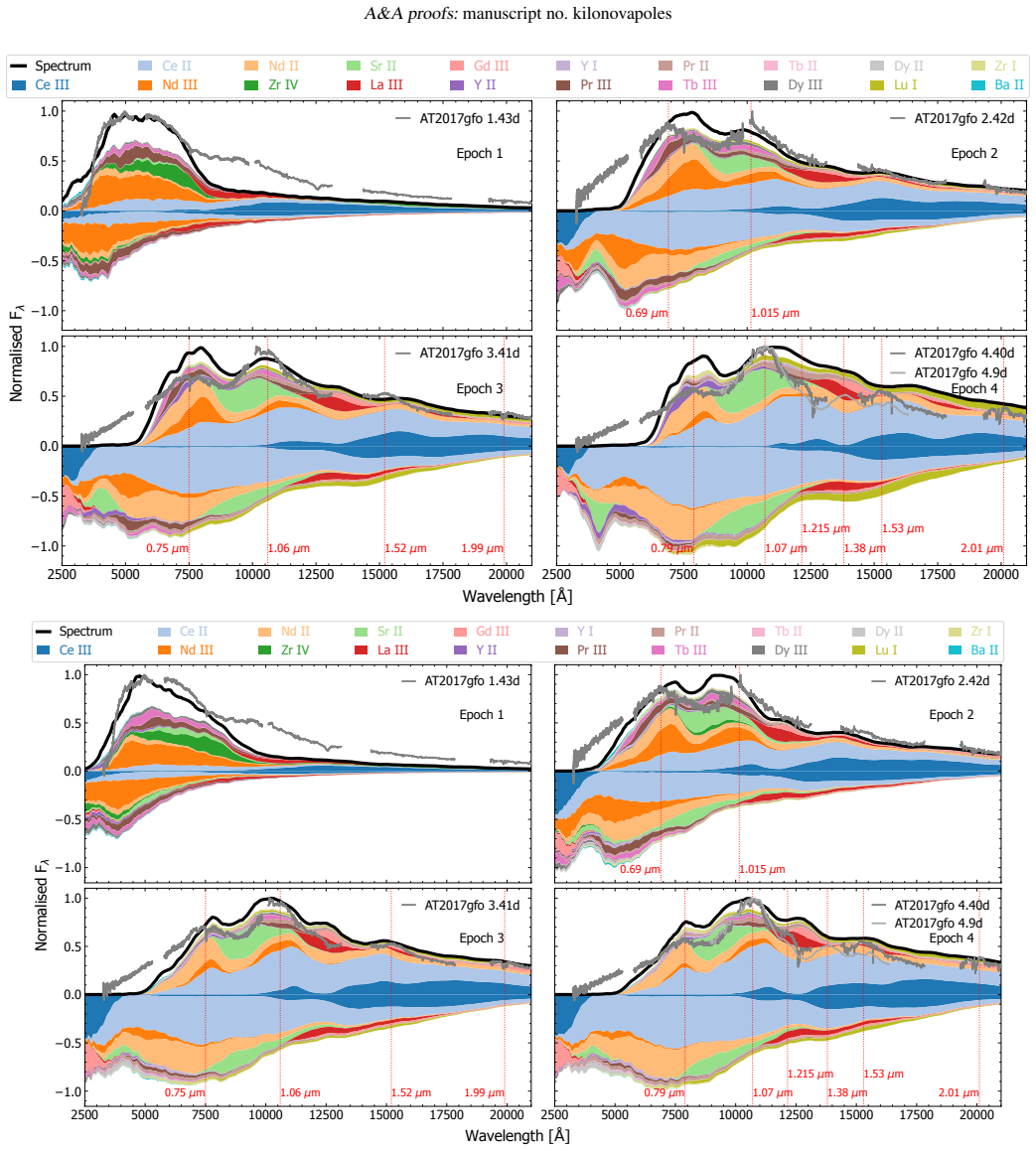
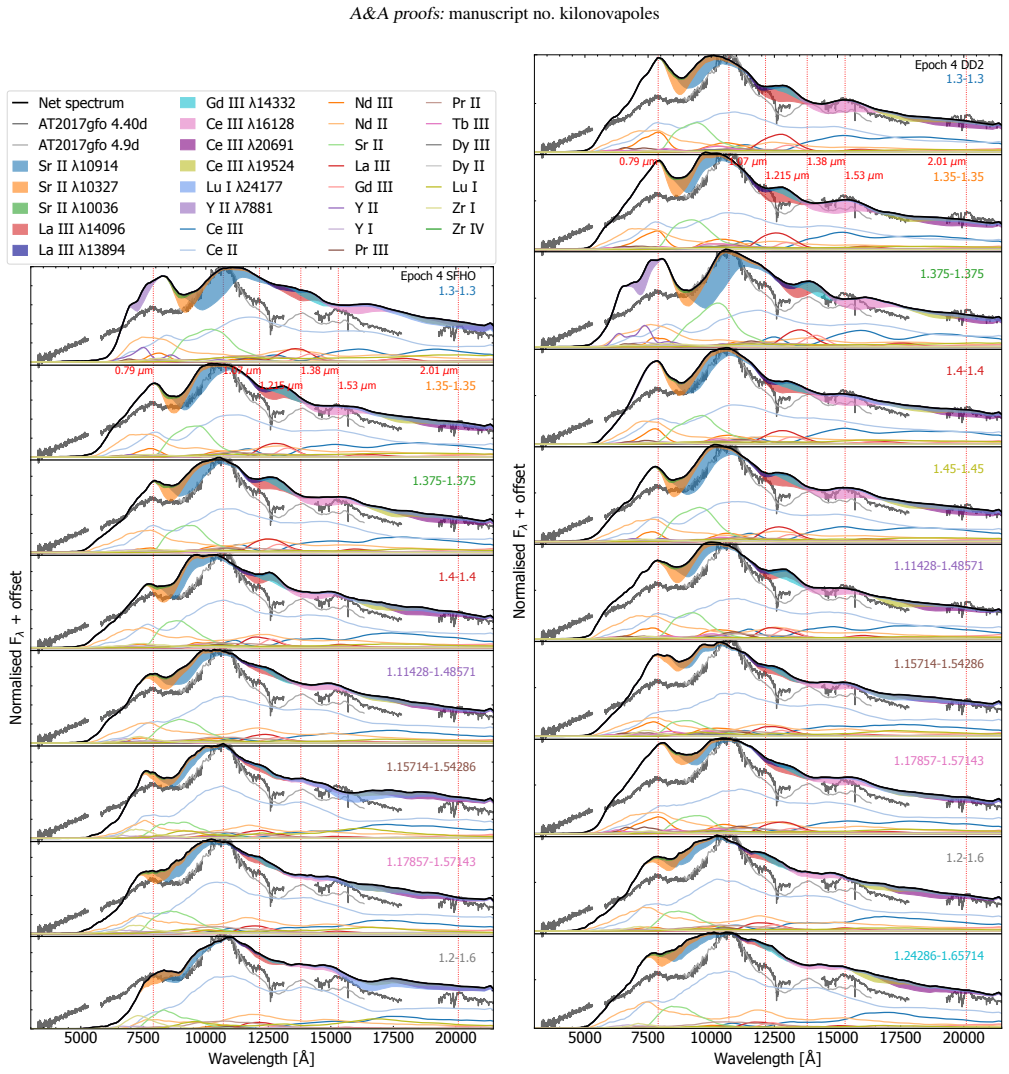
The central claim is that 3D radiative transfer models of dynamical ejecta from neutron star mergers, computed with line-by-line opacities and new calibrated lanthanide data, produce polar spectra that match many observed features of AT2017gfo (Sr II, La III, Gd III, Ce III lines and the overall continuum shape), although the match occurs at earlier times than the observations; this leads to the conclusion that dynamical ejecta exert a strong influence on the early spectral evolution of kilonovae.
What carries the argument
3D radiative transfer simulations with line-by-line opacities and new calibrated lanthanide atomic data applied to dynamical ejecta from binary neutron star merger models viewed along the polar axis.
If this is right
- Spectral properties in the polar direction remain largely insensitive to the precise neutron-star masses and equations of state explored.
- Bolometric luminosity in the polar direction increases with the total mass of dynamical ejecta.
- Ce III, Ce II, Nd III and Nd II ions dominate the shaping of the spectral continuum across all models.
- Models with the lowest polar lanthanide fraction produce an additional Y II feature not seen in higher-lanthanide cases.
Where Pith is reading between the lines
- Early-time polar spectra could be used to constrain the velocity and mass of dynamical ejecta even before full light-curve modeling is possible.
- The systematic blueshift of simulated lines relative to AT2017gfo suggests that real dynamical ejecta may have slightly lower velocities or different angular distributions than the models assume.
- If dynamical ejecta set the early spectrum, then any later spectral evolution must be attributed to slower, more isotropic components such as disk winds.
Load-bearing premise
The chosen 3D radiative transfer setup with line-by-line opacities and the new lanthanide atomic data sufficiently captures the real conditions in the dynamical ejecta without other ejecta components being required to shape the early polar spectrum.
What would settle it
A new kilonova observed at multiple early epochs would falsify the claim if its polar-view spectra lack the predicted Sr II, La III and Ce III features or if the observed line velocities and timings cannot be matched by any dynamical-ejecta model without additional components.
Figures




read the original abstract
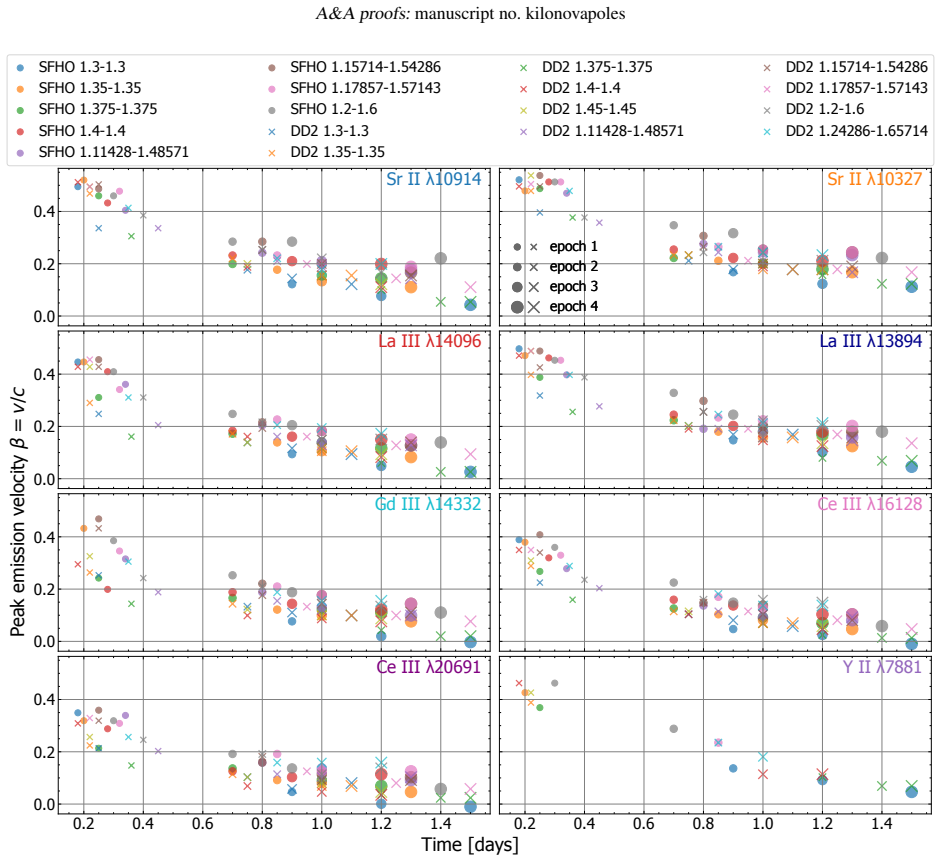
We present 3D kilonova radiative transfer simulations for a series of binary neutron star merger models. The masses of the neutron stars are varied as well as the total mass of the system and two different equations of state were used (SFHO and DD2), producing a range in dynamical ejecta masses and elemental abundance patterns. In this paper, we focus on the bolometric light curves and spectra in the polar direction for comparison with observations of the kilonova AT2017gfo. We calculate line-by-line opacities and include new calibrated lanthanide atomic data. All of the simulated spectra show strong features from Sr II, La III, Gd III and Ce III, which appear to correspond to features identified in AT2017gfo, although the simulated features are generally more blueshifted. The models with the lowest lanthanide fraction in the polar direction also show a Y II feature. Ce III, Ce II, Nd III and Nd II play an important role in shaping the spectral continuum. While the bolometric luminosities in the polar direction vary with the ejecta mass of each model, we find only little sensitivity of the spectral properties to the merger configuration. Our study demonstrates that dynamical ejecta alone can reproduce (although at earlier times) many spectral properties of AT2017gfo, suggesting dynamical ejecta may have a strong impact on the early spectral evolution. However, future simulations are needed to also elucidate the role of other ejecta components for shaping the kilonova spectrum.
Editorial analysis
A structured set of objections, weighed in public.
Referee Report
Summary. This paper presents 3D radiative transfer simulations of dynamical ejecta from binary neutron star mergers, varying neutron star masses, total system mass, and employing SFHO and DD2 equations of state. Focusing on the polar direction, it computes bolometric light curves and spectra using line-by-line opacities and new calibrated lanthanide atomic data. The simulated spectra exhibit strong features from Sr II, La III, Gd III, and Ce III that appear to correspond to those in AT2017gfo (though generally more blueshifted), with Y II in low-lanthanide cases and Ce/Nd ions shaping the continuum; bolometric luminosity scales with ejecta mass while spectral properties show little sensitivity to configuration. The central conclusion is that dynamical ejecta alone can reproduce many spectral properties of AT2017gfo at earlier times.
Significance. If the reported qualitative matches can be placed on a quantitative footing, the work would establish that dynamical ejecta play a dominant role in early kilonova spectral evolution, helping to interpret AT2017gfo-like events and guiding the inclusion of multiple ejecta components in future models. The use of full 3D radiative transfer, a range of merger parameters, and updated lanthanide atomic data constitutes a clear methodological advance over prior 1D or gray-opacity studies.
major comments (3)
- [Abstract] Abstract: the claim that dynamical ejecta alone 'can reproduce (although at earlier times) many spectral properties' of AT2017gfo rests entirely on qualitative feature matching (Sr II, La III, Gd III, Ce III) without any reported quantitative similarity metric, wavelength offset statistics, or formal comparison to observed line profiles and velocities.
- [Abstract and spectral comparison] Abstract and results on spectral features: the systematic blueshift of all identified lines and the restriction to 'earlier times' are noted but not quantified (e.g., no velocity offset table or time-alignment procedure), leaving open whether the offsets are reconcilable with the reproduction claim or indicate missing velocity structure or opacity sources.
- [Methods and discussion of atomic data] Radiative transfer setup: the sufficiency of the chosen 3D line-by-line opacity treatment plus the new lanthanide data (without other ejecta components) is asserted but not tested via sensitivity runs on post-processing choices or atomic-data variations, which directly affects the weakest assumption underlying the central claim.
minor comments (2)
- [Abstract] The statement 'only little sensitivity' of spectral properties to merger configuration would benefit from an explicit quantitative measure (e.g., standard deviation across models) rather than a qualitative descriptor.
- [Figure captions and results] Figures showing spectra should include the exact post-merger times used for comparison and, where possible, overlay the AT2017gfo observations with error bars to allow direct visual assessment of the claimed correspondence.
Simulated Author's Rebuttal
We thank the referee for their careful and constructive review of our manuscript. We address each of the major comments below and have revised the manuscript to incorporate quantitative comparisons and additional discussion of limitations.
read point-by-point responses
-
Referee: [Abstract] Abstract: the claim that dynamical ejecta alone 'can reproduce (although at earlier times) many spectral properties' of AT2017gfo rests entirely on qualitative feature matching (Sr II, La III, Gd III, Ce III) without any reported quantitative similarity metric, wavelength offset statistics, or formal comparison to observed line profiles and velocities.
Authors: We agree that the original comparison was qualitative. In the revised manuscript we have added a table listing the central wavelengths and equivalent widths of the principal absorption features (Sr II, La III, Gd III, Ce III) in both the observed AT2017gfo spectra and our model spectra at the epochs of closest bolometric-luminosity match. We also report the mean velocity offset for each feature and include a short discussion of line-profile morphology. revision: yes
-
Referee: [Abstract and spectral comparison] Abstract and results on spectral features: the systematic blueshift of all identified lines and the restriction to 'earlier times' are noted but not quantified (e.g., no velocity offset table or time-alignment procedure), leaving open whether the offsets are reconcilable with the reproduction claim or indicate missing velocity structure or opacity sources.
Authors: The blueshift is a direct consequence of the high velocities (0.1–0.3 c) that characterise dynamical ejecta. We have now quantified the offsets in a new subsection and accompanying table, giving the average Doppler shift for each ion (typically 5 000–10 000 km s⁻¹ larger than observed). We describe our time-alignment procedure (matching epochs by bolometric luminosity) and note that the earlier times reflect the faster expansion of dynamical ejecta alone; we explicitly discuss that slower wind or disk-wind components would be required to reduce the velocity discrepancy. revision: yes
-
Referee: [Methods and discussion of atomic data] Radiative transfer setup: the sufficiency of the chosen 3D line-by-line opacity treatment plus the new lanthanide data (without other ejecta components) is asserted but not tested via sensitivity runs on post-processing choices or atomic-data variations, which directly affects the weakest assumption underlying the central claim.
Authors: We acknowledge that dedicated sensitivity runs would be desirable. Because of the high computational cost of full 3D line-by-line calculations we did not perform additional post-processing or atomic-data variation suites in the present study. We have expanded the discussion to summarise the range of lanthanide opacity uncertainties reported in the recent literature and have added an explicit statement that the conclusions are subject to these uncertainties, with a recommendation for future work. revision: partial
Circularity Check
Forward simulations from independent merger models compared to external observations
full rationale
The paper selects binary neutron star merger parameters (NS masses, total mass, SFHO/DD2 EOS) independently of AT2017gfo, computes dynamical ejecta masses and abundances, then runs 3D line-by-line radiative transfer using new lanthanide atomic data as input. Polar bolometric light curves and spectra are generated and qualitatively compared to external observational data. No parameters are fitted to the target observation, no self-citations form a load-bearing chain for the central claim, and the spectral features (Sr II, La III, etc.) are outputs rather than inputs. The derivation chain is self-contained forward modeling without reduction to fitted quantities or self-referential definitions.
Axiom & Free-Parameter Ledger
free parameters (3)
- Neutron-star masses
- Total system mass
- Equation of state (SFHO or DD2)
axioms (2)
- domain assumption Line-by-line opacities computed with the new calibrated lanthanide atomic data correctly describe the radiative processes in the ejecta.
- domain assumption The polar viewing angle is representative for comparison with AT2017gfo observations.
Reference graph
Works this paper leans on
-
[1]
P., Abbott, R., Abbott, T
Abbott, B. P., Abbott, R., Abbott, T. D., et al. 2017, ApJ, 848, L13
2017
-
[2]
P., Abbott, R., Abbott, T
Abbott, B. P., Abbott, R., Abbott, T. D., et al. 2017, Phys. Rev. Lett., 119, 161101
2017
-
[3]
T., Just, O., & Bauswein, A
Ardevol-Pulpillo, R., Janka, H. T., Just, O., & Bauswein, A. 2019, MNRAS, 485, 4754 ARTIS Collaboration, Sim, S., Kromer, M., et al. 2025, ARTIS
2019
-
[4]
Arya, A., Damgaard, R., Sneppen, A., et al. 2026, arXiv e-prints, arXiv:2604.05812
work page internal anchor Pith review Pith/arXiv arXiv 2026
-
[5]
2013, ApJ, 773, 78
Bauswein, A., Goriely, S., & Janka, H.-T. 2013, ApJ, 773, 78
2013
-
[6]
2010, Phys
Bauswein, A., Oechslin, R., & Janka, H. 2010, Phys. Rev. D, 81, 024012
2010
-
[7]
2025, arXiv e-prints, arXiv:2508.18364
Brethauer, D., Kasen, D., Margutti, R., & Chornock, R. 2025, arXiv e-prints, arXiv:2508.18364
-
[8]
A., & Kromer, M
Bulla, M., Sim, S. A., & Kromer, M. 2015, MNRAS, 450, 967
2015
-
[9]
Non-LTE Ionization Modeling for Helium and Strontium in Neutron Star Merger Ejecta
Chiba, K., Tanaka, M., Wanajo, S., et al. 2026, arXiv e-prints, arXiv:2604.05703
work page internal anchor Pith review Pith/arXiv arXiv 2026
-
[10]
E., Bauswein, A., Sim, S
Collins, C. E., Bauswein, A., Sim, S. A., et al. 2023, MNRAS, 521, 1858
2023
-
[11]
E., Shingles, L
Collins, C. E., Shingles, L. J., Bauswein, A., et al. 2024, MNRAS, 529, 1333
2024
- [12]
-
[13]
A., Foley, R
Coulter, D. A., Foley, R. J., Kilpatrick, C. D., et al. 2017, Science, 358, 1556
2017
-
[14]
S., Berger, E., Villar, V
Cowperthwaite, P. S., Berger, E., Villar, V . A., et al. 2017, ApJ, 848, L17
2017
-
[15]
Dhawan, S., Bulla, M., Goobar, A., Sagués Carracedo, A., & Setzer, C. N. 2020, ApJ, 888, 67
2020
-
[16]
2022, ApJ, 939, 8
Domoto, N., Tanaka, M., Kato, D., et al. 2022, ApJ, 939, 8
2022
-
[17]
2021, ApJ, 913, 26
Domoto, N., Tanaka, M., Wanajo, S., & Kawaguchi, K. 2021, ApJ, 913, 26
2021
-
[18]
2025, ApJ, 978, 99
Domoto, N., Wanajo, S., Tanaka, M., Kato, D., & Hotokezaka, K. 2025, ApJ, 978, 99
2025
-
[19]
R., Piro, A
Drout, M. R., Piro, A. L., Shappee, B. J., et al. 2017, Science, 358, 1570 Fernández, R. & Metzger, B. D. 2013, MNRAS, 435, 502 Flörs, A., da Silva, R. F., Marques, J. P., Sampaio, J. M., & Martínez-Pinedo, G. 2026, Phys. Rev. D, 113, 063041
2017
-
[20]
D., Haas, R., et al
Foucart, F., Duez, M. D., Haas, R., et al. 2023, Phys. Rev. D, 107, 103055
2023
-
[21]
2021, Phys
Foucart, F., Mösta, P., Ramirez, T., et al. 2021, Phys. Rev. D, 104, 123010
2021
-
[22]
2018, ApJ, 860, 64
Fujibayashi, S., Kiuchi, K., Nishimura, N., Sekiguchi, Y ., & Shibata, M. 2018, ApJ, 860, 64
2018
-
[23]
Improved lanthanide constraints for the kilonova AT 2017gfo
Gillanders, J. H., Flors, A., & Ferreira da Silva, R. 2025, arXiv e-prints, arXiv:2512.24257
work page internal anchor Pith review Pith/arXiv arXiv 2025
-
[24]
H., Sim, S
Gillanders, J. H., Sim, S. A., Smartt, S. J., Goriely, S., & Bauswein, A. 2024, MNRAS, 529, 2918
2024
-
[25]
Gillanders, J. H. & Smartt, S. J. 2025, MNRAS, 538, 1663
2025
-
[26]
H., Smartt, S
Gillanders, J. H., Smartt, S. J., Sim, S. A., Bauswein, A., & Goriely, S. 2022, MNRAS, 515, 631
2022
-
[27]
Hillier, D. J. 1990, A&A, 231, 111
1990
-
[28]
2023, MNRAS, 526, L155
Hotokezaka, K., Tanaka, M., Kato, D., & Gaigalas, G. 2023, MNRAS, 526, L155
2023
-
[29]
2025, arXiv e-prints, arXiv:2510.12410
Jerkstrand, A., Pognan, Q., Banerjee, S., et al. 2025, arXiv e-prints, arXiv:2510.12410
-
[30]
Just, O., Bauswein, A., Ardevol Pulpillo, R., Goriely, S., & Janka, H. T. 2015, MNRAS, 448, 541
2015
-
[31]
2022, MNRAS, 510, 2820
Just, O., Kullmann, I., Goriely, S., et al. 2022, MNRAS, 510, 2820
2022
-
[32]
2023, ApJ, 951, L12
Just, O., Vijayan, V ., Xiong, Z., et al. 2023, ApJ, 951, L12
2023
-
[33]
R-process heating implementation in hydrodynamic simulations with neural networks
Just, O., Xiong, Z., & Martínez-Pinedo, G. 2025, arXiv e-prints, arXiv:2507.09040
work page internal anchor Pith review Pith/arXiv arXiv 2025
-
[34]
Kasen, D., Fernández, R., & Metzger, B. D. 2015, MNRAS, 450, 1777
2015
-
[35]
2022, ApJ, 933, 22
Kawaguchi, K., Fujibayashi, S., Hotokezaka, K., Shibata, M., & Wanajo, S. 2022, ApJ, 933, 22
2022
-
[36]
2021, ApJ, 913, 100
Kawaguchi, K., Fujibayashi, S., Shibata, M., Tanaka, M., & Wanajo, S. 2021, ApJ, 913, 100
2021
-
[37]
& Sim, S
Kromer, M. & Sim, S. A. 2009, MNRAS, 398, 1809 5 https://github.com/artis-mcrt/artis/ 6 https://github.com/artis-mcrt/artistools/
2009
-
[38]
2022, MNRAS, 510, 2804
Kullmann, I., Goriely, S., Just, O., et al. 2022, MNRAS, 510, 2804
2022
-
[39]
Kurucz, R. L. 2006, in EAS Publications Series, V ol. 18, Radiative Transfer and Applications to Very Large Telescopes, ed. P. Stee (EDP Sciences), 129–155
2006
-
[40]
Kurucz, R. L. 2018, Workshop on Astrophysical Opacities. ASP Conference Se- ries, 515, 47
2018
-
[41]
J., Gompertz, B
Levan, A. J., Gompertz, B. P., Salafia, O. S., et al. 2024, Nature, 626, 737
2024
-
[42]
Lucy, L. B. 2002, A&A, 384, 725
2002
-
[43]
Lucy, L. B. 2003, A&A, 403, 261
2003
-
[44]
Lucy, L. B. 2005, A&A, 429, 19
2005
-
[45]
2024, ApJ, 974, L5
Magistrelli, F., Bernuzzi, S., Perego, A., & Radice, D. 2024, ApJ, 974, L5
2024
-
[46]
& Chornock, R
Margutti, R. & Chornock, R. 2021, ARA&A, 59, 155
2021
-
[47]
A., Collins, C
McNeill, F., Sim, S. A., Collins, C. E., et al. 2026, MNRAS, 546, stag068
2026
-
[48]
Mendoza-Temis, J. d. J., Wu, M.-R., Langanke, K., et al. 2015, Phys. Rev. C, 92, 055805
2015
-
[49]
M., Ryan, B
Miller, J. M., Ryan, B. R., Dolence, J. C., et al. 2019, Phys. Rev. D, 100, 023008
2019
-
[50]
P., Anderson, J., & Lu, W
Mooley, K. P., Anderson, J., & Lu, W. 2022, Nature, 610, 273
2022
-
[51]
2021, ApJ, 906, 98
Nedora, V ., Bernuzzi, S., Radice, D., et al. 2021, ApJ, 906, 98
2021
-
[52]
2023, Phys
Neuweiler, A., Dietrich, T., Bulla, M., et al. 2023, Phys. Rev. D, 107, 023016
2023
-
[53]
2002, Phys
Oechslin, R., Rosswog, S., & Thielemann, F.-K. 2002, Phys. Rev. D, 65, 103005
2002
-
[54]
2017, ApJ, 850, L37
Perego, A., Radice, D., & Bernuzzi, S. 2017, ApJ, 850, L37
2017
-
[55]
M., et al
Perego, A., Rosswog, S., Cabezón, R. M., et al. 2014, MNRAS, 443, 3134
2014
-
[56]
2022, ApJ, 925, 22
Perego, A., Vescovi, D., Fiore, A., et al. 2022, ApJ, 925, 22
2022
-
[57]
2017, Nature, 551, 67
Pian, E., D’Avanzo, P., Benetti, S., et al. 2017, Nature, 551, 67
2017
-
[58]
2023, MNRAS, 526, 5220
Pognan, Q., Grumer, J., Jerkstrand, A., & Wanajo, S. 2023, MNRAS, 526, 5220
2023
-
[59]
2025, MNRAS, 536, 2973
Pognan, Q., Wu, M.-R., Martínez-Pinedo, G., et al. 2025, MNRAS, 536, 2973
2025
-
[60]
2018, The Astrophysical Journal, 869, 130
Radice, D., Perego, A., Hotokezaka, K., et al. 2018, The Astrophysical Journal, 869, 130
2018
-
[61]
2025, ApJ, 980, 43
Rahmouni, S., Tanaka, M., Domoto, N., et al. 2025, ApJ, 980, 43
2025
-
[62]
2025, MNRAS, 538, 907
Rosswog, S., Sarin, N., Nakar, E., & Diener, P. 2025, MNRAS, 538, 907
2025
-
[63]
2015, Phys
Sekiguchi, Y ., Kiuchi, K., Kyutoku, K., & Shibata, M. 2015, Phys. Rev. D, 91, 064059
2015
-
[64]
J., Collins, C
Shingles, L. J., Collins, C. E., Holas, A., et al. 2026, artistools
2026
-
[65]
J., Collins, C
Shingles, L. J., Collins, C. E., Vijayan, V ., et al. 2023, ApJ, 954, L41
2023
-
[66]
J., Sim, S
Shingles, L. J., Sim, S. A., Kromer, M., et al. 2020, MNRAS, 492, 2029
2020
-
[67]
Siegel, D. M. 2019, European Physical Journal A, 55, 203
2019
-
[68]
Siegel, D. M. & Metzger, B. D. 2018, ApJ, 858, 52
2018
-
[69]
Sim, S. A. 2007, MNRAS, 375, 154
2007
-
[70]
J., Chen, T
Smartt, S. J., Chen, T. W., Jerkstrand, A., et al. 2017, Nature, 551, 75
2017
-
[71]
2024, A&A, 692, A134
Sneppen, A., Damgaard, R., Watson, D., et al. 2024, A&A, 692, A134
2024
-
[72]
& Watson, D
Sneppen, A. & Watson, D. 2023, A&A, 675, A194
2023
-
[73]
W., Hempel, M., & Fischer, T
Steiner, A. W., Hempel, M., & Fischer, T. 2013, ApJ, 774, 17
2013
-
[74]
& Hotokezaka, K
Tanaka, M. & Hotokezaka, K. 2013, ApJ, 775, 113
2013
-
[75]
2020, Monthly Notices of the Royal Astronomical Society, 496, 1369
Tanaka, M., Kato, D., Gaigalas, G., & Kawaguchi, K. 2020, Monthly Notices of the Royal Astronomical Society, 496, 1369
2020
-
[76]
R., Levan, A
Tanvir, N. R., Levan, A. J., González-Fernández, C., et al. 2017, ApJ, 848, L27
2017
-
[77]
2023, arXiv e-prints, arXiv:2302.13061
Tarumi, Y ., Hotokezaka, K., Domoto, N., & Tanaka, M. 2023, arXiv e-prints, arXiv:2302.13061
-
[78]
Typel, S., Röpke, G., Klähn, T., Blaschke, D., & Wolter, H. H. 2010, Phys. Rev. C, 81, 015803
2010
-
[79]
2024, PhD thesis, Heidelberg University, Combined Faculty of Math- ematics, Engineering and Natural Sciences
Vijayan, V . 2024, PhD thesis, Heidelberg University, Combined Faculty of Math- ematics, Engineering and Natural Sciences
2024
-
[80]
2026, PoS, FAIRness2024, 041
Vijayan, V ., Bauswein, A., & Martinez-Pinedo, G. 2026, PoS, FAIRness2024, 041
2026
discussion (0)
Sign in with ORCID, Apple, or X to comment. Anyone can read and Pith papers without signing in.