Recognition: 2 theorem links
· Lean TheoremStrontium and helium in the kilonova AT2017gfo: Origin of the 1{μ}m feature constrained via NLTE calculations
Pith reviewed 2026-05-10 19:26 UTC · model grok-4.3
The pith
Strontium is required to explain the early onset of the 1μm feature in kilonova AT2017gfo, while helium can contribute or dominate later.
A machine-rendered reading of the paper's core claim, the machinery that carries it, and where it could break.
Core claim
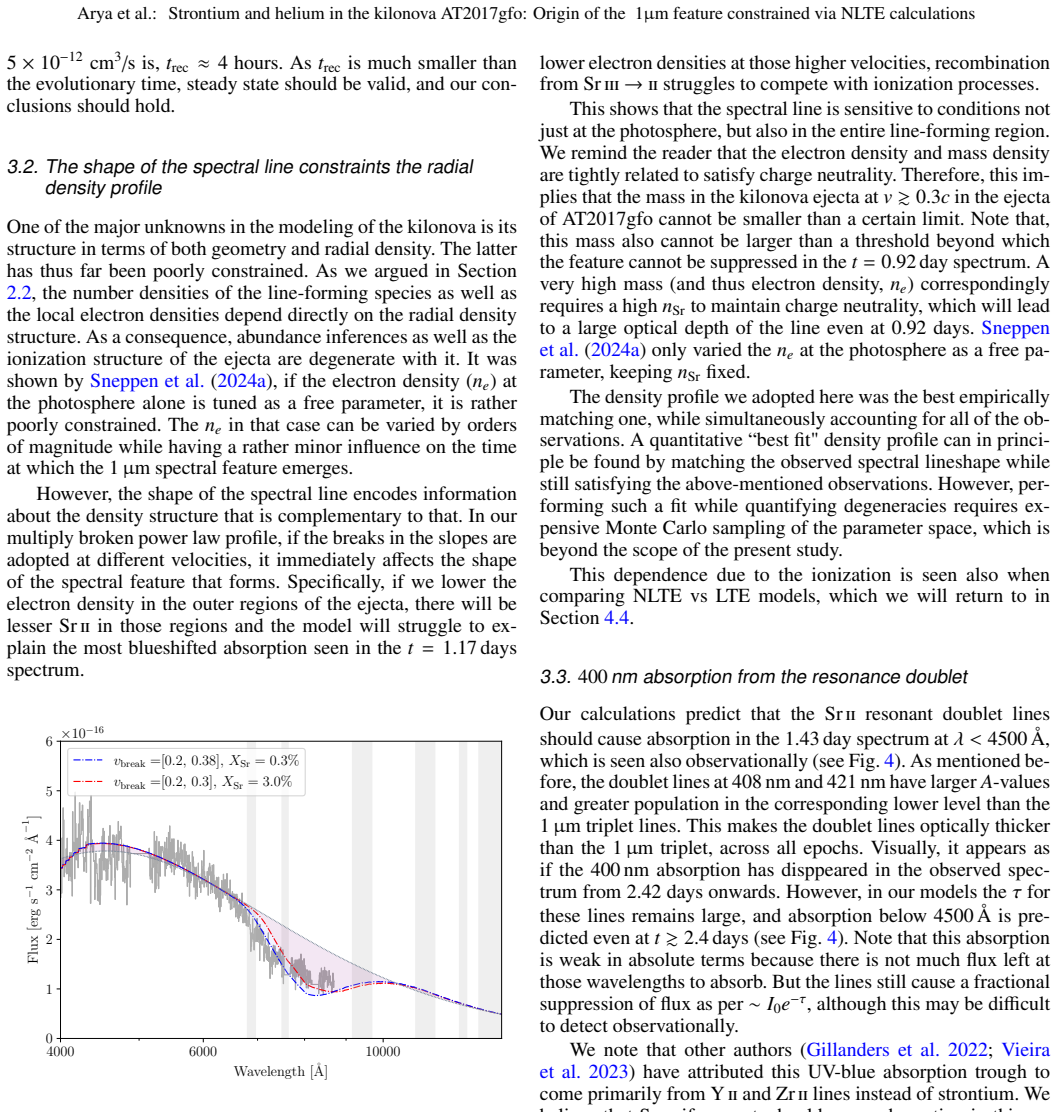
Our strontium model self-consistently reproduces the temporal evolution of the 1μm feature at early times, with its absence at 0.92 days to its clear emergence at 1.17 days. This transition mimics LTE, because at early epochs (t ≲ 1.5 days) the radiation field dominates the ionization state of the ejecta over thermal and non-thermal electron collisions. We further test if helium can form the feature under the same plasma conditions. The helium mass required at 1.17 days is comparable to the total ejecta mass, while a few percent by mass of helium suffices at 4.4 days. On the other hand, the strength of the strontium lines decrease with time, and may require a radially stratified abundance to
What carries the argument
Non-local thermodynamic equilibrium radiative transfer modelling that incorporates newly calculated strontium atomic data for electron impact collisions, photoionization, and recombination.
If this is right
- The feature's onset marks when radiation no longer fully controls the ionization balance in the ejecta.
- Strontium line strength decreases over time, implying a possible need for radially varying abundances to match observations at all epochs.
- Helium's relative contribution to the feature grows as the kilonova expands and cools.
Where Pith is reading between the lines
- Similar NLTE calculations applied to other kilonovae could help identify specific elements in their spectra at different times.
- Very early spectroscopic data might isolate strontium signatures before helium becomes competitive.
- This time-dependent distinction aids refinement of heavy-element yield estimates from neutron star mergers.
Load-bearing premise
The assumed plasma conditions including density, temperature, velocity structure, and ionization balance in the ejecta are representative of the actual event.
What would settle it
An observation showing the 1μm feature present at 0.92 days with no strontium contribution, or a helium mass measurement far below the total ejecta mass that still produces the feature at 1.17 days.
Figures





read the original abstract
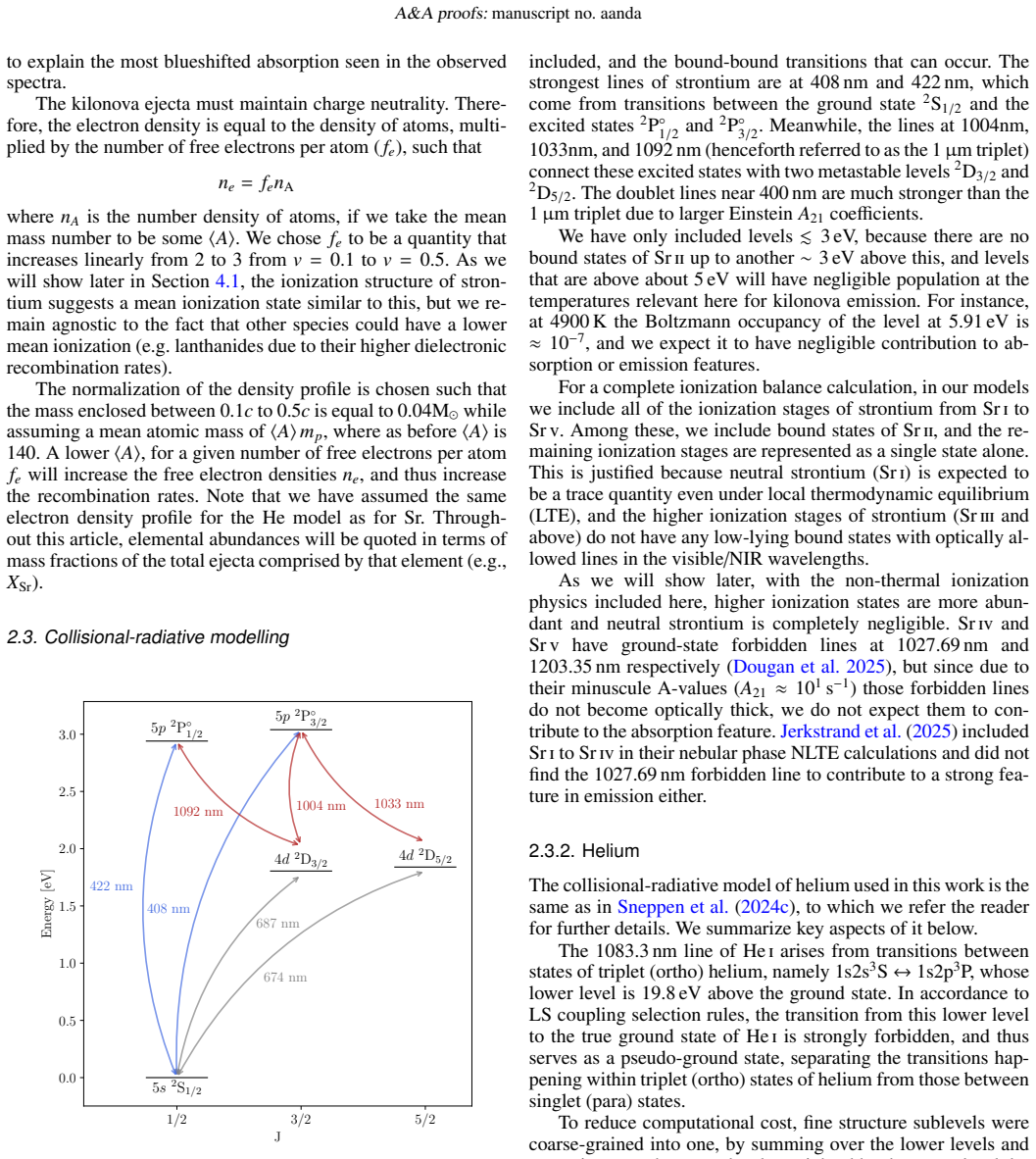
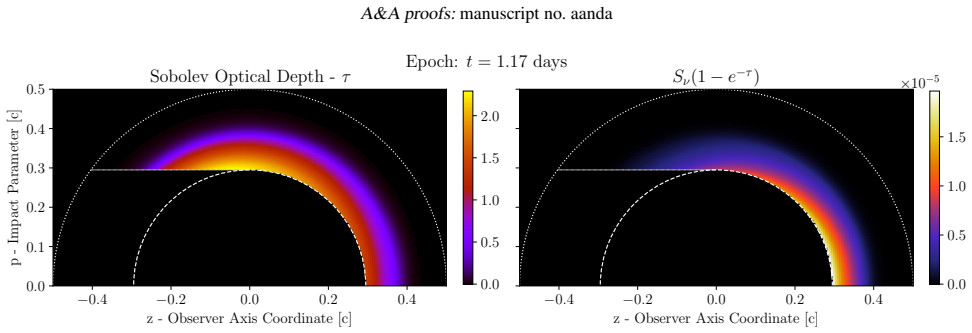
Mergers of neutron stars are believed to be one of the primary sites for the synthesis of the universe's heavy elements via the rapid neutron capture process. AT2017gfo, the kilonova following GW170817 provided the first direct spectroscopic evidence of the $r$-process happening in the universe. A prominent line feature near $1\,\mu$m in its spectrum was attributed to strontium -- a claim that has been independently recovered by several teams. However, in recent years it has been debated whether the feature arises instead from helium. Here, we present non--local thermodynamic equilibrium (NLTE) radiative transfer modelling of the observed kilonova spectra, including detailed radiation-matter interaction physics for both strontium and helium. We make use of freshly calculated strontium atomic data for e$^-$ impact collisions, photoionization, and recombination processes. Our strontium model self-consistently reproduces the temporal evolution of the $1\,\mu$m feature at early times, with its absence at $0.92\,$days to its clear emergence at $1.17\,$days. This transition mimics LTE, because at early epochs ($t\lesssim 1.5\,$days) the radiation field dominates the ionization state of the ejecta over thermal and non-thermal electron collisions. We further test if helium can form the feature under the same plasma conditions. The helium mass required at $1.17\,$days is comparable to the total ejecta mass, while a few percent by mass of helium suffices at 4.4 days. On the other hand, the strength of the strontium lines decrease with time, and may require a radially stratified abundance to consistently produce the feature. We conclude that strontium is required to explain the onset of the feature at early times, but helium can contribute to, or even dominate the feature at later epochs.
Editorial analysis
A structured set of objections, weighed in public.
Referee Report
Summary. The paper presents NLTE radiative transfer modeling of AT2017gfo spectra using newly computed strontium atomic data for collisions, photoionization, and recombination. It claims that strontium self-consistently reproduces the temporal evolution of the 1 μm feature (absent at 0.92 days, emergent at 1.17 days) because the radiation field dominates ionization at early times (t ≲ 1.5 days), while helium requires a mass comparable to the total ejecta at 1.17 days but only a few percent by mass at 4.4 days; strontium line strength decreases with time and may need radial stratification.
Significance. If the central result holds, the work is significant for kilonova spectroscopy and r-process studies because it uses detailed NLTE calculations and fresh atomic data to address the strontium-versus-helium debate for the prominent 1 μm feature in the first spectroscopically observed neutron-star merger event. The explicit demonstration of radiation-dominated ionization and the comparative mass requirements provide a concrete test of composition constraints.
major comments (1)
- [Abstract and modeling description] Abstract and modeling description: the claim that the strontium NLTE model 'self-consistently reproduces' the observed timing of the 1 μm feature (absence at 0.92 d to clear emergence at 1.17 d) rests on fixed assumptions for ejecta density, temperature, and velocity structure. No sensitivity runs are reported that vary these inputs (e.g., factor-of-two density changes or 20 % temperature shifts) while holding the new atomic data fixed. Because the paper states that radiation dominates ionization at t ≲ 1.5 d, level populations are sensitive to the radiation field and velocity gradient; without such tests it is unclear whether the timing match is a robust prediction or tied to the particular 1-D structure chosen.
Simulated Author's Rebuttal
We thank the referee for their careful reading and constructive comments on our manuscript. We address the major comment below.
read point-by-point responses
-
Referee: [Abstract and modeling description] Abstract and modeling description: the claim that the strontium NLTE model 'self-consistently reproduces' the observed timing of the 1 μm feature (absence at 0.92 d to clear emergence at 1.17 d) rests on fixed assumptions for ejecta density, temperature, and velocity structure. No sensitivity runs are reported that vary these inputs (e.g., factor-of-two density changes or 20 % temperature shifts) while holding the new atomic data fixed. Because the paper states that radiation dominates ionization at t ≲ 1.5 d, level populations are sensitive to the radiation field and velocity gradient; without such tests it is unclear whether the timing match is a robust prediction or tied to the particular 1-D structure chosen.
Authors: We agree that explicit sensitivity tests would strengthen the robustness claim. The adopted 1D density, temperature, and velocity structure follows standard assumptions from prior modeling of AT2017gfo and is not arbitrarily chosen. The key physical result—that radiation dominates ionization for t ≲ 1.5 days, producing the observed timing of the feature—is driven by the time-dependent radiation field intensity set by the observed bolometric luminosity and expansion, rather than fine details of the structure. Nevertheless, to directly address the concern, we will add a new subsection with sensitivity calculations that vary density by a factor of two and temperature by ±20% while keeping the new atomic data fixed. These tests show the feature emergence timing remains consistent with the observations. We will include the results and a brief discussion in the revised manuscript. revision: yes
Circularity Check
No circularity: NLTE model with new atomic data reproduces observed feature evolution independently of inputs
full rationale
The paper computes new strontium atomic data (electron-impact collisions, photoionization, recombination) and applies NLTE radiative transfer under stated ejecta conditions (density, temperature, velocity) to model the AT2017gfo spectra. The claimed reproduction of the 1μm feature's temporal evolution—from absence at 0.92 days to emergence at 1.17 days—is presented as an output of the radiation-dominated ionization physics and the atomic rates, not a redefinition or statistical fit of the target feature itself. Helium mass requirements are derived as a comparative test under identical conditions rather than presupposed. No self-citations provide load-bearing uniqueness theorems, no ansatz is imported via prior work, and no parameter fitted to the feature is relabeled as a prediction. The derivation chain remains self-contained against external inputs (observed spectra and freshly calculated atomic data).
Axiom & Free-Parameter Ledger
free parameters (2)
- helium mass fraction
- strontium radial abundance profile
axioms (2)
- domain assumption Radiation field dominates the ionization state of the ejecta over thermal and non-thermal electron collisions at t ≲ 1.5 days
- domain assumption The ejecta can be modeled with the chosen density, temperature, and velocity structure without significant contribution from other elements to the 1μm feature
Lean theorems connected to this paper
-
IndisputableMonolith/Cost/FunctionalEquation.leanwashburn_uniqueness_aczel unclear?
unclearRelation between the paper passage and the cited Recognition theorem.
Our strontium model self-consistently reproduces the temporal evolution of the 1μm feature at early times... We make use of freshly calculated strontium atomic data for e− impact collisions, photoionization, and recombination processes.
-
IndisputableMonolith/Foundation/AlphaCoordinateFixation.leanalpha_pin_under_high_calibration unclear?
unclearRelation between the paper passage and the cited Recognition theorem.
The helium mass required at 1.17 days is comparable to the total ejecta mass... the strength of the strontium lines decrease with time, and may require a radially stratified abundance
What do these tags mean?
- matches
- The paper's claim is directly supported by a theorem in the formal canon.
- supports
- The theorem supports part of the paper's argument, but the paper may add assumptions or extra steps.
- extends
- The paper goes beyond the formal theorem; the theorem is a base layer rather than the whole result.
- uses
- The paper appears to rely on the theorem as machinery.
- contradicts
- The paper's claim conflicts with a theorem or certificate in the canon.
- unclear
- Pith found a possible connection, but the passage is too broad, indirect, or ambiguous to say the theorem truly supports the claim.
Forward citations
Cited by 1 Pith paper
-
Exploring the diversity of kilonovae with 3D radiative transfer I. The polar direction
Dynamical ejecta from neutron star mergers reproduce key spectral properties of AT2017gfo in polar views, with features from Sr II, La III and other ions appearing at earlier times than observed.
Reference graph
Works this paper leans on
-
[1]
, " * write output.state after.block = add.period write newline
ENTRY address archiveprefix author booktitle chapter edition editor howpublished institution eprint journal key month note number organization pages publisher school series title type volume year label extra.label sort.label short.list INTEGERS output.state before.all mid.sentence after.sentence after.block FUNCTION init.state.consts #0 'before.all := #1 ...
-
[2]
write newline
" write newline "" before.all 'output.state := FUNCTION n.dashify 't := "" t empty not t #1 #1 substring "-" = t #1 #2 substring "--" = not "--" * t #2 global.max substring 't := t #1 #1 substring "-" = "-" * t #2 global.max substring 't := while if t #1 #1 substring * t #2 global.max substring 't := if while FUNCTION word.in bbl.in " " * FUNCTION format....
-
[3]
Abbott D. C., Lucy L. B., 1985, @doi [ ] 10.1086/162834 , https://ui.adsabs.harvard.edu/abs/1985ApJ...288..679A 288, 679
-
[4]
Abbott B. P., et al., 2017, @doi [ ] 10.3847/2041-8213/aa91c9 , https://ui.adsabs.harvard.edu/abs/2017ApJ...848L..12A 848, L12
-
[5]
Andreoni I., et al., 2017, @doi [ ] 10.1017/pasa.2017.65 , https://ui.adsabs.harvard.edu/abs/2017PASA...34...69A 34, e069
-
[6]
Arcavi I., et al., 2017, @doi [ ] 10.1038/nature24291 , https://ui.adsabs.harvard.edu/abs/2017Natur.551...64A 551, 64
-
[7]
Arnould M., Goriely S., Takahashi K., 2007, @doi [ ] 10.1016/j.physrep.2007.06.002 , https://ui.adsabs.harvard.edu/abs/2007PhR...450...97A 450, 97
-
[8]
Barnes J., Kasen D., Wu M.-R., Mart \' nez-Pinedo G., 2016, @doi [ ] 10.3847/0004-637X/829/2/110 , https://ui.adsabs.harvard.edu/abs/2016ApJ...829..110B 829, 110
-
[9]
Barnes J., Zhu Y. L., Lund K. A., Sprouse T. M., Vassh N., McLaughlin G. C., Mumpower M. R., Surman R., 2021, @doi [ ] 10.3847/1538-4357/ac0aec , https://ui.adsabs.harvard.edu/abs/2021ApJ...918...44B 918, 44
-
[10]
Bates D. R., Kingston A. E., McWhirter R. W. P., 1962, @doi [Proceedings of the Royal Society of London Series A] 10.1098/rspa.1962.0101 , https://ui.adsabs.harvard.edu/abs/1962RSPSA.267..297B 267, 297
-
[11]
Bernuzzi S., Magistrelli F., Jacobi M., Logoteta D., Perego A., Radice D., 2025, @doi [ ] 10.1093/mnras/staf1147 , https://ui.adsabs.harvard.edu/abs/2025MNRAS.tmp.1175B
-
[12]
Berrington K. A., Kingston A. E., 1987, @doi [Journal of Physics B Atomic Molecular Physics] 10.1088/0022-3700/20/24/014 , https://ui.adsabs.harvard.edu/abs/1987JPhB...20.6631B 20, 6631
-
[13]
2025, arXiv e-prints, arXiv:2508.18364
Brethauer D., Kasen D., Margutti R., Chornock R., 2025, @doi [arXiv e-prints] 10.48550/arXiv.2508.18364 , https://ui.adsabs.harvard.edu/abs/2025arXiv250818364B p. arXiv:2508.18364
-
[14]
Buckley D. A. H., et al., 2018, @doi [ ] 10.1093/mnrasl/slx196 , https://ui.adsabs.harvard.edu/abs/2018MNRAS.474L..71B 474, L71
-
[15]
Burbidge E. M., Burbidge G. R., Fowler W. A., Hoyle F., 1957, @doi [Reviews of Modern Physics] 10.1103/RevModPhys.29.547 , https://ui.adsabs.harvard.edu/abs/1957RvMP...29..547B 29, 547
-
[16]
Cameron A. G. W., 1957, @doi [ ] 10.1086/127051 , https://ui.adsabs.harvard.edu/abs/1957PASP...69..201C 69, 201
-
[17]
I., 1972, @doi [ ] 10.1086/151834 , https://ui.adsabs.harvard.edu/abs/1972ApJ...178..779C 178, 779
Castor J. I., 1972, @doi [ ] 10.1086/151834 , https://ui.adsabs.harvard.edu/abs/1972ApJ...178..779C 178, 779
-
[18]
Chornock R., et al., 2017, @doi [ ] 10.3847/2041-8213/aa905c , https://ui.adsabs.harvard.edu/abs/2017ApJ...848L..19C 848, L19
-
[19]
Collins C. E., et al., 2024, @doi [ ] 10.1093/mnras/stae571 , https://ui.adsabs.harvard.edu/abs/2024MNRAS.529.1333C 529, 1333
-
[20]
Combi L., Siegel D. M., 2023, @doi [ ] 10.3847/1538-4357/acac29 , https://ui.adsabs.harvard.edu/abs/2023ApJ...944...28C 944, 28
-
[21]
Science358, 1556 (2017) https://doi.org/10.1126/science.aap9811 arXiv:1710.05452 [astro- ph.HE]
Coulter D. A., et al., 2017, @doi [Science] 10.1126/science.aap9811 , https://ui.adsabs.harvard.edu/abs/2017Sci...358.1556C 358, 1556
-
[22]
Cowperthwaite P. S., et al., 2017, @doi [ ] 10.3847/2041-8213/aa8fc7 , https://ui.adsabs.harvard.edu/abs/2017ApJ...848L..17C 848, L17
-
[23]
Domoto N., Tanaka M., Wanajo S., Kawaguchi K., 2021, @doi [ ] 10.3847/1538-4357/abf358 , https://ui.adsabs.harvard.edu/abs/2021ApJ...913...26D 913, 26
-
[24]
Dougan D. J., McElroy N. E., Ballance C. P., Ramsbottom C. A., 2025, Strontium I, III, IV and V: Electron Impact Excitation Data for Kilonovae and White Dwarf Diagnostic Applications ( @eprint arXiv 2505.09788 ), https://arxiv.org/abs/2505.09788
-
[25]
Drout M. R., et al., 2017, @doi [Science] 10.1126/science.aaq0049 , https://ui.adsabs.harvard.edu/abs/2017Sci...358.1570D 358, 1570
-
[26]
Evans P. A., et al., 2017, @doi [Science] 10.1126/science.aap9580 , https://ui.adsabs.harvard.edu/abs/2017Sci...358.1565E 358, 1565
-
[27]
Fern \'a ndez R., Metzger B. D., 2013, @doi [ ] 10.1093/mnras/stt1312 , https://ui.adsabs.harvard.edu/abs/2013MNRAS.435..502F 435, 502
-
[28]
Fujibayashi S., Kiuchi K., Wanajo S., Kyutoku K., Sekiguchi Y., Shibata M., 2023, @doi [ ] 10.3847/1538-4357/ac9ce0 , https://ui.adsabs.harvard.edu/abs/2023ApJ...942...39F 942, 39
-
[29]
Ghisellini G., 2013, Radiative Processes in High Energy Astrophysics . Vol. 873, @doi 10.1007/978-3-319-00612-3,
-
[30]
2022, MNRAS, 515, 631, doi: 10.1093/mnras/stac1258
Gillanders J. H., Smartt S. J., Sim S. A., Bauswein A., Goriely S., 2022, @doi [ ] 10.1093/mnras/stac1258 , https://ui.adsabs.harvard.edu/abs/2022MNRAS.515..631G 515, 631
-
[31]
Improved lanthanide constraints for the kilonova AT 2017gfo
Gillanders J. H., Flors A., Ferreira da Silva R., 2025, arXiv e-prints, https://ui.adsabs.harvard.edu/abs/2025arXiv251224257G p. arXiv:2512.24257
work page internal anchor Pith review Pith/arXiv arXiv 2025
-
[32]
Hotokezaka K., Tanaka M., Kato D., Gaigalas G., 2021, @doi [ ] 10.1093/mnras/stab1975 , https://ui.adsabs.harvard.edu/abs/2021MNRAS.506.5863H 506, 5863
-
[33]
Hotokezaka K., Tanaka M., Kato D., Gaigalas G., 2022, @doi [ ] 10.1093/mnrasl/slac071 , https://ui.adsabs.harvard.edu/abs/2022MNRAS.515L..89H 515, L89
-
[34]
Hotokezaka K., Tanaka M., Kato D., Gaigalas G., 2023, @doi [ ] 10.1093/mnrasl/slad128 , https://ui.adsabs.harvard.edu/abs/2023MNRAS.526L.155H 526, L155
-
[35]
Hutsemekers D., Surdej J., 1990, @doi [ ] 10.1086/169203 , https://ui.adsabs.harvard.edu/abs/1990ApJ...361..367H 361, 367
-
[36]
Jacobi M., Magistrelli F., Loffredo E., Ricigliano G., Chiesa L., Bernuzzi S., Perego A., Arcones A., 2026, @doi [ ] 10.3847/2041-8213/ae4104 , https://ui.adsabs.harvard.edu/abs/2026ApJ...999L..16J 999, L16
-
[37]
J., 1993, @doi [ ] 10.1086/173197 , https://ui.adsabs.harvard.edu/abs/1993ApJ...415..734J 415, 734
Jeffery D. J., 1993, @doi [ ] 10.1086/173197 , https://ui.adsabs.harvard.edu/abs/1993ApJ...415..734J 415, 734
-
[38]
J., Branch D., 1990, in Wheeler J
Jeffery D. J., Branch D., 1990, in Wheeler J. C., Piran T., Weinberg S., eds, Vol. 6, Supernovae, Jerusalem Winter School for Theoretical Physics. p. 149
1990
- [39]
-
[40]
Just O., et al., 2023, @doi [ ] 10.3847/2041-8213/acdad2 , https://ui.adsabs.harvard.edu/abs/2023ApJ...951L..12J 951, L12
-
[41]
Kasen D., Barnes J., 2019, @doi [ ] 10.3847/1538-4357/ab06c2 , https://ui.adsabs.harvard.edu/abs/2019ApJ...876..128K 876, 128
-
[42]
Kasliwal M. M., et al., 2017, @doi [Science] 10.1126/science.aap9455 , https://ui.adsabs.harvard.edu/abs/2017Sci...358.1559K 358, 1559
-
[43]
Kasliwal M. M., et al., 2022, @doi [ ] 10.1093/mnrasl/slz007 , https://ui.adsabs.harvard.edu/abs/2022MNRAS.510L...7K 510, L7
-
[44]
Kilpatrick C. D., et al., 2017, @doi [Science] 10.1126/science.aaq0073 , https://ui.adsabs.harvard.edu/abs/2017Sci...358.1583K 358, 1583
-
[45]
Kiuchi K., Fujibayashi S., Hayashi K., Kyutoku K., Sekiguchi Y., Shibata M., 2023, @doi [ ] 10.1103/PhysRevLett.131.011401 , https://ui.adsabs.harvard.edu/abs/2023PhRvL.131a1401K 131, 011401
-
[46]
Kozma C., Fransson C., 1992, @doi [ ] 10.1086/171311 , https://ui.adsabs.harvard.edu/abs/1992ApJ...390..602K 390, 602
-
[47]
Kramida A., Ralchenko Y., Reader J., NIST ASD Team 2024, NIST Atomic Spectra Database (version 5.12), https://physics.nist.gov/asd, @doi 10.18434/T4W30F
-
[48]
Kullmann I., Goriely S., Just O., Bauswein A., Janka H.-T., 2023, @doi [ ] 10.1093/mnras/stad1458 , https://ui.adsabs.harvard.edu/abs/2023MNRAS.523.2551K 523, 2551
-
[49]
Lattimer J. M., Schramm D. N., 1974, @doi [ ] 10.1086/181612 , https://ui.adsabs.harvard.edu/abs/1974ApJ...192L.145L 192, L145
-
[50]
McCann M., Ballance C. P., Loch S. D., Ennis D. A., 2024, @doi [Journal of Physics B Atomic Molecular Physics] 10.1088/1361-6455/ad7cad , https://ui.adsabs.harvard.edu/abs/2024JPhB...57w5202M 57, 235202
-
[51]
McNeill F., Sim S. A., Collins C. E., Shingles L. J., Damgaard R., Sneppen A., Gillanders J. H., 2025, @doi [arXiv e-prints] 10.48550/arXiv.2510.09261 , https://ui.adsabs.harvard.edu/abs/2025arXiv251009261M p. arXiv:2510.09261
-
[52]
Living Reviews in Relativity , author =
Metzger B. D., 2019, @doi [Living Reviews in Relativity] 10.1007/s41114-019-0024-0 , https://ui.adsabs.harvard.edu/abs/2019LRR....23....1M 23, 1
-
[53]
and Anderson, Jay and Lu, Wenbin , year=
Mooley K. P., Anderson J., Lu W., 2022, @doi [ ] 10.1038/s41586-022-05145-7 , https://ui.adsabs.harvard.edu/abs/2022Natur.610..273M 610, 273
-
[54]
Mulholland L. P., McElroy N. E., McNeill F. L., Sim S. A., Ballance C. P., Ramsbottom C. A., 2024, @doi [ ] 10.1093/mnras/stae1615 , https://ui.adsabs.harvard.edu/abs/2024MNRAS.532.2289M 532, 2289
-
[55]
Mulholland L. P., Ramsbottom C. A., Ballance C. P., Sneppen A., Sim S. A., 2025, @doi [arXiv e-prints] 10.48550/arXiv.2510.17357 , https://ui.adsabs.harvard.edu/abs/2025arXiv251017357M p. arXiv:2510.17357
-
[56]
Nahar S. N., 2010, @doi [ ] 10.1016/j.newast.2009.11.010 , https://ui.adsabs.harvard.edu/abs/2010NewA...15..417N 15, 417
-
[57]
Neuweiler A., Dietrich T., Bulla M., Chaurasia S. V., Rosswog S., Ujevic M., 2023, @doi [ ] 10.1103/PhysRevD.107.023016 , https://ui.adsabs.harvard.edu/abs/2023PhRvD.107b3016N 107, 023016
-
[58]
Nicholl M., et al., 2017, @doi [ ] 10.3847/2041-8213/aa9029 , https://ui.adsabs.harvard.edu/abs/2017ApJ...848L..18N 848, L18
-
[59]
Noebauer U. M., Sim S. A., 2019, @doi [Living Reviews in Computational Astrophysics] 10.1007/s41115-019-0004-9 , https://ui.adsabs.harvard.edu/abs/2019LRCA....5....1N 5, 1
-
[60]
Perego A., et al., 2022, @doi [ ] 10.3847/1538-4357/ac3751 , https://ui.adsabs.harvard.edu/abs/2022ApJ...925...22P 925, 22
-
[61]
Pian E., et al., 2017, @doi [ ] 10.1038/nature24298 , https://ui.adsabs.harvard.edu/abs/2017Natur.551...67P 551, 67
-
[62]
Pindzola M. S., Griffin D. C., Bottcher C., 1986, Electron-Ion Collisions in the Average-Configuration Distorted-Wave Approximation. Springer US, Boston, MA, pp 75--91, @doi 10.1007/978-1-4684-5224-2_3 , https://doi.org/10.1007/978-1-4684-5224-2_3
-
[63]
Pognan Q., Jerkstrand A., Grumer J., 2022, @doi [ ] 10.1093/mnras/stab3674 , https://ui.adsabs.harvard.edu/abs/2022MNRAS.510.3806P 510, 3806
-
[64]
Pognan Q., Grumer J., Jerkstrand A., Wanajo S., 2023, @doi [ ] 10.1093/mnras/stad3106 , https://ui.adsabs.harvard.edu/abs/2023MNRAS.526.5220P 526, 5220
-
[65]
Quinet P., Palmeri P., Bi \'e mont E., McCurdy M. M., Rieger G., Pinnington E. H., Wickliffe M. E., Lawler J. E., 1999, @doi [ ] 10.1046/j.1365-8711.1999.02689.x , https://ui.adsabs.harvard.edu/abs/1999MNRAS.307..934Q 307, 934
-
[66]
B., Lightman A
Rybicki G. B., Lightman A. P., 1979, Radiative processes in astrophysics
1979
-
[67]
Sadeh G., 2025, @doi [ ] 10.3847/1538-4357/adecee , https://ui.adsabs.harvard.edu/abs/2025ApJ...988..130S 988, 130
-
[68]
Shingles L. J., et al., 2020, @doi [ ] 10.1093/mnras/stz3412 , https://ui.adsabs.harvard.edu/abs/2020MNRAS.492.2029S 492, 2029
-
[69]
Shingles L. J., et al., 2023, @doi [ ] 10.3847/2041-8213/acf29a , https://ui.adsabs.harvard.edu/abs/2023ApJ...954L..41S 954, L41
-
[70]
Singh S., Harman Z., Keitel C. H., 2025, @doi [arXiv e-prints] 10.48550/arXiv.2504.06639 , https://ui.adsabs.harvard.edu/abs/2025arXiv250406639S p. arXiv:2504.06639
-
[71]
Sippens Groenewegen L., Curtis S., M \"o sta P., Kasen D., Brethauer D., 2025, @doi [ ] 10.1093/mnras/staf1529 , https://ui.adsabs.harvard.edu/abs/2025MNRAS.543.2836S 543, 2836
-
[72]
J., Chen, T.-W., Jerkstrand, A., et al
Smartt S. J., et al., 2017, @doi [ ] 10.1038/nature24303 , https://ui.adsabs.harvard.edu/abs/2017Natur.551...75S 551, 75
-
[73]
J., & Gallino, R.\ 2008, , 46, 241
Sneden C., Cowan J. J., Gallino R., 2008, @doi [ ] 10.1146/annurev.astro.46.060407.145207 , https://ui.adsabs.harvard.edu/abs/2008ARA&A..46..241S 46, 241
-
[74]
Sneppen A., 2023, @doi [ ] 10.3847/1538-4357/acf200 , https://ui.adsabs.harvard.edu/abs/2023ApJ...955...44S 955, 44
-
[75]
Sneppen A., Watson D., Bauswein A., Just O., Kotak R., Nakar E., Poznanski D., Sim S., 2023a, @doi [ ] 10.1038/s41586-022-05616-x , https://ui.adsabs.harvard.edu/abs/2023Natur.614..436S 614, 436
-
[76]
Sneppen A., Watson D., Poznanski D., Just O., Bauswein A., Wojtak R., 2023b, @doi [ ] 10.1051/0004-6361/202346306 , https://ui.adsabs.harvard.edu/abs/2023A&A...678A..14S 678, A14
-
[77]
Sneppen A., Watson D., Gillanders J. H., Heintz K. E., 2024a, @doi [ ] 10.1051/0004-6361/202348758 , https://ui.adsabs.harvard.edu/abs/2024A&A...688A..95S 688, A95
-
[78]
Sneppen A., Watson D., Damgaard R., Heintz K. E., Vieira N., V \"a is \"a nen P., Mahoro A., 2024b, @doi [ ] 10.1051/0004-6361/202450317 , https://ui.adsabs.harvard.edu/abs/2024A&A...690A.398S 690, A398
-
[79]
2024, A&A, 692, A134, doi: 10.1051/0004-6361/202451450
Sneppen A., Damgaard R., Watson D., Collins C. E., Shingles L., Sim S. A., 2024c, @doi [ ] 10.1051/0004-6361/202451450 , https://ui.adsabs.harvard.edu/abs/2024A&A...692A.134S 692, A134
-
[80]
Sneppen A., et al., 2026, @doi [ ] 10.1103/5j43-l6xr , https://ui.adsabs.harvard.edu/abs/2026PhRvD.113f3038S 113, 063038
discussion (0)
Sign in with ORCID, Apple, or X to comment. Anyone can read and Pith papers without signing in.