Recognition: no theorem link
How the Hahn-Banach Theorem Sheds Bright Light on Fundamental Questions in Classical Thermodynamics
Pith reviewed 2026-05-12 01:46 UTC · model grok-4.3
The pith
The Hahn-Banach theorem applied to the Kelvin-Planck second law produces entropy and temperature functions satisfying the Clausius-Duhem inequality.
A machine-rendered reading of the paper's core claim, the machinery that carries it, and where it could break.
Core claim
From a Kelvin-Planck version of the Second Law, the Hahn-Banach Theorem delivers, immediately and simultaneously, entropy and thermodynamic-temperature functions of the local material state such that the Clausius-Duhem inequality is satisfied for every process a particular material might admit. For existence of such functions there is no need at all to require that their domain be restricted to states of equilibrium. However, the Hahn-Banach Theorem also indicates that for uniqueness of such a pair of functions across the entire state-space domain, every state must be visited by a reversible process.
What carries the argument
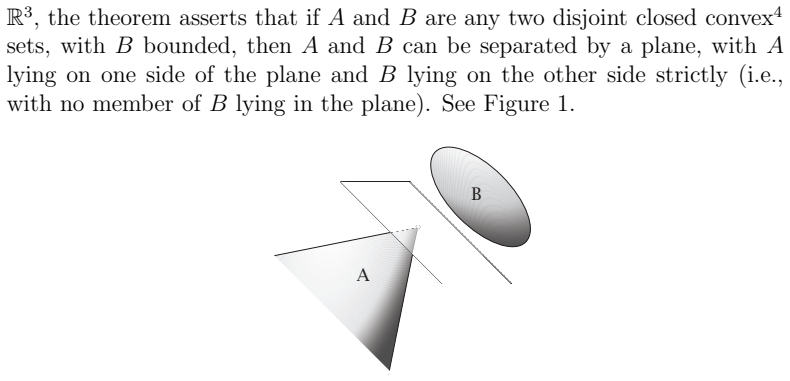
The Hahn-Banach theorem applied to the convex set of states or processes consistent with the Kelvin-Planck statement of the second law, producing separating hyperplanes that define the entropy and temperature.
If this is right
- Entropy and temperature functions exist even for non-equilibrium states.
- The Clausius-Duhem inequality holds automatically for all admissible processes by construction.
- Uniqueness of the entropy-temperature pair requires that reversible processes reach every state in the domain.
- This approach derives thermodynamic relations directly from the second law using functional analysis without extra physical postulates.
Where Pith is reading between the lines
- The method could extend to deriving other thermodynamic relations in systems with different process constraints.
- It connects classical thermodynamics to convex analysis in a way that might apply to other physical laws expressed as inequalities.
Load-bearing premise
The admissible processes or attainable states form a convex set in a vector space to which the Hahn-Banach theorem can be directly applied as a separating hyperplane condition.
What would settle it
A concrete thermodynamic model where the Kelvin-Planck statement holds but no entropy and temperature pair satisfies the Clausius-Duhem inequality for all processes, or where multiple pairs exist despite reversible paths reaching every state.
Figures


read the original abstract
The Hahn-Banach Theorem, a cornerstone of modern functional analysis, is a natural companion of the Second Law of Thermodynamics. From a Kelvin-Planck version of the Second Law, the Hahn-Banach Theorem delivers, immediately and simultaneously, entropy and thermodynamic-temperature functions of the local material state such that the Clausius-Duhem inequality is satisfied for every process a particular material might admit. For \emph{existence} of such functions there is no need at all to require that their domain be restricted to states of equilibrium. However, the Hahn-Banach Theorem also indicates that for \emph{uniqueness} of such a pair of functions across the entire state-space domain, every state must be visited by a reversible process. This review is intended to help make accessible to both thermodynamics scholars and mathematicians the remarkable interplay of the Hahn-Banach Theorem and the Second Law.
Editorial analysis
A structured set of objections, weighed in public.
Referee Report
Summary. The manuscript claims that a Kelvin-Planck formulation of the Second Law, when interpreted through the Hahn-Banach theorem (in its separating-hyperplane form), immediately yields the existence of entropy and thermodynamic-temperature functions on the local material state such that the Clausius-Duhem inequality holds for every admissible process. Existence requires no equilibrium restriction on the domain, while uniqueness across the full state space requires that every state be attained by some reversible process. The work is presented as a review to make the functional-analytic connection accessible to both thermodynamicists and mathematicians.
Significance. If the central claim were substantiated with explicit constructions, the result would offer a parameter-free, non-equilibrium foundation for thermodynamic potentials grounded in functional analysis rather than the usual manifold or path-integral structures. This could clarify existence questions in classical thermodynamics and highlight the role of convexity. The manuscript receives credit for attempting a direct bridge between the Second Law and Hahn-Banach without introducing free parameters or ad-hoc entities, though the absence of the required derivations prevents this potential from being realized in the current text.
major comments (3)
- [Abstract] Abstract and opening paragraphs: the repeated assertion that the Hahn-Banach theorem 'delivers immediately and simultaneously' entropy and temperature functions satisfying the Clausius-Duhem inequality is unsupported. No explicit convex set of admissible processes, no definition of the associated sublinear functional derived from the Kelvin-Planck statement, and no verification that the separating hyperplane yields precisely the entropy and temperature appearing in the Clausius-Duhem inequality are provided.
- [Introduction / §2] The application of Hahn-Banach presupposes that the set of admissible processes or states forms a real vector space (or convex cone) and that the Kelvin-Planck prohibition can be cast as a strict separation condition without additional continuity or topological hypotheses. The manuscript does not construct or justify this structure, which is load-bearing for the existence claim.
- [§3] The uniqueness statement (every state must be visited by a reversible process) is asserted but not derived from the Hahn-Banach theorem itself; the precise functional-analytic condition that would enforce uniqueness across the entire domain is not stated or proved.
minor comments (2)
- [§2] Notation for the local state variable and the set of processes should be introduced with explicit definitions before the Hahn-Banach application is invoked.
- The paper would benefit from a short appendix recalling the precise statement of the separating-hyperplane version of Hahn-Banach used, including any continuity or closure assumptions.
Simulated Author's Rebuttal
We thank the referee for the careful reading and constructive critique. The comments accurately note that the manuscript, presented as an accessible review, asserts the Hahn-Banach connection at a conceptual level without supplying the explicit convex-analytic constructions required to substantiate the existence and uniqueness claims in full detail. We will revise the text to incorporate these elements while preserving the review's bridging purpose for thermodynamicists and mathematicians.
read point-by-point responses
-
Referee: [Abstract] Abstract and opening paragraphs: the repeated assertion that the Hahn-Banach theorem 'delivers immediately and simultaneously' entropy and temperature functions satisfying the Clausius-Duhem inequality is unsupported. No explicit convex set of admissible processes, no definition of the associated sublinear functional derived from the Kelvin-Planck statement, and no verification that the separating hyperplane yields precisely the entropy and temperature appearing in the Clausius-Duhem inequality are provided.
Authors: We accept this criticism. The present text invokes the standard separating-hyperplane interpretation of the Second Law but does not exhibit the concrete objects. In revision we will insert, immediately after the abstract or as the opening of §2, an explicit construction: the convex cone C of admissible processes (those satisfying the Kelvin-Planck prohibition), the sublinear functional p induced by the Second Law (p(v) = inf{λ > 0 | v ∈ λC}), and the verification that any Hahn-Banach linear functional f separating 0 from the interior of C yields entropy S and temperature θ such that the Clausius-Duhem inequality holds identically. This addition will make the claim self-contained. revision: yes
-
Referee: [Introduction / §2] The application of Hahn-Banach presupposes that the set of admissible processes or states forms a real vector space (or convex cone) and that the Kelvin-Planck prohibition can be cast as a strict separation condition without additional continuity or topological hypotheses. The manuscript does not construct or justify this structure, which is load-bearing for the existence claim.
Authors: The referee correctly identifies the missing foundational step. We will add a short paragraph in the Introduction (and a clarifying remark in §2) stating that the space of processes is the real vector space of integrable state trajectories, that the admissible set is the convex cone defined by the Kelvin-Planck statement, and that the prohibition is expressed as a strict separation of the origin from the forbidden set. We will note that the purely algebraic form of the Hahn-Banach theorem (no continuity or topology required) already guarantees existence of the separating functional; any continuity assumptions will be flagged as optional for physical regularity rather than necessary for the existence result. revision: yes
-
Referee: [§3] The uniqueness statement (every state must be visited by a reversible process) is asserted but not derived from the Hahn-Banach theorem itself; the precise functional-analytic condition that would enforce uniqueness across the entire domain is not stated or proved.
Authors: We agree that the uniqueness claim is indicated rather than derived. In the revised §3 we will state the precise condition: the sublinear functional p is uniquely determined on the whole space precisely when the reversible processes are such that p(x) = -p(-x) for every direction x corresponding to a state (i.e., the reversible set generates the dual cone and saturates the inequality). A short argument will then show that this saturation forces the supporting functional (hence the entropy-temperature pair) to be unique across the entire domain. This will replace the current assertion with an explicit derivation. revision: yes
Circularity Check
No significant circularity; external theorem applied to independent physical statement
full rationale
The derivation begins from an external Kelvin-Planck formulation of the Second Law and invokes the external Hahn-Banach theorem (separating-hyperplane form) to establish existence of entropy and temperature functions satisfying the Clausius-Duhem inequality. No step redefines the target functions in terms of themselves, fits parameters to a subset and renames the fit as a prediction, or relies on a load-bearing self-citation whose content reduces to the present claim. The structural requirement that admissible processes form a convex cone is an input assumption drawn from the physical statement rather than smuggled in via prior work by the same authors or by renaming a known result. The paper therefore remains self-contained against external benchmarks.
Axiom & Free-Parameter Ledger
axioms (2)
- domain assumption Kelvin-Planck version of the Second Law
- standard math Hahn-Banach Theorem
Reference graph
Works this paper leans on
-
[1]
1961 On the equilibrium of heterogeneous substances
Gibbs JW. 1961 On the equilibrium of heterogeneous substances. In The Scientific Papers of J. Willard Gibbs . Dover Publications. Originally published in Transactions of the Connecticut Academy, III, pp. 10 8-224, Oct, 1875-May, 1876 and pp. 343-524, May, 1877-July, 1878
work page 1961
-
[2]
1824 R´ eflexions sur la Puissance Motrice du Feu
Carnot S. 1824 R´ eflexions sur la Puissance Motrice du Feu. Tran slated by R.H. Thurston in Reflections on the Motive Power of Fire and Other Papers on the Second Law of Thermodynamics , Dover Publications, 1960. 39
work page 1960
-
[3]
1834 Memoir sur la puissance motrice de la chaleur
Clapeyron BP ´E. 1834 Memoir sur la puissance motrice de la chaleur. Journal de l’ ´Ecole Royale Polytechnique pp. 153–190
-
[4]
Clausius R. 1854 ¨Uber eine ver¨ anderte Form des zweiten Hauptsatzes der mechanischen W¨ armetheorie.Annalen der Physik 169, 481–506
-
[5]
Clausius R. 1867 The Mechanical Theory of Heat with its Applications to the Steam-Engine and to the Physical Properties of Bodies . John Van Voorst. Translated by J. Tyndall
-
[6]
Thomson W. 1853 On the Dynamical Theory of Heat, with Numerica l Results Deduced from Mr Joule’s Equivalent of a Thermal Unit, and M. Regnault’s Observations on Steam. Earth and Environmental Science Transactions of The Royal Society of Edinburgh 20, 261–288
-
[7]
Fermi E. 1956 Thermodynamics. Dover Publications. (Originally pub- lished in 1937)
work page 1956
-
[8]
1964 Elements of Classical Thermodynamics for Advanced Students of Physics
Pippard AB. 1964 Elements of Classical Thermodynamics for Advanced Students of Physics . Cambridge University Press
work page 1964
-
[9]
Denbigh K. 1981 The Principles of Chemical Equilibrium: With Appli- cations in Chemistry and Chemical Engineering . Cambridge University Press
work page 1981
-
[10]
Giles R. 2016 Mathematical Foundations of Thermodynamics: Interna- tional series of monographs on pure and applied mathematics vol. 53. Elsevier
work page 2016
-
[11]
1999 The physics and mathematics of the s econd law of thermodynamics
Lieb EH, Yngvason J. 1999 The physics and mathematics of the s econd law of thermodynamics. Physics Reports 310, 1–96
work page 1999
-
[12]
2004 Entropy and Partial Differential Equations
Evans LC. 2004 Entropy and Partial Differential Equations. av ailable at https://math.berkeley.edu/ evans/entropy.and.PDE.pdf
work page 2004
-
[13]
2013 Entropy and convexity for nonlinear pa rtial differential equations
Ball JM, Chen GQG. 2013 Entropy and convexity for nonlinear pa rtial differential equations. Philosophical Transactions of the Royal Society A: Mathematical, Physical and Engineering Sciences 371
work page 2013
-
[14]
1983 Thermodynamics based on the Hahn- Banach theorem: the Clausius inequality
Feinberg M, Lavine R. 1983 Thermodynamics based on the Hahn- Banach theorem: the Clausius inequality. Archive for Rational Mechan- ics and Analysis 82, 203–293. 40
work page 1983
-
[15]
Cartesian vs. Radial – A Comparative Evaluation of Two Visualization Tools
Feinberg M, Lavine R. 1986 Foundations of the Clausius-Duhem I n- equality. In Serrin J, editor, New Perspectives in Thermodynamics , pp. 49–64. Springer. Also available as Appendix 2A in Truesdell, C., Rational Thermodynamics, Springer (1984) and at https://doi.org/10.1007/978- 3-642-70803-9-3
-
[16]
Feinberg M, Lavine RB. 2024a Entropy and thermodynamic temp era- ture in nonequilibrium classical thermodynamics as immediate conse- quences of the Hahn-Banach Theorem: I. Existence. Archive for Ratio- nal Mechanics and Analysis 248, 45
-
[17]
Feinberg M, Lavine RB. 2024b Entropy and thermodynamic temp era- ture in nonequilibrium classical thermodynamics as immediate conse- quences of the Hahn-Banach Theorem: II. Properties. Archive for Ra- tional Mechanics and Analysis 248, 43
-
[18]
Gibbs JW. 1961 A method of geometrical representation of the thermo- dynamic properties of substances by means of surfaces. In The Scientific Papers of J. Willard Gibbs . Dover Publications. Originally published in Transactions of the Connecticut Academy, II, pp. 382-404, Dec ., 1873
work page 1961
-
[19]
2011 Functional Analysis, Sobolev Spaces and Partial Differ- ential Equations
Br´ ezis H. 2011 Functional Analysis, Sobolev Spaces and Partial Differ- ential Equations . Springer
work page 2011
- [20]
-
[21]
Rudin W. 1991 Functional Analysis . McGraw-Hill Publishing 2nd edi- tion
work page 1991
-
[22]
2011 Convexity: An Analytic Viewpoint
Simon B. 2011 Convexity: An Analytic Viewpoint . Cambridge Univer- sity Press
work page 2011
-
[23]
1997 The Hahn-Banach theorem: the life and times
Narici L, Beckenstein E. 1997 The Hahn-Banach theorem: the life and times. Topology and its Applications 77, 193–211
work page 1997
-
[24]
1963 The thermodynamics of elastic materials with heat conduction and viscosity
Coleman BD, Noll W. 1963 The thermodynamics of elastic materials with heat conduction and viscosity. Archive for Rational Mechanics and Analysis 13, 167–178
work page 1963
-
[25]
1968 Thermochemistry of reacting materials
Bowen RM. 1968 Thermochemistry of reacting materials. The Journal of Chemical Physics 49, 1625–1637. 41
work page 1968
-
[26]
1964 Existence of caloric equations of sta te in thermodynamics
Coleman BD, Mizel VJ. 1964 Existence of caloric equations of sta te in thermodynamics. The Journal of Chemical Physics 40, 1116–1125
work page 1964
-
[27]
1987 Real and Complex Analysis
Rudin W. 1987 Real and Complex Analysis . McGraw-Hill Publishing Co. 3rd edition
work page 1987
-
[28]
1980 On measures, convex cones, and foundations of thermo- dynamics II
ˇSilhav´ y M. 1980 On measures, convex cones, and foundations of thermo- dynamics II. Thermodynamic Systems. Czechoslovak Journal of Physics 30, 961–991
work page 1980
-
[29]
1978 Preliminary Notes on the Sec- ond Law of Thermodynamics, July 2, 1978
Feinberg M, Lavine R. 1978 Preliminary Notes on the Sec- ond Law of Thermodynamics, July 2, 1978. available at https://zenodo.org/records/10635783
-
[30]
2013 The entropy concept for non-equilib rium states
Lieb EH, Yngvason J. 2013 The entropy concept for non-equilib rium states. Proceedings of the Royal Society A 469:20130408
work page 2013
-
[31]
1964 Thermodynamics of materials with memory
Coleman BD. 1964 Thermodynamics of materials with memory. Archive for Rational Mechanics and Analysis 17, 1–46. 42
work page 1964
discussion (0)
Sign in with ORCID, Apple, or X to comment. Anyone can read and Pith papers without signing in.