Recognition: unknown
Spectral-Domain Local Statistics with Missing-Data Support for Cartesian and Polar Grids
Pith reviewed 2026-05-08 08:49 UTC · model grok-4.3
The pith
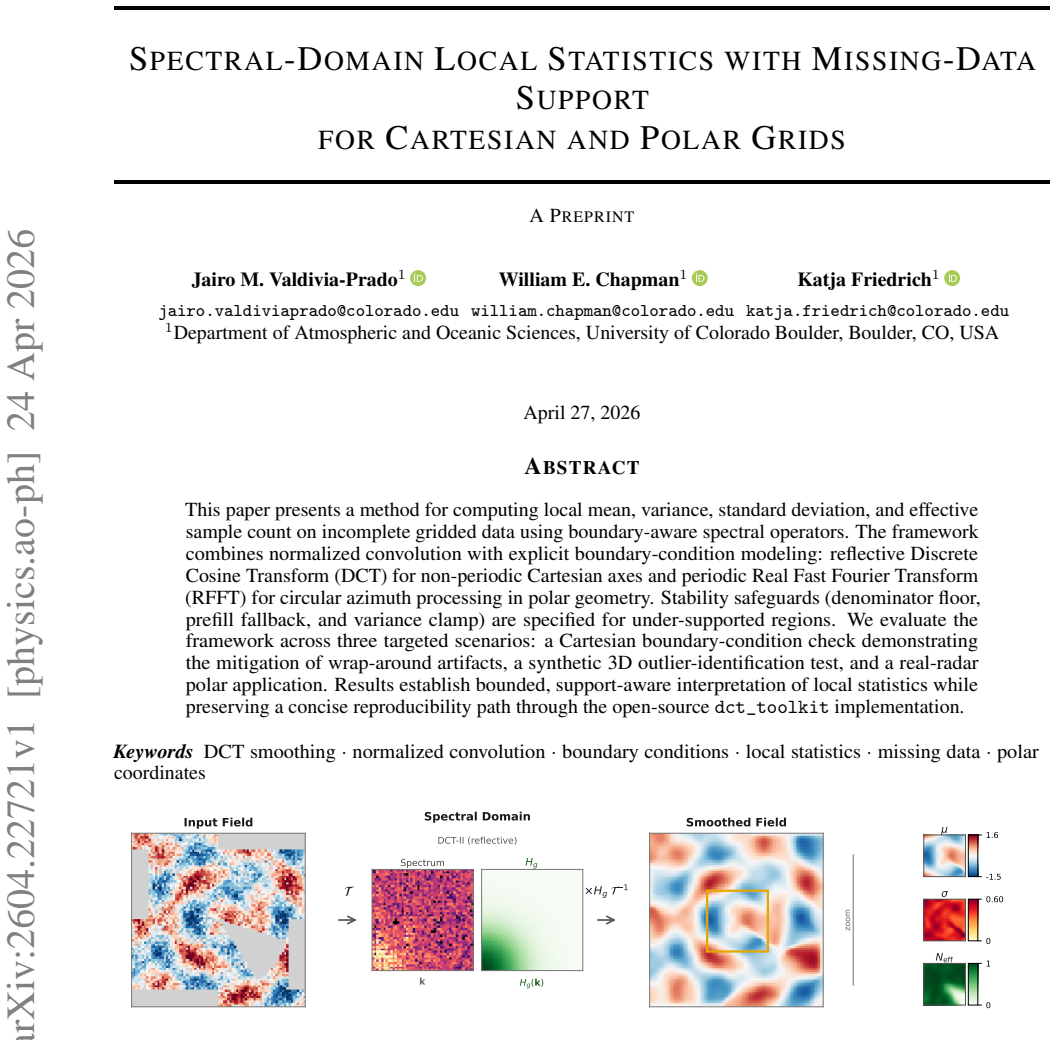
A spectral framework computes local mean, variance, and standard deviation on incomplete Cartesian and polar grids by combining normalized convolution with boundary-aware transforms.
A machine-rendered reading of the paper's core claim, the machinery that carries it, and where it could break.
Core claim
The central claim is that normalized convolution performed with reflective DCT boundary handling on non-periodic Cartesian directions and periodic RFFT handling on circular azimuth directions, together with explicit denominator floors, prefill fallbacks, and variance clamps, produces bounded, support-aware local mean, variance, standard deviation, and effective sample count on incomplete grids.
What carries the argument
Normalized convolution realized through boundary-aware spectral operators: reflective DCT for Cartesian non-periodicity and periodic RFFT for polar circularity, augmented by denominator-floor, prefill-fallback, and variance-clamp safeguards.
If this is right
- Cartesian boundary checks show elimination of wrap-around artifacts that appear with standard periodic assumptions.
- Synthetic 3D outlier tests yield support-aware variance that correctly flags anomalies without false positives near data gaps.
- Real-radar polar applications produce bounded local statistics suitable for interpretation even in sparsely sampled azimuth sectors.
- An open-source implementation supplies a concise, reproducible path for applying the operators to new datasets.
Where Pith is reading between the lines
- The same boundary-aware spectral construction could be tested on other incomplete gridded fields such as satellite imagery or climate reanalyses to check transferability.
- Extending the safeguards to time-varying data would allow direct application to sequential radar volumes without re-deriving the operators.
- Comparing the method against convolution kernels of varying support sizes on the same incomplete grid would quantify how much the spectral route reduces edge bias.
Load-bearing premise
The chosen reflective and periodic boundary conditions plus the stability safeguards produce accurate statistics without introducing new artifacts on real incomplete data.
What would settle it
Running the operators on a controlled synthetic Cartesian or polar grid whose true local mean and variance are known in advance and then checking whether the recovered values stay bounded and match the ground truth in under-supported regions.
Figures


read the original abstract
This paper presents a method for computing local mean, variance, standard deviation, and effective sample count on incomplete gridded data using boundary-aware spectral operators. The framework combines normalized convolution with explicit boundary-condition modeling: reflective Discrete Cosine Transform (DCT) for non-periodic Cartesian axes and periodic Real Fast Fourier Transform (RFFT) for circular azimuth processing in polar geometry. Stability safeguards (denominator floor, prefill fallback, and variance clamp) are specified for under-supported regions. We evaluate the framework across three targeted scenarios: a Cartesian boundary-condition check demonstrating the mitigation of wrap-around artifacts, a synthetic 3D outlier-identification test, and a real-radar polar application. Results establish bounded, support-aware interpretation of local statistics while preserving a concise reproducibility path through the open-source 'dct\_toolkit' implementation.
Editorial analysis
A structured set of objections, weighed in public.
Referee Report
Summary. The paper presents a spectral-domain framework for computing local mean, variance, standard deviation, and effective sample count on incomplete gridded data. It combines normalized convolution with reflective Discrete Cosine Transform (DCT) boundary conditions for non-periodic Cartesian axes and periodic Real Fast Fourier Transform (RFFT) for circular azimuths in polar geometry, plus three explicit stability safeguards (denominator floor, prefill fallback, variance clamp) for under-supported regions. The method is evaluated in three scenarios: a Cartesian boundary-condition check, a synthetic 3D outlier-identification test, and a real-radar polar application, with results claimed to establish bounded, support-aware statistics and supported by an open-source 'dct_toolkit' implementation.
Significance. If the central claims hold, the approach offers an efficient, reproducible alternative to spatial-domain methods for handling missing data in geophysical grids (e.g., radar, satellite), with explicit boundary modeling that avoids wrap-around artifacts. The open-source implementation and focus on polar geometry are strengths that could aid adoption in atmospheric and oceanic data processing.
major comments (2)
- [Abstract] Abstract: the claim that the three safeguards 'establish bounded, support-aware interpretation' without new artifacts is not supported by any derivation showing that the denominator floor, prefill fallback, and variance clamp commute with the DCT/RFFT operators or preserve the exact normalized-convolution identity when the support mask is non-uniform; in regimes where support falls below the implicit window size, prefill can inject values whose spectral leakage is not corrected by the denominator term.
- [Abstract] Abstract: the three evaluation scenarios are described but no quantitative error metrics, bias measurements, or comparisons to spatial-domain normalized convolution baselines are provided, preventing verification that the spectral implementation remains faithful to the available data support.
minor comments (1)
- The reproducibility path via 'dct_toolkit' is noted but the manuscript would benefit from explicit pseudocode or a small worked example showing how the safeguards interact with the spectral operators.
Simulated Author's Rebuttal
We thank the referee for the careful and constructive review. We address each major comment point by point below. Where the comments correctly identify gaps in the original manuscript, we have revised the text accordingly.
read point-by-point responses
-
Referee: [Abstract] Abstract: the claim that the three safeguards 'establish bounded, support-aware interpretation' without new artifacts is not supported by any derivation showing that the denominator floor, prefill fallback, and variance clamp commute with the DCT/RFFT operators or preserve the exact normalized-convolution identity when the support mask is non-uniform; in regimes where support falls below the implicit window size, prefill can inject values whose spectral leakage is not corrected by the denominator term.
Authors: We agree that the original abstract overstates the guarantees provided by the safeguards. The manuscript does not contain a formal derivation proving commutation with the DCT/RFFT operators or exact preservation of the normalized-convolution identity for arbitrary non-uniform masks. The safeguards are practical post-processing steps applied after the spectral computation to enforce non-negative variances and minimum effective sample counts; prefill is used only as a fallback when the denominator falls below a threshold. In low-support regimes this can indeed introduce uncorrected spectral leakage. In the revised manuscript we have replaced the abstract claim with a more precise statement and added a short subsection in the Methods section that discusses the limitations of the safeguards together with a small-scale numerical comparison between the spectral and direct spatial implementations on a test grid containing both well-supported and under-supported regions. revision: yes
-
Referee: [Abstract] Abstract: the three evaluation scenarios are described but no quantitative error metrics, bias measurements, or comparisons to spatial-domain normalized convolution baselines are provided, preventing verification that the spectral implementation remains faithful to the available data support.
Authors: The original evaluation section emphasized qualitative demonstration of boundary handling and practical utility rather than quantitative benchmarking. We accept that this leaves the fidelity claim insufficiently verified. In the revised manuscript we have added a new quantitative subsection that reports (i) root-mean-square difference and bias between the spectral local statistics and a reference spatial-domain normalized-convolution implementation on the synthetic 3D test case, and (ii) error statistics for the polar-radar example computed against a high-resolution reference obtained from denser sampling periods. These metrics are restricted to regions where the local support exceeds the implicit window size, consistent with the method’s design. revision: yes
Circularity Check
No circularity: framework uses standard transforms and explicit definitions
full rationale
The paper defines its method by combining normalized convolution with established boundary-aware spectral operators (reflective DCT for Cartesian axes, periodic RFFT for polar azimuth). These are standard, externally verifiable transforms rather than quantities defined in terms of the target statistics. Stability safeguards (denominator floor, prefill fallback, variance clamp) are presented as explicit, user-specified components of the implementation for under-supported regions, not as outputs derived from or fitted to the statistics themselves. No equations reduce predictions to inputs by construction, no self-citations form load-bearing uniqueness arguments, and no ansatz is smuggled via prior work. The derivation chain is self-contained against external benchmarks (standard DCT/RFFT libraries and normalized convolution literature) and does not exhibit any of the enumerated circular patterns.
Axiom & Free-Parameter Ledger
free parameters (2)
- denominator floor
- variance clamp
axioms (2)
- domain assumption Reflective DCT correctly models non-periodic boundaries without wrap-around artifacts.
- domain assumption Periodic RFFT correctly handles circular azimuth in polar grids.
Reference graph
Works this paper leans on
-
[1]
doi:10.1175/1520-0426(2002)019<0673:UOTDRS>2.0.CO;2. J. C. Hubbert, M. Dixon, S. M. Ellis, and G. Meymaris. Weather radar ground clutter. part i: Identifica- tion, modeling, and simulation.Journal of Atmospheric and Oceanic Technology, 26(7):1165–1180, 2009. doi:10.1175/2009JTECHA1159.1. Joan Bech, Bernat Codina, Jeroni Lorente, and David Bebbington. The ...
-
[2]
doi:10.1109/T-C.1974.223784. J. Makhoul. A fast cosine transform in one and two dimensions.IEEE Transactions on Acoustics, Speech, and Signal Processing, 28(1):27–34, 1980. doi:10.1109/TASSP.1980.1163351. Gilbert Strang. The discrete cosine transform.SIAM Review, 41(1):135–147, 1999. doi:10.1137/S0036144598336745. Michael K. Ng, Raymond H. Chan, and Wun-C...
-
[3]
Frédéric Fabry.Radar Meteorology: Principles and Practice
doi:10.1109/PROC.1979.11511. Frédéric Fabry.Radar Meteorology: Principles and Practice. Cambridge University Press, 2015. doi:10.1017/CBO9781107707405. Jairo M. Valdivia, Will Chapman, and Katja Friedrich. Radar data smoothing using the discrete cosine transform: A fast spectral domain algorithm.EGUsphere [preprint], 2026. doi:10.5194/egusphere-2026-415. ...
discussion (0)
Sign in with ORCID, Apple, or X to comment. Anyone can read and Pith papers without signing in.