Recognition: unknown
Multiplex Hypergraph Modeling of Higher Order Structures in Psychometric Networks
Pith reviewed 2026-05-08 08:55 UTC · model grok-4.3
The pith
A multiplex hypergraph model using information measures shows synergy forming a stable transdiagnostic core in eating disorder symptoms while redundancy stays limited to body-image domains.
A machine-rendered reading of the paper's core claim, the machinery that carries it, and where it could break.
Core claim
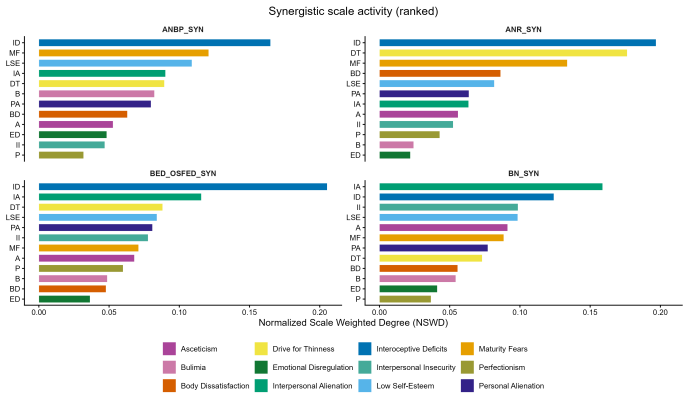
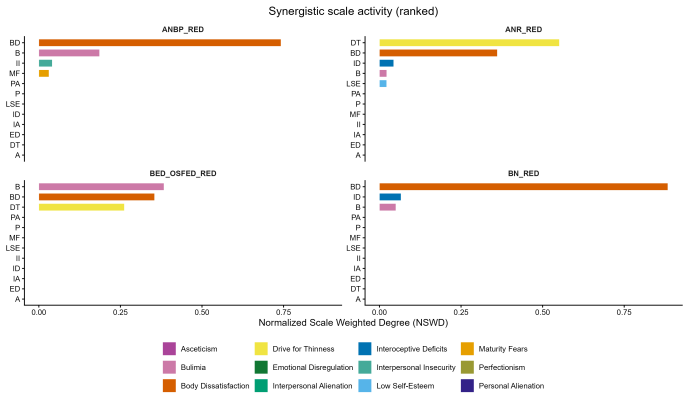
The authors establish that their information-theoretic multiplex hypergraph framework, applied to eating disorders data through targeted candidate selection and inferential testing, shows synergy capturing the emergent higher-order organization of diagnoses by revealing both a stable transdiagnostic core and diagnosis-specific ways in which symptom domains combine, whereas redundancy remains confined to eating and body-image related content.
What carries the argument
The diagnosis-layered multiplex hypergraph constructed from Ω-information on selected higher-order symptom subsets, assembled via a pipeline of dyadic topology-based candidate selection followed by null-model testing and bootstrap assessment.
If this is right
- Synergistic hypergraphs identify both a shared symptom core and diagnosis-specific combinations across eating disorder groups.
- Redundant hypergraphs mark reinforcement primarily within eating and body-image symptom domains.
- The layered multiplex structure allows direct comparison of higher-order organizations between diagnostic categories such as anorexia nervosa.
- Higher-order dependencies supply information beyond what pairwise symptom relations can provide in psychometric networks.
Where Pith is reading between the lines
- The same hypergraph construction could be applied to symptom data from other psychiatric conditions to test for additional transdiagnostic cores.
- Linking these synergistic structures to longitudinal clinical records could reveal whether they predict symptom progression or treatment response.
- Replacing the current selection step with methods that avoid dyadic pre-filtering might expose whether the reported core remains stable under broader search.
- Combining the Ω-information layers with causal modeling techniques could help clarify whether the observed higher-order patterns arise from direct interactions or shared causes.
Load-bearing premise
The targeted selection of candidate subsets from dyadic network topology plus the three-stage inferential pipeline of null-model testing and bootstrap reliably identifies true higher-order structures without systematic omission or bias.
What would settle it
Repeating the full analysis on the same dataset but replacing the dyadic topology-guided candidate selection with an exhaustive or random search over subsets and obtaining substantially different synergistic cores or hypergraph structures would show the pipeline misses or misidentifies key higher-order interactions.
Figures




read the original abstract
Psychiatric disorders have been traditionally conceptualized as latent conditions producing observable symptoms, but recent studies suggest that psychopathology may emerge from symptoms interactions. Psychometric networking model these relations focusing on pairwise associations but overlooks higher-order dependencies arising among groups of variables. These dependencies may reflect synergistic mechanisms, where joint symptom configurations convey more information than pairwise relations, or redundancy, where information overlaps. We introduce an information-theoretic multiplex hypergraph framework to identify and compare higher-order interactions in eating disorders data, across diagnostic groups (e.g., anorexia nervosa). Higher-order structures are quantified using $\Omega$-information, a measure that captures the balance between redundancy and synergy. To address the combinatorial growth of candidate subsets, multiple testing and estimation instability, we propose a structured pipeline comprising: (i) targeted candidate selection based on dyadic network topology and theory-driven subscale information; (ii) a three-stage inferential procedure combining null-model testing with bootstrap robustness assessment; and (iii) the construction and analysis of diagnosis-layered, synergistic and redundant multiplex hypergraphs. Results highlight how synergy captures the emergent, higher-order organization of diagnoses, revealing both a stable transdiagnostic core and diagnosis-specific ways in which these domains combine. By contrast, redundancy is confined to eating and body-image related content, marking reinforcement rather than broader symptom integration.
Editorial analysis
A structured set of objections, weighed in public.
Referee Report
Summary. The paper introduces an information-theoretic multiplex hypergraph framework to model higher-order synergistic and redundant interactions in psychometric networks for eating disorder data. It defines Ω-information to quantify the balance of synergy and redundancy, proposes a three-stage pipeline of dyadic-topology plus theory-driven candidate selection, null-model testing with bootstrap robustness checks, and constructs diagnosis-layered synergistic/redundant multiplex hypergraphs. The central empirical claim is that synergy reveals a stable transdiagnostic core plus diagnosis-specific domain combinations, while redundancy is limited to eating and body-image content.
Significance. If the pipeline reliably recovers true higher-order structures, the work would advance psychometric network modeling by moving beyond pairwise associations to capture emergent organization in psychopathology. The multiplex hypergraph construction for cross-diagnosis comparison is a concrete methodological contribution that could be adopted in other symptom-network studies.
major comments (1)
- [Abstract and pipeline description] Abstract and pipeline description: the targeted candidate selection step restricts subsets to those suggested by dyadic network topology and theory-driven subscales before any Ω-information testing occurs. This creates a selection bias risk that genuine higher-order synergies among variables with weak or absent pairwise associations are never evaluated, directly threatening the claim that the resulting hypergraphs faithfully represent the 'emergent, higher-order organization of diagnoses' and the reported stable transdiagnostic core.
minor comments (1)
- [Abstract] The abstract states results but supplies no numerical values, effect sizes, or example hyperedges; the full manuscript should include at least one concrete table or figure with Ω-information values, p-values, and bootstrap intervals for the reported transdiagnostic core.
Simulated Author's Rebuttal
We thank the referee for their constructive feedback and the opportunity to clarify aspects of our methodological pipeline. We respond to the single major comment below and indicate the revisions we will incorporate.
read point-by-point responses
-
Referee: [Abstract and pipeline description] Abstract and pipeline description: the targeted candidate selection step restricts subsets to those suggested by dyadic network topology and theory-driven subscales before any Ω-information testing occurs. This creates a selection bias risk that genuine higher-order synergies among variables with weak or absent pairwise associations are never evaluated, directly threatening the claim that the resulting hypergraphs faithfully represent the 'emergent, higher-order organization of diagnoses' and the reported stable transdiagnostic core.
Authors: We acknowledge that our candidate selection procedure—filtering subsets according to dyadic network topology and theory-driven subscales prior to Ω-information computation—introduces a genuine risk of missing higher-order synergies lacking strong pairwise signals. This step was implemented to render the combinatorial search tractable for psychometric datasets and to integrate domain knowledge, yet we agree it precludes an exhaustive enumeration of all possible higher-order structures. In the revised manuscript we will (i) insert an explicit limitations paragraph in the Methods section describing this selection bias and its consequences for completeness, (ii) qualify the abstract and discussion claims to refer to structures identified “within the theory- and dyadic-informed candidate space” rather than asserting a complete representation of emergent organization, and (iii) add a forward-looking statement in the Discussion proposing alternative candidate-generation strategies (e.g., higher-order screening or machine-learning filters) for future work. These textual revisions will temper the interpretation of the transdiagnostic core while preserving the robustness checks already performed on the selected subsets. revision: partial
Circularity Check
No significant circularity detected in derivation chain
full rationale
The paper introduces Ω-information as an independent information-theoretic measure of redundancy-synergy balance and derives results via an explicit three-stage pipeline of dyadic-topology candidate selection, null-model testing, and bootstrap assessment applied to empirical eating-disorder data. No step reduces a claimed prediction or higher-order structure to a fitted parameter or self-citation by construction; the transdiagnostic core and diagnosis-specific findings are outputs of the data analysis rather than tautological re-statements of the method definitions. The candidate-selection heuristic is a methodological filter whose limitations are acknowledged but does not create self-definitional or fitted-input circularity.
Axiom & Free-Parameter Ledger
axioms (1)
- domain assumption Higher-order dependencies among symptoms exist and convey information beyond pairwise associations.
invented entities (2)
-
Omega-information
no independent evidence
-
diagnosis-layered multiplex hypergraph
no independent evidence
Reference graph
Works this paper leans on
-
[1]
Garner, D. M. (2004). Eating Disorder Inventory--3: Professional manual. Psychological Assessment Resources
2004
-
[2]
(2020) Eating Disorder Inventory-3, American clinical cases
Brookings, Jeffrey. (2020) Eating Disorder Inventory-3, American clinical cases. Ann Arbor, MI: Inter-university Consortium for Political and Social Research [distributor], 2020-06-04. https://doi.org/10.3886/E109443V2
-
[3]
American Psychiatric Association. (2022). Diagnostic and statistical manual of mental disorders (5th ed., text rev.; DSM-5-TR). American Psychiatric Publishing
2022
-
[4]
Punzi, C., et al. (2023). Network-based validation of the EDI-3 for the assessment of eating disorders. Scientific Reports, 13, 1578. https://doi.org/10.1038/s41598-023-28641-6
-
[5]
Feng, B., Harms, J., Chen, E., Gao, P., Xu, P., & He, Y. (2023). Current discoveries and future implications of eating disorders. International Journal of Environmental Research and Public Health, 20(14), 6325. https://doi.org/10.3390/ijerph20146325
-
[6]
A., Osborn, K., Hooper, K., Vanzhula, I., & Ralph-Nearman, C
Levinson, C. A., Osborn, K., Hooper, K., Vanzhula, I., & Ralph-Nearman, C. (2024). Evidence-based assessments for transdiagnostic eating disorder symptoms: Guidelines for current use and future directions. Assessment, 31(1), 145--167. https://doi.org/10.1177/10731911231201150
-
[7]
Barakat, S., McLean, S. A., Bryant, E., et al. (2023). Risk factors for eating disorders: Findings from a rapid review. Journal of Eating Disorders, 11, 8. https://doi.org/10.1186/s40337-022-00717-4
-
[8]
H., Friborg, O., & Rokkedal, K
Clausen, L., Rosenvinge, J. H., Friborg, O., & Rokkedal, K. (2011). Validation of the Eating Disorder Inventory--3 in a clinical sample. International Journal of Eating Disorders, 44(7), 642--646
2011
-
[9]
Bhattacharya, A., DeFilipp, L., & Timko, C. A. (2020). Chapter 24 --- Feeding and eating disorders. In R. Lanzenberger et al. (Eds.), Handbook of Clinical Neurology (Vol. 175, pp. 387--403). Elsevier
2020
-
[10]
Ortiz, A. M. L., Peters, A. S., Webber, K. T., Butler, R. M., Fitterman-Harris, H. F., & Levinson, C. A. (2026). Eating disorder symptoms and corresponding evidence-based treatments: A narrative review. Journal of Eating Disorders, 14(1), 45. https://doi.org/10.1186/s40337-025-01485-7
-
[11]
T., Dorer, D
Eddy, K. T., Dorer, D. J., Franko, D. L., Tahilani, K., Thompson-Brenner, H., & Herzog, D. B. (2008). Diagnostic crossover in anorexia nervosa and bulimia nervosa: Implications for DSM-V. American Journal of Psychiatry
2008
-
[12]
G., Cooper, Z., & Shafran, R
Fairburn, C. G., Cooper, Z., & Shafran, R. (2003). Cognitive behaviour therapy for eating disorders: A transdiagnostic theory and treatment. Behaviour Research and Therapy, 41(5), 509--528
2003
-
[13]
Borsboom, D. (2017). A network theory of mental disorders. World Psychiatry, 16(1), 5--13. https://doi.org/10.1002/wps.20375
-
[14]
Friedman, J., Hastie, T., & Tibshirani, R. (2008). Sparse inverse covariance estimation with the graphical lasso. Biostatistics, 9(3), 432--441. https://doi.org/10.1093/biostatistics/kxm045
-
[15]
Epskamp, S., Borsboom, D., & Fried, E. I. (2018). Estimating psychological networks and their accuracy: A tutorial paper. Behavior Research Methods, 50(1), 195--212. https://doi.org/10.3758/s13428-017-0862-1
-
[16]
Borsboom, D., & Cramer, A. O. J. (2013). Network analysis: An integrative approach to the structure of psychopathology. Annual Review of Clinical Psychology, 9, 91--121. https://doi.org/10.1146/annurev-clinpsy-050212-185608
-
[17]
McNally, R. J. (2016). Can network analysis transform psychopathology? Behaviour Research and Therapy, 86, 95--104. https://doi.org/10.1016/j.brat.2016.06.006
-
[18]
Benson, A. R., Abebe, R., Schaub, M. T., Jadbabaie, A., & Kleinberg, J. (2018). Simplicial closure and higher-order link prediction. Proceedings of the National Academy of Sciences, 115(48), E11221--E11230. https://doi.org/10.1073/pnas.1800683115
-
[19]
Battiston, F., et al. (2021). The physics of higher-order interactions in complex systems. Nature Physics, 17(10), 1093--1098. https://doi.org/10.1038/s41567-021-01371-4
-
[20]
Punzi, C., Petti, M., & Tieri, P. (2022). Network-based methods for psychometric data of eating disorders: A systematic review. PLoS One. https://doi.org/10.1371/journal.pone.0276341
-
[21]
E., Stella, M., Comolatti, R., Colenbier, N., Stramaglia, S., & Rosseel, Y
Marinazzo, D., Van Roozendaal, J., Rosas, F. E., Stella, M., Comolatti, R., Colenbier, N., Stramaglia, S., & Rosseel, Y. (2024). An information-theoretic approach to build hypergraphs in psychometrics. Behavior Research Methods, 56(1). https://doi.org/10.3758/s13428-023-02262-4
-
[22]
Choo, H., Bu, F., Hwang, H., Yoon, Y., & Shin, K. (2025). HyperSearch: Prediction of new hyperedges through unconstrained yet efficient search. ICDM. https://doi.org/10.48550/arXiv.2510.17153
-
[23]
Christensen, A. P., Garrido, L. E., & Golino, H. (2020). Unique variable analysis: A network psychometrics method to detect local dependence. PsyArXiv. https://doi.org/10.31234/osf.io/4kra2
-
[24]
F., Montresor, A., & Battiston, F
Lotito, Q. F., Montresor, A., & Battiston, F. (2024). Multiplex measures for higher-order networks. Applied Network Science, 9, 55. https://doi.org/10.1007/s41109-024-00665-9
-
[25]
Rosas, F. E., Mediano, P. A. M., Gastpar, M., & Jensen, H. J. (2019). Quantifying high-order interdependencies via multivariate information theory. Physical Review E, 100(3), 032305. https://doi.org/10.1103/PhysRevE.100.032305
-
[26]
Rhemtulla, M., Brosseau-Liard, P. E., & Savalei, V. (2012). When can categorical variables be treated as continuous? Psychological Methods, 17(3), 354--373. https://doi.org/10.1037/a0029315
-
[27]
Johal, S. K., & Rhemtulla, M. (2023). Comparing estimation methods for psychometric networks with ordinal data. Psychological Methods, 28(6), 1251--1272. https://doi.org/10.1037/met0000449
-
[28]
P., Chacón-Moscoso, S., Barbero-García, I., & Vila-Abad, E
Holgado-Tello, F. P., Chacón-Moscoso, S., Barbero-García, I., & Vila-Abad, E. (2010). Polychoric versus Pearson correlations in exploratory and confirmatory factor analysis. Quality & Quantity, 44, 153--166. https://doi.org/10.1007/s11135-008-9190-y
-
[29]
Kiwanuka, F., Kopra, J., Sak-Dankosky, J., Nanyonga, R. C., & Kvist, T. (2022). Polychoric correlation with ordinal data in nursing research. Nursing Research, 71(6), 460--469. https://doi.org/10.1097/NNR.0000000000000600
-
[30]
Liu, H., Lafferty, J., & Wasserman, L. (2009). The nonparanormal: Semiparametric estimation of high-dimensional undirected graphs. Journal of Machine Learning Research, 10, 2295--2328
2009
-
[31]
Fox, J. (2016). polycor: Polychoric and polyserial correlations. R package documentation
2016
-
[32]
Gao, X., Zhou, F., Xu, K., Tian, X., & Chen, Y. (2022). A parallel algorithm for maximal cliques enumeration to improve hypergraph construction. Journal of Computational Science, 65, 101905. https://doi.org/10.1016/j.jocs.2022.101905
-
[33]
Contisciani, M., Battiston, F., & De Bacco, C. (2022). Inference of hyperedges and overlapping communities in hypergraphs. Nature Communications, 13, 7229. https://doi.org/10.1038/s41467-022-34714-7
-
[34]
Yang, Z., Algesheimer, R., & Tessone, C. J. (2016). A comparative analysis of community detection algorithms on artificial networks. Scientific Reports, 6, 30750. https://doi.org/10.1038/srep30750
-
[35]
Benjamini, Y., & Hochberg, Y. (1995). Controlling the false discovery rate: A practical and powerful approach to multiple testing. Journal of the Royal Statistical Society: Series B, 57, 289--300
1995
-
[36]
Efron, B., & Tibshirani, R. J. (1994). An introduction to the bootstrap. Chapman & Hall/CRC
1994
-
[37]
J., & Efron, B
DiCiccio, T. J., & Efron, B. (1996). Bootstrap confidence intervals. Statistical Science, 11(3), 189--228
1996
-
[38]
C., & Hinkley, D
Davison, A. C., & Hinkley, D. V. (1997). Bootstrap methods and their application. Cambridge University Press
1997
-
[39]
Efron, B., & Narasimhan, B. (2020). The automatic construction of bootstrap confidence intervals. Journal of Computational and Graphical Statistics, 29(3), 608--619. https://doi.org/10.1080/10618600.2020.1714633
discussion (0)
Sign in with ORCID, Apple, or X to comment. Anyone can read and Pith papers without signing in.