Recognition: unknown
An algebraic characterization of non-singular matrix semicircles
Pith reviewed 2026-05-08 07:07 UTC · model grok-4.3
The pith
Non-singularity of a matrix semicircle at the origin is equivalent to the generating matrix pencil being LR-semisimple and to the covariance map being symmetrically DS-scalable.
A machine-rendered reading of the paper's core claim, the machinery that carries it, and where it could break.
Core claim
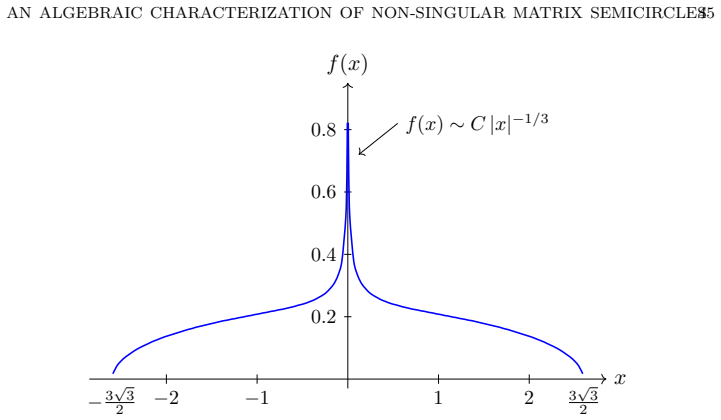
The matrix pencil A is LR-semisimple if and only if the matrix semicircle S is non-singular at t=0 if and only if the covariance map η is symmetrically DS-scalable. When these conditions hold, the spectral density f(0) equals (1/π) tr(C), where C is the unique trace minimizer of the positive definite solutions to η(W) W = I.
What carries the argument
Symmetric DS-scalability of the covariance map η: X ↦ sum Ai X Ai, shown equivalent to LR-semisimple decomposition of the pencil via Gurvits capacity theory and geodesic reflection in the positive definite matrices.
If this is right
- The value of the spectral density at zero is given explicitly by f(0) = (1/π) tr(C) for the trace-minimizing C.
- The matrix semicircle is non-singular at zero exactly when the pencil decomposes as a direct sum of unsplittable pencils up to left-right equivalence.
- The Lyapunov-Schmidt reduction at the trace-minimizing solution has positive definite Jacobian, so earlier stability hypotheses are unnecessary.
Where Pith is reading between the lines
- For concrete matrices one can solve numerically for a positive definite W satisfying η(W) W = I and check whether its trace is minimal to decide non-singularity without computing the full Cauchy transform.
- The same capacity-plus-reduction argument might apply to other free random-matrix ensembles whose covariance maps satisfy similar positivity and self-adjointness conditions.
Load-bearing premise
The equation η(W) W = I admits a unique trace-minimizing positive definite solution C at which the Jacobian of the reduced bifurcation equations is positive definite.
What would settle it
Take any matrix pencil that cannot be decomposed into unsplittable summands up to left-right equivalence; if its associated matrix semicircle still possesses a continuous boundary limit for the Cauchy transform at the origin, the claimed equivalence is false.
Figures
read the original abstract
Let $A_1, \ldots, A_r$ be Hermitian $n \times n$ matrices and $S = \sum A_i \otimes s_i$ the associated matrix semicircle, where $s_1, \ldots, s_r$ are free semicircular variables. We prove that the following are equivalent: (i) the matrix pencil $A = \sum A_i x_i$ is LR-semisimple (decomposes, up to left--right equivalence, as a direct sum of unsplittable pencils); (ii) $S$ is non-singular at $t = 0$ (the matrix-valued Cauchy transform has a continuous boundary limit near the origin); (iii) the covariance map $\eta\colon X \mapsto \sum A_i X A_i$ is symmetrically DS-scalable (there exists $C \succ 0$ with $\eta(C) = C^{-1}$). When these hold, the spectral density satisfies $f(0) = \frac{1}{\pi}\,\mathrm{tr}(C)$, where $C$ is the unique trace minimizer of the solution set $\{W \succ 0 : \eta(W)\,W = I\}$. The proof combines algebraic and analytic ingredients. On the algebraic side, we establish the equivalence (i) $\Leftrightarrow$ (iii) using Gurvits' capacity theory for indecomposable maps and a geodesic reflection theorem in the Riemannian manifold of positive definite matrices, which upgrades DS-scalability to symmetric DS-scalability for self-adjoint completely positive maps. On the analytic side, we prove (iii) $\Rightarrow$ (ii) via a Lyapunov--Schmidt reduction of Speicher's equation at a trace-minimizing solution, showing that the Jacobian of the bifurcation equations is positive definite. This removes a stability hypothesis that was required in earlier approaches.
Editorial analysis
A structured set of objections, weighed in public.
Referee Report
Summary. The paper proves the equivalence of three statements for Hermitian matrices A_1,...,A_r and the associated matrix semicircle S = sum A_i ⊗ s_i: (i) the pencil A = sum A_i x_i is LR-semisimple (decomposes up to left-right equivalence into unsplittable pencils); (ii) S is non-singular at t=0 (matrix-valued Cauchy transform has continuous boundary values near the origin); (iii) the covariance map η(X) = sum A_i X A_i is symmetrically DS-scalable (exists C ≻ 0 with η(C) = C^{-1}). When these hold, the spectral density satisfies f(0) = (1/π) tr(C) with C the unique trace minimizer of {W ≻ 0 : η(W)W = I}. The proof splits into an algebraic part using Gurvits capacity and geodesic reflection on positive-definite matrices to equate (i) and (iii), and an analytic part using Lyapunov-Schmidt reduction of Speicher's equation at the trace minimizer to obtain (iii) ⇒ (ii) while removing a prior stability hypothesis.
Significance. If the equivalences hold, the result supplies an algebraic criterion for non-singularity of matrix semicircles, connecting free probability, completely positive maps, and algebraic geometry. The removal of the stability assumption broadens the scope relative to earlier work, and the explicit formula for f(0) in terms of the trace minimizer C is a concrete payoff. The combination of Gurvits theory with Riemannian geometry on positive-definite matrices is a notable technical bridge.
major comments (1)
- [analytic part / Lyapunov-Schmidt reduction] § on analytic side, Lyapunov-Schmidt reduction of Speicher's equation: the claim that the Jacobian of the reduced bifurcation equations is positive definite at the asserted unique trace minimizer C is invoked to conclude non-singularity at t=0, yet the manuscript supplies no separate argument or explicit computation showing that the first-order minimality condition (vanishing variation of tr(W) under the constraint η(W)W = I) forces the required second-order positivity on the reduced Jacobian. This step is load-bearing for (iii) ⇒ (ii) and for the removal of the stability hypothesis.
Simulated Author's Rebuttal
We thank the referee for the careful reading of the manuscript and for highlighting the need for greater explicitness in the analytic portion of the argument. The observation identifies a genuine gap in the presentation of the Lyapunov–Schmidt reduction, and we will strengthen the manuscript accordingly.
read point-by-point responses
-
Referee: [analytic part / Lyapunov-Schmidt reduction] § on analytic side, Lyapunov-Schmidt reduction of Speicher's equation: the claim that the Jacobian of the reduced bifurcation equations is positive definite at the asserted unique trace minimizer C is invoked to conclude non-singularity at t=0, yet the manuscript supplies no separate argument or explicit computation showing that the first-order minimality condition (vanishing variation of tr(W) under the constraint η(W)W = I) forces the required second-order positivity on the reduced Jacobian. This step is load-bearing for (iii) ⇒ (ii) and for the removal of the stability hypothesis.
Authors: We agree that the manuscript does not supply a separate, self-contained argument establishing that the first-order stationarity condition for the trace minimizer C implies positive-definiteness of the reduced Jacobian. In the revised version we will insert a dedicated lemma (placed immediately after the statement of the trace-minimizing property) that computes the second variation of tr(W) on the constraint manifold η(W)W = I and verifies that this quadratic form is positive definite precisely when C is the unique minimizer. The argument relies only on the self-adjointness of η and the strict convexity of the trace functional; it does not invoke any additional stability hypothesis. This addition will make the passage from (iii) to (ii) fully rigorous and will clarify how the stability assumption of earlier work is removed. revision: yes
Circularity Check
No significant circularity in the algebraic-analytic equivalence chain.
full rationale
The paper establishes the three-way equivalence via Gurvits capacity theory plus a geodesic reflection theorem on positive-definite matrices for (i)⇔(iii), followed by a Lyapunov-Schmidt reduction of Speicher's equation that asserts (without reducing to a fitted parameter or self-definition) positive-definiteness of the reduced Jacobian at the trace-minimizer C of {W≻0:η(W)W=I}. C is introduced as the unique trace minimizer and the density formula is stated as a consequence; neither step collapses to an input by construction, nor does any load-bearing premise rest on a self-citation chain. External theorems supply independent content, so the derivation is self-contained.
Axiom & Free-Parameter Ledger
axioms (4)
- domain assumption The matrices A_i are Hermitian n by n matrices
- standard math Gurvits' capacity theory applies to indecomposable completely positive maps
- standard math The geodesic reflection theorem holds in the Riemannian manifold of positive definite matrices
- ad hoc to paper The Jacobian of the bifurcation equations is positive definite at the trace-minimizing solution
Reference graph
Works this paper leans on
-
[1]
doi: 10.4171/dm/780. Greg W. Anderson. Preservation of algebraicity in free probability. Preprint, arXiv:1406.6664,
-
[2]
Alternating minimization, scaling algorithms, and the null- cone problem from invariant theory
Peter B¨ urgisser, Ankit Garg, Rafael Oliveira, Michael Walter, and Avi Wigderson. Alternating minimization, scaling algorithms, and the null- cone problem from invariant theory. In9th Innovations in Theoret- ical Computer Science (ITCS 2018), volume 94 ofLIPIcs. Schloss Dagstuhl – Leibniz-Zentrum f¨ ur Informatik,
2018
-
[3]
Peter B¨ urgisser, Cole Franks, Ankit Garg, Rafael Oliveira, Michael Wal- ter, and Avi Wigderson
arXiv:1711.08039. Peter B¨ urgisser, Cole Franks, Ankit Garg, Rafael Oliveira, Michael Wal- ter, and Avi Wigderson. Towards a theory of non-commutative opti- mization: geodesic first and second order methods for moment maps and polytopes. In60th Annual IEEE Symposium on Foundations of Computer Science (FOCS 2019), pages 845–861. IEEE Computer Soc.,
-
[4]
arXiv:1910.12375. Man-Duen Choi. A Schwarz inequality for positive linear maps onc ∗- algebras.Illinois Journal of Mathematics, 18:565–574,
-
[5]
Paul Moritz Cohn.Free rings and their relations
doi: 10.1215/ijm/1256051007. Paul Moritz Cohn.Free rings and their relations. Academic Press, second edition,
-
[6]
R. Rashidi Far, T. Oraby, W. Bryc, and R. Speicher. Spectra of large block matrices. https://arxiv.org/abs/cs/0610045,
-
[7]
William Helton, Reza Rashidi Far, and Roland Speicher
J. William Helton, Reza Rashidi Far, and Roland Speicher. Operator-valued semicircular elements: Solving a quadratic matrix equation with positivity constraints.International Mathematics Research Notices, 2007,
2007
-
[8]
Tobias Mai and Roland Speicher
doi: 10.1007/ s10208-024-09684-5. Tobias Mai and Roland Speicher. Fuglede–Kadison determinants of matrix-valued semicircular elements and capacity estimates. https://arxiv.org/abs/2406.15922,
-
[9]
doi: 10.1016/j.jfa.2023.110016. J. A. Mingo and R. Speicher.Free Probability and Random Matrices. Schwinger-Verlag,
-
[10]
doi: 10.1090/S0002-9947-2015-06434-4. R. Speicher.Combinatorial Theory of the Free Product with Amal- gamation and Operator-Valued Free Probability Theory, volume 627 ofMemoirs of American Mathematical Society. A.M.S. Prov- idence, RI,
-
[11]
Roland Speicher. Non-commutative distributions. lecture notes. https://arxiv.org/abs/2009.03589,
-
[12]
Cambridge University Press, 2018
John Watrous.The Theory of Quantum Information. Cambridge University Press, 2018
2018
discussion (0)
Sign in with ORCID, Apple, or X to comment. Anyone can read and Pith papers without signing in.