pith. machine review for the scientific record. sign in

math.OA

Operator Algebras

Algebras of operators on Hilbert space, C^*-algebras, von Neumann algebras, non-commutative geometry

0
math.OA 2026-05-14 2 theorems

Left ideals give representation-free quantum graph morphisms

Categorical (Co)Limits of Quantum Graphs

This yields categorical colimits that agree with earlier definitions for quantum graphs.
Figure from the paper full image
abstract click to expand
We begin with the characterization of quantum graphs as left ideals in $\mathcal M \otimes_{eh} \mathcal M$ (the extended Haagerup tensor product of $\mathcal M$ with itself) to avoid technicalities surrounding representation dependence of quantum graphs. These left ideals roughly correspond to a canonical complement of a quantum graph. Using these left ideals and some operator space theory, we find a new, representation-free characterization of a morphism of quantum graphs compatible with previous representation-dependent morphisms. A notion of categorical (co)limit of quantum graphs follows. We also briefly explore an alternative quantization of graphs as bimodules over $C^*$-algebras ($C^*$-graphs), mostly to emphasize the point that a morphism of $C^*$-graphs is not a morphism of $C^*$-correspondences.
0
0
math.OA 2026-05-13 1 theorem

Regular inclusions of simple C*-algebras are twisted crossed products

Regular irreducible inclusions of simple C^*-algebras and crossed product structure

A generalized quasi-basis shows every regular irreducible inclusion equals a reduced twisted crossed product by the Weyl group.

abstract click to expand
We study regular irreducible inclusions $B\subset A$ of simple unital $C^*$-algebras admitting a conditional expectation. We introduce a generalized notion of quasi-basis extending Watatani's framework and show that such inclusions admit a unitary orthonormal generalized quasi-basis. As a consequence, we prove that every regular irreducible inclusion in this setting is canonically isomorphic to a reduced twisted crossed product of $B$ by its Weyl group. This extends earlier crossed product characterizations beyond the finite-index setting.
0
0
math.OA 2026-05-13 2 theorems

q-deformed USp, O and SO groups extended by central unitaries

Compact Quantum Group Extensions of USp_q(2n), O_q(n) and SO_q(2n)

The construction adds one commuting unitary generator while preserving the compact quantum group axioms, generalizing the known SU_q(n) to U

abstract click to expand
I introduce compact quantum group extensions associated with the $q$-deformations of the classical compact groups $USp(2n)$, $O(n,\mathbb{R})$ and $SO(2n,\mathbb{R})$. Motivated by the relationship between $SU_q(n)$ and $U_q(n)$, I study the problem of constructing compact quantum groups $Z_{q,n}$ extending the standard compact quantum groups $A_{q,n}\in\{ {USp_q(2n), O_q(N), SO_q(2n)}\}$ through an additional central unitary element.
0
0
math.OA 2026-05-13 1 theorem

Kubo-Ando means extended to completely positive maps

Relative Kubo-Ando Means of Completely Positive Maps

Definitions via Arveson derivative generalize operator means and match known cases for matrices and geometric means.

abstract click to expand
We introduce relative and intrinsic Kubo--Ando means for completely positive maps on \(C^*\)-algebras. These means extend the usual Kubo--Ando means of positive operators and are defined using Arveson's Radon--Nikodym theorem for completely positive maps. We prove their basic order-theoretic properties, including monotonicity, transformer and Jensen inequalities, data processing, and monotonicity with respect to the ambient map. In the geometric case, we obtain a block-positivity characterization and show that the intrinsic geometric mean vanishes exactly when the two maps have no nonzero common completely positive submap. We further prove agreement with the Choi-matrix mean for maps between matrix algebras and with Okayasu's Pusz--Woronowicz geometric mean on their common domain.
0
0
math.OA 2026-05-11 2 theorems

Commuting operator tuples have spectral radius fixed by normed space

On the spectral radius of operator tuples

The value equals the maximum norm over the joint spectrum regardless of the chosen quantization.

abstract click to expand
In recent work, Shalit and Shamovich associated to every operator space structure $\mathcal{E}$ on $\mathbb{C}^d$ a spectral radius function $\rho_{\mathcal{E}}$ on $d$-tuples of operators. The main goal of this paper is to elucidate how this spectral radius depends on the operator space structure. Let $V = (\mathbb{C}^d, \|\cdot\|_V)$ be a normed space and let $\mathcal{E}$ be a quantization of $V$. We show that for a commuting operator tuple $X$, the spectral radius depends only on the underlying normed space; more precisely, \[ \rho_{\mathcal{E}}(X) = \max\{ \|\lambda\|_V : \lambda \in \sigma(X)\}, \] where $\sigma(X)$ denotes the joint spectrum of $X$. In contrast, we prove that if $\dim V \geq 3$, then $\rho_{\min(V)}(X) \neq \rho_{\max(V)}(X)$ already for some matrix tuple $X$. When $\mathcal{E}_1$ and $\mathcal{E}_2$ are selfadjoint operator spaces, we show that $\rho_{\mathcal{E}_1}(X) = \rho_{\mathcal{E}_2}(X)$ for all tuples $X$ implies $\mathcal{E}_1 = \mathcal{E}_2$. We present two proofs of this result; a key ingredient in one of them is a characterization, of independent interest, of $\rho_{\mathcal{E}}(A)$ in terms of the invertibility domain of the linear pencil associated with $A$. Finally, we prove that if two operator spaces give rise to the same spectral radius function, then the algebras of locally uniformly bounded NC functions on the corresponding NC unit balls coincide.
0
0
math.OA 2026-05-11 Recognition

Scheme builds smooth subalgebras closed under calculus in C*-algebras

Rapid Decay Subalgebras of C^*-Algebras

The construction keeps smooth functions of self-adjoint elements inside the subalgebra and is verified on several examples.

abstract click to expand
We introduce a general scheme of constructing smooth subalgebras of C$^*$-algebras that are closed under the smooth calculus of self-adjoint elements. We illustrate the scheme with a number of examples.
0
0
math.OA 2026-05-11 2 theorems

Ergodic coactions yield new compact quantum hypergroups

Quantum hypergroups arising from ergodic coactions

A natural coproduct on the crossed-product algebra supplies fresh analytical examples and lets coamenability be read off from equivariant C*

abstract click to expand
Given a locally compact quantum group $\mathbb{G}$ and an ergodic, integrable action $L^\infty(\mathbb{X})\stackrel{\alpha}\curvearrowleft \mathbb{G}$, the von Neumann algebra $L^\infty(\mathbb{X}\times_{\mathbb{G}}\bar{\mathbb{X}}):= L^\infty(\mathbb{X})\square \overline{L^\infty(\mathbb{X})}$ is shown to carry a natural normal ucp coassociative map $\Delta_{\mathbb{X}\times_{\mathbb{G}}\bar{\mathbb{X}}}: L^\infty(\mathbb{X}\times_{\mathbb{G}}\bar{\mathbb{X}})\to L^\infty(\mathbb{X}\times_{\mathbb{G}}\bar{\mathbb{X}})\bar{\otimes} L^\infty(\mathbb{X}\times_{\mathbb{G}}\bar{\mathbb{X}})$. Restricting to the class of compact quantum groups, this provides a large class of new examples of (analytical) compact quantum hypergroups. We provide characterizations of coamenability for these compact quantum hypergroups, making use of the theory of equivariant correspondences.
0
0
math.OA 2026-05-11 2 theorems

KSGNS construction forms endofunctor on positive C*-correspondences

Functoriality of the KSGNS Construction for Intertwiners of Strict Positive C^*-Correspondences

Intertwiners that track automorphisms yield unique unitary dilations of strict equivariant correspondences in dynamical systems.

abstract click to expand
We prove that the KSGNS construction can be viewed as an endofunctor on a category whose objects are positive $C^*$-correspondences from a fixed $C^*$-algebra and morphisms are given by intertwiners which account for automorphisms of the fixed $C^*$-algebra. Using this perspective, we provide a functorial perspective for strict positive equivariant $C^*$-correspondences of $C^*$-dynamical systems and show every strict positive equivariant $C^*$-correspondence of $C^*$-dynamical systems unitarily uniquely dilates under the KSGNS construction to an equivariant $C^*$-correspondence of the dynamical systems.
0
0
math.OA 2026-05-08

Weak continuity on unit ball forces linearity for Jordan functionals

The Quasi-linearity problem for Jordan-Banach algebras: a topological characterization

In JB*-algebras without S_2(C) quotients, local quasi-linearity plus uniform weak continuity on the closed unit ball yields full linearity.

abstract click to expand
Let $\mathfrak{J}$ be a JB$^*$-algebra with no quotients isomorphic to $S_2(\mathbb{C})$. Let $\mu$ be a local quasi-linear Jordan functional on $\mathfrak{J}_{sa}$. We show that $\mu$ is a linear functional on $\mathfrak{J}_{sa}$ if and only if the restriction of $\mu$ to the closed unit ball of $\mathfrak{J}_{sa}$ is uniformly weakly continuous.
0
0
math.OA 2026-05-08

Geometric mean and Lebesgue decomposition for CP maps

Geometric Means and Lebesgue-type Decomposition of Completely Positive Maps

The parallel sum construction unifies decompositions of positive operators and functionals while applying to quantum channels.

abstract click to expand
We introduce the geometric mean and the parallel sum of completely positive (CP) maps on von Neumann algebras, based on the Pusz--Woronowicz theory of positive sesquilinear forms. We provide a concrete characterization via a block matrix positivity condition and establish their fundamental properties, including the AM--GM--HM inequality with respect to the CP order. In finite-dimensional settings, our construction is compatible with the Choi--Jamiolkowski correspondence, under which the geometric mean of CP maps corresponds to the Kubo--Ando geometric mean of their Choi matrices. This yields a natural operator-theoretic framework for interpolating quantum channels. As an application, we obtain index-type inequalities for conditional expectations in subfactor theory. Finally, we establish a Lebesgue-type decomposition of CP maps via a parallel sum construction, thereby providing a unified framework that simultaneously generalizes Ando's decomposition of bounded positive operators and Kosaki's decomposition of normal positive functionals on von Neumann algebras.
1 0
0
math.OA 2026-05-05 1 theorem

Almost periodic outer flows on hyperfinite II1 factor are unique

Uniqueness of almost periodic outer flows on the hyperfinite type II₁ factor

Flows with full Connes spectrum satisfy the Rokhlin property, hence all are cocycle conjugate.

abstract click to expand
We show that any almost periodic outer flow $\alpha : \mathbb R \curvearrowright R$ on the hyperfinite type $\mathrm{II}_1$ factor with Connes' spectrum $\Gamma(\alpha) = \mathbb R$ satisfies the Rokhlin property and thus is unique up to cocycle conjugacy. The proof relies on a key cocycle perturbation result for type $\mathrm{III}$ amenable equivalence relations. As a byproduct of our methods, we also show that every almost periodic factor of type $\mathrm{III}_1$ with separable predual has an extremal almost periodic faithful normal state.
0
0
math.OA 2026-05-05

Almost periodic flows on II1 hyperfinite factor all satisfy Rokhlin property

Uniqueness of almost periodic outer flows on the hyperfinite type II₁ factor

Flows with full Connes spectrum become unique up to cocycle conjugacy, completing their classification.

abstract click to expand
We show that any almost periodic outer flow $\alpha : \mathbb R \curvearrowright R$ on the hyperfinite type $\mathrm{II}_1$ factor with Connes' spectrum $\Gamma(\alpha) = \mathbb R$ satisfies the Rokhlin property and thus is unique up to cocycle conjugacy. The proof relies on a key cocycle perturbation result for type $\mathrm{III}$ amenable equivalence relations. As a byproduct of our methods, we also show that every almost periodic factor of type $\mathrm{III}_1$ with separable predual has an extremal almost periodic faithful normal state.
0
0
math.OA 2026-05-05

Shilov boundary ideal equals intersection of Γ-representation kernels

On the Shilov boundary ideal for Fr\'{e}chet local operator systems

The equality holds for separable Fréchet local operator systems and expresses the ideal directly from the system's boundary representations.

abstract click to expand
We show that the Shilov boundary ideal for a separable Fr\'{e}chet local operator system is given by the intersection of the kernels of all its $\Gamma$-boundary representations.
0
0
math.OA 2026-05-04

Group factors engineered with exactly n non-subgroup invariants for any n

Factors with prescribed number of invariant subalgebras not arising from subgroups

ICC groups G are built so L(G) contains precisely n G-invariant von Neumann subalgebras that do not come from subgroups.

abstract click to expand
For any given integer $n\geq 1$, we construct i.c.c. groups $G$ such that the II$_1$ factors $L(G)$ have exactly $n$-many $G$-invariant von Neumann subalgebras not arising from subgroups.
0
0
math.OA 2026-05-04

Ample groupoids are AF exactly when homological dimension is zero

A homological characterization of AF groupoids

The equivalence replaces explicit union constructions with algebraic checks on vanishing homology groups over any unital ring.

abstract click to expand
An ample groupoid is said to be AF if it is a directed union of compact open principal subgroupoids. In this paper, we provide a complete homological characterization of these groupoids. Specifically, we prove that an ample groupoid is AF if and only if it has homological dimension zero. More generally, we characterize groupoids of homological dimension zero over a unital ring $R$.
0
0
math.OA 2026-05-04

Strict comparison holds in uniform Roe algebras of amenable groups

Strict comparison holds in the uniform Roe algebra of a discrete amenable group

When trace dimensions satisfy a strict inequality, one positive element is Cuntz subequivalent to the other in the stabilization of these l^

abstract click to expand
Let $\Gamma$ be a countable discrete amenable group, and let $A=l^\infty(\Gamma) \rtimes \Gamma$ or $A = \mathrm{C}(M) \rtimes \Gamma$, where $(M, \Gamma)$ is the universal minimal set of $\Gamma$. It is shown that if $a, b \in A \otimes \mathcal K$ are positive elements such that $$\mathrm{d}_\tau(a) < \mathrm{d}_\tau(b),\quad \tau \in \mathrm{T}(A),$$ then $a$ is Cuntz subequivalent to $b$.
0
0
math.OA 2026-05-01

Spectral truncations converge in Gromov-Hausdorff distance for quantum groups

Gromov-Hausdorff Convergence of Spectral Truncations for Quantum Groups

Proper length functions define Dirac operators whose truncations recover the metric of SU(N), SO(N) and discrete quantum groups.

abstract click to expand
We study the quantum Gromov-Hausdorff convergence of spectral truncations for compact quantum groups. Using a proper length function, we define a Dirac operator and the associated spectral truncations. This work extends the previous convergence results for tori (Leimbach-van Suijlekom) to a broad class of quantum groups, and provides the first Gromov-Hausdorff convergence result for spectral truncations on quantum groups, encompassing both compact and discrete quantum groups. Our results are applicable to $SU(N)$,$SO(N)$ and discrete quantum groups with strong polynomial growth.
0
0
math.OA 2026-05-01

Exel-Laca algebras dual to Cuntz-Krieger via matrix reciprocity

A class of Exel--Laca algebras reciprocal to Cuntz--Krieger algebras

A class defined by infinite matrices swaps K-theory and extension groups in the Kirchberg duality.

abstract click to expand
The reciprocality means a duality in Kirchberg algebras between K-theory groups and strong extension groups. In the paper, we will find a certain class of unital simple Exel--Laca algebras for which the reciprocal duals are simple Cuntz--Krieger algebras in terms of the underlying infinite matrices. In our procedure to obtain simple Cuntz--Krieger algebras from Exel--Laca algebras, we compute the strong extension groups for Exel--Laca algebras belonging to the class.
0
0
math.OA 2026-04-30

Projections generate algebra linked to vertical Toeplitz operators

On a relationship between orthogonal projections and Toeplitz operators on poly-Bergman spaces of the upper half-plane: vertical symbols

On poly-Bergman spaces of the upper half-plane, all-but-one orthogonal projections in generic position relate closely to Toeplitz operators'

abstract click to expand
In the context of studying $C^*$-algebras generated by Toeplitz operators acting on the poly-Bergman space $\mathcal{A}^2_{n}(\Pi)$ of the upper half-plane $\Pi$, we introduce a system of all-but-one orthogonal projections in generic position. We show that the $C^*$-algebra generated by these orthoprojections is closely related to the $C^*$-algebra generated by all Toeplitz operators with vertical symbols satisfying boundary conditions. This result suggests a new approach in the study of Toeplitz operators acting on other reproducing kernel Hilbert spaces. Furthermore, the range of one of the orthoprojections herein has a reproducing kernel expressed in terms of the digamma and the Nielsen's beta functions. The harmonic function also emerges in this development.
0
0
math.OA 2026-04-30

ℓ^p-pseudofunctions yield isomorphic crossed product algebras for any representation

Crossed product functors associated to ell^p-pseudofunctions

The Banach algebras are isomorphic with a constant depending only on p, generalizing the group case and producing exotic crossed products

abstract click to expand
We show that the $\ell^p$-pseudofunctions, which were recently shown to lead to exotic completions of group $C^*$-algebras by Wiersma and the second named author, can be used to construct well-behaved crossed product functors in the sense of Buss, Echterhoff and Willett. The construction proceeds via introducing certain Banach algebras, related to operators acting on Hilbert valued $\ell^p$-spaces, which a priori depend on the choice of a Hilbert space representation of the underlying C*-algebra. We prove that, in fact, the resulting algebras are isomorphic (with the isomorphism constant depending only on $p$), and hence their C*-envelopes are isometrically isomorphic. This, in particular, means that the construction genuinely generalises the one studied earlier in the group case. The tools we develop allow us to show that for certain non-amenable actions, the resulting crossed product completions must indeed be exotic.
0
0
math.OA 2026-04-30

Subsequence argument extends to noncommutative weighted ergodic theorems

T-admissible processes and noncommutative weighted ergodic theorems

Decay-satisfying sequences from i.i.d. processes and the Möbius function become good weights for bilaterally almost uniform convergence.

abstract click to expand
In this article, we study the bilaterally almost uniform (b.a.u.) convergence of weighted averages of a positive Dunford-Schwartz operator on the noncommutative $L_p$-spaces associated to a semifinite von Neumann algebra by a large number of weighting sequences. We do this by extending the classical "subsequence argument" to the noncommutative setting. This is then used to establish a large number of sequences satisfying a certain decay condition as good weights for the noncommutative individual ergodic theorem. This class includes those sequences generated by bounded i.i.d. sequences and the M\"{o}bius function. We also study similar problems for $T$-admissible processes on a semifinite von Neumann algebra, showing that if a Wiener-Wintner type ergodic theorem holds for a class $\mathcal{U}\subset W_q$ of weights for $T$-additive process, then it also holds for strongly $p$-bounded $T$-admissible processes, assuming that the duality $\frac{1}{p}+\frac{1}{q}=1$ holds and that $T$ is a normal $\tau$-preserving $*$-automorphism.
0
0
math.OA 2026-04-29

Selflessness equals its finitary approximation for separable tracial C*-algebras

A finitary criterion for selfless tracial C*-algebras

The equivalence reduces an abstract global property to finite checks on unitaries and word traces, enabling direct proofs for certain groupC

abstract click to expand
We study the class of selfless C*-probability spaces introduced by Robert. It is known that a selfless tracial algebra has strict comparison and a unique trace. We prove that for separable tracial C*-algebras, selflessness is equivalent to approximate selflessness, a finitary condition: for every finite set $F$, every $N \geq 1$ and $\varepsilon > 0$ there exists a unitary $u$ with $|\tau(u^k)| < \varepsilon$ ($1 \leq |k| \leq N$) and $|\tau(w)| < \varepsilon$ for all alternating words $w$ of length $\leq N$ built from centered elements of $F$ and powers $u^n$ ($|n| \leq N$). The equivalence is established using a diagonalisation argument in the tracial ultrapower. As an application, we give a concise proof that countable groups with a topologically-free extreme boundary are C*-selfless. We also discuss the relation to nuclearity and $\mathcal{Z}$-stability.
0
0
math.OA 2026-04-28

Random averages converge pointwise in non-commutative Lp spaces

Pointwise Convergence for Random Ergodic Averages in Non-commutative L^p-spaces

Extends Bourgain's theorem to semifinite von Neumann algebras along Bernoulli subsequences for all 1<p<∞

abstract click to expand
Let $M$ be a semifinite von Neumann algebra and $T$ a positive contraction on both $L^1(M)$ and $L^\infty(M)$. We consider ergodic averages along a random sparse subsequence determined by independent Bernoulli variables $(X_n)_{n\geq 1}$ with $\mathbb{P}(X_n = 1) = n^{-\alpha}$, and set $W_N = \sum_{n=1}^N \mathbb{E}[X_n]$. We prove that, almost surely, the averages $\frac{1}{W_N} \sum_{n=1}^N X_n\, T^n(x)$ converge bilaterally almost uniformly to the ergodic projection for all $1 < p < \infty$. This extends a theorem of Bourgain to the non-commutative setting.
0
0
math.OA 2026-04-28

Relative property (T) forces invariant trace simplices to be Bauer

Invariant trace simplices and relative property (T)

A noncommutative Glasner-Weiss result shows that ergodicity of the subgroup action on extremal trace algebras makes the full simplex the闭凸包合

abstract click to expand
Let $\alpha\colon G\curvearrowright A$ be an action of a countable discrete group on a separable unital $C^*$-algebra. We study the simplex $\mathrm{T}(A)^G$ of $G$-invariant traces and ask when it is Bauer. Our main result is a noncommutative version of the Glasner-Weiss theorem: if $(G,H)$ has relative property (T) and the $H$-action on the von Neumann algebra of every extremal invariant trace is ergodic, that is, has only scalar fixed points, then $\mathrm{T}(A)^G$ is Bauer. We give criteria for the ergodicity hypothesis and apply them to certain quasi-local permutation actions, generalized Bernoulli actions, traces on group $C^*$-algebras, and reduced crossed products. In particular, if $G$ is infinite, has property (T), and trivial amenable radical, then $C_r^*(\Delta\wr G)$ has Bauer trace simplex for every countable discrete group $\Delta$.
0
0
math.OA 2026-04-28

Stable rank one plus tracial finiteness yields uniform property Γ

Stable rank one, tracial local homogeneity and uniform property Gamma

The implication covers Villadsen algebras and FC-group crossed products, confirming the Toms-Winter conjecture via a new route.

abstract click to expand
We prove that separable, simple, unital, non-elementary, stably finite C*-algebras that have stable rank one, and that have locally finite nuclear dimension in a tracial sense, have uniform property $\Gamma$. In particular, Villadsen algebras of the first type and crossed products of free minimal actions of FC (in particular, abelian) groups on compact metric spaces have uniform property $\Gamma$. This implies that all these C*-algebras satisfy the Toms-Winter conjecture, a fact already known for C*-algebras with stable rank one and locally finite nuclear dimension, and here recovered via a different approach.
0
0
math.OA 2026-04-28

Orbit space topology equals irreducible representation spectrum of uniform Roe algebra

Dynamics in large scale geometry

Partial translations on the Stone-Čech boundary turn large-scale dynamics into concrete statements about primitive ideals and separation in

abstract click to expand
We investigate the large scale geometry of certain metric spaces through the lens of dynamics. Our approach establishes a close connection between large scale dynamical phenomena and operator algebras by characterizing various large scale dynamic behaviors in terms of GNS representations of the uniform Roe algebras arising from natural canonical states. Our dynamical systems are given by the Stone-\v{C}ech boundary of metric spaces together with their inverse semigroup of partial translations. This defines a space of orbits and we characterize Hausdorffness and $T_1$-ness of this space by the failure of coarse embeddability of certain metric spaces. Surprisingly, while the orbit space has very weak separation properties, we show that it satisfies a certain ''localized version'' of Urysohn's lemma. We show that the topology of the space of orbits and quasi-orbits are given by the space of irreducible representations of uniform Roe algebras and by the space of their primitive ideals, respectively. As a highlight of the theory developed herein, we provide classes of spaces such that the prime ideals of their uniform Roe algebras are primitive. This is the case for instance of spaces whose orbit space is $T_1$.
0
0
math.OA 2026-04-28

Factorial tracially complete C*-algebras have real rank zero

The real and stable rank of tracially complete C*-algebras

They also have stable rank one, which gives an essentially complete description of their Cuntz semigroup and covers uniform tracial versions

abstract click to expand
We prove that a factorial tracially complete C*-algebra with CPoU has real rank zero and stable rank one. This leads to an essentially complete description of the Cuntz semigroup of these algebras. In particular, the results of this paper hold for the uniform tracial completions of $\mathcal{Z}$-stable C*-algebras.
0
0
math.OA 2026-04-28 Recognition

Factorial tracially complete C*-algebras have real rank zero

The real and stable rank of tracially complete C*-algebras

They also have stable rank one and receive a full Cuntz semigroup description, including uniform tracial completions of Z-stable algebras.

abstract click to expand
We prove that a factorial tracially complete C*-algebra with CPoU has real rank zero and stable rank one. This leads to an essentially complete description of the Cuntz semigroup of these algebras. In particular, the results of this paper hold for the uniform tracial completions of $\mathcal{Z}$-stable C*-algebras.
0
0
math.OA 2026-04-27

Rapid decay property for Fell bundles produces localizable C*-algebras

Rapid decay and localizability for Fell bundles over etale Groupoids

It produces dense subalgebras and allows approximation of sections by compactly supported ones inside any open set.

abstract click to expand
We introduce a notion of the Rapid Decay Property (RDP) for Fell bundles over locally compact Hausdorff \'etale groupoids, extending earlier rapid decay theories for \'etale groupoids and twists. Our approach yields analytic control on convolution norms and leads to the existence of dense Schwartz-type $*$-subalgebras of the reduced cross-sectional $C^*$-algebra $C_r^*(E)$. As an application, we obtain approximation results showing that, under suitable hypotheses, sections of $C_r^*(E)$ with support contained in an open subset $U\subseteq G$ can be approximated in the reduced norm by compactly supported sections supported inside $U$. In this sense, the Rapid Decay Property provides an analytic mechanism leading to a form of localizability for Fell bundles. We also investigate the relationship between RDP, polynomial growth, and dynamical systems. We show that Fell bundles over groupoids with polynomial growth naturally satisfy the RDP. Furthermore, for a transformation groupoid $G=\Gamma\ltimes_\theta X$ associated with a partial action, we prove that RDP for a Fell bundle over $G$ is equivalent to RDP for a naturally associated Fell bundle over the discrete group $\Gamma$. Finally, we apply these tools to Deaconu-Renault groupoids. By realizing them as partial crossed products of free groups, we show that the presence of persistent branching forces exponential growth, completely obstructing the RDP. This provides a striking illustration of a system where the acting group has RDP, but the associated groupoid fails to inherit it, fully clarifying the boundary between the group and groupoid theories.
0
0
math.OA 2026-04-27

Banach-compact operators are those with A-precompact unit ball images

Banach-compact operators, mathcal A-precompactness, and frames in Hilbert C^*-modules

A new geometric notion characterizes these operators on Hilbert C*-modules and connects them to frames.

abstract click to expand
For a couple $\mathcal M$, $\mathcal N$ of Hilbert $C^*$-modules over a $C^*$-algebra $\mathcal A$, one has two notions of ``$\mathcal A$-rank 1 operators'': $\theta_{x,y}:\mathcal M\to\mathcal N$, $\theta_{x,y}(z)=x\langle y,z\rangle$, where $y,z\in\mathcal M$, $x\in\mathcal N$, (called elementary $\mathcal A$-compact, or elementary Kasparov, operators) and $\theta_{x,f}:\mathcal M\to\mathcal N$, $\theta_{x,f}(z)=xf(z)$, where $z\in\mathcal M$, $x\in\mathcal N$, and $f$ is a bounded $\mathcal A$-functional on $\mathcal M$ (introduced by Manuilov). They generate a $C^*$-bimodule ${\mathbf{K}}(\mathcal M,\mathcal N)$ ($\mathcal A$-compact operators) over the $C^*$-algebras of adjointable operators and a Banach bimodule ${\mathbf{BK}}(\mathcal M,\mathcal N)$ (Banach-compact operators) over the algebras of all bounded morphisms, respectively. In order to give a geometrical characterization of these classes of operators, we introduce the notion of $\mathcal A$-compactness (developing the one introduced by Manuilov). Banach-compact operators can be characterized as those with $\mathcal A$-precompact image of the unit ball. Another obtained characterization is in terms of total boundedness of this set relatively the uniform structure introduced by one of us previously. The constructions and proofs turn out to be closely related to the concept of frame in a Hilbert $C^*$-module.
0
0
math.OA 2026-04-27

Fourier algebra preduals admit conditional-expectation skeletons

Projectional Skeletons of Fourier Algebras

For every locally compact group the predual of its group von Neumann algebra has a projectional skeleton whose adjoints are conditional exp.

abstract click to expand
The preduals of $W^*$-algebras are 1-Plichko spaces. A natural question arises: does every predual possess a projectional skeleton (PS) $\{P_s:s\in J\}$ such that each $P_s^*$ is a conditional expectation? In this note, we answer this question affirmatively for the preduals of the group von Neumann algebras of locally compact groups.
0
0
math.OA 2026-04-27

Two norms on nonassociative L^p spaces agree in scale but not shape

Spectral versus interpolation norms in tracial nonassociative L^p-spaces

Interpolation and spectral versions are equivalent yet fail to be isometric for p ≠ 2, even when the underlying algebra is associative via a

Figure from the paper full image
abstract click to expand
We investigate the metric structure of nonassociative $\mathrm{L}^p$-spaces associated with tracial $\mathrm{JW}^*$-algebras. While noncommutative $\mathrm{L}^p$-spaces arising from von Neumann algebras enjoy a unique natural norm, the situation in the Jordan setting is more subtle. We compare two canonical definitions: the interpolation norm, arising from the complex method between the algebra and its predual, and the spectral norm, defined with the trace. We show that these two norms are equivalent but generally not isometric for $p \neq 2$, even in the associative case of nonabelian von Neumann algebras when viewed through the Jordan product, thereby answering an open question raised by the first author in a previous paper. We further analyze the geometry of these spaces in concrete examples as complex spin factors or the complexified Albert algebra. Finally, we discuss the relevance of these results to generalized probabilistic theories (GPTs), where Jordan structures arise naturally, and explain why $\mathrm{JBW}$-algebras and their preduals provide a natural framework for such models.
0
0
math.OA 2026-04-27

Matrix semicircle non-singular at zero iff pencil LR-semisimple

An algebraic characterization of non-singular matrix semicircles

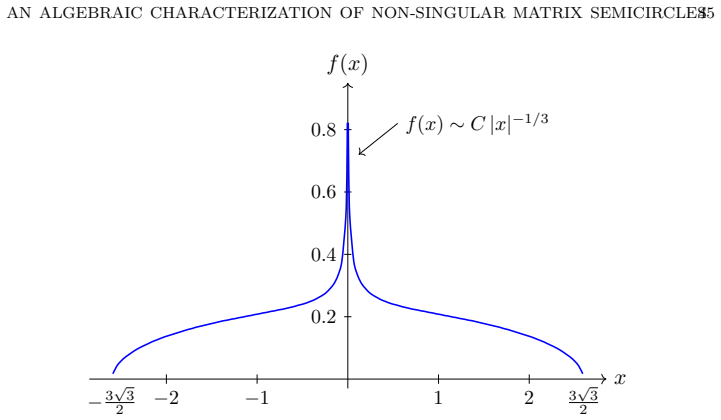
Equivalence also to symmetric DS-scalability of covariance map gives f(0) = tr(C)/π for the trace minimizer C.

Figure from the paper full image
abstract click to expand
Let $A_1, \ldots, A_r$ be Hermitian $n \times n$ matrices and $S = \sum A_i \otimes s_i$ the associated matrix semicircle, where $s_1, \ldots, s_r$ are free semicircular variables. We prove that the following are equivalent: (i) the matrix pencil $A = \sum A_i x_i$ is LR-semisimple (decomposes, up to left--right equivalence, as a direct sum of unsplittable pencils); (ii) $S$ is non-singular at $t = 0$ (the matrix-valued Cauchy transform has a continuous boundary limit near the origin); (iii) the covariance map $\eta\colon X \mapsto \sum A_i X A_i$ is symmetrically DS-scalable (there exists $C \succ 0$ with $\eta(C) = C^{-1}$). When these hold, the spectral density satisfies $f(0) = \frac{1}{\pi}\,\mathrm{tr}(C)$, where $C$ is the unique trace minimizer of the solution set $\{W \succ 0 : \eta(W)\,W = I\}$. The proof combines algebraic and analytic ingredients. On the algebraic side, we establish the equivalence (i) $\Leftrightarrow$ (iii) using Gurvits' capacity theory for indecomposable maps and a geodesic reflection theorem in the Riemannian manifold of positive definite matrices, which upgrades DS-scalability to symmetric DS-scalability for self-adjoint completely positive maps. On the analytic side, we prove (iii) $\Rightarrow$ (ii) via a Lyapunov--Schmidt reduction of Speicher's equation at a trace-minimizing solution, showing that the Jacobian of the bifurcation equations is positive definite. This removes a stability hypothesis that was required in earlier approaches.
0
0
math.OA 2026-04-24

Any finite group realized as tilde chi of a McDuff II1 factor

Gauging the Categorical Connes' tilde{chi}(M)

Outer actions and explicit gauging embed representation categories into the categorical Connes invariant of crossed-product factors.

abstract click to expand
We prove that if a finite group $G$ acts outerly on a McDuff $\rm II_1$ factor $M$, then $\mathsf{Rep}(G/KL)$ is a braided monoidal full subcategory of the categorical Connes' $\tilde{\chi}(M\rtimes G)$ defined in arXiv:2111.06378, where $K$ and $L$ are the centrally trivial and approximately inner parts in $G$ respectively. When $L$ is trivial, we give an explicit formula for the $G/K$-gauging procedure on $\tilde{\chi}(M\rtimes G)$. This is the categorical generalization of Connes' short exact sequence on $\chi(M\rtimes G)$. Using this machinery, for any finite group $G$, we construct a McDuff $\rm II_1$ factor $M$, whose $\tilde{\chi}(M)$ is braided equivalent to $\mathsf{Rep}(G)$. This is the first example of a braided fusion category which is not modular as $\tilde\chi$.
0
0
math.OA 2026-04-24

Normal operators similar to irreducibles fully characterized in factors

The similarity of irreducible operators in factors

The characterization arises from linking single generators of separable factors to maximal abelian self-adjoint subalgebras.

abstract click to expand
An operator $T$ in a separable factor $\mathcal{M}$ is said to be irreducible in $\mathcal{M}$ if the von Neumann subalgebra $W^*(T)$ generated by $T$ is an irreducible subfactor of $\mathcal{M}$, i.e., $W^*(T)'\cap\mathcal{M}=\mathbb{C}I$. We say that $T$ is a single generator of $\mathcal{M}$ if $W^*(T)=\mathcal{M}$. In this paper, we study generators of separable factors related to maximal abelian self-adjoint subalgebras. As an application, we obtain a complete characterization of normal operators in separable factors which are similar to irreducible operators.
0
0
math.OA 2026-04-23

Uniqueness theorems proven for combinatorial C*-algebras

Uniqueness theorems for combinatorial C*-algebras

Using groupoid models and tight representations, uniqueness is shown for C*-algebras from left cancellative categories, generalizing graph

abstract click to expand
Spielberg's construction of C*-algebras from left cancellative small categories is a common generalization for most C*-algebras one would consider to come from ``combinatorial data,'' including graph and $k$-graph C*-algebras, Li's semigroup C*-algebras, Nekrashevych's self-similar action algebras, and more. We use known groupoid models of these algebras and Exel's theory of tight representations of inverse semigroups to prove uniqueness theorems for these C*-algebras. As applications, we improve on our previous uniqueness theorem for the boundary quotient C*-algebras of right LCM monoids, and we also generalize the uniqueness theorem of Brown, Nagy, and Reznikoff for row-finite higher-rank graphs to the finitely aligned case.
0
0
math.OA 2026-04-23

Riesz products on quantum tori prove non-commutative Ornstein result

Finite Riesz products and Ornstein non-inequalities on quantum tori

A generalization from the classical torus yields the non-inequality in the operator algebra setting.

abstract click to expand
We demonstrate a construction of products on the quantum torus $\mathbb{T}_\theta^2$ that generalises the usual construction of finite Riesz products on the commutative torus $\mathbb{T}^2$. We explain why the former constitutes a natural analogue of the latter in the non-commutative setting and, based on this construction, as well as on previous results by K. Kazaniecki and the second author, we prove a non-commutative version of an Ornstein non-inequality.
0
0
math.OA 2026-04-21

Groups are C*-simple exactly when they lack non-trivial amenable confined subalgebras

C^*-simplicity, confined subalgebras, and operator algebraic uniform recurrence

The equivalence is proved by introducing confined subalgebras and uniformly recurrent states inside the group von Neumann algebra, extending

abstract click to expand
We introduce the notion of confined subalgebras in the context of the group von Neumann algebra. We also define Uniformly Recurrent States -- an operator-algebraic analog of Uniformly Recurrent Subgroups. Using this framework, we show that a countable discrete group is $C^*$-simple if and only if it admits no non-trivial amenable confined subalgebras. This generalizes the well-known result of Kennedy that characterizes $C^*$-simplicity in terms of trivial amenable uniformly recurrent subgroups.
0
0
math.OA 2026-04-21

Non-minimal actions on the circle give C*-algebras with unique traces

Crossed product C*-algebras associated with non-minimal actions on the circle

These crossed products are nuclear and quasidiagonal with stable rank one, and K-theory is computed when the group is Z^d.

abstract click to expand
We examine crossed product C*-algebras associated with non-minimal free actions of countably infinite discrete abelian groups on the circle, extending the work of Putnam, Schmidt, and Skau. We obtain a large class of unital separable nuclear and non-simple C*-algebras that are quasidiagonal, have stable rank one, and admit a unique tracial state. We determine their ideal structure and establish an improved uniform upper bound for their nuclear dimension. Finally, in the case $G = \mathbb{Z}^d$, we compute the ordered K-theory and its trace pairing.
0
0
math.OA 2026-04-21

Type semigroups get explicit formulas for self-similar graph actions

An introduction to separated graphs and their type semigroups

The combinatorial data determine the invariant for row-finite graphs without sources and for finite bipartite separated graphs.

Figure from the paper full image
abstract click to expand
We introduce $C^*$-algebras associated with directed graphs, along with two generalizations of this concept, namely Exel-Pardo $C^*$-algebras associated with a self-similar action of a group on a directed graph, and the $C^*$-algebras associated with separated graphs. These constructions have in common that they have a dynamical behavior, being the groupoid $C^*$-algebras associated to certain topological groupoids, which are built from the combinatorial structure. An important invariant one may associate to these dynamical systems is the so-called type semigroup. We will find a formula to compute the type semigroup for a general self-similar action of a group on a row-finite graph $E$ without sources, following a recent paper by Kwa\'sniewski, Meyer and Prasad, and for any finite bipartite separated graph, following a paper by Exel and the author. In addition, we will review various results concerning the structure of the type semigroup for different dynamical systems.
0
0
math.OA 2026-04-21

Quantum graphs are Morita equivalent iff both pull back from one common graph

Morita equivalence for quantum graphs

The equivalence leaves connectivity, independence number, Lovasz number and other parameters unchanged.

Figure from the paper full image
abstract click to expand
We introduce an operator-algebraic framework for Morita equivalence of quantum graphs based on $\Delta$-equivalence of operator systems introduced by Eleftherakis, Kakariadis and Todorov. Adopting the perspective of Weaver, we view quantum graphs as quantum relations, that is, operator systems endowed with a bimodule structure over the commutant of a von Neumann algebra. Within this framework, we show that two irreducibly acting quantum graphs are Morita equivalent if and only if they are both full pullbacks of a common quantum graph. This extends a result of Eleftherakis, Kakariadis and Todorov for graph operator systems to the quantum graph setting. In passing we construct a true-twin reduction analogue for an irreducibly acting quantum graph. We further characterise the case where we have simultaneous TRO-equivalence of the quantum graphs and their associated algebras, thus giving a second, stronger notion of Morita equivalence. In the special case of noncommutative graphs, corresponding to the zero-error quantum communication setting, the two notions coincide and we obtain a characterisation in terms of strong co-homomorphisms of noncommutative graphs. Finally, we show that connectivity, the independence number, Shannon capacity, quantum complexity and subcomplexity, Haemers bound, and the Lov\'asz number are invariant under Morita equivalence.
0
0
math.OA 2026-04-21

Explicit non-inner-amenable étale groupoids found beyond partial actions

On groupoids beyond partial actions, inner amenability, and models for Kirchberg algebras

Higson-Lafforgue-Skandalis constructions from residually finite groups resolve open questions on amenability and groupoid origins.

Figure from the paper full image
abstract click to expand
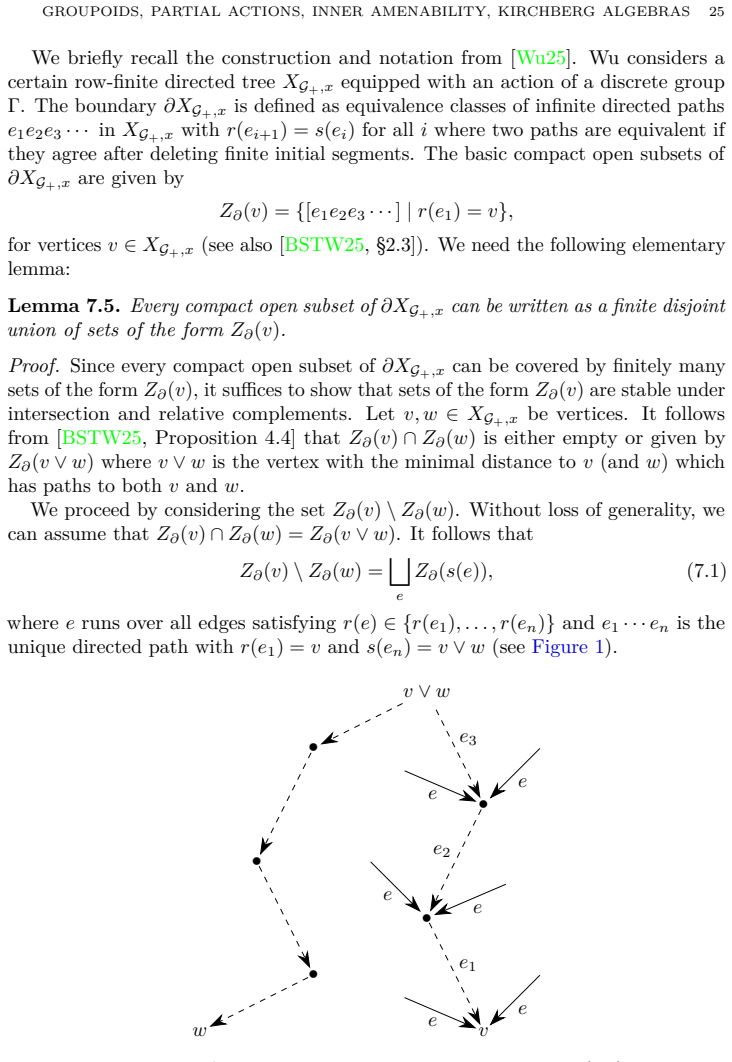
We construct the first explicit examples of locally compact Hausdorff \'etale groupoids that are not inner amenable and that do not arise as transformation groupoids associated to partial actions of discrete groups. This answers questions of Anantharaman--Delaroche and Exel. Our examples include all Higson--Lafforgue--Skandalis groupoids associated to non-amenable residually finite groups, as well as their principal variants constructed by Alekseev--Finn--Sell. These can be chosen to be second countable, ample, and in the latter case even principal. We also show that large classes of Deaconu--Renault groupoids with connected unit space do not arise from partial actions of discrete groups, including cases whose $C^*$-algebras are Kirchberg algebras in the UCT class. We contrast this with the totally disconnected case by giving ample transformation groupoid models for all unital Kirchberg algebras in the UCT class as well as many higher rank graph algebras. Finally, we characterize precisely when coarse groupoids arise from partial actions of discrete groups in terms of coarse embeddings into groups.
0
0
math.OA 2026-04-21

Crossed-product algebra yields tracial measures of flow complexity

Crossed-Product von Neumann Algebras for Incompressible Navier--Stokes Flows and Spectral Complexity Indicators

Commutators inside the von Neumann algebra generated by a divergence-free flow's Koopman unitary connect to determinants and entropy traces.

Figure from the paper full image
abstract click to expand
We introduce a traceable operator-algebraic framework for incompressible transport on M= T3 (and, more generally, compact Riemannian manifolds endowed with a smooth invariant probability measure). Given an autonomous divergence-free velocity field u, the time-1 map $\Phi$ induces the Koopman unitary U on L2(M) and the crossed-product finite von Neumann algebra Mu\,:= L$\infty$(M) ___$\alpha$ Z= W$\star$(L$\infty$(M),U), equipped with its canonical faithful normal trace $\tau$u. Within Mu we define tracial complexity functionals from commutators [U,Mf] (with Mf the multiplication operators) and associated positive elements, and we connect these quantities to Fuglede--Kadison determinants and entropy-like tracial functionals. In parallel, we introduce bounded regularized advection operators T(s) u\,:= KsTuKs as differential-level probes of transport oncommutativity, and we recall the Lie-bracket commutator identity at the formal generator level. This provides a natural algebraic setting in which tracial invariants are well posed and, in principle, computable on discretizations (e.g. cavity flow and vortex benchmarks).
0
0
math.OA 2026-04-20

Operator system is C*-algebra iff matrices carry JB structures

An order-theoretic characterization of C*-algebras

Order-theoretic test detects C*-algebras by requiring compatible JB-algebra data on every matrix level.

abstract click to expand
We give an order-theoretic characterization of the essential image of the forgetful functor from the category of real/complex unital C*-algebras to the category of real/complex unital operator systems. It is based on the characterization of JB-algebras among the order unit spaces in terms of the existence of gauge-reversing bijections obtained by M. Roelands and the author in arXiv:2507.09526. To this end, we show that a unital operator system is completely order isomorphic to a C*-algebra if and only if each of its matrix spaces admits a compatible JB-algebra structure. As an application, we prove that for $n\ge 4$ the range of a unital n-positive projection on a unital real C*-algebra is unitally n-order isomorphic to a unital real C*-algebra, which is the analogue of a result proven for complex C*-algebras by Choi--Effros.
0
0
math.OA 2026-04-20

Dimension vector partitions spectrum of graph C*-algebras

Classification of representations of higher-rank graph C*-algebras

Finite pieces are parametrized by smooth manifolds after lifting from a non-self-adjoint algebra.

abstract click to expand
We develop new techniques for the construction and classification of representations of row-finite and locally convex higher-rank graph C*-algebras O. This class includes Cuntz--Krieger algebras associated to row-finite directed graphs. Our approach relies on the representation theory of a certain non-self-adjoint algebra and a lifting process of representations. We introduce a novel dimension vector for representations of O yielding a countable partition of the spectrum. Given a Cuntz--Krieger algebra and a finite dimension vector, we construct a smooth manifold parametrising the corresponding spectral component. Our techniques are both explicit and functorial.
0
0
math.OA 2026-04-17

This paper proves that the quantitative coarse Baum-Connes conjecture holds for the free…

The quantitative coarse Baum-Connes conjecture for free products

The quantitative coarse Baum-Connes conjecture holds for the free product G * H if it holds for the groups G and H.

Figure from the paper full image
abstract click to expand
Let $G$ and $H$ be finitely generated groups. In this paper, we prove the quantitative coarse Baum--Connes conjecture for the free product $G* H$ under the assumption that the conjecture holds for both $G$ and $H$.
0
0
math.OA 2026-04-17

This monograph derives semiclassical Weyl laws and extensions of Connes' integration…

Noncommutative Geometry, Spectral Asymptotics, and Semiclassical Analysis

Semiclassical Weyl laws and Connes integration formulas are obtained for a large class of spectral triples by removing dimension and…

abstract click to expand
Semiclassical analysis and noncommutative geometry are two pillars of quantum theory. It's only recently that bridges between them have been emerging. In this monograph, we combine various techniques from functional analysis and spectral theory to obtain semiclassical Weyl laws and extensions of Connes' integration formula for a large class of noncommutative manifolds (i.e., spectral triples). These results generalize and simplify recent results of McDonald-Sukochev-Zanin. In particular, all the regularity assumptions and restrictions on dimension there are removed in our approach. Moreover, the Tauberian condition used by McDonald-Sukochev-Zanin is replaced by a weaker spectral theoretic condition, called Condition (W). That condition holds in fairly greater generality and significantly open the scope of applicability of the main results. We also give Tauberian conditions that imply Condition (W). These Tauberian conditions are easier to check in practice than the Tauberian condition of McDonald-Sukochev-Zanin and are satisfied in numerous examples. The need for these conditions was highlighted by Alain Connes in an online seminar. The main results of this memoire are illustrated by semiclassical Weyl's laws and integration formulas in the following settings: (i) Dirichlet and Neumann problems on Euclidean domains with smooth boundaries; (ii) closed Riemannian manifolds; (iii) open manifolds with conformally cusp metrics of finite volume; (iv) quantum tori; and (v) sub-Riemannian manifolds.
0
0
math.OA 2026-04-17

Braided quantum SU(2) gains Haar measure and antipode

Braided quantum SU(2) group - a case study

The constructions equip the braided group with invariant integrals and show two bosonization methods are the same.

abstract click to expand
We continue the study of the braided compact quantum group $\mathrm{SU}_q(2)$ for complex $q$ satisfying $0<|q|<1$ introduced by Kasprzak, Meyer, Roy and Woronowicz (J. Noncommut. Geom. 10(4):1611-1625, 2016). We address such aspects as existence of the Haar measure, construct the scaling group, the antipode and its polar decomposition and describe the related braided Hopf algebra. We also study when the braided flip extends to a completely bounded map and establish equivalence between the two approaches to bosonization and braided tensor product taken in the literature (Kasprzak, Meyer, Roy, Woronowicz J. Noncommut. Geom. 10(4):1611-1625, 2016 vs. Meyer, Roy Woronowicz Internat. J. Math. 25(2):1450019, 37, 2014, Roy Int. Math. Res. Not. (14):11791--11828, 2023 and De Commer, Krajczok arXiv:2412.17444, to appear in J. Operator Th.).
0
0
math.OA 2026-04-16

New theorem upgrades strong convergence via Toeplitz exactness

Toeplitz exactness for strong convergence

The result supplies a single checkable condition that works across the general setting of C*-correspondences and yields several applications

abstract click to expand
We prove a new "Toeplitz exactness" theorem for strong convergence. This is a machine to upgrade strong convergence in the general setting of $C^\ast$-correspondences, and has several applications.
0
0
math.OA 2026-04-15

Universal coefficient theorem holds for square-free cyclic group actions

A universal coefficient theorem for actions of finite cyclic groups of square-free order on C*-algebras

It gives an exact sequence computing equivariant KK-groups from K-theory data for bootstrap C*-algebras under these actions.

Figure from the paper full image
abstract click to expand
We prove a Universal Coefficient Theorem for objects in the bootstrap class in the equivariant Kasparov category for a finite cyclic group of square-free order.
0
0
math.OA 2026-04-15

P_analytic property on actions makes C*-algebras simple

Simplicity of action-based C^{*}-algebras from hyperbolic actions

Faithful isometric actions on countable metric spaces yield simple algebras when they satisfy the generalized analytic condition, including,

abstract click to expand
We study the simplicity of $C^{*}$-algebras built from group actions. For a faithful isometric action of a group $G$ on a countable metric space $X$, we use the associated action representation on $\ell^2(X)$ to define the action-based $C^{*}$-algebra $C^{*}_{X}G$. We define generalized versions of the properties $P_{\text{naive}}$ and $P_{\text{analytic}}$ relative to the action and show that the naive form implies the analytic form. We also prove that the properties $P_{\text{analytic}}$ associated with a continuous action ensure the simplicity of the action-based $C^*$-algebra. As an application, we deduce that big mapping class groups satisfy the property $P_{\text{naive}}^{\mathbb{X}}$ and the associated action-based $C^*$-algebra is simple.
0
0
math.OA 2026-04-15

Chronological free entropy is concave on Wasserstein geodesics

Free information geometry and the model theory of noncommutative stochastic processes

Defined via matrix microstates closed under suprema and the free heat semigroup, the entropy has heat evolution as its metric gradient flow.

abstract click to expand
We study entropy and optimal transport theory in the free probabilistic setting motivated by the large-$n$ theory of random tuples of matrices. We define a new version of free entropy $\chi_{\operatorname{chron}}^{\mathcal{U}}$, which is concave along geodesics in the corresponding Wasserstein space. Moreover, the heat evolution satisfies the evolution variational inequality, which means that the heat evolution is the Wasserstein gradient flow for entropy in the metric sense. It also has further desirable properties such as a chain rule for iterated conditioning, and an expression in terms of stochastic control problems. This entropy is defined using microstate spaces of matrix approximations with respect to an expanded class of test functions called chronological formulas, which are constructed so as to be closed under taking partial suprema and infima and application of a free heat semigroup. These formulas are part of a novel framework for studying noncommutative filtrations and stochastic processes as metric structures in the sense of continuous model theory.
0
0
math.OA 2026-04-13

Essentiality and topological essentiality coincide on right ideals

On Essential and Topologically Essential Submodules of Hilbert C*-Modules

The equivalence for two-sided ideals extends to one-sided ideals in C*-algebras and to submodules of Hilbert C*-modules via the compact-oper

abstract click to expand
We study two notions of largeness for closed submodules of Hilbert C*-modules: essentiality and topological essentiality. While the analogous properties are known to be equivalent for closed two-sided ideals of C*-algebras, the one-sided case is more subtle. We prove that these two notions remain equivalent for closed right ideals of an arbitrary C*-algebra. Next, using the correspondence between submodules and right ideals of the algebra of compact operators, we extend this result to closed submodules of Hilbert C*-modules. In the commutative case, where a Hilbert module can be realized as a continuous field of Hilbert spaces, we give a geometric reformulation of essentiality and derive a fiberwise criterion.
0
0
math.OA 2026-04-13

Crossed products by minimal or Rokhlin actions are pure

Pureness of Certain Crossed Product C*-Algebras

They satisfy comparison and divisibility, yielding stable rank one even when base algebras lack Z-stability or spaces are infinite.

abstract click to expand
We establish comparison and divisibility properties for crossed product C*-algebras arising from automorphisms of algebras C (X, D) which lie over minimal homeomorphisms, from actions of compact groups which have finite Rokhlin dimension with commuting towers, and from actions of compact groups which have the restricted tracial Rokhlin property with comparison. We deduce that these crossed products we consider are pure, and conclude they have stable rank one, and in certain cases have real rank zero. We give examples in which these properties do not follow from previous results, in the case of C (X, D) due to the lack of Z-stability of D, the underlying topological spaces not being finite dimensional, or both.
0
0
math.OA 2026-04-13

Quantum SO(4)/SO(2) algebra equals tight groupoid C*-algebra

C(SO_q(4)/SO_q(2)) as a Groupoid C^*-algebra

Four locally closed orbits with Z isotropy induce all irreps from circle-parametrized representations of C*(Z) and match Soibelman families.

abstract click to expand
In this paper, we prove that $C(SO_q(4)/SO_q(2))$ is isomorphic to the $C^*$-algebra of the tight groupoid $\mathcal{G}_{\mathrm{tight}}$ associated with the inverse semigroup generated by the standard generators of its classical limit $C(SO_0(4)/SO_0(2))$. We show that all four orbits of the unit space $\mathcal{G}_{\mathrm{tight}}^{(0)}$ under the natural action of $\mathcal{G}_{\mathrm{tight}}$ are locally closed, and that the associated isotropy groups are isomorphic to $\mathbb{Z}$. Consequently, every irreducible representation of $C^*(\mathcal{G}_{\mathrm{tight}})$ is induced from an irreducible representation of $C^*(\mathbb{Z})$, which are parametrized by $\mathbb{T}$. In this way, we obtain four families of irreducible representations parametrized by $\mathbb{T}$, and we explicitly construct their equivalence with the corresponding Soibelman irreducible representations of $C(SO_q(4)/SO_q(2))$.
0
0
math.OA 2026-04-13

Rokhlin dimension of partial actions matches dual representability dimension

Duality of partial Rokhlin dimension

For finite abelian groups the dimension of an action equals the dual dimension of its dual on the crossed product.

abstract click to expand
We extend the notion of representability dimension to partial actions and introduce a notion of dual representability dimension for global actions by finite abelian groups. We show that the Rokhlin dimension of a partial action by a finite abelian group agrees with the dual representability dimension of the dual action on the partial crossed product, while the representability dimension of a partial action agrees with the Rokhlin dimension of its dual.
0
0
math.OA 2026-04-10 2 theorems

Quantization yields unitary dual 2-cocycles on semidirect products

Kohn--Nirenberg quantization of the affine group and related examples

Double crossed product structure and a scalar Fourier transform via dressing transformations produce the cocycles for groups like the affine

abstract click to expand
We show how to construct unitary dual $2$-cocycles for a class of semidirect products that exhibit many similarities with the affine group ${\rm Aff}(V)=\GL(V)\ltimes V$ of a finite dimensional vector space over a local skew field. The primary source of examples comes from Lie groups whose Lie algebras are Frobenius seaweeds. The construction builds on our earlier results and relies heavily on representation theory and an associated quantization procedure of Kohn--Nirenberg type. On the technical side, the key point is the observation that any semidirect product $G=H\ltimes V$ in our class can be presented as a double crossed product $G=P\bowtie N$ with respect to which the unique square-integrable irreducible representation of $G$ takes a particularly nice form. The Kohn--Nirenberg quantization that we construct is intimately related to a scalar Fourier transform $\CF\colon L^2(N)\to L^2(P)$ intertwining the left regular representations of $P$ and $N$ with representations defined by the dressing transformations.
0
0
math.OA 2026-04-10 2 theorems

Noncommutative Villadsen algebra realizes Poulsen trace simplex

The trace simplex of a noncommutative Villadsen algebra

The fiber of traces over a fixed extreme AF trace fills the simplex with dense extreme points; the full space does so when the AF trace is 1

abstract click to expand
We construct a ``noncommutative'' Villadsen algebra $B$ and show that, given an extreme tracial state $\nu$ on its canonical AF subalgebra, the subset of $T(B)$ consisting of those tracial states that equal $\nu$ when restricted to the canonical AF subalgebra is the Poulsen simplex. In particular, if the canonical AF subalgebra has a unique trace, then $T(B)$ is the Poulsen simplex. We go on to show that in certain instances, the tracial cone of a ``classical'' AF-Villadsen algebra $D$ is isomorphic to the tracial cone of the algebra obtained from $D$ by deleting all point evaluations.
0
0
math.OA 2026-04-09 Recognition

Generalised diagonal dimension equals asymptotic dimension

Generalised diagonal dimension and applications to large-scale geometry

The new dimension applied to noncommutative Cartan subalgebras in finite-propagation operator algebras matches the geometric asymptotic of

abstract click to expand
In this paper, we introduce a generalised diagonal dimension. We explain why the generalised diagonal dimension extends the notion of diagonal dimension defined by Li, Liao, and Winter, and under which conditions these dimensions coincide. We prove permanence properties for the generalised diagonal dimension and compare it with the nuclear dimension. We investigate applications of the generalised diagonal dimension in large-scale geometry; specifically, we show that the generalised diagonal dimension of a noncommutative Cartan subalgebra in the C*-algebra of finite-propagation operators on a uniformly locally finite metric space is equal to the asymptotic dimension of the space.
0
0
math.OA 2026-04-09 2 theorems

Graph C*-algebras are RFD exactly under four conditions

The RFD property for graph C^*-algebras

The algebra is residually finite dimensional iff the graph avoids infinite receivers, exiting cycles and backward chains and every vertex is

Figure from the paper full image
abstract click to expand
It is proved that the C*-algebra of a graph is residually finite dimensional (RFD) if and only if the graph has no infinite receiver, no cycle with an exit, no infinite ackward chain and from each vertex, there is a finite path to a sink or a cycle or an infinite emitter.
0
0
math.OA 2026-04-09 Recognition

C*-algebra free products admit general selfless inclusions

Selfless reduced amalgamated free products and HNN extensions

The family generalizes prior HNN extension results and yields a short proof for graph product selflessness.

abstract click to expand
We find a general family of selfless inclusions in reduced amalgamated free products of C*-algebras. Apart from generalizing prior works due to McClanahan, Ivanov and Omland, our work yields a few other applications. We present a short new approach to construct HNN extensions of C*-algebras and find several new examples of selflessness using this. This generalizes results of Ueda, Ivanov and de la Harpe-Preaux. As another application our work yields a short proof of selflessness for arbitrary graph products of C*-algebras over graphs of more than 2 vertices and diameter greater than 3.
1 0
0
math.OA 2026-04-07 2 theorems

Torsion-free acylindrically hyperbolic groups satisfy relative ISR

On Relative Invariant Subalgebra Rigidity Property

Any subalgebra invariant under a normal subgroup must come from some subgroup of the group.

abstract click to expand
A countable discrete group $\Gamma$ is said to have the relative ISR-property if for every non-trivial normal subgroup $N\trianglelefteq\Gamma$ and every von Neumann subalgebra $\mathcal{M}\subseteq L(\Gamma)$ invariant under conjugation by $N$, one has $\mathcal{M}=L(K)$ for some subgroup $K\le\Gamma$. Similarly, $\Gamma$ has the relative $C^*$-ISR-property if every $N$-invariant unital $C^*$-subalgebra $\mathcal{A} \subseteq C_r^*(\Gamma)$ is of the form $C_r^*(K)$. We show that every torsion-free acylindrically hyperbolic group with trivial amenable radical satisfies the relative ISR property. Moreover, we also show that all torsion-free hyperbolic groups have the relative $C^*$-ISR property. Furthermore, we establish an analogous relative ISR-property for irreducible lattices in higher-rank semisimple Lie groups, such as $\mathrm{SL}_d(\mathbb{Z})$ ($d \geq 3$), with trivial center.
1 0
0
math.OA 2026-04-07 Recognition

Two parametrizations agree on gauge-invariant ideals for product systems

Gauge-invariant ideal structure of C*-algebras associated with proper product systems over mathbb{Z}_+^d

The match simplifies the description of ideals in quotients of the Toeplitz-Nica-Pimsner algebra for proper cases over Z_+^d.

abstract click to expand
We show that the gauge-invariant ideal parametrisation results of the author and Kakariadis are in agreement with those of Bilich in the case of a proper product system over $\mathbb{Z}_+^d$. This is accomplished in two ways: first via the use of Nica-covariant representations and Gauge-Invariant Uniqueness Theorems (the indirect route), and second via the definitions of the parametrising objects alone (the direct route). We then apply our findings to simplify the main parametrisation result of the author and Kakariadis in the proper case, thereby fully describing the gauge-invariant ideal structure of each equivariant quotient of the Toeplitz-Nica-Pimsner algebra. We close by providing applications in the contexts of C*-dynamical systems and row-finite higher-rank graphs.
0
0
math.OA 2026-04-07 2 theorems

Haagerup property for partial crossed products equals that of A and the action

On the Haagerup property for partial crossed products

This holds exactly when both the C*-algebra and the partial action possess the property, with consequences for inductive limits.

abstract click to expand
Let $(A,G,\alpha)$ be a partial dynamical system and let $A\rtimes_{\alpha,r} G$ denote the associated reduced partial crossed product. In this article, we introduce the Haagerup property for partial actions of discrete groups on $C^*$-algebras. We prove that the partial crossed product $A\rtimes_{\alpha,r} G$ has the Haagerup property if and only if both $A$ and the partial action $\alpha$ have the Haagerup property. As a consequence, we obtain an equivalence between the Haagerup property of the partial crossed product and that of the underlying $C^*$-algebra and the acting group. We also show that the Haagerup property is preserved under inductive limits and apply this result to study the Haagerup property of inductive limits of partial crossed products.
0
0
math.OA 2026-04-07 Recognition

Split exact sequences give KK-equivalences for amplified graph C*-algebras

On split exact sequences and KK-equivalences of amplified graph C*-algebras

The method produces explicit equivalences to C^N for quantum Grassmannians and equates classical and quantum projective lines.

Figure from the paper full image
abstract click to expand
We give a general methodology for constructing split exact sequences of amplified graph C*-algebras with sinks. This in turn allows us to construct explicit KK-equivalences with $\mathbb{C}^N$ for a large class of C*-algebras, including the quantum Grassmannian $\mathrm{Gr}_q(2,4)$. We discuss compatibility with known (quantum) CW-constructions and give an explicit KK-equivalence between the classical and quantum projective spaces $\mathbb{C}P^1$ and $\mathbb{C}P_q^1$.
0
0
math.OA 2026-04-07 2 theorems

Universal property governs Fell bundle section C*-algebras

A universal property for groupoid C*-algebras. II. Fell bundles

It renders the full section algebra functorial and exact while extending Renault's integration and disintegration theorems to general cases.

Figure from the paper full image
abstract click to expand
We define possibly unsaturated, upper semicontinuous Fell bundles over Hausdorff, locally compact groupoids and establish a universal property for representations of their full section C*-algebras on Hilbert modules over arbitrary C*-algebras. Based on this, we prove that the full section C*-algebra is functorial and exact, and we define a quasi-orbit space and a quasi-orbit map. We deduce and extend Renault's Integration and Disintegration Theorems to general Fell bundles using our universal property.
2 0
0
math.OA 2026-04-06 Recognition

Crossed product exactness equals algebra exactness for abelian semigroups

Some remarks on Reduced C^*-algebras of semigroup dynamical systems and product systems

For abelian finitely generated P the reduced crossed product A ⋊_red P is exact exactly when A is exact.

abstract click to expand
We study the exactness of the reduced crossed product of a semigroup dynamical system and the reduced $C^{*}$-algebra of a product system. We show that for a semigroup dynamical system $(A, P,\alpha)$, under reasonable hypotheses (e.g., $P$ is abelian and finitely generated), the reduced crossed product $A \rtimes_{red} P$ is exact if and only if $A$ is exact. This strengthens our earlier result (\cite{Amir_Sundar-product-system}), where it was assumed that the action of $P$ on $A$ is by injective endomorphisms. We also compare the groupoid crossed product described in \cite{Amir_Sundar-product-system} and the Fell bundle constructed in \cite{Rennie_Sims} for a product system, and show that they are equivalent as Fell bundles.
0
0
math.OA 2026-04-03 Recognition

Density space non-compact in Bures metric for infinite-dimensional algebras

The Bures metric and the quantum metric on the density space of a C*-algebra: the non-unital case

The space of trace-one positive elements is compact exactly when the C*-algebra is finite-dimensional, whether unital or not.

abstract click to expand
Building off work of Farenick and Rahaman, we extend the definition of the density space and the Bures metric to the setting of non-unital C*-algebras equipped with a faithful trace and prove that the Bures metric is also a metric in this case and show that its topology is weaker than the topology induced by the C*-norm. Furthermore, we prove a Heine-Borel type theorem for C*-algebras and the density space. In particular, we prove that for any C*-algebra (unital or non-unital) equipped with a faithful trace, the density space equipped with the Bures metric topology is not compact if and only if the C*-algebra is infinite dimensional. We also exhibit several examples of sequences that have no converging sequence in the unital and non-unital case including both commutative and noncommutative C*-algebras. Next, building off work from some of the authors, we extend the definition of the quantum metric on the density space to the non-unital C*-algebra case by introducing the notion of a quantum Lipschitz triple, which form a subclass of quantum locally compact metric spaces of Latr\'emoli\`ere that utilize Rieffel's notion of a quantum metric (we also introduce new classes of quantum locally compact metric spaces that include certain noncommutative homogeneous C*-algebras). Furthermore, we prove that this quantum metric topology is weaker than the topology of the one induced by the C*-norm and finish the article with an analysis of matrix-valued functions on the quantized interval, which provides commutative and noncommuataive examples where the quantum metric topology on the density space is not compact and is not uniformly equivalent to both the Bures metric and the metric induced by the C*-norm.
0

browse all of math.OA → full archive · search · sub-categories