Recognition: unknown
From Language to Logic: Bridging LLMs & Formal Representations for RTL Assertion Generation
Pith reviewed 2026-05-08 08:14 UTC · model grok-4.3
The pith
A tool-augmented agent generates SystemVerilog assertions from natural language hardware specifications with 82 percent functional correctness.
A machine-rendered reading of the paper's core claim, the machinery that carries it, and where it could break.
Core claim
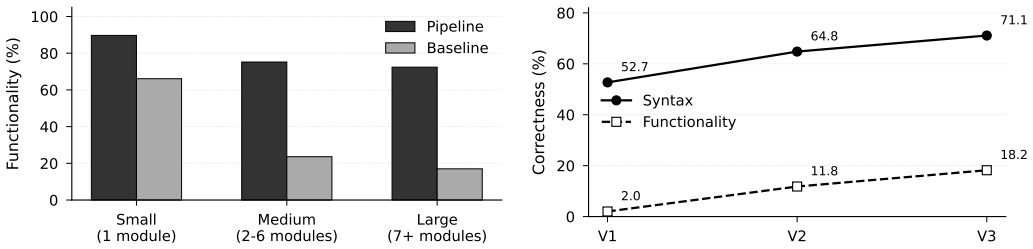
The paper claims that a two-phase agent first gathers design context autonomously through retrieval-augmented generation and structural tool queries, then generates and refines assertions using up to three rounds of formal solver feedback, reaching 93.7 percent syntax correctness and 82.0 percent functional correctness on the evaluated benchmarks while an ablation study shows that retrieval, tool integration, and the verification loop each add independent value.
What carries the argument
A two-phase tool-augmented ReAct agent that gathers design context via semantic search and structural queries before iteratively refining assertions through formal proof feedback.
If this is right
- Assertions for hardware designs can be produced reliably from text specifications with reduced manual effort.
- Retrieval of design context, formal tool queries, and iterative refinement each improve outcomes independently.
- Formal verification of digital hardware becomes accessible with less combined expertise in design and temporal logic.
- Fixed rounds of solver feedback can deliver substantial functional correctness on standard benchmark designs.
Where Pith is reading between the lines
- The same structure of context retrieval plus iterative solver feedback could transfer to generating other formal hardware specifications.
- Performance on large industrial designs may require adaptive rather than fixed numbers of refinement rounds.
- Embedding the agent inside existing electronic design automation flows could shorten overall verification timelines.
- Further gains in functional correctness might appear if the loop incorporates additional sources of design information.
Load-bearing premise
The chosen benchmarks capture the variety of real-world register-transfer level designs and three fixed rounds of solver feedback suffice to reach the reported correctness without overfitting to the test cases.
What would settle it
A sharp drop in functional correctness when the same agent is applied to a fresh collection of register-transfer level designs not included in the original benchmark set.
Figures

read the original abstract
SystemVerilog Assertions (SVA) are essential for formal verification of digital hardware, yet their manual creation demands significant expertise in both the design under verification and temporal logic. Recent studies have explored using large language models (LLMs) to automate SVA generation, but existing approaches suffer from incorrect signal references, missing timing constraints, and lack of formal correctness guarantees. This paper presents ProofLoop, a tool-augmented ReAct agent that generates SVA from natural-language specifications using a solver-in-the-loop approach. The agent operates in two phases: Phase A autonomously gathers design context by invoking EDA and formal tools, including semantic search over an AST-indexed vector database and JasperGold structural queries, while Phase B generates SVA and iteratively refines it using JasperGold formal proof feedback over up to fixed (here 3) verification rounds. We evaluate ProofLoop on FVEval Design2SVA design benchmarks and demonstrate that this framework can achieve 93.7% syntax correctness and 82.0% functional correctness. An ablation study confirms that each component, i.e., retrieval-augmented generation (RAG), JasperGold tools, and the verification loop contributes significantly (and orthogonally).
Editorial analysis
A structured set of objections, weighed in public.
Referee Report
Summary. The paper presents ProofLoop, a ReAct-style LLM agent that generates SystemVerilog Assertions (SVA) from natural-language specifications. Phase A gathers design context via semantic search over an AST-indexed vector database and JasperGold structural queries; Phase B generates candidate assertions and refines them iteratively (up to a fixed 3 rounds) using JasperGold proof feedback. On the FVEval Design2SVA benchmark suite the framework reports 93.7% syntax correctness and 82.0% functional correctness; an ablation study claims that RAG, JasperGold tooling, and the verification loop each contribute significantly and orthogonally.
Significance. If the reported correctness figures prove robust under broader evaluation, the work would meaningfully advance automated formal verification by closing the loop between LLMs and industrial solvers. The explicit use of solver feedback for refinement and the ablation analysis are positive features that distinguish it from purely generative baselines.
major comments (3)
- [Evaluation] Evaluation section: the 82.0% functional-correctness figure is presented without any description of the judgment procedure (manual review, equivalence checking against reference assertions, or property coverage metrics), the ground-truth construction for the FVEval Design2SVA designs, or inter-rater / statistical significance tests. This directly undermines the headline performance claim.
- [Evaluation] Benchmark description and experimental setup: no information is given on the size, complexity, or stylistic diversity of the FVEval Design2SVA designs, nor on how the suite was selected. Combined with the fixed three-round JasperGold loop that re-uses the same solver for both refinement and scoring, this leaves open the possibility that the reported numbers reflect overfitting to a narrow set of patterns rather than general capability.
- [Ablation study] Ablation study: the claim that the three components contribute 'significantly (and orthogonally)' is not supported by any quantitative analysis of interaction effects, variance decomposition, or cross-validation; the ablation table alone does not establish orthogonality.
minor comments (2)
- [Abstract] The abstract states 'fixed (here 3)' verification rounds; the main text should explicitly state whether this limit is a hyper-parameter or a hard cap and report sensitivity to round count.
- [Method] Notation for the ReAct agent loop (state, action, observation) is introduced without a compact diagram or pseudocode, making the two-phase description harder to follow.
Simulated Author's Rebuttal
We thank the referee for the constructive and detailed feedback. We address each major comment below and will revise the manuscript to strengthen the evaluation and ablation sections.
read point-by-point responses
-
Referee: [Evaluation] Evaluation section: the 82.0% functional-correctness figure is presented without any description of the judgment procedure (manual review, equivalence checking against reference assertions, or property coverage metrics), the ground-truth construction for the FVEval Design2SVA designs, or inter-rater / statistical significance tests. This directly undermines the headline performance claim.
Authors: We agree that the manuscript requires explicit details on the functional-correctness judgment procedure. In the revision we will add a dedicated paragraph stating that functional correctness is determined by running the generated SVA through JasperGold and checking whether the property is proved without counterexamples on the provided RTL. Ground-truth assertions are taken directly from the FVEval Design2SVA reference set, which encodes the natural-language intent. Because the metric is produced by an automated formal solver rather than subjective human judgment, inter-rater reliability testing was not performed; we will report the exact number of designs evaluated and any per-design variance. Statistical significance tests will be added where the data permit. revision: yes
-
Referee: [Evaluation] Benchmark description and experimental setup: no information is given on the size, complexity, or stylistic diversity of the FVEval Design2SVA designs, nor on how the suite was selected. Combined with the fixed three-round JasperGold loop that re-uses the same solver for both refinement and scoring, this leaves open the possibility that the reported numbers reflect overfitting to a narrow set of patterns rather than general capability.
Authors: We will expand the benchmark section with a table summarizing the FVEval Design2SVA suite: number of designs, average signal count, state-space complexity indicators, and stylistic variety (e.g., control vs. datapath). We will also state the selection criteria (designs drawn from the public FVEval release that contain natural-language specifications). On the reuse of JasperGold for both refinement and final scoring, we will clarify that the three-round cap is a fixed computational budget and that final correctness is measured on the converged assertion; however, we acknowledge the risk of pattern overfitting and will add an explicit limitations paragraph. No new experiments are required for this clarification. revision: partial
-
Referee: [Ablation study] Ablation study: the claim that the three components contribute 'significantly (and orthogonally)' is not supported by any quantitative analysis of interaction effects, variance decomposition, or cross-validation; the ablation table alone does not establish orthogonality.
Authors: We accept that the current ablation table alone does not rigorously demonstrate orthogonality. The table shows performance degradation when each component is removed, which we interpreted as independent contributions. In the revision we will either compute simple interaction terms from the existing ablation runs or revise the claim to 'each component contributes substantially, with largely additive effects' while explicitly noting the absence of cross-validation or variance decomposition. This change requires only textual and possibly tabular updates to the existing results. revision: partial
Circularity Check
No circularity: empirical evaluation on external benchmarks with no derivations or self-referential reductions.
full rationale
The paper describes ProofLoop as a ReAct agent that uses RAG, EDA tools, and JasperGold feedback in fixed rounds to generate and refine SVA from natural language specs. All reported results (93.7% syntax correctness, 82.0% functional correctness, ablation contributions) are direct empirical measurements on the external FVEval Design2SVA benchmark suite using independent solver outputs. No equations, fitted parameters renamed as predictions, self-definitional constructs, or load-bearing self-citations appear in the derivation chain; the central claims rest on observable tool outputs and benchmark comparisons rather than any reduction to the paper's own inputs by construction.
Axiom & Free-Parameter Ledger
Reference graph
Works this paper leans on
-
[1]
A survey on assertion- based hardware verification,
H. Witharana, Y . Lyu, S. Charles, and P. Mishra, “A survey on assertion- based hardware verification,”ACM Computing Surveys, vol. 54, no. 11s, pp. 1–33, 2022
2022
-
[2]
Vijayaraghavan and M
S. Vijayaraghavan and M. Ramanathan,A Practical Guide for Sys- temVerilog Assertions. Springer, 2005
2005
-
[3]
E. M. Clarke, T. A. Henzinger, H. Veith, and R. Bloem,Handbook of Model Checking. Springer, 2018
2018
-
[4]
Special session: CAD for hardware security—automation is key to adoption of solutions,
S. Aftabjahani, R. Kastner, M. Tehranipoor, F. Farahmandi, J. Oberg, A. Nordstrom, N. Fern, and A. Althoff, “Special session: CAD for hardware security—automation is key to adoption of solutions,” in2021 IEEE 39th VLSI Test Symposium (VTS). IEEE, 2021, pp. 1–10
2021
-
[5]
GoldMine: Automatic assertion generation using data mining and static analysis,
S. Vasudevan, D. Sheridan, S. Patel, D. Tcheng, B. Tuohy, and D. John- son, “GoldMine: Automatic assertion generation using data mining and static analysis,” in2010 Design, Automation & Test in Europe Conference & Exhibition (DATE). IEEE, 2010, pp. 626–629
2010
-
[6]
HARM: A hint-based assertion miner,
S. Germiniani and G. Pravadelli, “HARM: A hint-based assertion miner,” IEEE Transactions on Computer-Aided Design of Integrated Circuits and Systems, vol. 41, no. 11, pp. 4277–4288, 2022
2022
-
[7]
A-Team: Automatic template-based assertion miner,
A. Danese, N. Dalla Riva, and G. Pravadelli, “A-Team: Automatic template-based assertion miner,” inProceedings of the 54th Annual Design Automation Conference (DAC). ACM, 2017, pp. 1–6
2017
-
[8]
Au- toSV A: Democratizing formal verification of RTL module interactions,
M. Orenes-Vera, A. Manocha, D. Wentzlaff, and M. Martonosi, “Au- toSV A: Democratizing formal verification of RTL module interactions,” inProceedings of the 58th ACM/IEEE Design Automation Conference (DAC). ACM/IEEE, 2021, pp. 535–540
2021
-
[9]
SoC se- curity verification using property checking,
N. Farzana, F. Rahman, M. Tehranipoor, and F. Farahmandi, “SoC se- curity verification using property checking,” in2019 IEEE International Test Conference (ITC). IEEE, 2019, pp. 1–10
2019
-
[10]
(security) assertions by large language models,
R. Kande, H. Pearce, B. Tan, B. Dolan-Gavitt, S. Thakur, R. Karri, and J. Rajendran, “(security) assertions by large language models,”IEEE Transactions on Information Forensics and Security, 2024
2024
-
[11]
Using LLMs to facilitate formal verification of RTL,
M. Orenes-Vera, M. Martonosi, and D. Wentzlaff, “Using LLMs to facilitate formal verification of RTL,”arXiv preprint arXiv:2309.09437, 2023
-
[12]
Towards improving verification productivity with circuit-aware translation of natural language to Sys- temVerilog assertions,
C. Sun, C. Hahn, and C. Trippel, “Towards improving verification productivity with circuit-aware translation of natural language to Sys- temVerilog assertions,” inProceedings of the DAV Workshop, 2023
2023
-
[13]
71 Shailja Thakur, Baleegh Ahmad, Hammond Fan, et al
S. Thakur, B. Ahmad, H. Pearce, B. Tan, B. Dolan-Gavitt, R. Karri, and S. Garg, “VeriGen: A large language model for Verilog code generation,” arXiv preprint arXiv:2308.00708, 2023
-
[14]
Decortl: A run-time decoding framework for rtl code generation with llms,
M. Akyash, K. Azar, and H. Kamali, “Decortl: A run-time decoding framework for rtl code generation with llms,” in2025 IEEE/ACM International Conference On Computer Aided Design (ICCAD). IEEE, 2025, pp. 1–9
2025
-
[15]
Rtl- coder: Fully open-source and efficient llm-assisted rtl code generation technique,
S. Liu, W. Fang, Y . Lu, J. Wang, Q. Zhang, H. Zhang, and Z. Xie, “Rtl- coder: Fully open-source and efficient llm-assisted rtl code generation technique,”IEEE Transactions on Computer-Aided Design of Integrated Circuits and Systems, vol. 44, no. 4, pp. 1448–1461, 2024
2024
-
[16]
Rtl++: Graph-enhanced llm for rtl code generation,
M. Akyash, K. Azar, and H. Kamali, “Rtl++: Graph-enhanced llm for rtl code generation,” in2025 IEEE International Conference on LLM-Aided Design (ICLAD). IEEE, 2025, pp. 44–50
2025
-
[17]
Codev: Empowering llms with hdl generation through multi-level summarization,
Y . Zhao, D. Huang, C. Li, P. Jin, M. Song, Y . Xu, Z. Nan, M. Gao, T. Ma, L. Qiet al., “Codev: Empowering llms with hdl generation through multi-level summarization,”IEEE Transactions on Computer- Aided Design of Integrated Circuits and Systems, 2025
2025
-
[18]
Meltrtl: Multi- expert llms with inference-time intervention for rtl code generation,
N. Mashnoor, M. Akyash, H. Kamali, and K. Azar, “Meltrtl: Multi- expert llms with inference-time intervention for rtl code generation,” arXiv preprint arXiv:2601.13015, 2026
-
[19]
Towards llm-powered verilog rtl assistant: Self-verification and self-correction,
H. Huang, Z. Lin, Z. Wang, X. Chen, K. Ding, and J. Zhao, “Towards llm-powered verilog rtl assistant: Self-verification and self-correction,” arXiv preprint arXiv:2406.00115, 2024
-
[20]
Llm-ift: Llm- powered information flow tracking for secure hardware,
N. Mashnoor, M. Akyash, H. Kamali, and K. Azar, “Llm-ift: Llm- powered information flow tracking for secure hardware,” in2025 IEEE 43rd VLSI Test Symposium (VTS). IEEE, 2025, pp. 1–5
2025
-
[21]
AssertionBench: A benchmark to evaluate large-language models for assertion generation,
V . Pulavarthi, D. Nandal, S. Dan, and D. Pal, “AssertionBench: A benchmark to evaluate large-language models for assertion generation,” inFindings of the Association for Computational Linguistics: NAACL 2025, 2025
2025
-
[22]
Domain- adapted LLMs for VLSI design and verification: A case study on formal verification,
M. Kang, M. Liu, G. Bany Hamad, S. Suhaib, and H. Ren, “Domain- adapted LLMs for VLSI design and verification: A case study on formal verification,” in2024 IEEE 42nd VLSI Test Symposium (VTS). IEEE, 2024
2024
-
[23]
Retrieval- augmented generation for knowledge-intensive NLP tasks,
P. Lewis, E. Perez, A. Piktus, F. Petroni, V . Karpukhin, N. Goyal, H. K ¨uttler, M. Lewis, W.-t. Yih, T. Rockt ¨aschelet al., “Retrieval- augmented generation for knowledge-intensive NLP tasks,” inAdvances in Neural Information Processing Systems (NeurIPS), 2020
2020
-
[24]
Z. Ibnat, P. E. Calzada, R. M. Ihtemam, S. K. Saha, J. Zhou, F. Farah- mandi, and M. Tehranipoor, “DeepV: A model-agnostic retrieval- augmented framework for Verilog code generation with a high-quality knowledge base,”arXiv preprint arXiv:2510.05327, 2025
-
[25]
FVEval: Understanding language model capabilities in formal verification of digital hardware,
M. Kang, M. Liu, G. Bany Hamad, S. Suhaib, and H. Ren, “FVEval: Understanding language model capabilities in formal verification of digital hardware,”arXiv preprint arXiv:2410.23299, 2024
-
[26]
ChI- RAAG: ChatGPT informed rapid and automated assertion generation,
B. Mali, K. Maddala, V . Gupta, S. Reddy, C. Karfa, and R. Karri, “ChI- RAAG: ChatGPT informed rapid and automated assertion generation,” in2024 IEEE Computer Society Annual Symposium on VLSI (ISVLSI). IEEE, 2024, pp. 680–683
2024
-
[27]
W. Fang, M. Li, M. Li, Z. Yan, S. Liu, H. Zhang, and Z. Xie, “AssertLLM: Generating and evaluating hardware verification asser- tions from design specifications via multi-LLMs,”arXiv preprint arXiv:2402.00386, 2024
-
[28]
SANGAM: SystemVerilog as- sertion generation via Monte Carlo tree self-refine,
A. Gupta, B. Mali, and C. Karfa, “SANGAM: SystemVerilog as- sertion generation via Monte Carlo tree self-refine,”arXiv preprint arXiv:2506.13983, 2025
-
[29]
Saarthi: The first AI formal verification engineer,
A. Kumar, D. N. Gadde, K. K. Radhakrishna, and D. Lettnin, “Saarthi: The first AI formal verification engineer,”arXiv preprint arXiv:2502.16662, 2025
-
[30]
AssertionForge: Enhancing formal verification assertion generation with structured rep- resentation of specifications and RTL,
Y . Bai, G. Bany Hamad, S. Suhaib, and H. Ren, “AssertionForge: Enhancing formal verification assertion generation with structured rep- resentation of specifications and RTL,” in2025 IEEE International Conference on LLM-Aided Design (ICLAD). IEEE, 2025
2025
-
[31]
SV Agent: AI agent for hardware security verification assertion,
R. Guo, A. Ayalasomayajula, H. Li, J. Zhou, S. K. Saha, and F. Farah- mandi, “SV Agent: AI agent for hardware security verification assertion,” arXiv preprint arXiv:2507.16203, 2025
-
[32]
ChatSVA: Bridging SVA Generation for Hardware Verification via Task-Specific LLMs
L. T. Fu, J. Zhou, S. Ren, M. Zhang, J. Xiong, H. Jiang, N. Guan, X. Wang, and J. Yang, “ChatSV A: Bridging SV A genera- tion for hardware verification via task-specific LLMs,”arXiv preprint arXiv:2604.02811, 2026
work page internal anchor Pith review Pith/arXiv arXiv 2026
-
[33]
Enhancing large language models for hardware ver- ification: A novel SystemVerilog assertion dataset,
A. Menonet al., “Enhancing large language models for hardware ver- ification: A novel SystemVerilog assertion dataset,”ACM Transactions on Design Automation of Electronic Systems, 2025
2025
-
[34]
Rtlfixer: Automatically fixing rtl syntax errors with large language models,
Y .-D. Tsai, M. Liu, and H. Ren, “RTLFixer: Automatically fix- ing RTL syntax errors with large language models,”arXiv preprint arXiv:2311.16543, 2023
-
[35]
Automatically improving LLM-based Verilog generation using EDA tool feedback,
J. Blocklove, S. Thakur, B. Tan, H. Pearce, S. Garg, and R. Karri, “Automatically improving LLM-based Verilog generation using EDA tool feedback,”ACM Transactions on Design Automation of Electronic Systems, 2025
2025
-
[36]
LLM-guided formal verification coupled with mutation testing,
M. Hassan, S. Ahmadi-Pour, K. Qayyum, C. K. Jha, and R. Drechsler, “LLM-guided formal verification coupled with mutation testing,” in 2024 Design, Automation & Test in Europe Conference & Exhibition (DATE). IEEE, 2024, pp. 1–6
2024
-
[37]
Yosys—a free Verilog synthesis suite,
C. Wolf, J. Glaser, and J. Kepler, “Yosys—a free Verilog synthesis suite,” inProceedings of the 21st Austrian Workshop on Microelectronics (Austrochip), vol. 97, 2013
2013
discussion (0)
Sign in with ORCID, Apple, or X to comment. Anyone can read and Pith papers without signing in.