Recognition: unknown
EAD-Net: Emotion-Aware Talking Head Generation with Spatial Refinement and Temporal Coherence
Pith reviewed 2026-05-08 08:23 UTC · model grok-4.3
The pith
The EAD-Net produces talking head videos with stronger emotional accuracy while preserving lip synchronization and temporal coherence.
A machine-rendered reading of the paper's core claim, the machinery that carries it, and where it could break.
Core claim
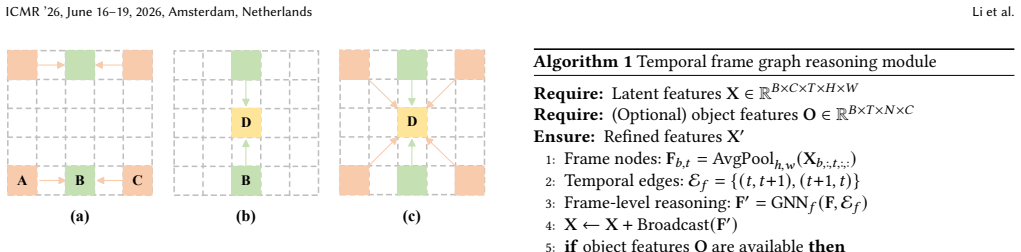
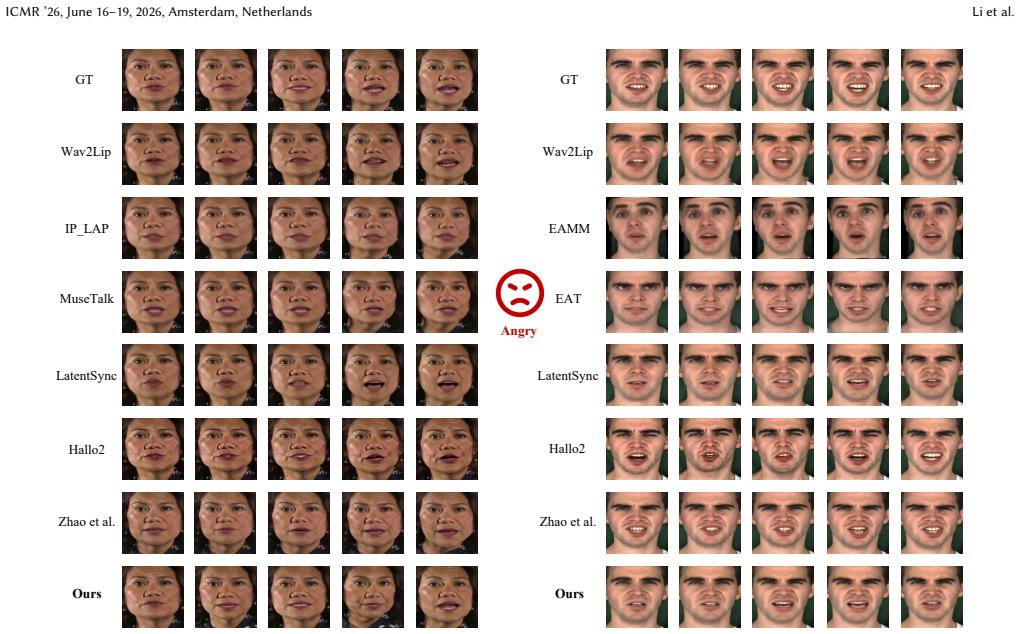
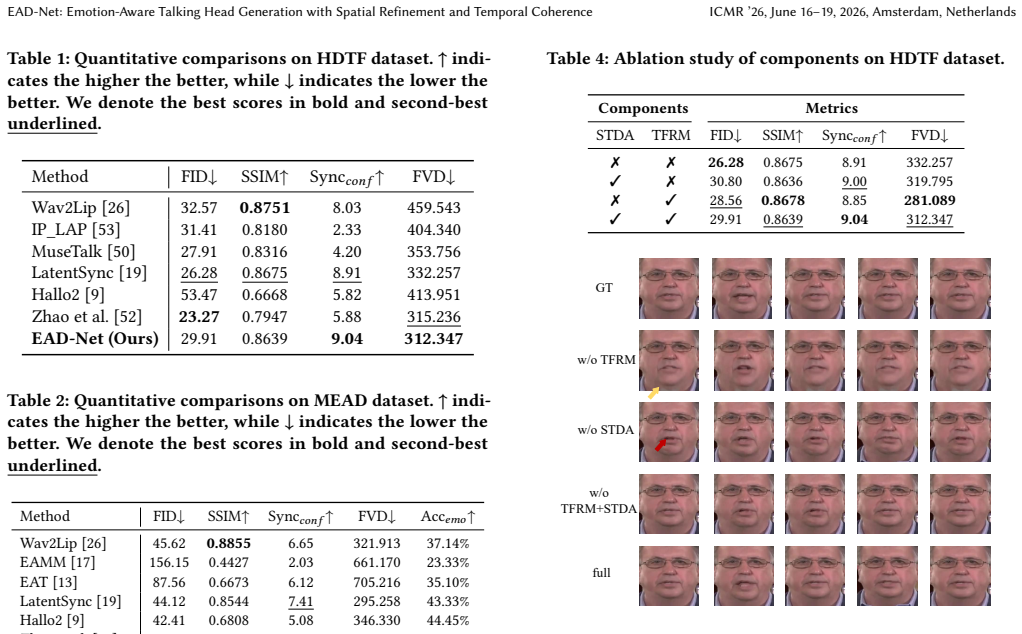
We propose EAD-Net, an emotion-aware diffusion network. SyncNet supervision and Temporal Representation Alignment prevent lip-sync loss when high-level semantics are fused in. Spatio-Temporal Directional Attention captures global motion via strip attention, while the Temporal Frame graph Reasoning Module models coherence between frames through graph learning. Textual descriptions extracted by a large language model supply detailed emotional guidance. On the HDTF and MEAD datasets the method records higher lip-sync accuracy, temporal consistency, and emotional accuracy than prior work.
What carries the argument
Spatio-Temporal Directional Attention (STDA) together with the Temporal Frame graph Reasoning Module (TFRM), which together handle global motion and frame-to-frame relations inside the diffusion pipeline.
If this is right
- High-level emotional semantics can be added without degrading lip synchronization.
- Global motion patterns become visible to the generator even in long sequences.
- Temporal relations between frames are modeled explicitly, raising consistency.
- Emotional control improves through detailed textual descriptions rather than label-only input.
Where Pith is reading between the lines
- The strip-attention design inside STDA could be reused in other long-video tasks where full self-attention is too expensive.
- Graph reasoning for coherence might transfer to audio-driven or text-driven video generation backbones.
- The same alignment losses could be tested on interactive, real-time talking-head systems to check whether sync holds under live input.
Load-bearing premise
The performance gains are produced by the new modules and language-model guidance rather than by dataset-specific tuning or hidden trade-offs.
What would settle it
Running the model on a fresh dataset with unseen speakers or emotion distributions and finding that lip-sync and emotional metrics no longer exceed those of the strongest baseline methods.
Figures



read the original abstract
Emotionally talking head video generation aims to generate expressive portrait videos with accurate lip synchronization and emotional facial expressions. Current methods rely on simple emotional labels, leading to insufficient semantic information. While introducing high-level semantics enhances expressiveness, it easily causes lip-sync degradation. Furthermore, mainstream generation methods struggle to balance computational efficiency and global motion awareness in long videos and suffer from poor temporal coherence. Therefore, we propose an \textbf{E}motion-\textbf{A}ware \textbf{D}iffusion model-based \textbf{Net}work, called \textbf{EAD-Net}. We introduce SyncNet supervision and Temporal Representation Alignment (TREPA) to mitigate lip-sync degradation caused by multi-modal fusion. To model complex spatio-temporal dependencies in long video sequences, we propose a Spatio-Temporal Directional Attention (STDA) mechanism that captures global motion patterns through strip attention. Additionally, we design a Temporal Frame graph Reasoning Module (TFRM) to explicitly model temporal coherence between video frames through graph structure learning. To enhance emotional semantic control, a large language model is employed to extract textual descriptions from real videos, serving as high-level semantic guidance. Experiments on the HDTF and MEAD datasets demonstrate that our method outperforms existing methods in terms of lip-sync accuracy, temporal consistency, and emotional accuracy.
Editorial analysis
A structured set of objections, weighed in public.
Referee Report
Summary. The manuscript proposes EAD-Net, a diffusion model-based network for generating emotion-aware talking head videos. It introduces SyncNet supervision combined with Temporal Representation Alignment (TREPA) to mitigate lip-sync degradation from multi-modal fusion, Spatio-Temporal Directional Attention (STDA) using strip attention to capture global motion in long sequences, Temporal Frame graph Reasoning Module (TFRM) for explicit graph-based modeling of temporal coherence, and LLM-extracted textual semantics for enhanced emotional control. The central claim is that the full model outperforms prior methods on the HDTF and MEAD datasets in lip-sync accuracy, temporal consistency, and emotional accuracy.
Significance. If the outperformance claims hold with proper validation, the work could advance talking-head synthesis by demonstrating a practical way to incorporate high-level LLM semantics without sacrificing synchronization, while using directional attention and graph reasoning to handle spatio-temporal structure in extended videos more efficiently than standard transformers. These modules address acknowledged trade-offs in the field and could influence downstream applications in virtual avatars and media production.
major comments (2)
- [Experiments] Experiments section: The central claim that EAD-Net outperforms existing methods on HDTF and MEAD in lip-sync accuracy, temporal consistency, and emotional accuracy is load-bearing, yet the manuscript provides no module-level ablation studies isolating the contributions of STDA, TFRM, TREPA, SyncNet supervision, or LLM semantic guidance. Without these ablations (or statistical tests on metric differences), it is impossible to confirm that the reported gains are produced by the proposed components rather than training schedule, baseline re-implementation, or dataset-specific factors.
- [Method] Method section (description of TREPA and multi-modal fusion): The paper states that TREPA plus SyncNet supervision mitigates the lip-sync vs. semantic-expressiveness trade-off, but supplies no quantitative before/after metrics, alternative alignment baselines, or analysis of how the alignment loss interacts with the diffusion objective. This directly affects the validity of the mitigation claim.
minor comments (2)
- [Abstract] Abstract: The outperformance claim is stated without any numerical metrics, error bars, or dataset-specific scores, which would immediately strengthen the summary for readers.
- Notation: The acronyms STDA, TFRM, and TREPA are introduced in the abstract before their full expansions appear in the main text; a parenthetical expansion on first use would improve readability.
Simulated Author's Rebuttal
We thank the referee for the constructive and detailed comments, which highlight important aspects for strengthening the validation of our proposed components. We address each major comment point-by-point below and will revise the manuscript accordingly to provide the requested evidence.
read point-by-point responses
-
Referee: Experiments section: The central claim that EAD-Net outperforms existing methods on HDTF and MEAD in lip-sync accuracy, temporal consistency, and emotional accuracy is load-bearing, yet the manuscript provides no module-level ablation studies isolating the contributions of STDA, TFRM, TREPA, SyncNet supervision, or LLM semantic guidance. Without these ablations (or statistical tests on metric differences), it is impossible to confirm that the reported gains are produced by the proposed components rather than training schedule, baseline re-implementation, or dataset-specific factors.
Authors: We agree that module-level ablation studies are necessary to rigorously isolate and validate the contributions of each proposed module. In the revised version, we will add comprehensive ablations on the HDTF and MEAD datasets that remove or replace STDA, TFRM, TREPA, SyncNet supervision, and LLM semantic guidance one at a time. We will also report statistical significance tests (e.g., paired t-tests or Wilcoxon tests) on the metric differences to demonstrate that the observed improvements are attributable to the proposed components rather than implementation or training artifacts. revision: yes
-
Referee: Method section (description of TREPA and multi-modal fusion): The paper states that TREPA plus SyncNet supervision mitigates the lip-sync vs. semantic-expressiveness trade-off, but supplies no quantitative before/after metrics, alternative alignment baselines, or analysis of how the alignment loss interacts with the diffusion objective. This directly affects the validity of the mitigation claim.
Authors: We acknowledge the absence of quantitative before-and-after comparisons for TREPA and SyncNet supervision in the current manuscript. The revised paper will include targeted ablation tables showing lip-sync (LSE-C, LSE-D) and emotional expressiveness metrics with and without these components. We will also add comparisons against alternative alignment strategies (e.g., simple feature concatenation or other contrastive losses) and provide an analysis of how the TREPA alignment loss interacts with the diffusion denoising objective, including loss curves and qualitative examples illustrating the trade-off mitigation. revision: yes
Circularity Check
No significant circularity in architecture proposal or empirical claims
full rationale
The paper proposes EAD-Net as a new diffusion-based architecture incorporating STDA, TFRM, TREPA, SyncNet supervision, and LLM-derived semantics. Performance claims rest on experiments comparing against prior methods on HDTF and MEAD datasets. No equations, derivations, or self-citations are presented that reduce any result to its own inputs by construction. The approach is self-contained as an empirical engineering contribution rather than a closed mathematical loop.
Axiom & Free-Parameter Ledger
free parameters (1)
- Diffusion model and attention hyperparameters
axioms (2)
- domain assumption Diffusion models are suitable for high-quality video frame generation
- domain assumption LLM-extracted text descriptions accurately capture emotional semantics from video
invented entities (3)
-
Spatio-Temporal Directional Attention (STDA)
no independent evidence
-
Temporal Frame graph Reasoning Module (TFRM)
no independent evidence
-
Temporal Representation Alignment (TREPA)
no independent evidence
Reference graph
Works this paper leans on
-
[1]
Shuai Bai, Keqin Chen, Xuejing Liu, Jialin Wang, Wenbin Ge, Sibo Song, Kai Dang, Peng Wang, Shijie Wang, Jun Tang, et al . 2025. Qwen2. 5-vl technical report.arXiv preprint arXiv:2502.13923(2025)
work page internal anchor Pith review arXiv 2025
-
[2]
Andreas Blattmann, Tim Dockhorn, Sumith Kulal, Daniel Mendelevitch, Maciej Kilian, Dominik Lorenz, Yam Levi, Zion English, Vikram Voleti, Adam Letts, et al. 2023. Stable video diffusion: Scaling latent video diffusion models to large datasets.arXiv preprint arXiv:2311.15127(2023)
work page internal anchor Pith review arXiv 2023
-
[3]
Andreas Blattmann, Robin Rombach, Huan Ling, Tim Dockhorn, Seung Wook Kim, Sanja Fidler, and Karsten Kreis. 2023. Align your latents: High-resolution video synthesis with latent diffusion models. InProceedings of the IEEE/CVF conference on computer vision and pattern recognition. 22563–22575. EAD-Net: Emotion-Aware Talking Head Generation with Spatial Ref...
2023
-
[4]
Aras Bozkurt, Junhong Xiao, Sarah Lambert, Angelica Pazurek, Helen Crompton, Suzan Koseoglu, Robert Farrow, Melissa Bond, Chrissi Nerantzi, Sarah Honey- church, et al. 2023. Speculative futures on ChatGPT and generative artificial intelligence (AI): A collective reflection from the educational landscape.Asian Journal of Distance Education18, 1 (2023)
2023
-
[5]
Yubing Cao, Yongming Li, Liejun Wang, and Yinfeng Yu. 2024. VNet: A GAN- based Multi-Tier Discriminator Network for Speech Synthesis Vocoders. In2024 IEEE International Conference on Systems, Man, and Cybernetics (SMC). IEEE, 4384–4389
2024
- [6]
-
[7]
Kun Cheng, Xiaodong Cun, Yong Zhang, Menghan Xia, Fei Yin, Mingrui Zhu, Xuan Wang, Jue Wang, and Nannan Wang. 2022. Videoretalking: Audio-based lip synchronization for talking head video editing in the wild. InSIGGRAPH Asia 2022 Conference Papers. 1–9
2022
-
[8]
Joon Son Chung and Andrew Zisserman. 2016. Out of time: automated lip sync in the wild. InAsian conference on computer vision. Springer, 251–263
2016
- [9]
-
[10]
Yuning Cui and Alois Knoll. 2024. Dual-domain strip attention for image restora- tion.Neural Networks171 (2024), 429–439
2024
-
[11]
Yao Feng, Haiwen Feng, Michael J Black, and Timo Bolkart. 2021. Learning an animatable detailed 3D face model from in-the-wild images.ACM Transactions on Graphics (ToG)40, 4 (2021), 1–13
2021
-
[12]
Jiahao Fu, Yinfeng Yu, and Liejun Wang. 2025. FSDENet: A Frequency and Spatial Domains based Detail Enhancement Network for Remote Sensing Semantic Segmentation.IEEE Journal of Selected Topics in Applied Earth Observations and Remote Sensing(2025)
2025
-
[13]
Yuan Gan, Zongxin Yang, Xihang Yue, Lingyun Sun, and Yi Yang. 2023. Efficient emotional adaptation for audio-driven talking-head generation. InProceedings of the IEEE/CVF International Conference on Computer Vision. 22634–22645
2023
-
[14]
Jiazhi Guan, Zhanwang Zhang, Hang Zhou, Tianshu Hu, Kaisiyuan Wang, Dongliang He, Haocheng Feng, Jingtuo Liu, Errui Ding, Ziwei Liu, et al . 2023. Stylesync: High-fidelity generalized and personalized lip sync in style-based generator. InProceedings of the IEEE/CVF Conference on Computer Vision and Pattern Recognition. 1505–1515
2023
-
[15]
Martin Heusel, Hubert Ramsauer, Thomas Unterthiner, Bernhard Nessler, and Sepp Hochreiter. 2017. Gans trained by a two time-scale update rule converge to a local nash equilibrium.Advances in neural information processing systems30 (2017)
2017
-
[16]
Jonathan Ho, Ajay Jain, and Pieter Abbeel. 2020. Denoising diffusion probabilistic models.Advances in neural information processing systems33 (2020), 6840–6851
2020
-
[17]
Xinya Ji, Hang Zhou, Kaisiyuan Wang, Qianyi Wu, Wayne Wu, Feng Xu, and Xun Cao. 2022. Eamm: One-shot emotional talking face via audio-based emotion- aware motion model. InACM SIGGRAPH 2022 conference proceedings. 1–10
2022
-
[18]
Xinya Ji, Hang Zhou, Kaisiyuan Wang, Wayne Wu, Chen Change Loy, Xun Cao, and Feng Xu. 2021. Audio-driven emotional video portraits. InProceedings of the IEEE/CVF conference on computer vision and pattern recognition. 14080–14089
2021
-
[19]
Chunyu Li, Chao Zhang, Weikai Xu, Jinghui Xie, Weiguo Feng, Bingyue Peng, and Weiwei Xing. 2024. Latentsync: Audio conditioned latent diffusion models for lip sync.arXiv e-prints(2024), arXiv–2412
2024
-
[20]
Jia Li, Yinfeng Yu, Liejun Wang, Fuchun Sun, and Wendong Zheng. 2025. Audio- Guided Dynamic Modality Fusion with Stereo-Aware Attention for Audio-Visual Navigation. InInternational Conference on Neural Information Processing. Springer, 346–359
2025
-
[21]
Steven R Livingstone and Frank A Russo. 2018. The Ryerson Audio-Visual Database of Emotional Speech and Song (RAVDESS): A dynamic, multimodal set of facial and vocal expressions in North American English.PloS one13, 5 (2018), e0196391
2018
- [22]
- [23]
-
[24]
Alimjan Mattursun, Liejun Wang, and Yinfeng Yu. 2024. BSS-CFFMA: cross- domain feature fusion and multi-attention speech enhancement network based on self-supervised embedding. In2024 IEEE International Conference on Systems, Man, and Cybernetics (SMC). IEEE, 3589–3594
2024
-
[25]
Soumik Mukhopadhyay, Saksham Suri, Ravi Teja Gadde, and Abhinav Shrivastava
-
[26]
In Proceedings of the IEEE/CVF Winter Conference on Applications of Computer Vision
Diff2lip: Audio conditioned diffusion models for lip-synchronization. In Proceedings of the IEEE/CVF Winter Conference on Applications of Computer Vision. 5292–5302
-
[27]
KR Prajwal, Rudrabha Mukhopadhyay, Vinay P Namboodiri, and CV Jawahar
-
[28]
In Proceedings of the 28th ACM international conference on multimedia
A lip sync expert is all you need for speech to lip generation in the wild. In Proceedings of the 28th ACM international conference on multimedia. 484–492
-
[29]
Cuifeng Shen, Yulu Gan, Chen Chen, Xiongwei Zhu, Lele Cheng, Tingting Gao, and Jinzhi Wang. 2024. Decouple content and motion for conditional image-to- video generation. InProceedings of the AAAI conference on artificial intelligence, Vol. 38. 4757–4765
2024
-
[30]
Shuai Shen, Wenliang Zhao, Zibin Meng, Wanhua Li, Zheng Zhu, Jie Zhou, and Jiwen Lu. 2023. Difftalk: Crafting diffusion models for generalized audio-driven portraits animation. InProceedings of the IEEE/CVF conference on computer vision and pattern recognition. 1982–1991
2023
-
[31]
Michał Stypułkowski, Konstantinos Vougioukas, Sen He, Maciej Zięba, Stavros Petridis, and Maja Pantic. 2024. Diffused heads: Diffusion models beat gans on talking-face generation. InProceedings of the IEEE/CVF Winter Conference on Applications of Computer Vision. 5091–5100
2024
-
[32]
Shaolin Su, Qingsen Yan, Yu Zhu, Cheng Zhang, Xin Ge, Jinqiu Sun, and Yanning Zhang. 2020. Blindly assess image quality in the wild guided by a self-adaptive hyper network. InProceedings of the IEEE/CVF conference on computer vision and pattern recognition. 3667–3676
2020
-
[33]
Kartik Teotia, Hyeongwoo Kim, Pablo Garrido, Marc Habermann, Mohamed Elgharib, and Christian Theobalt. 2024. Gaussianheads: End-to-end learning of drivable gaussian head avatars from coarse-to-fine representations.ACM Transactions on Graphics (ToG)43, 6 (2024), 1–12
2024
-
[34]
Linrui Tian, Qi Wang, Bang Zhang, and Liefeng Bo. 2024. Emo: Emote portrait alive generating expressive portrait videos with audio2video diffusion model under weak conditions. InEuropean Conference on Computer Vision. Springer, 244–260
2024
-
[35]
Thomas Unterthiner, Sjoerd Van Steenkiste, Karol Kurach, Raphael Marinier, Marcin Michalski, and Sylvain Gelly. 2018. Towards accurate generative models of video: A new metric & challenges.arXiv preprint arXiv:1812.01717(2018)
work page internal anchor Pith review arXiv 2018
-
[36]
Duomin Wang, Yu Deng, Zixin Yin, Heung-Yeung Shum, and Baoyuan Wang. 2023. Progressive disentangled representation learning for fine-grained controllable talking head synthesis. InProceedings of the IEEE/CVF Conference on Computer Vision and Pattern Recognition. 17979–17989
2023
-
[37]
Kaisiyuan Wang, Qianyi Wu, Linsen Song, Zhuoqian Yang, Wayne Wu, Chen Qian, Ran He, Yu Qiao, and Chen Change Loy. 2020. Mead: A large-scale audio- visual dataset for emotional talking-face generation. InEuropean conference on computer vision. Springer, 700–717
2020
-
[38]
Limin Wang, Bingkun Huang, Zhiyu Zhao, Zhan Tong, Yinan He, Yi Wang, Yali Wang, and Yu Qiao. 2023. Videomae v2: Scaling video masked autoencoders with dual masking. InProceedings of the IEEE/CVF conference on computer vision and pattern recognition. 14549–14560
2023
-
[39]
Xincheng Wang, Liejun Wang, Yinfeng Yu, and Xinxin Jiao. 2025. Modality- Invariant Bidirectional Temporal Representation Distillation Network for Missing Multimodal Sentiment Analysis. InICASSP 2025-2025 IEEE International Confer- ence on Acoustics, Speech and Signal Processing (ICASSP). IEEE, 1–5
2025
-
[40]
Fei Yin, Yong Zhang, Xiaodong Cun, Mingdeng Cao, Yanbo Fan, Xuan Wang, Qingyan Bai, Baoyuan Wu, Jue Wang, and Yujiu Yang. 2022. Styleheat: One- shot high-resolution editable talking face generation via pre-trained stylegan. In European conference on computer vision. Springer, 85–101
2022
-
[41]
Yinfeng Yu, Changan Chen, Lele Cao, Fangkai Yang, and Fuchun Sun. 2023. Measuring acoustics with collaborative multiple agents. InProceedings of the Thirty-Second International Joint Conference on Artificial Intelligence. 335–343
2023
-
[42]
Yinfeng Yu, Wenbing Huang, Fuchun Sun, Changan Chen, Yikai Wang, and Xiaohong Liu. 2022. Sound Adversarial Audio-Visual Navigation. InThe Tenth International Conference on Learning Representations, ICLR 2022, Virtual Event, April 25-29, 2022
2022
-
[43]
Yinfeng Yu and Shiyu Sun. 2025. DGFNet: End-to-End Audio-Visual Source Sep- aration Based on Dynamic Gating Fusion. InProceedings of the 2025 International Conference on Multimedia Retrieval. 1730–1738
2025
-
[44]
Yinfeng Yu and Dongsheng Yang. 2025. Dope: Dual object perception- enhancement network for vision-and-language navigation. InProceedings of the 2025 International Conference on Multimedia Retrieval. 1739–1748
2025
- [45]
-
[46]
Bingyuan Zhang, Xulong Zhang, Ning Cheng, Jun Yu, Jing Xiao, and Jianzong Wang. 2024. Emotalker: Emotionally editable talking face generation via diffusion model. InICASSP 2024-2024 IEEE International Conference on Acoustics, Speech and Signal Processing (ICASSP). IEEE, 8276–8280
2024
-
[48]
InInternational Conference on Neural Information Processing
Advancing Audio-Visual Navigation Through Multi-Agent Collaboration in 3D Environments. InInternational Conference on Neural Information Processing. Springer, 502–516
-
[49]
Hailong Zhang, Yinfeng Yu, Liejun Wang, Fuchun Sun, and Wendong Zheng
- [50]
- [51]
-
[52]
Jiang Zhang, Liejun Wang, Yinfeng Yu, and Miaomiao Xu. 2024. Nonlinear regularization decoding method for speech recognition.Sensors24, 12 (2024), ICMR ’26, June 16–19, 2026, Amsterdam, Netherlands Li et al. 3846
2024
-
[53]
Richard Zhang, Phillip Isola, Alexei A Efros, Eli Shechtman, and Oliver Wang
-
[54]
InProceedings of the IEEE conference on computer vision and pattern recognition
The unreasonable effectiveness of deep features as a perceptual metric. InProceedings of the IEEE conference on computer vision and pattern recognition. 586–595
- [55]
-
[56]
Zhimeng Zhang, Lincheng Li, Yu Ding, and Changjie Fan. 2021. Flow-guided one-shot talking face generation with a high-resolution audio-visual dataset. In Proceedings of the IEEE/CVF conference on computer vision and pattern recognition. 3661–3670
2021
-
[57]
Shuling Zhao, Fa-Ting Hong, Xiaoshui Huang, and Dan Xu. 2025. Synergizing motion and appearance: Multi-scale compensatory codebooks for talking head video generation. InProceedings of the Computer Vision and Pattern Recognition Conference. 26232–26241
2025
-
[58]
Weizhi Zhong, Chaowei Fang, Yinqi Cai, Pengxu Wei, Gangming Zhao, Liang Lin, and Guanbin Li. 2023. Identity-preserving talking face generation with landmark and appearance priors. InProceedings of the IEEE/CVF Conference on Computer Vision and Pattern Recognition. 9729–9738
2023
-
[59]
Yang Zhou, Xintong Han, Eli Shechtman, Jose Echevarria, Evangelos Kalogerakis, and Dingzeyu Li. 2020. Makelttalk: speaker-aware talking-head animation.ACM Transactions On Graphics (TOG)39, 6 (2020), 1–15
2020
discussion (0)
Sign in with ORCID, Apple, or X to comment. Anyone can read and Pith papers without signing in.