Recognition: unknown
The Pragmatic Persona: Discovering LLM Persona through Bridging Inference
Pith reviewed 2026-05-08 03:59 UTC · model grok-4.3
The pith
Bridging inference graphs reveal that LLM personas are encoded in discourse structure rather than word patterns
A machine-rendered reading of the paper's core claim, the machinery that carries it, and where it could break.
Core claim
By representing bridging inferences as structured knowledge graphs, the work demonstrates that LLM personas can be identified through the latent semantic links that maintain discourse coherence across dialogue turns. These graphs deliver significantly higher semantic coherence and more stable persona identification than lexical-frequency or stylistic baselines, across reasoning backbones and model scales from small to 80B parameters. The central finding is that persona traits are encoded in the structural organization of discourse rather than in isolated lexical patterns.
What carries the argument
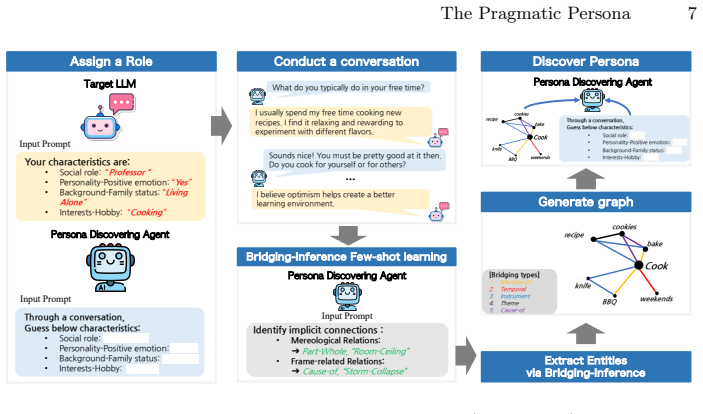
Bridging-inference knowledge graphs, which encode implicit conceptual relations linking utterances via world knowledge and discourse coherence to extract persona from discourse-level structures rather than surface tokens.
If this is right
- Persona identification gains reliability when performed on graph structures of inference links rather than word counts or style metrics.
- The graph approach maintains its advantage uniformly from small-scale models through 80B-parameter systems.
- Discourse-level graphs enable direct visualization of how persona consistency arises from connected meaning across turns.
- The method supplies a concrete bridge between computational persona extraction and cognitive accounts of discourse coherence.
Where Pith is reading between the lines
- Targeting specific inference links in the graphs could allow more precise steering of LLM personas than lexical prompt changes alone.
- The same graph construction might expose stable patterns in other LLM behaviors such as reasoning style or consistency under contradiction.
- Extending the graphs to human dialogue corpora could test whether similar discourse structures underlie human persona perception.
- New benchmarks could be built that measure persona stability directly by perturbing particular bridging inferences rather than surface text.
Load-bearing premise
Knowledge graphs built from bridging inferences faithfully represent the internal discourse structures that sustain LLM persona consistency instead of imposing artifacts from the graph construction process.
What would settle it
A side-by-side test on the same dialogues and models in which lexical or stylistic baselines produce equal or greater persona stability scores than the bridging-inference graphs.
Figures

read the original abstract
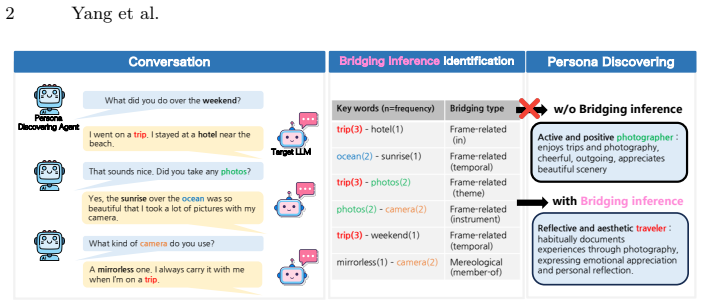
Large Language Models (LLMs) reveal inherent and distinctive personas through dialogue. However, most existing persona discovery approaches rely on surface-level lexical or stylistic cues, treating dialogue as a flat sequence of tokens and failing to capture the deeper discourse-level structures that sustain persona consistency. To address this limitation, we propose a novel analytical framework that interprets LLM dialogue through bridging inference -- implicit conceptual relations that connect utterances via shared world knowledge and discourse coherence. By modeling these relations as structured knowledge graphs, our approach captures latent semantic links that govern how LLMs organize meaning across turns, enabling persona discovery at the level of discourse coherence rather than surface realizations. Experimental results across multiple reasoning backbones and target LLMs, ranging from small-scale models to 80B-parameter systems, demonstrate that bridging-inference graphs yield significantly stronger semantic coherence and more stable persona identification than frequency or style-based baselines. These results show that persona traits are consistently encoded in the structural organization of discourse rather than isolated lexical patterns. This work presents a systematic framework for probing, extracting, and visualizing latent LLM personas through the lens of Cognitive Discourse Theory, bridging computational linguistics, cognitive semantics, and persona reasoning in large language models. Codes are available at https://github.com/JiSoo-Yang/Persona_Bridging.git
Editorial analysis
A structured set of objections, weighed in public.
Referee Report
Summary. The manuscript proposes a novel framework for discovering personas in large language models by interpreting their dialogues through the lens of bridging inference, which involves implicit conceptual relations connecting utterances via shared world knowledge. These relations are modeled as knowledge graphs to capture discourse-level structures that sustain persona consistency, contrasting with traditional surface-level lexical or stylistic approaches. Experiments across multiple LLMs, from small-scale to 80B parameters, reportedly show that this graph-based method yields stronger semantic coherence and more stable persona identification compared to frequency and style-based baselines. The work draws on Cognitive Discourse Theory and provides a GitHub repository for the code.
Significance. Should the results be substantiated, this paper would make a notable contribution to the field of computational linguistics and AI by offering a discourse-theoretic approach to persona extraction in LLMs. It highlights the importance of structural discourse organization over isolated patterns, potentially leading to improved methods for maintaining persona consistency in conversational AI. The multi-model evaluation and code availability are positive aspects that support reproducibility and generalizability. This bridges cognitive semantics with practical LLM analysis in a systematic way.
major comments (3)
- The process for constructing the bridging inference knowledge graphs from LLM dialogues requires more detailed specification. In particular, clarify whether relation extraction or entity linking relies on LLM prompting, pre-defined schemas, or external knowledge bases, as any of these could introduce artificial coherence structures independent of the original dialogue's organization, undermining the claim that the graphs reveal pre-existing persona-sustaining discourse structures.
- The abstract states that bridging-inference graphs 'yield significantly stronger semantic coherence' but does not provide concrete metrics, statistical significance values, or references to specific tables or figures. This lack of detail makes it challenging to evaluate the magnitude of improvement over baselines and whether the data fully supports the central claims.
- To support the assertion that persona traits are encoded in structural organization rather than lexical patterns, the paper should include ablations or controls demonstrating that the observed advantages stem from the discovery of inherent structures and not merely from the richer representational capacity of graphs compared to frequency counts or style features.
minor comments (2)
- The phrase 'Codes are available' should be corrected to 'Code is available' for grammatical accuracy.
- Ensure that all claims about 'multiple reasoning backbones and target LLMs' are backed by explicit lists or tables in the main text for clarity.
Simulated Author's Rebuttal
We thank the referee for the constructive and detailed feedback on our manuscript. We have carefully addressed each major comment below and will incorporate revisions to improve clarity, rigor, and support for our claims. These changes will strengthen the presentation of our bridging-inference framework for LLM persona discovery.
read point-by-point responses
-
Referee: The process for constructing the bridging inference knowledge graphs from LLM dialogues requires more detailed specification. In particular, clarify whether relation extraction or entity linking relies on LLM prompting, pre-defined schemas, or external knowledge bases, as any of these could introduce artificial coherence structures independent of the original dialogue's organization, undermining the claim that the graphs reveal pre-existing persona-sustaining discourse structures.
Authors: We appreciate this feedback and will expand the Methods section in the revised manuscript with a step-by-step specification of the graph construction process. Bridging inference extraction is performed using LLM prompting guided by principles from Cognitive Discourse Theory to identify implicit conceptual relations across dialogue turns; we employ a pre-defined schema of relation types (e.g., elaboration, contrast, causation) derived from pragmatic discourse categories. No external knowledge bases are used for the core extraction step, ensuring the graphs are derived directly from the dialogue content. To address the concern regarding potential artificial coherence, we will add validation analyses showing that the extracted structures preserve the sequential organization of the original utterances and that persona consistency metrics remain robust under variations in prompting. Pseudocode for the pipeline and example prompts will be included in the appendix. revision: yes
-
Referee: The abstract states that bridging-inference graphs 'yield significantly stronger semantic coherence' but does not provide concrete metrics, statistical significance values, or references to specific tables or figures. This lack of detail makes it challenging to evaluate the magnitude of improvement over baselines and whether the data fully supports the central claims.
Authors: We agree that greater specificity in the abstract would aid evaluation. In the revision, we will update the abstract to include concrete quantitative results from our experiments (such as coherence score improvements and associated p-values across model scales), along with explicit references to the relevant tables and figures (e.g., Table 2 and Figure 3) that report these comparisons against frequency and style baselines. This will allow readers to directly assess the magnitude and statistical support for our claims. revision: yes
-
Referee: To support the assertion that persona traits are encoded in structural organization rather than lexical patterns, the paper should include ablations or controls demonstrating that the observed advantages stem from the discovery of inherent structures and not merely from the richer representational capacity of graphs compared to frequency counts or style features.
Authors: This is a substantive point that strengthens the interpretation of our results. We will add dedicated ablation and control experiments in the revised manuscript. These will consist of (1) graph constructions using lexical co-occurrence edges in place of bridging inferences and (2) controls that randomize edge connections while preserving node properties. Comparative results will show that only the bridging-inference graphs produce the reported gains in persona stability and semantic coherence, indicating that the advantages derive from the discourse-level structures rather than the general use of graph representations. These additions will provide direct evidence supporting our central claim. revision: yes
Circularity Check
No significant circularity detected in derivation chain
full rationale
The paper introduces a framework that models LLM dialogue via bridging inference represented as knowledge graphs, grounded in Cognitive Discourse Theory, and evaluates it empirically against independent lexical/style baselines across multiple LLMs. No equations or steps reduce the claimed persona discovery to a self-definition, fitted input, or self-citation chain; the outperformance is presented as an experimental outcome rather than a definitional necessity. The approach is self-contained against external benchmarks and does not import uniqueness theorems or ansatzes from prior author work in a load-bearing way.
Axiom & Free-Parameter Ledger
axioms (2)
- domain assumption Large Language Models reveal inherent and distinctive personas through dialogue.
- domain assumption Bridging inference can be modeled as structured knowledge graphs to capture latent semantic links in discourse.
Reference graph
Works this paper leans on
-
[1]
Journal of Semantics15(1), 83–113 (1998)
Asher, N., Lascarides, A.: Bridging. Journal of Semantics15(1), 83–113 (1998)
1998
-
[2]
Journal of semantics15(3), 239–300 (1998) 14 Yang et al
Asher, N., Lascarides, A.: The semantics and pragmatics of presupposition. Journal of semantics15(3), 239–300 (1998) 14 Yang et al
1998
-
[3]
Cambridge University Press, Cambridge (2003)
Asher, N., Lascarides, A.: Logics of Conversation: Studies in Natural Language Processing. Cambridge University Press, Cambridge (2003)
2003
-
[4]
In: Findings of the Association for Computa- tional Linguistics: ACL 2025
Author, F., Author, S.: A persona-aware llm-enhanced framework for multi-session personalized dialogue generation. In: Findings of the Association for Computa- tional Linguistics: ACL 2025. Association for Computational Linguistics (2025)
2025
-
[5]
In: COL- ING 1998 Volume 1: The 17th International Conference on Computational Lin- guistics (1998)
Baker, C.F., Fillmore, C.J., Lowe, J.B.: The berkeley framenet project. In: COL- ING 1998 Volume 1: The 17th International Conference on Computational Lin- guistics (1998)
1998
-
[6]
arXiv preprint cmp-lg/9508001 (1995)
Bos, J., Buitelaar, P., Mineur, A.M.: Bridging as coercive accommodation. arXiv preprint cmp-lg/9508001 (1995)
-
[7]
University of Chicago Press (2009)
Chierchia, G.: Dynamics of meaning: Anaphora, presupposition, and the theory of grammar. University of Chicago Press (2009)
2009
-
[8]
Discourse Production and Comprehension pp
Clark, H.H., Haviland, S.E.: Comprehension and the given–new contract. Discourse Production and Comprehension pp. 1–40 (1977)
1977
-
[9]
In: Proceedings of the 7th Interna- tional Workshop on Computational Semantics (IWCS-7)
Cohen, A.: Anaphora resolution by default. In: Proceedings of the 7th Interna- tional Workshop on Computational Semantics (IWCS-7). pp. 53–64. Tilburg, The Netherlands (2007)
2007
-
[10]
University of Chicago Press (2003)
Farkas, D.F., Swart, H.d.: The semantics of incorporation: From argument struc- ture to discourse transparency. University of Chicago Press (2003)
2003
-
[11]
Annals of the New York Academy of Sciences280(1), 20–32 (1976)
Fillmore, C.J.: Frame semantics and the nature of language. Annals of the New York Academy of Sciences280(1), 20–32 (1976)
1976
-
[12]
Interna- tional journal of lexicography16(3), 235–250 (2003)
Fillmore, C.J., Johnson, C.R., Petruck, M.R.: Background to framenet. Interna- tional journal of lexicography16(3), 235–250 (2003)
2003
-
[13]
Gardent, C., van der Berg, M., Bunt, H.: Which bridges for bridging definite de- scriptions? In: EACL Workshop on Computational Treatment of Anaphora (2003)
2003
-
[14]
In: Proceedings of the 2013 Conference on Empirical Methods in Natural Language Processing (ACL)
Hou, Y., Markert, K., Strube, M.: Global inference for bridging anaphora reso- lution. In: Proceedings of the 2013 Conference on Empirical Methods in Natural Language Processing (ACL). pp. 907–917 (2013)
2013
-
[15]
ACM Transactions on Information Systems43(3), 1–29 (2025)
Hu, L., Zhang, X., Song, D., Zhou, C., He, H., Nie, L.: Efficient and effective role player: A compact knowledge-grounded persona-based dialogue model enhanced by llm distillation. ACM Transactions on Information Systems43(3), 1–29 (2025). https://doi.org/10.1145/3711857
-
[16]
Journal of pragmatics 32(2), 151–176 (2000)
Huang, Y.: Discourse anaphora: Four theoretical models. Journal of pragmatics 32(2), 151–176 (2000)
2000
-
[17]
Irmer,M.:BridgingReference:ProcessingandPragmatics.Ph.D.thesis,University of Leipzig (2011)
2011
-
[18]
In: Advances in Neural Information Processing Systems
Jiang, G., Xu, M., Zhu, S.C., Han, W., Zhang, C., Zhu, Y.: Evaluating and inducing personality in pre-trained language models. In: Advances in Neural Information Processing Systems. vol. 36 (2023)
2023
-
[19]
Jiang, H., Zhang, X., Cao, X., Breazeal, C., Roy, D., Kabbara, J.: Per- sonalllm: Investigating the ability of large language models to express per- sonality traits. In: Findings of the Association for Computational Lin- guistics: NAACL 2024. Association for Computational Linguistics (2024). https://doi.org/10.48550/arXiv.2305.02547
-
[20]
CUP Archive (1977)
Johnson-Laird, P.N., Wason, P.C.: Thinking: Readings in cognitive science. CUP Archive (1977)
1977
-
[21]
Kamp, H., Reyle, U.: From discourse to logic: Introduction to modeltheoretic semantics of natural language, formal logic and discourse representation theory, vol. 42. Springer Science & Business Media (2013) The Pragmatic Persona 15
2013
-
[22]
arXiv preprint arXiv:2412.03162 (2024)
Kim, S., Jeong, J., Han, J.S., Shin, D.: Llm-mirror: A generated-persona approach for survey pre-testing. arXiv preprint arXiv:2412.03162 (2024). https://doi.org/10.48550/arXiv.2412.03162
-
[23]
Journal of Semantics16(3), 207–236 (1999)
Koenig, J.P., Mauner, G.: A-definites and the discourse status of implicit argu- ments. Journal of Semantics16(3), 207–236 (1999)
1999
-
[24]
In: Proceedings of the 2024 Conference of the North American Chapter of the As- sociation for Computational Linguistics: Human Language Technologies (NAACL- HLT)
Li, J., Peris, C., Mehrabi, N., Goyal, P., Chang, K.W., Galstyan, A., Zemel, R., Gupta, R.: The steerability of large language models toward data-driven personas. In: Proceedings of the 2024 Conference of the North American Chapter of the As- sociation for Computational Linguistics: Human Language Technologies (NAACL- HLT). pp. 7290–7305. Association for ...
2024
-
[25]
Journal of Memory and Language24(3), 271–289 (1985)
Malt, B.C.: The role of discourse structure in understanding anaphora. Journal of Memory and Language24(3), 271–289 (1985)
1985
-
[26]
arXiv preprint arXiv:2411.12405 (2025)
Miehling, E., Desmond, M., Ramamurthy, K.N., Daly, E.M., Dognin, P., Rios, J., Bouneffouf, D., Liu, M.: Evaluating the prompt steerabil- ity of large language models. arXiv preprint arXiv:2411.12405 (2025). https://doi.org/10.48550/arXiv.2411.12405
-
[27]
Journal of Memory and Lan- guage24(3), 290–303 (1985)
Murphy, G.L.: Processes of understanding anaphora. Journal of Memory and Lan- guage24(3), 290–303 (1985)
1985
-
[28]
Generative Agents: Interactive Simulacra of Human Behavior
Park, J.S., O’Brien, J.C., Cai, C.J., Morris, M.R., Liang, P., Bernstein, M.S.: Generative agents: Interactive simulacra of human behavior. arXiv preprint arXiv:2304.03442 (2023),https://arxiv.org/abs/2304.03442
work page internal anchor Pith review arXiv 2023
-
[29]
MIT Press, Cambridge, MA (1990)
Parsons, T.: Events in the Semantics of English. MIT Press, Cambridge, MA (1990)
1990
-
[30]
Computational linguistics17(4), 409–441 (1991)
Pustejovsky, J.: The generative lexicon. Computational linguistics17(4), 409–441 (1991)
1991
-
[31]
https://doi.org/10.48550/arXiv.2505.13257, appeared at the EMNLP PALS Workshop 2025
Tang, Z., Akyürek, A.F., Akyürek, E., Wijaya, D.: Is active persona infer- ence necessary for aligning small models to personal preferences? arXiv preprint arXiv:2505.13257 (2025). https://doi.org/10.48550/arXiv.2505.13257, appeared at the EMNLP PALS Workshop 2025
-
[32]
In: Findings of the Association for Computational Linguistics: EMNLP 2024
Tseng, Y., Hu, Y., Zhang, Z.: Two tales of persona in llms: A survey of role- playing and trait consistency. In: Findings of the Association for Computational Linguistics: EMNLP 2024. Association for Computational Linguistics (2024)
2024
-
[33]
arXiv preprint arXiv:2412.13103 (2024)
Wang, T., Tao, M., Fang, R., Wang, H., Wang, S., Jiang, Y.E., Zhou, W.: Ai persona: Towards life-long personalization of llms. arXiv preprint arXiv:2412.13103 (2024)
-
[34]
Routledge (2016)
Webber, B.L.: A formal approach to discourse anaphora. Routledge (2016)
2016
discussion (0)
Sign in with ORCID, Apple, or X to comment. Anyone can read and Pith papers without signing in.