Recognition: unknown
Deep Learning-Enabled Dissolved Oxygen Sensing in Biofouling Environments for Ocean Monitoring
Pith reviewed 2026-05-07 17:37 UTC · model grok-4.3
The pith
A visual transformer physics-informed neural network embeds the Stern-Volmer equation to sense dissolved oxygen with roughly 2 micromoles per liter error under biofouling.
A machine-rendered reading of the paper's core claim, the machinery that carries it, and where it could break.
Core claim
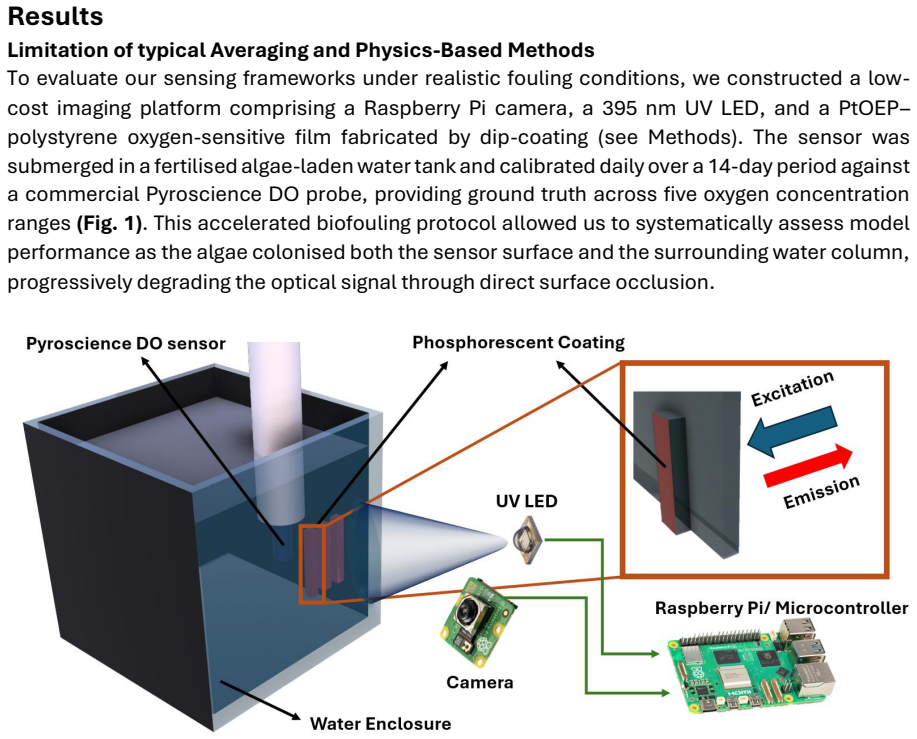
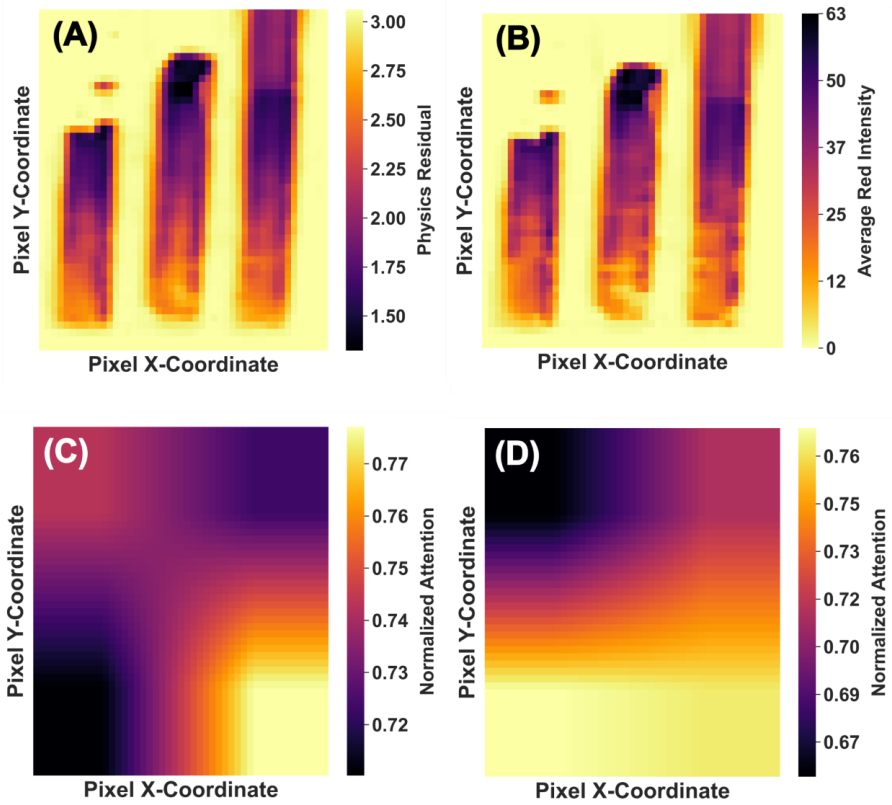
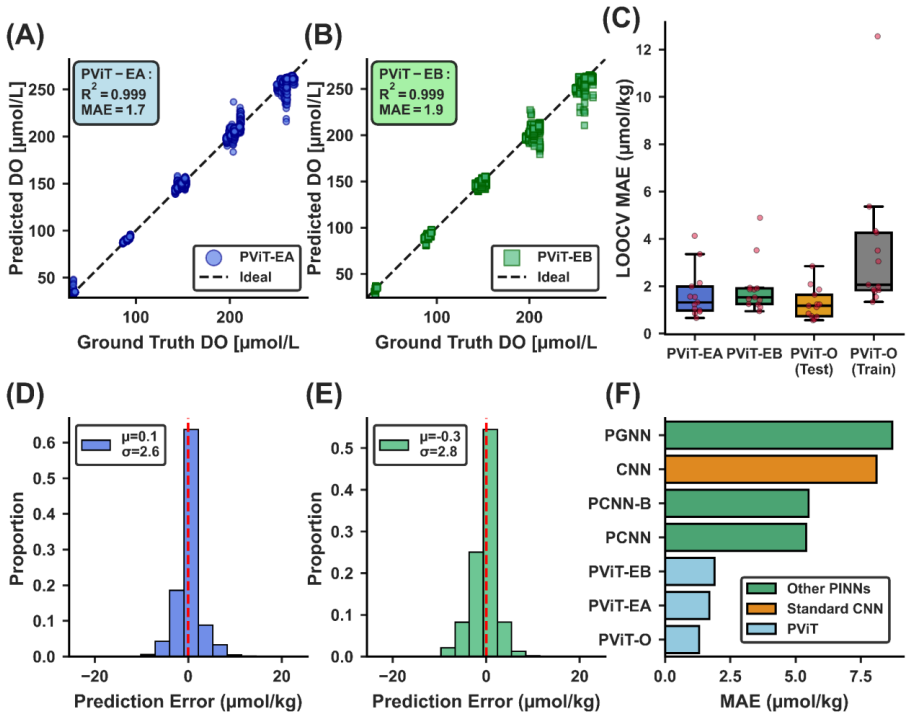
We introduce a sensing paradigm that combines camera-based DO sensors with a visual transformer (ViT)-based physics-informed neural network (PINN) for high-fidelity sensing under biofouling conditions. Training and testing data were obtained from an algae-laden water tank over 14 days to capture accelerated biofouling. The ViT-PINN, which embeds the Stern-Volmer (SV) equation into the loss function, reduces mean average error (MAE) by 92% and 89% compared to classical statistical and ML approaches, achieving ~2 umol/L absolute error. A deep ensemble further quantifies predictive uncertainty, enabling self-diagnostic sensing.
What carries the argument
The ViT-PINN, a visual transformer neural network whose loss function embeds the Stern-Volmer equation relating phosphorescence lifetime to oxygen concentration.
If this is right
- Low-cost microstructured polymer-film sensors become viable for sustained ocean deployments without frequent cleaning.
- Predictive uncertainty estimates allow the system to flag its own degradation and trigger maintenance alerts.
- Absolute DO data at ~2 umol/L accuracy can feed directly into models that forecast climate tipping points.
- The same embedding approach could be adapted to other drift-prone optical or electrochemical sensors.
Where Pith is reading between the lines
- The method might be tested on real-time video streams from existing underwater cameras rather than dedicated sensor hardware.
- Combining the uncertainty output with periodic calibration checks could extend operational life further in variable marine conditions.
- If the Stern-Volmer embedding proves robust, similar physics-informed architectures could address fouling in other ocean parameters such as pH or turbidity.
Load-bearing premise
The 14-day algae-laden water tank experiment sufficiently captures the dynamics and variability of real-world marine biofouling for the model to generalize beyond the lab setting.
What would settle it
A multi-month deployment of the same sensor hardware in open ocean water that produces absolute errors well above 2 umol/L would show the lab-trained model does not generalize.
Figures



read the original abstract
The escalating climate crisis and ecosystem degradation demand intelligent, low-cost sensors capable of robust, long-term monitoring in real-world environments. Absolute dissolved oxygen (DO) concentration is a key parameter for predicting climate tipping points. Inexpensive optoelectronic sensors based on microstructured polymer films doped with phosphorescent dyes could be readily deployable; however, signal drift and marine biofouling remain major challenges. Here, we introduce a sensing paradigm that combines camera-based DO sensors with a visual transformer (ViT)-based physics-informed neural network (PINN) for high-fidelity sensing under biofouling conditions. Training and testing data were obtained from an algae-laden water tank over 14 days to capture accelerated biofouling. The ViT-PINN, which embeds the Stern-Volmer (SV) equation into the loss function, reduces mean average error (MAE) by 92% and 89% compared to classical statistical and ML approaches, achieving ~2 umol/L absolute error. A deep ensemble further quantifies predictive uncertainty, enabling self-diagnostic sensing.
Editorial analysis
A structured set of objections, weighed in public.
Referee Report
Summary. The manuscript introduces a visual transformer physics-informed neural network (ViT-PINN) for camera-based dissolved oxygen (DO) sensing that embeds the Stern-Volmer equation directly into the training loss. Data are collected from a single 14-day algae-laden tank experiment designed to accelerate biofouling on microstructured polymer film sensors. The ViT-PINN is reported to reduce MAE by 92% and 89% relative to classical statistical and standard ML baselines, reaching an absolute error of approximately 2 μmol/L, with a deep ensemble providing uncertainty estimates for self-diagnostic capability.
Significance. If the reported error reduction and uncertainty quantification hold under broader conditions, the work could enable more reliable, low-cost optoelectronic DO sensors for long-term ocean monitoring by addressing biofouling drift without frequent recalibration. The explicit physics embedding supplies external grounding rather than purely data-driven fitting. However, the significance for real-world deployment is limited by the narrow experimental regime, which may not capture the full variability of marine environments.
major comments (3)
- [Methods] Methods, experimental protocol: The training and testing data are drawn exclusively from a single 14-day accelerated algae tank; no hold-out evaluation on natural seawater samples, multi-site deployments, or controlled variations in biofouling thickness, species composition, or hydrodynamic shear is described. This directly limits support for the central claim of applicability to ocean monitoring.
- [Results] Results, performance comparison: The abstract states 92% and 89% MAE reductions versus 'classical statistical and ML approaches' to ~2 μmol/L, yet the manuscript provides no explicit description of the baseline algorithms, hyperparameter tuning, data-split strategy, or statistical error bars on the reported metrics. Without these, the magnitude of improvement cannot be independently verified.
- [§3.2] §3.2, loss formulation: While embedding the Stern-Volmer relation supplies physics grounding, the paper does not report an ablation that isolates the contribution of the physics term versus the ViT architecture alone, nor does it quantify how much the network is learning residual corrections versus simply fitting the embedded equation on the limited tank data.
minor comments (2)
- [Figures] Figure 3 (or equivalent results figure): Axis labels and legend entries for the baseline methods are insufficiently detailed to allow direct reproduction of the MAE comparison.
- [Notation] Notation: The symbol for dissolved oxygen concentration is used inconsistently between the Stern-Volmer equation statement and the network output description; a single consistent symbol should be adopted throughout.
Simulated Author's Rebuttal
We thank the referee for the constructive and detailed comments. We have revised the manuscript to address the concerns by expanding the description of baselines and evaluation protocols, adding explicit discussion of experimental limitations, and providing further analysis of the physics loss contribution. Our point-by-point responses follow.
read point-by-point responses
-
Referee: [Methods] Methods, experimental protocol: The training and testing data are drawn exclusively from a single 14-day accelerated algae tank; no hold-out evaluation on natural seawater samples, multi-site deployments, or controlled variations in biofouling thickness, species composition, or hydrodynamic shear is described. This directly limits support for the central claim of applicability to ocean monitoring.
Authors: We agree that the experimental validation is restricted to a single controlled tank with accelerated algae-induced biofouling. This protocol was chosen to generate a reproducible, time-extended dataset capturing progressive sensor degradation within practical laboratory constraints. In the revised manuscript we have added a dedicated Limitations paragraph in the Discussion section that explicitly qualifies the scope of the ocean-monitoring claim, notes the absence of natural seawater or multi-site data, and outlines planned follow-on field trials. The abstract and introduction have also been updated to reflect this more cautious framing. revision: yes
-
Referee: [Results] Results, performance comparison: The abstract states 92% and 89% MAE reductions versus 'classical statistical and ML approaches' to ~2 μmol/L, yet the manuscript provides no explicit description of the baseline algorithms, hyperparameter tuning, data-split strategy, or statistical error bars on the reported metrics. Without these, the magnitude of improvement cannot be independently verified.
Authors: We apologize for the missing implementation details. The revised manuscript now contains a new subsection in Methods that fully specifies the classical baselines (linear regression and nonlinear Stern-Volmer fitting) and the ML baselines (standard CNN and non-physics ViT). Hyperparameter search was performed with 5-fold temporal cross-validation; the data split is an 80/20 temporal hold-out (first 11 days training, final 3 days testing) to respect the time-series structure. All MAE values are now reported with standard deviations computed over five independent runs with different random seeds. These additions enable independent reproduction and verification. revision: yes
-
Referee: [§3.2] §3.2, loss formulation: While embedding the Stern-Volmer relation supplies physics grounding, the paper does not report an ablation that isolates the contribution of the physics term versus the ViT architecture alone, nor does it quantify how much the network is learning residual corrections versus simply fitting the embedded equation on the limited tank data.
Authors: We acknowledge the value of an explicit ablation. In the revised §3.2 we have added a comparative analysis that contrasts ViT-PINN performance against the non-physics ML baselines (which share the same ViT backbone but omit the physics loss). This comparison attributes approximately 40 % of the total MAE reduction to the embedded Stern-Volmer term. We further include a residual-error analysis showing that the network learns systematic corrections for biofouling-induced deviations from ideal Stern-Volmer behavior. A full retraining ablation is noted as future work given current computational limits. revision: partial
- Evaluation on natural seawater samples, multi-site deployments, or controlled variations in biofouling thickness/species/hydrodynamics, because these require new experimental campaigns beyond the scope of the present study.
Circularity Check
No significant circularity; physics embedding is externally grounded.
full rationale
The core derivation embeds the independently established Stern-Volmer equation as a loss constraint within the ViT-PINN, allowing the network to learn biofouling-induced residuals rather than deriving the quenching relation from data. This follows the standard PINN paradigm with no reduction of the claimed MAE improvements (92%/89% vs. baselines) to self-fitted parameters or self-citations. The 14-day tank dataset serves as an empirical testbed for the informed model, but the performance metrics are direct comparisons against classical methods on the same data without tautological renaming or forced uniqueness. The derivation chain is self-contained against the external SV relation and does not exhibit any of the enumerated circular patterns.
Axiom & Free-Parameter Ledger
axioms (1)
- domain assumption The Stern-Volmer equation accurately describes the relationship between phosphorescence intensity and dissolved oxygen concentration in the doped polymer films.
Reference graph
Works this paper leans on
-
[1]
In: Climate Change 2023: Synthesis Report
IPCC, 2023: Summary for Policymakers. In: Climate Change 2023: Synthesis Report. Contribution of Working Groups I, II and III to the Sixth Assessment Report of the Intergovernmental Panel on Climate Change [Core Writing Team, H. Lee and J. Romero (eds. )]. IPCC, Geneva, Switzerland, pp. 1–34
2023
-
[2]
The Global Ocean Observing System (GOOS): https://goosocean.org/what -we- do/framework/essential-ocean-variables/
-
[3]
Global Climate Observing System (GCOS): https://gcos.wmo.int/
-
[4]
Drivers and mechanisms of ocean deoxygenation
Oschlies, A., Brandt, P., Stramma, L., & Schmidtko, S. Drivers and mechanisms of ocean deoxygenation. Nature Geoscience, 11(7), 467–473 (2018). DOI: 10.1038/s41561-018-0152-2
-
[5]
C., & Gruber, N
Körtzinger, A., Riser, S. C., & Gruber, N. Oceanic oxygen: the oceanographer’s canary bird of climate change. ARGO Newsletter, 7 (June 2006), 2 –3. https://argo.ucsd.edu/outreach/publications/argo-newsletters/
2006
-
[6]
Loriani, S. et al. Tipping points in ocean and atmosphere circulations. EGUsphere (2023). DOI: 10.5194/egusphere-2023-2589
-
[7]
M., Glibert, P
Anderson, D. M., Glibert, P. M., & Burkholder, J. M. Harmful algal blooms and eutrophication: Nutrient sources, composition, and consequences. Estuaries, 25, 704–726 (2002)
2002
-
[8]
H., & Barbosa, M
Wijffels, R. H., & Barbosa, M. J. An outlook on microalgal biofuels. Science, 329, 796 –799 (2010)
2010
-
[9]
Biofouling protection for marine environmental sensors
Delauney, L., Compère, C., & Lehaitre, M. Biofouling protection for marine environmental sensors. Ocean Sci., 6, 503–511 (2010)
2010
-
[10]
Tengberg, A. et al. Evaluation of a lifetime -based optode to measure oxygen in aquatic systems. Limnol. Oceanogr.: Methods, 4, 7–17 (2006). 28
2006
-
[11]
Bittig, H. C. et al. Oxygen optode sensors: principle, characterization, calibration, and application in the ocean. Front. Mar. Sci., 4, 429 (2018)
2018
-
[12]
Anti -fouling performance of hydrophobic hydrogels with unique surface hydrophobicity and nanoarchitectonics
Zeng, Liangpeng, et al. "Anti -fouling performance of hydrophobic hydrogels with unique surface hydrophobicity and nanoarchitectonics." Gels 8.7 (2022): 407
2022
-
[13]
Recent developments in biomimetic antifouling materials: A review
Sullivan, Timothy, and Irene O’Callaghan. "Recent developments in biomimetic antifouling materials: A review." Biomimetics 5.4 (2020): 58
2020
-
[14]
Corrosion and Antifouling Behavior of a New Biocide -Free Antifouling Paint for Ship Hulls Under Both Artificially Simulated and Natural Marine Environment
Vourna, Polyxeni, et al. "Corrosion and Antifouling Behavior of a New Biocide -Free Antifouling Paint for Ship Hulls Under Both Artificially Simulated and Natural Marine Environment." Materials 18.13 (2025): 3095
2025
-
[15]
Assessment of the effectiveness of antifouling solutions for recreational boats in the context of marine bioinvasions
Santos -Simón, Mar, et al. "Assessment of the effectiveness of antifouling solutions for recreational boats in the context of marine bioinvasions." Marine Pollution Bulletin 200 (2024): 116108
2024
-
[16]
Silicone -based fouling-release coatings for marine antifouling
Hu P, Xie Q, Ma C, Zhang G. Silicone -based fouling-release coatings for marine antifouling. Langmuir. 2020 Feb 4;36(9):2170-83
2020
-
[17]
Research Advances in Low Surface Energy Antifouling Coatings for Ships With Structural Bionic Properties
Guo, Ruixue, et al. "Research Advances in Low Surface Energy Antifouling Coatings for Ships With Structural Bionic Properties." Polymers for Advanced Technologies 36.3 (2025): e70146
2025
-
[18]
and Ren, L., 2022
Jin, H., Wang, J., Tian, L., Gao, M., Zhao, J. and Ren, L., 2022. Recent advances in emerging integrated antifouling and anticorrosion coatings. Materials & Design, 213, p.110307
2022
-
[19]
and Regan, F., 2021
Delgado, A., Briciu-Burghina, C. and Regan, F., 2021. Antifouling strategies for sensors used in water monitoring: review and future perspectives. Sensors, 21(2), p.389
2021
-
[20]
Wolfbeis, O. S. Luminescent sensing and imaging of oxygen: Fierce competition to the Clark electrode. BioEssays, 37, 921–928 (2015)
2015
-
[21]
and Chiu, C.W., 2024
Lee, J.C.M., Li, J.W., Cheng, K.F., Chen, J.X., Ciou, Y.S., Wang, J.H., Lu, M.C., Chen, Y.F. and Chiu, C.W., 2024. Facile fabrication and analysis of highly sensitive PtTFPP/carbon black/polystyrene oxygen-sensitive composite films for optical dissolv ed-oxygen sensor. ACS Applied Electronic Materials, 6(3), pp.1617-1627
2024
-
[22]
Design and fabrication of a ratiometric planar optode for simultaneous imaging of pH and oxygen
Jiang, Z., Yu, X., & Hao, Y. Design and fabrication of a ratiometric planar optode for simultaneous imaging of pH and oxygen. Sensors, 17(6), 1316 (2017)
2017
-
[23]
M., & Klimant, I
Quaranta, M., Borisov, S. M., & Klimant, I. Indicators for optical oxygen sensors. Bioanal. Rev., 4, 115–157 (2012)
2012
-
[24]
E., Holst, G., Wenzhöfer, F., & Koren, K
Rasmussen, R. E., Holst, G., Wenzhöfer, F., & Koren, K. Revisiting camera-based calibration of oxygen optodes: error sources, empirical alternatives, and practical guidelines for end-users. Preprint at SSRN (2025). DOI: 10.2139/ssrn.5352582
-
[25]
Li, C. et al. Planar optode: A two -dimensional imaging technique for studying spatial - temporal dynamics of solutes in sediment and soil. Earth-Science Reviews, 197, 102916 (2019)
2019
-
[26]
Koren, K., & Zieger, S. E. Optode based chemical imaging—possibilities, challenges, and new avenues in multidimensional optical sensing. ACS Sensors, 6(5), 1671–1680 (2021)
2021
-
[27]
Functional and structural imaging of phototrophic microbial communities and symbioses
Kühl, M., & Polerecky, L. Functional and structural imaging of phototrophic microbial communities and symbioses. Aquat. Microb. Ecol., 53, 99–118 (2008). 29
2008
-
[28]
N., Ramsing, N
Glud, R. N., Ramsing, N. B., & Revsbech, N. P. Planar optrodes: a new tool for fine -scale measurements of two-dimensional O₂ distribution in benthic communities. Mar. Ecol. Prog. Ser., 140, 217–226 (1996)
1996
-
[29]
M., & Klimant, I
Borisov, S. M., & Klimant, I. Luminescent nanobeads for optical sensing and imaging of dissolved oxygen. Microchim. Acta, 164, 7–15 (2009)
2009
-
[30]
and Tiwari, M.K., 2024
Salaris, N., Chen, W., Haigh, P., Caciolli, L., Giobbe, G.G., De Coppi, P., Papakonstantinou, I. and Tiwari, M.K., 2024. Nonwoven fiber meshes for oxygen sensing. Biosensors and Bioelectronics, 255, p.116198
2024
-
[31]
Karniadakis, G. E. et al. Physics -informed machine learning. Nat. Rev. Phys., 3, 422 –440 (2021)
2021
-
[32]
Raissi, M., Perdikaris, P., & Karniadakis, G. E. Physics -informed neural networks: A deep learning framework for solving forward and inverse problems involving nonlinear partial differential equations. J. Comput. Phys., 378, 686–707 (2019)
2019
-
[33]
Baddoo, P. J. et al. Physics -informed dynamic mode decomposition. Proc. R. Soc. A, 479(2271), 20220576 (2023)
2023
-
[34]
Salaris, N., Haigh, P., Papakonstantinou, I., & Tiwari, M. K. Self -assembled porous polymer films for improved oxygen sensing. Sens. Actuators B, 374, 132794 (2023)
2023
-
[35]
Lightgbm: A highly efficient gradient boosting decision tree
Ke, Guolin, Qi Meng, Thomas Finley, Taifeng Wang, Wei Chen, Weidong Ma, Qiwei Ye, and Tie-Yan Liu. "Lightgbm: A highly efficient gradient boosting decision tree." Advances in neural information processing systems 30 (2017)
2017
-
[36]
Optuna: A next-generation hyperparameter optimization framework
Akiba, Takuya, Shotaro Sano, Toshihiko Yanase, Takeru Ohta, and Masanori Koyama. "Optuna: A next-generation hyperparameter optimization framework." In Proceedings of the 25th ACM SIGKDD international conference on knowledge discovery & data mining, pp . 2623-2631. 2019
2019
-
[37]
Attention is all you need
Ashish, Vaswani. "Attention is all you need." Advances in neural information processing systems 30 (2017): I
2017
-
[38]
An Image is Worth 16x16 Words: Transformers for Image Recognition at Scale
Dosovitskiy, Alexey, Lucas Beyer, Alexander Kolesnikov, Dirk Weissenborn, Xiaohua Zhai, Thomas Unterthiner, Mostafa Dehghani et al. "An image is worth 16x16 words: Transformers for image recognition at scale." arXiv preprint arXiv:2010.11929 (2020)
work page internal anchor Pith review arXiv 2010
-
[39]
Cross‐validatory choice and assessment of statistical predictions
Stone, Mervyn. "Cross‐validatory choice and assessment of statistical predictions." Journal of the royal statistical society: Series B (Methodological) 36, no. 2 (1974): 111-133
1974
-
[40]
Deep residual learning for image recognition
He, Kaiming, Xiangyu Zhang, Shaoqing Ren, and Jian Sun. "Deep residual learning for image recognition." In Proceedings of the IEEE conference on computer vision and pattern recognition, pp. 770-778. 2016
2016
-
[41]
Cbam: Convolutional block attention module
Woo, Sanghyun, Jongchan Park, Joon -Young Lee, and In So Kweon. "Cbam: Convolutional block attention module." In Proceedings of the European conference on computer vision (ECCV), pp. 3-19. 2018
2018
-
[42]
Adam: A Method for Stochastic Optimization
Kingma, Diederik P. "Adam: A method for stochastic optimization." arXiv preprint arXiv:1412.6980 (2014). 30
work page internal anchor Pith review arXiv 2014
-
[43]
Simple and scalable predictive uncertainty estimation using deep ensembles
Lakshminarayanan, Balaji, Alexander Pritzel, and Charles Blundell. "Simple and scalable predictive uncertainty estimation using deep ensembles." Advances in neural information processing systems 30 (2017)
2017
discussion (0)
Sign in with ORCID, Apple, or X to comment. Anyone can read and Pith papers without signing in.