Recognition: unknown
Optimal incentive scheme for ESG disclosure
Pith reviewed 2026-05-07 17:21 UTC · model grok-4.3
The pith
Optimal ESG disclosure contracts balance own-signal and cross-signal loadings against hedging tilts on a traded climate factor, with the structure shifting to market-neutral identity pooling as principal risk aversion rises.
A machine-rendered reading of the paper's core claim, the machinery that carries it, and where it could break.
Core claim
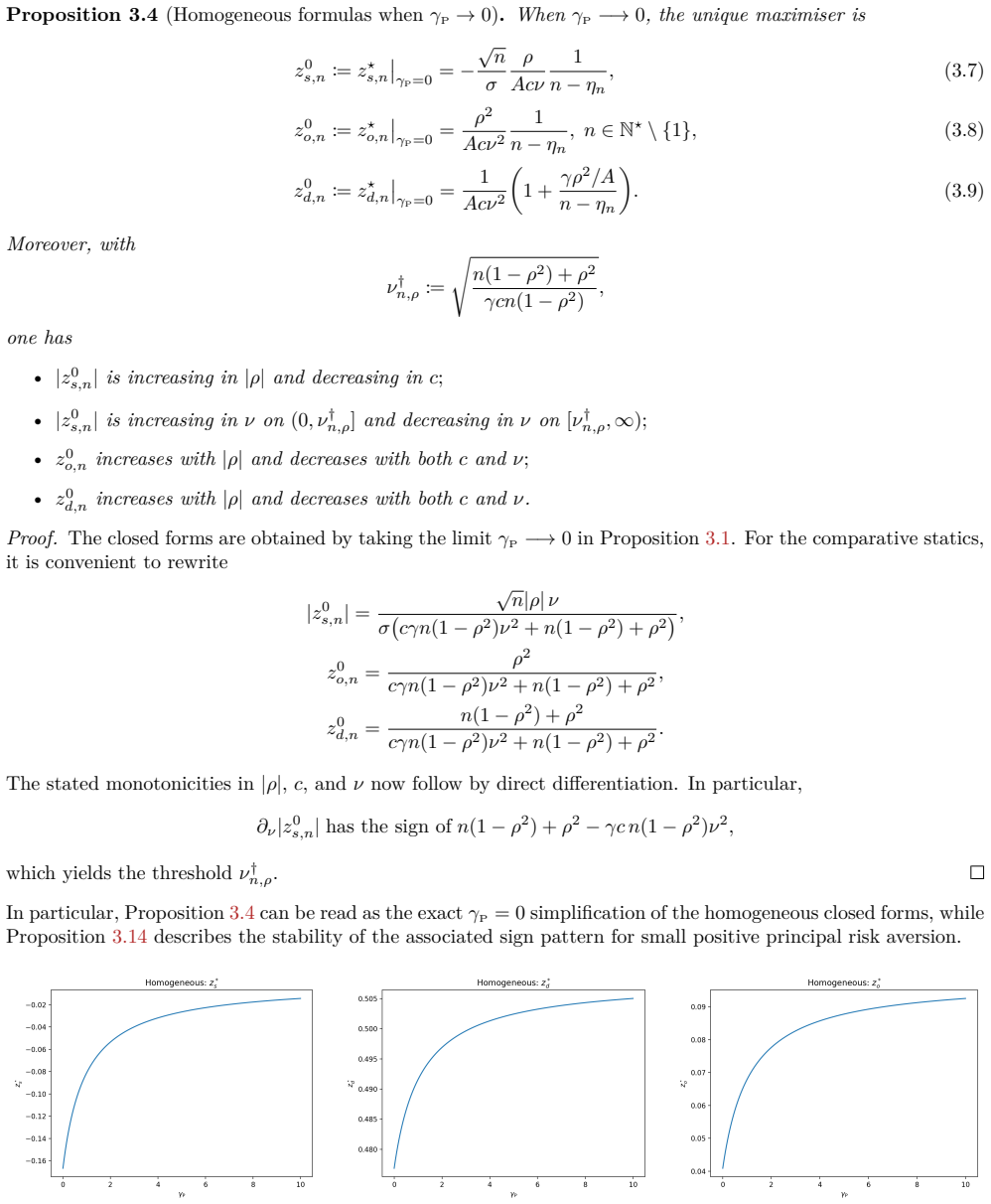
In a continuous-time principal-agent model with linear-quadratic-Gaussian structure, closed-form linear optimal controls for ESG disclosure employ own-signal loadings, cross-signal loadings, and hedging tilts on a traded climate risk factor; as the principal's risk aversion increases the scheme converges to a market-neutral regime that eliminates aggregate asset exposure and imposes an identity-pooling constraint solved by a constrained quadratic program governed by an M-matrix, under which heterogeneity requires the cross-section of S-tilts to change sign and permits an agent's own-signal diagonal to become negative when that row is too strongly exposed to the common factor.
What carries the argument
Closed-form linear optimal controls in the linear-quadratic-Gaussian framework, which reduce in the high-risk-aversion limit to the solution of a constrained quadratic program governed by an M-matrix.
If this is right
- When the principal is nearly risk-neutral the traded asset is used purely to hedge the enforcement risk created by high-powered incentives.
- As principal risk aversion rises the optimal scheme eliminates all aggregate exposure to the traded asset and tightens cross-signal loadings to an identity-pooling constraint.
- Heterogeneity forces the cross-section of S-tilts to change sign unless the problem is degenerate.
- An agent's own-signal loading can turn negative when that agent's exposure to the common traded factor is too strong relative to the rest of the group.
- The results rationalise the use of mixed compensation structures that combine stable payments with volatile governance tokens in regenerative finance.
Where Pith is reading between the lines
- Platforms designing ESG incentives could apply the closed-form loadings to set cross-agent terms that account for signal correlations and principal risk tolerance.
- When agents are identical the optimal loadings remain positive, supplying a benchmark against which heterogeneous cases can be compared.
- Empirical checks could test whether real-world ESG or ReFi compensation exhibits negative own-signal loadings precisely when principal risk aversion and agent heterogeneity are both high.
- The single-factor assumption could be relaxed to multiple traded risks to derive analogous but higher-dimensional controls.
Load-bearing premise
The problem is assumed to admit a linear-quadratic-Gaussian structure in which each disclosure signal is correlated with exactly one traded climate risk factor.
What would settle it
A concrete calculation or data set in which the optimal cross-signal loadings do not change sign under high principal risk aversion and agent heterogeneity, or in which the closed-form solutions fail to exist when the quadratic structure or single-factor correlation is violated.
Figures


read the original abstract
This paper characterises optimal incentive schemes for ESG disclosure in a continuous-time principal-agent setting. We model a risk-averse principal (e.g., a platform or standard-setter) contracting with a team of heterogeneous agents whose disclosure signals are each correlated with a traded climate risk factor. The optimal contract balances incentive provision against the variance of aggregate payouts by leveraging three instruments: own-signal loading, cross-signal loadings across agents, and hedging tilts on the traded asset. We derive closed-form linear optimal controls in a tractable linear-quadratic-Gaussian framework. When the principal is nearly risk-neutral, the contract uses the traded asset purely to hedge the specific `enforcement risk' generated by high-powered incentives. As the principal's risk aversion increases, the optimal scheme converges to a `market-neutral' regime where aggregate asset exposure is eliminated and the cross-signal structure tightens to an `identity pooling' constraint. We characterise this limit analytically as a constrained quadratic program governed by an M-matrix. In the high-risk-aversion regime, heterogeneity creates genuinely new effects absent under symmetry: the cross-section of S-tilts must change sign (unless degenerate), and an agent's own-signal diagonal can turn negative when that row is too strongly exposed to the common traded factor relative to the rest of the group. The results provide a theoretical foundation for `mixed' compensation structures in Regenerative Finance (ReFi), rationalising the use of both stable payments and volatile governance tokens to optimise risk-sharing.
Editorial analysis
A structured set of objections, weighed in public.
Referee Report
Summary. This paper develops a continuous-time principal-agent model for optimal ESG disclosure incentives. A risk-averse principal contracts with heterogeneous agents whose signals each correlate with one traded climate risk factor. In an LQG framework the authors derive closed-form linear optimal controls using three instruments (own-signal loadings, cross-signal loadings, and hedging tilts). They characterize the low-risk-aversion regime (pure hedging of enforcement risk) and the high-risk-aversion limit (market-neutral aggregate exposure with an identity-pooling constraint), the latter expressed as an M-matrix-governed constrained quadratic program. Heterogeneity produces novel effects absent under symmetry: sign-changing cross-sections of S-tilts and possible negative own-signal diagonals when an agent's exposure to the common factor is relatively strong.
Significance. If the derivations hold, the paper supplies a clean theoretical foundation for mixed compensation in Regenerative Finance by showing how stable payments and volatile tokens can be combined to balance incentive provision and risk-sharing. The analytic M-matrix characterization of the high-RA limit is a technical strength that delivers precise, falsifiable predictions about heterogeneity effects. The work extends principal-agent theory to ESG settings with continuous-time dynamics and traded hedging instruments while remaining fully self-contained within the stated LQG and single-factor assumptions; the stress-test concern therefore does not land as an internal inconsistency.
major comments (1)
- High-risk-aversion regime (abstract and main characterization): the claims that the cross-section of S-tilts must change sign (unless degenerate) and that own-signal diagonals can turn negative are load-bearing for the novelty of the heterogeneity results. The manuscript must exhibit the explicit M-matrix and the precise form of the quadratic-program constraints so that these sign properties can be verified directly from the relative factor exposures.
minor comments (3)
- Abstract: the phrase 'identity pooling constraint' is used without a parenthetical definition; a one-sentence gloss would improve immediate readability.
- Model section: introduce the notation for S-tilts and the M-matrix with explicit definitions and dimensions before the high-RA analysis begins.
- Conclusion: a short numerical illustration translating the optimal scheme into a concrete mix of stable payments and governance tokens would help readers connect the theory to ReFi practice.
Simulated Author's Rebuttal
We thank the referee for the careful reading of the manuscript and for the positive overall assessment. We address the single major comment below.
read point-by-point responses
-
Referee: [—] High-risk-aversion regime (abstract and main characterization): the claims that the cross-section of S-tilts must change sign (unless degenerate) and that own-signal diagonals can turn negative are load-bearing for the novelty of the heterogeneity results. The manuscript must exhibit the explicit M-matrix and the precise form of the quadratic-program constraints so that these sign properties can be verified directly from the relative factor exposures.
Authors: We agree that the explicit M-matrix and the full statement of the quadratic-program constraints should be displayed so that the sign properties can be verified directly from the agents' relative factor exposures. In the revised manuscript we will insert a new subsection (or appendix paragraph) that writes out the M-matrix entries in terms of the vector of factor loadings, states the precise objective and the three sets of constraints (market-neutral aggregate exposure, identity-pooling, and non-negativity of loadings), and shows how the solution of this program yields the claimed sign-changing cross-section and possible negative own-signal diagonals when an agent's exposure is sufficiently strong relative to the group. revision: yes
Circularity Check
No circularity: closed-form derivation from explicit LQG model assumptions
full rationale
The paper presents an analytic derivation of optimal linear controls and high-risk-aversion limits inside a stated linear-quadratic-Gaussian principal-agent model with single-factor signal correlations. No data-fitting, no self-referential predictions, and no load-bearing self-citations are described in the abstract or skeptic summary. The results (sign-changing cross-section, possible negative diagonals) are direct consequences of solving the constrained quadratic program under the model's quadratic structure and M-matrix properties; they are not equivalent to the inputs by construction. This is a standard self-contained theoretical derivation.
Axiom & Free-Parameter Ledger
axioms (2)
- domain assumption Linear-quadratic-Gaussian dynamics for the principal-agent problem
- domain assumption Disclosure signals are each correlated with a single traded climate risk factor
Reference graph
Works this paper leans on
-
[1]
Baldacci and D
B. Baldacci and D. Possamaï. Governmental incentives for green bonds investment.Mathematics and Financial Economics, 16:539–585, 2022
2022
-
[2]
Baldacci, D
B. Baldacci, D. Possamaï, and M. Rosenbaum. Optimal make–take fees in a multi market maker environment.SIAM Journal on Financial Mathematics, 12(1):446–486, 2021
2021
-
[3]
Ballesteros-Rodríguez, J
A. Ballesteros-Rodríguez, J. De-Lucio, and M.-Á. Sicilia. Tokenized carbon credits in voluntary carbon markets: the case of KlimaDAO.Frontiers in Blockchain, 7:1474540, 2024. 27
2024
-
[4]
F. Berg, J. F. Kölbel, and R. Rigobon. Aggregate confusion: the divergence of ESG ratings.Review of Finance, 26 (6):1315–1344, 2022
2022
-
[5]
Bolton and M
P. Bolton and M. Kacperczyk. Do investors care about carbon risk?Journal of Financial Economics, 142(2):517–549, 2021
2021
-
[6]
Caldarelli
G. Caldarelli. Understanding the blockchain oracle problem: a call for action.Information, 11(509):1–19, 2020
2020
-
[7]
H. B. Christensen, G. Serafeim, and A. Sikochi. Why is corporate virtue in the eye of the beholder? The case of ESG ratings.The Accounting Review, 97(1):147–175, 2022
2022
-
[8]
Corporate sustainability reporting.https://finance.ec.europa.eu/financial-markets/ company-reporting-and-auditing/company-reporting/corporate-sustainability-reporting_en, 2023
European commission. Corporate sustainability reporting.https://finance.ec.europa.eu/financial-markets/ company-reporting-and-auditing/company-reporting/corporate-sustainability-reporting_en, 2023. Accessed 5 April 2026
2023
-
[9]
European commission. Commission delegated regulation (EU) 2023/2772 of 31 July 2023 supplementing directive 2013/34/EU as regards sustainability reporting standards.https://eur-lex.europa.eu/eli/reg_del/2023/2772/ oj/eng, 2023. Accessed 5 April 2026
2023
-
[10]
Cvitanić, D
J. Cvitanić, D. Possamaï, and N. Touzi. Moral hazard in dynamic risk management.Management Science, 63(10): 3328–3346, 2017
2017
-
[11]
Cvitanić, D
J. Cvitanić, D. Possamaï, and N. Touzi. Dynamic programming approach to principal–agent problems.Finance and Stochastics, 22(1):1–37, 2018
2018
-
[12]
R. A. Dye. Disclosure of nonproprietary information.Journal of Accounting Research, 23(1):123–145, 1985
1985
-
[13]
Élie and D
R. Élie and D. Possamaï. Contracting theory with competitive interacting agents.SIAM Journal on Control and Optimization, 57(2):1157–1188, 2019
2019
-
[14]
R. Élie, T. Mastrolia, and D. Possamaï. A tale of a principal and many many agents.Mathematics of Operations Research, 44(2):440–467, 2019
2019
-
[15]
R. Élie, E. Hubert, T. Mastrolia, and D. Possamaï. Mean-field moral hazard for optimal energy demand response management.Mathematical Finance, 31(1):399–473, 2021
2021
-
[16]
C. Flammer. Corporate green bonds.Journal of Financial Economics, 142(2):499–516, 2021
2021
-
[17]
IFRS foundation. IFRS S1 general requirements for disclosure of sustainability-related financial information.https:// www.ifrs.org/issued-standards/ifrs-sustainability-standards-navigator/ifrs-s1-general-requirements/,
-
[18]
Accessed 5 April 2026
2026
-
[19]
IFRS S2 climate-related disclosures.https://www.ifrs.org/issued-standards/ ifrs-sustainability-standards-navigator/ifrs-s2-climate-related-disclosures/, 2023
IFRS foundation. IFRS S2 climate-related disclosures.https://www.ifrs.org/issued-standards/ ifrs-sustainability-standards-navigator/ifrs-s2-climate-related-disclosures/, 2023. Accessed 5 April 2026
2023
-
[20]
Gibbons and K
R. Gibbons and K. J. Murphy. Relative performance evaluation for chief executive officers.Industrial and Labor Relations Review, 43(3):30S–51S, 1990
1990
-
[21]
Hart and L
O. Hart and L. Zingales. Companies should maximize shareholder welfare not market value.Journal of Law, Finance, and Accounting, 2(2):247–274, 2017
2017
-
[22]
P. M. Healy and K. G. Palepu. Information asymmetry, corporate disclosure, and the capital markets: a review of the empirical disclosure literature.Journal of Accounting and Economics, 31(1–3):405–440, 2001
2001
-
[23]
Heinkel, A
R. Heinkel, A. Kraus, and J. Zechner. The effect of green investment on corporate behavior.Journal of Financial and Quantitative Analysis, 36(4):431–449, 2001
2001
-
[24]
Hernández Santibáñez
N. Hernández Santibáñez. Principal–multiagents problem under equivalent changes of measure: general study and an existence result.Stochastic Processes and their Applications, 177(104448):1–25, 2024
2024
-
[25]
Hölmstrom
B. Hölmstrom. Moral hazard and observability.The Bell Journal of Economics, 10(1):74–91, 1979
1979
-
[26]
Holmström
B. Holmström. Moral hazard in teams.The Bell Journal of Economics, 13(2):324–340, 1982
1982
-
[27]
Holmström and P
B. Holmström and P. Milgrom. Aggregation and linearity in the provision of intertemporal incentives.Econometrica, 55(2):303–328, 1987. 28
1987
-
[28]
R. A. Horn and C. R. Johnson.Matrix analysis. Cambridge University Press, second edition, 2013
2013
-
[29]
İlhan, Z
Z. İlhan, Z. Sautner, and G. Vilkov. Carbon tail risk.The Review of Financial Studies, 34(3):1540–1571, 2021
2021
-
[30]
H. K. Koo, G. Shim, and J. Sung. Optimal multi-agent performance measures for team contracts.Mathematical Finance, 18(4):649–667, 2008
2008
-
[31]
Krueger, Z
P. Krueger, Z. Sautner, and L. T. Starks. The importance of climate risks for institutional investors.The Review of Financial Studies, 33(3):1067–1111, 2020
2020
-
[32]
Lambert, C
R. Lambert, C. Leuz, and R. E. Verrecchia. Accounting information, disclosure, and the cost of capital.Journal of Accounting Research, 45(2):385–420, 2007
2007
-
[33]
Leuz and P
C. Leuz and P. D. Wysocki. The economics of disclosure and financial reporting regulation.Journal of Accounting Research, 54(2):525–622, 2016
2016
-
[34]
Mookherjee
D. Mookherjee. Optimal incentive schemes with many agents.The Review of Economic Studies, 51(3):433–446, 1984
1984
-
[35]
Y. Niu, Y. Fu, X. Liu, A.R. Harish, M. Li, and G.Q. Huang. Blockchain-based incentive mechanism for environmental, social, and governance disclosure: a principal–agent perspective.Corporate Social Responsibility and Environmental Management, 31(6):6318–6334, 2024
2024
-
[36]
Pastor, R
L. Pastor, R. F. Stambaugh, and L. A. Taylor. Sustainable investing in equilibrium.Journal of Financial Economics, 142(2):550–571, 2021
2021
-
[37]
Rachana Harish, W
A. Rachana Harish, W. Wu, M. Li, and G. Q. Huang. Blockchain-enabled digital asset tokenization for crowdsensing in environmental, social, and governance disclosure.Computers & Industrial Engineering, 185:109664, 2023
2023
-
[38]
Sannikov
Y. Sannikov. A continuous-time version of the principal–agent problem.The Review of Economic Studies, 75(3): 957–984, 2008
2008
-
[39]
Sorensen
D. Sorensen. Tokenized carbon credits.Ledger, 8:76–91, 2023
2023
-
[40]
R. E. Verrecchia. Essays on disclosure.Journal of Accounting and Economics, 32:97–180, 2001
2001
-
[41]
Williams
N. Williams. On dynamic principal–agent problems in continuous time. Technical report, University of Wisconsin, Madison, 2008. 29
2008
discussion (0)
Sign in with ORCID, Apple, or X to comment. Anyone can read and Pith papers without signing in.