Recognition: unknown
Relocation without preference: A destination-agnostic Schelling-type metapopulation model
Pith reviewed 2026-05-07 17:23 UTC · model grok-4.3
The pith
Segregation patterns emerge even when families relocate to any empty house chosen uniformly at random without destination preference.
A machine-rendered reading of the paper's core claim, the machinery that carries it, and where it could break.
Core claim
In the destination-agnostic Schelling-type metapopulation model, the mean-field ODE systems obtained in the large-N fixed-L and large-L fixed-N regimes possess long-time equilibria that are segregated for ranges of the relocation sensitivity and vacancy parameters, with most neighborhoods becoming dominated by one family type.
What carries the argument
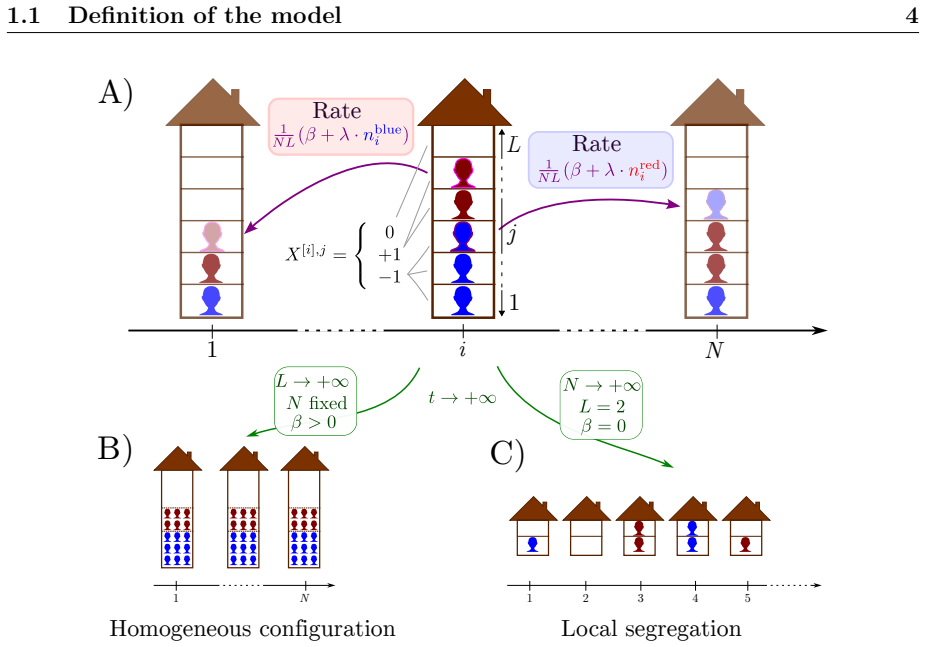
The system of ordinary differential equations for the occupation fractions of blue and red families in each of the N neighborhoods, obtained by taking the mean-field limit of the stochastic relocation process.
If this is right
- Segregation indices at equilibrium vary continuously with relocation sensitivity, vacancy fraction, and neighborhood size.
- The same local-dissatisfaction rule produces qualitatively different social structures depending on whether the large-N or large-L scaling is taken.
- Initial fluctuations are amplified into persistent neighborhood dominance even though every move is destination-neutral.
Where Pith is reading between the lines
- Policies that only randomize destination choice may still leave segregation intact if local dissatisfaction remains the dominant relocation trigger.
- Reintroducing even weak spatial correlations or heterogeneous house qualities could shift the parameter thresholds for segregation onset.
- Direct comparison of vacancy-rate dependence in the model against census relocation data would test whether the predicted scaling holds outside the mean-field regime.
Load-bearing premise
The relocation rate depends only on the local count of opposite-type families and the mean-field ODE limits accurately describe the long-time behavior of the underlying stochastic process.
What would settle it
An individual-based stochastic simulation with moderate but finite N and L that converges to mixed rather than segregated states for parameter values where the mean-field ODEs predict segregation.
Figures

read the original abstract
In this work, we propose and analyze a novel Schelling-type metapopulation model that examines how random relocations of families between neighborhoods can lead to segregation. The model consists of a large number of houses organized into $N$ neighborhoods with $L$ houses each, without any spatial structure. Houses can be occupied by either a blue or a red family, and families relocate -- to an empty house selected uniformly at random -- at a rate that depends only on the number of families of the other type within the same neighborhood. We study two mean-field regimes: the large $N$ limit with fixed $L$, and the large $L$ limit with fixed $N$. The associated mean-field systems of ODEs are derived, and their long-time behavior is investigated. As is often the case with Schelling-type models, we find a rich interplay between the model parameters and the social structure of the equilibrium distribution, which exhibits segregation in some parameter ranges. Our work demonstrates that segregation patterns can emerge even when the relocation mechanism is destination-agnostic.
Editorial analysis
A structured set of objections, weighed in public.
Referee Report
Summary. The manuscript introduces a metapopulation Schelling-type model with N neighborhoods of L houses each, where blue or red families relocate to a uniformly random empty house at a rate depending solely on the local count of opposite-type families. Mean-field ODEs are derived and analyzed in the large-N (fixed L) and large-L (fixed N) limits; equilibria are shown to include segregated states for ranges of the relocation-rate parameters.
Significance. If the mean-field attractors are representative of the underlying stochastic dynamics, the result is significant: it isolates local dissatisfaction as a sufficient driver for segregation without any destination preference or spatial structure, providing a minimal mathematical mechanism. The dual scaling regimes and explicit equilibrium analysis constitute a clean contribution to the Schelling-model literature.
major comments (2)
- [Mean-field derivation (large-N regime)] In the section deriving the mean-field ODEs for the large-N limit: the closure tracks only the distribution of neighborhood compositions and assumes that the global vacancy pool induces no persistent correlations in arrival rates; this assumption is load-bearing for the claim that the deterministic segregated equilibria are reached by the stochastic process, yet no error bounds, moment closures, or numerical comparisons between individual-based simulations and the ODE trajectories are supplied.
- [Equilibrium analysis] In the long-time behavior analysis (both regimes): the existence of stable segregated equilibria in the ODEs is demonstrated, but the manuscript does not establish that these equilibria remain attracting or are reached with high probability once finite-L vacancy fluctuations and global coupling are restored; this gap directly affects whether the destination-agnostic rule produces segregation in the original model.
minor comments (2)
- Notation for the relocation-rate function and the two scaling limits could be unified across sections to avoid redefinition.
- [Abstract] The abstract states that segregation occurs 'in some parameter ranges' but does not indicate the qualitative conditions on the rate function; a brief characterization would help readers.
Simulated Author's Rebuttal
We thank the referee for their careful reading of the manuscript and for the positive overall assessment. The two major comments identify important technical points concerning the mean-field closure and the link between the deterministic limits and the original stochastic process. We respond to each comment below and indicate the changes that will appear in the revised version.
read point-by-point responses
-
Referee: [Mean-field derivation (large-N regime)] In the section deriving the mean-field ODEs for the large-N limit: the closure tracks only the distribution of neighborhood compositions and assumes that the global vacancy pool induces no persistent correlations in arrival rates; this assumption is load-bearing for the claim that the deterministic segregated equilibria are reached by the stochastic process, yet no error bounds, moment closures, or numerical comparisons between individual-based simulations and the ODE trajectories are supplied.
Authors: The closure employed in the large-N derivation is the standard mean-field approximation for metapopulation models with global relocation to a shared vacancy pool; it follows from the law of large numbers once N becomes large with L held fixed. We agree that explicit justification and supporting evidence strengthen the presentation. In the revision we have added (i) a short paragraph recalling the propagation-of-chaos argument that justifies the closure in this scaling regime, together with a reference to related results for interacting particle systems, and (ii) a new figure and accompanying text that compare stochastic individual-based trajectories with the ODE solutions for successively larger N (L fixed). These comparisons illustrate convergence to the deterministic limit and thereby support the use of the segregated equilibria as a baseline description. revision: yes
-
Referee: [Equilibrium analysis] In the long-time behavior analysis (both regimes): the existence of stable segregated equilibria in the ODEs is demonstrated, but the manuscript does not establish that these equilibria remain attracting or are reached with high probability once finite-L vacancy fluctuations and global coupling are restored; this gap directly affects whether the destination-agnostic rule produces segregation in the original model.
Authors: We acknowledge that the manuscript analyzes the deterministic mean-field limits and does not supply a rigorous proof that the stochastic process converges to the same segregated states for finite L and N. Such a result would require additional tools (e.g., stochastic approximation or large-deviation estimates) that lie outside the scope of the present work. In the revision we have expanded the concluding discussion to state this limitation explicitly, to clarify that our contribution concerns the macroscopic behavior in the two scaling regimes, and to note that the mean-field segregated equilibria furnish a minimal, analytically tractable mechanism whose relevance to finite systems can be checked numerically or studied in future work. We believe this framing preserves the value of the mean-field analysis while addressing the referee's concern about over-interpretation. revision: partial
Circularity Check
No circularity: model defined from scratch and segregation derived from ODE analysis
full rationale
The paper constructs the metapopulation model explicitly: houses grouped into N neighborhoods of L houses each, families of two types, relocation rate depending only on local count of opposite type, and destination chosen uniformly at random among empty houses. It then derives the mean-field ODE systems for the large-N fixed-L and large-L fixed-N regimes directly from the stochastic process and analyzes their equilibria and long-time behavior. Segregation is shown to arise as a mathematical property of those ODE flows in certain parameter ranges. No parameters are fitted to target segregation patterns, no self-citations supply load-bearing uniqueness theorems or ansatzes, and the result is not a renaming of a known empirical pattern. The derivation chain is therefore self-contained against external benchmarks.
Axiom & Free-Parameter Ledger
free parameters (1)
- relocation rate function
axioms (1)
- domain assumption The large-N fixed-L and large-L fixed-N limits yield closed deterministic ODE systems whose long-time behavior matches the original stochastic model.
Reference graph
Works this paper leans on
-
[1]
Fei Cao, and Nadia Loy. The Bennati-Dragulescu-Yakovenko model in the continuous setting: PDE derivation and long-time behavior.arXiv preprint arXiv:2512.06101, 2025
-
[2]
Derivation of wealth distributions from biased ex- change of money.Kinetic & Related Models, 16(5):764–794, 2023
Fei Cao, and Sebastien Motsch. Derivation of wealth distributions from biased ex- change of money.Kinetic & Related Models, 16(5):764–794, 2023
2023
-
[3]
Fractal opinions among interacting agents.SIAM Journal on Applied Dynamical Systems, 24(2):1529–1552, 2025
Fei Cao, and Roberto Cortez. Fractal opinions among interacting agents.SIAM Journal on Applied Dynamical Systems, 24(2):1529–1552, 2025
2025
-
[4]
The fractal geometry of opinion formation.arXiv preprint arXiv:2601.21023, 2026
Fei Cao, and Roberto Cortez. The fractal geometry of opinion formation.arXiv preprint arXiv:2601.21023, 2026
-
[5]
The iterative persuasion-polarization opinion dynamics and its mean-field analysis.SIAM Journal on Applied Mathematics, 85(4):1596–1620, 2025
Fei Cao, and Stephanie Reed. The iterative persuasion-polarization opinion dynamics and its mean-field analysis.SIAM Journal on Applied Mathematics, 85(4):1596–1620, 2025
2025
-
[6]
Uncovering a two-phase dynamics from a dol- lar exchange model with bank and debt.SIAM Journal on Applied Mathematics, 83(5):1872–1891, 2023
Fei Cao, and Sebastien Motsch. Uncovering a two-phase dynamics from a dol- lar exchange model with bank and debt.SIAM Journal on Applied Mathematics, 83(5):1872–1891, 2023
2023
-
[7]
Fei Cao, Sebastien Motsch, and Wendy Garcia Umbarita. Wealth exchange under ceiling and flooring constraints: a modified Bennati-Dragulescu-Yakovenko model. arXiv preprint arXiv:2602.00988, 2026
-
[8]
Statistical physics of social dynamics.Reviews of modern physics, 81(2):591–646, 2009
Claudio Castellano, Santo Fortunato, and Vittorio Loreto. Statistical physics of social dynamics.Reviews of modern physics, 81(2):591–646, 2009
2009
-
[9]
Clark, and Mark Fossett
William A.V. Clark, and Mark Fossett. Understanding the social context of the Schelling segregation model.Proceedings of the National Academy of Sciences, 105(11):4109–4114, 2008. REFERENCES 24
2008
-
[10]
Quantitative propagation of chaos for gener- alized Kac particle systems.The Annals of Applied Probability, 26(2):892–916, 2016
Roberto Cortez, and Joaquin Fontbona. Quantitative propagation of chaos for gener- alized Kac particle systems.The Annals of Applied Probability, 26(2):892–916, 2016
2016
-
[11]
Uniform propagation of chaos for Kac’s 1D particle system.Journal of Statistical Physics, 165:1102–1113, 2016
Roberto Cortez. Uniform propagation of chaos for Kac’s 1D particle system.Journal of Statistical Physics, 165:1102–1113, 2016
2016
-
[12]
Quantitative uniform propagation of chaos for Maxwell molecules.Communications in Mathematical Physics, 357(3):913–941, 2018
Roberto Cortez, and Joaquin Fontbona. Quantitative uniform propagation of chaos for Maxwell molecules.Communications in Mathematical Physics, 357(3):913–941, 2018
2018
-
[13]
Statistical physics of the Schelling model of segregation.Journal of Statistical Mechanics: Theory and Exper- iment, 2008(07):L07002, 2008
Luca Dall’Asta, Claudio Castellano, and Matteo Marsili. Statistical physics of the Schelling model of segregation.Journal of Statistical Mechanics: Theory and Exper- iment, 2008(07):L07002, 2008
2008
-
[14]
Exact solution for a metapopulation version of Schelling’s model.Proceedings of the National Academy of Sciences, 111(39):14036– 14041, 2014
Richard Durrett, and Yuan Zhang. Exact solution for a metapopulation version of Schelling’s model.Proceedings of the National Academy of Sciences, 111(39):14036– 14041, 2014
2014
-
[15]
Sociophysics: A new approach of sociological collective behavior.The Journal of Mathematical Sociology, 9(1):1–13, 1982
Serge Galam, Yuval Gefen, and Yonathan Shapir. Sociophysics: A new approach of sociological collective behavior.The Journal of Mathematical Sociology, 9(1):1–13, 1982
1982
-
[16]
Emergent dense suburbs in a schelling metapopulation model: A simulation approach.Advances in Complex Systems, 20(01):1750001, 2017
Floriana Gargiulo, Yerali Gandica, and Timoteo Carletti. Emergent dense suburbs in a schelling metapopulation model: A simulation approach.Advances in Complex Systems, 20(01):1750001, 2017
2017
-
[17]
Entropy methods for diffusive partial differential equations.Springer, 2016
Ansgar Jüngel. Entropy methods for diffusive partial differential equations.Springer, 2016
2016
-
[18]
Differential equations and dynamical systems.Springer Science & Business Media, 2013
Lawrence Perko. Differential equations and dynamical systems.Springer Science & Business Media, 2013
2013
-
[19]
Limit theorems for individual-based models in economics and fi- nance.Stochastic processes and their applications, 119(8):2401–2435, 2009
Daniel Remenik. Limit theorems for individual-based models in economics and fi- nance.Stochastic processes and their applications, 119(8):2401–2435, 2009
2009
-
[20]
Mathematical modeling of collective behavior in socio-economic and life sciences.Springer Science & Business Media, 2010
Giovanni Naldi, Lorenzo Pareschi, and Giuseppe Toscani. Mathematical modeling of collective behavior in socio-economic and life sciences.Springer Science & Business Media, 2010
2010
-
[21]
Schelling
Thomas C. Schelling. Models of segregation.The American economic review, 59(2):488–493, 1969
1969
-
[22]
Schelling
Thomas C. Schelling. Dynamic models of segregation.Journal of mathematical soci- ology, 1(2):143–186, 1971
1971
-
[23]
Schelling
Thomas C. Schelling. Micromotives and macrobehavior.WW Norton & Company, 2006. REFERENCES 25
2006
-
[24]
Chakrabarti
Parongama Sen, and Bikas K. Chakrabarti. Sociophysics: an introduction. OUP Oxford, 2014
2014
-
[25]
Theoretical investigation on the Schelling’s critical neighborhood demand.Communications in Nonlinear Science and Numerical Simulation, 19(5):1417–1423, 2014
Jae Kyun Shin, and Hiroki Sayama. Theoretical investigation on the Schelling’s critical neighborhood demand.Communications in Nonlinear Science and Numerical Simulation, 19(5):1417–1423, 2014
2014
-
[26]
Topics in propagation of chaos
Alain-Sol Sznitman. Topics in propagation of chaos. InEcole d’été de probabilités de Saint-Flour XIX—1989, pages 165–251. Springer, 1991
1989
-
[27]
Portnov, and Ehud Meron
Hezi Yizhaq, Boris A. Portnov, and Ehud Meron. A mathematical model of segrega- tion patterns in residential neighbourhoods.Environment and Planning A, 36(1):149– 172, 2004
2004
discussion (0)
Sign in with ORCID, Apple, or X to comment. Anyone can read and Pith papers without signing in.