Recognition: unknown
A Tree-Based Repository Blockchain Framework for Shared Governance in Collaborative Fork Ecosystems
Pith reviewed 2026-05-07 16:56 UTC · model grok-4.3
The pith
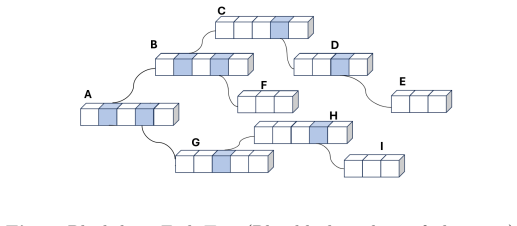
A repository blockchain organizes hard forks into a tree structure so a single process can access every block by navigating the networks instead of using inter-blockchain communication.
A machine-rendered reading of the paper's core claim, the machinery that carries it, and where it could break.
Core claim
The authors claim that a repository blockchain can manage hard forks by replacing Inter Blockchain Communication with direct network navigation, producing a tree-shaped construction rather than a chain. Under the assumption that one process knows the requirements of each fork, this process can access every block in the system. The model is demonstrated by a proof-of-concept that traverses the tree using depth-first search.
What carries the argument
The repository blockchain, which connects forked networks so navigation replaces separate communication protocols and yields a tree structure.
If this is right
- Shared governance becomes possible across multiple hard forks without additional communication layers.
- Inter Blockchain Communication is unnecessary inside the collaborative ecosystem.
- Depth-first search can locate blocks by traversing the tree formed by the repository.
- Diverse groups can cooperate on tasks while retaining decentralization and transaction security.
Where Pith is reading between the lines
- The tree could scale to many simultaneous forks if the single-process assumption holds in practice.
- Existing collaborative projects that already produce forks might adopt the structure to simplify block access.
- If navigation works reliably, developers could test whether the model reduces coordination overhead compared with current fork-management tools.
Load-bearing premise
A single process knows the requirements of every fork and can reach all blocks in the system.
What would settle it
A working multi-fork ecosystem in which any single process still requires separate inter-blockchain messages to reach blocks on all forks would show the navigation claim does not hold.
Figures


read the original abstract
Collaborative blockchain ecosystems allow diverse groups to cooperate on tasks while providing properties such as decentralization and transaction security. We provide a model that uses a repository blockchain to manage hard forks within a collaborative system such that a single process (assuming that it has knowledge of the requirements of each fork) can access all of the blocks within the system. The repository blockchain replaces the need for Inter Blockchain Communication (IBC) within the ecosystem by navigating the networks. The resulting construction resembles a tree instead of a chain. A proof-of-concept implementation performs a depth-first search on the new structure.
Editorial analysis
A structured set of objections, weighed in public.
Referee Report
Summary. The paper proposes a repository blockchain framework for managing hard forks in collaborative blockchain ecosystems. It models the structure as a tree (rather than a linear chain) such that a single process, assuming it possesses knowledge of the requirements for each fork, can traverse and access all blocks via navigation, thereby replacing the need for Inter-Blockchain Communication (IBC). A proof-of-concept implementation is described that performs depth-first search on this tree structure.
Significance. If the model could be shown to operate without a centralized knowledge assumption while preserving decentralization, it would provide a conceptually interesting alternative for fork governance and interoperability. However, the absence of any formal derivation, implementation details, validation metrics, or analysis of how fork requirements are acquired and maintained limits the potential impact; the work remains at the level of an unverified conceptual sketch.
major comments (2)
- Abstract: The central claim that 'the repository blockchain replaces the need for Inter Blockchain Communication (IBC) within the ecosystem by navigating the networks' rests entirely on the assumption that 'a single process (assuming that it has knowledge of the requirements of each fork)' can access all blocks. No mechanism is described for acquiring, updating, or decentralizing this knowledge across independent fork groups, which directly undermines the substitution for IBC in a collaborative setting.
- Proof-of-Concept description: The manuscript states that a PoC 'performs a depth-first search on the new structure' but supplies no pseudocode, architecture diagram, traversal algorithm, or evaluation against IBC baselines, error rates, or scalability metrics. This absence makes the tree-navigation claim impossible to assess as load-bearing evidence.
minor comments (2)
- The abstract and model description would benefit from explicit comparison to existing fork-management or cross-chain protocols (e.g., references to IBC standards or prior tree-based ledger proposals) to clarify novelty.
- Notation for the 'repository blockchain' and 'tree instead of a chain' construction is introduced without a diagram or formal definition, reducing clarity for readers unfamiliar with the specific ecosystem.
Simulated Author's Rebuttal
We thank the referee for the constructive feedback, which identifies key areas where the manuscript's assumptions and implementation details require clarification and expansion. We address each major comment point by point below, indicating the revisions we will incorporate to strengthen the presentation of the tree-based repository blockchain model.
read point-by-point responses
-
Referee: Abstract: The central claim that 'the repository blockchain replaces the need for Inter Blockchain Communication (IBC) within the ecosystem by navigating the networks' rests entirely on the assumption that 'a single process (assuming that it has knowledge of the requirements of each fork)' can access all blocks. No mechanism is described for acquiring, updating, or decentralizing this knowledge across independent fork groups, which directly undermines the substitution for IBC in a collaborative setting.
Authors: The manuscript explicitly frames the model under the stated assumption of knowledge possession, as a foundational approach for tree-structured navigation in collaborative fork ecosystems. This targets settings where fork requirements are accessible to the traversing process. We agree no mechanisms for acquisition, updating, or decentralization are provided. In the revised manuscript, we will qualify the abstract claim accordingly and add a new subsection outlining potential decentralized approaches, such as requirement broadcasting via shared governance smart contracts or periodic cross-fork consensus updates. This will better contextualize the IBC substitution while noting the assumption's role. revision: yes
-
Referee: Proof-of-Concept description: The manuscript states that a PoC 'performs a depth-first search on the new structure' but supplies no pseudocode, architecture diagram, traversal algorithm, or evaluation against IBC baselines, error rates, or scalability metrics. This absence makes the tree-navigation claim impossible to assess as load-bearing evidence.
Authors: We acknowledge the PoC description is high-level and lacks the details needed for assessment. The current text emphasizes the conceptual tree model over implementation specifics. In revision, we will expand this section to include pseudocode for the DFS traversal on the repository tree, an architecture diagram depicting fork nodes and navigation, the full traversal algorithm, and preliminary comparative metrics (e.g., latency and resource use versus IBC in simulated fork scenarios with varying depths). These additions will enable evaluation of the navigation claims. revision: yes
Circularity Check
No circularity; purely conceptual proposal with explicit assumptions
full rationale
The manuscript describes a high-level framework for managing hard forks via a repository blockchain that forms a tree structure navigable by a single process. No equations, parameters, or derivations appear in the provided text. The central construction is introduced by definition and assumption rather than derived from prior results. The single-process knowledge assumption is stated explicitly as a precondition and does not reduce any claimed prediction or result to an input by construction. No self-citations, fitted inputs, or uniqueness theorems are invoked. The proof-of-concept is a straightforward DFS traversal on the described structure. The framework is therefore self-contained as a modeling proposal without circular reduction.
Axiom & Free-Parameter Ledger
axioms (2)
- domain assumption Collaborative blockchain ecosystems allow diverse groups to cooperate on tasks while providing decentralization and transaction security.
- ad hoc to paper A single process can have knowledge of the requirements of each fork.
invented entities (1)
-
repository blockchain
no independent evidence
Reference graph
Works this paper leans on
-
[1]
Supply chain management using blockchain
Shivani Bhalerao, Siya Agarwal, Shruthi Borkar, Shruti Anekar, Nikita Kulkarni, and Sumedha Bhagwat. Supply chain management using blockchain. In2019 International Conference on Intelligent Sustainable Systems (ICISS), 2019
2019
-
[2]
Peer-to-peer networks
Jaydip Sen. Peer-to-peer networks. In2012 3rd National Conference on Emerging Trends and Applications in Computer Science, 2012
2012
-
[3]
Bitcoin: A peer-to-peer electronic cash system.www.bitcoin.org, 2008
Satoshi Nakamoto. Bitcoin: A peer-to-peer electronic cash system.www.bitcoin.org, 2008
2008
-
[4]
Ethereum whitepaper, 2014
Vitalik Buterin. Ethereum whitepaper, 2014
2014
-
[5]
Blockchain governance, risk, and compliance (grc), privacy, and legal con- cerns
Joseph Holbrook. Blockchain governance, risk, and compliance (grc), privacy, and legal con- cerns. InArchitecting Enterprise Blockchain Solutions. 2020
2020
-
[6]
Decentralized autonomous organizations - daos: the convergence of technology, law, governance, and behavioral economics.MIT Computational Law Report, November 2023
Andr´ e Guskow Cardoso. Decentralized autonomous organizations - daos: the convergence of technology, law, governance, and behavioral economics.MIT Computational Law Report, November 2023
2023
-
[7]
Rizal Batubara, Jolien Ubacht, and Marijn Janssen
F. Rizal Batubara, Jolien Ubacht, and Marijn Janssen. Unraveling transparency and account- ability in blockchain. Indg.o 2019: Proceedings of the 20th Annual International Conference on Digital Government Research, 2019
2019
-
[8]
The evolution of blockchain: A bib- liometric study.IEEE Access, PP, 2019
Mohammad Dabbagh, Mehdi Sookhak, and Nader Safa. The evolution of blockchain: A bib- liometric study.IEEE Access, PP, 2019
2019
-
[9]
A theoretical model for fork analy- sis in the bitcoin network
Yahya Shahsavari, Kaiwen Zhang, and Chamseddine Talhi. A theoretical model for fork analy- sis in the bitcoin network. In2019 IEEE International Conference on Blockchain (Blockchain), 2019
2019
-
[10]
Ensuring data integrity using blockchain technology
Igor Zikratov, Alexander Kuzmin, Vladislav Akimenko, Viktor Niculichev, and Lucas Yalan- sky. Ensuring data integrity using blockchain technology. In2017 20th Conference of Open Innovations Association (FRUCT), 2017
2017
-
[11]
Characteristics of blockchain and its relationship with trust
Vizaad Ali, Azah Norman, and Saaidal Razalli Bin Azzuhri. Characteristics of blockchain and its relationship with trust. In2022 IEEE Global Conference on Artificial Intelligence and Internet of Things (GCAIoT), 2022
2022
-
[12]
Miˇ si´ c, Jelena Miˇ si´ c, and Xiaolin Chang
Vojislav B. Miˇ si´ c, Jelena Miˇ si´ c, and Xiaolin Chang. On forks and fork characteristics in a bitcoin-like distribution network. In2019 IEEE International Conference on Blockchain (Blockchain), 2019
2019
-
[13]
Neo C.K. Yiu. An overview of forks and coordination in blockchain development.IEEE Access, 2021
2021
-
[14]
Segregated witness (consensus layer)
Eric Lombrozo, Johnson Lau, and Pieter Wuille. Segregated witness (consensus layer). Tech. Rep. BIP 141, Bitcoin Core Develop. Team, 2015
2015
-
[15]
Smart collaboration mech- anism using blockchain technology
Karanveer Singh Jhala, Rajvardhan Oak, and Mrunmayee Khare. Smart collaboration mech- anism using blockchain technology. In2018 5th IEEE International Conference on Cyber Security and Cloud Computing (CSCloud), 2018. 13
2018
-
[16]
A multiple blockchains architecture on inter-blockchain communication
Luo Kan, Yu Wei, Amjad Hafiz Muhammad, Wang Siyuan, Ling Chao Gao, and Hu Kai. A multiple blockchains architecture on inter-blockchain communication. In2018 IEEE In- ternational Conference on Software Quality, Reliability and Security Companion (QRS-C), 2018
2018
-
[17]
Establishing interoperability in blockchain enabled interconnected smart microgrids using ignite cli
Disha L Dinesha and P Balachandra. Establishing interoperability in blockchain enabled interconnected smart microgrids using ignite cli. In2023 IEEE Green Technologies Conference (GreenTech), 2023
2023
-
[18]
Applying social network analysis to model and handle a cross- blockchain ecosystem.Electronics, 12(5), 2023
Gianluca Bonifazi, Francesco Cauteruccio, Enrico Corradini, Michele Marchetti, Domenico Ursino, and Luca Virgili. Applying social network analysis to model and handle a cross- blockchain ecosystem.Electronics, 12(5), 2023
2023
-
[19]
An overview of forks and coordination in blockchain development
Neo C K Yiu. An overview of forks and coordination in blockchain development. Unpublished Article, 2021
2021
-
[20]
Blockchain system for trustless health- care data sharing with hyperledger fabric in action
Muhammad Mohsan Sheeraz, Md Ariful Islam Mozumder, Muhammad Omair Khan, Muham- mad Usama Abid, Moon-Ill Joo, and Hee-Cheol Kim. Blockchain system for trustless health- care data sharing with hyperledger fabric in action. In2023 25th International Conference on Advanced Communication Technology (ICACT), 2023
2023
-
[21]
Unlocking blockchain interconnectivity: Smart contract-driven cross-chain commu- nication.IEEE Access, 11, 2023
Kirtirajsinh Zala, Vyom Modi, Deepakkumar Giri, Biswaranjan Acharya, Saurav Mallik, and Hong Qin. Unlocking blockchain interconnectivity: Smart contract-driven cross-chain commu- nication.IEEE Access, 11, 2023
2023
-
[22]
Management of decentralized autonomous organizations
Richard Marko and Kristian Kostal. Management of decentralized autonomous organizations. In2022 IEEE International Conference on Omni-layer Intelligent Systems (COINS), 2022
2022
-
[23]
Governance token distributions of layer-one.x blockchain
Kevin Coutinho, Pornpit Wongthongtham, Alan McCarthy, and Zahid Hasan. Governance token distributions of layer-one.x blockchain. In2022 IEEE Asia-Pacific Conference on Com- puter Science and Data Engineering (CSDE), 2022
2022
-
[24]
A blockchain-based data governance with privacy and provenance: a case study for e-prescription
Rodrigo Dutra Garcia, Gowri Sankar Ramachandran, Raja Jurdak, and Jo Ueyama. A blockchain-based data governance with privacy and provenance: a case study for e-prescription. In2022 IEEE International Conference on Blockchain and Cryptocurrency (ICBC), 2022
2022
-
[25]
Blockchain ecosystem
Rishabh Garg. Blockchain ecosystem. InBlockchain for Real World Applications. 2023
2023
-
[26]
To fork or not to fork? bitcoin forks’ success analysis using twitter data: Pre- liminary results
Sarah Bouraga. To fork or not to fork? bitcoin forks’ success analysis using twitter data: Pre- liminary results. In2022 4th Conference on Blockchain Research & Applications for Innovative Networks and Services (BRAINS), 2022
2022
-
[27]
Bitcoin and beyond: A technical survey on decen- tralized digital currencies.IEEE Communications Surveys & Tutorials, 18(3), 2016
Florian Tschorsch and Bj¨ orn Scheuermann. Bitcoin and beyond: A technical survey on decen- tralized digital currencies.IEEE Communications Surveys & Tutorials, 18(3), 2016
2016
-
[28]
Ethereum proof-of-stake con- sensus layer: Participation and decentralization
Dominic Grandjean, Lioba Heimbach, and Roger Wattenhofer. Ethereum proof-of-stake con- sensus layer: Participation and decentralization. arXiv:2306.10777, 2023. Authors Razwan Ahmed Tanvir Razwan’s primary academic research focuses on the advancement of blockchain technology, specifically exploring Inter-Blockchain Communication (IBC), smart contracts, an...
discussion (0)
Sign in with ORCID, Apple, or X to comment. Anyone can read and Pith papers without signing in.