Recognition: unknown
DiRe-RAPIDS: Topology-faithful dimensionality reduction at scale
Pith reviewed 2026-05-07 16:47 UTC · model grok-4.3
The pith
DiRe recovers exact first Betti numbers on stress tests while matching or beating GPU UMAP on classification accuracy.
A machine-rendered reading of the paper's core claim, the machinery that carries it, and where it could break.
Core claim
The paper establishes that local-neighborhood objectives reward noise memorization, which produces invented cycles and islands, and that DiRe tuned on a topology-faithfulness benchmark derived from noisy manifolds with known homology yields embeddings that recover exact first Betti numbers on controlled tests and preserve substantially more topological structure on large real-world data at the same computational cost as GPU-accelerated UMAP.
What carries the argument
The topology-faithfulness benchmark built from noisy manifolds with known homology, used to tune DiRe configurations so that global topological invariants are prioritized over local noise.
If this is right
- Embeddings produced by DiRe avoid fabricating topological features that are absent from the original data.
- The method scales to datasets of several hundred thousand points while staying competitive in wall-clock time with GPU UMAP.
- Downstream tasks such as classification can be performed without trading away fidelity to global data geometry.
- Scientific visualizations of high-dimensional data can retain more of the intrinsic shape instead of noise-induced artifacts.
Where Pith is reading between the lines
- If the benchmark correlates with real data, DiRe-style tuning could become useful in any domain where global manifold structure affects scientific conclusions.
- The same benchmark-driven approach might be extended to preserve higher Betti numbers or other topological invariants beyond the first.
- Replacing purely local objectives with hybrid ones that incorporate topological constraints could change how dimensionality reduction is evaluated in practice.
Load-bearing premise
Performance on synthetic noisy manifolds with known homology accurately predicts how well the method will preserve topology in real high-dimensional data whose true topology cannot be checked independently.
What would settle it
Run DiRe and UMAP on a collection of simulated physical systems or biological networks whose true loops and connected components can be measured by independent means, then check whether DiRe embeddings produce measurably closer agreement with those known invariants.
Figures



read the original abstract
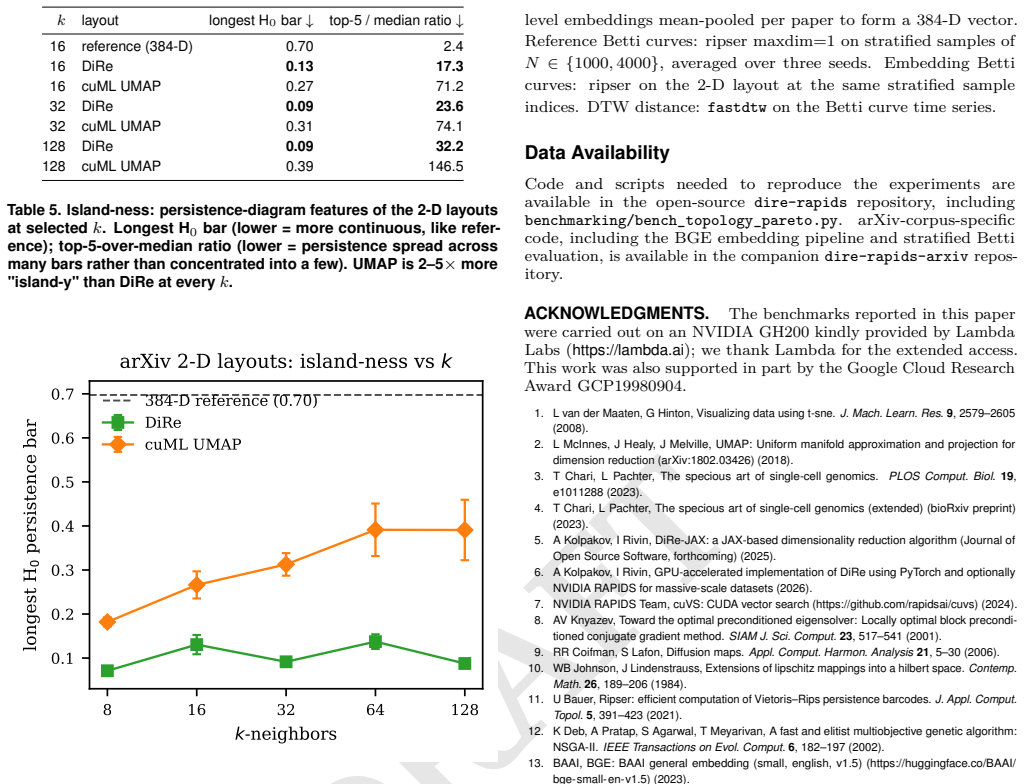
Dimensionality reduction methods such as UMAP and t-SNE are central tools for visualising high-dimensional data, but their local-neighborhood objectives can preserve sampling noise while distorting global topology. We show that standard local metrics reward this noise memorisation: top-performing embeddings invent cycles and disconnected islands absent from the data. We introduce a topology-faithfulness benchmark based on noisy manifolds with known homology, tune DiRe against it, and find Pareto-optimal configurations that match or beat GPU-accelerated UMAP on classification while recovering exact first Betti numbers on stress tests. On 723K arXiv paper embeddings, DiRe preserves 3-4 times more topological structure than UMAP at comparable wall-clock.
Editorial analysis
A structured set of objections, weighed in public.
Referee Report
Summary. The manuscript introduces DiRe-RAPIDS, a scalable dimensionality reduction method intended to preserve global topology more faithfully than local-neighborhood approaches such as UMAP and t-SNE. It defines a topology-faithfulness benchmark using noisy manifolds whose homology is known a priori, tunes DiRe against this benchmark, and reports Pareto-optimal configurations that recover exact first Betti numbers on stress tests while matching or exceeding GPU-accelerated UMAP on downstream classification accuracy. On a 723 K-point embedding of arXiv papers, the method is claimed to retain 3–4 times more topological structure than UMAP at comparable wall-clock time.
Significance. If the central empirical claims are substantiated, the work would supply a practically useful tool for topology-aware visualization of large embedding spaces and would establish a reproducible benchmark for evaluating topological fidelity in dimensionality reduction. The explicit use of known-homology manifolds for tuning and the reported scalability to hundreds of thousands of points are concrete strengths that could influence both algorithmic development and evaluation standards in the field.
major comments (2)
- [Abstract and §5] Abstract and §5 (real-data evaluation): the claim that DiRe 'preserves 3–4 times more topological structure' on the 723 K arXiv embeddings rests on a proxy metric (persistent-homology feature counts or equivalent) whose correlation with actual topological fidelity has not been demonstrated on data whose true homology is unknown. The synthetic benchmark permits direct verification via Betti-number recovery, but the transfer argument to real data therefore lacks an independent test of whether higher proxy scores indicate greater faithfulness rather than increased detection of spurious features.
- [§3 and §4] §3 (benchmark construction) and §4 (tuning procedure): the manuscript states that DiRe is tuned to recover exact first Betti numbers, yet provides no explicit description of the noise model, the range of manifold dimensions or sampling densities used, the precise definition of the topological-structure score, or the cross-validation protocol that prevents the benchmark from being overfit during hyper-parameter search. Without these details the reported Pareto optimality cannot be independently reproduced or generalized.
minor comments (2)
- [Abstract] The abstract refers to 'exact first Betti numbers on stress tests' without stating whether this holds for every realization or is an average; a table or figure caption clarifying the success rate across replicates would improve clarity.
- [§2] Notation for the topological-structure metric is introduced without an equation number or explicit formula in the early sections; adding a numbered definition would aid readers.
Simulated Author's Rebuttal
We thank the referee for the constructive and detailed comments. We address each major point below and have prepared revisions to improve clarity and reproducibility.
read point-by-point responses
-
Referee: [Abstract and §5] Abstract and §5 (real-data evaluation): the claim that DiRe 'preserves 3–4 times more topological structure' on the 723 K arXiv embeddings rests on a proxy metric (persistent-homology feature counts or equivalent) whose correlation with actual topological fidelity has not been demonstrated on data whose true homology is unknown. The synthetic benchmark permits direct verification via Betti-number recovery, but the transfer argument to real data therefore lacks an independent test of whether higher proxy scores indicate greater faithfulness rather than increased detection of spurious features.
Authors: We agree that the proxy metric cannot be independently validated against ground-truth homology on real data. The same persistent-homology feature count is used throughout, and §4 shows it correlates with exact Betti-number recovery on the synthetic manifolds. On the arXiv embeddings we therefore report only a relative comparison under this fixed, previously validated metric. In the revised §5 we have added an explicit paragraph acknowledging the proxy limitation and the absence of an independent real-data test. revision: partial
-
Referee: [§3 and §4] §3 (benchmark construction) and §4 (tuning procedure): the manuscript states that DiRe is tuned to recover exact first Betti numbers, yet provides no explicit description of the noise model, the range of manifold dimensions or sampling densities used, the precise definition of the topological-structure score, or the cross-validation protocol that prevents the benchmark from being overfit during hyper-parameter search. Without these details the reported Pareto optimality cannot be independently reproduced or generalized.
Authors: We accept that the current text lacks sufficient detail for reproduction. In the revised manuscript we expand §3 and §4 to include the noise model, the ranges of manifold dimensions and sampling densities, the exact definition of the topological-structure score, and the cross-validation protocol employed during hyper-parameter search. revision: yes
Circularity Check
No significant circularity; benchmark and real-data metrics are externally defined and independently validated
full rationale
The paper introduces a topology-faithfulness benchmark on noisy manifolds with known homology, tunes DiRe parameters to recover exact first Betti numbers on stress tests, and reports Pareto-optimal performance matching or beating UMAP on classification accuracy. On the 723K arXiv embeddings it measures preservation of 3-4 times more topological structure at comparable speed. No equations, self-citations, or definitions in the provided abstract reduce these claims to quantities defined by the same fitted parameters or by renaming the inputs. The benchmark is explicitly new and external; downstream classification tasks supply an independent check. Per the hard rules, when the derivation remains self-contained against external benchmarks and no load-bearing step reduces by construction, the score is 0. The skeptic concern about proxy correlation on real data is a validity question, not a circularity reduction.
Axiom & Free-Parameter Ledger
Reference graph
Works this paper leans on
-
[1]
L van der Maaten, G Hinton, Visualizing data using t-sne.J. Mach. Learn. Res.9, 2579–2605 (2008)
2008
-
[2]
L McInnes, J Healy, J Melville, UMAP: Uniform manifold approximation and projection for dimension reduction (arXiv:1802.03426) (2018)
work page internal anchor Pith review arXiv 2018
-
[3]
Biol.19, e1011288 (2023)
T Chari, L Pachter, The specious art of single-cell genomics.PLOS Comput. Biol.19, e1011288 (2023)
2023
-
[4]
T Chari, L Pachter, The specious art of single-cell genomics (extended) (bioRxiv preprint) (2023)
2023
-
[5]
A Kolpakov, I Rivin, DiRe-JAX: a JAX-based dimensionality reduction algorithm (Journal of Open Source Software, forthcoming) (2025)
2025
-
[6]
A Kolpakov, I Rivin, GPU-accelerated implementation of DiRe using PyTorch and optionally NVIDIA RAPIDS for massive-scale datasets (2026)
2026
-
[7]
NVIDIA RAPIDS Team, cuVS: CUDA vector search (https://github.com/rapidsai/cuvs) (2024)
2024
-
[8]
AV Knyazev, Toward the optimal preconditioned eigensolver: Locally optimal block precondi- tioned conjugate gradient method.SIAM J. Sci. Comput.23, 517–541 (2001)
2001
-
[9]
RR Coifman, S Lafon, Diffusion maps.Appl. Comput. Harmon. Analysis21, 5–30 (2006)
2006
-
[10]
Math.26, 189–206 (1984)
WB Johnson, J Lindenstrauss, Extensions of lipschitz mappings into a hilbert space.Contemp. Math.26, 189–206 (1984)
1984
-
[11]
U Bauer, Ripser: efficient computation of Vietoris–Rips persistence barcodes.J. Appl. Comput. T opol.5, 391–423 (2021)
2021
-
[12]
Comput.6, 182–197 (2002)
K Deb, A Pratap, S Agarwal, T Meyarivan, A fast and elitist multiobjective genetic algorithm: NSGA-II.IEEE T ransactions on Evol. Comput.6, 182–197 (2002)
2002
-
[13]
BAAI, BGE: BAAI general embedding (small, english, v1.5) (https://huggingface.co/BAAI/ bge-small-en-v1.5) (2023)
2023
-
[14]
A Kolpakov, I Rivin, Mean-pooled embeddings for 723,457 arXiv papers, produced with BAAI/bge-small-en-v1.5 (2026)
2026
-
[15]
A Kolpakov, I Rivin, DiRe – RAPIDS on the arXiv corpus (2026). 4| www.pnas.org/cgi/doi/10.1073/pnas.XXXXXXXXXX Kolpakovet al. DRAFT DiRe (n=60,000) cuML UMAP (n=60,000) cs.IT math-ph math.AG math.AP math.CA math.CO math.DG math.DS math.FA math.GT math.NA math.NT math.OC math.PR math.RT other Fig. 4.arXiv-paper 2-D layout, DiRe (left) vs cuML UMAP (right),...
discussion (0)
Sign in with ORCID, Apple, or X to comment. Anyone can read and Pith papers without signing in.