Recognition: unknown
A unified quantum random walk model for internal crystal effects in dynamical diffraction
Pith reviewed 2026-05-07 13:51 UTC · model grok-4.3
The pith
A quantum random walk model now reproduces every established dynamical diffraction effect in real crystals with internal imperfections.
A machine-rendered reading of the paper's core claim, the machinery that carries it, and where it could break.
Core claim
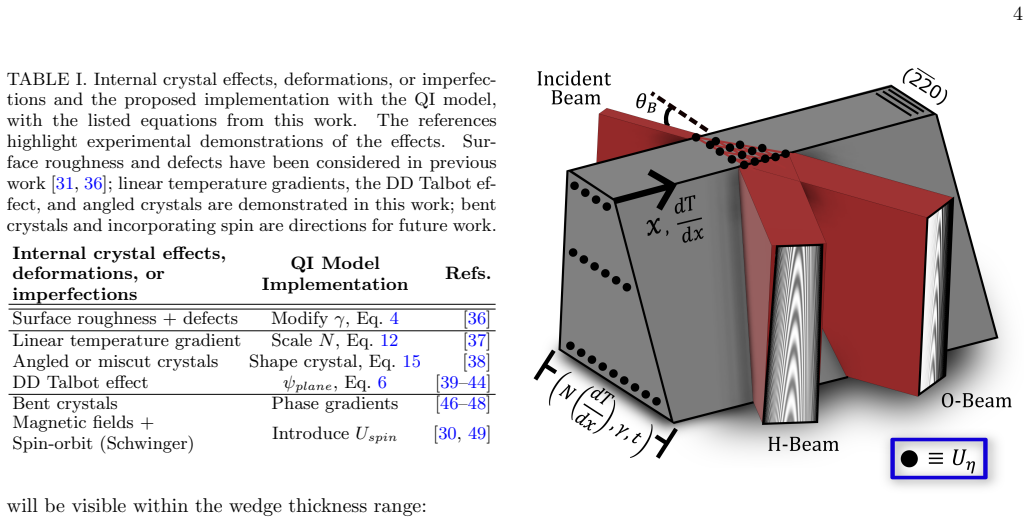
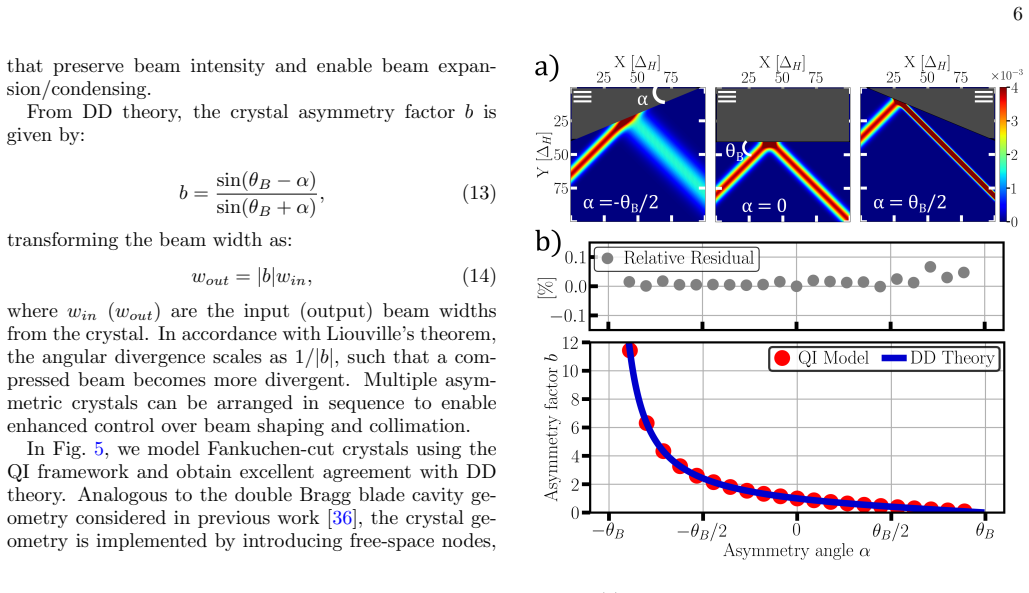
We present a unified quantum random walk model that is now suitable for reproducing all established DD effects. We demonstrate this by incorporating a broad range of internal crystal effects influencing DD intensity distributions, including linear temperature gradients, the DD Talbot effect, and angled or miscut crystals.
What carries the argument
The unified quantum random walk model for dynamical diffraction, which propagates probability amplitudes through a lattice of scattering events while embedding crystal deformations.
If this is right
- Intensity distributions for crystals with temperature gradients or miscuts can be computed directly from the same walk rules used for ideal crystals.
- Experimental analysis of neutron interferometer data becomes possible even when the crystal faces are angled or the lattice is deformed.
- Design of next-generation neutron optical components such as condensing monochromators can use the model to predict performance under realistic conditions.
- The DD Talbot effect emerges naturally inside the walk without separate optical treatment.
Where Pith is reading between the lines
- The same walk rules might later handle curvature or defects distributed in three dimensions if the lattice is extended accordingly.
- Because the model already works for both neutrons and X-rays in principle, it could reduce the need for separate simulation codes in synchrotron beamline design.
- If the framework remains parameter-free across effects, it offers a route to inverse problems that extract crystal deformation maps from measured diffraction patterns.
Load-bearing premise
The quantum random walk structure can capture every internal crystal effect through its current rules without new ad-hoc parameters for each case.
What would settle it
Record the neutron intensity pattern behind a crystal with a measured linear temperature gradient and check whether the model's calculated distribution matches the data within experimental uncertainty.
Figures




read the original abstract
The theory of dynamical diffraction (DD) in perfect crystals is the backbone of high-precision neutron and X-ray diffraction experiments, enabling accurate determination of crystal structure factors and the realization of perfect crystal interferometers. In practice, however, real crystals exhibit deformations and imperfections, including surface roughness, defects, temperature gradients, angled crystal faces, and curvature, that degrade interferometer performance and are difficult to model using conventional DD theory, particularly in complex geometries. To address these challenges, a quantum information (QI) model for DD has been under development, with demonstrated experimental agreement for both ideal crystals and in the presence of some imperfections such as surface roughness and defects. Here, we present a unified quantum random walk model that is now suitable for reproducing all established DD effects. We demonstrate this by incorporating a broad range of internal crystal effects influencing DD intensity distributions, including linear temperature gradients, the DD Talbot effect, and angled or miscut crystals. These results establish the QI model as a comprehensive and flexible framework for experimental analysis, as well as for the design of next-generation perfect crystal neutron interferometers and neutron optical components, such as condensing monochromators.
Editorial analysis
A structured set of objections, weighed in public.
Referee Report
Summary. The manuscript extends a prior quantum information (QI) model of dynamical diffraction (DD) in perfect crystals to a unified quantum random walk framework. It claims this single structure now reproduces all established DD effects by incorporating internal crystal phenomena including linear temperature gradients, the DD Talbot effect, and angled or miscut crystals, while retaining agreement with experiment for ideal cases plus surface roughness and defects. The work positions the model as a comprehensive tool for analyzing real-crystal imperfections and designing neutron interferometers and optical components.
Significance. If the unification is achieved by re-using the existing walk rules and parameters without new ad-hoc mechanisms for each effect, the result would provide a flexible, extensible alternative to conventional DD theory for complex geometries. The prior experimental validations cited for the base model supply independent grounding, and successful extension to temperature gradients, Talbot fringes, and miscut crystals would strengthen its utility for high-precision neutron and X-ray work.
major comments (2)
- [§4.2] §4.2, Eq. (17): the mapping from a linear temperature gradient to the position-dependent phase shift in the walk propagator is presented as a direct substitution, but the derivation of the effective step probability p(T) from the thermal expansion coefficient and Debye-Waller factor is not shown explicitly; without this step the claim that no new parameters are introduced remains unverified.
- [§5.3] §5.3, Fig. 7: the DD Talbot effect is reproduced by periodic modulation of the walk lattice spacing, yet the period is chosen to match the observed fringe spacing rather than derived from the crystal thickness and wavelength; this risks making the reproduction circular unless the modulation is fixed by the same parameters used for the ideal-crystal case.
minor comments (3)
- [Abstract] The abstract states the model is 'now suitable for reproducing all established DD effects,' but the manuscript only demonstrates three additional effects; a brief statement clarifying the scope of 'all' would avoid overstatement.
- [§3.1] Notation for the walk operator in §3.1 uses both U and W interchangeably; consistent use of a single symbol would improve readability.
- [References] Reference list omits the original experimental papers on the DD Talbot effect in neutron interferometry; adding these would strengthen the comparison in §5.3.
Simulated Author's Rebuttal
We thank the referee for their positive evaluation and constructive comments, which have identified opportunities to strengthen the clarity of our derivations. We respond point by point to the major comments and will incorporate the suggested additions in the revised manuscript.
read point-by-point responses
-
Referee: [§4.2] §4.2, Eq. (17): the mapping from a linear temperature gradient to the position-dependent phase shift in the walk propagator is presented as a direct substitution, but the derivation of the effective step probability p(T) from the thermal expansion coefficient and Debye-Waller factor is not shown explicitly; without this step the claim that no new parameters are introduced remains unverified.
Authors: We agree that an explicit derivation of p(T) would improve transparency. In the revised manuscript we will insert a short derivation in §4.2 showing how a linear temperature gradient produces a position-dependent lattice spacing through the thermal expansion coefficient, which then enters the structure factor via the Debye-Waller factor and yields the position-dependent phase shift and step probability p(T) in Eq. (17). All quantities remain those already present in the ideal-crystal model; no additional free parameters are introduced. revision: yes
-
Referee: [§5.3] §5.3, Fig. 7: the DD Talbot effect is reproduced by periodic modulation of the walk lattice spacing, yet the period is chosen to match the observed fringe spacing rather than derived from the crystal thickness and wavelength; this risks making the reproduction circular unless the modulation is fixed by the same parameters used for the ideal-crystal case.
Authors: The modulation period is fixed by the standard Talbot condition of dynamical diffraction, Λ = λL/d, where L is crystal thickness, λ the wavelength, and d the lattice spacing—exactly the same parameters employed for the ideal-crystal simulations. The agreement with observed fringe spacing is therefore a validation rather than a fit. To remove any ambiguity, we will add an explicit paragraph in §5.3 deriving the period from L and λ and confirming that the same values are used throughout the manuscript. revision: yes
Circularity Check
No significant circularity; derivation remains self-contained via prior experimental validation
full rationale
The paper extends an existing quantum random walk / QI model whose base case already carries independent experimental agreement for ideal crystals plus surface roughness and defects. The new effects (linear temperature gradients, DD Talbot effect, angled/miscut crystals) are described as incorporated into the same unified structure without the text indicating that each is realized by fitting new free parameters to the target intensity distributions. Because the load-bearing support for the framework originates outside the present manuscript (prior experimental matches), and no equation is shown to reduce a claimed prediction to a fitted input or to a self-citation chain that itself lacks external grounding, the derivation chain does not collapse by construction. This is the normal, non-circular outcome for incremental model extension.
Axiom & Free-Parameter Ledger
axioms (1)
- standard math Quantum superposition and interference govern neutron/X-ray propagation in crystals
invented entities (1)
-
Unified quantum random walk model for DD
no independent evidence
Reference graph
Works this paper leans on
-
[1]
An x-ray interferometer,
U. Bonse and M. Hart, “An x-ray interferometer,”Ap- plied Physics Letters, vol. 6, no. 8, pp. 155–156, 1965
1965
-
[2]
Review lecture: Ten years of x-ray interferom- etry,
M. Hart, “Review lecture: Ten years of x-ray interferom- etry,”Proceedings of the Royal Society of London. Se- ries A, Mathematical and Physical Sciences, vol. 346, no. 1644, pp. 1–22, 1975
1975
-
[3]
Rauch and S
H. Rauch and S. A. Werner,Neutron Interferometry: Lessons in Experimental Quantum Mechanics, Wave- Particle Duality, and Entanglement, vol. 12. Oxford Uni- versity Press, New York, 2015
2015
-
[4]
V. F. Sears,Neutron Optics. Oxford University Press, 1989
1989
-
[5]
Phase-contrast imaging of weakly absorbing materials using hard x-rays,
T. J. Davis, D. Gao, T. Gureyev, A. Stevenson, and S. Wilkins, “Phase-contrast imaging of weakly absorbing materials using hard x-rays,”Nature, vol. 373, no. 6515, pp. 595–598, 1995
1995
-
[6]
Phase– contrast x–ray computed tomography for observing bi- ological soft tissues,
A. Momose, T. Takeda, Y. Itai, and K. Hirano, “Phase– contrast x–ray computed tomography for observing bi- ological soft tissues,”Nature medicine, vol. 2, no. 4, pp. 473–475, 1996
1996
-
[7]
Reciprocal space approaches to neutron imaging,
D. Pushin, D. Cory, M. Arif, D. Jacobson, and M. Hu- ber, “Reciprocal space approaches to neutron imaging,” Applied physics letters, vol. 90, no. 22, 2007
2007
-
[8]
Absolute measurement of the (220) lat- tice plane spacing in a silicon crystal,
P. Becker, K. Dorenwendt, G. Ebeling, R. Lauer, W. Lu- cas, R. Probst, H.-J. Rademacher, G. Reim, P. Seyfried, and H. Siegert, “Absolute measurement of the (220) lat- tice plane spacing in a silicon crystal,”Phys. Rev. Lett., vol. 46, pp. 1540–1543, Jun 1981
1981
-
[9]
Si lattice param- eter measurement by centimeter x-ray interferometry,
L. Ferroglio, G. Mana, and E. Massa, “Si lattice param- eter measurement by centimeter x-ray interferometry,” Optics express, vol. 16, no. 21, pp. 16877–16888, 2008
2008
-
[10]
Mea- surement of the{2 2 0}lattice-plane spacing of a 28si x-ray interferometer,
E. Massa, G. Mana, U. Kuetgens, and L. Ferroglio, “Mea- surement of the{2 2 0}lattice-plane spacing of a 28si x-ray interferometer,”Metrologia, vol. 48, no. 2, p. S37, 2011
2011
-
[11]
Neutron limit on the strongly-coupled chameleon field,
K. Li, M. Arif, D. G. Cory, R. Haun, B. Heacock, M. G. Huber, J. Nsofini, D. A. Pushin, P. Saggu, D. Sarenac, et al., “Neutron limit on the strongly-coupled chameleon field,”Physical Review D, vol. 93, no. 6, p. 062001, 2016
2016
-
[12]
Pendell¨ osung interferometry probes the neutron charge radius, lattice dynamics, and fifth forces,
B. Heacock, T. Fujiie, R. W. Haun, A. Henins, K. Hirota, T. Hosobata, M. G. Huber, M. Kitaguchi, D. A. Pushin, H. Shimizu,et al., “Pendell¨ osung interferometry probes the neutron charge radius, lattice dynamics, and fifth forces,”Science, vol. 373, no. 6560, pp. 1239–1243, 2021
2021
-
[13]
X-ray determination of the elastic deforma- tion of a perfect crystal neutron interferometer: implica- tions for gravitational phase shift experiments,
M. Arif, M. S. Dewey, G. Greene, D. Jacobson, and S. Werner, “X-ray determination of the elastic deforma- tion of a perfect crystal neutron interferometer: implica- tions for gravitational phase shift experiments,”Physics Letters A, vol. 184, no. 2, pp. 154–158, 1994
1994
-
[14]
Achieving a near-ideal sil- icon crystal neutron interferometer using submicrometer fabrication techniques,
M. Huber, B. Heacock, I. Taminiau, D. Cory, D. Sarenac, R. Valdillez, and D. Pushin, “Achieving a near-ideal sil- icon crystal neutron interferometer using submicrometer fabrication techniques,”Physical Review Research, vol. 6, no. 4, p. 043079, 2024
2024
-
[15]
Particle and/or wave features in neutron in- terferometry,
H. Rauch, “Particle and/or wave features in neutron in- terferometry,”Journal of Physics: Conference Series, vol. 361, p. 012019, may 2012
2012
-
[16]
Observation of a bent crystal-lattice by x-ray interferometry,
E. Massa, G. Mana, and L. Ferroglio, “Observation of a bent crystal-lattice by x-ray interferometry,”Optics Ex- press, vol. 17, no. 13, pp. 11172–11178, 2009
2009
-
[17]
Neutron interferometer crys- tallographic imperfections and gravitationally induced quantum interference measurements,
B. Heacock, M. Arif, R. Haun, M. G. Huber, D. A. Pushin, and A. R. Young, “Neutron interferometer crys- tallographic imperfections and gravitationally induced quantum interference measurements,”Physical Review A, vol. 95, no. 1, p. 013840, 2017
2017
-
[18]
Dynamical theory of x-ray diffraction,
A. Authier, “Dynamical theory of x-ray diffraction,” in International Tables for Crystallography, Volume B: Re- ciprocal Space(U. Shmueli, ed.), pp. 534–551, Interna- tional Union of Crystallography, 2006
2006
-
[19]
Decoherence-free neutron interferometry,
D. A. Pushin, M. Arif, and D. G. Cory, “Decoherence-free neutron interferometry,”Physical Review A—Atomic, Molecular, and Optical Physics, vol. 79, no. 5, p. 053635, 2009
2009
-
[20]
Experi- mental realization of decoherence-free subspace in neu- tron interferometry,
D. Pushin, M. Huber, M. Arif, and D. Cory, “Experi- mental realization of decoherence-free subspace in neu- tron interferometry,”Physical Review Letters, vol. 107, no. 15, p. 150401, 2011
2011
-
[21]
Decoupling of a neutron interferometer from tem- perature gradients,
P. Saggu, T. Mineeva, M. Arif, D. G. Cory, R. Haun, B. Heacock, M. G. Huber, K. Li, J. Nsofini, D. Sarenac, et al., “Decoupling of a neutron interferometer from tem- perature gradients,”Review of Scientific Instruments, vol. 87, no. 12, 2016
2016
-
[22]
Increased interference fringe visibility from the post-fabrication heat treatment of a perfect crystal silicon neutron interferometer,
B. Heacock, M. Arif, D. G. Cory, T. Gnaeupel-Herold, R. Haun, M. G. Huber, M. E. Jamer, J. Nsofini, D. A. Pushin, D. Sarenac,et al., “Increased interference fringe visibility from the post-fabrication heat treatment of a perfect crystal silicon neutron interferometer,”Review of Scientific Instruments, vol. 89, no. 2, 2018
2018
-
[23]
Measurement and al- leviation of subsurface damage in a thick-crystal neutron 9 interferometer,
B. Heacock, R. Haun, K. Hirota, T. Hosobata, M. G. Huber, M. E. Jamer, M. Kitaguchi, D. A. Pushin, H. Shimizu, I. Taminiau,et al., “Measurement and al- leviation of subsurface damage in a thick-crystal neutron 9 interferometer,”Foundations of Crystallography, vol. 75, no. 6, pp. 833–841, 2019
2019
-
[24]
Neutron interferometry and tests of short-range modifications of gravity,
J. M. Rocha and F. Dahia, “Neutron interferometry and tests of short-range modifications of gravity,”Phys. Rev. D, vol. 103, p. 124014, Jun 2021
2021
-
[25]
Neutron in- terference from a split-crystal interferometer,
H. Lemmel, M. Jentschel, H. Abele, F. Lafont, B. Guer- ard, C. P. Sasso, G. Mana, and E. Massa, “Neutron in- terference from a split-crystal interferometer,”Journal of Applied Crystallography, vol. 55, no. 4, pp. 870–875, 2022
2022
-
[26]
Symmetry vi- olations and schwinger scattering in neutron interferom- etry,
A. Zeilinger, M. Horne, and H. Bernstein, “Symmetry vi- olations and schwinger scattering in neutron interferom- etry,”Le Journal de Physique Colloques, vol. 45, no. C3, pp. C3–209, 1984
1984
-
[27]
Measure- ment of the neutron reflectivity for bragg reflections off a perfect silicon crystal,
T. Dombeck, R. Ringo, D. D. Koetke, H. Kaiser, K. Schoen, S. A. Werner, and D. Dombeck, “Measure- ment of the neutron reflectivity for bragg reflections off a perfect silicon crystal,”Physical Review A, vol. 64, no. 5, p. 053607, 2001
2001
-
[28]
Measurement of the neutron elec- tric dipole moment via spin rotation in a non- centrosymmetric crystal,
V. V. Fedorov, M. Jentschel, I. A. Kuznetsov, E. G. Lapin, E. Lelievre-Berna, V. Nesvizhevsky, A. Petoukhov, S. Y. Semenikhin, T. Soldner, V. V. Voronin,et al., “Measurement of the neutron elec- tric dipole moment via spin rotation in a non- centrosymmetric crystal,”Physics Letters B, vol. 694, no. 1, pp. 22–25, 2010
2010
-
[29]
Anomalous behavior of neutron refraction in- dex in a perfect crystal near the bragg reflex,
M. V. Lasitsa, Y. P. Braginetz, E. O. Vezhlev, S. Y. Se- menikhin, I. A. Kuznetsov, V. V. Fedorov, and V. V. Voronin, “Anomalous behavior of neutron refraction in- dex in a perfect crystal near the bragg reflex,”Journal of Physics: Conference Series, vol. 572, p. 012008, dec 2014
2014
-
[30]
Direct obser- vation of neutron spin rotation in bragg scattering due to the spin-orbit interaction in silicon,
T. R. Gentile, M. G. Huber, D. D. Koetke, M. Peshkin, M. Arif, T. Dombeck, D. S. Hussey, D. L. Jacobson, P. Nord, D. A. Pushin, and R. Smither, “Direct obser- vation of neutron spin rotation in bragg scattering due to the spin-orbit interaction in silicon,”Phys. Rev. C, vol. 100, p. 034005, Sep 2019
2019
-
[31]
A perfect crystal neutron loop cavity
O. Lailey, D. Sarenac, D. G. Cory, M. G. Huber, and D. A. Pushin, “A perfect crystal neutron loop cavity,” arXiv preprint arXiv:2604.02541, 2026
work page internal anchor Pith review Pith/arXiv arXiv 2026
-
[32]
Quantum-information approach to dy- namical diffraction theory,
J. Nsofini, K. Ghofrani, D. Sarenac, D. G. Cory, and D. A. Pushin, “Quantum-information approach to dy- namical diffraction theory,”Physical Review A, vol. 94, Dec 2016
2016
-
[33]
Noise refocus- ing in a five-blade neutron interferometer,
J. Nsofini, D. Sarenac, K. Ghofrani, M. G. Huber, M. Arif, D. G. Cory, and D. A. Pushin, “Noise refocus- ing in a five-blade neutron interferometer,”Journal of Applied Physics, vol. 122, no. 5, p. 054501, 2017
2017
-
[34]
Coherence optimization in neutron interferom- etry through defocusing,
J. Nsofini, D. Sarenac, D. G. Cory, and D. A. Pushin, “Coherence optimization in neutron interferom- etry through defocusing,”Physical Review A, vol. 99, no. 4, p. 043614, 2019
2019
-
[35]
Generalizing the quantum information model for dynamic diffraction,
O. Nahman-L´ evesque, D. Sarenac, D. G. Cory, B. Hea- cock, M. G. Huber, and D. A. Pushin, “Generalizing the quantum information model for dynamic diffraction,” Physical Review A, vol. 105, no. 2, p. 022403, 2022
2022
-
[36]
Quantum informa- tion approach to the implementation of a neutron cav- ity,
O. Nahman-L´ evesque, D. Sarenac, O. Lailey, D. G. Cory, M. G. Huber, and D. A. Pushin, “Quantum informa- tion approach to the implementation of a neutron cav- ity,”New Journal of Physics, vol. 25, no. 7, p. 073016, 2023
2023
-
[37]
Pendell¨ osung fringes in elastically deformed silicon,
M. Hart, “Pendell¨ osung fringes in elastically deformed silicon,”Zeitschrift f¨ ur Physik, vol. 189, no. 3, pp. 269– 291, 1966
1966
-
[38]
A condensing monochromator for x-rays,
I. Fankuchen, “A condensing monochromator for x-rays,” Nature, vol. 139, no. 3509, pp. 193–194, 1937
1937
-
[39]
X-ray two-wave dynamical diffraction ana- logue of talbot effect,
M. Balyan, “X-ray two-wave dynamical diffraction ana- logue of talbot effect,”Journal of Optics, vol. 21, no. 5, p. 055603, 2019
2019
-
[40]
An x-ray dynamical diffraction analogue of talbot effect in the transmitted beam,
M. Balyan, “An x-ray dynamical diffraction analogue of talbot effect in the transmitted beam,”Journal of Contemporary Physics (Armenian Academy of Sciences), vol. 54, no. 3, pp. 253–261, 2019
2019
-
[41]
X-ray dynamical diffraction analogues of the integer and fractional talbot effects,
M. K. Balyan, “X-ray dynamical diffraction analogues of the integer and fractional talbot effects,”Synchrotron Radiation, vol. 26, no. 5, pp. 1650–1659, 2019
2019
-
[42]
Spherical-wave x-ray dynamical diffraction talbot effect inside a crystal,
M. K. Balyan, L. V. Levonyan, and K. G. Trouni, “Spherical-wave x-ray dynamical diffraction talbot effect inside a crystal,”Foundations of Crystallography, vol. 76, no. 4, pp. 494–502, 2020
2020
-
[43]
X-ray dynamical diffraction analogue of tal- bot effect in case of incident finite front wave,
M. Balyan, “X-ray dynamical diffraction analogue of tal- bot effect in case of incident finite front wave,”Journal of Contemporary Physics (Armenian Academy of Sciences), vol. 55, no. 1, pp. 70–76, 2020
2020
-
[44]
X-ray dynami- cal diffraction talbot effect behind a crystal in free space,
M. Balyan, L. Levonyan, and K. Trouni, “X-ray dynami- cal diffraction talbot effect behind a crystal in free space,” Foundations of Crystallography, vol. 77, no. 2, pp. 149– 159, 2021
2021
-
[45]
Observation of pendell¨ osung fringe structure in neutron diffraction,
C. Shull, “Observation of pendell¨ osung fringe structure in neutron diffraction,”Physical Review Letters, vol. 21, no. 23, p. 1585, 1968
1968
-
[46]
Dynamical neutron diffrac- tion by ideally curved crystals,
B. Klar and F. Rustichelli, “Dynamical neutron diffrac- tion by ideally curved crystals,”Il Nuovo Cimento B (1971-1996), vol. 13, no. 2, pp. 249–271, 1973
1971
-
[47]
A simple model for dynamical neutron diffraction by deformed crystals,
G. Albertini, A. Boeuf, G. Cesini, S. Mazkedian, S. Mel- one, and F. Rustichelli, “A simple model for dynamical neutron diffraction by deformed crystals,”Foundations of Crystallography, vol. 32, no. 5, pp. 863–868, 1976
1976
-
[48]
Dynamical neutron diffraction by curved crystals in the laue geometry,
G. Albertini, A. Boeuf, B. Klar, S. Lagomarsino, S. Mazkedian, S. Melone, P. Puliti, and F. Rustichelli, “Dynamical neutron diffraction by curved crystals in the laue geometry,”physica status solidi (a), vol. 44, no. 1, pp. 127–136, 1977
1977
-
[49]
Magnetic field effects on dynamical diffraction of neutrons by perfect crystals,
A. Zeilinger and C. Shull, “Magnetic field effects on dynamical diffraction of neutrons by perfect crystals,” Physical Review B, vol. 19, no. 8, p. 3957, 1979
1979
-
[50]
A simple method for mitigating error in the fixed-offset of a double-crystal monochromator,
G. E. Sterbinsky and S. M. Heald, “A simple method for mitigating error in the fixed-offset of a double-crystal monochromator,”Synchrotron Radiation, vol. 28, no. 6, pp. 1737–1746, 2021
2021
-
[51]
Asymmetric x-ray diffraction,
A. M. Afanas’ ev, R. M. Imamov, and E. K. Mukhmedzhanov, “Asymmetric x-ray diffraction,”Crys- tallography reviews, vol. 3, no. 2, pp. 157–226, 1992
1992
-
[52]
Study of asym- metric neutron diffraction including the transition from bragg to laue case,
F. Eichhorn, J. Kulda, and P. Mikula, “Study of asym- metric neutron diffraction including the transition from bragg to laue case,”physica status solidi (a), vol. 80, no. 2, pp. 483–489, 1983
1983
-
[53]
Perfect crys- tals in the asymmetric bragg geometry as optical ele- ments for coherent x-ray beams,
S. Brauer, G. Stephenson, and M. Sutton, “Perfect crys- tals in the asymmetric bragg geometry as optical ele- ments for coherent x-ray beams,”Synchrotron Radiation, vol. 2, no. 4, pp. 163–173, 1995
1995
-
[54]
Aparallel- beam’concentrating monochromator for x-rays,
R. Evans, P. Hirsch, and J. Kellar, “Aparallel- beam’concentrating monochromator for x-rays,”Acta Crystallographica, vol. 1, no. 3, pp. 124–129, 1948
1948
-
[55]
Evidence for the fankuchen effect in neutron diffraction by curved crys- 10 tals,
G. Albertini, A. Boeuf, S. Lagomarsino, S. Mazke- dian, S. Melone, and F. Rustichelli, “Evidence for the fankuchen effect in neutron diffraction by curved crys- 10 tals,”Foundations of Crystallography, vol. 33, no. 3, pp. 360–365, 1977
1977
-
[56]
The plain truth about forming a plane wave of neutrons,
A. G. Wagh, S. Abbas, and W. Treimer, “The plain truth about forming a plane wave of neutrons,”Nuclear Instru- ments and Methods in Physics Research Section A: Accel- erators, Spectrometers, Detectors and Associated Equip- ment, vol. 634, no. 1, pp. S41–S45, 2011
2011
-
[57]
Facts relating to optical science,
H. F. Talbot, “Facts relating to optical science,”Philos. Mag., vol. 9, pp. 401–407, 1836
-
[58]
The talbot effect: re- cent advances in classical optics, nonlinear optics, and quantum optics,
J. Wen, Y. Zhang, and M. Xiao, “The talbot effect: re- cent advances in classical optics, nonlinear optics, and quantum optics,”Advances in optics and photonics, vol. 5, no. 1, pp. 83–130, 2013
2013
-
[59]
Bent perfect crystals as neutron reflectors: Test experiments with si plates,
M. T. Rekveldt and P. Westerhuijs, “Bent perfect crystals as neutron reflectors: Test experiments with si plates,” Nuclear Instruments and Methods in Physics Research Section B: Beam Interactions with Materials and Atoms, vol. 28, no. 4, pp. 583–591, 1987
1987
-
[60]
Observation of multiple bragg reflections of neutrons in bent perfect crystals,
P. Mikula, M. Vr´ ana, J.ˇSaroun, B. Seong, V. Em, and M. Moon, “Observation of multiple bragg reflections of neutrons in bent perfect crystals,”Nuclear Instruments and Methods in Physics Research Section A: Acceler- ators, Spectrometers, Detectors and Associated Equip- ment, vol. 634, no. 1, pp. S108–S111, 2011
2011
-
[61]
X-ray focusing by bent crystals: focal positions as predicted by the crys- tal lens equation and the dynamical diffraction theory,
J.-P. Guigay and M. Sanchez del Rio, “X-ray focusing by bent crystals: focal positions as predicted by the crys- tal lens equation and the dynamical diffraction theory,” Journal of Synchrotron Radiation, vol. 29, no. 1, pp. 148– 158, 2022
2022
-
[62]
Neutron whispering gallery,
V. V. Nesvizhevsky, A. Y. Voronin, R. Cubitt, and K. V. Protasov, “Neutron whispering gallery,”Nature Physics, vol. 6, no. 2, pp. 114–117, 2010
2010
discussion (0)
Sign in with ORCID, Apple, or X to comment. Anyone can read and Pith papers without signing in.