Recognition: unknown
A stellated tetrahedron that is probably not Rupert
Pith reviewed 2026-05-07 10:39 UTC · model grok-4.3
The pith
Numerical checks indicate a stellated tetrahedron is not Rupert.
A machine-rendered reading of the paper's core claim, the machinery that carries it, and where it could break.
Core claim
By sampling many pairs of orientations from SO(3) times SO(3) and solving linear programs to determine the largest scaling factor allowing one 2D projection to translate into the other, the authors find that more than 88 percent of such pairs do not allow a scaling of at least 1, suggesting the stellated tetrahedron admits no Rupert passage.
What carries the argument
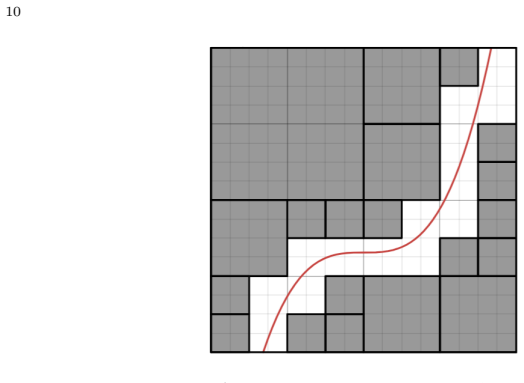
Linear program solvers that compute the largest scaling factor for which one polygon can be translated to fit inside another polygon, applied to the 2D projections of the 3D polyhedron in chosen orientations.
If this is right
- The stellated tetrahedron would serve as a simpler counterexample than those previously constructed.
- The same linear-program technique can test the Rupert property for other polyhedra of low face count.
- The Rupert property appears sensitive to the precise geometry even for highly symmetric shapes.
Where Pith is reading between the lines
- Denser sampling or an exhaustive search over orientations might convert the numerical evidence into a rigorous proof of non-Rupert status.
- The same method could be used to check whether any tetrahedron, or any simplicial polyhedron, fails to be Rupert.
- Similar optimization reductions may apply to other questions about whether one rigid body can pass through a hole in a copy of itself.
Load-bearing premise
The sampled orientations are representative of all possible passages and the reduction from 3D passage to 2D polygon fitting is complete.
What would settle it
An explicit pair of orientations together with a linear-program result showing a maximum fitting scale of 1 or greater would demonstrate that a passage exists for that case.
Figures



read the original abstract
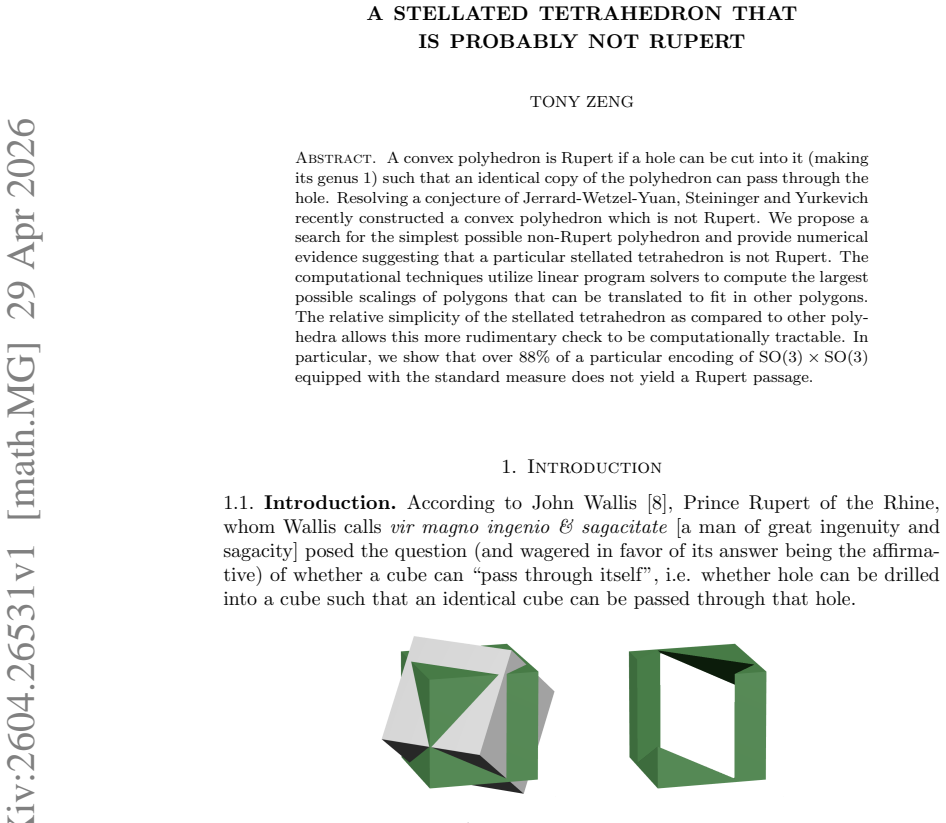
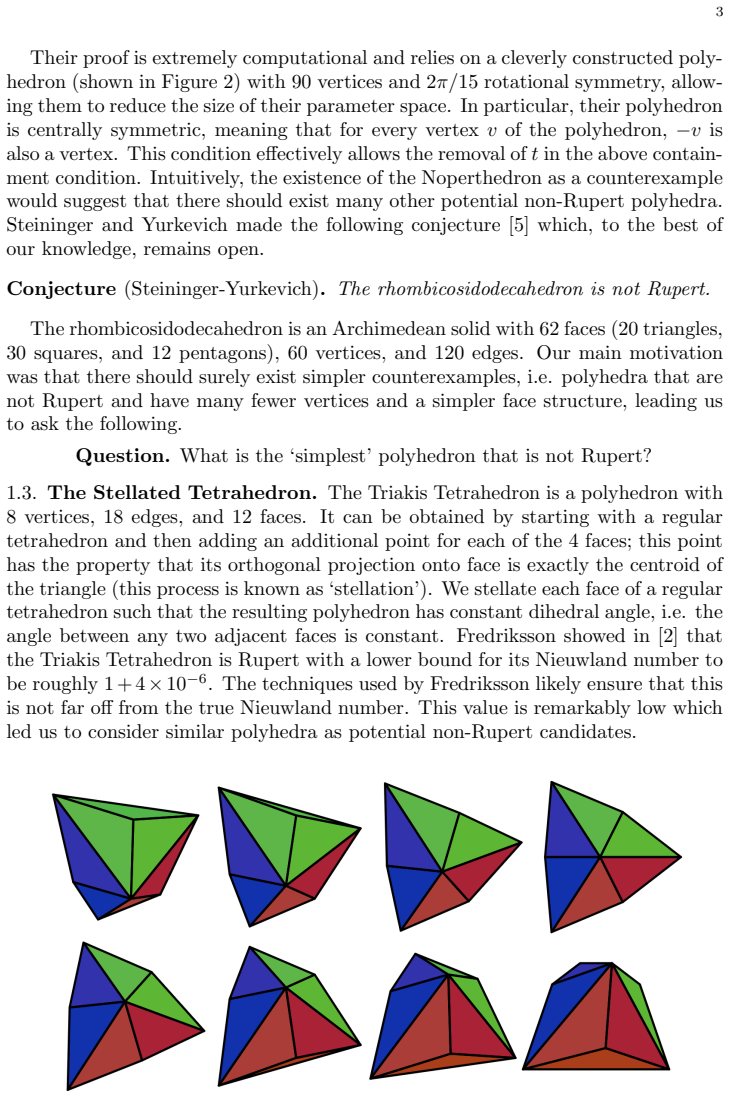
A convex polyhedron is Rupert if a hole can be cut into it (making its genus $1$) such that an identical copy of the polyhedron can pass through the hole. Resolving a conjecture of Jerrard-Wetzel-Yuan, Steininger and Yurkevich recently constructed a convex polyhedron which is not Rupert. We propose a search for the simplest possible non-Rupert polyhedron and provide numerical evidence suggesting that a particular stellated tetrahedron is not Rupert. The computational techniques utilize linear program solvers to compute the largest possible scalings of polygons that can be translated to fit in other polygons. The relative simplicity of the stellated tetrahedron as compared to other polyhedra allows this more rudimentary check to be computationally tractable. In particular, we show that over 88% of a particular encoding of $\text{SO}(3) \times \text{SO}(3)$ equipped with the standard measure does not yield a Rupert passage.
Editorial analysis
A structured set of objections, weighed in public.
Referee Report
Summary. The paper claims to provide numerical evidence that a particular stellated tetrahedron is probably not Rupert. It does so by sampling pairs of orientations from a parametrization of SO(3) × SO(3) and using linear-program solvers to check whether the orthogonal projections admit a translation-fitting scaled copy at factor 1; the authors report that more than 88% of the sampled pairs yield no such passage.
Significance. If the Monte-Carlo sampling is representative and the 2D-projection reduction is complete, the result would identify a relatively simple convex polyhedron as a non-Rupert example, advancing the search for the minimal counterexample to the Jerrard–Wetzel–Yuan conjecture. The computational approach—reducing the passage check to linear programs on 2D polygons—is appropriate and exploits the low complexity of the stellated tetrahedron to remain tractable.
major comments (2)
- [Abstract] Abstract: the central claim that “over 88% … does not yield a Rupert passage” is stated without sample size, variance estimate, or error bounds on the Monte-Carlo measure; this omission prevents assessment of whether the observed 12% failure rate could be explained by undersampling of a positive-measure set of passages.
- [The computational techniques] The computational method: the reduction of the 3D Rupert-passage problem to checking fixed-orientation 2D polygon-fitting conditions via linear programs is used without an argument that every possible passage (including those involving non-prismatic holes or intermediate rotations during transit) must correspond to some pair of orthogonal projections that satisfy the translation condition at scale 1.
minor comments (2)
- [Abstract] The specific parametrization chosen for the “particular encoding of SO(3) × SO(3)” is not described in sufficient detail to allow independent reproduction of the sampling measure.
- [Abstract] The abstract refers to “the standard measure” on SO(3) × SO(3) without citing the normalization or Haar-measure convention employed.
Simulated Author's Rebuttal
We thank the referee for the careful reading and constructive comments. We address the two major comments point by point below and will revise the manuscript to improve clarity and acknowledge limitations where appropriate.
read point-by-point responses
-
Referee: [Abstract] Abstract: the central claim that “over 88% … does not yield a Rupert passage” is stated without sample size, variance estimate, or error bounds on the Monte-Carlo measure; this omission prevents assessment of whether the observed 12% failure rate could be explained by undersampling of a positive-measure set of passages.
Authors: We agree that additional statistical details would strengthen the abstract. In the revised manuscript we will specify the sample size used for the Monte Carlo sampling over the parametrization of SO(3) × SO(3) and, where computable from the existing data, include variance estimates or confidence intervals for the reported proportion. revision: yes
-
Referee: [The computational techniques] The computational method: the reduction of the 3D Rupert-passage problem to checking fixed-orientation 2D polygon-fitting conditions via linear programs is used without an argument that every possible passage (including those involving non-prismatic holes or intermediate rotations during transit) must correspond to some pair of orthogonal projections that satisfy the translation condition at scale 1.
Authors: The referee correctly notes that our reduction checks fixed-orientation projection pairs for translation fitting at scale 1, which corresponds to a necessary condition for passages through prismatic holes with constant orientation. We do not possess a complete argument showing that every conceivable Rupert passage, including those with intermediate rotations or non-prismatic holes, must manifest as such a pair. The manuscript presents the 88 % figure as numerical evidence that the stellated tetrahedron is probably not Rupert rather than a rigorous proof. In revision we will add an explicit discussion of this scope and limitation. revision: yes
Circularity Check
No circularity: direct numerical sampling and LP checks
full rationale
The paper's central claim is a Monte Carlo statistic obtained by sampling orientations in a parametrization of SO(3) × SO(3) and using linear-program solvers to test whether one 2D projection can be translated to fit inside the other at scale 1. This computation applies standard geometric optimization directly to the input polyhedron without fitting any free parameters to the reported percentage, without renaming known results, and without load-bearing self-citations or imported uniqueness theorems. The reduction to 2D polygon fitting is presented as an explicit computational procedure rather than an algebraic identity that collapses to the inputs by construction. Consequently the derivation chain remains independent of the final statistic.
Axiom & Free-Parameter Ledger
axioms (1)
- domain assumption The Rupert property for a convex polyhedron reduces to checking whether one projected polygon can be scaled and translated to fit inside another for some pair of orientations.
Reference graph
Works this paper leans on
-
[1]
The polygon containment problem.Advances in Computing Research, 1:1– 33, 1983
Bernard Chazelle. The polygon containment problem.Advances in Computing Research, 1:1– 33, 1983
1983
-
[2]
Optimizing for the Rupert property.The American Mathematical Monthly, 131(3):255–261, 2023
Albin Fredriksson. Optimizing for the Rupert property.The American Mathematical Monthly, 131(3):255–261, 2023
2023
-
[3]
Platonic passages.Mathematics Maga- zine, 90(2):87–98, 2017
Richard P Jerrard, John E Wetzel, and Liping Yuan. Platonic passages.Mathematics Maga- zine, 90(2):87–98, 2017
2017
-
[4]
Evan Scott. Two sufficient conditions for a polyhedron to be (locally) Rupert.arXiv preprint arXiv:2208.12912, 2022
-
[5]
An algorithmic approach to rupert’s problem.Math- ematics of Computation, 92(342):1905–1929, 2023
Jakob Steininger and Sergey Yurkevich. An algorithmic approach to rupert’s problem.Math- ematics of Computation, 92(342):1905–1929, 2023
1905
-
[6]
A convex polyhedron without Rupert’s property.arXiv preprint arXiv:2508.18475, 2025
Jakob Steininger and Sergey Yurkevich. A convex polyhedron without Rupert’s property.arXiv preprint arXiv:2508.18475, 2025
-
[7]
Jean Henri van Swinden.Grondbeginsels der meetkunde. P. den Hengst en zoon, 1816
-
[8]
E Theatro, Sheldoniano, Oxoniae, 1685
John Wallis.De Algebra Tractatus; Historicus & Practicus, volume 2. E Theatro, Sheldoniano, Oxoniae, 1685. Department of Mathematics, University of W ashington, Seattle, W A 98195, USA Email address:txz@uw.edu
discussion (0)
Sign in with ORCID, Apple, or X to comment. Anyone can read and Pith papers without signing in.