Recognition: unknown
A Rare Eddington-Limited, Heavily Obscured Low-Mass Active Galactic Nucleus Likely Triggered by a Galaxy Merger
Pith reviewed 2026-05-07 13:10 UTC · model grok-4.3
The pith
A low-mass galaxy merger has triggered a heavily obscured Eddington-limited AGN with rapid black-hole growth.
A machine-rendered reading of the paper's core claim, the machinery that carries it, and where it could break.
Core claim
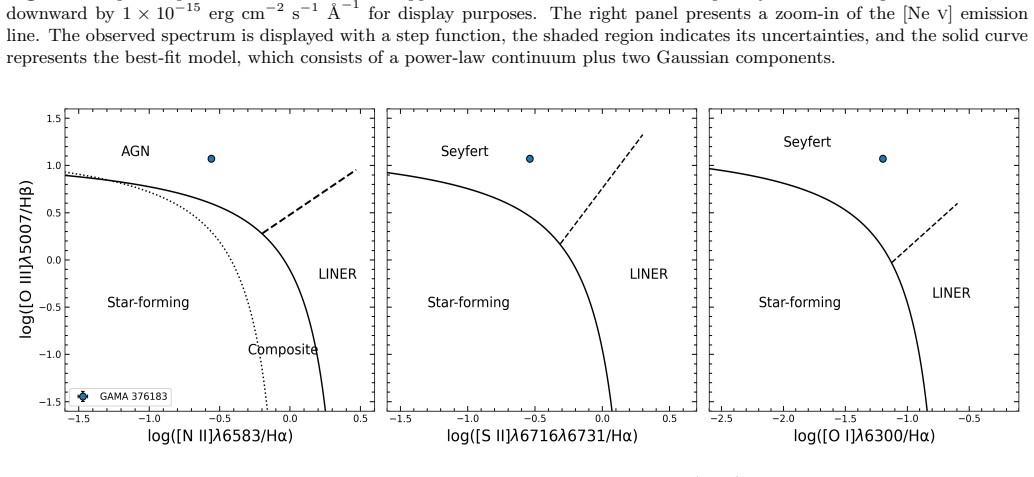
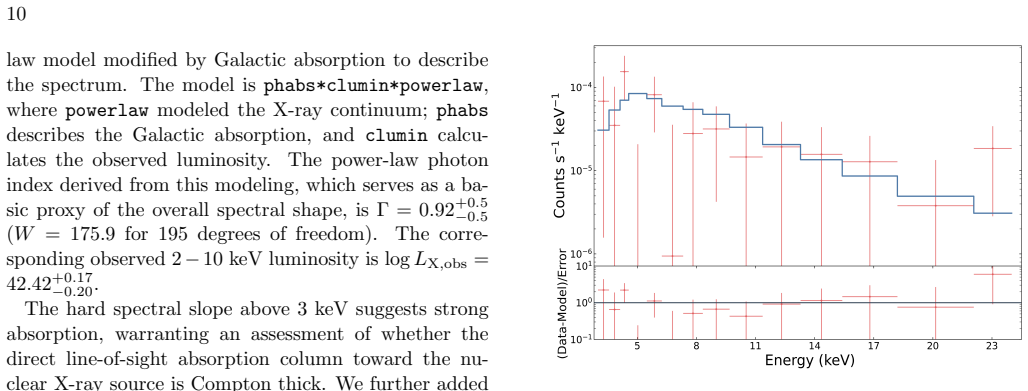
GAMA 376183 is a heavily obscured AGN in a low-mass galaxy with log N_H approximately 23.3, intrinsic 2-10 keV luminosity of about 10^42.9 erg/s, and Eddington ratio around 0.8; the disturbed morphology indicates the merger is simultaneously driving the Eddington-limited accretion and a recent starburst.
What carries the argument
NuSTAR spectral fit combined with [Ne V] equivalent width, high-resolution optical imaging of disturbed morphology, and multiwavelength SED modeling of the starburst.
If this is right
- [Ne V] emission provides an effective way to find heavily obscured AGNs in low-mass galaxies.
- The merger-driven coevolution picture established for massive galaxies also applies at lower masses.
- Rapid black-hole growth episodes can occur in low-mass merging systems.
- Such objects remain rare but are detectable with current X-ray and optical facilities.
Where Pith is reading between the lines
- Targeted [Ne V] searches in low-mass galaxies could uncover more examples of merger-triggered obscured growth.
- Black-hole growth histories in low-mass galaxies may be more episodic and merger-dependent than current models assume.
- The fraction of obscured accretion in the low-mass regime could be higher than inferred from unobscured samples alone.
Load-bearing premise
The disturbed optical morphology signals an ongoing galaxy merger that is directly triggering both the Eddington-limited accretion and the starburst.
What would settle it
Deeper imaging or kinematic data showing the galaxy is isolated with no merger signatures, or refined X-ray modeling yielding an Eddington ratio below 0.1.
Figures




read the original abstract
We report a detailed analysis of GAMA 376183, a powerful, heavily obscured active galactic nucleus (AGN) hosted by a low-mass galaxy ($M_\star \approx 10^{10}~M_{\odot}$) likely experiencing a galaxy merger. The source was initially identified due to its remarkably strong [Ne v] $\lambda3426$ emission, exhibiting a rest-frame equivalent width (EW) of $\approx 48$ A. We present $\sim100$ ks Nuclear Spectroscopic Telescope Array follow-up observations, confirming its heavily obscured nature with a column density (in $\mathrm{cm^{-2}}$) of $\log N_\mathrm{H} = 23.3^{+0.4}_{-1.2}$ and an intrinsic $2$--$10$ keV luminosity (in $\mathrm{erg~s^{-1}}$) of $\log L_\mathrm{X,int} = 42.92^{+0.24}_{-0.20}$. GAMA 376183 thus represents one of the few known heavily obscured AGNs in low-mass galaxies. Its estimated Eddington ratio is $\lambda_\mathrm{Edd}\approx0.8$, indicative of rapid black-hole growth. High-resolution optical images reveal a disturbed, likely merging morphology, while its multiwavelength spectral energy distribution indicates a recent starburst in its host galaxy. These pieces of evidence suggest that the ongoing merger has triggered both the heavily obscured, Eddington-limited accretion and the starburst, making GAMA 376183 a rare observed case in low-mass galaxies. Overall, this unique source demonstrates that (i) [Ne v] can help identify heavily obscured low-mass AGNs, and (ii) the merger-driven coevolution framework established for massive galaxies may also extend to low-mass galaxies.
Editorial analysis
A structured set of objections, weighed in public.
Referee Report
Summary. The manuscript presents a multi-wavelength analysis of GAMA 376183, a low-mass galaxy (M_star ≈ 10^10 M_⊙) hosting a heavily obscured AGN. NuSTAR observations yield log N_H = 23.3^{+0.4}_{-1.2} and log L_{X,int} = 42.92^{+0.24}_{-0.20}; combined with strong [Ne V] λ3426 emission (EW ≈ 48 Å), disturbed optical morphology, and SED evidence for a recent starburst, the authors conclude that the source is undergoing Eddington-limited accretion (λ_Edd ≈ 0.8) triggered by an ongoing galaxy merger, representing a rare case in low-mass systems and supporting extension of the merger-coevolution framework.
Significance. If the derived parameters and merger interpretation are robust, the result would provide one of the few documented examples of a heavily obscured, near-Eddington AGN in a low-mass host, demonstrating that [Ne V] can select such objects and that merger-driven triggering may operate at lower masses than previously emphasized.
major comments (2)
- [Abstract and §4 (X-ray analysis and Eddington ratio)] Abstract and the paragraph deriving λ_Edd: the central claim of Eddington-limited accretion (λ_Edd ≈ 0.8) and rapid black-hole growth rests on an unspecified M_BH (presumably from an M_BH–M_star or M_BH–σ scaling relation), an unspecified bolometric correction to L_{X,int}, and no propagated uncertainty budget. The quoted asymmetric errors on log L_{X,int} and the 0.5–1 dex intrinsic scatter in the scaling relations imply that λ_Edd could easily range from ~0.3 to >2; this must be quantified before the 'Eddington-limited' classification can be considered secure.
- [§3 and §5] §3 (optical imaging) and §5 (discussion): the assertion that the disturbed morphology indicates an ongoing major merger that directly triggers both the AGN and starburst is load-bearing for the coevolution conclusion, yet relies on qualitative visual inspection without quantitative merger diagnostics (e.g., CAS parameters, tidal feature statistics, or comparison to a control sample of non-AGN low-mass galaxies). Alternative drivers (secular instabilities, minor encounters) are not quantitatively excluded.
minor comments (2)
- [§2 (observations)] The NuSTAR exposure is stated as '~100 ks' in the abstract; the exact on-source time, background subtraction method, and full model comparison (including reflection or partial-covering variants) should be reported in the methods section with χ² or C-stat values.
- [Abstract and §3] The [Ne V] equivalent width is given as '≈48 A'; adopt the standard unit Å throughout and confirm the rest-frame measurement details.
Simulated Author's Rebuttal
We thank the referee for their detailed and constructive report. The comments highlight important areas where the presentation of our results can be strengthened, particularly regarding the robustness of the Eddington ratio and the merger interpretation. We address each major comment below and outline the revisions we will make.
read point-by-point responses
-
Referee: [Abstract and §4 (X-ray analysis and Eddington ratio)] Abstract and the paragraph deriving λ_Edd: the central claim of Eddington-limited accretion (λ_Edd ≈ 0.8) and rapid black-hole growth rests on an unspecified M_BH (presumably from an M_BH–M_star or M_BH–σ scaling relation), an unspecified bolometric correction to L_{X,int}, and no propagated uncertainty budget. The quoted asymmetric errors on log L_{X,int} and the 0.5–1 dex intrinsic scatter in the scaling relations imply that λ_Edd could easily range from ~0.3 to >2; this must be quantified before the 'Eddington-limited' classification can be considered secure.
Authors: We agree that the derivation of λ_Edd in the abstract and §4 requires explicit specification of the inputs and a full uncertainty budget to support the nominal value of ≈0.8. In the revised manuscript we will (i) state the adopted M_BH–M_star relation (Reines & Volonteri 2015) and the resulting M_BH, (ii) specify the bolometric correction (k_bol ≈ 20 for the 2–10 keV band in Compton-thick AGNs, consistent with the NuSTAR-derived N_H), and (iii) propagate uncertainties including the asymmetric errors on log L_{X,int}, the 0.5 dex intrinsic scatter of the scaling relation, and the uncertainty on k_bol. We will report the resulting range for λ_Edd (approximately 0.2–2.5 at 1σ) and qualify the 'Eddington-limited' description as the nominal value while noting that the source is consistent with rapid growth. This quantification will be added to both the abstract and the relevant paragraph in §4. revision: yes
-
Referee: [§3 and §5] §3 (optical imaging) and §5 (discussion): the assertion that the disturbed morphology indicates an ongoing major merger that directly triggers both the AGN and starburst is load-bearing for the coevolution conclusion, yet relies on qualitative visual inspection without quantitative merger diagnostics (e.g., CAS parameters, tidal feature statistics, or comparison to a control sample of non-AGN low-mass galaxies). Alternative drivers (secular instabilities, minor encounters) are not quantitatively excluded.
Authors: We acknowledge that the merger interpretation rests on visual classification of the disturbed morphology in the available high-resolution imaging. While we cannot perform a full statistical comparison to a control sample of non-AGN low-mass galaxies within the scope of this single-source study, we will revise §3 and §5 to include (i) a more quantitative description of the observed features (e.g., asymmetry, possible tidal tails), (ii) explicit discussion of why secular instabilities or minor encounters are less favored given the combination of a recent starburst (from SED fitting) and the heavily obscured, high-Eddington AGN, and (iii) a brief note on the limitations of the current data for CAS or tidal-feature statistics. These additions will make the triggering argument more transparent without overstating the evidence. revision: partial
Circularity Check
No significant circularity in observational report
full rationale
The manuscript reports new NuSTAR X-ray spectroscopy and optical imaging of GAMA 376183. Fitted parameters (log N_H = 23.3, log L_X,int = 42.92) and the Eddington ratio estimate (λ_Edd ≈ 0.8) follow from standard spectral modeling and host-galaxy mass scaling relations applied to the fresh data. No derivation reduces a claimed prediction to a fitted input by construction, no self-citation supplies a load-bearing uniqueness theorem, and no ansatz is smuggled via prior work. The chain is self-contained observational analysis.
Axiom & Free-Parameter Ledger
axioms (2)
- domain assumption Standard assumptions in X-ray spectral fitting for Compton-thick or heavily obscured AGNs allow reliable recovery of intrinsic luminosity and column density from NuSTAR data.
- domain assumption Disturbed galaxy morphology indicates an ongoing merger that can trigger both starburst and AGN activity.
Forward citations
Cited by 1 Pith paper
-
A new sample of Little Red Dots at $z<0.45$ in DESI DR1: Broad Balmer lines, low ionization spectrum and no variability
Eight low-redshift Little Red Dots identified in DESI DR1 exhibit broad Balmer lines, steep decrements, compact shapes, and negligible variability, with a number density roughly 10,000 times lower than at z>4.
Reference graph
Works this paper leans on
-
[1]
Aihara, H., AlSayyad, Y., Ando, M., et al. 2022, PASJ, 74, 247, doi: 10.1093/pasj/psab122
-
[2]
Alexander, D. M., & Hickox, R. C. 2012, NewAR, 56, 93, doi: 10.1016/j.newar.2011.11.003
-
[3]
Ananna, T. T., Treister, E., Urry, C. M., et al. 2019, ApJ, 871, 240, doi: 10.3847/1538-4357/aafb77
-
[4]
Annuar, A., Alexander, D. M., Gandhi, P., et al. 2025, arXiv e-prints, arXiv:2506.08527, doi: 10.48550/arXiv.2506.08527
-
[5]
Ansh, S., Chen, C.-T. J., Brandt, W. N., et al. 2023, ApJ, 942, 82, doi: 10.3847/1538-4357/ac9382
-
[6]
Arnouts, S., Cristiani, S., Moscardini, L., et al. 1999, MNRAS, 310, 540, doi: 10.1046/j.1365-8711.1999.02978.x
-
[7]
Assef, R. J., Eisenhardt, P. R. M., Stern, D., et al. 2015, ApJ, 804, 27, doi: 10.1088/0004-637X/804/1/27 Astropy Collaboration, Price-Whelan, A. M., Lim, P. L., et al. 2022, ApJ, 935, 167, doi: 10.3847/1538-4357/ac7c74
-
[8]
Baldassare, V. F., Geha, M., & Greene, J. 2018, ApJ, 868, 152, doi: 10.3847/1538-4357/aae6cf
-
[9]
Baldwin, J. A., Phillips, M. M., & Terlevich, R. 1981, PASP, 93, 5, doi: 10.1086/130766 Balokovi´ c, M., Brightman, M., Harrison, F. A., et al. 2018, ApJ, 854, 42, doi: 10.3847/1538-4357/aaa7eb
-
[10]
2024, A&A, 685, A141, doi: 10.1051/0004-6361/202245288
Barchiesi, L., Vignali, C., Pozzi, F., et al. 2024, A&A, 685, A141, doi: 10.1051/0004-6361/202245288
-
[11]
Bellstedt, S., Driver, S. P., Robotham, A. S. G., et al. 2020, MNRAS, 496, 3235, doi: 10.1093/mnras/staa1466
-
[12]
Berg, D. A., Chisholm, J., Erb, D. K., et al. 2021, ApJ, 922, 170, doi: 10.3847/1538-4357/ac141b
-
[13]
A., et al., 2000, @doi [ ] 10.1086/301386 , 119, 2645
Bershady, M. A., Jangren, A., & Conselice, C. J. 2000, AJ, 119, 2645, doi: 10.1086/301386
-
[14]
2013,, Astrophysics Source Code Library, record ascl:1301.001 http://ascl.net/1301.001
Bertin, E. 2013,, Astrophysics Source Code Library, record ascl:1301.001 http://ascl.net/1301.001
2013
-
[15]
F., Satyapal, S., & Ellison, S
Blecha, L., Snyder, G. F., Satyapal, S., & Ellison, S. L. 2018, MNRAS, 478, 3056, doi: 10.1093/mnras/sty1274
-
[16]
Boorman, P. G., Stern, D., Assef, R. J., et al. 2024, ApJ, 975, 230, doi: 10.3847/1538-4357/ad7f56
-
[17]
G., Gandhi, P., Buchner, J., et al
Boorman, P. G., Gandhi, P., Buchner, J., et al. 2025, ApJ, 978, 118, doi: 10.3847/1538-4357/ad8236
-
[18]
CIGALE: a python Code Investigating GALaxy Emission
Boquien, M., Burgarella, D., Roehlly, Y., et al. 2019, A&A, 622, A103, doi: 10.1051/0004-6361/201834156
-
[19]
2018, PASJ, 70, S5, doi: 10.1093/pasj/psx080
Bosch, J., Armstrong, R., Bickerton, S., et al. 2018, PASJ, 70, S5, doi: 10.1093/pasj/psx080
-
[20]
The demographics, physics, and ecology of growing supermassive black holes
Brandt, W. N., & Alexander, D. M. 2015, A&A Rv, 23, 1, doi: 10.1007/s00159-014-0081-z
-
[21]
2003, MNRAS, 339, 937, doi: 10.1046/j.1365-8711.2003.06241.x G¨ otberg, Y., de Mink, S
Bruzual, G., & Charlot, S. 2003, MNRAS, 344, 1000, doi: 10.1046/j.1365-8711.2003.06897.x
-
[22]
Burke, C. J., Liu, X., Shen, Y., et al. 2022, MNRAS, 516, 2736, doi: 10.1093/mnras/stac2262 15
-
[23]
Byrne, C. M., Stanway, E. R., Eldridge, J. J., McSwiney, L., & Townsend, O. T. 2022, MNRAS, 512, 5329, doi: 10.1093/mnras/stac807
-
[24]
Calzetti, D., Armus, L., Bohlin, R. C., et al. 2000, ApJ, 533, 682, doi: 10.1086/308692
-
[25]
Cann, J. M., Satyapal, S., Abel, N. P., et al. 2018, ApJ, 861, 142, doi: 10.3847/1538-4357/aac64a
-
[26]
Carpineti, A., Kaviraj, S., Hyde, A. K., et al. 2015, A&A, 577, A119, doi: 10.1051/0004-6361/201425276
-
[27]
2003, , 586, L133, 10.1086/374879
Chabrier, G. 2003, ApJL, 586, L133, doi: 10.1086/374879
-
[28]
Chen, C.-H., Ho, L. C., Li, R., & Inayoshi, K. 2025a, ApJL, 989, L12, doi: 10.3847/2041-8213/adee0a
-
[29]
The Host Galaxy (If Any) of the Little Red Dots
Chen, C.-H., Ho, L. C., Li, R., & Zhuang, M.-Y. 2025b, ApJ, 983, 60, doi: 10.3847/1538-4357/ada93a
-
[30]
Chen, C.-T. J., Brandt, W. N., Luo, B., et al. 2018, MNRAS, 478, 2132, doi: 10.1093/mnras/sty1036
-
[31]
2016, A&A, 585, A43, doi: 10.1051/0004-6361/201527107
Ciesla, L., Boselli, A., Elbaz, D., et al. 2016, A&A, 585, A43, doi: 10.1051/0004-6361/201527107
-
[32]
Cleri, N. J., Olivier, G. M., Hutchison, T. A., et al. 2023a, ApJ, 953, 10, doi: 10.3847/1538-4357/acde55
-
[33]
J., Yang, G., Papovich, C., et al
Cleri, N. J., Yang, G., Papovich, C., et al. 2023b, ApJ, 948, 112, doi: 10.3847/1538-4357/acc1e6
-
[34]
Conselice, C. J. 2003, ApJS, 147, 1, doi: 10.1086/375001
-
[35]
2007, MNRAS, 378, 910, doi: 10.1111/j.1365-2966.2007.11817.x
Dekel, A. 2008, MNRAS, 384, 386, doi: 10.1111/j.1365-2966.2007.12730.x
-
[36]
Dale, D. A., Helou, G., Magdis, G. E., et al. 2014, ApJ, 784, 83, doi: 10.1088/0004-637X/784/1/83 de Jong, R. S., Agertz, O., Berbel, A. A., et al. 2019, The Messenger, 175, 3, doi: 10.18727/0722-6691/5117 DESI Collaboration, Abdul-Karim, M., Adame, A. G., et al. 2025, arXiv e-prints, arXiv:2503.14745, doi: 10.48550/arXiv.2503.14745 Di Matteo, P., Combes,...
-
[37]
Dong, X.-B., Ho, L. C., Yuan, W., et al. 2012, ApJ, 755, 167, doi: 10.1088/0004-637X/755/2/167
-
[38]
V., Melchior, A.-L., & Zolotukhin, I
Driver, S. P., Hill, D. T., Kelvin, L. S., et al. 2011, MNRAS, 413, 971, doi: 10.1111/j.1365-2966.2010.18188.x
-
[39]
Driver, S. P., Bellstedt, S., Robotham, A. S. G., et al. 2022, MNRAS, 513, 439, doi: 10.1093/mnras/stac472
-
[40]
Duras, F., Bongiorno, A., Ricci, F., et al. 2020, A&A, 636, A73, doi: 10.1051/0004-6361/201936817
-
[41]
L., Viswanathan, A., Patton, D
Ellison, S. L., Viswanathan, A., Patton, D. R., et al. 2019, MNRAS, 487, 2491, doi: 10.1093/mnras/stz1431
-
[42]
2016, ApJL, 822, L32, doi: 10.3847/2041-8205/822/2/L32
Fan, L., Han, Y., Fang, G., et al. 2016, ApJL, 822, L32, doi: 10.3847/2041-8205/822/2/L32
-
[43]
Clayton, G. C. 2019, ApJ, 886, 108, doi: 10.3847/1538-4357/ab4c3a
-
[44]
2021, Zenodo, doi: 10.5281/ZENODO.4893646
Fu, Y. 2021, Zenodo, doi: 10.5281/ZENODO.4893646
-
[45]
2007, A&A, 463, 79, doi: 10.1051/0004-6361:20066334
Gilli, R., Comastri, A., & Hasinger, G. 2007, A&A, 463, 79, doi: 10.1051/0004-6361:20066334
-
[46]
2010, A&A, 519, A92, doi: 10.1051/0004-6361/201014039
Gilli, R., Vignali, C., Mignoli, M., et al. 2010, A&A, 519, A92, doi: 10.1051/0004-6361/201014039
-
[47]
2022, A&A, 666, A17, doi: 10.1051/0004-6361/202243708
Gilli, R., Norman, C., Calura, F., et al. 2022, A&A, 666, A17, doi: 10.1051/0004-6361/202243708
-
[48]
Greene, J. E., Strader, J., & Ho, L. C. 2020, ARA&A, 58, 257, doi: 10.1146/annurev-astro-032620-021835
-
[49]
Ferland, G. J. 2023, Research Notes of the American Astronomical Society, 7, 246, doi: 10.3847/2515-5172/ad0e75
-
[50]
2018,, Astrophysics Source Code Library, record ascl:1809.008
Guo, H., Shen, Y., & Wang, S. 2018,, Astrophysics Source Code Library, record ascl:1809.008
2018
-
[51]
Harrison, F. A., Craig, W. W., Christensen, F. E., et al. 2013, ApJ, 770, 103, doi: 10.1088/0004-637X/770/2/103 HI4PI Collaboration, Ben Bekhti, N., Fl¨ oer, L., et al. 2016, A&A, 594, A116, doi: 10.1051/0004-6361/201629178
-
[52]
Hickox, R. C., & Alexander, D. M. 2018, ARA&A, 56, 625, doi: 10.1146/annurev-astro-081817-051803
-
[53]
Hopkins, P. F., Hernquist, L., Cox, T. J., et al. 2006, ApJS, 163, 1, doi: 10.1086/499298
-
[54]
Hopkins, P. F., Hernquist, L., Cox, T. J., & Kereˇ s, D. 2008, ApJS, 175, 356, doi: 10.1086/524362
work page internal anchor Pith review doi:10.1086/524362 2008
-
[55]
Accurate photometric redshifts for the CFHT Legacy Survey calibrated using the VIMOS VLT Deep Survey
Ilbert, O., Arnouts, S., McCracken, H. J., et al. 2006, A&A, 457, 841, doi: 10.1051/0004-6361:20065138
-
[56]
2009, ApJ, 690, 1236, doi: 10.1088/0004-637X/690/2/1236 Ivezi´ c,ˇZ., Kahn, S
Ilbert, O., Capak, P., Salvato, M., et al. 2009, ApJ, 690, 1236, doi: 10.1088/0004-637X/690/2/1236
-
[57]
2020, ARA&A, 58, 27, doi: 10.1146/annurev-astro-120419-014455
Inayoshi, K., Visbal, E., & Haiman, Z. 2020, ARA&A, 58, 27, doi: 10.1146/annurev-astro-120419-014455
-
[58]
2020, , 890, 125, 10.3847/1538-4357/ab655a
Kawaguchi, T., Yutani, N., & Wada, K. 2020, ApJ, 890, 125, doi: 10.3847/1538-4357/ab655a
-
[59]
Kewley, L. J., Dopita, M. A., Sutherland, R. S., Heisler, C. A., & Trevena, J. 2001, ApJ, 556, 121, doi: 10.1086/321545
-
[60]
Kewley, L. J., Groves, B., Kauffmann, G., & Heckman, T. 2006, MNRAS, 372, 961, doi: 10.1111/j.1365-2966.2006.10859.x
-
[61]
D., Brightman, M., Nandra, K., et al
Kocevski, D. D., Brightman, M., Nandra, K., et al. 2015, ApJ, 814, 104, doi: 10.1088/0004-637X/814/2/104
-
[62]
Kormendy, J., & Ho, L. C. 2013, ARA&A, 51, 511, doi: 10.1146/annurev-astro-082708-101811
work page Pith review doi:10.1146/annurev-astro-082708-101811 2013
-
[63]
2010, ApJL, 716, L125, doi: 10.1088/2041-8205/716/2/L125
Koss, M., Mushotzky, R., Veilleux, S., & Winter, L. 2010, ApJL, 716, L125, doi: 10.1088/2041-8205/716/2/L125
-
[64]
Kraft, R. P., Burrows, D. N., & Nousek, J. A. 1991, ApJ, 374, 344, doi: 10.1086/170124
-
[65]
Kroupa, P. 2001, MNRAS, 322, 231, doi: 10.1046/j.1365-8711.2001.04022.x 16
-
[66]
2015, A&A, 578, A120, doi: 10.1051/0004-6361/201526036
Lanzuisi, G., Perna, M., Delvecchio, I., et al. 2015, A&A, 578, A120, doi: 10.1051/0004-6361/201526036
-
[67]
2019, ApJ, 877, 5, doi: 10.3847/1538-4357/ab184b
Li, J., Xue, Y., Sun, M., et al. 2019, ApJ, 877, 5, doi: 10.3847/1538-4357/ab184b
-
[68]
Li, R., Ho, L. C., & Chen, C.-H. 2025, arXiv e-prints, arXiv:2505.12867, doi: 10.48550/arXiv.2505.12867
-
[69]
Liske, J., Baldry, I. K., Driver, S. P., et al. 2015, MNRAS, 452, 2087, doi: 10.1093/mnras/stv1436
-
[70]
2017, ApJS, 232, 8, doi: 10.3847/1538-4365/aa7847
Liu, T., Tozzi, P., Wang, J.-X., et al. 2017, ApJS, 232, 8, doi: 10.3847/1538-4365/aa7847
-
[71]
Lotz, J. M., Primack, J., & Madau, P. 2004, AJ, 128, 163, doi: 10.1086/421849
-
[72]
1991, A Practical Guide to Data Analysis for Physical Science Students
Lyons, L. 1991, A Practical Guide to Data Analysis for Physical Science Students
1991
-
[73]
Martin, D. C., Fanson, J., Schiminovich, D., et al. 2005, ApJL, 619, L1, doi: 10.1086/426387
-
[74]
D., Satyapal, S., Laor, A., et al
McKaig, J. D., Satyapal, S., Laor, A., et al. 2024, ApJ, 976, 130, doi: 10.3847/1538-4357/ad7a79
-
[75]
2013, A&A, 556, A29, doi: 10.1051/0004-6361/201220846
Mignoli, M., Vignali, C., Gilli, R., et al. 2013, A&A, 556, A29, doi: 10.1051/0004-6361/201220846
-
[76]
Mountrichas, G., Viitanen, A., Carrera, F. J., et al. 2024, A&A, 683, A172, doi: 10.1051/0004-6361/202348204 NASA High Energy Astrophysics Science Archive Research Center (Heasarc). 2014,, Astrophysics Source Code Library, record ascl:1408.004 http://ascl.net/1408.004
-
[77]
Negus, J., Comerford, J. M., S´ anchez, F. M., et al. 2023, ApJ, 945, 127, doi: 10.3847/1538-4357/acb772
-
[78]
Ni, Q., Brandt, W. N., Chen, C.-T., et al. 2021, ApJS, 256, 21, doi: 10.3847/1538-4365/ac0dc6
-
[79]
C., Bottrell, C., Walmsley, M., et al
Omori, K. C., Bottrell, C., Walmsley, M., et al. 2023, A&A, 679, A142, doi: 10.1051/0004-6361/202346743
-
[80]
Pacifici, C., Iyer, K. G., Mobasher, B., et al. 2023, ApJ, 944, 141, doi: 10.3847/1538-4357/acacff
discussion (0)
Sign in with ORCID, Apple, or X to comment. Anyone can read and Pith papers without signing in.