Recognition: unknown
Primitive Two-Dimensional Words and Iterated Pedal Triangles via Symbolic Coding
Pith reviewed 2026-05-07 10:48 UTC · model grok-4.3
The pith
A four-symbol coding of the sorted pedal map establishes a bijection between primitive two-dimensional words and triangles whose nth pedal triangle is the first similar one.
A machine-rendered reading of the paper's core claim, the machinery that carries it, and where it could break.
Core claim
The central claim is that a finite four-symbol coding of the sorted pedal map is complete, injective, and surjective onto the primitive two-dimensional words while exactly preserving the condition that the nth pedal triangle is the first one similar to the original. The resulting branch itineraries therefore supply a bijection between the set of primitive 2-by-n words over a binary alphabet and the set of triangles whose first similar pedal triangle occurs at step n.
What carries the argument
The four-symbol coding of the sorted pedal map, which labels each branch of the map and generates itineraries that label both the words and the triangles while tracking the similarity condition at the nth iterate.
Load-bearing premise
The four-symbol coding must be a complete, injective, and surjective map from the primitive words onto the relevant triangles while preserving the exact location of the first similarity under pedal iteration.
What would settle it
An explicit primitive two-dimensional word of dimension 2 by n that cannot be realized as the itinerary of any triangle under the sorted pedal map, or a triangle whose nth pedal iterate is similar to the original but whose itinerary does not correspond to a primitive word.
Figures
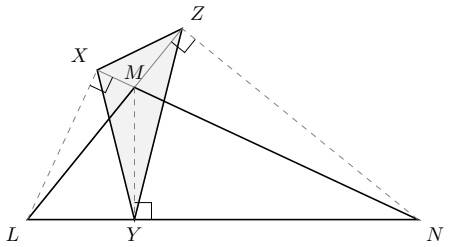
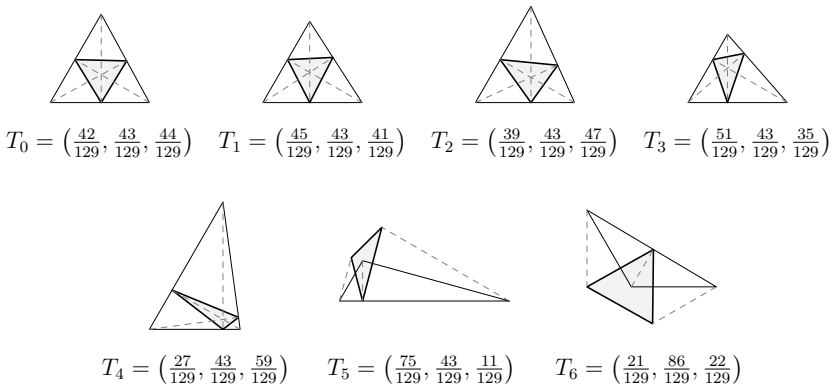
read the original abstract
The notion of a two-dimensional word arises naturally in the study of combinatorics on words, while the iterative construction of pedal triangles results in a rich dynamical system in the study of geometry. At first, these two classes of objects seem to be unrelated. However, it is known that for all $n \geq 1$, the number of primitive two-dimensional words of dimension $2 \times n$ over a binary alphabet agrees with the number of triangles whose first similar pedal triangle is their $n$th pedal triangle. We construct a finite four-symbol coding of the sorted pedal map and use the resulting branch itineraries to give a bijection between these two classes.
Editorial analysis
A structured set of objections, weighed in public.
Referee Report
Summary. The manuscript constructs a finite four-symbol coding of the sorted pedal map on the space of triangle shapes. It then uses the branch itineraries under this coding to produce an explicit bijection between primitive two-dimensional words of dimension 2×n over a binary alphabet and the triangles whose first similar pedal triangle occurs precisely at the nth iteration, thereby accounting for the known equality of their cardinalities.
Significance. The explicit, parameter-free symbolic coding supplies a direct combinatorial-geometric correspondence that explains a previously observed numerical coincidence. Because the construction proceeds by defining symbols from the ordering of feet and vertex actions and then verifying itinerary-to-word and return-time-to-similarity mappings, the result is falsifiable and potentially extensible to other iterated geometric constructions.
minor comments (3)
- [Section 3] The four-symbol alphabet is introduced in the main construction without an accompanying summary table listing the geometric meaning of each symbol; adding such a table would improve cross-referencing.
- [Introduction] A few sentences in the introduction repeat the statement that the counts agree without citing the source of that numerical observation; a single reference would suffice.
- [Section 2] The notation for the first-return time under the pedal map is used before its formal definition; moving the definition earlier or adding a forward reference would aid readability.
Simulated Author's Rebuttal
We thank the referee for the positive report, accurate summary of the bijection via the four-symbol coding, and recommendation to accept. The significance statement correctly identifies the combinatorial-geometric correspondence as the core contribution.
Circularity Check
No significant circularity; explicit construction of bijection
full rationale
The paper states that the counts of primitive 2D words and certain pedal triangles agree (as background), then constructs a four-symbol coding of the sorted pedal map by partitioning based on ordering of feet and vertex actions. It defines symbols and itineraries explicitly, verifies injectivity/surjectivity onto primitive words of size 2×n, and shows that first-return times under the map encode the similarity condition for the nth pedal triangle. This is a direct, self-contained construction with no reduction to fitted parameters, self-definitional loops, or load-bearing self-citations; the bijection is established by explicit verification rather than by renaming or importing uniqueness from prior author work.
Axiom & Free-Parameter Ledger
axioms (2)
- domain assumption Standard properties of pedal triangles, iteration, and similarity in the Euclidean plane
- domain assumption Definitions of two-dimensional words, primitivity, and binary alphabets in combinatorics on words
invented entities (1)
-
Finite four-symbol coding of the sorted pedal map
no independent evidence
Reference graph
Works this paper leans on
-
[1]
Alexander
James C. Alexander. The symbolic dynamics of the sequence of pedal triangles.Math- ematics Magazine, 66(3):147–158, 1993
1993
-
[2]
Guilhem Gamard, Gwena¨ el Richomme, Jeffrey Shallit, and Taylor J. Smith. Periodicity in rectangular arrays.Information Processing Letters, 118:58–63, 2017
2017
-
[3]
Two-dimensional languages
Dora Giammarresi and Antonio Restivo. Two-dimensional languages. In G. Rozenberg and A. Salomaa, editors,Handbook of Formal Languages, volume 3, pages 215–267. Springer-Verlag, Berlin Heidelberg, 1997
1997
-
[4]
Hobson.A Treatise on Plane Trigonometry
Ernest W. Hobson.A Treatise on Plane Trigonometry. Cambridge University Press, Cambridge, 1891
-
[5]
Kingston and John L
John G. Kingston and John L. Synge. The sequence of pedal triangles.American Mathematical Monthly, 95(7):609–620, 1988
1988
-
[6]
Peter D. Lax. The ergodic character of sequences of pedal triangles.American Mathe- matical Monthly, 97(5):377–381, 1990
1990
-
[7]
Lothaire.Combinatorics on Words, volume 17 ofEncyclopedia of Mathematics and its Applications
M. Lothaire.Combinatorics on Words, volume 17 ofEncyclopedia of Mathematics and its Applications. Addison-Wesley, Reading, 1983
1983
-
[8]
M¨ obius
August F. M¨ obius. ¨Uber eine besondere Art von Umkehrung der Reihen.Journal f¨ ur die reine und angewandte Mathematik, 9:105–123, 1832
-
[9]
Computer Science and Applied Mathematics
Azriel Rosenfeld.Picture Languages: Formal Models for Picture Recognition. Computer Science and Applied Mathematics. Academic Press, New York, 1979
1979
-
[10]
Neil J. A. Sloane. The On-line Encyclopedia of Integer Sequences.http://oeis.org
-
[11]
Taylor J. Smith. Properties of two-dimensional words. Master’s thesis, University of Waterloo, 2017
2017
-
[12]
Mixing property of the pedal mapping.American Mathematical Monthly, 97(10):898–900, 1990
Peter Ungar. Mixing property of the pedal mapping.American Mathematical Monthly, 97(10):898–900, 1990
1990
-
[13]
¨Uber die Fußpunktdreiecke.Monatshefte f¨ ur Mathematik und Physik, 14(1):243–253, 1903
Gyula V´ alyi. ¨Uber die Fußpunktdreiecke.Monatshefte f¨ ur Mathematik und Physik, 14(1):243–253, 1903. 14
1903
discussion (0)
Sign in with ORCID, Apple, or X to comment. Anyone can read and Pith papers without signing in.