Recognition: unknown
Artistic Practice Opportunities in CST Evaluations: A Longitudinal Group Deployment of ArtKrit
Pith reviewed 2026-05-07 09:08 UTC · model grok-4.3
The pith
CST evaluations should be designed as longitudinal group artistic practices rather than isolated measurements.
A machine-rendered reading of the paper's core claim, the machinery that carries it, and where it could break.
Core claim
We present a longitudinal, group-based CST evaluation through a three-week deployment of ArtKrit, a computational drawing tool that supports disciplined drawing. Nine digital artists, organized into three communities of practice, completed weekly master studies alongside a researcher-artist. Our results show users' evolving relationships with ArtKrit over time—from early experimentation to selective incorporation or misuse—alongside changes in their ways of artistic seeing. These changes unfolded within artist support networks that fostered confidence and creative safety, and validated individual expression. Overall, our findings suggest that CST evaluations can—and should—be designed as op
What carries the argument
The longitudinal group-based deployment using communities of practice and weekly master studies, which tracks evolving tool relationships and artistic seeing inside supportive artist networks.
If this is right
- Tool relationships progress from broad experimentation to selective or adapted use across multiple sessions.
- Supportive artist networks build confidence and creative safety during tool integration.
- Changes in artistic seeing accompany sustained tool use within group settings.
- Evaluations structured as group practices can capture temporal and social dimensions of CST adoption.
Where Pith is reading between the lines
- Short-term individual lab studies may systematically understate how CSTs become part of ongoing artistic practice.
- The method could extend to other CSTs to identify which tool features benefit from community validation.
- Researcher-artist participation in the groups models a collaborative stance that might itself shape creative outcomes.
Load-bearing premise
The observed changes in tool relationships and artistic seeing are caused by the longitudinal group structure and communities of practice rather than by individual differences, the specific features of ArtKrit, or researcher presence alone.
What would settle it
A short-term individual study of ArtKrit use that produces the same progression from experimentation to selective incorporation and shifts in artistic seeing would show the group longitudinal structure is not required.
Figures




read the original abstract
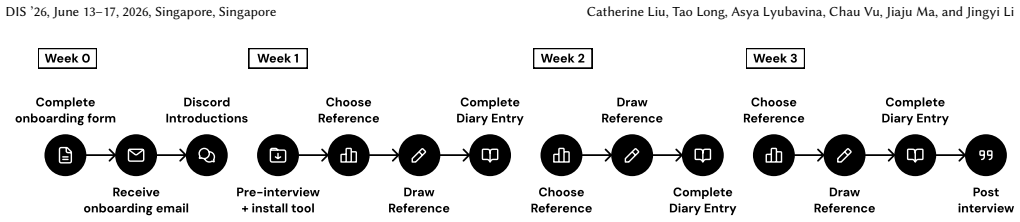
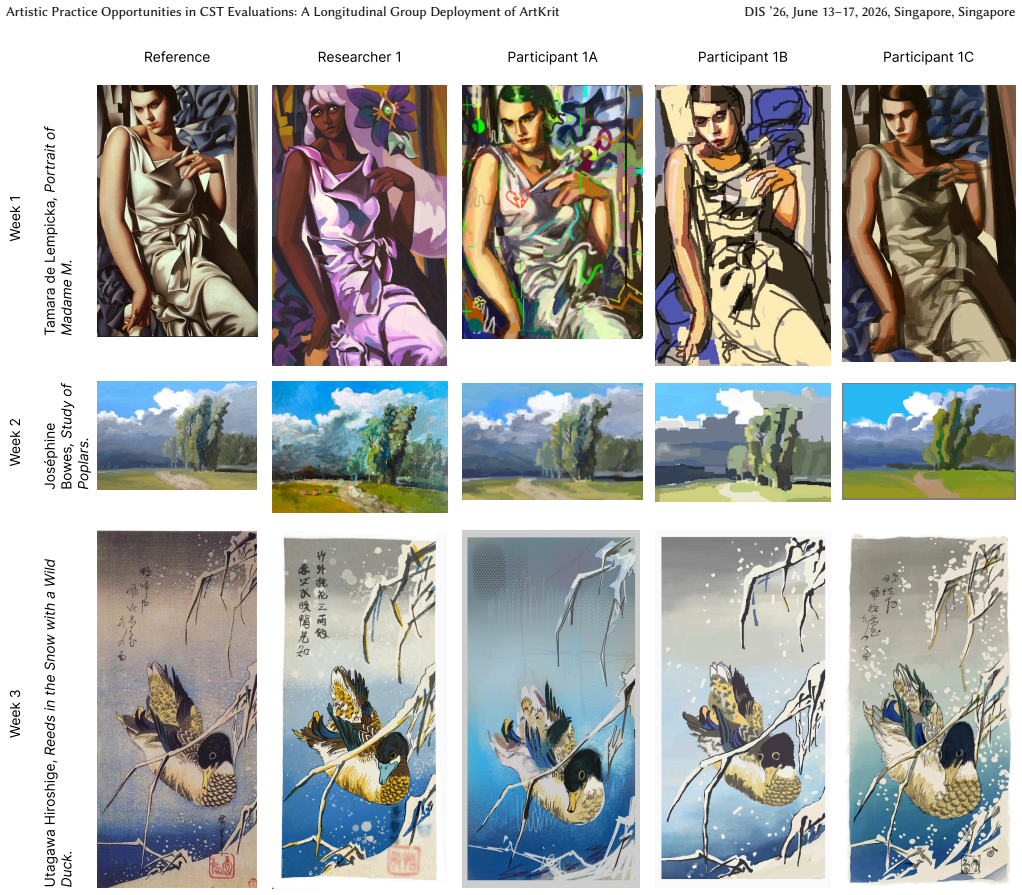
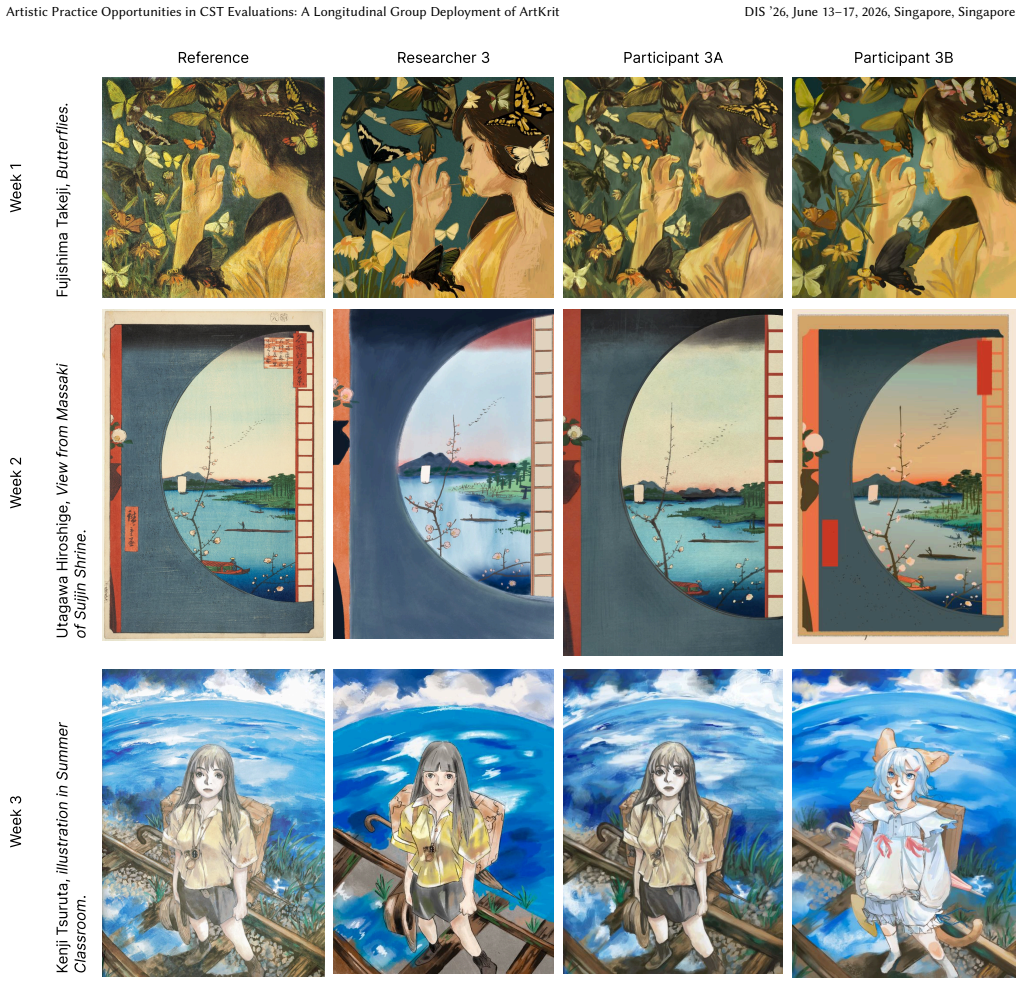
Creativity support tools (CSTs) aim to elevate the quality of artists' creative processes and artifacts. Yet most current CST evaluations overlook temporal and social aspects of tool use. To address this gap, we present a longitudinal, group-based CST evaluation through a three-week deployment of ArtKrit, a computational drawing tool that supports disciplined drawing. Nine digital artists, organized into three communities of practice, completed weekly "master studies" alongside a researcher-artist. Our results show users' evolving relationships with ArtKrit over time - from early experimentation to selective incorporation or misuse - alongside changes in their ways of artistic seeing. These changes unfolded within artist support networks that fostered confidence and creative safety, and validated individual expression. Overall, our findings suggest that CST evaluations can - and should - be designed as opportunities for meaningful artistic engagement rather than purely extractive measurement exercises. We contribute this longitudinal, group-based approach as one CST evaluation method.
Editorial analysis
A structured set of objections, weighed in public.
Referee Report
Summary. The manuscript reports on a three-week longitudinal, group-based deployment of the ArtKrit creativity support tool involving nine digital artists in three communities of practice. Through weekly master studies, it observes evolving relationships with the tool and shifts in artistic seeing within supportive networks, arguing that CST evaluations should prioritize meaningful artistic engagement over extractive measurement and contributing this approach as an evaluation method.
Significance. Should the interpretive findings prove robust, the work could meaningfully influence CST evaluation practices in HCI by promoting longitudinal and social dimensions, fostering deeper tool integration and creative safety. It provides a practical example that challenges conventional short-term, individual-focused assessments.
major comments (3)
- [Abstract and Study Description] The central claim that changes in tool relationships and artistic seeing are attributable to the longitudinal group structure rests on qualitative observations without reported details on data collection protocols, coding procedures, or inter-rater reliability. This methodological gap is load-bearing for the interpretive synthesis and the recommendation to redesign evaluations.
- [Results] No baseline measures or comparison arms (e.g., solo deployment or alternative CST) are described, leaving the observed evolutions consistent with alternative explanations such as individual differences, researcher presence, or ArtKrit-specific features.
- [Discussion] The leap to 'should' in redesigning CST evaluations requires stronger evidence isolating the group-based aspect; without it, the normative suggestion risks overgeneralization from the N=9 case study.
minor comments (1)
- [Abstract] The abstract could more explicitly state the number of participants and duration to provide immediate context for the claims.
Simulated Author's Rebuttal
We thank the referee for their thoughtful and constructive feedback, which has helped us strengthen the methodological transparency and framing of our qualitative case study. We address each major comment below and have revised the manuscript accordingly.
read point-by-point responses
-
Referee: [Abstract and Study Description] The central claim that changes in tool relationships and artistic seeing are attributable to the longitudinal group structure rests on qualitative observations without reported details on data collection protocols, coding procedures, or inter-rater reliability. This methodological gap is load-bearing for the interpretive synthesis and the recommendation to redesign evaluations.
Authors: We agree that greater detail on data collection and analysis is warranted. In the revised manuscript, we have expanded the Methods section with a new subsection detailing the protocols (weekly semi-structured interviews, session observation notes, and digital artifact collection), the reflexive thematic analysis process (following Braun and Clarke's six phases with an audit trail), and trustworthiness measures (participant member checking, reflexivity journal, and peer debriefing). As a single-researcher interpretive study, formal inter-rater reliability statistics were not used; we instead prioritized transparency and participant validation. These additions directly address the identified gap. revision: yes
-
Referee: [Results] No baseline measures or comparison arms (e.g., solo deployment or alternative CST) are described, leaving the observed evolutions consistent with alternative explanations such as individual differences, researcher presence, or ArtKrit-specific features.
Authors: Our study was designed as a naturalistic, longitudinal case study within existing artist communities rather than a controlled experiment. We have added explicit language in the Results and a new Limitations subsection in the Discussion acknowledging that observed changes cannot be isolated from factors such as individual differences, researcher presence, or tool-specific characteristics. We clarify that the work documents evolutions in this context without claiming sole attribution to the group structure. While we cannot add retrospective baselines or arms, this revision better situates the findings as interpretive rather than causal. revision: partial
-
Referee: [Discussion] The leap to 'should' in redesigning CST evaluations requires stronger evidence isolating the group-based aspect; without it, the normative suggestion risks overgeneralization from the N=9 case study.
Authors: We have revised the Discussion to moderate the normative language, presenting the longitudinal group-based approach as one valuable evaluation method illustrated by this case rather than a required redesign for all CST evaluations. The contribution is now framed more cautiously as an example that highlights artistic practice opportunities. We have also expanded the limitations discussion to note the small sample size and the difficulty of isolating group effects without comparative data, reducing the risk of overgeneralization while retaining the interpretive value of the findings. revision: yes
Circularity Check
No circularity: qualitative observations with no derivations or self-referential fits
full rationale
The paper reports results from a three-week group deployment study of ArtKrit with N=9 artists, describing observed changes in tool relationships and artistic seeing through user experiences and researcher notes. No equations, fitted parameters, predictions derived from subsets of data, or mathematical derivations appear in the provided text or abstract. Claims about redesigning CST evaluations rest on interpretive synthesis of reported data rather than any reduction to self-citation chains, ansatzes, or definitional equivalences. The central contribution is presented as an empirical method suggestion supported by the deployment outcomes, with no load-bearing steps that collapse back to the inputs by construction.
Axiom & Free-Parameter Ledger
axioms (1)
- domain assumption Qualitative self-reports and researcher observations accurately reflect genuine changes in artists' tool relationships and ways of seeing.
Reference graph
Works this paper leans on
-
[1]
Shm Garanganao Almeda, Joy O Kim, and Bjoern Hartmann. 2025. Creativity Supportive Ecosystems: A Framework for Understanding Function and Disrup- tion in Online Art Worlds. InProceedings of the 2025 CHI Conference on Human Factors in Computing Systems (CHI ’25). Association for Computing Machinery, New York, NY, USA, Article 267, 17 pages. doi:10.1145/370...
-
[2]
Aragon, S
C. Aragon, S. Poon, A. Monroy-Hernández, and Diana Aragon. 2009. A tale of two online communities: fostering collaboration and creativity in scientists and children. InCreativity & Cognition. http://dl.acm.org/citation.cfm?id=1640239
2009
-
[3]
2023.Art worlds: updated and expanded
Howard S Becker. 2023.Art worlds: updated and expanded. Univ of California Press
2023
-
[4]
2005.Domestication of media and technology
Thomas Berker, Maren Hartmann, and Yves Punie. 2005.Domestication of media and technology. McGraw-Hill Education (UK)
2005
-
[5]
Divyanshu Bhardwaj, Alexander Ponticello, Shreya Tomar, Adrian Dabrowski, and Katharina Krombholz. 2024. In Focus, Out of Privacy: The Wearer’s Per- spective on the Privacy Dilemma of Camera Glasses. InProceedings of the 2024 CHI Conference on Human Factors in Computing Systems(Honolulu, HI, USA) (CHI ’24). Association for Computing Machinery, New York, N...
-
[6]
Kathryn Blair, Miriam Sturdee, Lindsay MacDonald Vermeulen, and Lora Oehlberg. 2022. Art is Not Research. Research is not Art.. InExtended Abstracts of the 2022 CHI Conference on Human Factors in Computing Systems(New Orleans, LA, USA)(CHI EA ’22). Association for Computing Machinery, New York, NY, USA, Article 4, 9 pages. doi:10.1145/3491101.3516391
-
[7]
Jessica Blaynee, Dr David Kreps, Dr Maria Kutar, and Dr Marie Griffiths. 2016. Collaborative HCI and UX: longitudinal diary studies as a means of uncovering barriers to digital adoption. InProceedings of the 30th International BCS Human Computer Interaction Conference: Fusion!(Poole, United Kingdom)(HCI ’16). BCS Learning & Development Ltd., Swindon, GBR,...
2016
-
[8]
Susanne Bødker, Christian Dindler, Ole S Iversen, and Rachel C Smith. 2022. What is participatory design? InParticipatory design. Springer, 5–13
2022
-
[9]
Virginia Braun and Victoria Clarke. 2006. Using thematic analysis in psychology. Qualitative research in psychology3, 2 (2006), 77–101
2006
-
[10]
John Brooke. [n. d.]. SUS - A quick and dirty usability scale. ([n. d.])
-
[11]
Alex Calderwood, John Joon Young Chung, Yuqian Sun, Melissa Roemmele, and Max Kreminski. 2025. Phraselette: A Poet’s Procedural Palette. InProceedings of the 2025 ACM Designing Interactive Systems Conference (DIS ’25). Association for Computing Machinery, New York, NY, USA, 2701–2717. doi:10.1145/3715336. 3735832
-
[12]
Erin Cherry and Celine Latulipe. 2014. Quantifying the Creativity Support of Digital Tools through the Creativity Support Index.ACM Trans. Comput.-Hum. Interact.21, 4, Article 21 (June 2014), 25 pages. doi:10.1145/2617588
-
[13]
John Joon Young Chung, Shiqing He, and Eytan Adar. 2022. Artist Support Networks: Implications for Future Creativity Support Tools. InProceedings of the 2022 ACM Designing Interactive Systems Conference(Virtual Event, Australia) (DIS ’22). Association for Computing Machinery, New York, NY, USA, 232–246. doi:10.1145/3532106.3533505
-
[14]
Tim Coughlan and Peter Johnson. 2009. Understanding productive, structural and longitudinal interactions in the design of tools for creative activities. In Proceedings of the seventh ACM conference on Creativity and cognition. 155–164
2009
-
[15]
Audrey Desjardins and Aubree Ball. 2018. Revealing Tensions in Autobiographical Design in HCI. InProceedings of the 2018 Designing Interactive Systems Conference (Hong Kong, China)(DIS ’18). Association for Computing Machinery, New York, NY, USA, 753–764. doi:10.1145/3196709.3196781
-
[16]
Audrey Desjardins and Cayla Key. 2020. Parallels, Tangents, and Loops: Reflec- tions on the ’Through’ Part of RtD. InProceedings of the 2020 ACM Designing Interactive Systems Conference(Eindhoven, Netherlands)(DIS ’20). Association for Computing Machinery, New York, NY, USA, 2133–2147. doi:10.1145/3357236. 3395586
-
[17]
Alan Dix. 2007. Designing for appropriation. InProceedings of the 21st British HCI Group Annual Conference on People and Computers: HCI...but Not as We Know It - Volume 2(University of Lancaster, United Kingdom)(BCS-HCI ’07). BCS Learning & Development Ltd., Swindon, GBR, 27–30
2007
-
[18]
Emerson, Shreyosi Endow, and Cesar Torres
Adam G. Emerson, Shreyosi Endow, and Cesar Torres. 2024. Shared, Shaped, and Stolen: Tracing Sites of Knowledge Transfer across Creative Communities of Practice. InProceedings of the 16th Conference on Creativity & Cognition(Chicago, IL, USA)(C&C ’24). Association for Computing Machinery, New York, NY, USA, 638–650. doi:10.1145/3635636.3656199
-
[19]
Thomas Erickson and Wendy A. Kellogg. 2000. Social translucence: An ap- proach to designing systems that support social processes.ACM Transactions on Computer-Human Interaction7, 1 (2000), 59–83. doi:10.1145/344949.345004
-
[20]
Krita Foundation. 2025. Krita (Version 5.2.9). https://krita.org Released on January 29, 2025. Free and open-source digital painting software
2025
-
[21]
Jonas Frich, Lindsay MacDonald Vermeulen, Christian Remy, Michael Mose Biskjaer, and Peter Dalsgaard. 2019. Mapping the Landscape of Creativity Support Tools in HCI. InProceedings of the 2019 CHI Conference on Human Factors in Computing Systems. Association for Computing Machinery, Glasgow Scotland Uk, 1–18. doi:10.1145/3290605.3300619
-
[22]
Bill Gaver, Tony Dunne, and Elena Pacenti. 1999. Design: Cultural probes.Inter- actions6, 1 (Jan. 1999), 21–29. doi:10.1145/291224.291235
-
[23]
William Gaver. 2012. What should we expect from research through design?. In Proceedings of the SIGCHI Conference on Human Factors in Computing Systems (Austin, Texas, USA)(CHI ’12). Association for Computing Machinery, New York, NY, USA, 937–946. doi:10.1145/2207676.2208538
-
[24]
Saul Greenberg and Bill Buxton. 2008. Usability evaluation considered harmful (some of the time). InProceedings of the SIGCHI Conference on Human Factors in Computing Systems(Florence, Italy)(CHI ’08). Association for Computing Machinery, New York, NY, USA, 111–120. doi:10.1145/1357054.1357074
-
[25]
Sandra G Hart and Lowell E Staveland. 1988. Development of NASA-TLX (Task Load Index): Results of empirical and theoretical research. InAdvances in psy- chology. Vol. 52. Elsevier, 139–183
1988
-
[26]
A. Hertzmann. 2023. The Curse of Performative User Studies.IEEE Computer Graphics and Applications43, 06 (nov 2023), 112–116. doi:10.1109/MCG.2023. 3315759
-
[27]
Tom Hewett, Mary Czerwinski, Michael Terry, Jay Nunamaker, Linda Candy, Bill Kules, and Elisabeth Sylvan. 2005. Creativity support tool evaluation methods and metrics.Creativity Support Tools(2005), 10–24
2005
-
[28]
Hilary Hutchinson, Wendy Mackay, Bo Westerlund, Benjamin B. Bederson, Al- lison Druin, Catherine Plaisant, Michel Beaudouin-Lafon, Stéphane Conversy, Helen Evans, Heiko Hansen, Nicolas Roussel, and Björn Eiderbäck. 2003. Technol- ogy probes: inspiring design for and with families. InProceedings of the SIGCHI Conference on Human Factors in Computing System...
-
[29]
Jennifer Jacobs, Sumit Gogia, Radomír Mundefinedch, and Joel R. Brandt. 2017. Supporting Expressive Procedural Art Creation through Direct Manipulation. In Proceedings of the 2017 CHI Conference on Human Factors in Computing Systems (Denver, Colorado, USA)(CHI ’17). Association for Computing Machinery, New York, NY, USA, 6330–6341. doi:10.1145/3025453.3025927
-
[30]
Mohit Jain and Ravin Balakrishnan. 2012. User learning and performance with bezel menus. InProceedings of the SIGCHI Conference on Human Factors in Com- puting Systems. 2221–2230
2012
-
[31]
Jun Kato, Kenta Hara, and Nao Hirasawa. 2024. Griffith: A Storyboarding Tool Designed with Japanese Animation Professionals. InProceedings of the 2024 CHI Conference on Human Factors in Computing Systems(Honolulu, HI, USA)(CHI ’24). Association for Computing Machinery, New York, NY, USA, Article 233, 14 pages. doi:10.1145/3613904.3642121
-
[32]
Joy Kim, Maneesh Agrawala, and Michael S. Bernstein. 2017. Mosaic: Designing Online Creative Communities for Sharing Works-in-Progress. InProceedings of the 2017 ACM Conference on Computer Supported Cooperative Work and Social Computing(Portland, Oregon, USA)(CSCW ’17). Association for Computing Machinery, New York, NY, USA, 246–258. doi:10.1145/2998181.2998195
-
[33]
Obada Kraishan. 2025. The AI Attribution Paradox: Transparency as Social Strategy in Open-Source Software Development. doi:10.48550/arXiv.2512.00867 arXiv:2512.00867 [cs]
-
[34]
Max Kreminski and Michael Mateas. 2021. Reflective Creators. InProceedings of the 2021 International Conference on Computational Creativity. International Conference on Computational Creativity, Online, 309–318. https://mkremins. github.io/publications/ReflectiveCreators_ICCC2021.pdf
2021
-
[35]
Min Kyung Lee, Jodi Forlizzi, Sara Kiesler, Paul Rybski, John Antanitis, and Sarun Savetsila. 2012. Personalization in HRI: a longitudinal field experiment. InProceed- ings of the Seventh Annual ACM/IEEE International Conference on Human-Robot Interaction(Boston, Massachusetts, USA)(HRI ’12). Association for Computing Machinery, New York, NY, USA, 319–326...
-
[36]
Isabel Li, Ace Chen, Eric Rawn, Shm Garanganao Almeda, Bjoern Hartmann, and Jingyi. Li. 2025. Reimagining Misuse as Creative Practice: Impressions and Implications of Usage Norms on Digital Artists. InProceedings of the SIGCHI Conference on Human Factors in Computing Systems(Yokohama, Japan)(CHI ’25). Association for Computing Machinery, New York, NY, USA...
-
[37]
Jingyi Li, Eric Rawn, Jacob Ritchie, Jasper Tran O’Leary, and Sean Follmer. 2023. Beyond the Artifact: Power as a Lens for Creativity Support Tools. InProceedings of the 36th Annual ACM Symposium on User Interface Software and Technology (San Francisco, CA, USA)(UIST ’23). Association for Computing Machinery, New York, NY, USA, Article 47, 15 pages. doi:1...
-
[38]
Tao Long, Katy Ilonka Gero, and Lydia B Chilton. 2024. Not Just Novelty: A Lon- gitudinal Study on Utility and Customization of an AI Workflow. InProceedings of the 2024 ACM Designing Interactive Systems Conference(Copenhagen, Denmark) (DIS ’24). Association for Computing Machinery, New York, NY, USA, 782–803. doi:10.1145/3643834.3661587
-
[39]
Tao Long, Sitong Wang, Émilie Fabre, Tony Wang, Anup Sathya, Jason Wu, Savvas Dimitrios Petridis, Ding Li, Tuhin Chakrabarty, Yue Jiang, Jingyi Li, Tiffany Tseng, Ken Nakagaki, Qian Yang, Nikolas Martelaro, Jeffrey V Nickerson, and Lydia B Chilton. 2025. Facilitating Longitudinal Interaction Studies of AI Systems. InAdjunct Proceedings of the 38th Annual ...
-
[40]
Tao Long, Dorothy Zhang, Grace Li, Batool Taraif, Samia Menon, Kynnedy Si- mone Smith, Sitong Wang, Katy Ilonka Gero, and Lydia B. Chilton. 2023. Tweetorial Hooks: Generative AI Tools to Motivate Science on Social Media. doi:10.48550/arXiv.2305.12265 arXiv:2305.12265 [cs]
-
[41]
Jiaju Ma, Chau Vu, Asya Lyubavina, Catherine Liu, and Jingyi Li. 2025. Compu- tational Scaffolding of Composition, Value, and Color for Disciplined Drawing. InProceedings of the 38th Annual ACM Symposium on User Interface Software and Technology (UIST ’25). Association for Computing Machinery, New York, NY, USA, Article 161, 15 pages. doi:10.1145/3746059.3747605
-
[42]
Wendy E. Mackay and Joanna McGrenere. 2025. Comparative Structured Obser- vation.ACM Trans. Comput.-Hum. Interact.32, 2, Article 14 (April 2025), 27 pages. doi:10.1145/3711838
-
[43]
Thomas P Moran. 2002. Everyday adaptive design. InProceedings of the 4th confer- ence on Designing interactive systems: processes, practices, methods, and techniques (London England, 2002-06-25). ACM, 13–14. doi:10.1145/778712.778715
-
[44]
Michael Muller, Katja Neureiter, Nervo Verdezoto, Alina Krischkowsky, Anna Maria Al Zubaidi-Polli, and Manfred Tscheligi. 2016. Collaborative Appro- priation: How Couples, Teams, Groups and Communities Adapt and Adopt Technologies. InProceedings of the 19th ACM Conference on Computer Sup- ported Cooperative Work and Social Computing Companion (CSCW ’16 Co...
-
[45]
Peter Axel Nielsen. 2021. Longitudinal Studies in Information Systems. In Advances in Longitudinal HCI Research, Evangelos Karapanos, Jens Gerken, Jesper Kjeldskov, and Mikael B. Skov (Eds.). Springer International Publishing, 41–56. doi:10.1007/978-3-030-67322-2_3
-
[46]
Doenja Oogjes and Audrey Desjardins. 2024. A temporal vocabulary of Design Events for Research through Design. InProceedings of the 2024 CHI Conference on Artistic Practice Opportunities in CST Evaluations: A Longitudinal Group Deployment of ArtKrit DIS ’26, June 13–17, 2026, Singapore, Singapore Human Factors in Computing Systems(Honolulu, HI, USA)(CHI ’...
-
[47]
Christian Remy, Lindsay MacDonald Vermeulen, Jonas Frich, Michael Mose Biskjaer, and Peter Dalsgaard. 2020. Evaluating Creativity Support Tools in HCI Research. InProceedings of the 2020 ACM Designing Interactive Systems Conference (Eindhoven, Netherlands)(DIS ’20). Association for Computing Machinery, New York, NY, USA, 457–476. doi:10.1145/3357236.3395474
-
[48]
Mitchel Resnick and Brian Silverman. 2005. Some reflections on designing construction kits for kids. InProceedings of the 2005 Conference on Interaction Design and Children(Boulder, Colorado)(IDC ’05). Association for Computing Machinery, New York, NY, USA, 117–122. doi:10.1145/1109540.1109556
-
[49]
Samuel Rhys Cox, Helena Bøjer Djernæs, and Niels van Berkel. 2025. Beyond Productivity: Rethinking the Impact of Creativity Support Tools. InProceedings of the 2025 Conference on Creativity and Cognition (’25). Association for Computing Machinery, New York, NY, USA, 735–749. doi:10.1145/3698061.3726924
-
[50]
Raquel B Robinson, Anya Osborne, Chen Ji, James Collin Fey, Ella Dagan, and Katherine Isbister. 2024. "That’s Not Good Science!": An Argument for the Thoughtful Use of Formative Situations in Research Through Design. InExtended Abstracts of the CHI Conference on Human Factors in Computing Systems(Hon- olulu, HI, USA)(CHI EA ’24). Association for Computing...
-
[51]
Soheil Sadeghi, Somit Gupta, Stefan Gramatovici, Jiannan Lu, Hao Ai, and Ruhan Zhang. 2022. Novelty and Primacy: A Long-Term Estimator for Online Experi- ments.Technometrics64, 4 (2022), 524–534. doi:10.1080/00401706.2022.2124309 arXiv:https://doi.org/10.1080/00401706.2022.2124309
-
[52]
Christine Satchell and Paul Dourish. 2009. Beyond the user: use and non-use in HCI. InProceedings of the 21st Annual Conference of the Australian Computer- Human Interaction Special Interest Group: Design: Open 24/7(Melbourne, Australia) (OZCHI ’09). Association for Computing Machinery, New York, NY, USA, 9–16. doi:10.1145/1738826.1738829
-
[53]
Grace Shin, Yuanyuan Feng, Mohammad Hossein Jarrahi, and Nicci Gafinowitz
-
[54]
Beyond novelty effect: a mixed-methods exploration into the motiva- tion for long-term activity tracker use.JAMIA Open2, 1 (2018), 62–72. doi:10. 1093/jamiaopen/ooy048 _eprint: https://academic.oup.com/jamiaopen/article- pdf/2/1/62/32298485/ooy048.pdf
2018
-
[55]
Ben Shneiderman. 2000. Creating creativity: user interfaces for supporting innovation.ACM Trans. Comput.-Hum. Interact.7, 1 (March 2000), 114–138. doi:10.1145/344949.345077
-
[56]
Adam J Sporka, Torsten Felzer, Sri H Kurniawan, Ondřej Poláček, Paul Haiduk, and I Scott MacKenzie. 2011. Chanti: Predictive text entry using non-verbal vocal input. InProceedings of the SIGCHI Conference on Human Factors in Computing Systems. 2463–2472
2011
-
[57]
Fiona Ssozi-Mugarura, Thomas Reitmaier, Anja Venter, and Edwin Blake. 2016. Enough with ’In-The-Wild’. InProceedings of the First African Conference on Human Computer Interaction(Nairobi, Kenya)(AfriCHI ’16). Association for Com- puting Machinery, New York, NY, USA, 182–186. doi:10.1145/2998581.2998601
-
[58]
Martin Tricaud and Michel Beaudouin-Lafon. 2023. Revisiting Creative Behaviour as an Epistemic Process: Lessons from 12 Computational Artists and Designers. InProceedings of the 35th Australian Computer -Human Interaction Conference (OzCHI ’23). Association for Computing Machinery, New York, NY, USA, 175–190. doi:10.1145/3638380.3638395
-
[59]
1998.Communities of Practice: Learning, Meaning, and Identity
Etienne Wenger. 1998.Communities of Practice: Learning, Meaning, and Identity. Cambridge University Press, Cambridge, UK
1998
-
[60]
Haoqi Zhang. 2024. Searching for the Non-Consequential: Dialectical Activities in HCI and the Limits of Computers. InProceedings of the 2024 CHI Conference on Human Factors in Computing Systems. Association for Computing Machinery, New York, NY, USA, 1–13. doi:10.1145/3613904.3641945
discussion (0)
Sign in with ORCID, Apple, or X to comment. Anyone can read and Pith papers without signing in.