Recognition: unknown
Degree-dependent and distance-dependent contact rates interpolate between explosive, exponential and polynomial epidemic growth
Pith reviewed 2026-05-07 08:47 UTC · model grok-4.3
The pith
Degree and distance dependent contact rates can shift epidemic growth from explosive to polynomial on the same network.
A machine-rendered reading of the paper's core claim, the machinery that carries it, and where it could break.
Core claim
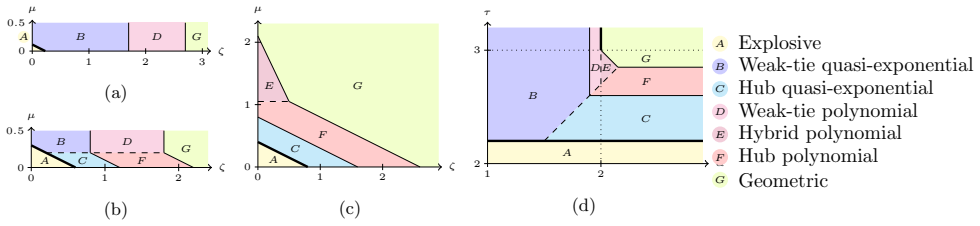
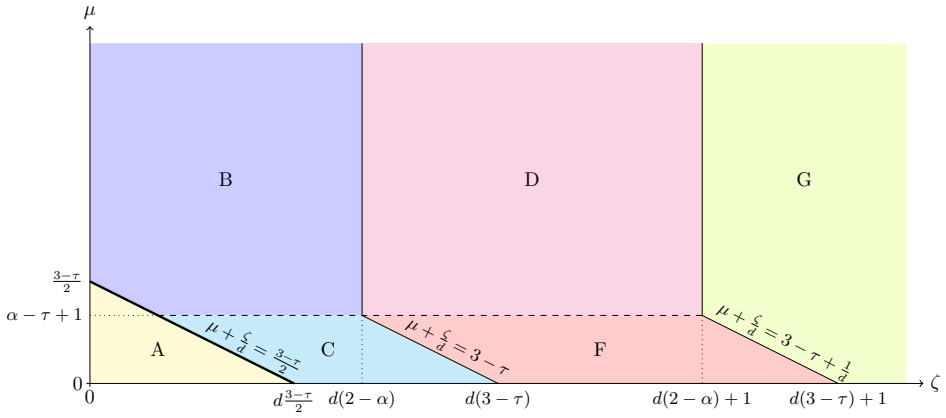
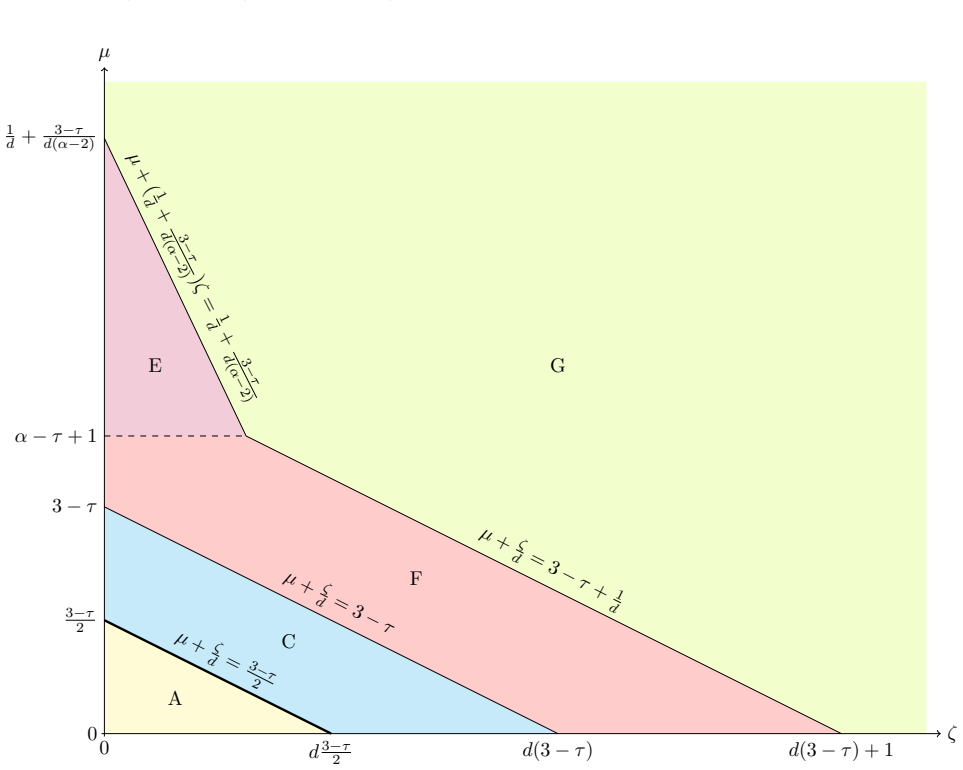
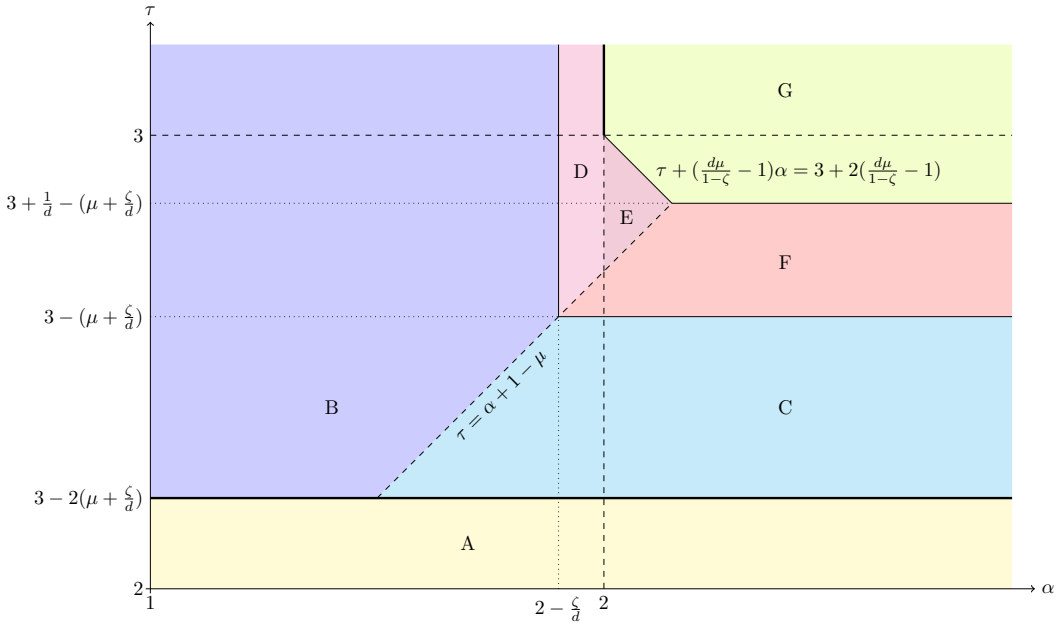
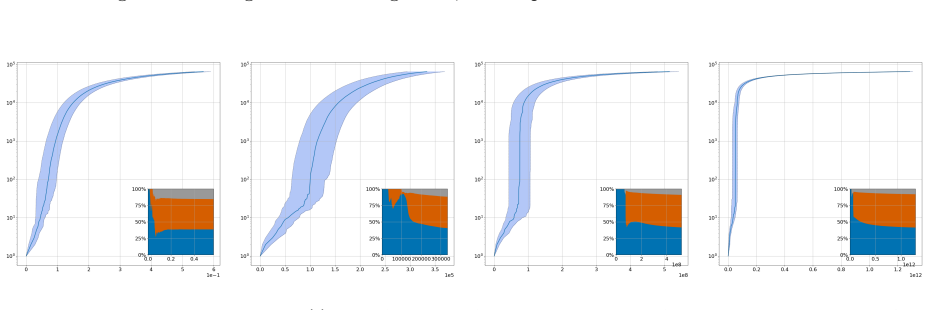
In a network model with geometry, transmission rates that depend on degree and distance allow the spreading process to interpolate between explosive, exponential, and polynomial growth phases. The growth rate is controlled by the combination of the network geometry, the prevalence of weak long-range ties, and the presence of superspreaders. This is demonstrated through data-driven simulations and proven rigorously using a spatial multiscale argument in long-range heterogeneous first passage percolation.
What carries the argument
Degree-dependent and distance-dependent contact rates within a spatial network model.
If this is right
- Consecutive waves of the same pandemic can exhibit different growth rates even when the basic spreading rules stay similar.
- The overall speed of spread depends on geometry, weak ties, and superspreaders together.
- Models that ignore these rate dependencies will overestimate growth in geometrically structured networks.
- Small changes in how contacts scale with distance or degree can produce large shifts in epidemic curves.
Where Pith is reading between the lines
- Interventions that reduce long-distance contacts or limit interactions with high-degree individuals could be directly incorporated into growth forecasts using this model.
- The same dependencies might explain varying spread speeds in non-disease contexts like the diffusion of information across social networks with spatial structure.
- Further work could test how sensitive the growth type is to the exact functional form of the degree and distance dependencies.
Load-bearing premise
Real contact networks have an underlying geometry where distance between individuals affects transmission rates in a sublinear way.
What would settle it
Simulations on geometric networks where removing the degree and distance dependencies does not change the observed growth rates from polynomial or subexponential back to exponential.
Figures





read the original abstract
It is a fundamental question in epidemiology to estimate, model and predict the growth rate of a pandemic. Analogously, analysing the diffusion of innovation, (fake) news, memes, and rumours is of key importance in the social sciences. The resulting epidemic growth curves can be classified according to their growth rates. These have been found to range from exponential to both faster super-exponential curves and slower subexponential or polynomial curves. Previous research has lacked a unified explanatory framework capable of accommodating super-exponential, (stretched) exponential, and polynomial growth patterns within the same contact network. In this paper we propose a simple agent-based network model that can capture all these phases. We provide such a framework by modelling how transmission rates depend on spatial distance and on individuals' numbers of contacts. By comparing the growth rate of spreading processes with or without degree-dependent and/or distance-dependent contact rates through data-driven and synthetic simulations on real and modelled networks with underlying geometry, we find evidence that even a 'sublinear presence' of these causes may cause a significant slow down of the growth rate on the same underlying network. We find that the growth rate is governed by a combination of three factors: geometry, the prevalence of weak ties, and superspreaders. We confirm our results with rigorous proofs in a theoretical model, using a spatial multiscale-argument in long-range heterogeneous first passage percolation. Our results give a plausible explanation of why the consecutive waves of a single pandemic can differ in their growth even if their spreading mechanisms are similar.
Editorial analysis
A structured set of objections, weighed in public.
Referee Report
Summary. The manuscript proposes an agent-based network epidemic model in which transmission rates depend on node degree and spatial distance. By comparing spreading processes on fixed geometric networks with and without these dependencies, the authors claim that even sublinear forms of degree- and distance-dependence can produce a transition from explosive/super-exponential to exponential to polynomial growth. The claim is supported by data-driven and synthetic simulations on real and modeled networks together with rigorous proofs that employ a spatial multiscale argument in long-range heterogeneous first-passage percolation. The growth rate is attributed to the interplay of geometry, weak ties, and superspreaders, offering an explanation for differing growth rates across consecutive waves of the same pandemic.
Significance. If the central claims hold, the work supplies a unified, network-intrinsic mechanism for the full spectrum of observed epidemic growth regimes without altering the underlying contact structure. The controlled simulation design (fixed network, varying only the functional form of the rates) and the percolation-theoretic confirmation are notable strengths. The results could inform both epidemiological forecasting and the modeling of information diffusion, provided the geometric embedding and sublinear functional forms are shown to be robust.
major comments (2)
- [§3] §3 (Simulation results): The quantitative evidence for a 'significant slow down' relies on comparing growth curves with and without degree/distance dependence, but the manuscript does not report the precise functional forms (e.g., power-law exponents) or the range of strength parameters used; without these, it is unclear whether the slowdown is generic or tied to specific post-hoc choices.
- [§4] §4 (Theoretical analysis): The spatial multiscale argument in long-range heterogeneous first-passage percolation is invoked to confirm the simulation findings, yet the proof sketch does not explicitly derive how the distance-dependent rate modifies the passage-time distribution across scales; a concrete bound linking the sublinear exponent to the resulting growth regime is needed to make the interpolation claim rigorous.
minor comments (3)
- [Abstract] Abstract: The phrase 'sublinear presence' is introduced without definition; it should be clarified in the model section with the exact functional dependence (e.g., rate ~ d^α with α<1).
- [Figures] Figure captions (throughout): Several growth-curve panels lack error bands or indication of the number of independent realizations; adding these would improve reproducibility.
- [§2] §2 (Model): The embedding procedure used to assign distances on real networks is only sketched; a short paragraph detailing the geometric embedding algorithm and its sensitivity would help readers assess the distance-dependent component.
Simulated Author's Rebuttal
We thank the referee for their positive assessment of the manuscript and for the constructive comments, which have helped us strengthen the presentation. We address each major comment point by point below.
read point-by-point responses
-
Referee: [§3] §3 (Simulation results): The quantitative evidence for a 'significant slow down' relies on comparing growth curves with and without degree/distance dependence, but the manuscript does not report the precise functional forms (e.g., power-law exponents) or the range of strength parameters used; without these, it is unclear whether the slowdown is generic or tied to specific post-hoc choices.
Authors: We agree that the precise functional forms and parameter ranges must be reported explicitly to demonstrate that the slowdown is generic rather than dependent on particular choices. In the revised manuscript we have expanded Section 3 to state the exact functional forms (sublinear power-law dependence on degree and on distance), the specific exponents employed in the primary simulations, and the full ranges of strength parameters over which the transition in growth regimes was tested. We have also added supplementary figures confirming robustness across these ranges. revision: yes
-
Referee: [§4] §4 (Theoretical analysis): The spatial multiscale argument in long-range heterogeneous first-passage percolation is invoked to confirm the simulation findings, yet the proof sketch does not explicitly derive how the distance-dependent rate modifies the passage-time distribution across scales; a concrete bound linking the sublinear exponent to the resulting growth regime is needed to make the interpolation claim rigorous.
Authors: The referee is right that the main-text presentation is a sketch. The complete multiscale argument, including the explicit modification of the passage-time distribution by the distance-dependent rate and the concrete bounds that relate the sublinear exponent to the resulting growth regime, appears in the supplementary appendix. In the revision we have inserted a more detailed outline of these steps into Section 4, thereby making the link between the sublinear form and the interpolated growth regimes explicit in the main text. revision: yes
Circularity Check
No significant circularity; derivation relies on independent simulations and percolation proofs
full rationale
The paper introduces an agent-based model with degree- and distance-dependent transmission rates, then validates growth-rate interpolation via controlled simulations on fixed networks (varying only the rate functions) and confirms via rigorous multiscale arguments in long-range heterogeneous first-passage percolation. No equation reduces to a fitted parameter by construction, no prediction is statistically forced from the same data subset, and no load-bearing premise rests on self-citation chains or imported uniqueness theorems. The geometry assumption is scoped explicitly to the studied networks and does not smuggle ansatzes; the central claim therefore remains self-contained against external benchmarks.
Axiom & Free-Parameter Ledger
free parameters (2)
- degree-dependence strength parameter
- distance-dependence strength parameter
axioms (2)
- domain assumption Contact networks possess an underlying geometric structure that permits meaningful distance-dependent rates.
- domain assumption Transmission rates can be expressed as functions of degree and distance.
Reference graph
Works this paper leans on
-
[1]
https://github.com/mapado/haversine, 2013
Haversine. https://github.com/mapado/haversine, 2013
2013
-
[2]
Weighted distances in scale-free configuration models.Journal of Statistical Physics, 173:1082–1109, 2018
Erwin Adriaans and J´ ulia Komj´ athy. Weighted distances in scale-free configuration models.Journal of Statistical Physics, 173:1082–1109, 2018
2018
-
[3]
On the chemical distance for supercritical Bernoulli percolation
Peter Antal and Agoston Pisztora. On the chemical distance for supercritical Bernoulli percolation. The Annals of Probability, 24(2):1036–1048, 1996. 14
1996
-
[4]
Springer Science & Business Media, 2012
Krishna B Athreya and Peter Jagers.Classical and modern branching processes, volume 84. Springer Science & Business Media, 2012
2012
-
[5]
Springer, 1972
Krishna B Athreya, Peter E Ney, and PE Ney.Branching processes. Springer, 1972
1972
-
[6]
American Mathematical Soc., 2017
Antonio Auffinger, Michael Damron, and Jack Hanson.50 years of first-passage percolation, volume 68. American Mathematical Soc., 2017
2017
-
[7]
Hyper-exponential growth of covid-19 during resurgence of the disease in russia, 2020
Hemanta K Baruah. Hyper-exponential growth of covid-19 during resurgence of the disease in russia, 2020
2020
-
[8]
How viral are viral videos? InProceedings of the International AAAI Conference on Web and Social Media, volume 9, pages 22–30, 2015
Christian Bauckhage, Fabian Hadiji, and Kristian Kersting. How viral are viral videos? InProceedings of the International AAAI Conference on Web and Social Media, volume 9, pages 22–30, 2015
2015
-
[9]
Degree dependent transmission rates in epidemic processes.Journal of Statistical Mechanics: Theory and Experiment, 2021(10):103501, 2021
GJ Baxter and G Tim´ ar. Degree dependent transmission rates in epidemic processes.Journal of Statistical Mechanics: Theory and Experiment, 2021(10):103501, 2021
2021
-
[10]
Degree- dependent and distance-dependent contact rates interpolate between explosive, exponential and poly- nomial epidemic growth
Zylan Benjert, J´ ulia Komj´ athy, John Lapinskas, Johannes Lengler, and Ulysse Schaller. Degree- dependent and distance-dependent contact rates interpolate between explosive, exponential and poly- nomial epidemic growth. preprint, 2025
2025
-
[11]
The diameter of (threshold) geometric inhomogeneous random graphs, 2025
Zylan Benjert, Kostas Lakis, Johannes Lengler, and Raghu Raman Ravi. The diameter of (threshold) geometric inhomogeneous random graphs, 2025
2025
-
[12]
A lower bound for the chemical distance in sparse long-range percolation models, 2004
Noam Berger. A lower bound for the chemical distance in sparse long-range percolation models, 2004
2004
-
[13]
R´ eflexions sur les avantages de l’inoculation,” mercure de france (1760) 173–190
D Bernoulli. R´ eflexions sur les avantages de l’inoculation,” mercure de france (1760) 173–190. en- glish translation by r. pulskamp, department of mathematics and computer science, xavier university, cincinnati (2009), 1760
2009
-
[14]
Universality for first passage percolation on sparse random graphs.The Annals of Probability, 45(4):2568–2630, 2017
S Bhamidi, RW van der Hofstad, and G Hooghiemstra. Universality for first passage percolation on sparse random graphs.The Annals of Probability, 45(4):2568–2630, 2017
2017
-
[15]
Large degrees in scale-free inhomogeneous random graphs.The annals of applied probability, 32(1):696–720, 2022
Chinmoy Bhattacharjee and Matthias Schulte. Large degrees in scale-free inhomogeneous random graphs.The annals of applied probability, 32(1):696–720, 2022
2022
-
[16]
On the scaling of the chemical distance in long-range percolation models.Annals of Probability, 32(4):2938–2977, 2004
Marek Biskup et al. On the scaling of the chemical distance in long-range percolation models.Annals of Probability, 32(4):2938–2977, 2004
2004
-
[17]
Characteristic times of biased random walks on complex networks.Physical Review E, 89(1):012803, 2014
Moreno Bonaventura, Vincenzo Nicosia, and Vito Latora. Characteristic times of biased random walks on complex networks.Physical Review E, 89(1):012803, 2014
2014
-
[18]
Compartmental models in epidemiology.Mathematical epidemiology, 1945:19–79, 2008
Fred Brauer. Compartmental models in epidemiology.Mathematical epidemiology, 1945:19–79, 2008
1945
-
[19]
Sampling geometric inhomogeneous random graphs in linear time
Karl Bringmann, Ralph Keusch, and Johannes Lengler. Sampling geometric inhomogeneous random graphs in linear time. In25th Annual European Symposium on Algorithms (ESA 2017), volume 87, page 20. Schloss Dagstuhl-Leibniz-Zentrum f¨ ur Informatik, 2017
2017
-
[21]
Geometric inhomogeneous random graphs
Karl Bringmann, Ralph Keusch, and Johannes Lengler. Geometric inhomogeneous random graphs. Theoretical Computer Science, 760:35–54, 2019
2019
-
[22]
Average distance in a general class of scale-free networks.Advances in Applied Probability, 57(2):371–406, 2025
Karl Bringmann, Ralph Keusch, and Johannes Lengler. Average distance in a general class of scale-free networks.Advances in Applied Probability, 57(2):371–406, 2025
2025
-
[23]
Aerial dispersal of pathogens on the global and continental scales and its impact on plant disease.Science, 297(5581):537–541, 2002
James KM Brown and Mogens S Hovmøller. Aerial dispersal of pathogens on the global and continental scales and its impact on plant disease.Science, 297(5581):537–541, 2002
2002
-
[24]
Shirshendu Chatterjee and Partha S. Dey. Multiple phase transitions in long-range first-passage per- colation on square lattices.Communications on Pure and Applied Mathematics, 69(2):203–256, 2016. 15
2016
-
[25]
Contact processes on random graphs with power law degree distributions have critical value 0.The Annals of Probability, 37(6):2332, 2009
Shirshendu Chatterjee and Rick Durrett. Contact processes on random graphs with power law degree distributions have critical value 0.The Annals of Probability, 37(6):2332, 2009
2009
-
[26]
Mathematical models to char- acterize early epidemic growth: A review.Physics of Life Reviews, 18:66–97, 2016
Gerardo Chowell, Shweta Bansal, Lisa Sattenspiel, and C´ ecile Viboud. Mathematical models to char- acterize early epidemic growth: A review.Physics of Life Reviews, 18:66–97, 2016
2016
-
[27]
The western africa ebola virus disease epidemic exhibits both global exponential and local polynomial growth rates.PLoS currents, 7, 2015
Gerardo Chowell, C´ ecile Viboud, James M Hyman, and Lone Simonsen. The western africa ebola virus disease epidemic exhibits both global exponential and local polynomial growth rates.PLoS currents, 7, 2015
2015
-
[28]
Jeffrey A. Clark. Pillow: Python imaging library (fork). https://github.com/python-pillow/Pillow, 2015
2015
-
[29]
Limiting shape for first-passage percolation models on random geometric graphs.Journal of Applied Probability, 60(4):1367–1385, 2023
Cristian F Coletti, Lucas R De Lima, Alexander Hinsen, Benedikt Jahnel, and Daniel Valesin. Limiting shape for first-passage percolation models on random geometric graphs.Journal of Applied Probability, 60(4):1367–1385, 2023
2023
-
[30]
The diameter of a long-range percolation graph.Random Structures & Algorithms, 21(1):1–13, 2002
Don Coppersmith, David Gamarnik, and Maxim Sviridenko. The diameter of a long-range percolation graph.Random Structures & Algorithms, 21(1):1–13, 2002
2002
-
[31]
Some limit theorems for percolation processes with necessary and sufficient conditions.The Annals of Probability, 9(4):583–603, 1981
J Theodore Cox and Richard Durrett. Some limit theorems for percolation processes with necessary and sufficient conditions.The Annals of Probability, 9(4):583–603, 1981
1981
-
[32]
A Cuenca, AE Escalante, and D Pinero. Long-distance colonization, isolation by distance, and historical demography in a relictual mexican pinyon pine (pinus nelsonii shaw) as revealed by paternally inherited genetic markers (cpssrs).Molecular Ecology, 12(8):2087–2097, 2003
2087
-
[33]
Scale-free percolation
Maria Deijfen, Remco van der Hofstad, and Gerard Hooghiemstra. Scale-free percolation. InAnnales de l’IHP Probabilit´ es et statistiques, volume 49,3, pages 817–838, 2013
2013
-
[34]
Inhomogeneous long-range percolation for real-life network modeling.Risks, 3(1):1–23, 2015
Philippe Deprez, Rajat Subhra Hazra, and Mario V W¨ uthrich. Inhomogeneous long-range percolation for real-life network modeling.Risks, 3(1):1–23, 2015
2015
-
[35]
Surface order large deviations for high-density per- colation.Probability Theory and Related Fields, 104(4):467–482, 1996
Jean-Dominique Deuschel and Agoston Pisztora. Surface order large deviations for high-density per- colation.Probability Theory and Related Fields, 104(4):467–482, 1996
1996
-
[36]
Centrality ranking in multiplex networks using topologically biased random walks.Neurocomputing, 312:263–275, 2018
Cangfeng Ding and Kan Li. Centrality ranking in multiplex networks using topologically biased random walks.Neurocomputing, 312:263–275, 2018
2018
-
[37]
Strong and weak ties
David Easley and Jon Kleinberg. Strong and weak ties. InNetworks, crowds, and markets: Reasoning about a highly connected world, pages 47–84. Cambridge University Press Cambridge, UK, 2010
2010
-
[38]
On closure and factorization properties of subexponential and related distributions.Journal of the Australian Mathematical Society, 29(2):243–256, 1980
Paul Embrechts and Charles M Goldie. On closure and factorization properties of subexponential and related distributions.Journal of the Australian Mathematical Society, 29(2):243–256, 1980
1980
-
[39]
Erd˝ os, Catherine Greenhill, Tam´ as R´ obert Mezei, Istv´ an Mikl´ os, D´ aniel Solt´ esz, and La- jos Soukup
P´ eter L. Erd˝ os, Catherine Greenhill, Tam´ as R´ obert Mezei, Istv´ an Mikl´ os, D´ aniel Solt´ esz, and La- jos Soukup. The mixing time of switch markov chains: A unified approach.European Journal of Combinatorics, 99:103421, 2022
2022
-
[40]
High degree vertices and spread of infections in spatially modelled social networks
Joshua Feldman and Jeannette Janssen. High degree vertices and spread of infections in spatially modelled social networks. InInternational Workshop on Algorithms and Models for the Web-Graph, pages 60–74. Springer, 2017
2017
-
[41]
Effects of dispersal mechanisms on spatio-temporal development of epi- demics.Journal of theoretical biology, 226(2):125–141, 2004
JAN Filipe and MM Maule. Effects of dispersal mechanisms on spatio-temporal development of epi- demics.Journal of theoretical biology, 226(2):125–141, 2004
2004
-
[42]
Requests
Python Software Foundation. Requests. https://github.com/psf/requests, 2011
2011
-
[43]
PhD thesis, Department of Mathematics, Stockholm University, 2023
Carolina Fransson.Stochastic epidemics on random networks and competition in growth. PhD thesis, Department of Mathematics, Stockholm University, 2023. 16
2023
-
[44]
The dual effect of social ties on covid-19 spread in japan
Timothy Fraser and Daniel P Aldrich. The dual effect of social ties on covid-19 spread in japan. Scientific reports, 11(1):1596, 2021
2021
-
[45]
The spread of awareness and its impact on epidemic outbreaks.Proceedings of the National Academy of Sciences, 106(16):6872–6877, 2009
Sebastian Funk, Erez Gilad, Chris Watkins, and Vincent AA Jansen. The spread of awareness and its impact on epidemic outbreaks.Proceedings of the National Academy of Sciences, 106(16):6872–6877, 2009
2009
-
[46]
Using a household-structured branching process to analyse contact tracing in the sars-cov-2 pandemic.Philo- sophical Transactions of the Royal Society B, 376(1829):20200267, 2021
Martyn Fyles, Elizabeth Fearon, Christopher Overton, University of Manchester COVID-19 Mod- elling Group, Tom Wingfield, Graham F Medley, Ian Hall, Lorenzo Pellis, and Thomas House. Using a household-structured branching process to analyse contact tracing in the sars-cov-2 pandemic.Philo- sophical Transactions of the Royal Society B, 376(1829):20200267, 2021
2021
-
[47]
Girg sampling.https://github.com/gavento/girg-sampling, 2023
Tom´ aˇ s Gavenˇ ciak. Girg sampling.https://github.com/gavento/girg-sampling, 2023
2023
-
[48]
Taves, Joshua Arnott, Brendan C
Sean Gillies, Casper van der Wel, Joris van den Bossche, Mike W. Taves, Joshua Arnott, Brendan C. Ward, et al. Shapely. https://github.com/shapely/shapely, 2021
2021
-
[49]
Criticality on networks with topology-dependent interactions.Physical Review E, 74(3):036108, 2006
CV Giuraniuc, JPL Hatchett, JO Indekeu, M Leone, I Perez Castillo, Bert Van Schaeybroeck, and Carlo Vanderzande. Criticality on networks with topology-dependent interactions.Physical Review E, 74(3):036108, 2006
2006
-
[50]
The strength of weak ties.American journal of sociology, 78(6):1360–1380, 1973
Mark S Granovetter. The strength of weak ties.American journal of sociology, 78(6):1360–1380, 1973
1973
-
[51]
Harris, K
Charles R. Harris, K. Jarrod Millman, St´ efan J. van der Walt, Ralf Gommers, Pauli Virtanen, David Cournapeau, Eric Wieser, Julian Taylor, Sebastian Berg, Nathaniel J. Smith, Robert Kern, Matti Picus, Stephan Hoyer, Marten H. van Kerkwijk, Matthew Brett, Allan Haldane, Jaime Fern´ andez del R´ ıo, Mark Wiebe, Pearu Peterson, Pierre G´ erard-Marchant, Kev...
2020
-
[52]
Bruce M. Hill. A simple general approach to inference about the tail of a distribution.The Annals of Statistics, 3(5):1163–1174, 1975
1975
-
[53]
Biased percolation on scale-free networks.Physical Review E, 81(1):011102, 2010
Hans Hooyberghs, Bert Van Schaeybroeck, Andr´ e A Moreira, Jos´ e S Andrade Jr, Hans J Herrmann, and Joseph O Indekeu. Biased percolation on scale-free networks.Physical Review E, 81(1):011102, 2010
2010
-
[54]
J. D. Hunter. Matplotlib: A 2d graphics environment.Computing in Science & Engineering, 9(3):90– 95, 2007
2007
-
[55]
Superspreaders drive the largest outbreaks of hospital onset covid-19 infections.elife, 10:e67308, 2021
Christopher JR Illingworth, William L Hamilton, Ben Warne, Matthew Routledge, Ashley Popay, Chris Jackson, Tom Fieldman, Luke W Meredith, Charlotte J Houldcroft, Myra Hosmillo, et al. Superspreaders drive the largest outbreaks of hospital onset covid-19 infections.elife, 10:e67308, 2021
2021
-
[56]
Branching processes as population dynamics.Bernoulli, 1:191–200, 1995
Peter Jagers. Branching processes as population dynamics.Bernoulli, 1:191–200, 1995
1995
-
[57]
Information and cyber security: The wannacry attack
Karla Jonsson and Karl Modig. Information and cyber security: The wannacry attack
-
[58]
Cluster-size decay in supercritical kernel-based spatial random graphs.The Annals of Probability, 53(4):1537–1597, 2025
Joost Jorritsma, J´ ulia Komj´ athy, and Dieter Mitsche. Cluster-size decay in supercritical kernel-based spatial random graphs.The Annals of Probability, 53(4):1537–1597, 2025
2025
-
[59]
Nonequilibrium phase transitions and finite-size scaling in weighted scale-free networks.Physical Review E, 73(3):036116, 2006
M´ arton Karsai, R´ obert Juh´ asz, and Ferenc Igl´ oi. Nonequilibrium phase transitions and finite-size scaling in weighted scale-free networks.Physical Review E, 73(3):036116, 2006
2006
-
[60]
In vivo kinetics of sars-cov-2 infection and its relationship with a person’s infectiousness.Proceedings of the National Academy of Sciences, 118(49):e2111477118, 2021
Ruian Ke, Carolin Zitzmann, David D Ho, Ruy M Ribeiro, and Alan S Perelson. In vivo kinetics of sars-cov-2 infection and its relationship with a person’s infectiousness.Proceedings of the National Academy of Sciences, 118(49):e2111477118, 2021
2021
-
[61]
The implications of network structure for epidemic dynamics.Theoretical population biology, 67(1):1–8, 2005
Matt Keeling. The implications of network structure for epidemic dynamics.Theoretical population biology, 67(1):1–8, 2005. 17
2005
-
[62]
Deterministic and stochastic epidemics in closed populations
David G Kendall. Deterministic and stochastic epidemics in closed populations. InProceedings of the third Berkeley symposium on mathematical statistics and probability, volume 4, pages 149–165. University of California Press Berkeley, CA, USA, 1956
1956
-
[63]
A contribution to the mathematical theory of epidemics.Proceedings of the royal society of london
William Ogilvy Kermack and Anderson G McKendrick. A contribution to the mathematical theory of epidemics.Proceedings of the royal society of london. Series A, Containing papers of a mathematical and physical character, 115(772):700–721, 1927
1927
-
[64]
Super-spreading events initiated the exponential growth phase of covid-19 with r0 higher than initially estimated.Royal Society open science, 7(9):200786, 2020
Marek Kocha´ nczyk, Frederic Grabowski, and Tomasz Lipniacki. Super-spreading events initiated the exponential growth phase of covid-19 with r0 higher than initially estimated.Royal Society open science, 7(9):200786, 2020
2020
-
[65]
Penalising transmission to hubs in scale- free spatial random graphs.Annales de l’Institut Henri Poincare (B) Probabilites et statistiques, 57(4):1968–2016, 2021
J´ ulia Komj´ athy, John Lapinskas, and Johannes Lengler. Penalising transmission to hubs in scale- free spatial random graphs.Annales de l’Institut Henri Poincare (B) Probabilites et statistiques, 57(4):1968–2016, 2021
1968
-
[66]
Four universal growth regimes in degree-dependent first passage percolation on spatial random graphs I
J´ ulia Komj´ athy, John Lapinskas, Johannes Lengler, and Ulysse Schaller. Four universal growth regimes in degree-dependent first passage percolation on spatial random graphs I
-
[67]
Polynomial growth in degree- dependent first passage percolation on spatial random graphs.Electronic Journal of Probability, 29:1– 48, 2024
J´ ulia Komj´ athy, John Lapinskas, Johannes Lengler, and Ulysse Schaller. Polynomial growth in degree- dependent first passage percolation on spatial random graphs.Electronic Journal of Probability, 29:1– 48, 2024
2024
-
[68]
Explosion in weighted hyperbolic random graphs and geometric inhomogeneous random graphs.Stochastic Processes and their Applications, 130(3):1309–1367, 2020
J´ ulia Komj´ athy and Bas Lodewijks. Explosion in weighted hyperbolic random graphs and geometric inhomogeneous random graphs.Stochastic Processes and their Applications, 130(3):1309–1367, 2020
2020
-
[69]
Let the weakest link go! empirical explorations on the relative importance of weak and strong ties on social networking sites.Societies, 4(4):785–809, 2014
Nicole C Kr¨ amer, Leonie R¨ osner, Sabrina C Eimler, Stephan Winter, and German Neubaum. Let the weakest link go! empirical explorations on the relative importance of weak and strong ties on social networking sites.Societies, 4(4):785–809, 2014
2014
-
[70]
Hy- perbolic geometry of complex networks.Physical Review E, 82(3):036106, 2010
Dmitri Krioukov, Fragkiskos Papadopoulos, Maksim Kitsak, Amin Vahdat, and Mari´ an Bogun´ a. Hy- perbolic geometry of complex networks.Physical Review E, 82(3):036106, 2010
2010
-
[71]
Superspreading and heterogeneity in epidemics
Klaus Kroy. Superspreading and heterogeneity in epidemics. InDiffusive Spreading in Nature, Tech- nology and Society, pages 473–507. Springer, 2023
2023
-
[72]
The weakness of weak ties for novel information diffusion.Applied network science, 2:1–15, 2017
Jennifer M Larson. The weakness of weak ties for novel information diffusion.Applied network science, 2:1–15, 2017
2017
-
[73]
Centrality measure of complex networks using biased random walks
S Lee, S-H Yook, and Y Kim. Centrality measure of complex networks using biased random walks. The European Physical Journal B, 68(2):277–281, 2009
2009
-
[74]
SNAP Datasets: Stanford large network dataset collection.http: //snap.stanford.edu/data/loc-gowalla.html, June 2014
Jure Leskovec and Andrej Krevl. SNAP Datasets: Stanford large network dataset collection.http: //snap.stanford.edu/data/loc-gowalla.html, June 2014
2014
-
[75]
A model of covid-19 propagation based on a gamma subordinated negative binomial branching process.Journal of theoretical biology, 512:110536, 2021
J´ erˆ ome Levesque, David W Maybury, and RHA David Shaw. A model of covid-19 propagation based on a gamma subordinated negative binomial branching process.Journal of theoretical biology, 512:110536, 2021
2021
-
[76]
Epidemic spread on patch networks with community structure.Mathematical Biosciences, 359:108996, 2023
Brandon Lieberthal, Aiman Soliman, Shaowen Wang, Sandra De Urioste-Stone, and Allison M Gard- ner. Epidemic spread on patch networks with community structure.Mathematical Biosciences, 359:108996, 2023
2023
-
[77]
Temporal and spatial evolution of the distribution related to the number of covid-19 pandemic.Physica A: Statistical Mechanics and Its Applications, 603:127837, 2022
Peng Liu and Yanyan Zheng. Temporal and spatial evolution of the distribution related to the number of covid-19 pandemic.Physica A: Statistical Mechanics and Its Applications, 603:127837, 2022
2022
-
[78]
Multifractal scaling analyses of the spatial diffusion pattern of covid-19 pandemic in chinese mainland.Humanities and Social Sciences Communications, 10(1):1–13, 2023
Yuqing Long, Yanguang Chen, and Yajing Li. Multifractal scaling analyses of the spatial diffusion pattern of covid-19 pandemic in chinese mainland.Humanities and Social Sciences Communications, 10(1):1–13, 2023. 18
2023
-
[79]
A theory of strong ties, weak ties, and activity behavior: Leisure activity variety and frequency.Transportation research record, 2665(1):30–39, 2017
Michael Maness. A theory of strong ties, weak ties, and activity behavior: Leisure activity variety and frequency.Transportation research record, 2665(1):30–39, 2017
2017
-
[80]
P. Massart. The tight constant in the dvoretzky-kiefer-wolfowitz inequality.The Annals of Probability, 18(3):1269–1283, 1990
1990
-
[81]
Rates of spread of marine pathogens.Ecology Letters, 6(12):1062–1067, 2003
Hamish McCallum, Drew Harvell, and Andy Dobson. Rates of spread of marine pathogens.Ecology Letters, 6(12):1062–1067, 2003
2003
discussion (0)
Sign in with ORCID, Apple, or X to comment. Anyone can read and Pith papers without signing in.