Recognition: unknown
Hyper Input Convex Neural Networks for Shape Constrained Learning and Optimal Transport
Pith reviewed 2026-05-07 08:21 UTC · model grok-4.3
The pith
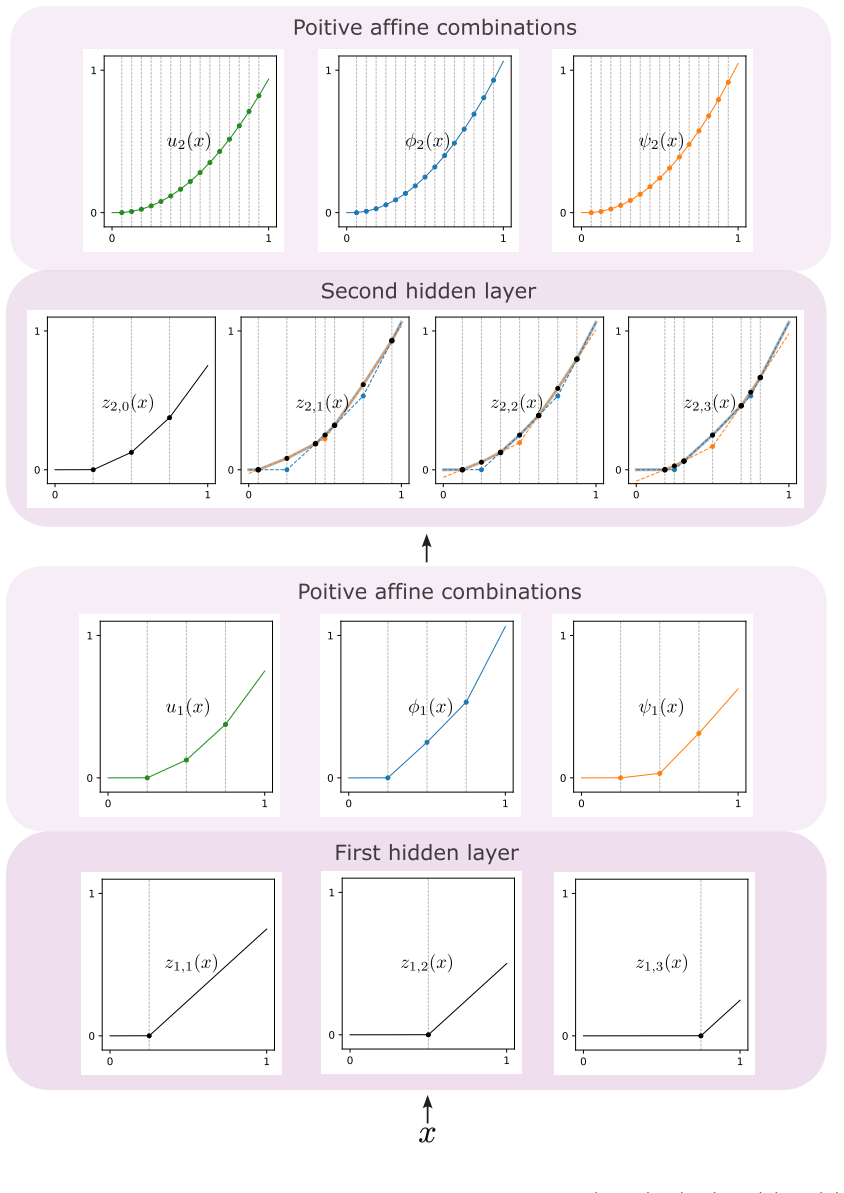
HyCNNs require exponentially fewer parameters than ICNNs to approximate quadratic functions to a given precision.
A machine-rendered reading of the paper's core claim, the machinery that carries it, and where it could break.
Core claim
HyCNNs integrate maxout activations into the ICNN framework so that the output remains convex in the input by construction while depth can be used effectively. The key theoretical result is that the parameter count needed to approximate quadratic functions to any given accuracy scales exponentially better than in prior ICNN designs. This efficiency translates into more stable training at scale and stronger performance on convex regression, interpolation, and optimal transport map estimation tasks.
What carries the argument
Hyper Input Convex Neural Networks (HyCNNs), which replace selected layers in ICNNs with maxout units to preserve guaranteed input convexity while improving parameter efficiency and depth utilization.
If this is right
- HyCNNs achieve any fixed approximation error on quadratic targets with exponentially fewer parameters than ICNNs.
- HyCNNs produce lower prediction error than ICNNs and standard MLPs on synthetic convex regression and interpolation tasks.
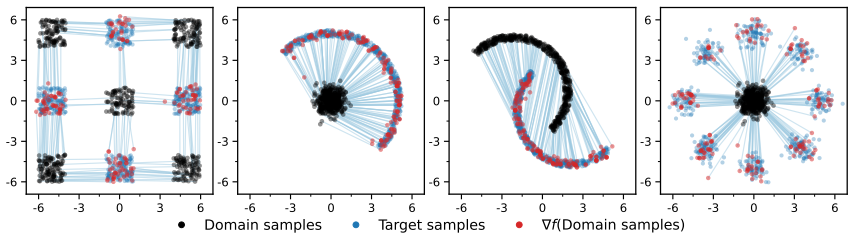
- HyCNNs learn high-dimensional optimal transport maps that often outperform those obtained from ICNN-based neural optimal transport methods on both synthetic and single-cell RNA datasets.
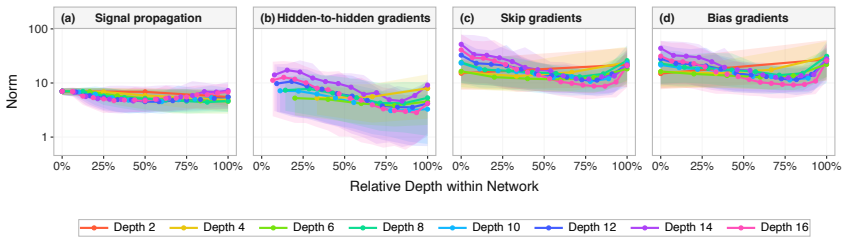
- HyCNN training remains reliable when the network depth and width are increased, addressing a known limitation of earlier ICNN constructions.
Where Pith is reading between the lines
- The exponential parameter savings could enable convex-constrained models in problem dimensions where ICNNs become computationally infeasible.
- The architecture may transfer to other tasks that require monotonicity or convexity guarantees, such as utility function estimation or certain physics-informed learning problems.
- Practitioners could adopt HyCNNs as a drop-in replacement in existing optimal transport pipelines to gain accuracy without altering the overall optimization setup.
Load-bearing premise
The approach assumes that the target functions of interest are well approximated by the HyCNN structure and that input convexity together with training stability continue to hold when the networks are scaled up.
What would settle it
Compare the smallest number of parameters required by a HyCNN versus a standard ICNN to approximate the squared Euclidean norm (a simple quadratic) to within a fixed small error in dimension 10 or higher; absence of an exponential gap in parameter count would refute the efficiency claim.
Figures





read the original abstract
We introduce Hyper Input Convex Neural Networks (HyCNNs), a novel neural network architecture designed for learning convex functions. HyCNNs combine the principles of Maxout networks with input convex neural networks (ICNNs) to create a neural network that is always convex in the input, theoretically capable of leveraging depth, and performs reliable when trained at scale compared to ICNNs. Concretely, we prove that HyCNNs require exponentially fewer parameters than ICNNs to approximate quadratic functions up to a given precision. Throughout a series of synthetic experiments, we demonstrate that HyCNNs outperform existing ICNNs and MLPs in terms of predictive performance for convex regression and interpolation tasks. We further apply HyCNNs to learn high-dimensional optimal transport maps for synthetic examples and for single-cell RNA sequencing data, where they oftentimes outperform ICNN-based neural optimal transport methods and other baselines across a wide range of settings.
Editorial analysis
A structured set of objections, weighed in public.
Referee Report
Summary. The paper introduces Hyper Input Convex Neural Networks (HyCNNs) that combine maxout networks with input convex neural networks (ICNNs) to produce models that are convex in the input. The central claim is a proof that HyCNNs require exponentially fewer parameters than ICNNs to approximate quadratic functions to a given precision. The authors further report that HyCNNs outperform ICNNs and MLPs on synthetic convex regression and interpolation tasks and yield competitive or superior results when used to learn high-dimensional optimal transport maps on both synthetic data and single-cell RNA sequencing data.
Significance. If the exponential parameter-reduction result survives comparison to strengthened ICNN baselines and the reported empirical gains are statistically reliable, the architecture could improve scalability for shape-constrained regression and neural optimal transport. The explicit use of maxout units to increase expressivity while preserving convexity is a concrete technical contribution, and the real-data OT experiments provide a useful existence proof of practical applicability.
major comments (3)
- [§4, Theorem on quadratic approximation] §4 (theoretical analysis, Theorem on quadratic approximation): The proof that HyCNNs require exponentially fewer parameters than ICNNs for quadratic approximation compares against a standard ICNN using ReLU-style activations and fixed positive weights. It does not address whether an ICNN variant that incorporates maxout units while still obeying the non-negative input-weight constraints required for convexity could achieve comparable scaling. Without ruling out or comparing against such variants, the claimed exponential gap may be an artifact of the chosen baseline rather than an intrinsic advantage of the HyCNN construction.
- [§5] §5 (experimental evaluation): The synthetic and real-data results claim consistent outperformance, yet the manuscript provides no error bars, standard deviations across random seeds, or detailed descriptions of hyperparameter selection and network-depth choices. For the single-cell RNA-seq optimal-transport experiments, it is unclear how the high-dimensional maps were regularized and whether post-training convexity was verified numerically.
- [§3] §3 (architecture definition): The precise weight constraints and activation rules that guarantee input-convexity after the maxout combination are stated at a high level but lack an explicit inductive proof or set of sufficient conditions that survive depth scaling. This detail is load-bearing for the claim that HyCNNs remain convex while leveraging depth.
minor comments (3)
- [Abstract] Abstract: 'performs reliable when trained at scale' should read 'performs reliably when trained at scale'.
- [§5] Figures in §5: Add captions that explicitly state the plotted metric (e.g., mean squared error, Wasserstein distance) and whether shaded regions represent standard error over multiple runs.
- [§3] Notation: The definition of the hyper-network parameters and how they interact with the maxout units should be introduced with a single consolidated equation block rather than scattered across paragraphs.
Simulated Author's Rebuttal
We thank the referee for their detailed and constructive feedback on our manuscript. We address each of the major comments below and outline the revisions we will make to strengthen the paper.
read point-by-point responses
-
Referee: [§4, Theorem on quadratic approximation] The proof that HyCNNs require exponentially fewer parameters than ICNNs for quadratic approximation compares against a standard ICNN using ReLU-style activations and fixed positive weights. It does not address whether an ICNN variant that incorporates maxout units while still obeying the non-negative input-weight constraints required for convexity could achieve comparable scaling. Without ruling out or comparing against such variants, the claimed exponential gap may be an artifact of the chosen baseline rather than an intrinsic advantage of the HyCNN construction.
Authors: We appreciate this insightful comment. Our theoretical analysis in §4 establishes the parameter efficiency of HyCNNs relative to the standard ICNN architecture as introduced in prior work. The HyCNN construction integrates maxout units in a manner that preserves input convexity through a hypernetwork parameterization, which differs from simply augmenting an ICNN with maxout while enforcing non-negative weights on input connections. We acknowledge that a direct comparison to a hypothetical maxout-enhanced ICNN variant would further strengthen the result. In the revised manuscript, we will add a discussion in §4 clarifying the distinction between our approach and such variants, and note that no such maxout-ICNN has been proposed or analyzed in the literature to date. revision: partial
-
Referee: [§5] The synthetic and real-data results claim consistent outperformance, yet the manuscript provides no error bars, standard deviations across random seeds, or detailed descriptions of hyperparameter selection and network-depth choices. For the single-cell RNA-seq optimal-transport experiments, it is unclear how the high-dimensional maps were regularized and whether post-training convexity was verified numerically.
Authors: Thank you for highlighting these important aspects of the experimental section. We agree that the current presentation lacks sufficient statistical rigor and implementation details. In the revised version, we will include error bars and standard deviations computed over multiple random seeds for all synthetic and real-data experiments. We will also expand the experimental setup subsection to provide full details on hyperparameter selection, network architectures, and depth choices. For the single-cell RNA-seq OT experiments, we will describe the regularization techniques employed and report numerical verification of post-training convexity, such as checking the Hessian or gradient monotonicity on held-out samples. These changes will be incorporated as a full revision to §5. revision: yes
-
Referee: [§3] The precise weight constraints and activation rules that guarantee input-convexity after the maxout combination are stated at a high level but lack an explicit inductive proof or set of sufficient conditions that survive depth scaling. This detail is load-bearing for the claim that HyCNNs remain convex while leveraging depth.
Authors: We thank the referee for pointing out the need for greater rigor in the architectural definition. While §3 outlines the weight constraints and the use of maxout to maintain convexity, we agree that an explicit inductive proof would enhance clarity. In the revised manuscript, we will include a formal inductive proof in §3 or an appendix demonstrating that the HyCNN architecture preserves input convexity at arbitrary depth under the specified constraints. This will involve showing that each layer's output remains convex in the input when composed appropriately. This constitutes a full revision to address the concern. revision: yes
Circularity Check
No circularity: HyCNN parameter-efficiency claim is a new construction with independent proof content
full rationale
The paper defines HyCNNs as a novel combination of maxout units with the non-negative weight constraints of ICNNs, then states a separate theorem proving exponential parameter reduction for quadratic approximation. No quoted step reduces the claimed advantage to a fitted parameter renamed as prediction, a self-citation chain, or an ansatz smuggled from prior work by the same authors. The baseline ICNN is the standard construction from external literature; the proof is presented as comparing against that fixed baseline rather than re-deriving it from HyCNN itself. Empirical sections on regression and OT maps are downstream validations, not load-bearing for the theoretical claim. The derivation chain therefore remains self-contained against external benchmarks.
Axiom & Free-Parameter Ledger
axioms (1)
- domain assumption Target functions are convex
invented entities (1)
-
Hyper Input Convex Neural Network (HyCNN)
no independent evidence
Reference graph
Works this paper leans on
-
[1]
Amos, B., Xu, L., & Kolter, J. Z. (2017). Input convex neural networks. In International conference on machine learning \!\!, pages 146--155.: PMLR
2017
-
[2]
Bal \'a zs, G., Gy \"o rgy, A., & Szepesv \'a ri, C. (2015). Near-optimal max-affine estimators for convex regression. In Artificial Intelligence and Statistics \!\!, pages 56--64.: PMLR
2015
-
[3]
Brenier, Y. (1991). Polar factorization and monotone rearrangement of vector-valued functions. Communications on pure and applied mathematics , 44(4), 375--417
1991
-
[4]
G., Gut, G., Del Castillo, J
Bunne, C., Stark, S. G., Gut, G., Del Castillo, J. S., Levesque, M., Lehmann, K.-V., Pelkmans, L., Krause, A., & R \"a tsch, G. (2023). Learning single-cell perturbation responses using neural optimal transport. Nature methods , 20(11), 1759--1768
2023
-
[5]
Chen, Y., Shi, Y., & Zhang, B. (2018). Optimal control via neural networks: A convex approach. Preprint arXiv:1805.11835
work page Pith review arXiv 2018
-
[6]
Courty, N., Flamary, R., Tuia, D., & Rakotomamonjy, A. (2016). Optimal transport for domain adaptation. IEEE transactions on pattern analysis and machine intelligence , 39(9), 1853--1865
2016
- [7]
-
[8]
De Lara, L., Gonz \'a lez-Sanz, A., Asher, N., Risser, L., & Loubes, J.-M. (2024). Transport-based counterfactual models. Journal of Machine Learning Research , 25(136), 1--59
2024
-
[9]
Deschatre, T. & Warin, X. (2025). Input convex Kolmogorov Arnold Networks . Preprint arXiv:2505.21208
-
[10]
Divol, V., Niles-Weed, J., & Pooladian, A.-A. (2025). Optimal transport map estimation in general function spaces. The Annals of Statistics , 53(3), 963--988
2025
-
[11]
& Schmidt-Hieber, J
Eckle, K. & Schmidt-Hieber, J. (2019). A comparison of deep networks with ReLU activation function and linear spline-type methods. Neural Networks , 110, 232--242
2019
-
[12]
Y., Kao, Y.-C., Xu, M., & Samworth, R
Feng, O. Y., Kao, Y.-C., Xu, M., & Samworth, R. J. (2026). Optimal convex m-estimation via score matching. The Annals of Statistics , 54(1), 408--441
2026
-
[13]
Feydy, J., S \'e journ \'e , T., Vialard, F.-X., Amari, S.-i., Trouv \'e , A., & Peyr \'e , G. (2019). Interpolating between optimal transport and MMD using Sinkhorn divergences. In The 22nd international conference on artificial intelligence and statistics \!\!, pages 2681--2690.: PMLR
2019
-
[14]
Goodfellow, I., Warde-Farley, D., Mirza, M., Courville, A., & Bengio, Y. (2013). Maxout networks. In S. Dasgupta & D. McAllester (Eds.), Proceedings of the 30th International Conference on Machine Learning , number 28(3) in Proceedings of Machine Learning Research \!\!, pages 1319--1327
2013
-
[15]
Gordaliza, P., Del Barrio, E., Fabrice, G., & Loubes, J.-M. (2019). Obtaining fairness using optimal transport theory. In International conference on machine learning \!\!, pages 2357--2365.: PMLR
2019
-
[16]
& Hundrieser, S
Groppe, M. & Hundrieser, S. (2024). Lower complexity adaptation for empirical entropic optimal transport. Journal of Machine Learning Research , 25(344), 1--55
2024
-
[17]
& Sen, B
Guntuboyina, A. & Sen, B. (2015). Global risk bounds and adaptation in univariate convex regression. Probability Theory and Related Fields , 163(1), 379--411
2015
-
[18]
Hallin, M., del Barrio, E., Cuesta-Albertos, J., & Matr \'a n, C. (2021). Distribution and quantile functions, ranks and signs in dimension d . The Annals of Statistics , 49(2), 1139--1165
2021
-
[19]
Hannah, L. A. & Dunson, D. B. (2013). Multivariate convex regression with adaptive partitioning. Journal of Machine Learning Research , 14(1), 3261--3294
2013
-
[20]
He, K., Zhang, X., Ren, S., & Sun, J. (2015). Delving deep into rectifiers: Surpassing human-level performance on imagenet classification. In Proceedings of the IEEE international conference on computer vision \!\!, pages 1026--1034
2015
-
[21]
& Klambauer, G
Hoedt, P.-J. & Klambauer, G. (2023). Principled weight initialisation for input-convex neural networks. Advances in Neural Information Processing Systems , 36, 46093--46104
2023
-
[22]
T., Tsirigotis, C., & Courville, A
Huang, C.-W., Chen, R. T., Tsirigotis, C., & Courville, A. (2020). Convex potential flows: Universal probability distributions with optimal transport and convex optimization. Preprint arXiv:2012.05942
-
[23]
Hundrieser, S., Staudt, T., & Munk, A. (2024). Empirical optimal transport between different measures adapts to lower complexity. Annales de l'Institut Henri Poincare (B) Probabilites et statistiques , 60(2), 824--846
2024
-
[24]
& Rigollet, P
H \"u tter, J.-C. & Rigollet, P. (2021). Minimax estimation of smooth optimal transport maps. The Annals of Statistics , 49(2), 1166--1194
2021
-
[25]
Hyv \"a rinen, A. (2005). Estimation of non-normalized statistical models by score matching. Journal of Machine Learning Research , 6(4)
2005
-
[26]
Kingma, D. P. & Ba, J. (2014). Adam: A method for stochastic optimization. Preprint arXiv:1412.6980
work page internal anchor Pith review arXiv 2014
-
[27]
B., & M \"u ller, K.-R
LeCun, Y., Bottou, L., Orr, G. B., & M \"u ller, K.-R. (2002). Efficient backprop. In Neural networks: Tricks of the trade \!\!, pages 9--50. Springer
2002
-
[28]
& Srikant, R
Liang, S. & Srikant, R. (2017). Why deep neural networks for function approximation? In International Conference on Learning Representations . https://openreview.net/forum?id=SkpSlKIel
2017
-
[29]
Lin, A. & Ba, D. E. (2023). How to train your FALCON : Learning log-concave densities with energy-based neural networks. In Fifth Symposium on Advances in Approximate Bayesian Inference
2023
-
[30]
Makkuva, A., Taghvaei, A., Oh, S., & Lee, J. (2020). Optimal transport mapping via input convex neural networks. In International Conference on Machine Learning \!\!, pages 6672--6681.: PMLR
2020
-
[31]
Manole, T., Balakrishnan, S., Niles-Weed, J., & Wasserman, L. (2024). Plugin estimation of smooth optimal transport maps. The Annals of Statistics , 52(3), 966--998
2024
-
[32]
McClure, D. E. (1975). Nonlinear segmented function approximation and analysis of line patterns. Quarterly of Applied Mathematics , 33(1), 1--37
1975
- [33]
-
[34]
& Cuturi, M
Peyr \'e , G. & Cuturi, M. (2019). Computational optimal transport: With applications to data science. Foundations and Trends in Machine Learning , 11(5-6), 355--607
2019
-
[35]
arXiv preprint arXiv:2109.12004 , year =
Pooladian, A.-A. & Niles-Weed, J. (2021). Entropic estimation of optimal transport maps. Preprint arXiv:2109.12004
-
[36]
& Mohamed, S
Rezende, D. & Mohamed, S. (2015). Variational inference with normalizing flows. In International conference on machine learning \!\!, pages 1530--1538.: PMLR
2015
-
[37]
Samworth, R. J. (2018). Recent progress in log-concave density estimation. Statistical Science , 33(4), 493
2018
-
[38]
Santambrogio, F. (2015). Optimal transport for applied mathematicians. Calculus of variations, PDEs, and modeling . Birkh \"a user Basel
2015
-
[39]
Schiebinger, G., Shu, J., Tabaka, M., Cleary, B., Subramanian, V., Solomon, A., Gould, J., Liu, S., Lin, S., Berube, P., Lee, L., Chen, J., Brumbaugh, J., Rigollet, P., Hochedlinger, K., Jaenisch, R., Regev, A., & Lander, E. S. (2019). Optimal-transport analysis of single-cell gene expression identifies developmental trajectories in reprogramming. Cell , ...
2019
-
[40]
Schmidt-Hieber, J. (2020). Nonparametric regression using deep neural networks with ReLU activation function. The Annals of Statistics , 48(4), 1875--1897
2020
-
[41]
B., Flamary, R., Courty, N., Rolet, A., & Blondel, M
Seguy, V., Damodaran, B. B., Flamary, R., Courty, N., Rolet, A., & Blondel, M. (2017). Large-scale optimal transport and mapping estimation. Preprint arXiv:1711.02283
-
[42]
& Sen, B
Seijo, E. & Sen, B. (2011). Nonparametric least squares estimation of a multivariate convex regression function. The Annals of Statistics , 39(3), 1633--1657
2011
-
[43]
Sivaprasad, S., Singh, A., Manwani, N., & Gandhi, V. (2021). The curious case of convex neural networks. In Joint European Conference on Machine Learning and Knowledge Discovery in Databases \!\!, pages 738--754.: Springer
2021
-
[44]
Song, Y., Durkan, C., Murray, I., & Ermon, S. (2021). Maximum likelihood training of score-based diffusion models. In M. Ranzato, A. Beygelzimer, Y. Dauphin, P. Liang, & J. W. Vaughan (Eds.), Advances in Neural Information Processing Systems , volume 34 \!\!, pages 1415--1428
2021
-
[45]
Stromme, A. J. (2024). Minimum intrinsic dimension scaling for entropic optimal transport. In International Conference on Soft Methods in Probability and Statistics \!\!, pages 491--499.: Springer
2024
-
[46]
Taghvaei, A. & Jalali, A. (2019). 2- Wasserstein approximation via restricted convex potentials with application to improved training for GANs . Preprint arXiv:1902.07197
-
[47]
Tameling, C., Stoldt, S., Stephan, T., Naas, J., Jakobs, S., & Munk, A. (2021). Colocalization for super-resolution microscopy via optimal transport. Nature computational science , 1(3), 199--211
2021
-
[48]
Y., Mukherjee, S., Tang, J., & Sch \"o nlieb, C.-B
Tan, H. Y., Mukherjee, S., Tang, J., & Sch \"o nlieb, C.-B. (2023). Data-driven mirror descent with input-convex neural networks. SIAM Journal on Mathematics of Data Science , 5(2), 558--587
2023
-
[49]
Telgarsky, M. (2016). Benefits of depth in neural networks. In V. Feldman, A. Rakhlin, & O. Shamir (Eds.), 29th Annual Conference on Learning Theory , volume 49 of Proceedings of Machine Learning Research \!\!, pages 1517--1539. Columbia University, New York, New York, USA: PMLR
2016
-
[50]
Thakolkaran, P., Guo, Y., Saini, S., Peirlinck, M., Alheit, B., & Kumar, S. (2025). Can KAN CAN s? I nput-convex Kolmogorov-Arnold networks (KANs) as hyperelastic constitutive artificial neural networks ( CAN s). Computer Methods in Applied Mechanics and Engineering , 443, 118089
2025
-
[51]
& Cuturi, M
Uscidda, T. & Cuturi, M. (2023). The Monge gap: A regularizer to learn all transport maps. In International Conference on Machine Learning \!\!, pages 34709--34733.: PMLR
2023
-
[52]
Villani, C. (2008). Optimal transport: old and new , volume 338. Springer
2008
-
[53]
A., Slep c ev, D., Lee, A
Wang, W., Ozolek, J. A., Slep c ev, D., Lee, A. B., Chen, C., & Rohde, G. K. (2010). An optimal transportation approach for nuclear structure-based pathology. IEEE transactions on medical imaging , 30(3), 621--631
2010
-
[54]
Warin, X. (2023). The GroupMax neural network approximation of convex functions. IEEE Transactions on Neural Networks and Learning Systems , 35(8), 11608--11612
2023
-
[55]
Warin, X. (2024). P1-KAN : An effective Kolmogorov-Arnold network with application to hydraulic valley optimization. Preprint arXiv:2410.03801
work page internal anchor Pith review Pith/arXiv arXiv 2024
-
[56]
& Bach, F
Weed, J. & Bach, F. (2019). Sharp asymptotic and finite-sample rates of convergence of empirical measures in wasserstein distance. Bernoulli , 25(4A), 2620--2648
2019
-
[57]
Yarotsky, D. (2017). Error bounds for approximations with deep ReLU networks. Neural Networks , 94, 103 -- 114
2017
discussion (0)
Sign in with ORCID, Apple, or X to comment. Anyone can read and Pith papers without signing in.