Recognition: unknown
Fast-Vollib: A Fast Implied Volatility Library for Pythonwith PyTorch, JAX, and CUDA Fused-Kernel Backends
Pith reviewed 2026-05-07 10:39 UTC · model grok-4.3
The pith
Fast-vollib provides high-performance European option pricing, implied volatility, and Greeks as a drop-in replacement for py_vollib using PyTorch, JAX, and CUDA backends.
A machine-rendered reading of the paper's core claim, the machinery that carries it, and where it could break.
Core claim
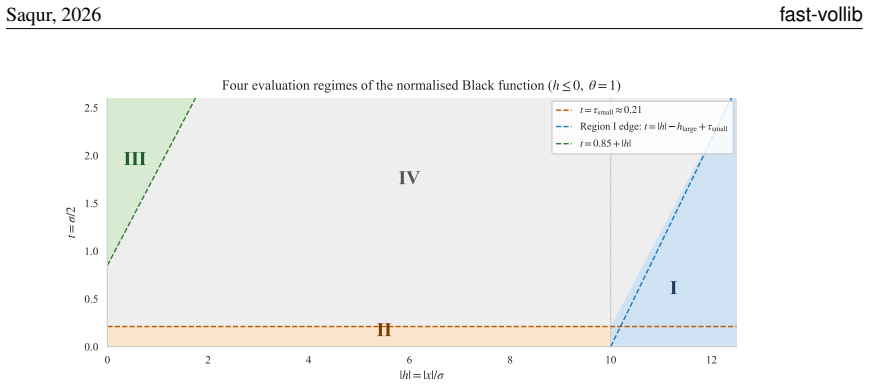
Fast-vollib is an open-source library that implements European option pricing, implied volatility computation, and Greeks under Black-76, Black-Scholes, and Black-Scholes-Merton models. It supplies pluggable PyTorch, JAX, and CUDA-Triton backends, a vectorized Halley-method IV solver, and an experimental fully-vectorized Jäckel Let's Be Rational algorithm with NumPy/Numba, torch.compile, JAX, and single-pass GPU kernels for batched workloads.
What carries the argument
Pluggable execution backends (PyTorch, JAX, Triton) paired with vectorized implied-volatility solvers that support batched processing across hardware and automatic-differentiation frameworks.
Load-bearing premise
The claimed performance gains, numerical correctness, and API compatibility hold across the supported backends and workloads.
What would settle it
A direct benchmark run on representative option chains that shows either slower wall-clock times than py_vollib or implied-volatility outputs differing by more than machine precision.
Figures
read the original abstract
We present fast-vollib, an open-source Python library that provides high-performance European option pricing, implied volatility (IV) computation, and Greeks under the Black-76, Black-Scholes, and Black-Scholes-Merton models. The library is designed as a drop-in alternative to the de-facto-standard py_vollib and py_vollib_vectorized packages, with pluggable PyTorch and JAX execution backends, a CUDA fused-kernel Triton contribution for batched IV workloads, and a compatibility-first public API. In addition to a vectorized Halley-method IV solver, fast-vollib ships an experimental, fully-vectorized implementation of J\"ackel's "Let's Be Rational" (LBR) algorithm with NumPy/Numba, torch.compile, JAX, and Triton single-pass GPU kernels for batched option chains. This note announces the library and describes its public API surface, with source, documentation, and packaging artifacts available at: GitHub (https://github.com/raeidsaqur/fast-vollib), Docs (https://raeidsaqur.github.io/fast-vollib/), PyPI (https://pypi.org/project/fast-vollib/).
Editorial analysis
A structured set of objections, weighed in public.
Referee Report
Summary. The manuscript announces fast-vollib, an open-source Python library for high-performance European option pricing, implied volatility computation, and Greeks under the Black-76, Black-Scholes, and Black-Scholes-Merton models. It features pluggable PyTorch, JAX, and CUDA fused-kernel Triton backends, a vectorized Halley-method IV solver, and an experimental fully-vectorized implementation of Jäckel's Let's Be Rational algorithm, positioning itself as a drop-in replacement for py_vollib with source, documentation, and PyPI artifacts available externally.
Significance. If the performance and compatibility claims are substantiated, the library would provide a useful high-performance tool for quantitative finance practitioners, especially those integrating option pricing with PyTorch or JAX workflows. The multi-backend architecture and experimental vectorized LBR implementation are positive contributions to reproducible computational finance software. The open-source release and compatibility focus are explicit strengths.
major comments (1)
- Abstract and manuscript body: the central claims of 'high-performance', 'fast' execution, and 'drop-in' compatibility with py_vollib are presented without any benchmark timings, accuracy comparisons to existing libraries, error analysis, or validation results. These empirical elements are load-bearing for evaluating the library's contribution, as the text relies entirely on external repository links rather than contained evidence.
minor comments (1)
- The manuscript is concise and refers readers to GitHub/Docs/PyPI for all implementation details; incorporating a short self-contained usage example or API snippet would improve readability and independence from external resources.
Simulated Author's Rebuttal
We thank the referee for the positive assessment of the library's potential utility and for the constructive critique regarding empirical substantiation. We address the single major comment below and commit to a revision that incorporates the requested evidence directly into the manuscript.
read point-by-point responses
-
Referee: Abstract and manuscript body: the central claims of 'high-performance', 'fast' execution, and 'drop-in' compatibility with py_vollib are presented without any benchmark timings, accuracy comparisons to existing libraries, error analysis, or validation results. These empirical elements are load-bearing for evaluating the library's contribution, as the text relies entirely on external repository links rather than contained evidence.
Authors: We agree that the current short announcement format leaves the performance and compatibility claims without self-contained empirical support, which weakens the manuscript's ability to stand alone. In the revised version we will add a dedicated 'Performance and Validation' section containing: (i) wall-clock timing tables for batched pricing and IV computation across NumPy, PyTorch, JAX, and Triton backends for representative batch sizes (1k–1M options); (ii) direct accuracy and runtime comparisons against py_vollib and py_vollib_vectorized on identical test vectors; (iii) convergence and error statistics for the vectorized Halley and experimental LBR solvers (maximum absolute error, iteration counts, and failure rates versus reference implementations); and (iv) a brief validation subsection confirming Greeks and model prices against closed-form expectations and known test suites. Representative figures and tables will be generated from the existing benchmarking scripts already present in the repository. This revision will make the claims verifiable without requiring the reader to consult external links. revision: yes
Circularity Check
No significant circularity; software library announcement
full rationale
The manuscript is a concise library announcement describing an open-source Python package for European option pricing, IV computation, and Greeks under standard Black-76/BS/BSM models. It implements known algorithms (vectorized Halley solver, experimental Jäckel LBR) via pluggable backends but contains no derivations, equations, fitted parameters, or predictions. All substantive claims are supported by external links to GitHub, documentation, and PyPI rather than internal reductions or self-citations. No load-bearing steps reduce to inputs by construction.
Axiom & Free-Parameter Ledger
Reference graph
Works this paper leans on
-
[1]
QuantLib : A free/open-source library for quantitative finance
Ferdinando Ametrano and Luigi Ballabio. QuantLib : A free/open-source library for quantitative finance. https://www.quantlib.org, 2003
2003
-
[2]
The pricing of commodity contracts
Fischer Black. The pricing of commodity contracts. Journal of Financial Economics, 3 0 (1--2): 0 167--179, 1976
1976
-
[3]
The pricing of options and corporate liabilities
Fischer Black and Myron Scholes. The pricing of options and corporate liabilities. Journal of Political Economy, 81 0 (3): 0 637--654, 1973
1973
-
[4]
Menachem Brenner and Marti G. Subrahmanyam. A simple formula to compute the implied standard deviation. Financial Analysts Journal, 44 0 (5): 0 80--83, 1988. doi:10.2469/faj.v44.n5.80
-
[5]
Deep hedging
Hans Buehler, Lukas Gonon, Josef Teichmann, and Ben Wood. Deep hedging. Quantitative Finance, 19 0 (8): 0 1271--1291, 2019
2019
-
[6]
Charles J. Corrado and Thomas W. Miller. A note on a simple, accurate formula to compute implied standard deviations. Journal of Banking & Finance, 20 0 (3): 0 595--603, 1996. doi:10.1016/0378-4266(95)00014-3
-
[7]
py\_vollib\_vectorized : a vectorized P ython port of py\_vollib
Marc Demers. py\_vollib\_vectorized : a vectorized P ython port of py\_vollib . https://github.com/marcdemers/py_vollib_vectorized, 2021
2021
-
[8]
Deep learning volatility: a deep neural network perspective on pricing and calibration in (rough) volatility models
Blanka Horvath, Aitor Muguruza, and Mehdi Tomas. Deep learning volatility: a deep neural network perspective on pricing and calibration in (rough) volatility models. Quantitative Finance, 21 0 (1): 0 11--27, 2021
2021
-
[9]
Let's be rational
Peter J \"a ckel. Let's be rational. Wilmott, 2015 0 (75): 0 40--53, 2015
2015
-
[10]
The calculation of implied variances from the B lack-- S choles model: A note
Steven Manaster and Gary Koehler. The calculation of implied variances from the B lack-- S choles model: A note. The Journal of Finance, 37 0 (1): 0 227--230, 1982. doi:10.1111/j.1540-6261.1982.tb01105.x
-
[11]
Robert C. Merton. Theory of rational option pricing. The Bell Journal of Economics and Management Science, pages 141--183, 1973
1973
-
[12]
py\_vollib : A P ython library for option pricing, implied volatility, and G reeks
Larry Richards. py\_vollib : A P ython library for option pricing, implied volatility, and G reeks. https://github.com/vollib/py_vollib, 2023. GitHub repository
2023
-
[13]
fast-vollib documentation
Raeid Saqur. fast-vollib documentation. https://raeidsaqur.github.io/fast-vollib/, 2025
2025
-
[14]
Triton : an intermediate language and compiler for tiled neural network computations
Philippe Tillet, Hsiang-Tsung Kung, and David Cox. Triton : an intermediate language and compiler for tiled neural network computations. In Proceedings of the 3rd ACM SIGPLAN International Workshop on Machine Learning and Programming Languages (MAPL), pages 10--19, 2019. doi:10.1145/3315508.3329973
discussion (0)
Sign in with ORCID, Apple, or X to comment. Anyone can read and Pith papers without signing in.