pith. machine review for the scientific record. sign in

q-fin.MF

Mathematical Finance

Mathematical and analytical methods of finance, including stochastic, probabilistic and functional analysis, algebraic, geometric and other methods

0
q-fin.MF 2026-05-13 2 theorems

Optimal utility stays continuous under price tweaks in cost markets

On convergence of the Mayer problems arising in the theory of financial markets with transaction cost

In the geometric model with price and solvency processes, small changes to S keep maximal expected terminal utility close and strategies are

abstract click to expand
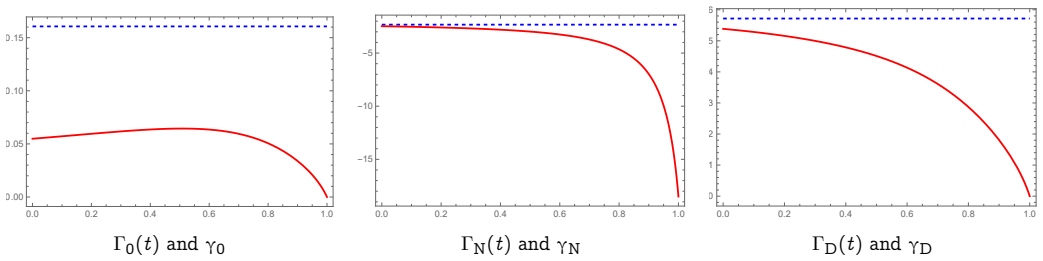
The geometric approach to financial markets with proportional transaction cost prescribes to imbed a specific model (of stock market, of currency market etc.), usually given in a parametric form, into a natural framework defined by the two random processes, S and K. The first one, d-dimensional, models the price evolution of basic securities while the second one, cone-valued, describes the evolution of the solvency set. It happened that the fundamental questions -- no-arbitrage criteria, hedging problems, portfolio optimization -- can be studied in this general setting opening the door to set-valued techniques. In this note we explore, in such a general framework, the stochastic Mayer control problem, consisting in the maximization of the expected utility of the portfolio terminal wealth. We get results on continuity of the optimal value and the optimal control under price approximations in a general multi-asset framework described by the geometric formalism.
0
0
q-fin.MF 2026-05-12 2 theorems

Explicit optimal control derived for Ethena yield positions

Optimal Control of the Ethena Yield-Bearing Stablecoin

The model shows how the rate of building the delta-neutral carry trade balances staking rewards and funding income against permanent basis-n

Figure from the paper full image
abstract click to expand
We formulate and solve stochastic control problems that model the core yield-generating strategy of the Ethena protocol, a decentralized finance (DeFi) stablecoin that earns yield by combining a long position in staked Ethereum (stETH) with an equal-sized short position in ETH perpetual futures. The combined position is delta-neutral with respect to the ETH spot price, yet earns carry from two sources: staking rewards on the stETH leg, and funding-rate payments received from long perpetual holders when the perpetual trades at a premium to spot. A key feature of our model is that the control -- the rate of simultaneously buying stETH and shorting the perpetual -- exerts two distinct types of price impact. \textit{Permanent} impact shifts the mid-market prices of both legs, compressing the basis and permanently eroding future funding income. \textit{Temporary} impact reflects execution slippage on each leg. We study both an infinite-horizon discounted problem and a finite-horizon problem in which the protocol maximizes total wealth up to a fixed date $T$, subject to a terminal cost for liquidating any remaining position. In both cases the optimal control is obtained explicitly.
0
0
q-fin.MF 2026-05-11 Recognition

Expected returns shape Black-Scholes-Merton prices

Stochastic Calculus and the Black-Scholes-Merton Model: A Simplified Approach

Simplified stochastic calculus shows the underlying asset's drift enters the option formula, refuting its exclusion from standard models.

Figure from the paper full image
abstract click to expand
This paper refutes the claim that the expected rate of return of the underlying asset plays no role in the Black-Scholes-Merton option pricing model.
0
0
q-fin.MF 2026-05-08

Funding-aware quotes outperform classical market making in DEX perpetuals

Funding-Aware Optimal Market Making for Perpetual DEXs

Simulations on Hyperliquid data show higher average returns and lower inventory swings for ETH and BTC when funding payments are treated as

Figure from the paper full image
abstract click to expand
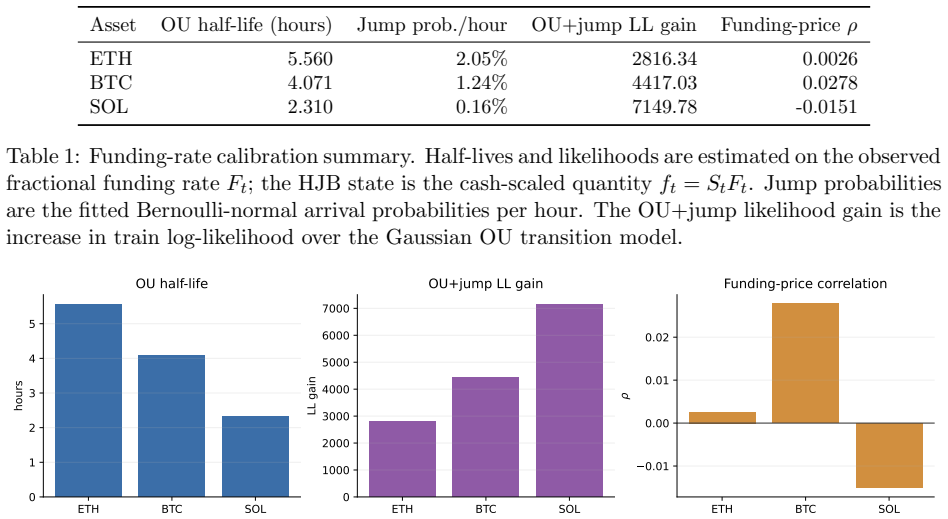
This paper studies optimal liquidity provision for perpetual contracts when the funding rate is a stochastic state variable. The core extension to classical market making is the coupling between inventory and funding payments: inventory creates both mark-to-market exposure and a state-dependent funding cash flow. A reduced inventory-funding control problem is formulated, solved with a monotone finite-difference Hamilton-Jacobi-Bellman scheme, and bid and ask quote offsets are recovered from discrete inventory value differences. Funding is calibrated on Hyperliquid ETH, BTC, and SOL perpetual data. Gaussian OU funding is retained as a tractable diffusion baseline, while OU-plus-jump diagnostics document the heavy-tailed funding innovations that should enter a future extension. In 100-seed holdout simulations under two official-fill proxy calibrations, the funding-aware HJB improves mean ETH/BTC performance while lowering inventory RMS relative to classical Avellaneda-Stoikov. SOL gains are positive versus unscaled AS but are not a Pareto improvement once a risk-scaled AS diagnostic is included.
0
0
q-fin.MF 2026-05-07

ESG cuts crashes in stress but drags returns in calm markets

ESG as Priced Crash Insurance: State-Dependent Tail Risk and Deconfounding Evidence

Double machine learning isolates lower tail losses for high-rated firms only during drawdowns, revealing priced insurance behavior.

Figure from the paper full image
abstract click to expand
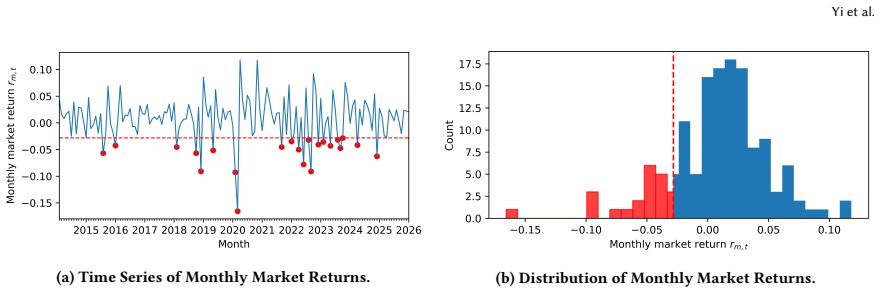
This research establishes ESG as a state dependent insurance mechanism against equity crashes by addressing the decoupling of unconditional alpha from tail risk resilience. By validating market stress regimes as distinct economic states through a drawdown-based truncation rule, the study demonstrates that high ESG ratings materially reduce the incidence of discrete crash events during systemic drawdowns. To address the selection bias and high-dimensional confounding inherent in traditional linear frameworks, we implement Double Machine Learning as a structural deconfounding layer. Unlike simple predictive modeling, the Double Machine Learning framework utilizes machine learning to handle complex nuisance parameters, allowing us to isolate the asymmetric treatment effects of ESG across different market states. Distributional analysis reveals the underlying mechanism as ESG specifically attenuates the severity of realized tail losses at the most adverse quantiles instead of shifting the entire return distribution. Confirmed by structural estimates, this protection functions as priced insurance that incurs performance drags during stable periods while providing critical resilience when tail risks are most acute.
0
0
q-fin.MF 2026-05-05

Greenium gaps imply time to low-carbon transition

Market-implied time to transition to a low-carbon economy: a stochastic modelling and inference framework

Cross-maturity premium differences define a waiting time modeled with deadline diffusions and recovered via daily filters plus infill asympt

abstract click to expand
This paper introduces a new market-implied object, Time to Transition (TtT), extracted from the difference between two selected nodes of the greenium term structure. TtT is defined as the latent waiting time until this cross-maturity greenium difference vanishes, meaning that the greenium becomes equal across the two selected maturities. We develop an inference theory for this object. To model TtT, we introduce two tractable stochastic frameworks: the Regulatory Deadline-Constrained Model, in which the transition date is fixed, and a switching extension, in which alternative transition dates capture heterogeneous perceived deadlines across economic agents. The paper combines two layers of analysis. On a fixed daily grid, a deadline-constrained diffusion provides a tractable benchmark through an exact Gaussian bridge likelihood, while the switching extension preserves tractability through regime-specific bridge densities and filtering recursions. Under a fixed-horizon infill scheme, the same framework yields a structural identification result for the regime-wise diffusion parameters, with full or partial consistency depending on the observed region. The paper therefore contributes both a new inferential object, market-implied transition timing based on cross-maturity differences in the greenium term structure, and a two-layer inference framework: finite-sample filtering provides an operational monitoring tool, while fixed-horizon infill asymptotics specify when the regime-wise diffusion parameters carrying information about competing transition dates can be consistently estimated.
0
0
q-fin.MF 2026-05-05

Single risk factor gives closed-form frontier under volatility uncertainty

Pareto frontier of portfolio investment under volatility uncertainty and short-sale constraints market

SLE-MUV model yields polynomial portfolio weights and convex curve that beats mean-variance on US and Chinese stocks

Figure from the paper full image
abstract click to expand
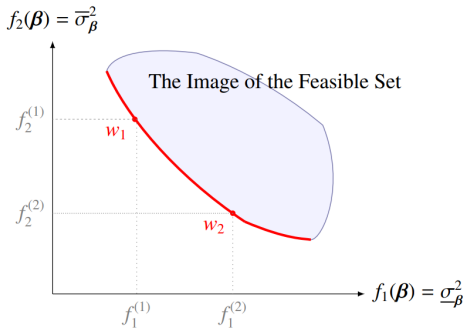
In this paper, we investigate a portfolio investment problem under volatility uncertainty and short-sale constraints market via sublinear expectation which is used to model volatility uncertainty. We assume the stocks admit volatility uncertainty. Thus the related portfolio has upper variance (maximum risk) and lower variance (minimum risk). By introducing a risk factor $w$ to conduct coupled modeling of the maximum and minimum risks, a simplified Sublinear Expectation Mean-Uncertainty Variance (SLE-MUV) model is constructed. Theoretically, we show that the Pareto frontier of the SLE-MUV model is a continuous convex curve, and its optimal solution can be expressed as a polynomial analytical expression with respect to the risk factor $w$. Empirically, we systematically test the practical performance of the SLE-MUV model and conduct comparative analysis with the traditional Mean-Variance (MV) model as the benchmark based on three sets of samples -- simulated generated data, data of the US stock market and the A-share market. The empirical results show that the SLE-MUV model can significantly improving the risk-adjusted return of the investment portfolio.
0
0
q-fin.MF 2026-05-04

Cohomology detects arbitrage as loop obstructions in time categories

Martingale Cohomology, Holonomy, and Homological Arbitrage

After ฮฒ-gauge normalization, 1-cochains capture consistent gains no price process can generate and cohomological holonomy isolates the loop-

abstract click to expand
We introduce a transport cohomological framework for categorical filtrations. Given a contravariant filtration $F:\mathcal T^{op}\to\mathbf{Prob}$ on a small category \(\mathcal T\), conditional expectation induces transport operators between local probabilistic states. Using the simplicial structure of the nerve \(N_\bullet(\mathcal T)\), we construct simplex-local cochain complexes associated with parametrized simplices and study their transport cohomology. The resulting framework naturally produces loop effects and holonomy structures. In particular, transport around closed simplicial histories may generate nontrivial probabilistic distortions, even when the initial and terminal objects coincide. The associated holonomy operators encode global transport effects between probabilistic states and detect obstructions generated by loop transport. This leads to the notion of homological arbitrage, understood as a global transport phenomenon emerging from probabilistic distortion along loops. From this viewpoint, the essential source of loop effects is the probabilistic distortion generated by transport around closed simplicial histories. The present framework is structurally analogous to parallel transport and holonomy in differential geometry, providing a geometric viewpoint on categorical filtrations and probabilistic transport structures.
0
0
q-fin.MF 2026-05-04 Recognition

Closed loops in filtrations create homological arbitrage

Martingale Cohomology, Holonomy, and Homological Arbitrage

Probabilistic distortions persist along simplicial histories even when start and end states are identical.

abstract click to expand
We introduce a transport cohomological framework for categorical filtrations. Given a contravariant filtration $F:\mathcal T^{op}\to\mathbf{Prob}$ on a small category \(\mathcal T\), conditional expectation induces transport operators between local probabilistic states. Using the simplicial structure of the nerve \(N_\bullet(\mathcal T)\), we construct simplex-local cochain complexes associated with parametrized simplices and study their transport cohomology. The resulting framework naturally produces loop effects and holonomy structures. In particular, transport around closed simplicial histories may generate nontrivial probabilistic distortions, even when the initial and terminal objects coincide. The associated holonomy operators encode global transport effects between probabilistic states and detect obstructions generated by loop transport. This leads to the notion of homological arbitrage, understood as a global transport phenomenon emerging from probabilistic distortion along loops. From this viewpoint, the essential source of loop effects is the probabilistic distortion generated by transport around closed simplicial histories. The present framework is structurally analogous to parallel transport and holonomy in differential geometry, providing a geometric viewpoint on categorical filtrations and probabilistic transport structures.
0
0
q-fin.MF 2026-05-01

Control model beats TWAP benchmark in renewable power trades

Data-Driven Stochastic Optimal Control for Intraday Electricity Trading by Renewable Producers

A stochastic framework using mean-reverting diffusions helps renewable producers cut imbalance costs and approach perfect-foresight profits.

Figure from the paper full image
abstract click to expand
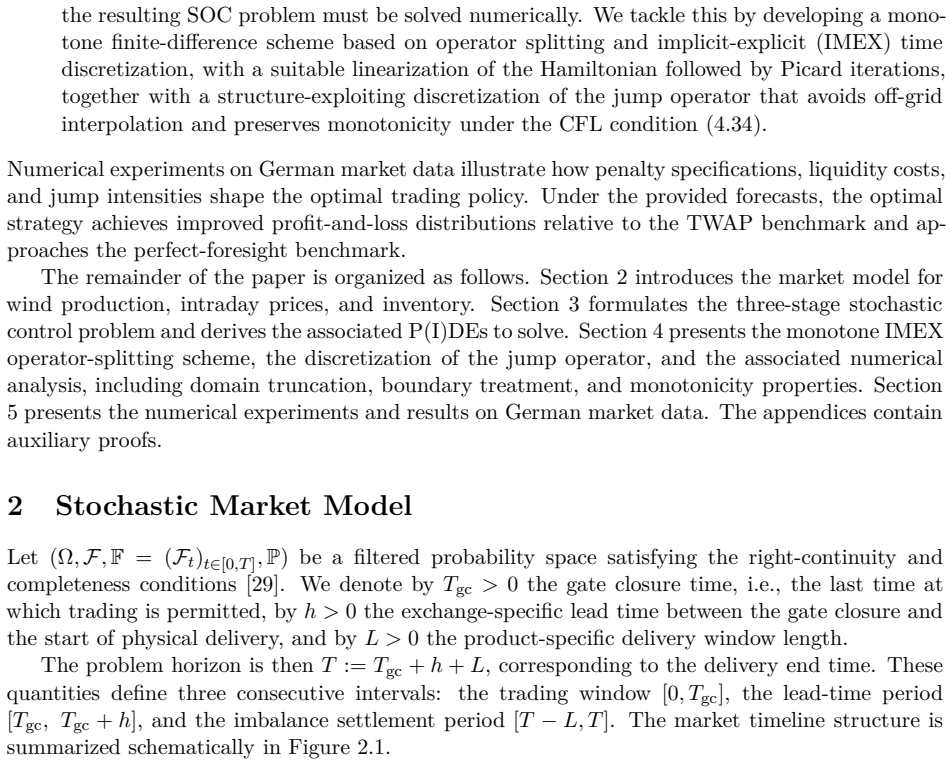
The rapid growth of weather-dependent renewable generation increases price volatility and imbalance penalty risk in power markets, creating the need for advanced quantitative trading strategies. We develop a data-driven continuous-time stochastic optimal control framework for intraday electricity trading using stochastic differential equations with drift terms ensuring mean reversion to deterministic forecast trajectories. Production follows a Jacobi diffusion, while prices follow an asymmetric jump-diffusion to reflect the heavy-tailed behavior observed in intraday markets. The framework accounts for realistic market features by incorporating gate closure and energy-based imbalance settlement over the delivery window, where the path-dependent imbalance cost is handled by state augmentation to preserve the Markovian structure. The value function is characterized via the dynamic programming principle by a three-stage sequence of two linear Kolmogorov backward equations and a nonlinear Hamilton-Jacobi-Bellman partial integro-differential equation. To solve this problem efficiently, we propose a monotone IMEX finite-difference scheme with operator splitting, semi-implicit linearization, and a differential formulation for the jump operator. Numerical experiments based on German market data indicate that, under the provided forecasts, the computed strategy outperforms the TWAP benchmark and approaches the perfect-foresight benchmark. Sensitivity experiments further show how jump intensity, delivery-window length, and trading horizon affect the trading policy and the resulting profit-and-loss distribution.
0
0
q-fin.MF 2026-04-30

News sentiment spillover intensifies among tech firms after COVID

Do News and Social Media Tell the Same Story? Constructing and Comparing Sentiment Spillover Networks

Transfer entropy networks show stronger post-pandemic information flow from news than from social media, with distinct hub and chain roles.

Figure from the paper full image
abstract click to expand
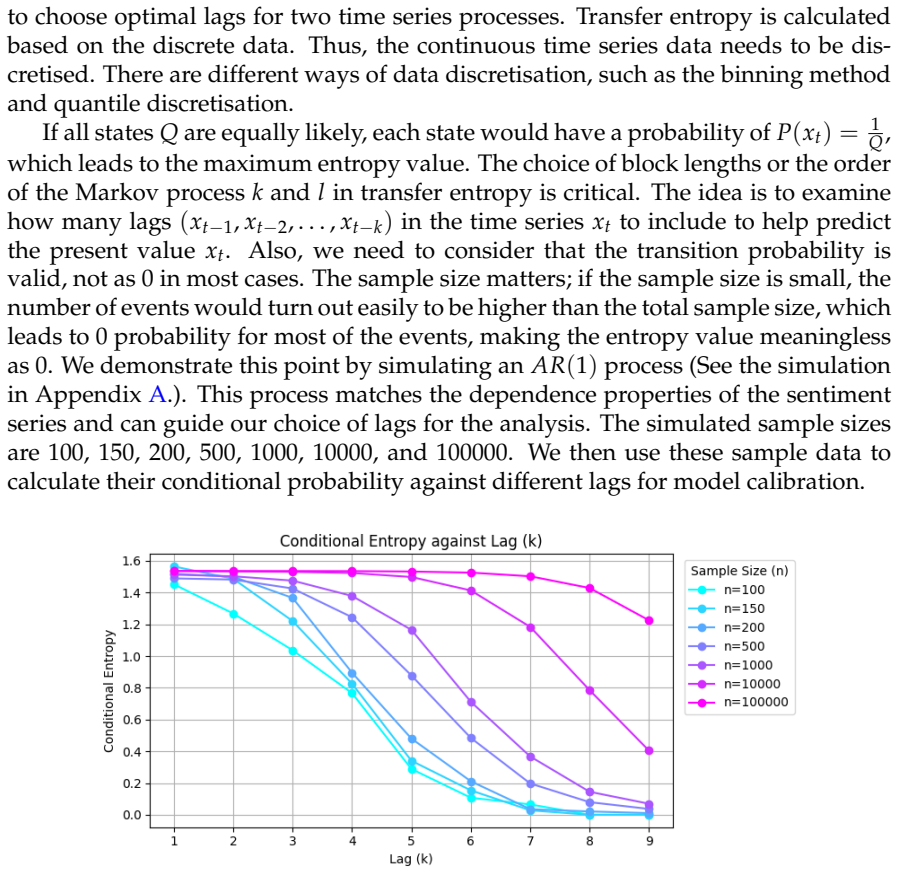
Investor sentiment reflects the collective attitude of investors towards the asset, whether positive, negative or neutral. Market information, such as news and relevant social media posts, plays a significant role in shaping investor sentiment, which influences investment decisions accordingly. The sentiment for one single company may spill over to other relevant companies which are in the same industry. The information spillover network pattern between news and social media may also differ, as they are two different media sources. In this study, we introduce a network-based transfer entropy method to measure and compare the information transmission of news and social media sentiment across the technology companies. We examine whether and to what extent sentiment information from one company can transfer to other companies, and how different the spillover effect is for news and social media. The result signifies a stronger intensity of news information flow among the tech companies after COVID-19. We also highlight the companies which act as information hubs in the sentiment network. Furthermore, we identify the companies which lead the strongest information flow chain. Overall, this study provides a novel perspective in modelling sentiment spillover under two different media sources, and we find that news and social media show a different information transmission pattern during the studied period.
0
0
q-fin.MF 2026-04-30

News sentiment networks intensify among tech firms after COVID-19

Do News and Social Media Tell the Same Story? Constructing and Comparing Sentiment Spillover Networks

Transfer entropy reveals stronger news flows and different hub structures compared to social media during the studied period.

Figure from the paper full image
abstract click to expand
Investor sentiment reflects the collective attitude of investors towards the asset, whether positive, negative or neutral. Market information, such as news and relevant social media posts, plays a significant role in shaping investor sentiment, which influences investment decisions accordingly. The sentiment for one single company may spill over to other relevant companies which are in the same industry. The information spillover network pattern between news and social media may also differ, as they are two different media sources. In this study, we introduce a network-based transfer entropy method to measure and compare the information transmission of news and social media sentiment across the technology companies. We examine whether and to what extent sentiment information from one company can transfer to other companies, and how different the spillover effect is for news and social media. The result signifies a stronger intensity of news information flow among the tech companies after COVID-19. We also highlight the companies which act as information hubs in the sentiment network. Furthermore, we identify the companies which lead the strongest information flow chain. Overall, this study provides a novel perspective in modelling sentiment spillover under two different media sources, and we find that news and social media show a different information transmission pattern during the studied period.
0
0
q-fin.MF 2026-04-29

LOV model auto-calibrates to European options with path flexibility

Pricing with Passion: The Local Occupied Volatility (LOV) Model

Tuning the occupation sensitivity function lets it capture extra volatility facts while keeping vanilla calibration exact.

Figure from the paper full image
abstract click to expand
We introduce the Local Occupied Volatility (LOV) model that sits between Dupire's local volatility and fully path-dependent dynamics. By design, the LOV model ensures automatic calibration to European vanilla options, while offering the flexibility to capture stylized facts of volatility or fit additional instruments. This is achieved by tuning the occupation sensitivity function that quantifies the effect of path-dependent shocks on volatility. We validate the model through the joint American-European calibration of options chain on non-dividend paying stocks.
0
0
q-fin.MF 2026-04-28

Kelly optimization accuracy follows a sigmoid scaling law

Efficient Multivariate Kelly Optimization Reveals Sigmoidal Scaling Laws

Decomposition methods solve hundreds of simultaneous bets and show that the gap between bounds shrinks predictably with relative subproblem

Figure from the paper full image
abstract click to expand
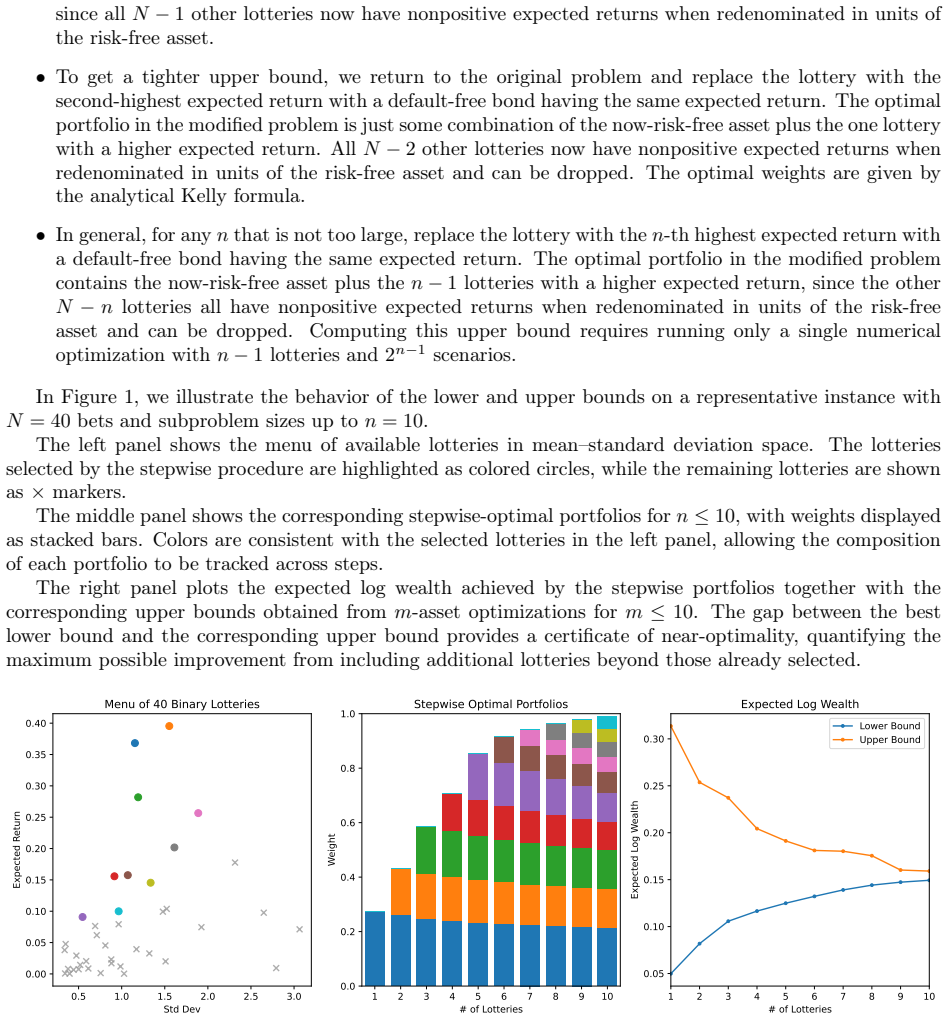
For a sequence of binary bets, the Kelly criterion provides a closed-form solution that maximizes the expected growth rate of wealth. In contrast, when multiple bets are placed simultaneously (e.g., in portfolio allocation or prediction markets), the optimal Kelly strategy generally requires numerical optimization over a joint outcome space. A naive formulation scales exponentially in the number of bets, requiring $O(2^N)$ time and memory for $N$ simultaneous wagers, which restricts existing methods to small problem sizes. We present two complementary methods that dramatically extend the scale of multivariate Kelly problems that can be solved. First, in the case of independent bets, we introduce an integral transform formulation that eliminates explicit enumeration of outcomes, reducing the computational complexity of evaluating the objective from $O(2^N)$ to $O(N)$. Combined with numerically stable quadrature, this enables accurate solutions for problems involving hundreds of bets. Second, we develop a decomposition-based approach that constructs and solves carefully chosen subproblems, yielding feasible lower bounds and infeasible upper bounds on the optimal growth rate. This provides a practical mechanism for quantifying worst-case suboptimality as a function of subproblem size. Together, these methods make it possible to study the large-$N$ regime of the multivariate Kelly problem. Using synthetic data inspired by prediction markets, we show that the relationship between subproblem size and solution accuracy follows a simple and highly regular scaling law. In particular, the shortfall ratio between the lower and upper bounds is well-approximated by a sigmoid function of the relative subproblem size, with parameters that can be predicted from low-dimensional summary statistics of the problem.
0
0
q-fin.MF 2026-04-28

Implied volatility solved explicitly via inverse Gaussian quantile

An Explicit Solution to Black-Scholes Implied Volatility

The Black-Scholes call price is rewritten as an inverse Gaussian survival probability, so volatility is recovered by applying its quantile,

Figure from the paper full image
abstract click to expand
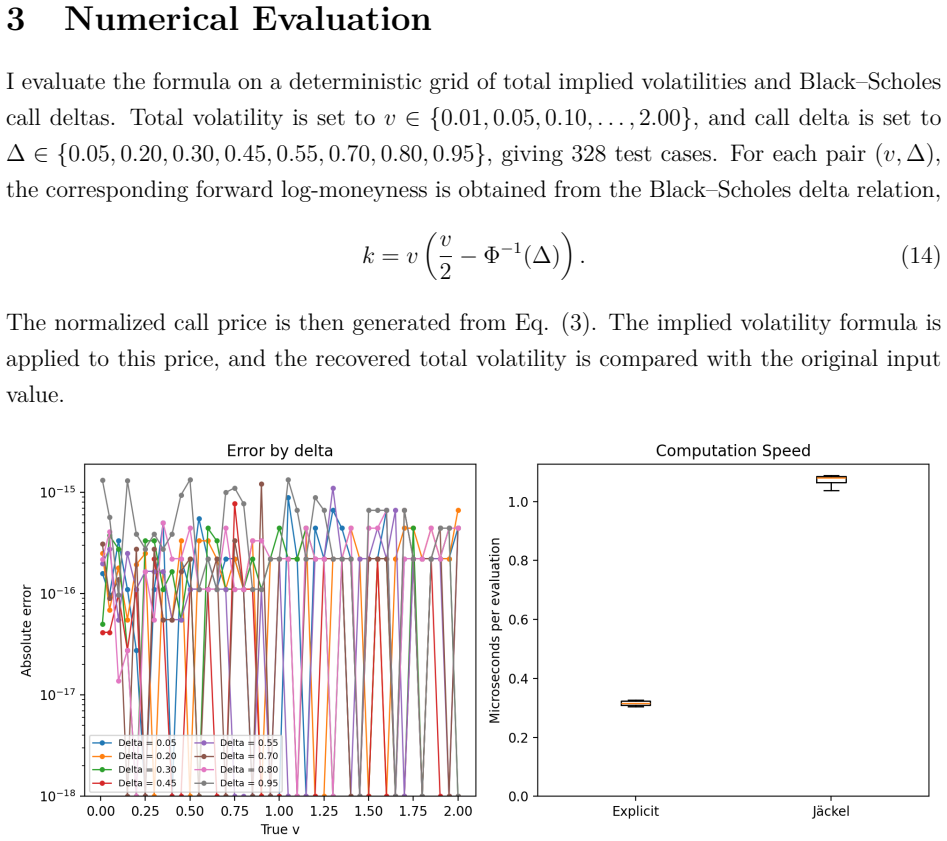
This paper observes that the Black--Scholes call price can be written as the survival probability of an inverse Gaussian distribution, equivalently as a probability in variance space. Inverting this representation yields an analytically explicit formula for implied volatility in terms of the corresponding inverse Gaussian quantile function, with volatility on the left-hand side and only observable option inputs on the right-hand side. Numerical tests recover implied volatility to machine precision and, in a controlled setting, show the formula to be faster than a state-of-the-art benchmark.
0
0
q-fin.MF 2026-04-27

Truncated Gaussian policies optimize entropy-regularized portfolios under volatility

Optimal Investment and Entropy-Regularized Learning Under Stochastic Volatility Models with Portfolio Constraints

The optimal exploratory strategy emerges from spatial derivatives of the solution to a nonlinear quasilinear PDE.

Figure from the paper full image
abstract click to expand
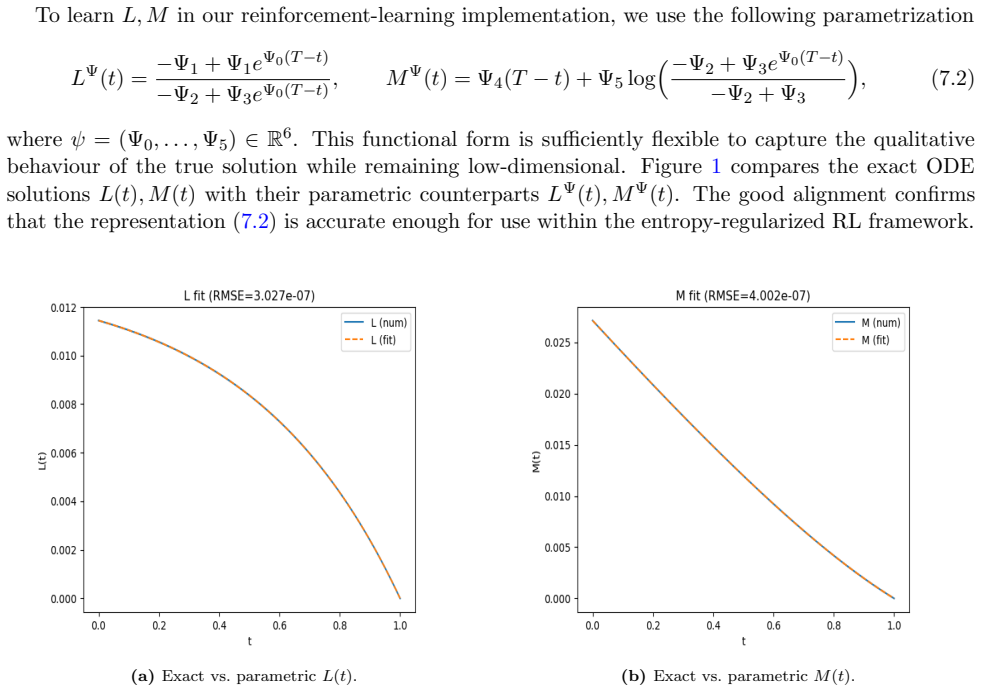
We study the problem of optimal portfolio selection under stochastic volatility within a continuous time reinforcement learning framework with portfolio constraints. Exploration is modeled through entropy-regularized relaxed controls, where the investor selects probability distributions over admissible portfolio allocations rather than deterministic strategies. Using dynamic programming arguments, we derive the associated entropy-regularized Hamilton-Jacobi-Bellman equation, whose Hamiltonian involves optimization over probability measures supported on a compact control set. We show that the optimal exploratory policy takes the form of a truncated Gaussian distribution characterized by spatial derivatives of the solution of the resulting nonlinear quasilinear parabolic partial differential equation. Under suitable structural conditions on the model coefficients, we prove the existence of classical solutions to this nonlinear HJB equation for the value function. We then establish a verification theorem and analyze the policy-improvement structure induced by the entropy-regularized Hamiltonian, showing how the resulting sequence of PDEs provides a continuous-time interpretation of actor-critic learning dynamics. Finally, our PDE analysis with a semi-closed form of optimal value and optimal policy enables the design of an implementable reinforcement learning algorithm by recasting the optimal problem in a martingale framework.
0
0
q-fin.MF 2026-04-24

Linear M&A contracts cost more and allow broker manipulation

Pricing and Hedging Financial Derivatives in Merger\&Acquisition Deals with Price Impact

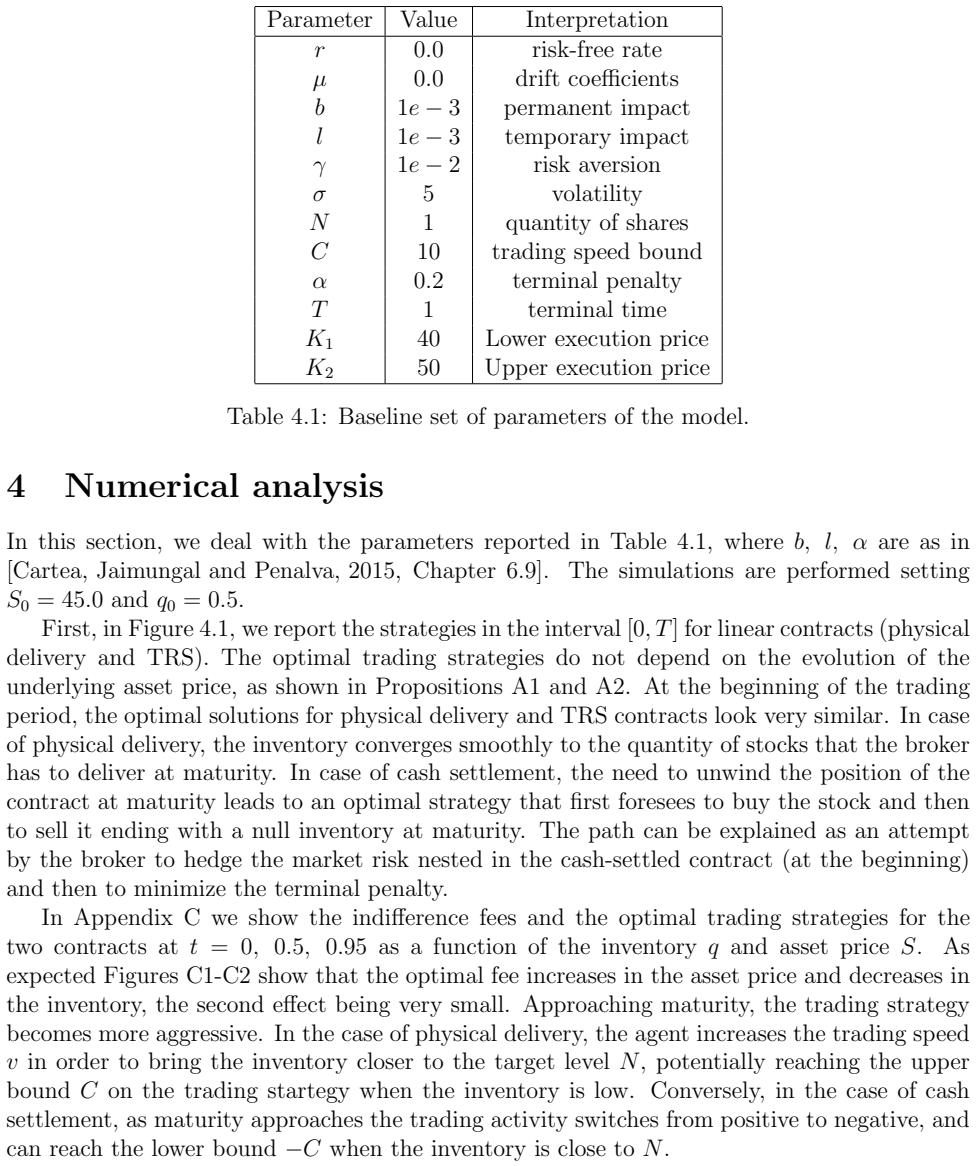
Under linear price impact, cash-settled total return swaps lead to higher fees and greater statistical arbitrage risks than collars or TWAP

Figure from the paper full image
abstract click to expand
We investigate the optimal execution of contracts that are used in merger\&acquisition deals. We consider cash-settled and physically delivered contracts between a broker and a counterpart. Contracts are linear (total returns swaps), nonlinear (collar contracts) or Asian type (TWAP based contracts). We derive the optimal execution strategy and the optimal fee through indifference utility arguments allowing for linear market effects of trades. We show that linear cash-settled contracts are more expensive and more exposed to manipulation/statistical arbitrages by the broker. Also nonlinear and Asian type contracts are exposed to these phenomena.
0
0
q-fin.MF 2026-04-21

Best Estimates for lifelong health insurance vary with rate models

On the market-consistent valuation of health insurance liabilities

Lifelong policies with inflation adjustments yield different market-consistent values depending on chosen stochastic dynamics for interest,

Figure from the paper full image
abstract click to expand
We are concerned with the market-consistent valuation of lifelong health insurance products, which are subject to adjustments derived from the actuarial equivalence principle and driven by (medical) inflation. Such products are well-established in the European national markets, and the dynamics of the adjustment mechanism is well-understood from an actuarial perspective. However, the question of market-consistent valuation (as is necessary for Solvency II reporting) has not previously been addressed. This gap has led to a situation where some practitioners use stochastic models while others rely on deterministic methods to assign market-consistent values (Best Estimates) to the same type of health insurance liabilities. The purpose of this note is to fill this gap by showing that the Best Estimate of a lifelong health insurance policy depends on the choice of model for the interest and inflation rates. That is, the Best Estimate is not uniquely determined by the currently prevailing term structures of nominal and real spot rates, whence a deterministic calculation is theoretically unjustified. Furthermore, we construct a valuation portfolio such that the Best Estimate valuation decouples into calculations of 1.) deterministic coefficients derived from policy data and 2.) the prices of basis financial instruments that are independent of the individual policy data. Using this decomposition, the policies do not have to be tracked individually along each generated stochastic path. This allows for a more efficient evaluation of the Best Estimate for a large stock of policies with a stochastic model.
0
0
q-fin.MF 2026-04-14 2 theorems

Regulator mechanisms cut herding and lift welfare in investment games

Mechanism Design for Investment Regulation under Herding

A leader-follower model solved by optimal control yields enforceable rules that reduce imitation and raise total market outcomes.

abstract click to expand
Herding, where investors imitate others' decisions rather than relying on their own analysis, is a prevalent phenomenon in financial markets. Excessive herding distorts rational decisions, amplifies volatility, and can be exploited by manipulators to harm the market. Traditional regulatory tools, such as information disclosure and transaction restrictions, are often imprecise and lack theoretical guarantees for effectiveness. This calls for a quantitative approach to regulating herding. We propose a regulator-leader-follower trilateral game framework based on optimal control theory to study the complex dynamics among them. The leader makes rational decisions, the follower maximizes utility while aligning with the leader's decisions, whereas the regulator designs a mechanism to maximize social welfare and minimize regulatory cost. We derive the follower's decisions and the regulator's mechanisms, theoretically analyze the impact of regulation on decisions, and investigate effective mechanisms to improve social welfare.
0
0
q-fin.MF 2026-04-13

Non-trivial holonomy in filtrations yields self-financing arbitrage

Aharanov-Bohm Type Arbitrage and Homological Obstructions in Financial Markets

Global loop effects from conditional expectations become predictable trading strategies under admissibility conditions.

abstract click to expand
We introduce a new perspective on arbitrage based on global loop effects in filtered market systems, providing a conceptual extension of classical arbitrage theory beyond local consistency conditions. Given a filtration modeled as a contravariant functor $F : \mathcal{T}^{op} \to \mathrm{Prob}$, we consider the associated conditional expectation functor $\mathcal{E} \circ F$ and show that it induces a canonical multiplicative distortion $dF(i) := (\mathcal{E} \circ F)(i)(1)$, which measures the failure of constant functions to be preserved under non-measure-preserving transitions. We define the holonomy of $dF$ along loops in $\mathcal{T}$ and interpret non-trivial holonomy as a global inconsistency that is invisible at the level of individual transitions. This leads to a notion of Aharonov--Bohm (AB) arbitrage, in which arbitrage arises from loop effects rather than local price discrepancies. We further show that, under suitable admissibility conditions, non-trivial holonomy can be converted into a predictable self-financing trading strategy. This establishes a connection between cohomological structures and economically realizable arbitrage, highlighting the role of global invariants in the structure of financial markets.
1 0
0
q-fin.MF 2026-04-13

Long-only min-var portfolio supported only on betas above a positive threshold

The Long-Only Minimum Variance Portfolio in a One-Factor Market: Theory and Asymptotics

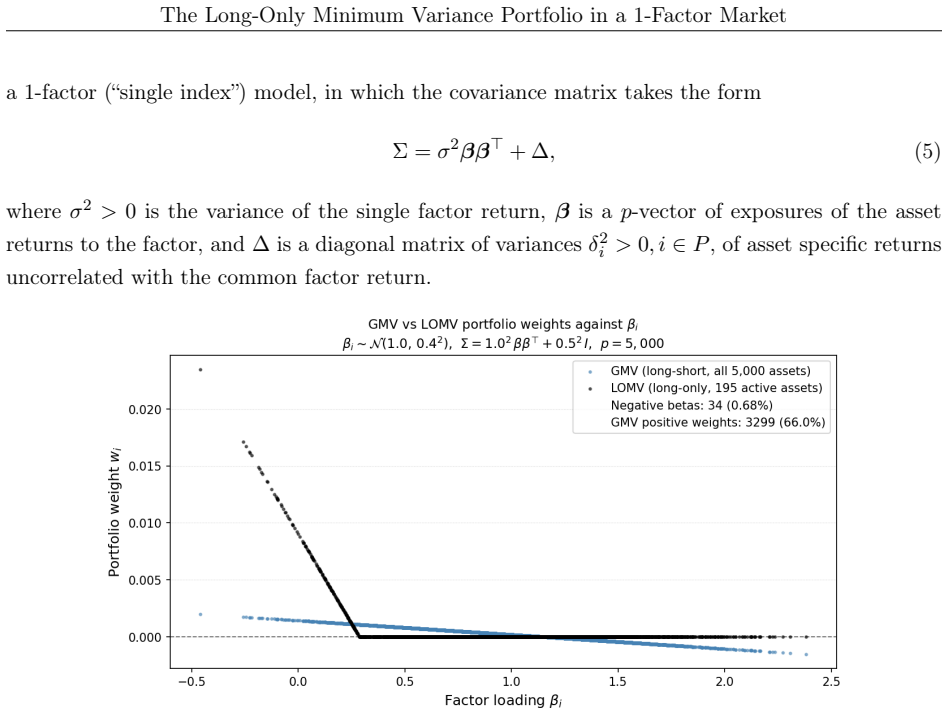
In the high-dimensional one-factor limit the active fraction converges to F evaluated at the root of an explicit integral equation.

Figure from the paper full image
abstract click to expand
We study the long-only minimum variance (LOMV) portfolio under a one-factor covariance model with asset betas of arbitrary sign. We provide an explicit solution in terms of the set of active (positive weight) assets, and provide an explicit and computable characterization of the active set. As a corollary we resolve an open question of \citet{qi2021} concerning the extension to mixed-sign betas. In the high-dimensional regime $p \to \infty$ where the betas are drawn from a distribution with cdf $F$, we prove that the proportion of active assets (the active ratio) in the LOMV portfolio converges in almost all cases to $F(\beta^{*})$, where $\beta^* \geq 0$ is the root of an explicit integral equation determined by $F$. This is a variation of a result first appearing in \citet{bernstein2025}. In particular, when $F$ is continuous and all betas are positive ($F(0)=0$), the active ratio converges to zero. When $F(0) >0$ is small, under mild moment conditions and concentration bounds we establish the convergence rate $F(\beta^*)=O(F(0)^{1/3})$ as $F(0) \to 0$.
0
0
q-fin.MF 2026-04-13 2 theorems

Closed-form solutions give optimal annuitization times under health shocks

Optimal Annuitization Time under a Mortality Shock

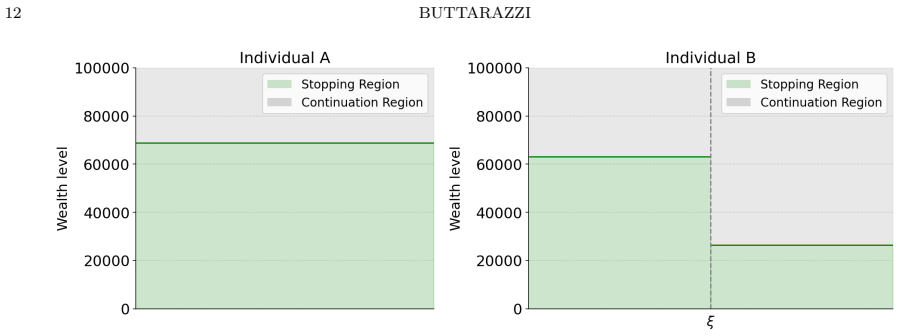
Formulas show how the risk of sudden health decline changes when to convert retirement wealth into annuity payments.

Figure from the paper full image
abstract click to expand
In this paper, we derive explicit closed-form solutions for the value function and the associated optimal stopping boundaries in an optimal annuitization problem under a mortality shock. We consider an individual whose retirement wealth is invested in a financial fund following the dynamics of a geometric Brownian motion and has the option at any time to irreversibly convert their wealth into a life annuity. The individual faces a sudden, permanent health deterioration occurring at a random, exponentially distributed time, and the annuitization decision is modelled as an optimal stopping problem across two health states. Our analytical expressions characterise both the value function and the optimal timing of annuitization. The results provide clear economic intuition: the optimal strategy is governed by the critical interplay between the relative attractiveness of the annuity (money's worth), the financial returns from the investment fund, and bequest motives across different health states. A numerical analysis compares the optimal annuitization strategy of an individual facing a health shock against a benchmark case with constant mortality, highlighting how the likelihood and severity of a health shock significantly alter optimal annuitization behaviour.
0
0
q-fin.MF 2026-04-06 2 theorems

Condition reveals when cooperation boosts all agents' utilities

When cooperation is beneficial to all agents

Necessary and sufficient criterion links strict utility gains to compatibility with collective pricing measures in semimartingale markets.

Figure from the paper full image
abstract click to expand
Within a general semimartingale framework, we study the relationship between collective market efficiency and individual rationality. We derive a necessary and sufficient condition for the existence of (possibly zero-sum) exchanges among agents that strictly increase their indirect utilities and characterize this condition in terms of the compatibility between agents' preferences and collective pricing measures. The framework applies to both continuous- and discrete-time models and clarifies when cooperation leads to a strict improvement in each participating agent's indirect utility.
0

browse all of q-fin.MF โ†’ full archive ยท search ยท sub-categories