Recognition: unknown
Exact Flatness Constant for One-Point Convex Bodies and the Discrete Isominwidth Problem: The Planar Case
Pith reviewed 2026-05-07 10:24 UTC · model grok-4.3
The pith
Any planar convex body with at most one interior lattice point has lattice width at most 3.
A machine-rendered reading of the paper's core claim, the machinery that carries it, and where it could break.
Core claim
The authors show that Flt(2,1) = 3. Every convex body in R^2 with at most one interior lattice point therefore has lattice width at most 3, and this value is tight. The proof combines supporting-line arguments with enumeration of possible interior-point configurations to obtain both the upper bound and matching examples.
What carries the argument
The flatness constant Flt(d,k), the supremum of lattice widths taken over all convex bodies in R^d that contain at most k interior lattice points.
If this is right
- The exact value yields an isominwidth inequality that bounds the lattice-point enumerator of any planar convex body from below by a function of its isominwidth.
- It confirms the planar case of the discrete isominwidth problem.
- It supplies the missing exact constant needed to relate the classical flatness problem to Makai's conjectural dual form of Minkowski's theorem.
Where Pith is reading between the lines
- The width bound could be used to restrict the feasible region in 2D integer linear programs before enumeration.
- The same geometric technique might determine Flt(3,1) or the value for other small k in the plane.
- It constrains the possible areas and shapes of convex bodies that are nearly lattice-point free.
Load-bearing premise
Convex bodies are closed sets in the plane and the lattice is the standard integer lattice Z^2, with width measured as the minimum distance between parallel supporting lines.
What would settle it
A single closed convex set in the plane that contains at most one interior integer point yet has lattice width 4 or greater would disprove the equality.
Figures







read the original abstract
A variant of the flatness problem from integer programming is studied, in which one considers convex bodies in $\mathbb{R}^d$ with at most $k$ interior lattice points. The maximum lattice width of such a body is denoted by Flt(d,k) and it is related to the classical flatness constant as well as a conjectural dual version of Minkowski's convex body theorem due to Makai. Moreover, it is shown that Flt(2, 1) = 3, i.e., any planar convex body with at most one interior point has lattice width at most three. This leads to an isominwidth inequality for the lattice point enumerator of planar convex bodies.
Editorial analysis
A structured set of objections, weighed in public.
Referee Report
Summary. The manuscript defines Flt(d,k) as the maximum lattice width attained by any convex body in R^d with at most k interior lattice points. It proves that Flt(2,1)=3, i.e., every planar convex body with at most one interior lattice point has lattice width at most 3. The upper bound is established by exhaustive case analysis of the possible positions of the (at most one) interior point relative to a minimal-width direction; sharpness is shown by an explicit example attaining width exactly 3. The result is applied to obtain an isominwidth inequality relating the lattice-point enumerator of planar convex bodies to their minimal width.
Significance. If the result holds, it supplies the exact flatness constant for the one-interior-point case in the plane, resolving a concrete instance of the flatness problem and its discrete isominwidth variant. The proof relies on elementary convex geometry and exhaustive enumeration of configurations in Z^2, together with an explicit attaining example; these elements constitute a self-contained and verifiable argument. The derived inequality provides a new quantitative relation between width and lattice-point count that may be useful in integer programming and discrete geometry.
minor comments (3)
- [§2] §2: The definition of lattice width via supporting lines is standard but should be recalled with the explicit formula w_L(K) = min_{u in Z^2, ||u||=1} (max <x,u> - min <x,u>) to make the subsequent case analysis self-contained for readers outside the immediate subfield.
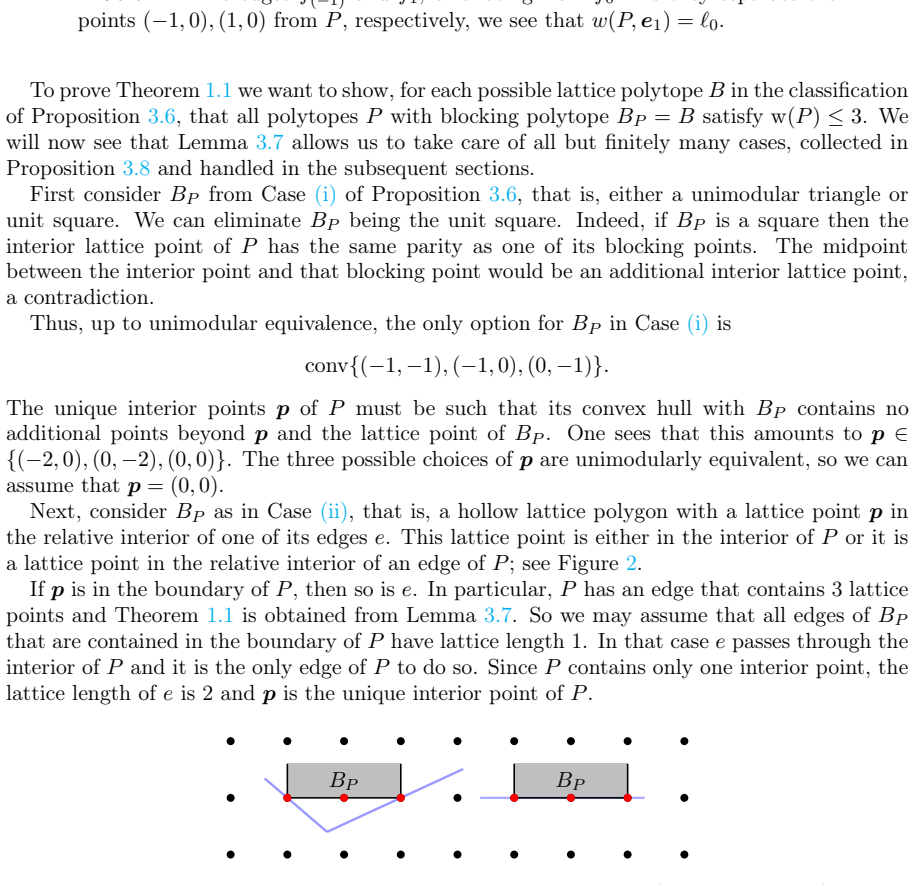
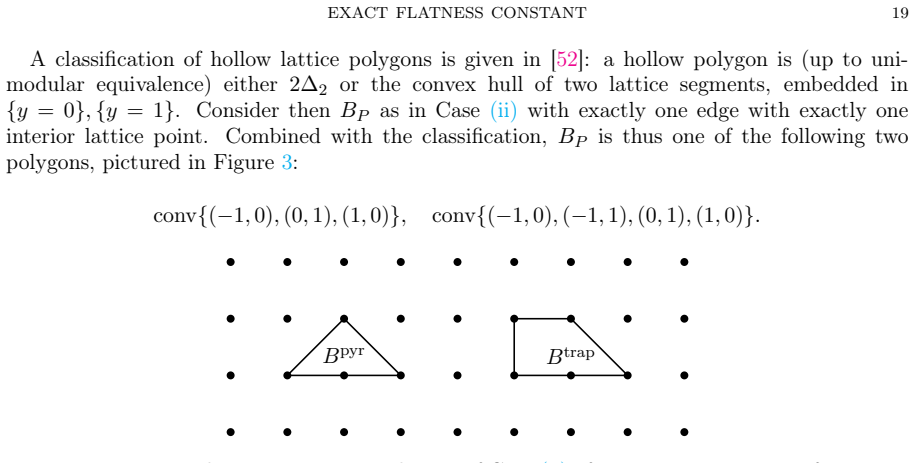
- [Theorem 1.1 and §4] Theorem 1.1 and the example in §4: The attaining body (a specific polygon with one interior point) is described geometrically; adding the explicit vertex coordinates and verification that it contains exactly one interior lattice point would allow immediate independent checking of sharpness.
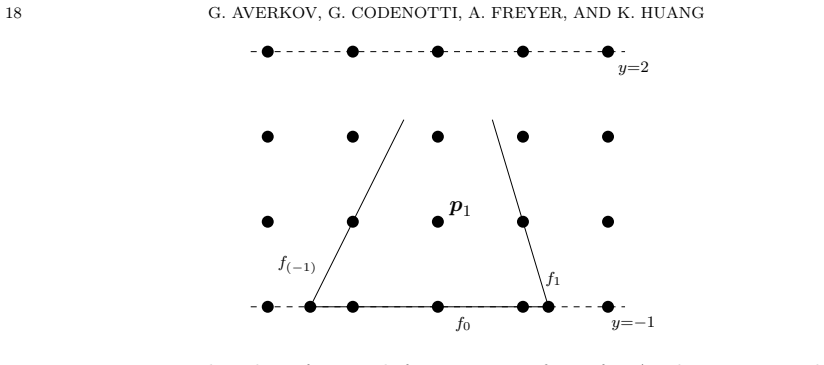
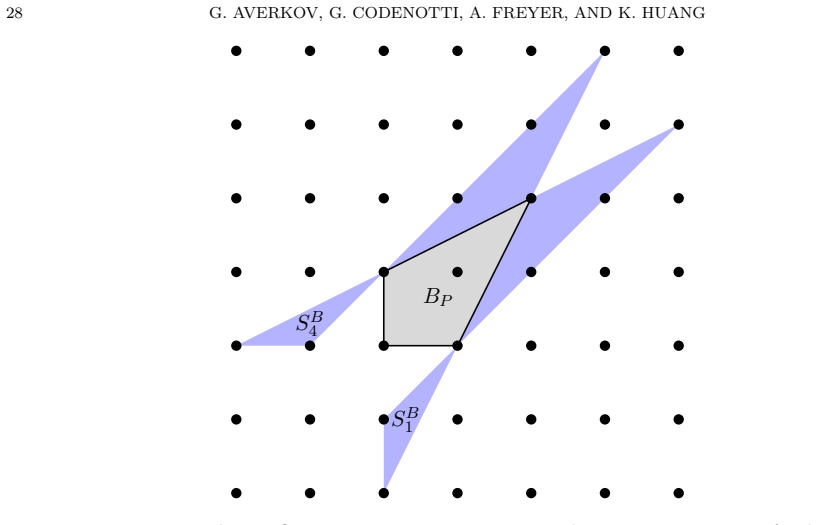
- [Figure 1] Figure 1 (case-analysis diagram): The diagram illustrating the relative positions of the interior point is useful, but the arrows indicating the minimal-width direction and the lattice points should be labeled more clearly to match the textual cases.
Simulated Author's Rebuttal
We thank the referee for their careful reading, positive evaluation, and recommendation of minor revision. The report accurately summarizes the main result establishing Flt(2,1)=3 and its applications. No specific major comments were raised in the report.
Circularity Check
No significant circularity identified
full rationale
The manuscript proves the central claim Flt(2,1)=3 via an exhaustive case analysis of the possible positions of the (at most one) interior lattice point relative to a minimal-width direction, together with an explicit convex body attaining width exactly 3. This argument rests only on the standard definitions of lattice width, supporting hyperplanes, and convex bodies in the plane with respect to Z^2; no quantity is fitted to data and then renamed as a prediction, no self-citation supplies a load-bearing uniqueness theorem or ansatz, and the equality is not obtained by construction from the inputs. Prior conjectures are cited only for context and do not enter the derivation chain.
Axiom & Free-Parameter Ledger
axioms (3)
- standard math Convex bodies are closed subsets of R^d that contain the line segment between any two of their points.
- standard math The lattice is the standard integer lattice Z^d with the usual Euclidean norm for width calculations.
- domain assumption Lattice width is defined via the minimum over integer directions of the difference between supporting hyperplanes.
Reference graph
Works this paper leans on
-
[1]
Alexander, M
M. Alexander, M. Henk, and A. Zvavitch. A discrete version of Koldobsky’s slicing inequality.Israel J. Math., 222(1):261–278, 2017
2017
-
[2]
A. Aliev. The exact bound for the reverse isodiametric problem in 3-space.Rev. R. Acad. Cienc. Exactas Fís. Nat. Ser. A Mat. RACSAM, 118(3):Paper No. 111, 22, 2024
2024
-
[3]
Alonso-Gutiérrez, E
D. Alonso-Gutiérrez, E. Lucas, and J. Yepes Nicolás. On Rogers-Shephard-type inequalities for the lattice point enumerator.Commun. Contemp. Math., 25(8):Paper No. 2250022, 30, 2023
2023
-
[4]
Ambro and A
F. Ambro and A. Ito. Successive minima of line bundles.Adv. Math., 365:107045, 38, 2020. EXACT FLATNESS CONSTANT 43
2020
-
[5]
G. Averkov. A proof of Lovász’s theorem on maximal lattice-free sets.Beitr. Algebra Geom., 54(1):105–109, 2013
2013
-
[6]
Averkov, A
G. Averkov, A. Basu, and J. Paat. Approximation of corner polyhedra with families of intersection cuts. SIAM Journal on Optimization, 28(1):904–929, 2018
2018
-
[7]
Averkov, G
G. Averkov, G. Codenotti, A. Macchia, and F. Santos. A local maximizer for lattice width of 3-dimensional hollow bodies.Discrete Applied Mathematics, 298:129–142, 2021
2021
-
[8]
Averkov, M
G. Averkov, M. Conforti, A. Del Pia, M. Di Summa, and Y. Faenza. On the convergence of the affine hull of the chvátal–gomory closures.SIAM Journal on Discrete Mathematics, 27(3):1492–1502, 2013
2013
-
[9]
Averkov, B
G. Averkov, B. González Merino, I. Paschke, M. Schymura, and S. Weltge. Tight bounds on discrete quan- titative Helly numbers.Adv. Math., 89:76–101, 2017
2017
-
[10]
Averkov, J
G. Averkov, J. Hofscheier, and B. Nill. Generalized flatness constants, spanning lattice polytopes, and the Gromov width.Manuscripta Math., 170(1-2):147–165, 2023
2023
-
[11]
Averkov, J
G. Averkov, J. Krümpelmann, and S. Weltge. Notions of maximality for integral lattice-free polyhedra: the case of dimension three.Mathematics of Operations Research, 42(4):1035–1062, 2017
2017
-
[12]
Averkov, C
G. Averkov, C. Wagner, and R. Weismantel. Maximal lattice-free polyhedra: finiteness and an explicit description in dimension three.Mathematics of Operations Research, 36(4):721–742, 2011
2011
-
[13]
E. Balas. Integer programming and convex analysis: Intersection cuts from outer polars.Mathematical Programming, 2(1):330–382, 1972
1972
-
[14]
Balas.Disjunctive programming
E. Balas.Disjunctive programming. Springer, 2018
2018
-
[16]
Banaszczyk
W. Banaszczyk. Inequalities for convex bodies and polar reciprocal lattices inRn.Discrete Comput. Geom., 13(2):217–231, 1995
1995
-
[17]
Banaszczyk
W. Banaszczyk. Inequalities for convex bodies and polar reciprocal lattices inRn. II. Application ofK- convexity.Discrete Comput. Geom., 16(3):305–311, 1996
1996
-
[18]
Banaszczyk, A
W. Banaszczyk, A. E. Litvak, A. Pajor, and J. Stanislaw. The flatness theorem for nonsymmetric convex bodies via the local symmetry of Banach spaces.Math. Oper. Res., 24(3):728–750, 1999
1999
-
[19]
Bárány and Z
I. Bárány and Z. Füredi. On the lattice diameter of a convex polygon.Discrete Math., 241(1-3):41–50, 2001
2001
-
[20]
Bochnak, M
J. Bochnak, M. Coste, and M.-F. Roy.Real algebraic geometry, volume 36. Springer Science & Business Media, 2013
2013
-
[21]
M. Bohnert and J. Springer. Classifying rational polygons with small denominator and few interior lattice points.arXiv preprint arXiv:2410.17244, 2024
-
[22]
Codenotti and A
G. Codenotti and A. Freyer. Lattice reduced and complete convex bodies.J. Lond. Math. Soc. (2), 110(4):Pa- per No. e12982, 39, 2024
2024
-
[23]
Codenotti, T
G. Codenotti, T. Hall, and J. Hofscheier. Generalised flatness constants: A framework applied in dimension
- [24]
-
[25]
Codenotti and F
G. Codenotti and F. Santos. Hollow polytopes of large width.Proc. Am. Math. Soc., 148:1, 06 2019
2019
-
[26]
Conforti, G
M. Conforti, G. Cornuéjols, and G. Zambelli. Integer programming models. InInteger Programming, pages 45–84. Springer, 2014
2014
-
[27]
D. A. Cox, J. B. Little, and D. O’Shea. Ideals, varieties, and algorithms.American Mathematical Monthly, 101:656, 2025
2025
-
[28]
Dadush.Integer programming, lattice algorithms, and deterministic volume Estimation
D. Dadush.Integer programming, lattice algorithms, and deterministic volume Estimation. Georgia Institute of Technology, USA, 2012
2012
-
[29]
S. Dash, N. B. Dobbs, O. Günlük, T. J. Nowicki, and G. M. Świrszcz. Lattice-free sets, multi-branch split disjunctions, and mixed-integer programming.Mathematical Programming, 145(1):483–508, 2014
2014
-
[30]
Fejes Tóth and E
L. Fejes Tóth and E. Makai, Jr. On the thinnest non-separable lattice of convex plates.Studia Sci. Math. Hungar., 9:191–193, 1974
1974
-
[31]
Freyer and M
A. Freyer and M. Henk. Bounds on the lattice point enumerator via slices and projections.Discrete Comput. Geom., 67:895–918, 2022
2022
-
[32]
Freyer and M
A. Freyer and M. Henk. Polynomial bounds in Koldobsky’s discrete slicing problem.Proc. Amer. Math. Soc., 152(7):3063–3074, 2024
2024
-
[33]
Freyer and E
A. Freyer and E. Lucas. Interpolating between volume and lattice point enumerator with successive minima. Monatsh. Math., 198:717–740, 2022
2022
-
[34]
Gardner, P
R. Gardner, P. Gronchi, and C. Zong. Sums, projections, and sections of lattice sets, and the discrete covariogram.Discrete Comput. Geom., 34(2):391–409, 2005
2005
-
[35]
R. J. Gardner and P. Gronchi. A Brunn-Minkowski inequality for the integer lattice.Trans. Amer. Math. Soc., 353(10):3995–4024, 2001
2001
-
[36]
Griva, S
I. Griva, S. G. Nash, and A. Sofer.Linear and Nonlinear Optimization 2nd Edition. Society for Industrial and Applied Mathematics, Philadelphia, PA, 2008. 44 G. A VERKOV, G. CODENOTTI, A. FREYER, AND K. HUANG
2008
-
[37]
P. M. Gruber and C. G. Lekkerkerker.Geometry of Numbers. North-Holland, second edition, 1987
1987
-
[38]
Haase and J
C. Haase and J. Schicho. Lattice polygons and the number 2i + 7.The American Mathematical Monthly, 116(2):151–165, 2009
2009
-
[39]
Halikias, B
D. Halikias, B. Klartag, and B. A. Slomka. Discrete variants of Brunn-Minkowski type inequalities.Ann. Fac. Sci. Toulouse Math. (6), 30(2):267–279, 2021
2021
-
[40]
D.Hättig, J.Hausen, andJ.Springer.Classifyinglogdelpezzosurfaceswithtorusaction.Revista Matemática Complutense, pages 1–74, 2025
2025
-
[41]
Henk and F
M. Henk and F. Xue. On successive minima-type inequalities for the polar of a convex body.Rev. R. Acad. Cienc. Exactas Fís. Nat. Ser. A Mat. RACSAM, 113(3):2601–2616, 2019
2019
-
[42]
Old and recent problems for a new generation
A. G. Horváth. On convex bodies that are characterizable by volume function. “Old and recent problems for a new generation”: a survey.Arnold Math. J., 6(1):1–20, 2020
2020
-
[43]
C. A. J. Hurkens. Blowing up convex sets in the plane.Linear Algebra Appl., 134:121–128, 1990
1990
-
[44]
Iglesias, J
D. Iglesias, J. Yepes Nicolás, and A. Zvavitch. Brunn-Minkowski type inequalities for the lattice point enumerator.Adv. Math., 370:107193, 25, 2020
2020
-
[45]
Iglesias-Valiño and F
Ó. Iglesias-Valiño and F. Santos. Classification of empty lattice 4-simplices of width larger than 2.Trans. Amer. Math. Soc., 371:6605–6625, 2019
2019
-
[46]
R.KannanandL.Lovasz.Coveringminimaandlattice-point-freeconvexbodies.Ann. Math. (2), 128(3):577– 602, 1988
1988
-
[47]
H. W. Lenstra. Integer programming with a fixed number of variables.Math. Oper. Res., 8(4):538–548, 1983
1983
-
[48]
Lovász.Geometry of numbers and integer programming, pages 177–201
L. Lovász.Geometry of numbers and integer programming, pages 177–201. Kluwer Academic Publishers, 1989
1989
-
[49]
Makai, Jr
E. Makai, Jr. On the thinnest nonseparable lattice of convex bodies.Studia Sci. Math. Hungar., 13(1-2):19– 27, 1978
1978
-
[50]
Mayrhofer, J
L. Mayrhofer, J. Schade, and S. Weltge. Lattice-free simplices with lattice width2d−o(d). InInteger Programming and Combinatorial Optimization: 23rd International Conference, IPCO 2022, Eindhoven, The Netherlands, June 27–29, 2022, Proceedings, page 375–386, Berlin, Heidelberg, 2022. Springer-Verlag
2022
-
[51]
S. Mori, D. R. Morrison, and I. Morrison. On four-dimensional terminal quotient singularities.Mathematics of computation, 51(184):769–786, 1988
1988
-
[52]
J. Pál. Ein Minimierungsproblem für Ovale.Math. Ann., 83:311–319, 1921
1921
-
[53]
Rabinowitz
S. Rabinowitz. A census of convex lattice polygons with at most one interior lattice point.Ars Combinatoria, 28, 01 1989
1989
-
[54]
Reis and T
V. Reis and T. Rothvoss. The subspace flatness conjecture and faster integer programming. In2023 IEEE 64th Annual Symposium on Foundations of Computer Science—FOCS 2023, pages 974–988. IEEE Computer Soc., Los Alamitos, CA, [2023]©2023
2023
-
[55]
Scheiderer.A course in real algebraic geometry
C. Scheiderer.A course in real algebraic geometry. Springer, 2024
2024
-
[56]
Schneider.Convex bodies: The Brunn-Minkowski Theory
R. Schneider.Convex bodies: The Brunn-Minkowski Theory. Cambridge University press, second expanded edition, 2014
2014
-
[57]
https://www.sagemath.org
The Sage Developers.SageMath, the Sage Mathematics Software System (Version 9.4), 2022. https://www.sagemath.org. FU Berlin, AG Diskrete Geometrie und Topologische Kombinatorik, Arnimallee 2, 14195 Berlin, Germany Email address:{giulia.codenotti, a.freyer}@fu-berlin.de Brandenburg University of Technology Cottbus-Senftenberg, Platz der Deutschen Einheit 1...
2022
discussion (0)
Sign in with ORCID, Apple, or X to comment. Anyone can read and Pith papers without signing in.