Recognition: unknown
Pragmos: A Process Agentic Modeling System
Pith reviewed 2026-05-07 10:14 UTC · model grok-4.3
The pith
A hybrid system of LLMs and specialized tools generates sound and comprehensible process models via transparent incremental steps.
A machine-rendered reading of the paper's core claim, the machinery that carries it, and where it could break.
Core claim
The authors claim that by decomposing the modeling task into smaller manageable steps that produce intermediate artifacts and explicitly document the rationale for each decision, and by incrementally uncovering simple behavioral relations that guide model construction with the help of specialized tools, it is possible to generate sound yet comprehensible process models that evolve through transparent and explainable steps, as demonstrated in the Pragmos prototype.
What carries the argument
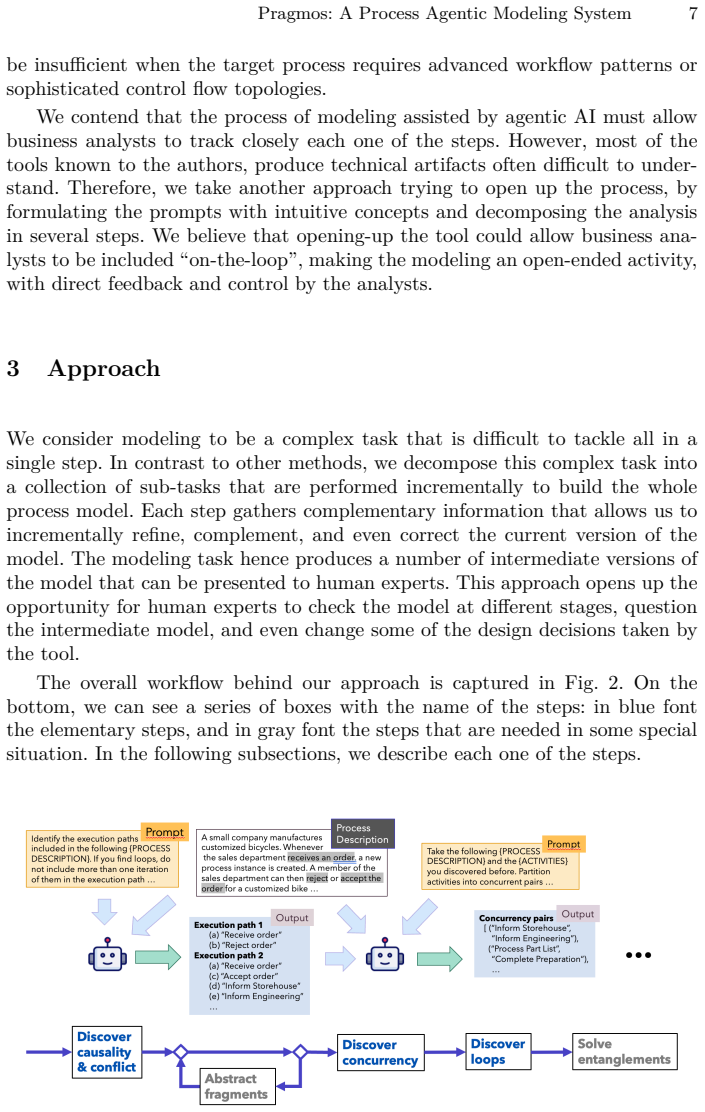
The Pragmos prototype system, which decomposes process modeling into an open-ended conversational workflow using LLMs for collaboration and specialized tools for handling behavioral relations to ensure model soundness.
Load-bearing premise
Current limitations of LLMs with complex dependencies can be overcome by complementing them with specialized tools that structure models from incrementally uncovered behavioral relations.
What would settle it
Observing whether models produced by Pragmos on realistic process descriptions contain undetected soundness issues or lack clear rationales for key constructs when reviewed by domain experts.
Figures




read the original abstract
The advent of Large Language Models (LLMs) has significantly transformed tasks across Software Engineering. In the context of Business Process Management, LLMs are now being explored as tools to derive process models directly from textual descriptions. Existing approaches range from chatbot-driven systems that assist with iterative, text-based modeling to fully automated end-to-end modeling assistants. However, we argue that process modeling is inherently complex and cannot be effectively addressed through black-box solutions. Instead, we envision modeling as an open-ended conversational activity, best supported by an interactive, iterative process involving both humans and LLM. In our approach, the modeling task is decomposed into smaller, manageable steps. Each step results in intermediate artifacts and explicitly documents the rationale behind each modeling decision. During this process, we incrementally uncover simple behavioral relations that guide the construction of the model. Given the current limitations of LLMs in reasoning about complex dependencies, we complement them with specialized tools developed in the field to structure process models based on behavioral relations. This hybrid approach enables the generation of sound, yet comprehensible models that evolve through transparent and explainable steps. In this paper, we present our research agenda and introduce Pragmos, a prototype system that operationalizes this vision. Pragmos demonstrates how LLMs can collaborate with human users as both domain and modeling experts to co-create evolving process models through a structured and explainable workflow.
Editorial analysis
A structured set of objections, weighed in public.
Referee Report
Summary. The paper presents a research agenda and prototype (Pragmos) for an interactive, hybrid LLM-plus-specialized-tool workflow in business process modeling. It decomposes modeling into incremental steps that produce intermediate artifacts, document rationales, and uncover behavioral relations, arguing that this yields sound yet comprehensible and explainable process models superior to black-box LLM approaches.
Significance. If the proposed workflow can be shown to produce verifiable models, it would address a genuine gap in LLM-assisted BPM by emphasizing transparency and incremental structure; the emphasis on complementing LLM limitations with established behavioral-relation tools is a constructive direction.
major comments (2)
- [Abstract] Abstract: the statement that the hybrid approach 'enables the generation of sound, yet comprehensible models' is presented as an achieved outcome rather than a hypothesis; no evaluation protocol, soundness criteria, or even illustrative case study is supplied to support this central claim.
- [Pragmos prototype section] Prototype description: the manuscript introduces Pragmos as operationalizing the vision but provides no concrete specification of the specialized tools, the exact interface for incremental behavioral-relation extraction, or how soundness is checked at each step, rendering the prototype non-reproducible from the text alone.
minor comments (1)
- [Introduction / Related Work] The related-work discussion could more explicitly contrast the proposed incremental approach with existing chatbot-driven and end-to-end LLM modeling systems cited in the introduction.
Simulated Author's Rebuttal
We thank the referee for the constructive feedback on our research agenda and prototype paper. We address each major comment below and outline planned revisions to improve clarity and completeness.
read point-by-point responses
-
Referee: [Abstract] Abstract: the statement that the hybrid approach 'enables the generation of sound, yet comprehensible models' is presented as an achieved outcome rather than a hypothesis; no evaluation protocol, soundness criteria, or even illustrative case study is supplied to support this central claim.
Authors: We agree that the abstract phrasing presents the benefit as an achieved result. The manuscript is a research agenda paper that introduces the vision and an initial prototype rather than reporting completed empirical validation. We will revise the abstract to frame the hybrid approach as enabling sound and comprehensible models as a proposed outcome and hypothesis to be tested in future work, while clarifying that the current contribution focuses on the structured workflow and prototype design without supplying a full evaluation protocol or case study. revision: yes
-
Referee: [Pragmos prototype section] Prototype description: the manuscript introduces Pragmos as operationalizing the vision but provides no concrete specification of the specialized tools, the exact interface for incremental behavioral-relation extraction, or how soundness is checked at each step, rendering the prototype non-reproducible from the text alone.
Authors: We acknowledge that the prototype section provides only a high-level description. As this is an early-stage prototype for a research agenda, the manuscript does not include exhaustive implementation details. In revision we will expand the section with additional concrete information on the behavioral-relation tools drawn from the process mining literature, the incremental extraction interface, and the step-wise soundness mechanisms based on the documented behavioral relations. We will also add a link to a public repository containing the current prototype code to support reproducibility where textual description alone is insufficient. revision: yes
Circularity Check
No significant circularity; conceptual proposal without derivations
full rationale
The paper is framed explicitly as a research agenda and prototype description rather than a completed study with quantitative derivations or predictions. No equations, fitted parameters, or formal derivation chains exist that could reduce to self-definitions, renamed inputs, or self-citation load-bearing premises. The central vision—that a hybrid LLM-plus-tool workflow yields sound and explainable models—is presented as an intended outcome of the proposed system, not as a result already demonstrated or derived within the manuscript. General observations about LLM limitations and BPM practices are invoked without reliance on unverified prior results by the same authors, rendering the argument self-contained and non-circular.
Axiom & Free-Parameter Ledger
axioms (1)
- domain assumption Process modeling is inherently complex and cannot be effectively addressed through black-box solutions.
invented entities (1)
-
Pragmos
no independent evidence
Reference graph
Works this paper leans on
-
[1]
Introducing ChatGPT (November 2022),https://openai.com/index/chatgpt/, last accessed in Feb 2026
2022
-
[2]
WIREs Data Mining Knowl
van der Aalst, W.M.P.: Process discovery from event data: Relating models and logs through abstractions. WIREs Data Mining Knowl. Discov.8(3) (2018)
2018
-
[3]
IEEE Trans
van der Aalst, W.M.P., Weijters, T., Maruster, L.: Workflow Mining: Discovering Process Models from Event Logs. IEEE Trans. Knowl. Data Eng.16(9), 1128–1142 (2004)
2004
-
[4]
In: Proc
Bellan, P., van der Aa, H., Dragoni, M., Ghidini, C., Ponzetto, S.P.: PET: an annotated dataset for process extraction from natural language text tasks. In: Proc. of BPM 2022 Workshops. LNBIP, vol. 460, pp. 315–321. Springer (2022)
2022
-
[5]
In: Matulevicius, R., Dijkman, R.M
Bock, J.D., Claes, J.: The Origin and Evolution of Syntax Errors in Simple Se- quence Flow Models in BPMN. In: Matulevicius, R., Dijkman, R.M. (eds.) Proc. of CAiSE Workshops 2018. LNBIP, vol. 316, pp. 155–166. Springer (2018)
2018
-
[6]
Brown, P.F., Pietra, V.J.D., de Souza, P.V., Lai, J.C., Mercer, R.L.: Class-Based n-gram Models of Natural Language. Comput. Linguistics18(4), 467–479 (1992)
1992
-
[7]
Language Models are Few-Shot Learners
Brown, T.B., Mann, B., Ryder, N., Subbiah, M., Kaplan, J., Dhariwal, P., Nee- lakantan, A., Shyam, P., Sastry, G., Askell, A., Agarwal, S., Herbert-Voss, A., Krueger, G., Henighan, T., Child, R., Ramesh, A., Ziegler, D.M., Wu, J., Win- ter, C., Hesse, C., Chen, M., Sigler, E., Litwin, M., Gray, S., Chess, B., Clark, J., Berner, C., McCandlish, S., Radford...
work page internal anchor Pith review arXiv 2005
-
[8]
Towards Reasoning Era: A Survey of Long Chain-of-Thought for Reasoning Large Language Models
Chen, Q., Qin, L., Liu, J., Peng, D., Guan, J., Wang, P., Hu, M., Zhou, Y., Gao, T., Che, W.: Towards Reasoning Era: A Survey of Long Chain-of-Thought for Reasoning Large Language Models. CoRRabs/2503.09567(2025),https://doi. org/10.48550/arXiv.2503.09567
work page internal anchor Pith review doi:10.48550/arxiv.2503.09567 2025
-
[9]
Springer (2018)
Dumas, M., Rosa, M.L., Mendling, J., Reijers, H.A.: Fundamentals of Business Process Management, Second Edition. Springer (2018)
2018
-
[10]
In: Proc
Friedrich, F., Mendling, J., Puhlmann, F.: Process Model Generation from Natural Language Text. In: Proc. of CAiSE 2011. LNCS, vol. 6741, pp. 482–496. Springer (2011)
2011
-
[11]
Reijers and Jan Mendling: Styles in business process modeling: an exploration and a model
Jakob Pinggera and Pnina Soffer and Dirk Fahland and Matthias Weidlich and Stefan Zugal and Barbara Weber and Hajo A. Reijers and Jan Mendling: Styles in business process modeling: an exploration and a model. Softw. Syst. Model.14(3), 1055–1080 (2015) 22 P.A. Hern´ andez and L. Garc´ ıa-Ba˜ nuelos
2015
-
[12]
In: Proc
Klievtsova, N., Benzin, J., Kampik, T., Mangler, J., Rinderle-Ma, S.: Conver- sational Process Modelling: State of the Art, Applications, and Implications in Practice. In: Proc. of Business Process Management Forum - BPM 2023. LNBIP, vol. 490, pp. 319–336. Springer (2023)
2023
-
[13]
Leopold, H.: Natural Language in Business Process Models - Theoretical Founda- tions, Techniques, and Applications, LNBIP, vol. 168. Springer (2013)
2013
-
[14]
McConnell, R.M., de Montgolfier, F.: Linear-time modular decomposition of di- rected graphs. Discret. Appl. Math.145(2), 198–209 (2005)
2005
-
[15]
OpenAI: Introducing ChatGPT (2022),https://openai.com/index/chatgpt/, accessed: 2023-10-31
2022
-
[16]
Oulsnam, G.: Unravelling Unstructured Programs. Comput. J.25(3), 379–387 (1982)
1982
-
[17]
In: Proc
Polyvyanyy, A., Garc´ ıa-Ba˜ nuelos, L., Dumas, M.: Structuring Acyclic Process Models. In: Proc. of BPM. LNCS, vol. 6336, pp. 276–293. Springer (2010)
2010
-
[18]
Polyvyanyy, A., Garc´ ıa-Ba˜ nuelos, L., Dumas, M.: Structuring acyclic process mod- els. Inf. Syst.37(6), 518–538 (2012)
2012
-
[19]
Polyvyanyy, A., Garc´ ıa-Ba˜ nuelos, L., Fahland, D., Weske, M.: Maximal Structuring of Acyclic Process Models. Comput. J.57(1), 12–35 (2014)
2014
-
[20]
IEEE88(8), 1270–1278 (2000)
Rosenfeld, R.: Two decades of statistical language modeling: where do we go from here? Proc. IEEE88(8), 1270–1278 (2000)
2000
-
[21]
Vaswani, A., Shazeer, N., Parmar, N., Uszkoreit, J., Jones, L., Gomez, A.N., Kaiser, L., Polosukhin, I.: Attention Is All You Need. CoRRabs/1706.03762(2017), http://arxiv.org/abs/1706.03762
work page internal anchor Pith review arXiv 2017
-
[22]
In: Proc
Wei, J., Wang, X., Schuurmans, D., Bosma, M., Ichter, B., Xia, F., Chi, E.H., Le, Q.V., Zhou, D.: Chain-of-Thought Prompting Elicits Reasoning in Large Language Models. In: Proc. of NeurIPS 2022 (2022)
2022
discussion (0)
Sign in with ORCID, Apple, or X to comment. Anyone can read and Pith papers without signing in.