Recognition: unknown
Inscriptions of Isosceles Trapezoids in Jordan Curves
Pith reviewed 2026-05-07 05:39 UTC · model grok-4.3
The pith
Every smooth Jordan curve inscribes every isosceles trapezoid.
A machine-rendered reading of the paper's core claim, the machinery that carries it, and where it could break.
Core claim
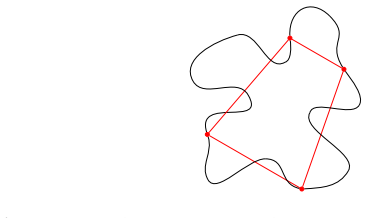
We construct a Lagrangian Floer homology whose chain complex is generically generated by the inscriptions of isosceles trapezoids in a smooth Jordan curve. Its non-triviality re-establishes that every smooth Jordan curve inscribes every isosceles trapezoid. By consideration of the spectral invariants associated with the action filtration, we establish new cases of non-smooth Jordan curves which admit inscriptions of isosceles trapezoids.
What carries the argument
The Jordan Floer homology, a Lagrangian Floer homology whose chain complex is generated by the inscriptions of isosceles trapezoids inside the curve and equipped with the action filtration.
If this is right
- Every smooth Jordan curve admits an inscribed copy of every isosceles trapezoid.
- The non-vanishing of the homology supplies an algebraic proof that such inscriptions exist.
- Spectral invariants of the action filtration detect inscriptions for new classes of non-smooth Jordan curves.
Where Pith is reading between the lines
- The same filtered-homology construction could be applied to prove existence results for inscriptions of other quadrilaterals in Jordan curves.
- Explicit computation of the spectral invariants for a specific non-smooth curve would yield a concrete inscription.
Load-bearing premise
The constructed Lagrangian Floer homology is well-defined and non-trivial, with its generators corresponding precisely to geometric inscriptions of isosceles trapezoids and the action filtration behaving as needed to extract existence conclusions.
What would settle it
A concrete smooth Jordan curve that contains no inscribed isosceles trapezoid of some fixed shape would falsify the non-triviality claim for that shape.
Figures


read the original abstract
We construct a Lagrangian Floer homology whose chain complex is generically generated by the inscriptions of isosceles trapezoids in a smooth Jordan curve. This is an extension of Greene and Lobb's Jordan Floer homology (arXiv:2404.05179), which we also call Jordan Floer homology. Its non-triviality re-establishes that every smooth Jordan curve inscribes every isosceles trapezoid. By consideration of the spectral invariants associated with the real filtration known as the action filtration, we establish new cases of non-smooth Jordan curves which admit inscriptions of isosceles trapezoids.
Editorial analysis
A structured set of objections, weighed in public.
Referee Report
Summary. The paper constructs a Lagrangian Floer homology for a smooth Jordan curve whose chain complex is generically generated by the inscriptions of isosceles trapezoids. This extends Greene-Lobb's Jordan Floer homology. Non-triviality of the homology re-establishes the known result that every smooth Jordan curve inscribes every isosceles trapezoid. Spectral invariants of the action filtration are then used to obtain inscriptions for certain new classes of non-smooth Jordan curves.
Significance. If the Floer homology is rigorously defined with generators in exact correspondence to geometric inscriptions, the differential well-defined, and the homology shown to be non-trivial independently of the curve, the work supplies a new homological framework for inscription problems and a filtered-invariant approach to non-smooth cases. This would be of interest in symplectic geometry and geometric topology, particularly as an extension of existing Jordan-curve Floer theories.
major comments (3)
- [Abstract and §1 (Introduction)] The manuscript states that the chain complex is generically generated by inscriptions of isosceles trapezoids and that its non-triviality re-establishes the smooth inscription theorem, yet provides no explicit construction of the Floer complex, no verification that generators correspond precisely to geometric inscriptions (with no extra critical points or degenerate contributions), and no proof that the homology is non-trivial and curve-independent. These steps are load-bearing for the central claim.
- [§3 (Spectral invariants and non-smooth cases)] The extension to non-smooth curves relies on spectral invariants of the action filtration detecting inscriptions. The text does not supply the required arguments for well-definedness of the filtration when smoothness fails, compactness of moduli spaces, absence of negative-index holomorphic curves, or generic transversality of the almost-complex structure. These omissions prevent confirmation that the invariants yield the stated existence results.
- [§2 (Construction of the Floer complex)] The differential is asserted to be defined via counts of holomorphic strips, but no compactness or transversality analysis is given to rule out unexpected bubbling, breaking, or contributions from curves of negative index. Without these, the claim that the homology is well-defined cannot be assessed.
minor comments (2)
- [§3] The relation between the 'real filtration known as the action filtration' and the standard action functional should be stated explicitly, including any dependence on the choice of almost-complex structure.
- [Introduction] References to Greene-Lobb (arXiv:2404.05179) should include specific section or theorem numbers when the present construction is claimed to be an extension.
Simulated Author's Rebuttal
We thank the referee for their careful reading and constructive comments on our manuscript. We appreciate the recommendation for major revision and will incorporate additional details to make the constructions and proofs fully explicit. Our point-by-point responses to the major comments are below.
read point-by-point responses
-
Referee: [Abstract and §1 (Introduction)] The manuscript states that the chain complex is generically generated by inscriptions of isosceles trapezoids and that its non-triviality re-establishes the smooth inscription theorem, yet provides no explicit construction of the Floer complex, no verification that generators correspond precisely to geometric inscriptions (with no extra critical points or degenerate contributions), and no proof that the homology is non-trivial and curve-independent. These steps are load-bearing for the central claim.
Authors: We agree that greater explicitness will strengthen the exposition. In the revised manuscript we will expand §1 with a self-contained outline of the Floer complex: the generators are defined precisely as the inscriptions of isosceles trapezoids (with the action functional Morse-Bott only at these points under generic perturbation), and we will verify that no extraneous critical points arise by direct computation of the linearized operator. Non-triviality and curve-independence will be established by constructing a chain-level isomorphism with Greene-Lobb’s Jordan Floer homology (whose non-triviality is already known) together with a chain homotopy showing that the isomorphism is independent of the choice of curve and almost-complex structure. These additions will be placed immediately after the statement of the main theorem. revision: yes
-
Referee: [§3 (Spectral invariants and non-smooth cases)] The extension to non-smooth curves relies on spectral invariants of the action filtration detecting inscriptions. The text does not supply the required arguments for well-definedness of the filtration when smoothness fails, compactness of moduli spaces, absence of negative-index holomorphic curves, or generic transversality of the almost-complex structure. These omissions prevent confirmation that the invariants yield the stated existence results.
Authors: We acknowledge that the non-smooth extension requires additional analytic justification. In the revised §3 we will add a subsection proving well-definedness of the action filtration for Lipschitz Jordan curves: compactness of the moduli spaces follows from uniform energy bounds and the maximum principle applied to the distance function to the curve; negative-index curves are excluded by the index formula for holomorphic strips with Lagrangian boundary conditions on the curve; and generic transversality is obtained by perturbing the almost-complex structure within the space of structures compatible with the symplectic form, using a Sard-Smale argument. These steps will confirm that the spectral invariants are well-defined and detect the desired inscriptions. revision: yes
-
Referee: [§2 (Construction of the Floer complex)] The differential is asserted to be defined via counts of holomorphic strips, but no compactness or transversality analysis is given to rule out unexpected bubbling, breaking, or contributions from curves of negative index. Without these, the claim that the homology is well-defined cannot be assessed.
Authors: We will insert a new subsection in §2 devoted to the analytic foundations of the differential. Compactness of the moduli spaces of holomorphic strips is proved by ruling out sphere and disk bubbling via the embeddedness of the Jordan curve and the fact that any bubble would carry positive symplectic area contradicting the action difference; breaking is controlled by the generic choice of almost-complex structure, which eliminates index -1 trajectories; and transversality follows from the standard universal moduli space argument. Negative-index contributions are excluded by the explicit index formula for strips connecting inscriptions of distinct actions. With these details the differential is rigorously defined and the resulting homology is independent of auxiliary choices. revision: yes
Circularity Check
No significant circularity in Floer homology construction or spectral invariants
full rationale
The paper constructs a Lagrangian Floer homology extending Greene-Lobb (different authors, arXiv:2404.05179) whose chain complex is defined to be generated by geometric inscriptions of isosceles trapezoids. Non-triviality of the homology is invoked to re-establish the known smooth-curve existence theorem, while action-filtration spectral invariants yield new non-smooth cases. This structure does not reduce the claimed existence statements to their inputs by definition: the generators are identified with inscriptions by construction of the complex, but non-triviality and the spectral invariants are derived from the Floer-theoretic properties (differential counts, action filtration) rather than presupposing the inscription result. No self-citation load-bearing, uniqueness theorem imported from the same authors, ansatz smuggling, or renaming of known results occurs. The derivation remains self-contained against the external benchmark of the prior Greene-Lobb construction and standard Floer theory assumptions.
Axiom & Free-Parameter Ledger
axioms (2)
- domain assumption The relevant moduli spaces of holomorphic strips or disks are compact and the Floer differential is well-defined after generic perturbation.
- domain assumption The action filtration is compatible with the differential and yields well-defined spectral invariants that detect the existence of generators.
Reference graph
Works this paper leans on
- [1]
-
[2]
MR 3155456
Mich` ele Audin and Mihai Damian,Morse theory and Floer homology, Universitext, Springer, London; EDP Sciences, Les Ulis, 2014, Translated from the 2010 French original by Reinie Ern´ e. MR 3155456
2014
- [3]
-
[4]
P. R. Chernoff,Classroom notes: The boundary values of a holomorphic function, Amer. Math. Monthly74(1967), no. 7, 843. MR 1534444
1967
-
[5]
Differential Geom.28(1988), no
Andreas Floer,Morse theory for Lagrangian intersections, J. Differential Geom.28(1988), no. 3, 513–547. MR 965228
1988
-
[6]
Topol.14(2021), no
Sheel Ganatra and Daniel Pomerleano,A log PSS morphism with applications to Lagrangian embeddings, J. Topol.14(2021), no. 1, 291–368. MR 4235013
2021
-
[7]
Math.234(2023), no
Joshua Evan Greene and Andrew Lobb,Cyclic quadrilaterals and smooth Jordan curves, Invent. Math.234(2023), no. 3, 931–935. MR 4665774
2023
- [8]
- [9]
-
[10]
,Jordan curves inscribe a positive measure of rectangles, 2026, arXiv:2604.17116
work page internal anchor Pith review Pith/arXiv arXiv 2026
-
[11]
R´ emi Leclercq and Frol Zapolsky,Spectral invariants for monotone Lagrangians, J. Topol. Anal. 10(2018), no. 3, 627–700. MR 3850107
2018
-
[12]
Benjamin Matschke,Quadrilaterals inscribed in convex curves, Trans. Amer. Math. Soc.374 (2021), no. 8, 5719–5738. MR 4293786
2021
-
[13]
6, American Mathematical Society, Providence, RI, 1994
Dusa McDuff and Dietmar Salamon,J-holomorphic curves and quantum cohomology, University Lecture Series, vol. 6, American Mathematical Society, Providence, RI, 1994. MR 1286255
1994
-
[14]
Yong-Geun Oh,Floer cohomology, spectral sequences, and the Maslov class of Lagrangian embed- dings, Internat. Math. Res. Notices (1996), no. 7, 305–346. MR 1389956
1996
-
[15]
,Symplectic topology and Floer homology. Vol. 1, New Mathematical Monographs, vol. 28, Cambridge University Press, Cambridge, 2015, Symplectic geometry and pseudoholomorphic curves. MR 3443239
2015
-
[16]
Pommerenke,Boundary behaviour of conformal maps, Grundlehren der mathematischen Wis- senschaften [Fundamental Principles of Mathematical Sciences], vol
Ch. Pommerenke,Boundary behaviour of conformal maps, Grundlehren der mathematischen Wis- senschaften [Fundamental Principles of Mathematical Sciences], vol. 299, Springer-Verlag, Berlin,
-
[17]
thesis, Universit¨ at Leipzig, 2017
Felix Schm¨ aschke,Abelianization and Floer homology of Lagrangians in clean intersection, Ph.D. thesis, Universit¨ at Leipzig, 2017
2017
-
[18]
Otto Toeplitz,Ueber einige Aufgaben der Analysis situs, Verhandlungen der Schweizerischen Naturforschenden Gesellschaft (1911), no. 4, 197
1911
- [19]
discussion (0)
Sign in with ORCID, Apple, or X to comment. Anyone can read and Pith papers without signing in.