Recognition: unknown
Clustering in co-evolving opinion dynamics: reduced SPDE models
Pith reviewed 2026-05-07 05:27 UTC · model grok-4.3
The pith
Reduced SPDE models reproduce clustering in co-evolving opinion dynamics at far lower computational cost than full-state alternatives.
A machine-rendered reading of the paper's core claim, the machinery that carries it, and where it could break.
Core claim
We obtain reduced SPDE descriptions of cluster dynamics by coarse-graining the agent-based opinion dynamics. The resulting equations govern the stochastic evolution of a lower-dimensional state consisting of cluster locations and masses. In the non-feedback case opinions evolve independently of the social graph; in the feedback case the graph updates depend on opinion similarity. These reduced SPDEs reproduce the long-time clustering patterns of the microscopic model while remaining far cheaper to integrate than the full Dean-Kawasaki equation.
What carries the argument
The reduced stochastic partial differential equations obtained by projecting the full agent-based model onto a coarse-grained description of cluster positions and sizes.
If this is right
- The reduced models make feasible the simulation of opinion clustering in populations of thousands of agents.
- Both the non-feedback and feedback coupling between opinions and social structure can be studied within the same reduced framework.
- Long-term stochastic effects such as cluster merging, splitting, and persistence are captured without simulating every agent.
- The approach provides a practical route to fitting models to large empirical social datasets like the GSS.
Where Pith is reading between the lines
- Similar reduction techniques might be applied to other co-evolving dynamical systems, for example in ecology or epidemiology where agents and their traits interact.
- Parameter inference from data could be performed directly on the reduced SPDE, bypassing the need to run many expensive agent-based realizations.
- Extensions to multiple opinion dimensions or to directed social networks would broaden the range of social phenomena that can be studied efficiently.
Load-bearing premise
The essential long-term clustering dynamics of the agent-based model are preserved when the system is projected onto the reduced state space of cluster statistics.
What would settle it
A direct comparison in which the reduced SPDE produces cluster size distributions or merging rates that systematically deviate from those observed in large-scale agent-based simulations of the same system.
Figures


read the original abstract
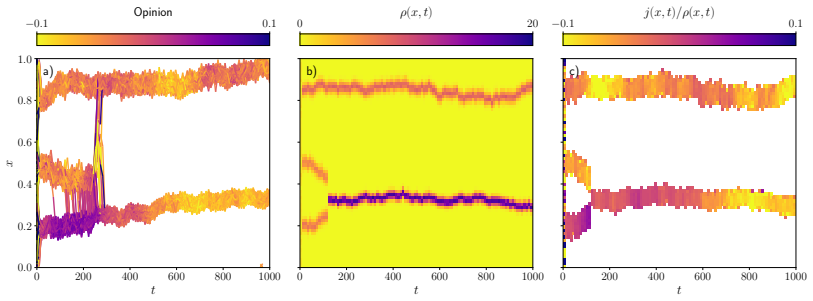
Clustering is a fundamental collective phenomenon in agent-based models (ABMs) of opinion dynamics. To study clustering in systems with co-evolving social and opinion variables, we derive stochastic partial differential equation (SPDE) models that describe the evolution of clusters on a reduced state space. We consider two settings: one in which opinions do not affect social interactions, and another one in which a feedback mechanism couples the two. Our approach extends reduced PDE modelling to a stochastic framework, which is essential for capturing long-term cluster behaviour. Numerical experiments demonstrate that the proposed reduced SPDEs substantially decrease computational cost compared to full-state SPDE models, such as the Dean-Kawasaki equation, while still accurately reproducing the clustering behaviour of the underlying ABM. As a result, these reduced models provide an efficient tool for studying systems with large populations, including those arising in the analysis of real-world data: in particular, we provide an application related to the large-scale General Social Survey (GSS), which comprises opinion and social data of the US population since 1972.
Editorial analysis
A structured set of objections, weighed in public.
Referee Report
Summary. The paper derives reduced SPDE models for clustering dynamics in co-evolving opinion ABMs by projecting the full density onto a lower-dimensional state space of cluster descriptors. It treats both a non-feedback case and a feedback case where opinions influence social interactions, extending prior deterministic reduced PDEs to the stochastic setting. Numerical experiments are presented to show that the reduced SPDEs reproduce ABM clustering behavior at substantially lower computational cost than full-state models such as the Dean-Kawasaki equation, with an additional application to GSS survey data.
Significance. If the accuracy claims hold under systematic testing, the reduced SPDEs would supply a practical, scalable tool for exploring long-term stochastic clustering in large populations, including real-world opinion data. The stochastic formulation is a clear advance over deterministic reductions for capturing fluctuation-driven cluster merging and splitting.
major comments (2)
- [§4] §4 (Numerical validation): the reported comparisons of cluster-size histograms and trajectories between reduced SPDE and ABM are visual only; no quantified error metrics (e.g., mean integrated squared error, Wasserstein distance, or standard errors from multiple independent runs) are provided, nor are long-time cluster lifetime distributions compared. This directly affects the central claim that the reduced models “accurately reproduce” the ABM clustering statistics, especially under feedback.
- [§3.2] §3.2 (Derivation of feedback model): the closure that neglects higher-order correlations induced by the opinion-interaction feedback term is introduced without an a-priori error bound or a posteriori test; the numerical experiments use only a single feedback strength, so it remains unclear whether the reduced drift and noise terms preserve merging/splitting rates when fluctuations are strong.
minor comments (2)
- [Figures 4–6] Figure captions should state the number of Monte-Carlo realizations used for each histogram or trajectory and whether error bands are shown.
- [§3] The notation for the cluster-descriptor projection operator should be introduced once with a clear definition before its repeated use in the SPDE derivations.
Simulated Author's Rebuttal
We thank the referee for the constructive and detailed report. The comments on numerical validation and the feedback-model closure are well taken and point to ways to strengthen the central claims. We address each major comment below and will incorporate revisions in the next version of the manuscript.
read point-by-point responses
-
Referee: [§4] §4 (Numerical validation): the reported comparisons of cluster-size histograms and trajectories between reduced SPDE and ABM are visual only; no quantified error metrics (e.g., mean integrated squared error, Wasserstein distance, or standard errors from multiple independent runs) are provided, nor are long-time cluster lifetime distributions compared. This directly affects the central claim that the reduced models “accurately reproduce” the ABM clustering statistics, especially under feedback.
Authors: We agree that the present numerical comparisons rely primarily on visual inspection of histograms and sample trajectories. To strengthen the evidence, we will add quantitative metrics in the revised §4: specifically, the mean integrated squared error (MISE) between the empirical cluster-size distributions of the reduced SPDE and the ABM, averaged over 50 independent realizations, together with standard-error bands. We will also compute the Wasserstein-1 distance between the same distributions at selected times. In addition, we will include a comparison of long-time cluster lifetime distributions (obtained by tracking birth/death events of clusters above a size threshold) to assess whether merging and splitting rates are reproduced under feedback. These new panels and tables will be added to the existing figures and will be accompanied by a short discussion of the observed error magnitudes. revision: yes
-
Referee: [§3.2] §3.2 (Derivation of feedback model): the closure that neglects higher-order correlations induced by the opinion-interaction feedback term is introduced without an a-priori error bound or a posteriori test; the numerical experiments use only a single feedback strength, so it remains unclear whether the reduced drift and noise terms preserve merging/splitting rates when fluctuations are strong.
Authors: The closure in §3.2 follows the standard moment-closure strategy used in mean-field reductions of interacting particle systems; an a-priori rigorous error bound for the stochastic case is technically involved and beyond the scope of the present work. Nevertheless, we acknowledge that the current numerical tests are limited to a single feedback parameter. In the revision we will (i) add a brief paragraph in §3.2 discussing the nature of the neglected correlations and the expected regime of validity, and (ii) extend the numerical experiments in §4 to three distinct feedback strengths (including a stronger regime where fluctuations are visibly larger). For each strength we will report the same quantitative error metrics described above, thereby providing a posteriori evidence that the reduced drift and noise terms continue to capture merging/splitting statistics. We will also note the limitation that a systematic error analysis for arbitrary feedback remains an open question. revision: partial
Circularity Check
No circularity in the SPDE reduction derivation
full rationale
The paper derives reduced SPDE models by projecting the full agent density onto a lower-dimensional cluster descriptor state space, extending deterministic reduced PDE techniques to include stochastic terms for both non-feedback and feedback opinion-social coupling. This projection and closure step is a standard model-reduction procedure whose output equations are not equivalent to the input ABM statistics by construction; the resulting drift and noise terms are obtained from the microscopic rules rather than fitted to or defined by the target clustering behavior. No self-definitional loops, fitted-input predictions, or load-bearing self-citations that render the central claim tautological appear in the derivation chain. Numerical experiments serve only as post-derivation validation and do not enter the formal reduction. The approach therefore remains self-contained with independent mathematical content.
Axiom & Free-Parameter Ledger
axioms (1)
- domain assumption Mean-field or moment-closure assumptions allow reduction from individual agent rules to SPDE descriptions of cluster densities
Reference graph
Works this paper leans on
-
[1]
G. Albi, E. Calzola, and G. Dimarco. A data-driven kinetic model for opinion dynamics with social network contacts.European Journal of Applied Mathematics, 36(2), 2024
2024
-
[2]
Banisch and E
S. Banisch and E. Olbrich. Opinion polarization by learning from social feedback.The Journal of Mathematical Sociology, 43(2):76–103, 2019
2019
-
[3]
Berner, T
R. Berner, T. Gross, C. Kuehn, J. Kurths, and S. Yanchuk. Adaptive dynamical networks. Physics Reports, 1031:1–59, 2023
2023
-
[4]
J. A. Carrillo, M. Fornasier, G. Toscani, and F. Vecil. Particle, kinetic, and hydrodynamic models of swarming. In G. Naldi, L. Pareschi, and G. Toscani, editors,Mathematical Model- ing of Collective Behavior in Socio-Economic and Life Sciences, pages 297–336. Birkh¨ auser Boston, Boston, 2010
2010
-
[5]
M. E. Cates and J. Tailleur. Motility-induced phase separation.Annu. Rev. Condens. Matter Phys., 6(1):219–244, 2015
2015
-
[6]
Choi, S.-Y
Y.-P. Choi, S.-Y. Ha, and Z. Li. Emergent dynamics of the Cucker–Smale flocking model and its variants. In N. Bellomo, P. Degond, and E. Tadmor, editors,Active Particles, Volume 1 : Advances in Theory, Models, and Applications, pages 299–331. Springer International Publishing, Cham, 2017. 18
2017
-
[7]
Cornalba and J
F. Cornalba and J. Fischer. The Dean–Kawasaki equation and the structure of density fluctuations in systems of diffusing particles.Archive for Rational Mechanics and Analysis, 247, 08 2023
2023
-
[8]
Cornalba and J
F. Cornalba and J. Fischer. Multilevel Monte Carlo methods for the Dean–Kawasaki equa- tion from fluctuating hydrodynamics.SIAM J. Numer. Anal., 63(1):262–287, 2025
2025
-
[9]
Cornalba, J
F. Cornalba, J. Fischer, J. Ingmanns, and C. Raithel. Density fluctuations in weakly interacting particle systems via the Dean–Kawasaki equation.The Annals of Probability, 54(1), 2026
2026
-
[10]
Cornalba and T
F. Cornalba and T. Shardlow. The regularised inertial Dean–Kawasaki equation: discontin- uous galerkin approximation and modelling for low-density regime.ESAIM: Mathematical Modelling and Numerical Analysis, 57(5):3061–3090, 2023
2023
-
[11]
Cornalba, T
F. Cornalba, T. Shardlow, and J. Zimmer. A regularized Dean–Kawasaki model: Derivation and analysis.SIAM Journal on Mathematical Analysis, 51(2):1137–1187, 2019
2019
-
[12]
Cornalba, T
F. Cornalba, T. Shardlow, and J. Zimmer. From weakly interacting particles to a regularised Dean–Kawasaki model.Nonlinearity, 33(2), 2020
2020
-
[13]
Cornalba, T
F. Cornalba, T. Shardlow, and J. Zimmer. Well-posedness for a regularised inertial Dean– Kawasaki model for slender particles in several space dimensions.Journal of Differential Equations, 284:253–283, 2021
2021
-
[14]
Davern, R
M. Davern, R. Bautista, J. Freese, P. Herd, and S. L. Morgan. General social survey 1972-2023. [Machine-readable data file]. Principal Investigator, M. Davern; Co-Principal Investigators, R. Bautista, J. Freese, P. Herd, and S. L. Morgan. Sponsored by National Science Foundation. NORC ed. Chicago: NORC, 2024: NORC at the University of Chicago [producer an...
1972
-
[15]
D. Dean. Langevin equation for the density of a system of interacting Langevin processes. J. Phys. A, 29:L613–L617, 1996
1996
-
[16]
Deffuant, D
G. Deffuant, D. Neau, F. Amblard, and G. Weisbuch. Mixing beliefs among interacting agents.Advances in Complex Systems, 3(01n04):87–98, 2000
2000
- [17]
-
[18]
Djurdjevac, A
A. Djurdjevac, A. Almgren, and J. Bell. A hybrid algorithm for systems of noninteracting particles with an external potential.Communications in Applied Mathematics and Com- putational Science, 20(1):147–174, 2025
2025
-
[19]
Djurdjevac, H
A. Djurdjevac, H. Kremp, and N. Perkowski. Weak error analysis for a nonlinear SPDE approximation of the Dean–Kawasaki equation.Stoch. Partial Differ. Equ.: Anal. Comput., 12(4):2330–2355, 2024
2024
-
[20]
Djurdjevac Conrad, J
N. Djurdjevac Conrad, J. K¨ oppl, and A. Djurdjevac. Feedback loops in opinion dynamics of agent-based models with multiplicative noise.Entropy, 24(10), 2022
2022
-
[21]
Djurdjevac Conrad, N
N. Djurdjevac Conrad, N. Quang Vu, and S. Nagel. Co-evolving networks for opinion and social dynamics in agent-based models.Chaos: An Interdisciplinary Journal of Nonlinear Science, 34(9), 2024
2024
-
[22]
M. Duerinckx and P.-E. Jabin. Correlation estimates for Brownian particles with singular interactions.arXiv preprint arXiv:2510.01507, 2025
-
[23]
M. H. Duong and G. A. Pavliotis. Mean field limits for non-Markovian interacting particles: convergence to equilibrium, generic formalism, asymptotic limits and phase transitions. Commun. Math. Sci., 16(8):2199–2230, 2018. 19
2018
-
[24]
M. H. Duong, M. A. Peletier, and J. Zimmer. Generic formalism of a Vlasov–Fokker–Planck equation and connection to large-deviation principles.Nonlinearity, 26(11), 2013
2013
-
[25]
Fehrman and B
B. Fehrman and B. Gess. Well-posedness of nonlinear diffusion equations with nonlinear, conservative noise.Arch. Ration. Mech. Anal., 233(1):249–322, 2019
2019
-
[26]
M. Gabbay. The effects of nonlinear interactions and network structure in small group opinion dynamics.Physica A: Statistical Mechanics and its Applications, 378(1):118–126, 2007
2007
-
[27]
Garnier, G
J. Garnier, G. Papanicolaou, and T.-W. Yang. Consensus convergence with stochastic effects.Vietnam Journal of Mathematics, 45(1–2), 2016
2016
- [28]
-
[29]
B. D. Goddard, B. Gooding, H. Short, and G. Pavliotis. Noisy bounded confidence models for opinion dynamics: the effect of boundary conditions on phase transitions.IMA Journal of Applied Mathematics, 87(1):80–110, 2022
2022
-
[30]
Hegselmann, U
R. Hegselmann, U. Krause, et al. Opinion dynamics and bounded confidence models, analysis, and simulation.Journal of artificial societies and social simulation, 5(3), 2002
2002
-
[31]
Helfmann, N
L. Helfmann, N. Djurdjevac Conrad, P. Lorenz-Spreen, and C. Sch¨ utte. Modelling opinion dynamics under the impact of influencer and media strategies.Scientific Reports, 13, 2023
2023
- [32]
-
[33]
Kawasaki
K. Kawasaki. Microscopic analyses of the dynamical density functional equation of dense fluids.Journal of Statistical Physics, 93(3–4), 1998
1998
-
[34]
Kozma and A
B. Kozma and A. Barrat. Consensus formation on adaptive networks.Physical Review E, 77(1), 2008
2008
-
[35]
Krylov and M
N. Krylov and M. R¨ ockner. Strong solutions of stochastic equations with singular time dependent drift.Probability Theory and Related Fields, 131(2), 2004
2004
-
[36]
B. Leimkuhler, R. Lohmann, G. A. Pavliotis, and P. A. Whalley. Cluster formation in diffusive systems.arXiv preprint arXiv:2510.25034, 2025
-
[37]
J. F. Lutsko. A dynamical theory of nucleation for colloids and macromolecules.The Journal of chemical physics, 136(3), 2012
2012
-
[38]
Monmarch´ e
P. Monmarch´ e. Long-time behaviour and propagation of chaos for mean field kinetic par- ticles.Stoch. Process. Their Appl., 127(6):1721–1737, 2017
2017
-
[39]
Pareschi, G
L. Pareschi, G. Toscani, A. Tosin, and M. Zanella. Hydrodynamic models of preference formation in multi-agent societies.Journal of Nonlinear Science, 29(6), 2019
2019
-
[40]
A. F. Peralta, J. Kert´ esz, and G. I˜ niguez. Opinion dynamics in social networks: From models to data. InHandbook of Computational Social Science, pages 384–406. Edward Elgar Publishing Limited, 2025
2025
-
[41]
Spohn.Large scale dynamics of interacting particles
H. Spohn.Large scale dynamics of interacting particles. Springer Science & Business Media, 2012
2012
-
[42]
Sznitman
A.-S. Sznitman. Topics in propagation of chaos. InEcole d’Et´ e de Probabilit´ es de Saint- Flour XIX — 1989. Springer Berlin Heidelberg, 1991
1989
-
[43]
Thompson, J
A. Thompson, J. Tailleur, M. Cates, and R. Blythe. Lattice models of nonequilibrium bacterial dynamics.J. Stat. Mech: Theory Exp. P, 2029, 2011. 20
2029
-
[44]
A. J. Veretennikov. On strong solutions and explicit formulas for solutions of stochastic integral equations.Mathematics of the USSR-Sbornik, 39(3), 1981
1981
-
[45]
C. Wang, Q. Li, W. E, and B. Chazelle. Noisy Hegselmann–Krause systems: Phase tran- sition and the 2R-conjecture.Journal of Statistical Physics, 166(5), 2017
2017
-
[46]
Data-driven Reduction of Transfer Operators for Particle Clustering Dynamics
N. Wehlitz, G. A. Pavliotis, C. Sch¨ utte, and S. Winkelmann. Data-driven reduction of transfer operators for particle clustering dynamics.arXiv preprint arXiv:2601.02932, 2026
work page internal anchor Pith review Pith/arXiv arXiv 2026
-
[47]
Wehlitz, M
N. Wehlitz, M. Sadeghi, A. Montefusco, C. Sch¨ utte, G. A. Pavliotis, and S. Winkelmann. Approximating particle-based clustering dynamics by stochastic PDEs.SIAM Journal on Applied Dynamical Systems, 24(2):1231–1250, 2025
2025
-
[48]
Yanchuk, E
S. Yanchuk, E. Andreas Martens, C. Kuehn, and J. Kurths. Focus issue on recent advances in adaptive dynamical networks.Chaos: An Interdisciplinary Journal of Nonlinear Science, 35(10), 10 2025
2025
-
[49]
Y. Yu, G. Xiao, G. Li, W. P. Tay, and H. F. Teoh. Opinion diversity and community formation in adaptive networks.Chaos: An Interdisciplinary Journal of Nonlinear Science, 27(10), 2017
2017
-
[50]
Zimper, F
S. Zimper, F. Cornalba, N. Djurdjevac Conrad, and A. Djurdjevac. On reduced inertial PDE models for Cucker–Smale flocking dynamics.Proceedings of the Royal Society A, 481(2310):20240675, 2025
2025
- [51]
-
[52]
A. K. Zvonkin. A transformation of the phase space of a diffusion process that removes the drift.Mathematics of the USSR-Sbornik, 22(1), 1974. 6 Appendix 6.1 Derivation of reduced models for the non-feedback case The derivation of the reduced SPDE for the non-feedback model (SPDE-NF) with one dimen- sional opinion variable is formal and proceeds as follow...
1974
discussion (0)
Sign in with ORCID, Apple, or X to comment. Anyone can read and Pith papers without signing in.