Recognition: no theorem link
Mean-Field Path-Integral Diffusion: From Samples to Interacting Agents
Pith reviewed 2026-05-15 19:40 UTC · model grok-4.3
The pith
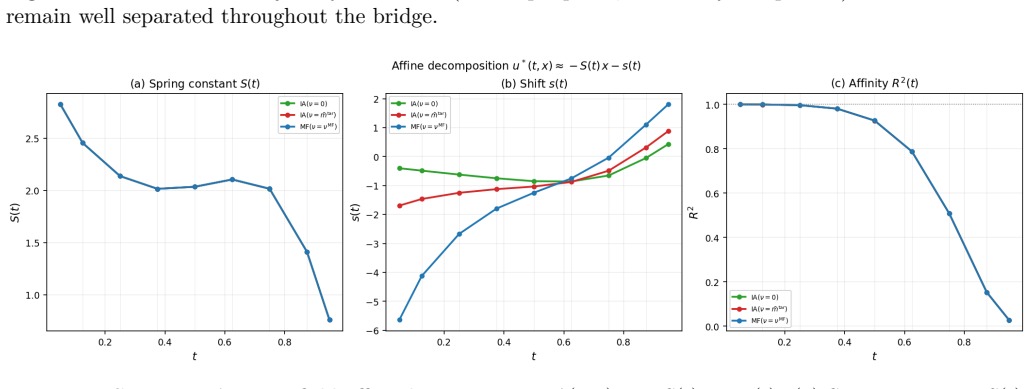
For quadratic interactions, the self-consistent mean-field guidance in diffusion exactly equals the linear interpolant between initial and target global means for arbitrary densities and any schedule.
A machine-rendered reading of the paper's core claim, the machinery that carries it, and where it could break.
Core claim
For a quadratic interaction potential with schedule β_t and zero base drift the self-consistent MF guidance is the exact linear interpolant between initial and target global means; the identity holds for arbitrary initial and target densities and any β_t. The infinite-dimensional mean-field system reduces to a finite set of Riccati and linear ODEs in the linear-quadratic-Gaussian regime and remains closed-form solvable under piecewise-constant protocols for Gaussian mixtures.
What carries the argument
The self-consistent mean-field drift inside the McKean-Vlasov stochastic differential equation obtained from the Hamilton-Jacobi-Bellman/Kolmogorov-Fokker-Planck duality of the interacting-agent optimal transport problem.
If this is right
- In the linear-quadratic-Gaussian benchmark the infinite-dimensional system collapses to a finite-dimensional set of ordinary differential equations that can be solved in closed form.
- The same construction yields 19 to 24 percent lower cumulative control energy than independent-agent baselines while exactly matching the prescribed terminal distribution.
- Coordination automatically redistributes actuation effort across heterogeneous sub-populations without requiring explicit per-agent tuning.
- The Gaussian-mixture regime remains solvable in closed form when the interaction protocol is piecewise constant.
Where Pith is reading between the lines
- The exact linear-interpolant property may serve as a diagnostic test for whether a given interaction potential admits an analytic mean-field solution.
- Finite-population corrections to the mean-field limit could be derived systematically by expanding around the proven infinite-agent solution.
- The same mean-field construction might be transplanted to other generative tasks whose objectives can be expressed as stochastic optimal transport between arbitrary marginals.
Load-bearing premise
The mean-field limit accurately describes the collective dynamics of any finite number of agents and a unique self-consistent solution to the interaction equations exists for the chosen potentials and schedules.
What would settle it
Numerical integration of a finite population of agents under the quadratic interaction showing that the realized drift deviates from the linear mean interpolant at any positive time would falsify the exactness claim.
Figures




read the original abstract
Independent sample generation is the prevailing paradigm in modern diffusion-based generative models of AI. We ask a different question: can samples \emph{coordinate} through shared population statistics to transport probability mass more efficiently? We introduce Mean-Field Path-Integral Diffusion (MF-PID), a framework in which samples are promoted to interacting agents whose drift depends self-consistently on the evolving population density. The coupling converts distribution matching into a McKean--Vlasov extension of the stochastic optimal transport problem, unifying generative modeling and multi-agent control under the same Hamilton--Jacobi--Bellman/Kolmogorov--Fokker--Planck duality. We identify two analytically tractable regimes: a Linear--Quadratic--Gaussian (LQG) benchmark in which the infinite-dimensional mean-field system reduces to a finite set of Riccati and linear ODEs, and a Gaussian-mixture regime governed by a piecewise-constant protocol that preserves closed-form solvability. For a quadratic interaction potential with schedule $\beta_t$ and zero base drift we prove that the self-consistent MF guidance is the \emph{exact} linear interpolant between initial and target global means -- a result that holds for arbitrary initial and target densities and any $\beta_t$. Applied to demand-response control of energy systems, where agents aggregated into an ensemble are energy consumers (e.g.\ thermal zones within a building), MF-PID achieves 19--24\% reductions in cumulative control energy over independent-agent baselines while matching the prescribed terminal distribution exactly, and reveals how coordination redistributes actuation effort across heterogeneous sub-populations.
Editorial analysis
A structured set of objections, weighed in public.
Referee Report
Summary. The manuscript introduces Mean-Field Path-Integral Diffusion (MF-PID), promoting diffusion samples to interacting agents whose drifts depend self-consistently on the population density. This recasts distribution matching as a McKean-Vlasov stochastic optimal transport problem, unifying generative modeling with multi-agent control via HJB/KFP duality. Two tractable regimes are identified: an LQG benchmark reducing to Riccati and linear ODEs, and a Gaussian-mixture regime with piecewise-constant protocols. For quadratic interaction potentials with schedule β_t and zero base drift, the authors prove that self-consistent MF guidance equals the exact linear interpolant between initial and target global means, holding for arbitrary densities and any β_t. In a demand-response energy control application, MF-PID yields 19-24% cumulative control energy reductions over independent baselines while exactly matching the prescribed terminal distribution.
Significance. If the analytical claims hold, the work offers a rigorous mean-field bridge between diffusion-based generative models and multi-agent control, with the quadratic-case result standing out for its parameter-free character and independence from density shape (arising from closure of the mean dynamics). The LQG reduction to finite ODEs enhances tractability, and the control application supplies concrete quantitative gains with exact terminal matching. These elements strengthen the unification narrative and suggest broader applicability in coordinated sampling or ensemble control.
major comments (1)
- [LQG benchmark and quadratic-interaction proof (near the statement of the linear-interpolant theorem)] The central proof that quadratic interactions yield the exact linear mean interpolant (for arbitrary initial/target densities and any β_t) is load-bearing; the manuscript should supply the explicit derivation of the closed mean ODE, the self-consistency condition, and the uniqueness argument so that the result can be verified directly from the equations rather than asserted.
minor comments (2)
- [Abstract and §1] The abstract and introduction should explicitly define the interaction schedule β_t and its relation to the base drift to avoid ambiguity in the zero-base-drift case.
- [Numerical experiments / demand-response section] In the energy-control application, report the number of agents, the degree of sub-population heterogeneity, and any statistical measures (e.g., standard deviation across runs) supporting the 19-24% energy-saving range.
Simulated Author's Rebuttal
We thank the referee for the positive assessment of the work and for the constructive comment on the central proof. We have revised the manuscript to supply the requested explicit derivations.
read point-by-point responses
-
Referee: [LQG benchmark and quadratic-interaction proof (near the statement of the linear-interpolant theorem)] The central proof that quadratic interactions yield the exact linear mean interpolant (for arbitrary initial/target densities and any β_t) is load-bearing; the manuscript should supply the explicit derivation of the closed mean ODE, the self-consistency condition, and the uniqueness argument so that the result can be verified directly from the equations rather than asserted.
Authors: We agree that the proof is load-bearing and must be fully explicit. In the revised manuscript we have expanded the relevant section (immediately preceding the statement of the linear-interpolant theorem) with a self-contained derivation: (i) the closed mean ODE is obtained by taking the expectation of the McKean-Vlasov SDE, substituting the quadratic interaction potential, and observing that all higher-order moments cancel, leaving a finite-dimensional linear ODE driven only by the population mean; (ii) the self-consistency condition is imposed by inserting the candidate linear interpolant m_t = (1-t)m_0 + t m_1 into the mean-field drift and verifying that the resulting expression satisfies the fixed-point equation identically for any schedule β_t and for arbitrary initial and target densities; (iii) uniqueness of the resulting mean trajectory follows from the global Lipschitz continuity of the quadratic interaction (with constant independent of the density) together with the standard Picard-Lindelöf theorem on the finite-dimensional ODE. All algebraic steps are now written out explicitly so that the result can be verified directly from the equations. revision: yes
Circularity Check
No significant circularity; derivation is self-contained
full rationale
The paper derives the exact linear-interpolant result for quadratic interactions by closing the mean dynamics under the McKean-Vlasov equations (force depends only on global mean, yielding an independent ODE for the mean path whose unique solution is the linear interpolant). This holds for arbitrary densities and any schedule β_t, with no fitting to data, no self-referential definitions, and no load-bearing self-citations. The LQG reduction to Riccati/linear ODEs is a standard, independent mathematical step. The result is therefore a direct consequence of the governing equations rather than a renaming or tautology.
Axiom & Free-Parameter Ledger
free parameters (1)
- interaction schedule β_t
axioms (1)
- domain assumption McKean-Vlasov extension of the stochastic optimal transport problem
Reference graph
Works this paper leans on
-
[1]
Sohl-Dickstein, J., Weiss, E., Maheswaranathan, N. & Ganguli, S. Deep Unsupervised Learning using Nonequilibrium Thermodynamics. In Bach, F. & Blei, D. (eds.)Proceedings of the 32nd International Conference on Machine Learning, vol. 37 ofProceedings of Machine Learning Research, 2256–2265 (PMLR, Lille, France, 2015). URLhttps://proceedings.mlr.press/v37/s...
work page 2015
-
[2]
Denoising Diffusion Probabilistic Models
Ho, J., Jain, A. & Abbeel, P. Denoising Diffusion Probabilistic Models (2020). URLhttp://arxiv. org/abs/2006.11239. ArXiv:2006.11239 [cs, stat]
work page internal anchor Pith review Pith/arXiv arXiv 2020
-
[3]
Score-Based Generative Modeling through Stochastic Differential Equations
Song, Y.et al.Score-Based Generative Modeling through Stochastic Differential Equations (2021). URL http://arxiv.org/abs/2011.13456. ArXiv:2011.13456 [cs, stat]
work page internal anchor Pith review Pith/arXiv arXiv 2021
-
[4]
Rezende, D. & Mohamed, S. Variational Inference with Normalizing Flows. In Bach, F. & Blei, D. (eds.)Proceedings of the 32nd International Conference on Machine Learning, vol. 37 ofProceedings of Machine Learning Research, 1530–1538 (PMLR, Lille, France, 2015). URLhttps://proceedings.mlr. press/v37/rezende15.html
work page 2015
-
[5]
Papamakarios, G., Nalisnick, E., Rezende, D. J., Mohamed, S. & Lakshminarayanan, B. Normalizing flows for probabilistic modeling and inference.J. Mach. Learn. Res.22(2021)
work page 2021
-
[6]
Pavon, M. & Wakolbinger, A. On Free Energy, Stochastic Control, and Schrödinger Processes. In Modeling, Estimation and Control of Systems with Uncertainty, 334–348 (Birkhäuser Boston, Boston, MA, 1991). URLhttp://link.springer.com/10.1007/978-1-4612-0443-5_22
-
[7]
A survey of the Schrödinger problem and some of its connections with optimal transport (2013)
Léonard, C. A survey of the Schrödinger problem and some of its connections with optimal transport (2013). URLhttp://arxiv.org/abs/1308.0215. ArXiv:1308.0215 [math]
-
[8]
Chen, Y., Georgiou, T.T.&Pavon, M. OptimalTransportOveraLinearDynamicalSystem.IEEE Trans- actions on Automatic Control62, 2137–2152 (2017). URLhttp://ieeexplore.ieee.org/document/ 7549018/
work page 2017
-
[9]
Albergo, M. S. & Vanden-Eijnden, E. Building Normalizing Flows with Stochastic Interpolants (2023). URLhttp://arxiv.org/abs/2209.15571. ArXiv:2209.15571 [cs, stat]. 29
work page internal anchor Pith review Pith/arXiv arXiv 2023
-
[10]
Brambati, M., Celani, A., Gherardi, M. & Ginelli, F. Learning to flock in open space by avoiding collisions and staying together (2026). URLhttp://arxiv.org/abs/2506.15587. ArXiv:2506.15587 [cond-mat]
-
[11]
Callaway, D. S. Tapping the energy storage potential in electric loads to deliver load following and regulation, with application to wind energy.Energy Conversion and Management50, 1389–1400 (2009). URLhttp://dx.doi.org/10.1016/j.enconman.2008.12.012
-
[12]
Callaway, D. S. & Hiskens, I. A. Achieving controllability of electric loads.Proceedings of the IEEE99, 184–199 (2011)
work page 2011
-
[13]
L., Kamgarpour, M., Lygeros, J., Andersson, G
Mathieu, J. L., Kamgarpour, M., Lygeros, J., Andersson, G. & Callaway, D. S. Arbitraging Intraday Wholesale Energy Market Prices With Aggregations of Thermostatic Loads.IEEE Transactions on Power Systems30, 763–772 (2015)
work page 2015
-
[14]
Beil, I., Hiskens, I. A. & Backhaus, S. Frequency Regulation From Commercial Building HVAC Demand Response.Proceedings of the IEEE104, 745–757 (2016)
work page 2016
-
[15]
Borra, F., Cencini, M. & Celani, A. Optimal collision avoidance in swarms of active Brownian particles.Journal of Statistical Mechanics: Theory and Experiment2021, 083401 (2021). URL http://arxiv.org/abs/2105.10198. ArXiv:2105.10198 [cond-mat]
- [16]
-
[17]
Behjoo, H. & Chertkov, M. Harmonic Path Integral Diffusion.IEEE Access13, 42196–42213 (2025). URLhttps://ieeexplore.ieee.org/document/10910146/
-
[18]
Chertkov, M. & Behjoo, H. Adaptive Path Integral Diffusion: AdaPID (2025). URLhttp://arxiv. org/abs/2512.11858. ArXiv:2512.11858 [cs]
-
[19]
Generative Stochastic Optimal Transport: Guided Harmonic Path-Integral Diffusion (2025)
Chertkov, M. Generative Stochastic Optimal Transport: Guided Harmonic Path-Integral Diffusion (2025). URLhttp://arxiv.org/abs/2512.11859. ArXiv:2512.11859 [cs]
- [20]
- [21]
-
[22]
Evensen, G.Data Assimilation: The Ensemble Kalman Filter(Springer, 2009), 2nd edn
work page 2009
-
[23]
Backhoff-Veraguas, J., Conforti, G., Gentil, I. & Léonard, C. The mean field Schrödinger problem: ergodic behavior, entropy estimates and functional inequalities (2019). URLhttp://arxiv.org/abs/ 1905.02393. ArXiv:1905.02393 [math]
work page internal anchor Pith review Pith/arXiv arXiv 2019
-
[24]
Hernández, C. & Tangpi, L. Propagation of chaos for mean field Schrödinger problems (2024). URL http://arxiv.org/abs/2304.09340. ArXiv:2304.09340 [math]. 30
- [25]
-
[26]
Huang, M., Caines, P. E. & Malhame, R. P. Large-Population Cost-Coupled LQG Problems With Nonuniform Agents: Individual-Mass Behavior and Decentralized epsilon-Nash Equilibria.IEEE Transactions on Automatic Control52, 1560–1571 (2007)
work page 2007
- [27]
-
[28]
Hao, H., Sanandaji, B. M., Poolla, K. & Vincent, T. L. Aggregate flexibility of thermostatically controlled loads.IEEE Transactions on Power Systems30, 189–198 (2015)
work page 2015
-
[29]
Grammatico, S., Gentile, B., Parise, F. & Lygeros, J. A Mean Field control approach for demand side management of large populations of Thermostatically Controlled Loads. In2015 European Control Conference, ECC 2015(2015)
work page 2015
-
[30]
Métivier, D. & Chertkov, M. Mean-field control for efficient mixing of energy loads.Physical Review E 101, 022115 (2020). URLhttps://link.aps.org/doi/10.1103/PhysRevE.101.022115
-
[31]
Valenzuela, L. F., Williams, L. & Chertkov, M. Statistical mechanics of thermostatically controlled multizone buildings.Physical Review E107, 034140 (2023). URL https://link.aps.org/doi/10. 1103/PhysRevE.107.034140
work page 2023
-
[32]
Theoretical guarantees for sampling and inference in generative models with latent diffusions
Tzen, B. & Raginsky, M. Theoretical guarantees for sampling and inference in generative models with latent diffusions (2019). URLhttp://arxiv.org/abs/1903.01608. ArXiv:1903.01608 [cs, math, stat]
work page internal anchor Pith review Pith/arXiv arXiv 2019
-
[33]
Chertkov, M., Ahn, S. & Behjoo, H. Sampling Decisions (2025). URLhttp://arxiv.org/abs/2503. 14549. ArXiv:2503.14549 [cs]
-
[34]
Mathematics of Generative AI (2025)
Chertkov, M. Mathematics of Generative AI (2025). URL https://github.com/mchertkov/ Mathematics-of-Generative-AI-Book
work page 2025
- [35]
discussion (0)
Sign in with ORCID, Apple, or X to comment. Anyone can read and Pith papers without signing in.