Recognition: unknown
Merger remnant and eccentricity dynamics surrogates for eccentric nonspinning black hole binaries
Pith reviewed 2026-05-09 20:37 UTC · model grok-4.3
The pith
Two surrogate models trained on numerical-relativity simulations predict remnant properties and the time evolution of eccentricity for nonspinning black-hole binaries with mass ratios up to four.
A machine-rendered reading of the paper's core claim, the machinery that carries it, and where it could break.
Core claim
We present two new models trained on numerical-relativity simulations of unequal-mass, non-spinning eccentric binary black holes: NRSurE_q4NoSpin_Remnant, which predicts remnant properties, and NRSurE_q4NoSpin_Dynamics, a time-domain surrogate for the evolution of eccentricity and mean anomaly. Both models are trained on NR simulations over a three-dimensional parameter space with mass ratios q ≤ 4, eccentricity e < 0.23, and mean anomaly ℓ ∈ [0,2π) radians, where both e and ℓ are defined at t=-1000M relative to peak amplitude.
What carries the argument
The two trained surrogate models, NRSurE_q4NoSpin_Remnant for remnant mass, spin and recoil and NRSurE_q4NoSpin_Dynamics for time-domain eccentricity and mean-anomaly evolution, that interpolate over the three-dimensional numerical-relativity dataset.
Load-bearing premise
The surrogates remain accurate only inside the trained range of mass ratios up to four, eccentricities below 0.23, nonspinning black holes, and initial conditions fixed at t = -1000M.
What would settle it
A new numerical-relativity run at mass ratio three, eccentricity 0.15 and mean anomaly π/2 at t=-1000M whose remnant spin, recoil or eccentricity trajectory deviates from the surrogate output by more than the quoted error bound.
Figures





read the original abstract
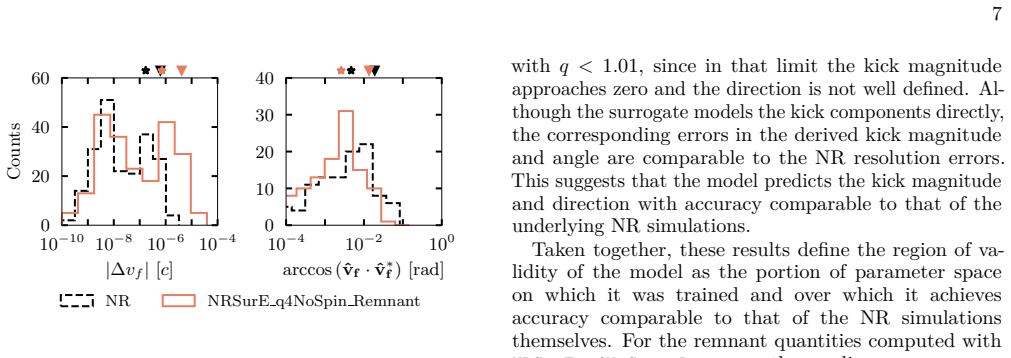
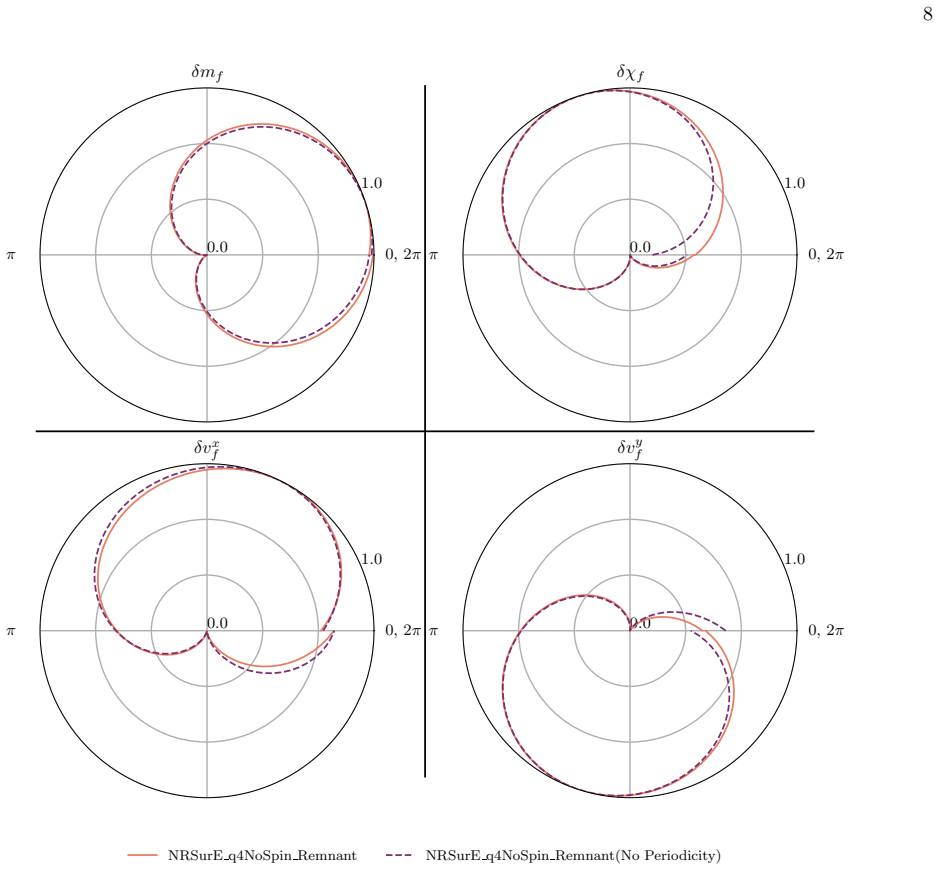
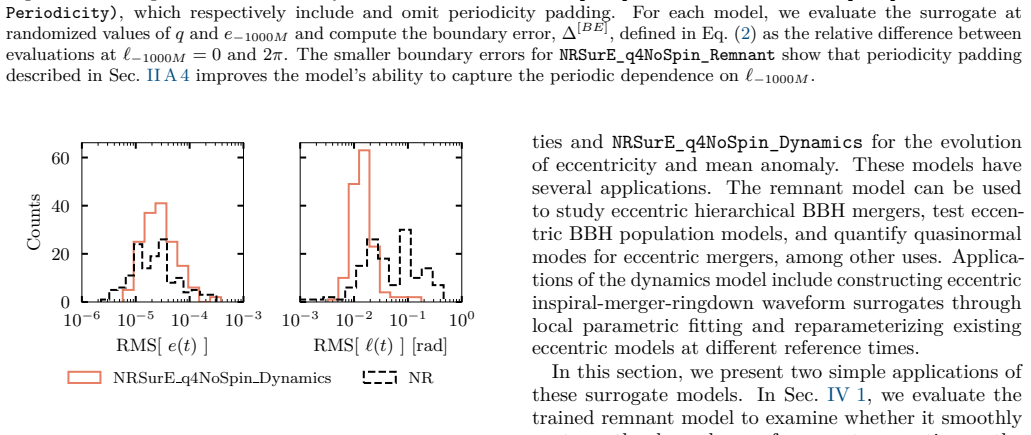
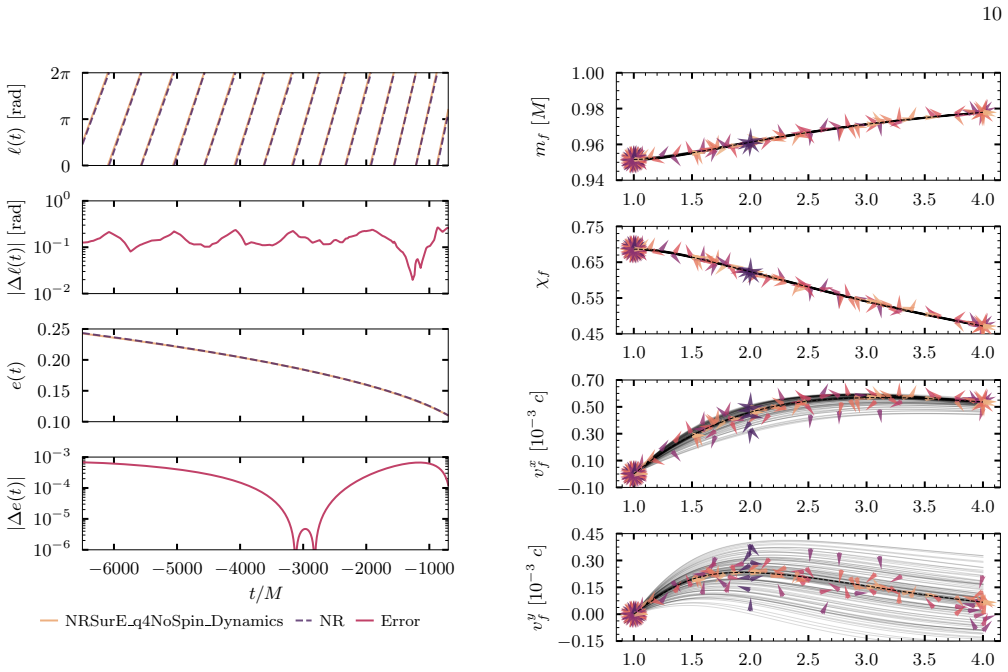
Accurate models of merger remnants are increasingly important for gravitational-wave science, including precision tests of gravity with ringdown, inference of black-hole populations, and modeling hierarchical mergers. For eccentric binaries, remnant mass, spin, and recoil carry nontrivial imprints of eccentricity that are both physically informative and more challenging to model, yet remain less developed than in the quasi-circular case. We present two new models trained on numerical-relativity (NR) simulations of unequal-mass, non-spinning eccentric binary black holes: NRSurE_q4NoSpin_Remnant, which predicts remnant properties, and NRSurE_q4NoSpin_Dynamics, a time-domain surrogate for the evolution of eccentricity and mean anomaly. Both models are trained on NR simulations over a three-dimensional parameter space with mass ratios $q \leq 4$, eccentricity $e < 0.23$, and mean anomaly $\ell \in [0,2\pi)$ radians, where both $e$ and $\ell$ defined at $t=-1000M$ relative to peak amplitude and $M$ is the total mass. We highlight some applications, including the phenomenological impact of eccentricity on remnant properties and the enhancement or suppression of recoil. We also provide error estimates for all modeled quantities, supporting reliable use in current and future gravitational-wave parameter-estimation analyses. Both models will be made available through open-source codes.
Editorial analysis
A structured set of objections, weighed in public.
Referee Report
Summary. The paper presents two surrogate models trained on NR simulations of non-spinning eccentric BBH binaries: NRSurE_q4NoSpin_Remnant, which predicts remnant mass, spin, and recoil velocity, and NRSurE_q4NoSpin_Dynamics, a time-domain model for the evolution of eccentricity e(t) and mean anomaly ℓ(t). Both are trained over the domain q ≤ 4, e < 0.23, ℓ ∈ [0, 2π) with e and ℓ defined at fixed retarded time t = -1000M relative to peak amplitude; error estimates are supplied and applications to GW analyses and eccentricity effects on remnants/recoil are discussed.
Significance. If the accuracy and error estimates hold within the stated domain, the models would fill a useful niche for eccentric BBH modeling in gravitational-wave science, where eccentricity imprints on remnants are physically informative but currently under-modeled compared to quasi-circular cases. The open-source release and explicit error estimates are strengths that support reproducibility and practical use in parameter estimation.
major comments (2)
- [Abstract] Abstract: the claim that the models 'support reliable use in current and future gravitational-wave parameter-estimation analyses' is central but not fully supported by the training domain alone (q ≤ 4, e < 0.23); the manuscript must either demonstrate validated performance near or beyond the boundaries or supply explicit extrapolation error bounds, as the current restriction leaves the reliability assertion load-bearing and untested.
- [Abstract] Definition of e and ℓ (Abstract and training description): anchoring eccentricity and mean anomaly at a fixed retarded time t = -1000M couples the initial conditions to the inspiral duration, which varies with q; this choice risks reduced accuracy or inconsistent generalization even inside the quoted box when time-to-merger changes, and the paper should include robustness tests (e.g., re-anchoring at different times or variable peak offsets) to substantiate the surrogate's internal consistency.
Simulated Author's Rebuttal
We thank the referee for their careful reading of the manuscript and for the constructive comments, which help clarify the scope and robustness of the surrogate models. We address each major comment below and will revise the manuscript accordingly to strengthen the presentation.
read point-by-point responses
-
Referee: [Abstract] Abstract: the claim that the models 'support reliable use in current and future gravitational-wave parameter-estimation analyses' is central but not fully supported by the training domain alone (q ≤ 4, e < 0.23); the manuscript must either demonstrate validated performance near or beyond the boundaries or supply explicit extrapolation error bounds, as the current restriction leaves the reliability assertion load-bearing and untested.
Authors: We agree that the abstract claim should be qualified to avoid implying performance outside the trained domain. In the revised version we will change the relevant sentence to state that the supplied error estimates support reliable use within the trained domain (q ≤ 4, e < 0.23). We will also add a short paragraph in the discussion section that explicitly notes the absence of validated extrapolation bounds and cautions against use beyond the quoted limits without further testing. This revision removes any load-bearing assertion that exceeds what the training data demonstrate. revision: yes
-
Referee: [Abstract] Definition of e and ℓ (Abstract and training description): anchoring eccentricity and mean anomaly at a fixed retarded time t = -1000M couples the initial conditions to the inspiral duration, which varies with q; this choice risks reduced accuracy or inconsistent generalization even inside the quoted box when time-to-merger changes, and the paper should include robustness tests (e.g., re-anchoring at different times or variable peak offsets) to substantiate the surrogate's internal consistency.
Authors: The fixed-time anchoring at t = -1000M was chosen to furnish a uniform, simulation-independent reference that precedes merger for all runs. We acknowledge that this couples the definition to the q-dependent inspiral length and could affect generalization. To substantiate consistency we will add a new subsection (or appendix) containing robustness tests in which e and ℓ are re-anchored at t = -500M and t = -1500M; the surrogate is retrained on the alternative definitions and the resulting errors are compared to the original model. These tests will be reported in the revised manuscript. revision: yes
Circularity Check
No circularity: surrogates are standard interpolants of independent NR data
full rationale
The paper describes the construction of two surrogate models (NRSurE_q4NoSpin_Remnant and NRSurE_q4NoSpin_Dynamics) by training on a set of numerical-relativity simulations spanning a bounded three-dimensional parameter space (q ≤ 4, e < 0.23, ℓ ∈ [0, 2π) with e and ℓ fixed at t = −1000M). The claimed outputs are direct approximations to quantities computed from those simulations, accompanied by error estimates derived from the training residuals. No step in the described workflow equates a model output to its own training inputs by definition, renames a fitted parameter as an independent prediction, or relies on a load-bearing self-citation whose validity is presupposed by the present work. The derivation therefore remains an ordinary data-driven interpolation whose accuracy is independently testable against the underlying NR runs.
Axiom & Free-Parameter Ledger
free parameters (1)
- surrogate fitting coefficients
axioms (1)
- domain assumption Numerical relativity simulations accurately capture the physics of eccentric nonspinning black hole mergers
Reference graph
Works this paper leans on
-
[1]
Observation of Gravitational Waves from a Binary Black Hole Merger
B. P. Abbottet al.(LIGO Scientific, Virgo), “Observation of Gravitational Waves from a Binary Black Hole Merger,” Phys. Rev. Lett.116, 061102 (2016), arXiv:1602.03837 [gr-qc]
work page internal anchor Pith review arXiv 2016
-
[2]
J. Aasiet al.(LIGO Scientific), “Advanced LIGO,” Class. Quant. Grav.32, 074001 (2015), arXiv:1411.4547 [gr-qc]
work page internal anchor Pith review arXiv 2015
-
[3]
Advanced Virgo: a 2nd generation interferometric gravitational wave detector
F. Acerneseet al.(Virgo), “Advanced Virgo: a second- generation interferometric gravitational wave detector,” Class. Quant. Grav.32, 024001 (2015), arXiv:1408.3978 [gr-qc]
work page internal anchor Pith review arXiv 2015
-
[4]
T. Akutsuet al.(KAGRA), “Overview of KAGRA: Detec- tor design and construction history,” PTEP2021, 05A101 (2021), arXiv:2005.05574 [physics.ins-det]
-
[5]
B. P. Abbottet al.(KAGRA, LIGO Scientific, VIRGO), “Prospects for Observing and Localizing Gravitational- Wave Transients with Advanced LIGO, Advanced 14 Virgo and KAGRA,” Living Rev. Rel.21, 3 (2018), arXiv:1304.0670 [gr-qc]
-
[6]
A. G. Abacet al.(LIGO Scientific, VIRGO, KAGRA), “GWTC-4.0: Updating the Gravitational-Wave Transient Catalog with Observations from the First Part of the Fourth LIGO-Virgo-KAGRA Observing Run,” (2025), arXiv:2508.18082 [gr-qc]
work page internal anchor Pith review arXiv 2025
-
[7]
Tests of General Relativity with GWTC-3
R. Abbottet al.(LIGO Scientific, VIRGO, KAGRA), “Tests of General Relativity with GWTC-3,” (2021), arXiv:2112.06861 [gr-qc]
work page internal anchor Pith review arXiv 2021
-
[8]
GWTC-4.0: Population Properties of Merging Compact Binaries
A. G. Abacet al.(LIGO Scientific, VIRGO, KAGRA), “GWTC-4.0: Population Properties of Merging Compact Binaries,” (2025), arXiv:2508.18083 [astro-ph.HE]
work page internal anchor Pith review Pith/arXiv arXiv 2025
-
[9]
Fabio Antonini, Silvia Toonen, and Adrian S. Hamers, “Binary black hole mergers from field triples: properties, rates and the impact of stellar evolution,” Astrophys. J. 841, 77 (2017), arXiv:1703.06614 [astro-ph.GA]
-
[10]
Repeated mergers and ejection of black holes within nuclear star clusters,
Giacomo Fragione and Joseph Silk, “Repeated mergers and ejection of black holes within nuclear star clusters,” Mon. Not. Roy. Astron. Soc.498, 4591–4604 (2020), arXiv:2006.01867 [astro-ph.GA]
-
[11]
Lidov-Kozai Cycles with Gravitational Radiation: Merging Black Holes in Isolated Triple Systems,
Kedron Silsbee and Scott Tremaine, “Lidov-Kozai Cycles with Gravitational Radiation: Merging Black Holes in Isolated Triple Systems,” Astrophys. J.836, 39 (2017), arXiv:1608.07642 [astro-ph.HE]
-
[12]
Manuel Arca-Sedda, Gongjie Li, and Bence Kocsis, “Or- der in the chaos - Eccentric black hole binary mergers in triples formed via strong binary–binary scatterings,” Astron. Astrophys.650, A189 (2021), arXiv:1805.06458 [astro-ph.HE]
-
[13]
Massive Stellar Triples Leading to Sequential Binary Black-Hole Mergers in the Field,
Alejandro Vigna-Gómez, Silvia Toonen, Enrico Ramirez- Ruiz, Nathan W. C. Leigh, Jeff Riley, and Carl-Johan Haster, “Massive Stellar Triples Leading to Sequential Binary Black-Hole Mergers in the Field,” Astrophys. J. Lett.907, L19 (2021), arXiv:2010.13669 [astro-ph.HE]
-
[14]
Antoni Ramos-Buades, Alessandra Buonanno, and Jonathan Gair, “Bayesian inference of binary black holes with inspiral-merger-ringdown waveforms using two ec- centric parameters,” Phys. Rev. D108, 124063 (2023), arXiv:2309.15528 [gr-qc]
- [15]
-
[16]
Evidence for eccentricity in the population of binary black holes observed by LIGO-Virgo-KAGRA
Nihar Gupteet al., “Evidence for eccentricity in the population of binary black holes observed by LIGO- Virgo-KAGRA,” Phys. Rev. D112, 104045 (2025), arXiv:2404.14286 [gr-qc]
work page internal anchor Pith review Pith/arXiv arXiv 2025
-
[17]
Gravitational-wave inference for eccen- tric binaries: the argument of periapsis,
Teagan A. Clarke, Isobel M. Romero-Shaw, Paul D. Lasky, and Eric Thrane, “Gravitational-wave inference for eccen- tric binaries: the argument of periapsis,” Mon. Not. Roy. Astron. Soc.517, 3778–3784 (2022), arXiv:2206.14006 [gr-qc]
-
[18]
Reanalysis of binary black hole gravitational wave events for orbital eccentricity signatures,
Maria de Lluc Planas, Antoni Ramos-Buades, Cecilio García-Quirós, Héctor Estellés, Sascha Husa, and Maria Haney, “Reanalysis of binary black hole gravitational wave events for orbital eccentricity signatures,” Phys. Rev. D 112, 123004 (2025), arXiv:2504.15833 [gr-qc]
-
[19]
Keisi Kacanja, Kanchan Soni, and Alexander Harvey Nitz, “Eccentricity signatures in LIGO-Virgo-KAGRA’s binary neutron star and neutron-star black holes,” Phys. Rev. D112, 122007 (2025), arXiv:2508.00179 [gr-qc]
- [20]
-
[21]
Antoni Ramos-Buades, Sascha Husa, Geraint Pratten, Héctor Estellés, Cecilio García-Quirós, Maite Mateu- Lucena, Marta Colleoni, and Rafel Jaume, “First sur- vey of spinning eccentric black hole mergers: Numer- ical relativity simulations, hybrid waveforms, and pa- rameter estimation,” Phys. Rev. D101, 083015 (2020), arXiv:1909.11011 [gr-qc]
-
[22]
Expanding RIFT: Improving per- formance for GW parameter inference,
J. Woffordet al., “Expanding RIFT: Improving per- formance for GW parameter inference,” (2022), arXiv:2210.07912 [gr-qc]
-
[23]
A Numerical Relativity Waveform Surrogate Model for Generically Precessing Binary Black Hole Mergers
Jonathan Blackman, Scott E. Field, Mark A. Scheel, Chad R. Galley, Christian D. Ott, Michael Boyle, Lawrence E. Kidder, Harald P. Pfeiffer, and Béla Szilá- gyi, “Numerical relativity waveform surrogate model for generically precessing binary black hole mergers,” Phys. Rev. D96, 024058 (2017), arXiv:1705.07089 [gr-qc]
work page Pith review arXiv 2017
-
[24]
Surrogate mod- els for precessing binary black hole simulations with unequal masses,
Vijay Varma, Scott E. Field, Mark A. Scheel, Jonathan Blackman, Davide Gerosa, Leo C. Stein, Lawrence E. Kid- der, and Harald P. Pfeiffer, “Surrogate models for precess- ing binary black hole simulations with unequal masses,” Phys. Rev. Research.1, 033015 (2019), arXiv:1905.09300 [gr-qc]
-
[25]
Tousif Islam, Vijay Varma, Jackie Lodman, Scott E. Field, Gaurav Khanna, Mark A. Scheel, Harald P. Pfeiffer, Da- vide Gerosa, and Lawrence E. Kidder, “Eccentric binary black hole surrogate models for the gravitational waveform and remnant properties: comparable mass, nonspinning case,” Phys. Rev. D103, 064022 (2021), arXiv:2101.11798 [gr-qc]
-
[26]
Targeted large mass ratio numerical relativity surrogate waveform model for GW190814,
Jooheon Yoo, Vijay Varma, Matthew Giesler, Mark A. Scheel, Carl-Johan Haster, Harald P. Pfeiffer, Lawrence E. Kidder, and Michael Boyle, “Targeted large mass ratio numerical relativity surrogate waveform model for GW190814,” Phys. Rev. D106, 044001 (2022), arXiv:2203.10109 [gr-qc]
-
[27]
Numerical relativity surrogate model with memory effects and post-Newtonian hybridization,
Jooheon Yooet al., “Numerical relativity surrogate model with memory effects and post-Newtonian hybridization,” Phys. Rev. D108, 064027 (2023), arXiv:2306.03148 [gr- qc]
-
[28]
Eccentric binary black holes: A new framework for numerical relativity waveform surro- gates,
Peter James Neeet al., “Eccentric binary black holes: A new framework for numerical relativity waveform surro- gates,” (2025), arXiv:2510.00106 [gr-qc]
-
[29]
Black- hole kicks from numerical-relativity surrogate models,
DavideGerosa, FrançoisHébert, andLeoC.Stein,“Black- hole kicks from numerical-relativity surrogate models,” Phys. Rev. D97, 104049 (2018), arXiv:1802.04276 [gr- qc]
-
[30]
High-accuracy mass, spin, and recoil predictions of generic black-hole merger remnants
Vijay Varma, Davide Gerosa, Leo C. Stein, François Hébert, and Hao Zhang, “High-accuracy mass, spin, and recoil predictions of generic black-hole merger remnants,” Phys. Rev. Lett.122, 011101 (2019), arXiv:1809.09125 [gr-qc]
work page Pith review arXiv 2019
-
[31]
Mapping the asymptotic inspiral of precessing bi- nary black holes to their merger remnants,
Luca Reali, Matthew Mould, Davide Gerosa, and Vijay Varma, “Mapping the asymptotic inspiral of precessing bi- nary black holes to their merger remnants,” Class. Quant. Grav.37, 225005 (2020), arXiv:2005.01747 [gr-qc]
-
[32]
Tousif Islam, Scott E. Field, and Gaurav Khanna, “Remnant black hole properties from numerical-relativity- informed perturbation theory and implications for wave- form modeling,” Phys. Rev. D108, 064048 (2023), arXiv:2301.07215 [gr-qc]
-
[33]
Predicting the properties of black-hole merger remnants with deep neural networks,
Leïla Haegel and Sascha Husa, “Predicting the properties of black-hole merger remnants with deep neural networks,” 15 Class. Quant. Grav.37, 135005 (2020), arXiv:1911.01496 [gr-qc]
-
[34]
Formation and evo- lution of binary black holes in n-body simulations of star clusters with up to two million stars,
Jordan Barber and Fabio Antonini, “Formation and evo- lution of binary black holes in n-body simulations of star clusters with up to two million stars,” Monthly Notices of the Royal Astronomical Society538, 639–658 (2025)
2025
-
[35]
Jonathan Blackman, Scott E. Field, Mark A. Scheel, Chad R. Galley, Daniel A. Hemberger, Patricia Schmidt, and Rory Smith, “A Surrogate Model of Gravitational Waveforms from Numerical Relativity Simulations of Pre- cessing Binary Black Hole Mergers,” Phys. Rev. D95, 104023 (2017), arXiv:1701.00550 [gr-qc]
work page Pith review arXiv 2017
-
[36]
Defining eccentricity for gravitational wave astronomy,
Md Arif Shaikh, Vijay Varma, Harald P. Pfeiffer, Antoni Ramos-Buades, and Maarten van de Meent, “Defining eccentricity for gravitational wave astronomy,” Phys. Rev. D108, 104007 (2023), arXiv:2302.11257 [gr-qc]
-
[37]
Post-Newtonian theory-inspired framework for characterizing eccentricity in gravitational waveforms,
Tousif Islam and Tejaswi Venumadhav, “Post-Newtonian theory-inspired framework for characterizing eccentricity in gravitational waveforms,” Phys. Rev. D112, 104039 (2025), arXiv:2502.02739 [gr-qc]
-
[38]
Aditya Vijaykumar, Alexandra G. Hanselman, and Michael Zevin, “Consistent Eccentricities for Gravitational-wave Astronomy: Resolving Discrepancies between Astrophysical Simulations and Waveform Models,” Astrophys. J.969, 132 (2024), arXiv:2402.07892 [astro-ph.HE]
-
[39]
Defining eccentricity for spin-precessing binaries,
Md Arif Shaikh, Vijay Varma, Antoni Ramos-Buades, Harald P. Pfeiffer, Michael Boyle, Lawrence E. Kid- der, and Mark A. Scheel, “Defining eccentricity for spin-precessing binaries,” Class. Quant. Grav.42, 195012 (2025), arXiv:2507.08345 [gr-qc]
-
[40]
The SXS collaboration’s third catalog of binary black hole simulations,
Mark A. Scheelet al., “The SXS collaboration’s third catalog of binary black hole simulations,” Class. Quant. Grav.42, 195017 (2025), arXiv:2505.13378 [gr-qc]
- [41]
-
[42]
Shilpa Kastha, “Linear momentum flux from inspiralling compact binaries in quasielliptical orbits at 2.5 post- Newtonian order,” Phys. Rev. D105, 064039 (2022), arXiv:2110.12807 [gr-qc]
-
[43]
Ap- proximate helical symmetry in compact binaries,
Aniket Khairnar, Leo C. Stein, and Michael Boyle, “Ap- proximate helical symmetry in compact binaries,” Phys. Rev. D111, 024072 (2025), arXiv:2410.16373 [gr-qc]
-
[44]
Impact of eccentricity and mean anomaly in numerical relativity mergers,
Peter James Neeet al., “Impact of eccentricity and mean anomaly in numerical relativity mergers,” Class. Quant. Grav.42, 135011 (2025), arXiv:2503.05422 [gr-qc]
-
[45]
Multipole expansions for energy and momenta carried by gravitational waves
Milton Ruiz, Ryoji Takahashi, Miguel Alcubierre, and Dario Nunez, “Multipole expansions for energy and mo- menta carried by gravitational waves,” Gen. Rel. Grav. 40, 2467 (2008), arXiv:0707.4654 [gr-qc]
work page Pith review arXiv 2008
-
[46]
Extrapolating gravitational-wave data from numerical simulations,
Michael Boyle and Abdul H. Mroue, “Extrapolating gravitational-wave data from numerical simulations,” Phys. Rev.D80, 124045 (2009), arXiv:0905.3177 [gr-qc]
-
[47]
Transformations of asymptotic gravitational-wave data,
Michael Boyle, “Transformations of asymptotic gravitational-wave data,” Phys. Rev.D93, 084031 (2016), arXiv:1509.00862 [gr-qc]
-
[48]
Comparing Remnant Prop- erties from Horizon Data and Asymptotic Data in Nu- merical Relativity,
Dante A. B. Iozzoet al., “Comparing Remnant Prop- erties from Horizon Data and Asymptotic Data in Nu- merical Relativity,” Phys. Rev. D103, 124029 (2021), arXiv:2104.07052 [gr-qc]
-
[49]
Nils Deppe, William Throwe, Lawrence E. Kidder, Nils L. Vu, Kyle C. Nelli, Cristóbal Armaza, Marceline S. Bonilla, François Hébert, Yoonsoo Kim, Prayush Kumar, Geoffrey Lovelace, Alexandra Macedo, Jordan Moxon, Eamonn O’Shea, HaraldP.Pfeiffer, MarkA.Scheel, SaulA.Teukol- sky, Nikolas A. Wittek,et al., “SpECTRE v2023.10.11 ,” 10.5281/zenodo.8431874 (2023)
-
[50]
ImprovedCauchy-characteristicevolutionsystemforhigh- precision numerical relativity waveforms,
Jordan Moxon, Mark A. Scheel, and Saul A. Teukolsky, “ImprovedCauchy-characteristicevolutionsystemforhigh- precision numerical relativity waveforms,” Phys. Rev. D 102, 044052 (2020), arXiv:2007.01339 [gr-qc]
-
[51]
SpECTRE Cauchy-characteristic evolution system for rapid, precise waveform extraction,
Jordan Moxon, Mark A. Scheel, Saul A. Teukolsky, Nils Deppe, Nils Fischer, Francois Hébert, Lawrence E. Kidder, and William Throwe, “SpECTRE Cauchy-characteristic evolution system for rapid, precise waveform extraction,” Phys. Rev. D107, 064013 (2023), arXiv:2110.08635 [gr- qc]
-
[52]
Asymptotic structure of spacetime and the Newman-Penrose formal- ism: a brief review,
L. A. Gómez López and G. D. Quiroga, “Asymptotic structure of spacetime and the Newman-Penrose formal- ism: a brief review,” Rev. Mex. Fis.63, 275 (2017), arXiv:1711.11381 [gr-qc]
-
[53]
Momentum flux at null infinity,
T Dray, “Momentum flux at null infinity,” Classical and Quantum Gravity2, L7 (1985)
1985
-
[54]
Angular momentum at null infinity,
T Dray and M Streubel, “Angular momentum at null infinity,” Classical and Quantum Gravity1, 15 (1984)
1984
-
[55]
“conserved
Michael Streubel, ““conserved” quantities for isolated gravitational systems,” General Relativity and Gravita- tion9, 551–561 (1978)
1978
-
[56]
A review of gravitational memory and BMS frame fixing in numerical relativity,
Keefe Mitmanet al., “A review of gravitational memory and BMS frame fixing in numerical relativity,” Class. Quant. Grav.41, 223001 (2024), arXiv:2405.08868 [gr- qc]
-
[57]
Modeling the BMS transformation induced by a binary black hole merger,
Guido Da Reet al., “Modeling the BMS transformation induced by a binary black hole merger,” Phys. Rev. D 111, 124019 (2025), arXiv:2503.09569 [gr-qc]
-
[58]
Scikit-learn: Machine learning in Python,
F. Pedregosa, G. Varoquaux, A. Gramfort, V. Michel, B. Thirion, O. Grisel, M. Blondel, P. Prettenhofer, R. Weiss, V. Dubourg, J. Vanderplas, A. Passos, D. Cour- napeau, M. Brucher, M. Perrot, and E. Duchesnay, “Scikit-learn: Machine learning in Python,” Journal of Machine Learning Research12, 2825–2830 (2011)
2011
-
[59]
Characterizing the merger of equatorial-eccentric-geodesic plunges in ro- tating black holes,
Guglielmo Faggioli, Maarten van de Meent, Alessan- dra Buonanno, and Gaurav Khanna, “Characterizing the merger of equatorial-eccentric-geodesic plunges in ro- tating black holes,” Phys. Rev. D112, 084009 (2025), arXiv:2507.05870 [gr-qc]
-
[60]
Michael Boyleet al., “The SXS Collaboration catalog of binary black hole simulations,” Class. Quant. Grav.36, 195006 (2019), arXiv:1904.04831 [gr-qc]
-
[61]
Fast prediction and evaluation of gravitational waveforms using surrogate models,
Scott E. Field, Chad R. Galley, Jan S. Hesthaven, Jason Kaye, and Manuel Tiglio, “Fast prediction and evaluation of gravitational waveforms using surrogate models,” Phys. Rev. X4, 031006 (2014), arXiv:1308.3565 [gr-qc]
-
[63]
An ‘empirical interpolation’ method: application to efficient reduced-basis discretiza- tion of partial differential equations,
Maxime Barrault, Yvon Maday, Ngoc Cuong Nguyen, and Anthony T. Patera, “An ‘empirical interpolation’ method: application to efficient reduced-basis discretiza- tion of partial differential equations,” Comptes Rendus Mathematique339, 667–672 (2004)
2004
-
[64]
A general multipurpose interpolation procedure: the magic points,
Yvon Maday, Ngoc Cuong Nguyen, Anthony T. Patera, and S. H. Pau, “A general multipurpose interpolation procedure: the magic points,” Communications on Pure 16 and Applied Analysis8, 383–404 (2009)
2009
-
[65]
Efficient greedy algorithms for high-dimensional param- eter spaces with applications to empirical interpolation and reduced basis methods,
Hesthaven, Jan S., Stamm, Benjamin, and Zhang, Shun, “Efficient greedy algorithms for high-dimensional param- eter spaces with applications to empirical interpolation and reduced basis methods,” ESAIM: M2AN48, 259–283 (2014)
2014
-
[66]
Hao Wang, Yuan-Chuan Zou, Qing-Wen Wu, Yu Liu, and Xiaolin Liu, “Characterizing the effect of eccentric- ity on the dynamics of binary black hole mergers in nu- merical relativity,” Phys. Rev. D109, 084063 (2024), arXiv:2310.04777 [gr-qc]
-
[67]
Complete waveform comparison of post- Newtonian and numerical relativity in eccentric orbits,
Hao Wang, Yuan-Chuan Zou, Qing-Wen Wu, Xiaolin Liu, and Zhao Li, “Complete waveform comparison of post- Newtonian and numerical relativity in eccentric orbits,” Phys. Rev. D111, 064018 (2025), arXiv:2409.17636 [gr- qc]
-
[68]
Unveiling the Fingerprint of Eccentric Binary Black Hole Mergers,
Hao Wang, Yuan-Chuan Zou, Qing-Wen Wu, and Yu Liu, “Unveiling the Fingerprint of Eccentric Binary Black Hole Mergers,” (2023), arXiv:2311.08822 [gr-qc]
- [69]
-
[70]
Unveiling the Merger Structure of Black Hole Binaries in Generic Planar Orbits,
Gregorio Carullo, Simone Albanesi, Alessandro Nagar, Rossella Gamba, Sebastiano Bernuzzi, Tomas Andrade, and Juan Trenado, “Unveiling the Merger Structure of Black Hole Binaries in Generic Planar Orbits,” Phys. Rev. Lett.132, 101401 (2024), arXiv:2309.07228 [gr-qc]
-
[71]
Amplification of superkicks in black-hole binaries through orbital eccentricity,
U. Sperhake, R. Rosca-Mead, D. Gerosa, and E. Berti, “Amplification of superkicks in black-hole binaries through orbital eccentricity,” Phys. Rev. D101, 024044 (2020), arXiv:1910.01598 [gr-qc]
-
[72]
Lawrence Kidder, Mark Scheel, Saul Teukolsky, Eric Carl- son, and Gregory Cook, “Black hole evolution by spectral methods,” Physical Review D62(2000), 10.1103/phys- revd.62.084032
-
[73]
vi- jayvarma392/surfinbh: Surrogate final bh properties,
Vijay Varma, Leo C. Stein, and Davide Gerosa, “vi- jayvarma392/surfinbh: Surrogate final bh properties,” (2018)
2018
-
[74]
GWSurrogate: A Python package for gravitational wave surrogate models,
Scott E. Field, Vijay Varma, Jonathan Blackman, Bhooshan Gadre, Chad R. Galley, Tousif Islam, Keefe Mitman, Michael Pürrer, Adhrit Ravichandran, Mark A. Scheel, Leo C. Stein, and Jooheon Yoo, “GWSurrogate: A Python package for gravitational wave surrogate models,” J. Open Source Softw.10, 7073 (2025), arXiv:2504.08839 [astro-ph.IM]
-
[75]
Uiuc-ppl/charm: Charm++ version 6.10.2,
Laxmikant Kale, Bilge Acun, Seonmyeong Bak, Aaron Becker, Milind Bhandarkar, Nitin Bhat, Abhinav Bhatele, Eric Bohm, Cyril Bordage, Robert Brunner, Ronak Buch, Sayantan Chakravorty, Kavitha Chandrasekar, Jaemin Choi, Michael Denardo, Jayant DeSouza, Matthias Di- ener, Harshit Dokania, Isaac Dooley, Wayne Fenton, Juan Galvez, Fillipo Gioachin, Abhishek Gup...
2020
discussion (0)
Sign in with ORCID, Apple, or X to comment. Anyone can read and Pith papers without signing in.