Recognition: unknown
Wasserstein Distributionally Robust Regret Optimization for Reinforcement Learning from Human Feedback
Pith reviewed 2026-05-09 21:00 UTC · model grok-4.3
The pith
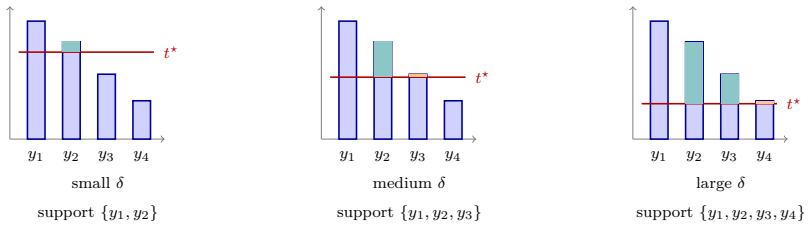
DRRO for RLHF solves the inner worst-case regret exactly under l1 ambiguity sets with water-filling optimal policies.
A machine-rendered reading of the paper's core claim, the machinery that carries it, and where it could break.
Core claim
Under the promptwise simplex allocation model with an l1 ambiguity set, the inner worst-case regret in Wasserstein DRRO admits an exact solution, and the optimal policy has a water-filling structure. These results yield a policy-gradient algorithm with a simple sampled-bonus interpretation that requires only minor changes to existing RLHF pipelines.
What carries the argument
The promptwise simplex allocation model under an l1 Wasserstein ambiguity set, which reduces the inner worst-case regret computation to an exact water-filling allocation over policy probabilities.
If this is right
- The optimal policy under DRRO can be obtained by a simple water-filling adjustment to the estimated advantage values.
- The resulting algorithm integrates into PPO or GRPO training loops by adding a sampled bonus term derived from the regret formulation.
- DRRO produces less pessimistic policies than standard distributionally robust value optimization under the same ambiguity sets.
- Empirical results indicate that DRRO mitigates reward over-optimization more effectively than uncertainty penalties or conservative constraints.
Where Pith is reading between the lines
- The water-filling structure may appear in trained language models when similar regret-based robustness is applied at scale.
- The regret perspective could extend to other settings with objective misspecification, such as recommendation systems or robotic control.
- The framework suggests that bounding regret rather than value may provide tighter guarantees on deployed performance gaps.
Load-bearing premise
The promptwise simplex allocation model sufficiently captures the essential dynamics of full-sequence RLHF optimization under reward misspecification.
What would settle it
A small-scale promptwise instance where the computed worst-case regret solution deviates from the predicted water-filling allocation under l1 perturbations, or controlled RLHF experiments where the DRRO algorithm shows no reduction in over-optimization relative to standard baselines.
Figures



read the original abstract
Reinforcement learning from human feedback (RLHF) has become a core post-training step for aligning large language models, yet the reward signal used in RLHF is only a learned proxy for true human utility. From an operations research perspective, this creates a decision problem under objective misspecification: the policy is optimized against an estimated reward, while deployment performance is determined by an unobserved objective. The resulting gap leads to reward over-optimization, or Goodharting, where proxy reward continues to improve even after true quality deteriorates. Existing mitigations address this problem through uncertainty penalties, pessimistic rewards, or conservative constraints, but they can be computationally burdensome and overly pessimistic. We propose Wasserstein distributionally robust regret optimization (DRRO) for RLHF. Instead of pessimizing worst-case value as in standard DRO, DRRO pessimizes worst-case regret relative to the best policy under the same plausible reward perturbation. We study the promptwise problem through a simplex allocation model and show that, under an $\ell_1$ ambiguity set, the inner worst-case regret admits an exact solution and the optimal policy has a water-filling structure. These results lead to a practical policy-gradient algorithm with a simple sampled-bonus interpretation and only minor changes to PPO/GRPO-style RLHF training. The framework also clarifies theoretically why DRRO is less pessimistic than DRO, and our experiments show that DRRO mitigates over-optimization more effectively than existing baselines while standard DRO is systematically over-pessimistic.
Editorial analysis
A structured set of objections, weighed in public.
Referee Report
Summary. The paper proposes Wasserstein distributionally robust regret optimization (DRRO) for RLHF to mitigate reward over-optimization (Goodharting). Modeling the problem via a promptwise simplex allocation under an ℓ1 ambiguity set, it claims that the inner worst-case regret admits an exact closed-form solution with a water-filling structure for the optimal policy. This yields a practical policy-gradient algorithm with a sampled-bonus interpretation requiring only minor changes to PPO/GRPO-style training. The framework is argued to be less pessimistic than standard DRO, with experiments indicating superior mitigation of over-optimization compared to baselines.
Significance. If the central derivations hold, the work offers a theoretically grounded alternative to pessimistic DRO methods in RLHF, with an exact solution and interpretable water-filling policy that could improve robustness to reward misspecification in LLM alignment. The sampled-bonus policy-gradient update and theoretical clarification on reduced pessimism relative to DRO represent potential advances for practical robust RLHF algorithms.
major comments (2)
- [Abstract and theoretical development of the promptwise model] The central claim of an exact solution for the inner worst-case regret and water-filling optimal policy under the ℓ1 ambiguity set is derived only for the promptwise simplex allocation model (as stated in the abstract). No full derivation, proof, or error analysis is provided in the manuscript, preventing verification that the closed-form regret solution is parameter-free or that it does not reduce to a fitted quantity by construction.
- [Promptwise simplex allocation model and § on the inner optimization] The promptwise simplex allocation model treats each prompt's allocation independently and memorylessly. In full-sequence RLHF, reward perturbations can exhibit correlations across tokens within a trajectory or across multiple responses to the same prompt; if such dependencies are material, the exact regret solution and the sampled-bonus policy-gradient update lose their guarantee of mitigating Goodharting more effectively than standard DRO.
Simulated Author's Rebuttal
We thank the referee for their detailed and constructive comments on our work. We address the major comments point by point below, providing clarifications and indicating planned revisions where appropriate.
read point-by-point responses
-
Referee: [Abstract and theoretical development of the promptwise model] The central claim of an exact solution for the inner worst-case regret and water-filling optimal policy under the ℓ1 ambiguity set is derived only for the promptwise simplex allocation model (as stated in the abstract). No full derivation, proof, or error analysis is provided in the manuscript, preventing verification that the closed-form regret solution is parameter-free or that it does not reduce to a fitted quantity by construction.
Authors: The derivation of the exact closed-form solution for the worst-case regret under the ℓ1 ambiguity set, along with the water-filling structure of the optimal policy, is provided in Section 3.2 of the manuscript for the promptwise simplex allocation model. We solve the inner min-max problem by considering the dual formulation of the Wasserstein distance and obtain a threshold-based allocation rule that depends solely on the ambiguity radius and the nominal reward vector, without introducing additional fitted parameters. This ensures it does not reduce to a fitted quantity by construction. To address the verification concern, we will include a more detailed proof with intermediate steps and an error analysis in the supplementary material of the revised version. revision: partial
-
Referee: [Promptwise simplex allocation model and § on the inner optimization] The promptwise simplex allocation model treats each prompt's allocation independently and memorylessly. In full-sequence RLHF, reward perturbations can exhibit correlations across tokens within a trajectory or across multiple responses to the same prompt; if such dependencies are material, the exact regret solution and the sampled-bonus policy-gradient update lose their guarantee of mitigating Goodharting more effectively than standard DRO.
Authors: We acknowledge that the promptwise simplex allocation model assumes independence across prompts and memorylessness within sequences to derive the closed-form solution. In scenarios where reward perturbations exhibit significant correlations across tokens or responses, the strict theoretical guarantees for mitigating Goodharting may not hold. However, the DRRO framework remains less pessimistic than standard DRO, as established in our theoretical analysis, and the sampled-bonus algorithm offers a practical approach that shows improved empirical performance. We will add a section discussing these modeling assumptions and potential limitations in the revised manuscript. revision: partial
Circularity Check
No significant circularity; derivation is self-contained optimization result
full rationale
The paper defines the promptwise simplex allocation model and the ℓ1 ambiguity set explicitly, then derives the exact inner worst-case regret solution and water-filling policy structure by solving the resulting min-max optimization problem. This is a direct consequence of the ℓ1-ball geometry on the probability simplex and does not reduce to any fitted parameter, self-citation chain, or renamed input. The subsequent policy-gradient algorithm with sampled-bonus interpretation follows as an implementation of the closed-form result rather than an assumption smuggled in. No load-bearing self-citations or ansatz smuggling are required for the central claims; the derivation remains independent of the target RLHF application once the model is stated.
Axiom & Free-Parameter Ledger
free parameters (1)
- ambiguity radius
axioms (1)
- domain assumption Wasserstein distance defines a valid ambiguity set for reward perturbations
Reference graph
Works this paper leans on
-
[1]
Johannes Ackermann, Takashi Ishida, and Masashi Sugiyama. Off-policy corrected reward modeling for reinforcement learning from human feedback.arXiv preprint arXiv:2507.15507,
-
[2]
Alekh Agarwal and Tong Zhang. Minimax regret optimization for robust machine learning under distribution shift.arXiv preprint arXiv:2202.05436,
-
[3]
Distributionally robust regret minimization.arXiv preprint arXiv:2412.15406,
Eilyan Bitar. Distributionally robust regret minimization.arXiv preprint arXiv:2412.15406,
-
[4]
Adversarial training of reward models.arXiv preprint arXiv:2504.06141,
Alexander Bukharin, Haifeng Qian, Shengyang Sun, Adithya Renduchintala, Soumye Singhal, Zhilin Wang, Oleksii Kuchaiev, Olivier Delalleau, and Tuo Zhao. Adversarial training of reward models.arXiv preprint arXiv:2504.06141,
-
[5]
Rlhf deciphered: A critical analysis of reinforcement learning from human feedback for LLMs
Shreyas Chaudhari, Pranjal Aggarwal, Vishvak Murahari, Tanmay Rajpurohit, Ashwin Kalyan, Karthik Narasimhan, Ameet Deshpande, and Bruno Castro da Silva. Rlhf deciphered: A critical analysis of reinforcement learning from human feedback for LLMs. arXiv preprint arXiv:2404.08555,
-
[6]
The accuracy paradox in RLHF: When better reward models don’t yield better language models
Yanjun Chen, Dawei Zhu, Yirong Sun, Xinghao Chen, Wei Zhang, and Xiaoyu Shen. The accuracy paradox in RLHF: When better reward models don’t yield better language models. InProceedings of the 2024 Conference on Empirical Methods in Natural Language Processing, pages 2980–2989,
2024
-
[7]
Juntao Dai, Taiye Chen, Yaodong Yang, Qian Zheng, and Gang Pan. Mitigating reward over-optimization in RLHF via behavior-supported regularization.arXiv preprint arXiv:2503.18130,
-
[8]
Active preference optimization for sample efficient rlhf.arXiv preprint arXiv:2402.10500, 2024
Nirjhar Das, Souradip Chakraborty, Aldo Pacchiano, and Sayak Ray Chowdhury. Active preference optimization for sample efficient RLHF.arXiv preprint arXiv:2402.10500,
-
[9]
Wasserstein distributionally robust regret optimization.arXiv preprint arXiv:2504.10796,
Lukas-Benedikt Fiechtner and Jose Blanchet. Wasserstein distributionally robust regret optimization.arXiv preprint arXiv:2504.10796,
-
[10]
Open-Reasoner-Zero: An Open Source Approach to Scaling Up Reinforcement Learning on the Base Model
Jingcheng Hu, Yinmin Zhang, Qi Han, Daxin Jiang, Xiangyu Zhang, and Heung-Yeung Shum. Open-reasoner-zero: An open source approach to scaling up reinforcement learning on the base model.arXiv preprint arXiv:2503.24290,
work page internal anchor Pith review arXiv
-
[11]
Smith, and Hannaneh Hajishirzi
Nathan Lambert, Valentina Pyatkin, Jacob Morrison, LJ Miranda, Bill Yuchen Lin, Khyathi Chandu, Nouha Dziri, Sachin Kumar, Tom Zick, Yejin Choi, Noah A. Smith, and Hannaneh Hajishirzi. RewardBench: Evaluating reward models for language modeling. InFindings of the Association for Computational Linguistics: NAACL 2025, pages 1755–1797,
2025
-
[12]
General exploratory bonus for optimistic exploration in RLHF.arXiv preprint arXiv:2510.03269,
37 Wendi Li, Changdae Oh, and Sharon Li. General exploratory bonus for optimistic exploration in RLHF.arXiv preprint arXiv:2510.03269,
-
[13]
Reinforcement Learning from Human Feedback: A Statistical Perspective
Pangpang Liu, Chengchun Shi, and Will Wei Sun. Reinforcement learning from human feedback: A statistical perspective.arXiv preprint arXiv:2604.02507,
work page internal anchor Pith review Pith/arXiv arXiv
-
[14]
Direct Preference Optimization: Your Language Model is Secretly a Reward Model
Rafael Rafailov, Archit Sharma, Eric Mitchell, Stefano Ermon, Christopher D. Manning, and Chelsea Finn. Direct preference optimization: Your language model is secretly a reward model.arXiv preprint arXiv:2305.18290,
work page internal anchor Pith review arXiv
-
[15]
Hamed Rahimian and Sanjay Mehrotra. Distributionally robust optimization: A review. arXiv preprint arXiv:1908.05659,
-
[16]
Countering reward over-optimization in LLM with demonstration- guided reinforcement learning
Mathieu Rita, Florian Strub, Rahma Chaabouni, Paul Michel, Emmanuel Dupoux, and Olivier Pietquin. Countering reward over-optimization in LLM with demonstration- guided reinforcement learning. InFindings of the Association for Computational Linguistics: ACL 2024,
2024
-
[17]
DeepSeekMath: Pushing the Limits of Mathematical Reasoning in Open Language Models
Zhihong Shao, Peiyi Wang, Qihao Zhu, Runxin Yang, Junxiao Xu, Maosong Li, et al. DeepSeekMath: Pushing the limits of mathematical reasoning in open language models. arXiv preprint arXiv:2402.03300,
work page internal anchor Pith review Pith/arXiv arXiv
-
[18]
Reward model overoptimisation in iterated RLHF.arXiv preprint arXiv:2505.18126,
Lorenz Wolf, Robert Kirk, and Mirco Musolesi. Reward model overoptimisation in iterated RLHF.arXiv preprint arXiv:2505.18126,
-
[19]
Learning a pessimistic reward model in RLHF.arXiv preprint arXiv:2505.20556,
Yinglun Xu, Hangoo Kang, Tarun Suresh, Yuxuan Wan, and Gagandeep Singh. Learning a pessimistic reward model in RLHF.arXiv preprint arXiv:2505.20556,
-
[20]
arXiv preprint arXiv:2409.15360 , year=
Yuzi Yan, Xingzhou Lou, Jialian Li, Yiping Zhang, Jian Xie, Chao Yu, Yu Wang, Dong Yan, and Yuan Shen. Reward-robust RLHF in LLMs.arXiv preprint arXiv:2409.15360,
-
[21]
DAPO: An Open-Source LLM Reinforcement Learning System at Scale
Qiying Yu, Zheng Zhang, Ruofei Zhu, Yufeng Yuan, Xiaochen Zuo, Yu Yue, Weinan Dai, Tiantian Fan, Gaohong Liu, Lingjun Liu, Xin Liu, Haibin Lin, Zhiqi Lin, Bole 39 Ma, Guangming Sheng, Yuxuan Tong, Chi Zhang, Mofan Zhang, Wang Zhang, Hang Zhu, Jinhua Zhu, Jiaze Chen, Jiangjie Chen, Chengyi Wang, Hongli Yu, Yuxuan Song, Xiangpeng Wei, Hao Zhou, Jingjing Liu...
work page internal anchor Pith review Pith/arXiv arXiv
-
[22]
Yuanzhao Zhai, Han Zhang, Yu Lei, Yue Yu, Kele Xu, Dawei Feng, Bo Ding, and Huaimin Wang. Uncertainty-penalized reinforcement learning from human feedback with diverse reward LoRA ensembles.arXiv preprint arXiv:2401.00243,
-
[23]
Fine-Tuning Language Models from Human Preferences
Daniel M. Ziegler, Nisan Stiennon, Jeffrey Wu, Tom B. Brown, Alec Radford, Dario Amodei, Paul Christiano, and Geoffrey Irving. Fine-tuning language models from human preferences.arXiv preprint arXiv:1909.08593,
work page internal anchor Pith review arXiv 1909
discussion (0)
Sign in with ORCID, Apple, or X to comment. Anyone can read and Pith papers without signing in.