Recognition: unknown
Intermittency induced by long memory under stochastic regime switching
Pith reviewed 2026-05-09 18:27 UTC · model grok-4.3
The pith
Long memory combined with stochastic regime switching induces intermittency where systems stable in expectation exhibit pathwise growth and burst phases.
A machine-rendered reading of the paper's core claim, the machinery that carries it, and where it could break.
Core claim
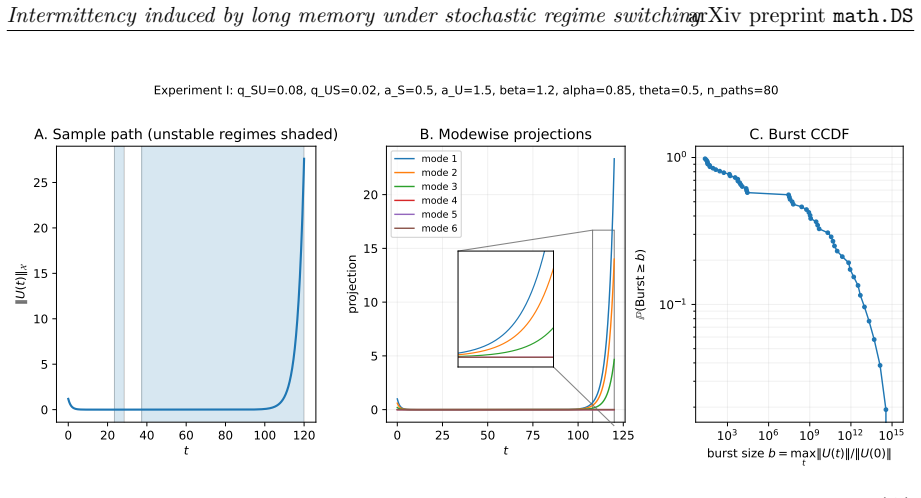
In network-coupled operator-valued Volterra evolutions with completely monotone memory kernels modulated by an ergodic continuous-time Markov chain, an averaged memory gain yields annealed stability in expectation, while quenched behavior features almost sure growth and metastable burst phases amplified by memory during persistent supercritical regimes.
What carries the argument
The annealed-quenched dichotomy arising from the interaction of long-range memory kernels and stochastic regime switching, formalized via memory-adapted Lyapunov functionals for the annealed side and subadditive ergodic arguments for the quenched growth exponent.
If this is right
- Uniform moment bounds and mean-square control hold under the averaged subcriticality condition.
- Pathwise almost sure growth occurs with a deterministic exponent obtained via subadditive ergodic theory.
- Microscopic regime-modulated self-exciting point processes converge to the random-coefficient Volterra macroscopic limit.
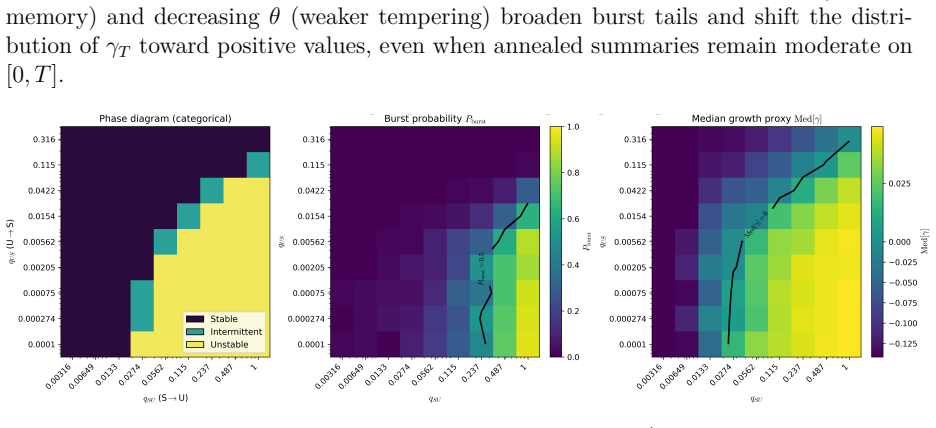
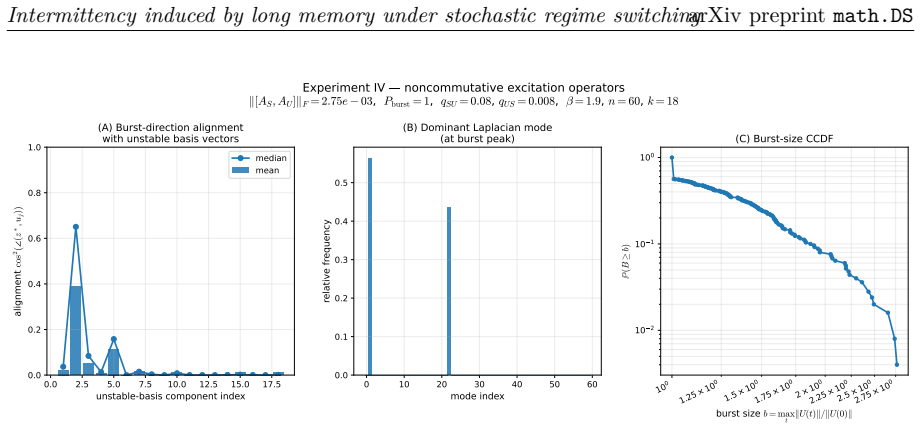
- Intermittent bursts exhibit heavy-tailed statistics and depend on graph geometry and noncommuting excitation operators.
Where Pith is reading between the lines
- Real-world systems with long memory and occasional parameter shifts may exhibit unexpected intermittency not captured by Markovian models alone.
- The micro-macro correspondence allows branching process simulations to predict burst statistics in the continuous Volterra setting.
- Relaxing ergodicity of the switching chain could produce qualitatively different growth behaviors.
- Network topology choices may offer a way to suppress or localize bursts through geometry effects.
Load-bearing premise
The memory kernels are completely monotone and the regime-switching Markov chain is ergodic with the excitation operators satisfying the stated subcriticality condition.
What would settle it
A numerical simulation or analytical counterexample where completely monotone kernels are replaced by non-monotone ones while keeping other conditions, showing loss of uniform moment bounds and separation of annealed and quenched behaviors.
Figures



read the original abstract
We study a fundamental instability mechanism in nonlinear, nonlocal dynamical systems arising from the interaction of long-range memory and stochastic regime switching. The dynamics are governed by network-coupled, operator-valued Volterra evolutions with completely monotone memory kernels whose excitation operators and kernel parameters are modulated by an ergodic finite-state continuous-time Markov chain. We formalize a sharp separation between annealed stability (in expectation) and quenched behaviour (along typical sample paths). On the annealed side, we identify an averaged memory gain that yields uniform moment bounds and a memory-adapted Lyapunov functional implying mean-square control under an averaged subcriticality condition. On the quenched side, we show that rare but persistent excursions into supercritical regimes are amplified by memory, producing intermittent macroscopic bursts with heavy-tailed statistics and a deterministic almost sure growth exponent obtained via a subadditive ergodic argument. This establishes an annealed--quenched dichotomy specific to non-Markovian switching systems, where stability in expectation can coexist with pathwise growth and metastable burst phases. We further derive a micro--macro correspondence by proving that a population of regime-modulated self-exciting point processes converges, both annealed and quenched, to the random-coefficient Volterra limit, transferring the burst mechanism from microscopic branching dynamics to macroscopic long-memory flows. Numerical experiments illustrate how burst localization depends on graph geometry and on noncommuting excitation operators.
Editorial analysis
A structured set of objections, weighed in public.
Referee Report
Summary. The paper studies intermittency in nonlinear nonlocal systems from the interaction of long-range memory and stochastic regime switching. It considers network-coupled operator-valued Volterra evolutions with completely monotone kernels modulated by an ergodic finite-state continuous-time Markov chain. The central claims are an annealed-quenched dichotomy: annealed mean-square stability under an averaged subcriticality condition via memory-adapted Lyapunov functionals and uniform moment bounds, versus quenched pathwise intermittent macroscopic bursts with heavy-tailed statistics and a deterministic a.s. growth exponent via subadditive ergodic arguments. It further establishes a micro-macro correspondence by showing convergence of regime-modulated self-exciting point processes to the random-coefficient Volterra limit (annealed and quenched), with numerics on burst localization depending on graph geometry and noncommuting operators.
Significance. If the results hold, this identifies a specific mechanism for intermittency in non-Markovian switching systems where expectation stability coexists with pathwise growth and metastable bursts, extending standard tools (Lyapunov functionals, subadditive ergodic theorem, point-process convergence) to this setting. The micro-macro correspondence transferring burst dynamics from microscopic branching to macroscopic long-memory flows is a clear strength, as is the explicit separation of annealed and quenched behaviors. This could inform analysis of complex systems with memory and modulation, provided the quenched arguments are fully justified.
major comments (1)
- [Quenched analysis (subadditive ergodic argument)] Quenched analysis, subadditive ergodic argument for the deterministic a.s. growth exponent: the regime-modulated Volterra process has state depending on the full history through the completely monotone kernel. Standard subadditive ergodic theorems (e.g., Kingman-type) require subadditivity on an ergodic dynamical system with suitable measurability and mixing; the long-range dependence from the memory tail may destroy independence or mixing of increments even when the modulating Markov chain is ergodic. The manuscript must supply explicit control on the memory-induced dependence to ensure the limit is deterministic and pathwise constant, as this is load-bearing for the quenched side of the annealed-quenched dichotomy.
minor comments (3)
- [Notation and setup] The notation for excitation operators, kernel parameters, and the subcriticality condition should be introduced with a brief example of noncommuting operators to aid readability before the main theorems.
- [Numerical experiments] Numerical experiments section: figure captions for burst localization should explicitly list the graph geometries, parameter values, and how noncommuting operators are implemented to allow reproduction.
- [References] References: add precise citations for the specific statements of the subadditive ergodic theorem and point-process convergence results used, including any extensions to Volterra processes.
Simulated Author's Rebuttal
We thank the referee for the careful reading and for isolating the key technical point in the quenched analysis. We address it directly below and will revise the manuscript to make the required control explicit.
read point-by-point responses
-
Referee: Quenched analysis, subadditive ergodic argument for the deterministic a.s. growth exponent: the regime-modulated Volterra process has state depending on the full history through the completely monotone kernel. Standard subadditive ergodic theorems (e.g., Kingman-type) require subadditivity on an ergodic dynamical system with suitable measurability and mixing; the long-range dependence from the memory tail may destroy independence or mixing of increments even when the modulating Markov chain is ergodic. The manuscript must supply explicit control on the memory-induced dependence to ensure the limit is deterministic and pathwise constant, as this is load-bearing for the quenched side of the annealed-quenched dichotomy.
Authors: We agree that the long memory induced by the completely monotone kernel requires explicit justification before Kingman’s theorem can be invoked. Because the kernels are completely monotone, Bernstein’s theorem supplies a representation as Laplace transforms of positive measures. This permits an auxiliary-state augmentation (a continuum of exponential modes) that renders the joint (Volterra + auxiliary + Markov chain) process Markovian with respect to a suitable filtration. The finite-state ergodicity of the modulating chain then propagates to the extended system, restoring the necessary mixing and allowing the subadditive sequence (log-norm of the solution) to satisfy the hypotheses of the subadditive ergodic theorem. The resulting limit is therefore deterministic and pathwise constant. We will add a dedicated appendix that (i) constructs the auxiliary process, (ii) verifies the required measurability and subadditivity, and (iii) confirms that the ergodic theorem applies directly to the augmented dynamics. This addresses the load-bearing character of the quenched side of the dichotomy. revision: yes
Circularity Check
No circularity: claims rely on external ergodic theory and Lyapunov methods
full rationale
The derivation establishes an annealed-quenched dichotomy for non-Markovian regime-switching Volterra systems using an averaged memory gain for uniform moment bounds and a memory-adapted Lyapunov functional under subcriticality, together with a subadditive ergodic argument for the deterministic almost-sure growth on the quenched side. These steps invoke standard external tools (ergodic theorems, Lyapunov analysis) applied to the modulated kernels and Markov chain, without any reduction of a claimed prediction or growth exponent to a fitted parameter, self-defined quantity, or self-cited uniqueness result by construction. The micro-macro convergence from point processes to the random-coefficient Volterra limit is likewise obtained via independent convergence arguments. No load-bearing step equates outputs to inputs via renaming, ansatz smuggling, or self-referential fitting.
Axiom & Free-Parameter Ledger
axioms (2)
- domain assumption Memory kernels are completely monotone.
- domain assumption The modulating continuous-time Markov chain is ergodic.
Reference graph
Works this paper leans on
-
[1]
Uriel Frisch.Turbulence: The Legacy of A. N. Kolmogorov. Cambridge University Press, Cambridge, 1995
1995
-
[2]
Universal scaling laws in fully developed tur- bulence.Physical Review Letters, 72(3):336–339, 1994
Zhen-Su She and Emmanuel Leveque. Universal scaling laws in fully developed tur- bulence.Physical Review Letters, 72(3):336–339, 1994
1994
-
[3]
Intermittent transition to turbulence in dissipa- tive dynamical systems.Communications in Mathematical Physics, 74(2):189–197, 1980
Yves Pomeau and Paul Manneville. Intermittent transition to turbulence in dissipa- tive dynamical systems.Communications in Mathematical Physics, 74(2):189–197, 1980
1980
-
[4]
Platt, E
N. Platt, E. A. Spiegel, and C. Tresser. On–off intermittency: A mechanism for bursting.Physical Review Letters, 70(3):279–282, 1993
1993
-
[5]
Beggs and Dietmar Plenz
John M. Beggs and Dietmar Plenz. Neuronal avalanches in neocortical circuits. Journal of Neuroscience, 23(35):11167–11177, 2003
2003
-
[6]
Empirical properties of asset returns: stylized facts and statistical issues
Rama Cont. Empirical properties of asset returns: stylized facts and statistical issues. Quantitative Finance, 1(2):223–236, 2001
2001
-
[7]
Birkhäuser, 1993
Jan Prüss.Evolutionary integral equations and applications. Birkhäuser, 1993
1993
-
[8]
PhD thesis, Eindhoven University of Technology, 2000
Elena Bazhlekova.Fractional evolution equations in Banach spaces. PhD thesis, Eindhoven University of Technology, 2000
2000
-
[9]
Horwood, 1999
Xuerong Mao.Stochastic Differential Equations and Applications. Horwood, 1999. 31 Intermittency induced by long memory under stochastic regime switchingarXiv preprintmath.DS
1999
-
[10]
Yin and C
G. Yin and C. Zhu.Hybrid Switching Diffusions. Springer, 2010
2010
-
[11]
Keeling and Pejman Rohani.Modeling Infectious Diseases in Humans and Animals
Matt J. Keeling and Pejman Rohani.Modeling Infectious Diseases in Humans and Animals. Princeton University Press, 2008
2008
-
[12]
Epidemic processes in complex networks.Reviews of Modern Physics, 87(3):925–979, 2015
Romualdo Pastor-Satorras, Claudio Castellano, Piet Van Mieghem, and Alessandro Vespignani. Epidemic processes in complex networks.Reviews of Modern Physics, 87(3):925–979, 2015
2015
-
[13]
Cambridge University Press, 2014
Wulfram Gerstner, Werner Kistler, Richard Naud, and Liam Paninski.Neuronal Dynamics. Cambridge University Press, 2014
2014
-
[14]
Eden, Matthew R
Wilson Truccolo, Uri T. Eden, Matthew R. Fellows, John P. Donoghue, and Emery N. Brown. A point process framework for relating neural spiking activity to spiking history.Journal of Neurophysiology, 93(2):1074–1089, 2005
2005
-
[15]
Robert F. Engle. Autoregressive conditional heteroskedasticity with estimates of the variance of uk inflation.Econometrica, 50(4):987–1007, 1982
1982
-
[16]
Hawkes processes in finance.Market Microstructure and Liquidity, 1(01):1550005, 2015
Emmanuel Bacry, Iacopo Mastromatteo, and Jean-François Muzy. Hawkes processes in finance.Market Microstructure and Liquidity, 1(01):1550005, 2015
2015
-
[17]
Franzke, Terence J
Christian L.E. Franzke, Terence J. O’Kane, Judith Berner, Paul D. Williams, and Valerio Lucarini. Stochastic climate theory and modeling.WIREs Climate Change, 6(1):63–78, 2015
2015
-
[18]
Cambridge University Press, 2013
Shaun Lovejoy and Daniel Schertzer.The Weather and Climate: Emergent Laws and Multifractal Cascades. Cambridge University Press, 2013
2013
-
[19]
Spectra of some self-exciting and mutually exciting point processes
Alan G Hawkes. Spectra of some self-exciting and mutually exciting point processes. Biometrika, 58(1):83–90, 1971
1971
-
[20]
Stability of nonlinear hawkes processes
Pierre Brémaud and Laurent Massoulié. Stability of nonlinear hawkes processes. Annals of Probability, 24(3):1563–1588, 1996
1996
-
[21]
Limit theorems for nearly unstable hawkes processes.Annals of Applied Probability, 25(2):600–631, 2015
Thibault Jaisson and Mathieu Rosenbaum. Limit theorems for nearly unstable hawkes processes.Annals of Applied Probability, 25(2):600–631, 2015
2015
-
[22]
Rough fractional diffusions as scaling limits of nearly unstable hawkes processes.Annals of Applied Probability, 26(5):3540– 3570, 2016
Thibault Jaisson and Mathieu Rosenbaum. Rough fractional diffusions as scaling limits of nearly unstable hawkes processes.Annals of Applied Probability, 26(5):3540– 3570, 2016
2016
-
[23]
Chevallier
J. Chevallier. Mean-field limit of generalized hawkes processes.Stochastic Processes and their Applications, 129:420–435, 2019
2019
-
[24]
L. N. Trefethen, A. E. Trefethen, S. C. Reddy, and T. A. Driscoll. Hydrodynamic stability without eigenvalues.Science, 261:578–584, 1993. 32 Intermittency induced by long memory under stochastic regime switchingarXiv preprintmath.DS
1993
-
[25]
Benaych-Georges and R
F. Benaych-Georges and R. R. Nadakuditi. The eigenvalues and eigenvectors of finite, low rank perturbations of large random matrices.Advances in Mathematics, 227:494–521, 2011
2011
-
[26]
Bordenave and M
C. Bordenave and M. Lelarge. Resolvent of large random graphs.Random Structures & Algorithms, 37:332–352, 2010. 33
2010
discussion (0)
Sign in with ORCID, Apple, or X to comment. Anyone can read and Pith papers without signing in.