Recognition: unknown
Self-Adaptive Multi-Agent LLM-Based Security Pattern Selection for IoT Systems
Pith reviewed 2026-05-09 19:01 UTC · model grok-4.3
The pith
ASPO separates LLM-generated mitigation proposals from a deterministic optimizer to guarantee conflict-free and feasible security in IoT systems.
A machine-rendered reading of the paper's core claim, the machinery that carries it, and where it could break.
Core claim
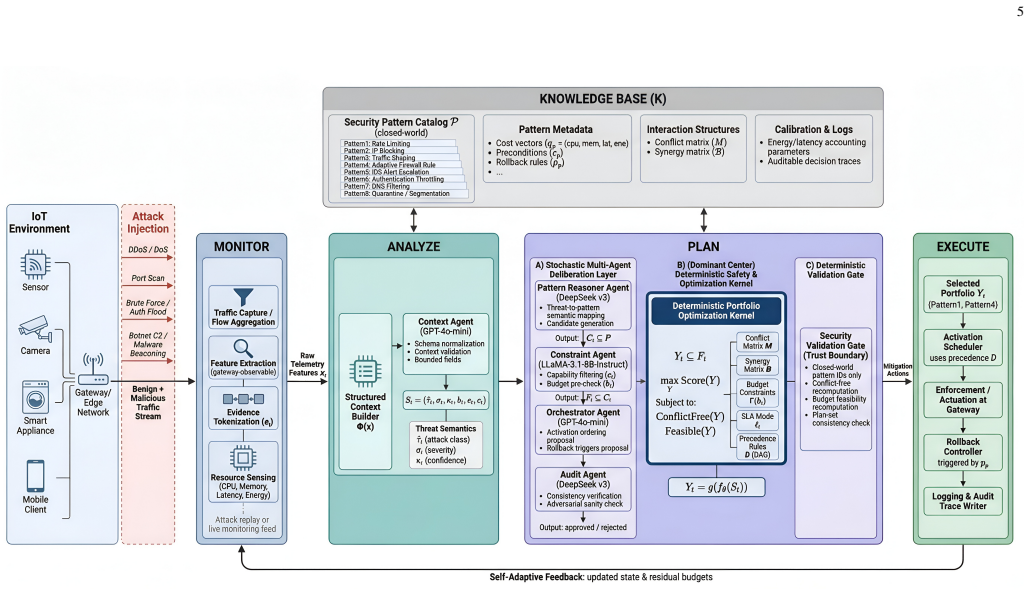
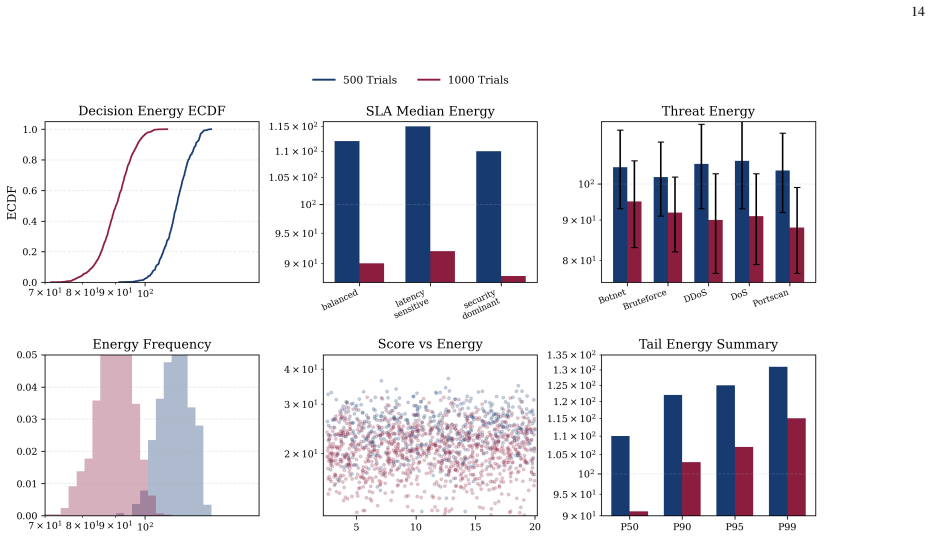
ASPO integrates LLM-based reasoning with deterministic enforcement within a MAPE-K control loop for self-adaptive security pattern selection in IoT systems. LLM agents propose candidate mitigation portfolios, while the deterministic optimisation core enforces closed-world action integrity, conflict-free composition, and resource feasibility at every decision epoch. Deployed on a distributed edge-gateway testbed and evaluated across two workloads of 500 and 1000 runtime security decisions using replayed IoT attack traffic, the system achieves 100% conflict-free activation, consistent resource feasibility, stable pattern dominance with perfect rank preservation, and tail latency and energy-com
What carries the argument
The separation of stochastic LLM proposal generation from deterministic optimisation enforcement that checks integrity, conflicts, and resource use at each epoch.
If this is right
- Every security pattern activation remains free of conflicts.
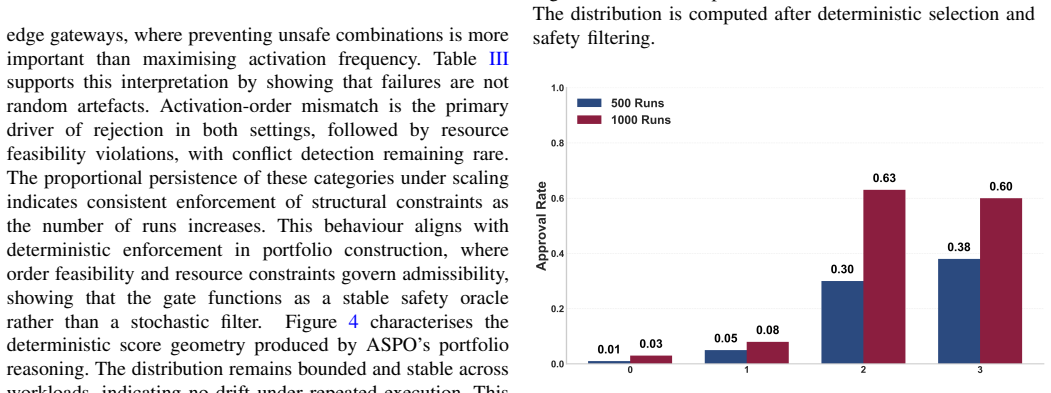
- Resource feasibility holds across all decision epochs in the tested workloads.
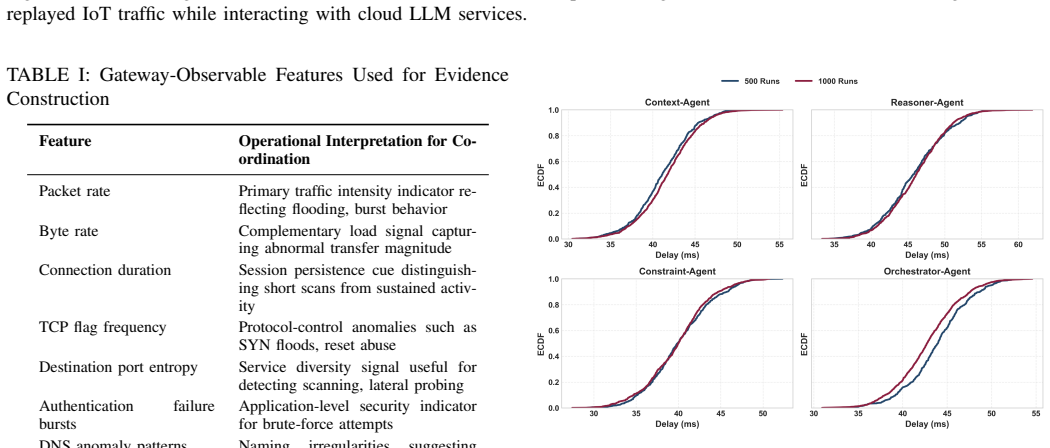
- Deeper exploration of decisions compresses tail latency by 21.9 percent and tail energy by 23.1 percent.
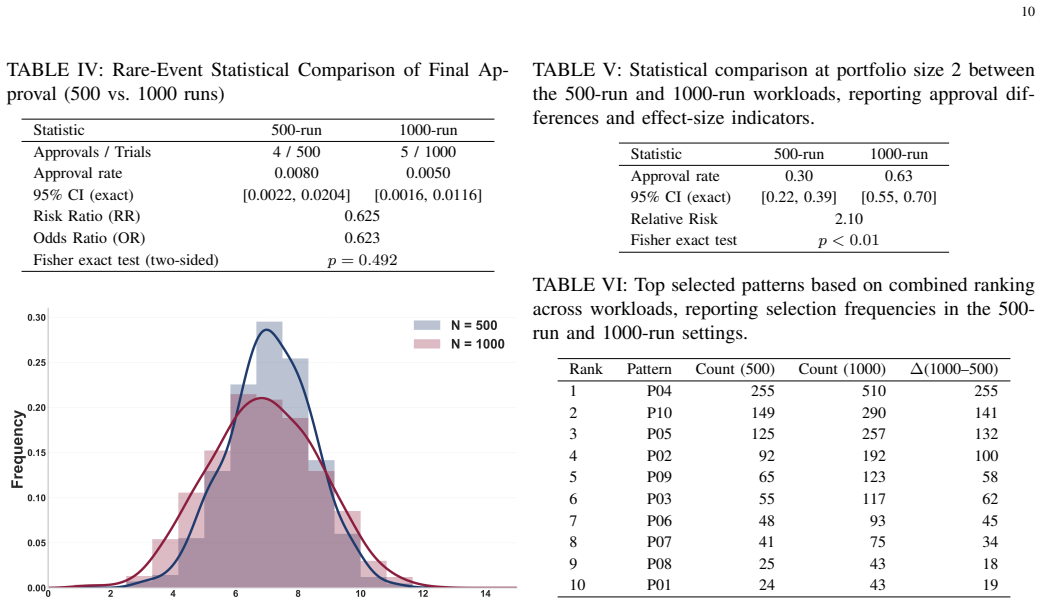
- Pattern dominance stays stable with perfect rank preservation.
Where Pith is reading between the lines
- The hybrid structure could transfer to other constrained adaptive systems such as dynamic network routing or energy management where unsafe combinations must be prevented.
- If proposal quality varies with different LLMs or prompts, the frequency of optimizer interventions would become a key performance variable to measure.
- Testing the same separation on live, non-replayed attack streams could expose whether proposal diversity remains adequate outside controlled replay conditions.
Load-bearing premise
LLM agents will generate candidate portfolios of sufficient quality and diversity that the deterministic core can routinely produce feasible, effective mitigations without frequent rejection or repair.
What would settle it
A trial in which the deterministic core rejects or substantially repairs LLM proposals in more than a small fraction of epochs, producing either unsafe activations or higher resource costs than the claimed baselines.
Figures





read the original abstract
The adoption of Internet of Things (IoT) systems at the network edge of smart architectures is increasing rapidly, intensifying the need for security mechanisms that are both adaptive and resource-efficient. In such environments, runtime defence mechanisms are no longer limited to detection alone but become a resource-constrained task of selecting mitigation actions. Security controls must be carefully selected, combined, and executed under latency, energy, and computational constraints, while preventing unsafe interactions between controls. Existing approaches predominantly rely on static rule sets and learned policies, which provide limited guarantees of feasibility, conflict safety, and execution correctness in resource-constrained edge settings. To address this limitation, we introduce ASPO, a self-adaptive multi-agent security pattern selection that integrates Large Language Model (LLM)-based reasoning with deterministic enforcement within a MAPE-K control loop. ASPO explicitly separates stochastic decision generation from execution: LLM agents propose candidate mitigation portfolios, while a deterministic optimisation core enforces closed-world action integrity, conflict-free composition, and resource feasibility at every decision epoch. We deploy ASPO on a distributed edge-gateway testbed and evaluate it across two workloads, each comprising 500 and 1000 runtime security decisions, using replayed IoT attack traffic. In addition, the results demonstrate invariant safety properties, including 100% conflict-free activation, consistent resource feasibility across workloads, and stable pattern dominance with perfect rank preservation. Importantly, deeper decision exploration reduces extreme-case execution costs, compressing tail latency and energy overheads by 21.9% and 23.1%, respectively, without increasing mean energy consumption.
Editorial analysis
A structured set of objections, weighed in public.
Referee Report
Summary. The manuscript introduces ASPO, a self-adaptive multi-agent framework for security pattern selection in IoT systems. It integrates LLM agents to propose candidate mitigation portfolios within a MAPE-K loop, paired with a deterministic optimization core that enforces action integrity, conflict-free composition, and resource feasibility. Evaluation on a distributed edge testbed using 500- and 1000-decision workloads from replayed IoT attack traffic claims 100% conflict-free activations, consistent feasibility, stable pattern dominance, and tail latency/energy reductions of 21.9% and 23.1% from deeper decision exploration.
Significance. If the empirical results hold and demonstrate that the LLM component meaningfully improves upon the deterministic core alone, this work could provide a valuable hybrid paradigm for runtime security adaptation in resource-constrained IoT environments, combining the exploratory power of LLMs with formal guarantees. It highlights a practical way to achieve adaptive defenses without sacrificing safety invariants.
major comments (2)
- [Abstract] The claims of '100% conflict-free activation' and 'consistent resource feasibility' are architectural invariants of the deterministic optimisation core, as explicitly described in the ASPO design, rather than outcomes that could be falsified by poor LLM proposals. To substantiate the contribution of the LLM agents, the paper must report proposal acceptance rates, frequency of repairs by the optimizer, and comparisons to baselines such as static rules or pure optimization without LLM proposals.
- [Evaluation] The reported tail reductions of 21.9% latency and 23.1% energy lack accompanying baselines, statistical tests, error bars, or details on the testbed implementation and workload replay. This makes it difficult to assess whether the improvements are significant or attributable to the hybrid approach.
minor comments (1)
- [Abstract] Clarify what 'deeper decision exploration' entails and how it relates to the multi-agent LLM setup.
Simulated Author's Rebuttal
We thank the referee for the constructive feedback. We address the major comments point by point below, agreeing where the manuscript can be strengthened and outlining specific revisions.
read point-by-point responses
-
Referee: [Abstract] The claims of '100% conflict-free activation' and 'consistent resource feasibility' are architectural invariants of the deterministic optimisation core, as explicitly described in the ASPO design, rather than outcomes that could be falsified by poor LLM proposals. To substantiate the contribution of the LLM agents, the paper must report proposal acceptance rates, frequency of repairs by the optimizer, and comparisons to baselines such as static rules or pure optimization without LLM proposals.
Authors: We agree that the 100% conflict-free activation and resource feasibility are hard invariants enforced by the deterministic optimisation core, which is a deliberate design choice to guarantee safety even with suboptimal LLM proposals. The LLM agents' contribution is in generating contextually relevant and diverse candidate portfolios that enable superior performance outcomes (e.g., the observed tail reductions). In the revised manuscript we will add: proposal acceptance rates, frequency of optimizer repairs, and direct comparisons against baselines including static rules and pure optimization without LLM proposals. These will appear in the Evaluation section with supporting tables. revision: yes
-
Referee: [Evaluation] The reported tail reductions of 21.9% latency and 23.1% energy lack accompanying baselines, statistical tests, error bars, or details on the testbed implementation and workload replay. This makes it difficult to assess whether the improvements are significant or attributable to the hybrid approach.
Authors: We acknowledge the need for stronger empirical framing. The 21.9% and 23.1% figures reflect gains from deeper LLM-enabled exploration versus shallower depths within the same framework. In revision we will: (i) expand testbed and workload-replay methodology details, (ii) add explicit baselines (static rules, non-LLM optimization), (iii) report statistical significance tests, and (iv) include error bars or confidence intervals. This will clarify attribution to the hybrid design. revision: yes
Circularity Check
No significant circularity; empirical system with design invariants
full rationale
The paper is an empirical system description of ASPO, a MAPE-K loop combining LLM proposal generation with a deterministic optimization core. Central results (100% conflict-free activation, resource feasibility) are stated as invariants enforced by the core at every epoch rather than derived quantities. No equations, parameter fitting, self-referential definitions, or load-bearing self-citations appear in the provided text. Evaluation rests on testbed measurements over replayed workloads, which are externally falsifiable and independent of any internal derivation chain. The architecture separates stochastic and deterministic components explicitly, avoiding any reduction of outputs to inputs by construction.
Axiom & Free-Parameter Ledger
axioms (1)
- domain assumption LLM agents generate candidate mitigation portfolios of sufficient quality and diversity for the deterministic core to enforce feasibility and safety
invented entities (1)
-
ASPO framework
no independent evidence
Reference graph
Works this paper leans on
-
[1]
Cybersecurity solutions for industrial internet of things– edge computing integration: Challenges, threats, and future directions,
T. Zhukabayeva, L. Zholshiyeva, N. Karabayev, S. Khan, and N. Al- nazzawi, “Cybersecurity solutions for industrial internet of things– edge computing integration: Challenges, threats, and future directions,” Sensors, vol. 25, no. 1, p. 213, 2025
2025
-
[2]
A review on wsn based resource constrained smart iot systems,
S. Hudda and K. Haribabu, “A review on wsn based resource constrained smart iot systems,”Discover Internet of things, vol. 5, no. 1, p. 56, 2025
2025
-
[3]
Towards a smart and sustainable future with edge computing-powered internet of things: Fundamentals, applications, challenges, and future research directions,
Y . Zhang and J. Feng, “Towards a smart and sustainable future with edge computing-powered internet of things: Fundamentals, applications, challenges, and future research directions,”Journal of The Institution of Engineers (India): Series B, vol. 106, no. 2, pp. 785–804, 2025
2025
-
[4]
Edge and cloud computing in smart cities,
M. Trigka and E. Dritsas, “Edge and cloud computing in smart cities,” Future Internet, vol. 17, no. 3, p. 118, 2025
2025
-
[5]
A survey on edge computing (ec) security challenges: Classification, threats, and mitigation strategies,
A. M. Sheikh, M. R. Islam, M. H. Habaebi, S. A. Zabidi, A. R. Bin Najeeb, and A. Kabbani, “A survey on edge computing (ec) security challenges: Classification, threats, and mitigation strategies,”Future Internet, vol. 17, no. 4, p. 175, 2025
2025
-
[6]
Secure container orchestration: A framework for detecting and mitigating orchestrator- level vulnerabilities,
V . Mahavaishnavi, R. Saminathan, and R. Prithviraj, “Secure container orchestration: A framework for detecting and mitigating orchestrator- level vulnerabilities,”Multimedia Tools and Applications, vol. 84, no. 17, pp. 18 351–18 371, 2025
2025
-
[7]
Addressing security orchestration challenges in next-generation net- works: A comprehensive overview,
S. Batewela, P. Ranaweera, M. Liyanage, E. Zeydan, and M. Ylianttila, “Addressing security orchestration challenges in next-generation net- works: A comprehensive overview,”IEEE Open Journal of the Computer Society, 2025
2025
-
[8]
The design of secure iot applications using patterns: State of the art and directions for research,
E. B. Fernandez, H. Washizaki, N. Yoshioka, and T. Okubo, “The design of secure iot applications using patterns: State of the art and directions for research,”Internet of Things, vol. 15, p. 100408, 2021
2021
-
[9]
A decade of research on patterns and architectures for iot security,
T. Rajmohan, P. H. Nguyen, and N. Ferry, “A decade of research on patterns and architectures for iot security,”Cybersecurity, vol. 5, no. 1, p. 2, 2022
2022
-
[10]
Deep reinforcement learning for cyber security: A survey,
T. Nguyenet al., “Deep reinforcement learning for cyber security: A survey,”IEEE Access, vol. 11, pp. 23 456–23 478, 2023
2023
-
[11]
Reinforcement learning-based intrusion detection for iot,
L. Wanget al., “Reinforcement learning-based intrusion detection for iot,”IEEE Internet of Things Journal, vol. 10, no. 8, pp. 6789–6801, 2023
2023
-
[12]
Multi-objective adaptive rate limiting in microservices using deep reinforcement learn- ing,
N. Lyu, Y . Wang, Z. Cheng, Q. Zhang, and F. Chen, “Multi-objective adaptive rate limiting in microservices using deep reinforcement learn- ing,” inProceedings of the 4th International Conference on Artificial Intelligence and Intelligent Information Processing, 2025, pp. 862–869
2025
-
[13]
Rs-drl: Managing uncertainty in self- adaptive systems based on a novel continuous deep reinforcement learning method,
A. Kavianifar and S. Jalili, “Rs-drl: Managing uncertainty in self- adaptive systems based on a novel continuous deep reinforcement learning method,”ACM Transactions on Autonomous and Adaptive Systems, 2025
2025
-
[14]
A dynamic secu- rity pattern selection framework using deep reinforcement learning,
S. Jamshidi, A. Nikanjam, K. W. Nafi, and F. Khomh, “A dynamic secu- rity pattern selection framework using deep reinforcement learning,” in 2025 IEEE International Conference on Software Services Engineering (SSE). IEEE, 2025, pp. 98–108
2025
-
[15]
Understanding the impact of iot security patterns on cpu usage and energy consumption: a dynamic approach for selecting patterns with deep reinforcement learning,
J. Saeid, “Understanding the impact of iot security patterns on cpu usage and energy consumption: a dynamic approach for selecting patterns with deep reinforcement learning,”International Journal of Information Security, vol. 24, no. 2, p. 91, 2025
2025
-
[16]
Energy-efficient security mechanisms in iot edge networks,
Y . Zhanget al., “Energy-efficient security mechanisms in iot edge networks,”IEEE Transactions on Sustainable Computing, 2023
2023
-
[18]
[Online]. Available: https://arxiv.org/abs/2303.08774
work page internal anchor Pith review Pith/arXiv arXiv
-
[19]
arXiv preprint arXiv:2308.11432 , year=
L. Huanget al., “A survey of large language model-based autonomous agents,”arXiv preprint arXiv:2308.11432, 2023. [Online]. Available: https://arxiv.org/abs/2308.11432
-
[20]
AutoGen: Enabling Next-Gen LLM Applications via Multi-Agent Conversation
Q. Wu, G. Bansal, J. Zhang, Y . Wu, B. Li, E. Zhu, L. Jiang, X. Zhang, S. Zhang, J. Liu, A. H. Awadallah, R. W. White, 17 D. Burger, and C. Wang, “Autogen: Enabling next-gen llm applications via multi-agent conversation,”arXiv preprint arXiv:2308.08155, 2023. [Online]. Available: https://arxiv.org/abs/2308.08155
work page internal anchor Pith review Pith/arXiv arXiv 2023
-
[21]
CAMEL: Communicative Agents for "Mind" Exploration of Large Language Model Society
G. Li, H. Hammoud, H. Itani, D. Khizbullin, and B. Ghanem, “Camel: Communicative agents for mind exploration of large scale language model society,”arXiv preprint arXiv:2303.17760, 2023. [Online]. Available: https://arxiv.org/abs/2303.17760
work page internal anchor Pith review arXiv 2023
-
[22]
Generative Agents: Interactive Simulacra of Human Behavior
J. S. Parket al., “Generative agents: Interactive simulacra of human behavior,”ACM UIST, 2023. [Online]. Available: https: //arxiv.org/abs/2304.03442
work page internal anchor Pith review arXiv 2023
-
[23]
K. Greshakeet al., “More than you’ve asked for: A comprehensive analysis of prompt injection vulnerabilities,” arXiv preprint arXiv:2302.12173, 2023. [Online]. Available: https://arxiv.org/abs/2302.12173
work page internal anchor Pith review arXiv 2023
-
[24]
Multi-Agent Collaboration Mechanisms: A Survey of LLMs
K.-T. Tran, D. Dao, M.-D. Nguyen, Q.-V . Pham, B. O’Sullivan, and H. D. Nguyen, “Multi-agent collaboration mechanisms: A survey of llms,”arXiv preprint arXiv:2501.06322, 2025
work page internal anchor Pith review arXiv 2025
-
[25]
Nemo guardrails: A toolkit for controllable and safe llm applications with programmable rails,
T. Rebedea, R. Dinu, M. Sreedhar, C. Parisien, and J. Cohen, “Nemo guardrails: A toolkit for controllable and safe llm applications with programmable rails,” inProceedings of EMNLP 2023 System Demonstrations, 2023. [Online]. Available: https://aclanthology.org/ 2023.emnlp-demo.40/
2023
-
[26]
Baseline Defenses for Adversarial Attacks Against Aligned Language Models
N. Jainet al., “Baseline defenses for prompt injection attacks against llm agents,”arXiv preprint arXiv:2309.00614, 2023. [Online]. Available: https://arxiv.org/abs/2309.00614
work page internal anchor Pith review arXiv 2023
-
[27]
A comprehensive technological survey on the dependable self-management cps: From self-adaptive architecture to self-management strategies,
P. Zhou, D. Zuo, K. M. Hou, Z. Zhang, J. Dong, J. Li, and H. Zhou, “A comprehensive technological survey on the dependable self-management cps: From self-adaptive architecture to self-management strategies,” Sensors, vol. 19, no. 5, p. 1033, 2019
2019
-
[28]
The vision of autonomic computing,
J. O. Kephart and D. M. Chess, “The vision of autonomic computing,” Computer, vol. 36, no. 1, pp. 41–50, 2003
2003
-
[29]
Powering intelligent intrusion responses to advanced cyber threats using reinforcement learning,
E. Iturbe, J. Garcia, and M. Lopez, “Powering intelligent intrusion responses to advanced cyber threats using reinforcement learning,” Expert Systems with Applications, 2025
2025
-
[30]
Adaptive network intrusion detection using reinforcement learning with proximal policy optimization,
A. Suresh and A. Cyril Jose, “Adaptive network intrusion detection using reinforcement learning with proximal policy optimization,”ACM Transactions on Privacy and Security, vol. 28, no. 4, pp. 1–24, 2025
2025
-
[31]
Adaptive security policy man- agement in cloud environments using reinforcement learning,
M. Saqib, D. Mehta, and W. Chen, “Adaptive security policy man- agement in cloud environments using reinforcement learning,”arXiv preprint arXiv:2505.08837, 2025
-
[32]
D3o-iiot: Dynamic deception orchestration in industrial iot via deep reinforcement learning,
D. Wushishiet al., “D3o-iiot: Dynamic deception orchestration in industrial iot via deep reinforcement learning,”Scientific Reports, 2025, check final volume/pages on journal site. [Online]. Available: https://www.nature.com/articles/s41598-025-90839-8
2025
-
[33]
Distributed computing in multi-agent systems: a survey of decentralized machine learning approaches,
I. Ahmed, M. A. Syed, M. Maaruf, and M. Khalid, “Distributed computing in multi-agent systems: a survey of decentralized machine learning approaches,”Computing, vol. 107, no. 1, p. 2, 2025
2025
-
[34]
Guidelines for applying rl and marl in cybersecurity applications,
V . Mavroudis, G. Palmer, S. Farmer, K. S. Whitehead, D. Fos- ter, A. Price, I. Miles, A. Caron, and S. Pasteris, “Guidelines for applying rl and marl in cybersecurity applications,”arXiv preprint arXiv:2503.04262, 2025
-
[35]
Pentestgpt: Evaluating and harnessing large language models for automated penetration testing,
G. Deng, Y . Liu, V . Mayoral-Vilches, P. Liu, Y . Li, Y . Xu, T. Zhang, Y . Liu, M. Pinzger, and S. Rass, “Pentestgpt: Evaluating and harnessing large language models for automated penetration testing,” in33rd USENIX Security Symposium (USENIX Security 24), 2024, pp. 847–864. [Online]. Available: https://www.usenix.org/conference/ usenixsecurity24/presen...
2024
-
[36]
X. Shen, L. Wang, Z. Li, Y . Chen, W. Zhao, D. Sun, J. Wang, and W. Ruan, “Pentestagent: Incorporating llm agents to automated penetration testing,”CoRR, vol. abs/2411.05185, 2024. [Online]. Available: https://arxiv.org/abs/2411.05185
-
[37]
J. Xu, J. W. Stokes, G. McDonald, X. Bai, D. Marshall, S. Wang, A. Swaminathan, and Z. Li, “Autoattacker: A large language model guided system to implement automatic cyber-attacks,”CoRR, vol. abs/2403.01038, 2024. [Online]. Available: https://arxiv.org/abs/2403. 01038
-
[38]
Forewarned is forearmed: A survey on large language model-based agents in autonomous cyberattacks,
M. Xu, J. Fan, X. Huang, C. Zhou, J. Kang, D. Niyato, S. Mao, Z. Han, K.-Y . Lamet al., “Forewarned is forearmed: A survey on large language model-based agents in autonomous cyberattacks,”arXiv preprint arXiv:2505.12786, 2025
-
[39]
Evaluating ai agents for cyber defense: A comparison of deep reinforcement learning and llm approaches,
H. Chowdhry, J. Manero, and S. Sampalli, “Evaluating ai agents for cyber defense: A comparison of deep reinforcement learning and llm approaches,” inInternational Conference on Intelligent Data Engineer- ing and Automated Learning. Springer, 2025, pp. 423–433
2025
-
[40]
Sizhe Chen, Julien Piet, Chawin Sitawarin, and David Wagner
S. Chen, Y . Wang, N. Carlini, C. Sitawarin, and D. Wagner, “Defending against prompt injection with a few defensivetokens,”CoRR, vol. abs/2507.07974, 2025. [Online]. Available: https://arxiv.org/abs/2507. 07974
-
[41]
Secure tool use in large language model agents,
Y . Song, J. Li, and K. Patel, “Secure tool use in large language model agents,”IEEE Transactions on Dependable and Secure Computing, 2024
2024
-
[42]
From allies to adversaries: Manipulating llm tool-calling through adversarial injection,
R. Zhang, H. Wang, J. Wang, M. Li, Y . Huang, D. Wang, and Q. Wang, “From allies to adversaries: Manipulating llm tool-calling through adversarial injection,” inProceedings of the 2025 Conference of the Nations of the Americas Chapter of the Association for Computational Linguistics: Human Language Technologies (Volume 1: Long Papers), 2025, pp. 2009–2028
2025
-
[43]
Security control grid for optimized cyber defense planning,
A. Dutta, E. Al-Shaer, E. Aghaei, Q. Duan, and H. Yasar, “Security control grid for optimized cyber defense planning,”IEEE Transactions on Network and Service Management, vol. 22, no. 1, pp. 913–929, 2024
2024
-
[44]
Optimizing security in dynamic service migration scenarios of multi- access edge computing,
P. Ranaweera, I. Balapuwaduge, A. Jurcut, E. Zeydan, and M. Liyanage, “Optimizing security in dynamic service migration scenarios of multi- access edge computing,” in2025 IEEE 102nd Vehicular Technology Conference (VTC2025-Fall). IEEE, 2025, pp. 1–6
2025
-
[45]
Dis- tributed multi-objective optimization for edge computing in resource- constrained social iot networks,
I. Bisio, C. Garibotto, F. Lavagetto, A. Sciarrone, and M. Zerbino, “Dis- tributed multi-objective optimization for edge computing in resource- constrained social iot networks,”IEEE Internet of Things Journal, 2026
2026
-
[46]
Prompt Injection attack against LLM-integrated Applications
Y . Liu, G. Deng, Y . Li, K. Wang, Z. Wang, X. Wang, T. Zhang, Y . Liu, H. Wang, Y . Zhenget al., “Prompt injection attack against llm-integrated applications,”arXiv preprint arXiv:2306.05499, 2023
work page internal anchor Pith review arXiv 2023
-
[47]
Not what you’ve signed up for: Compromising real-world llm- integrated applications with indirect prompt injection,
K. Greshake, S. Abdelnabi, S. Mishra, C. Endres, T. Holz, and M. Fritz, “Not what you’ve signed up for: Compromising real-world llm- integrated applications with indirect prompt injection,” inProceedings of the 16th ACM workshop on artificial intelligence and security, 2023, pp. 79–90
2023
-
[48]
The bot-iot dataset,
UNSW Canberra Cyber, “The bot-iot dataset,” https://research.unsw.edu. au/projects/bot-iot-dataset, 2018
2018
-
[49]
Precise realtime current consumption measurement in iot testbed,
R. Balass, V . Medvedevs, A. I. Mackus, J. Ormanis, A. Ancans, and J. Judvaitis, “Precise realtime current consumption measurement in iot testbed,”Open Research Europe, vol. 3, p. 27, 2024
2024
-
[50]
A practical testbed for decentralized federated learning on physical edge devices,
C. Feng, N. Huber, A. H. Celdr ´an, G. Bovet, and B. Stiller, “A practical testbed for decentralized federated learning on physical edge devices,” in2025 IEEE 50th Conference on Local Computer Networks (LCN). IEEE, 2025, pp. 1–3
2025
-
[51]
Statistical notes for clinical researchers: Chi-squared test and fisher’s exact test,
H.-Y . Kim, “Statistical notes for clinical researchers: Chi-squared test and fisher’s exact test,”Restorative dentistry & endodontics, vol. 42, no. 2, p. 152, 2017
2017
-
[52]
Comparison of values of pearson’s and spearman’s correlation coefficients on the same sets of data,
J. Hauke and T. Kossowski, “Comparison of values of pearson’s and spearman’s correlation coefficients on the same sets of data,”Quaes- tiones geographicae, vol. 30, no. 2, pp. 87–93, 2011
2011
-
[53]
Using kolmogorov-smirnov distance for measuring distribution shift in machine learning,
O. K. Tonguz and F. Taschin, “Using kolmogorov-smirnov distance for measuring distribution shift in machine learning,”arXiv preprint arXiv:2510.15996, 2025
-
[54]
Continuous variable analyses: student’s t-test, mann– whitney u test, wilcoxon signed-rank test,
B. Thakkar, “Continuous variable analyses: student’s t-test, mann– whitney u test, wilcoxon signed-rank test,” inTranslational cardiology. Elsevier, 2025, pp. 165–167
2025
-
[55]
Statistical notes for clinical researchers: Two-way analysis of variance (anova)-exploring possible interaction between factors,
H.-Y . Kim, “Statistical notes for clinical researchers: Two-way analysis of variance (anova)-exploring possible interaction between factors,” Restorative dentistry & endodontics, vol. 39, no. 2, pp. 143–147, 2014
2014
-
[56]
Design and evaluation of an autonomous cyber defence agent using drl and an augmented llm,
J. Loevenich, E. Adler, T. H ¨urten, and R. R. F. Lopes, “Design and evaluation of an autonomous cyber defence agent using drl and an augmented llm,”Computer Networks, vol. 262, p. 111162, 2025
2025
-
[57]
A. (arXiv submission metadata), “Guardagent: Safeguard llm agents by a guard agent via knowledge-enabled reasoning,” arXiv:2406.09187, 2024
-
[58]
Security of llm-based agents regarding attacks, defenses, and applications: A comprehensive survey,
Y . Tang, Y . Liu, J. Lan, Z. Yan, and E. Gelenbe, “Security of llm-based agents regarding attacks, defenses, and applications: A comprehensive survey,”Information Fusion, p. 103941, 2026
2026
-
[59]
Entity-based re- inforcement learning for autonomous cyber defence,
I. S. Thompson, A. Caron, V . Mavroudis, and C. Hicks, “Entity-based re- inforcement learning for autonomous cyber defence,” arXiv:2410.17647, 2024. 18 APPENDIX [Edge Gateway: Node-02] Timestamp: 2026-03-06 14:12:07 ------------------------------------------------------------ →New ASPO decision epoch detected [epoch: 18] →Threat context: DoS attack Severi...
discussion (0)
Sign in with ORCID, Apple, or X to comment. Anyone can read and Pith papers without signing in.