Recursive Maximum Likelihood Estimation for Interacting Particle Systems using Virtual Particles
Pith reviewed 2026-05-09 18:51 UTC · model grok-4.3
The pith
Recursive maximum likelihood estimation for interacting particle systems is achieved by optimizing the mean-field stationary log-likelihood with stochastic gradients from virtual particle systems.
A machine-rendered reading of the paper's core claim, the machinery that carries it, and where it could break.
Core claim
By integrating a virtual interacting particle system and virtual tangent system with the online parameter, the method produces surrogate gradients for a finite-particle objective that, for fixed N and M, are driven to zero as t tends to infinity; in the double limit t to infinity followed by N,M to infinity these gradients converge uniformly to the gradient of the stationary log-likelihood of the mean-field limit, yielding convergence of the estimates to its stationary points.
What carries the argument
The stochastic gradient estimate computed from the single observed particle trajectory together with an integrated virtual interacting particle system and virtual tangent interacting particle system.
If this is right
- For any fixed N and M the surrogate gradient of the finite-particle objective is driven to zero as t tends to infinity.
- In the iterated limit the surrogate gradients converge uniformly to the mean-field stationary gradient.
- Parameter estimates therefore converge to stationary points of the mean-field objective.
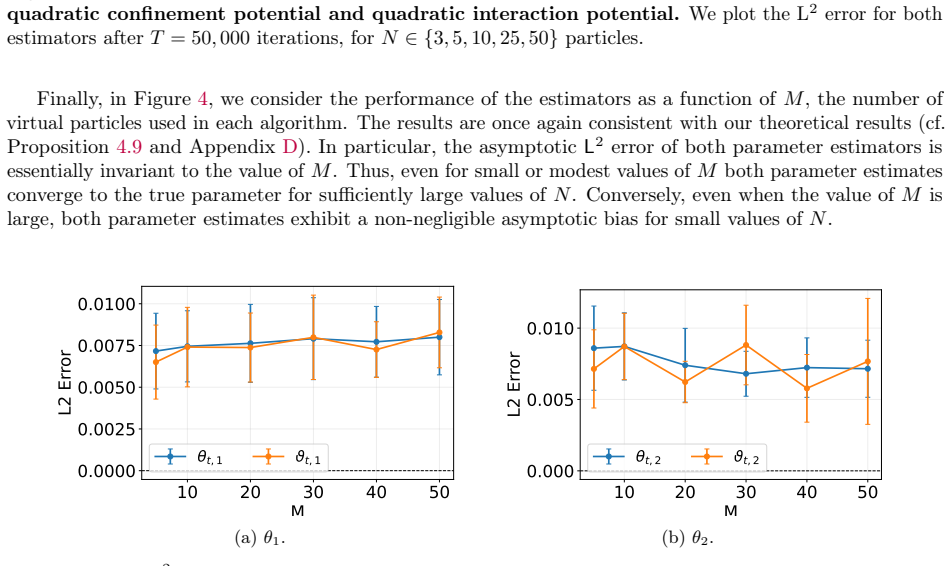
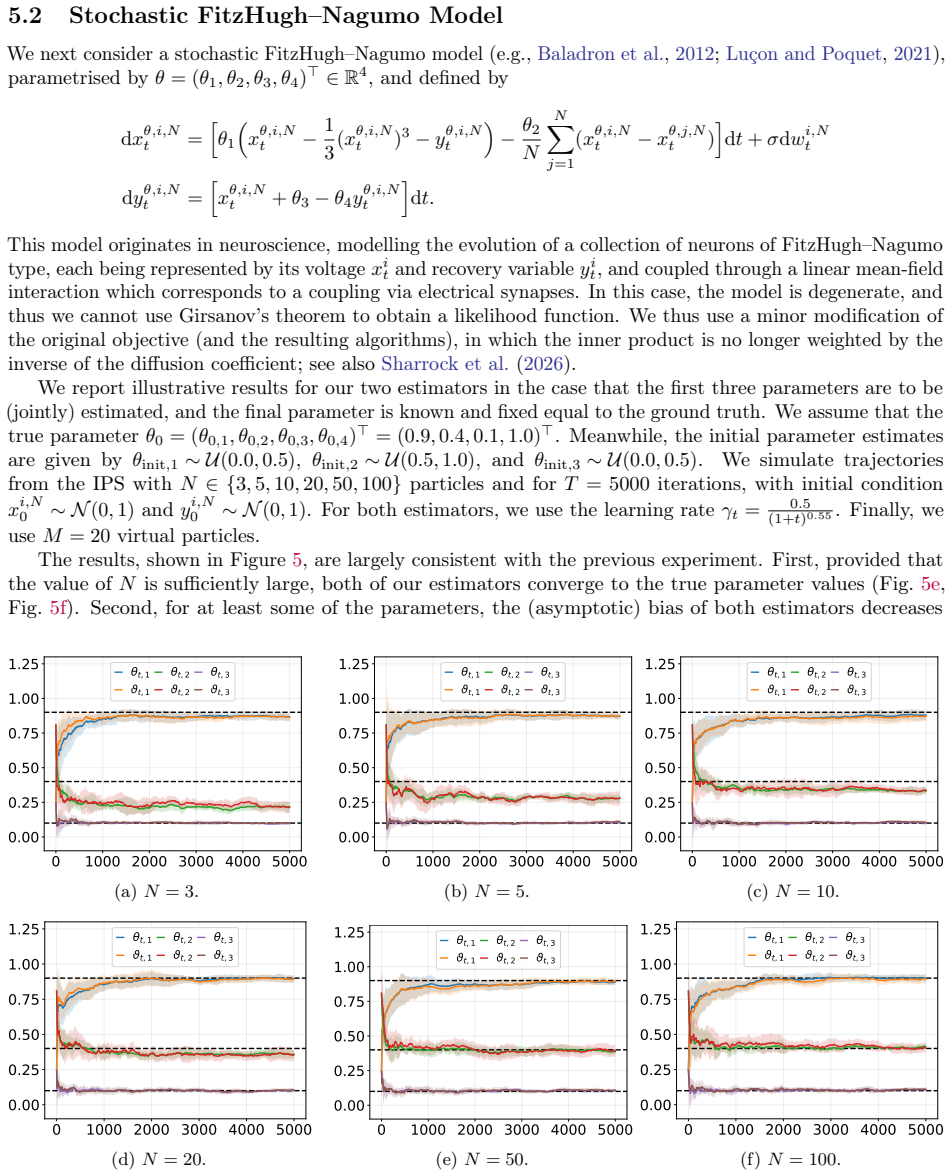
- The procedure is illustrated on quadratic confinement models, FitzHugh-Nagumo neuron networks, and the stochastic Kuramoto model.
Where Pith is reading between the lines
- The same virtual-particle construction could be tested on systems whose mean-field limit is only known numerically rather than in closed form.
- Adaptation to discrete-time or noisy partial observations would extend the method to typical experimental recordings.
- The approach suggests that consistent parameter recovery does not require simultaneous observation of the entire interacting ensemble.
- Links to mean-field filtering or control problems may allow reuse of the virtual tangent system for related inference tasks.
Load-bearing premise
The particle system admits a well-defined differentiable stationary log-likelihood in its mean-field limit.
What would settle it
Numerical runs with increasing N and M in which the parameter trajectory fails to approach a stationary point of the explicitly computable mean-field log-likelihood would falsify the double-limit convergence claim.
Figures



read the original abstract
We study recursive maximum likelihood estimation for stochastic interacting particle systems based on continuous observation of a single particle. In this regime, consistent estimation of the finite-particle log-likelihood is not possible, even in the limit as the number of particles $N\rightarrow\infty$ and the time horizon $t\rightarrow\infty$. We thus seek to optimise the stationary log-likelihood of the limiting mean-field system. We achieve this via a form of stochastic gradient estimate in continuous time, with stochastic gradient estimates computed using the continuous trajectory of the single observed particle, alongside a virtual interacting particle system and a virtual tangent interacting particle system, which are integrated with the online parameter estimate. For fixed numbers of real and virtual particles, we show that the resulting algorithms drive the gradient of a finite-particle surrogate objective to zero as $t\to\infty$. We then prove that, in the iterated limit $t\to\infty$ followed by $N,M\to\infty$, these surrogate gradients converge uniformly to the gradient of the stationary log-likelihood of the limiting mean-field system, yielding convergence to its stationary points. We illustrate the method on several numerical examples, including a model with quadratic confinement and interaction potentials, a model of interacting FitzHugh--Nagumo neurons, and a stochastic Kuramoto model.
Editorial analysis
A structured set of objections, weighed in public.
Referee Report
Summary. The paper develops a recursive MLE procedure for stochastic interacting particle systems observed through a single continuous trajectory. It constructs online stochastic gradient estimates via an auxiliary virtual interacting particle system and a virtual tangent interacting particle system driven by the current parameter estimate. For fixed N and M the surrogate gradient is shown to converge to zero as t→∞. In the iterated limit t→∞ followed by N,M→∞ the surrogate gradients converge uniformly to the gradient of the stationary log-likelihood of the mean-field limit, implying convergence to its stationary points. The method is illustrated on a quadratic-potential model, FitzHugh–Nagumo neurons, and the stochastic Kuramoto model.
Significance. If the stated convergence results hold under verifiable conditions, the work supplies a practical online estimator for mean-field parameters from single-particle data, circumventing the inconsistency of finite-N likelihoods. The virtual-particle construction for gradient estimation is technically novel and the double-limit analysis is a substantive contribution. The approach could be useful in statistical physics and neuroscience applications where only partial observations are available.
major comments (1)
- [Assumptions preceding the main convergence theorem and the statements of the numerical examples] The central iterated-limit claim (abstract and main convergence theorem) requires that both the real and virtual (including tangent) particle systems possess a unique stationary measure with sufficiently rapid mixing so that time averages equal expectations and the virtual law tracks the mean-field law uniformly. The manuscript invokes ergodicity and mixing but supplies no explicit conditions on potentials, noise intensities, or coupling strengths that guarantee these properties. For the stochastic Kuramoto and FitzHugh–Nagumo examples, synchronization or oscillatory regimes can produce slow mixing or multiple invariant measures, directly threatening the uniformity needed for the double-limit interchange.
minor comments (2)
- [Section 2 (model and algorithm)] The distinction between the real, virtual, and tangent processes is introduced gradually; a single early diagram or table summarizing the three coupled SDEs and their driving noises would improve readability.
- [Numerical examples section] Numerical figures would benefit from overlaying multiple independent runs or reporting variability measures to illustrate the stochastic nature of the online estimates.
Simulated Author's Rebuttal
We thank the referee for the detailed and constructive report. The positive assessment of the work's novelty and potential applications is appreciated. We address the single major comment below.
read point-by-point responses
-
Referee: [Assumptions preceding the main convergence theorem and the statements of the numerical examples] The central iterated-limit claim (abstract and main convergence theorem) requires that both the real and virtual (including tangent) particle systems possess a unique stationary measure with sufficiently rapid mixing so that time averages equal expectations and the virtual law tracks the mean-field law uniformly. The manuscript invokes ergodicity and mixing but supplies no explicit conditions on potentials, noise intensities, or coupling strengths that guarantee these properties. For the stochastic Kuramoto and FitzHugh–Nagumo examples, synchronization or oscillatory regimes can produce slow mixing or multiple invariant measures, directly threatening the uniformity needed for the double-limit interchange.
Authors: We agree that the manuscript would benefit from greater explicitness regarding the ergodicity and mixing assumptions that underpin the convergence statements. In the revised version we will insert a dedicated subsection (immediately preceding the main theorem) that states verifiable sufficient conditions: Lipschitz continuity and quadratic growth bounds on the confining and interaction potentials, an upper bound on the noise intensity relative to the potential strength, and a restriction on the coupling parameter that guarantees a positive Dobrushin coefficient (or Wasserstein contraction) for the mean-field McKean–Vlasov dynamics and its virtual/tangent counterparts. These conditions are standard in the interacting-particle literature and can be checked directly from the model coefficients. For the numerical examples we will add a short paragraph specifying the exact parameter values used and explaining why they lie inside the regime where uniqueness and exponential mixing hold (weak coupling for Kuramoto to preclude full synchronization; parameters yielding a globally attractive limit cycle for FitzHugh–Nagumo). While a exhaustive classification of every possible regime is beyond the scope of the present work, the added material will make the hypotheses checkable and will clarify the scope of the double-limit result. We view this as a partial but substantive revision that directly responds to the concern without changing the paper’s main contributions. revision: partial
Circularity Check
No circularity: convergence to external mean-field objective via auxiliary virtual systems
full rationale
The paper's derivation constructs surrogate gradients from an observed particle trajectory together with separately simulated virtual interacting particle and tangent systems that are driven by the current online parameter estimate. For fixed N and M the algorithm is shown to drive the finite-particle surrogate gradient to zero as t→∞. The subsequent iterated limit t→∞ then N,M→∞ is proved to produce uniform convergence of these surrogates to the gradient of the stationary log-likelihood of the limiting mean-field system. The target mean-field log-likelihood is an independent object defined by the mean-field limit itself; the surrogates are not defined in terms of it, nor is any fitted parameter renamed as a prediction. No self-definitional loops, load-bearing self-citations, or ansatz smuggling appear in the chain. The result is a standard stochastic-approximation convergence theorem resting on external ergodicity and mixing assumptions rather than on any reduction to its own inputs.
Axiom & Free-Parameter Ledger
axioms (1)
- domain assumption The finite-particle system converges to a well-defined mean-field limit whose stationary log-likelihood is differentiable and has isolated stationary points.
invented entities (2)
-
virtual interacting particle system
no independent evidence
-
virtual tangent interacting particle system
no independent evidence
Reference graph
Works this paper leans on
-
[1]
Acebr \'o n, J. A., Bonilla, L. L., P \'e rez Vicente, C. J., Ritort, F., and Spigler, R. (2005). The Kuramoto model: A simple paradigm for synchronization phenomena. Reviews of Modern Physics , 77(1):137--185
work page 2005
-
[2]
Amorino, C., Belomestny, D., Pilipauskait \.e , V., Podolskij, M., and Zhou, S.-Y. (2025). Polynomial rates via deconvolution for nonparametric estimation in McKean--Vlasov SDEs . Probability Theory and Related Fields , 193:539--584
work page 2025
-
[3]
Amorino, C., Heidari, A., Pilipauskait \.e , V., and Podolskij, M. (2023). Parameter estimation of discretely observed interacting particle systems. Stochastic Processes and their Applications , 163:350--386
work page 2023
-
[4]
Amorino, C. and Pilipauskait \.e , V. (2024). Kinetic interacting particle system: parameter estimation from complete and partial discrete observations. arXiv preprint arXiv:2410.10226
-
[5]
Baladron, J., Fasoli, D., Faugeras, O., and Touboul, J. (2012). Mean-field description and propagation of chaos in networks of Hodgkin--Huxley and FitzHugh--Nagumo neurons. Journal of Mathematical Neuroscience , 2(1):10
work page 2012
-
[6]
Bashiri, K. (2020). On the long-time behaviour of McKean--Vlasov paths. Electronic Communications in Probability , 25:1--14
work page 2020
-
[7]
Bauer, M., Meyer-Brandis, T., and Proske, F. (2018). Strong solutions of mean-field stochastic differential equations with irregular drift. Electronic Journal of Probability , 23:1--35
work page 2018
- [8]
-
[9]
Benachour, S., Roynette, B., Talay, D., and Vallois, P. (1998). Nonlinear self-stabilizing processes I : Existence, invariant probability, propagation of chaos. Stochastic Processes and their Applications , 75(2):173--201
work page 1998
-
[10]
Benedetto, D., Caglioti, E., and Pulvirenti, M. (1997). A kinetic equation for granular media. Mathematical Modelling and Numerical Analysis , 31(5):615--641
work page 1997
-
[11]
Bertini, L., Giacomin, G., and Pakdaman, K. (2010). Dynamical aspects of mean field plane rotators and the Kuramoto model. Journal of Statistical Physics , 138(1--3):270--290
work page 2010
-
[12]
Bhudisaksang, T. and Cartea, \'A . (2021). Online drift estimation for jump-diffusion processes. Bernoulli , 27(4):2494--2518
work page 2021
-
[13]
Bishwal, J. P. N. (2011). Estimation in interacting diffusions: Continuous and discrete sampling. Applied Mathematics , 2(9):1154--1158
work page 2011
-
[14]
Bolley, F., Gentil, I., and Guillin, A. (2013). Uniform convergence to equilibrium for granular media. Archive for Rational Mechanics and Analysis , 208(2):429--445
work page 2013
-
[15]
Bourguin, S., Dhama, S. S., and Spiliopoulos, K. (2026). Quantitative fluctuation analysis for continuous-time stochastic gradient descent via Malliavin calculus. arXiv preprint arXiv:2603.07149
-
[16]
Buckdahn, R., Li, J., and Ma, J. (2017). A mean-field stochastic control problem with partial observations. The Annals of Applied Probability , 27(5):3201--3245
work page 2017
-
[17]
Burger, M., Capasso, V., and Morale, D. (2007). On an aggregation model with long and short range interactions. Nonlinear Analysis: Real World Applications , 8(3):939--958
work page 2007
-
[18]
Canuto, C., Fagnani, F., and Tilli, P. (2012). An Eulerian approach to the analysis of Krause 's consensus models. SIAM Journal on Control and Optimization , 50(1):243--265
work page 2012
-
[19]
Cardaliaguet, P., Delarue, F., Lasry, J.-M., and Lions, P.-L. (2019). The Master Equation and the Convergence Problem in Mean Field Games , volume 201 of Annals of Mathematics Studies . Princeton University Press, Princeton, NJ
work page 2019
-
[20]
Cardaliaguet, P. and Lehalle, C.-A. (2018). Mean field game of controls and an application to trade crowding. Mathematics and Financial Economics , 12(3):335--363
work page 2018
-
[21]
Carmona, R. and Delarue, F. (2018). Probabilistic Theory of Mean Field Games with Applications I . Springer-Verlag, Cham, Switzerland
work page 2018
-
[22]
Carrillo, J. A., Gvalani, R. S., Pavliotis, G. A., and Schlichting, A. (2020). Long-time behaviour and phase transitions for the McKean--Vlasov equation on the torus. Archive for Rational Mechanics and Analysis , 235(1):635--690
work page 2020
-
[23]
Carrillo, J. A., McCann, R. J., and Villani, C. (2006). Contractions in the 2- Wasserstein length space and thermalization of granular media. Archive for Rational Mechanics and Analysis , 179(2):217--263
work page 2006
-
[24]
Cattiaux, P., Guillin, A., and Malrieu, F. (2008). Probabilistic approach for granular media equations in the non-uniformly convex case. Probability Theory and Related Fields , 140(1--2):19--40
work page 2008
-
[25]
Chaintron, L.-P. and Diez, A. (2022a). Propagation of chaos: A review of models, methods and applications. I . models and methods. Kinetic and Related Models , 15(6):895--1015
-
[26]
Chaintron, L.-P. and Diez, A. (2022b). Propagation of chaos: A review of models, methods and applications. II . applications. Kinetic and Related Models , 15(6):1017--1173
-
[27]
Chaudru de Raynal, P.-E. (2020). Strong well posedness of McKean--Vlasov stochastic differential equations with H \"o lder drift. Stochastic Processes and their Applications , 130(1):79--107
work page 2020
-
[28]
Chazelle, B., Jiu, Q., Li, Q., and Wang, C. (2017). Well-posedness of the limiting equation of a noisy consensus model in opinion dynamics. Journal of Differential Equations , 263(1):365--397
work page 2017
-
[29]
Chen, X. (2021). Maximum likelihood estimation of potential energy in interacting particle systems from single-trajectory data. Electronic Communications in Probability , 26:1--13
work page 2021
-
[30]
Comte, F. and Genon-Catalot, V. (2023). Nonparametric adaptive estimation for interacting particle systems. Scandinavian Journal of Statistics , 50(4):1716--1755
work page 2023
-
[31]
Comte, F., Genon-Catalot, V., and Lar \'e do, C. (2025). Nonparametric moment method for scalar McKean--Vlasov stochastic differential equations. ESAIM: Probability and Statistics , 29:400--449
work page 2025
-
[32]
Crisan, D. and Xiong, J. (2010). Approximate McKean--Vlasov representations for a class of SPDEs . Stochastics , 82(1):53--68
work page 2010
-
[33]
Delgadino, M. G., Gvalani, R. S., Pavliotis, G. A., and Smith, S. A. (2023). Phase transitions, logarithmic Sobolev inequalities, and uniform-in-time propagation of chaos for weakly interacting diffusions. Communications in Mathematical Physics , 401:275--323
work page 2023
-
[34]
Della Maestra, L. and Hoffmann, M. (2022). Nonparametric estimation for interacting particle systems: McKean--Vlasov models. Probability Theory and Related Fields , 182(1):551--613
work page 2022
-
[35]
Della Maestra, L. and Hoffmann, M. (2023). The LAN property for McKean--Vlasov models in a mean-field regime. Stochastic Processes and their Applications , 155:109--146
work page 2023
-
[36]
Durmus, A., Eberle, A., Guillin, A., and Zimmer, R. (2020). An elementary approach to uniform in time propagation of chaos. Proceedings of the American Mathematical Society , 148(12):5387--5398
work page 2020
-
[37]
Eberle, A., Guillin, A., and Zimmer, R. (2019). Quantitative Harris -type theorems for diffusions and McKean--Vlasov processes. Transactions of the American Mathematical Society , 371(10):7135--7173
work page 2019
-
[38]
Genon-Catalot, V. and Lar \'e do, C. (2024a). Inference for ergodic McKean--Vlasov stochastic differential equations with polynomial interactions. Annales de l'Institut Henri Poincar \'e (B) Probabilit \'e s et Statistiques , 60(4):2668--2693
-
[39]
Genon-Catalot, V. and Lar \'e do, C. (2024b). Parametric inference for ergodic McKean--Vlasov stochastic differential equations. Bernoulli , 30(3):1971--1997
work page 1971
-
[40]
Gerencs \'e r, L., Gy \"o ngy, I., and Michaletzky, G. (1984). Continuous-time recursive maximum likelihood method: a new approach to Ljung 's scheme. IFAC Proceedings Volumes , 17(2):683--686
work page 1984
-
[41]
Gerencs \'e r, L. and Prokaj, V. (2009). Recursive identification of continuous-time linear stochastic systems: convergence w.p.\ 1 and in L^q . In Proceedings of the 2009 European Control Conference (ECC) , pages 1209--1214
work page 2009
-
[42]
Giesecke, K., Schwenkler, G., and Sirignano, J. A. (2020). Inference for large financial systems. Mathematical Finance , 30(1):3--46
work page 2020
-
[43]
D., Gooding, B., Short, H., and Pavliotis, G
Goddard, B. D., Gooding, B., Short, H., and Pavliotis, G. A. (2022). Noisy bounded confidence models for opinion dynamics: the effect of boundary conditions on phase transitions. IMA Journal of Applied Mathematics , 87(1):80--110
work page 2022
-
[44]
Heidari, A. and Podolskij, M. (2025). Local asymptotic normality for discretely observed mckean-vlasov diffusions. arXiv preprint arXiv:2511.13366
-
[45]
Hu, K., Ren, Z., Šiška, D., and Szpruch, . (2021). Mean-field Langevin dynamics and energy landscape of neural networks . Annales de l'Institut Henri Poincaré, Probabilités et Statistiques , 57(4):2043 -- 2065
work page 2021
-
[46]
Huang, X. and Wang, F.-Y. (2019). Distribution dependent SDEs with singular coefficients. Stochastic Processes and their Applications , 129(11):4747--4770
work page 2019
- [47]
-
[48]
Jasra, A., Maama, M., and Tempone, R. F. (2025). Parameter estimation for partially observed McKean--Vlasov diffusions. Royal Society Open Science , 12(12):251918
work page 2025
- [49]
-
[50]
Jourdain, B., M \'e l \'e ard, S., and Woyczynski, W. A. (2008). Nonlinear SDEs driven by L \'e vy processes and related PDEs . ALEA: Latin American Journal of Probability and Mathematical Statistics , 4:1--29
work page 2008
-
[51]
Kasonga, R. A. (1990). Maximum likelihood theory for large interacting systems. SIAM Journal on Applied Mathematics , 50(3):865--875
work page 1990
-
[52]
Kuramoto, Y. (1981). Rhythms and turbulence in populations of chemical oscillators. Physica A: Statistical Mechanics and its Applications , 106(1--2):128--143
work page 1981
-
[53]
Lacker, D. (2018). On a strong form of propagation of chaos for McKean--Vlasov equations. Electronic Communications in Probability , 23:1--11
work page 2018
-
[54]
Lacker, D. (2023). Hierarchies, entropy, and quantitative propagation of chaos for mean field diffusions. Probability and Mathematical Physics , 4(2):377--432
work page 2023
-
[55]
Lacker, D. and Le Flem, L. (2023). Sharp uniform-in-time propagation of chaos. Probability Theory and Related Fields , 187(1--2):443--480
work page 2023
- [56]
-
[57]
Levanony, D., Shwartz, A., and Zeitouni, O. (1994). Recursive identification in continuous-time stochastic processes. Stochastic Processes and their Applications , 49(2):245--275
work page 1994
-
[58]
Liu, Q. and Wang, D. (2016). Stein variational gradient descent: A general purpose Bayesian inference algorithm. In Proceedings of the 30th Annual Conference on Neural Information Processing Systems (NeurIPS 2016)
work page 2016
-
[59]
Lu, F., Maggioni, M., and Tang, S. (2021). Learning interaction kernels in heterogeneous systems of agents from multiple trajectories. Journal of Machine Learning Research , 22(32):1--67
work page 2021
-
[60]
Lu, F., Zhong, M., Tang, S., and Maggioni, M. (2019). Nonparametric inference of interaction laws in systems of agents from trajectory data. Proceedings of the National Academy of Sciences , 116(29):14424--14433
work page 2019
-
[61]
Lu c on, E. and Poquet, C. (2021). Periodicity induced by noise and interaction in the kinetic mean-field FitzHugh--Nagumo model. The Annals of Applied Probability , 31(2):561--593
work page 2021
-
[62]
Malrieu, F. (2001). Logarithmic Sobolev inequalities for some nonlinear PDE 's. Stochastic Processes and their Applications , 95(1):109--132
work page 2001
-
[63]
Malrieu, F. (2003). Convergence to equilibrium for granular media equations and their Euler schemes. The Annals of Applied Probability , 13(2):540--560
work page 2003
-
[64]
McKean, Jr., H. P. (1966). A class of Markov processes associated with nonlinear parabolic equations. Proceedings of the National Academy of Sciences of the United States of America , 56(6):1907--1911
work page 1966
-
[65]
Mei, S., Montanari, A., and Nguyen, P.-M. (2018). A mean field view of the landscape of two-layer neural networks. Proceedings of the National Academy of Sciences , 115(33):E7665--E7671
work page 2018
-
[66]
M \'e l \'e ard, S. (1996). Asymptotic behaviour of some interacting particle systems; McKean--Vlasov and Boltzmann models. In Talay, D. and Tubaro, L., editors, Probabilistic Models for Nonlinear Partial Differential Equations , volume 1627 of Lecture Notes in Mathematics , pages 42--95. Springer, Berlin, Heidelberg
work page 1996
-
[67]
Mishura, Y. S. and Veretennikov, A. Y. (2020). Existence and uniqueness theorems for solutions of McKean--Vlasov stochastic equations. Theory of Probability and Mathematical Statistics , 103:59--101
work page 2020
-
[68]
Nickl, R., Pavliotis, G. A., and Ray, K. (2025). Bayesian nonparametric inference in McKean--Vlasov models. The Annals of Statistics , 53(1):170--193
work page 2025
-
[69]
Oelschl \"a ger, K. (1984). A martingale approach to the law of large numbers for weakly interacting stochastic processes. The Annals of Probability , 12(2):458--479
work page 1984
-
[70]
ksendal, B. (2003). Stochastic Differential Equations: An Introduction with Applications . Springer-Verlag, 6th edition
work page 2003
-
[71]
Pavliotis, G. A., Reich, S., and Zanoni, A. (2025). Filtered data based estimators for stochastic processes driven by colored noise. Stochastic Processes and their Applications , 181:104558
work page 2025
-
[72]
Pavliotis, G. A. and Zanoni, A. (2022). Eigenfunction martingale estimators for interacting particle systems and their mean field limit. SIAM Journal on Applied Dynamical Systems , 21(4):2338--2370
work page 2022
-
[73]
Pavliotis, G. A. and Zanoni, A. (2024). A method of moments estimator for interacting particle systems and their mean field limit. SIAM/ASA Journal on Uncertainty Quantification , 12(2):262--288
work page 2024
-
[74]
Pavliotis, G. A. and Zanoni, A. (2026). A Fourier-based inference method for learning interaction kernels in particle systems. SIAM Journal on Applied Mathematics , 86(2):615--643
work page 2026
-
[75]
Rotskoff, G. M. and Vanden-Eijnden, E. (2022). Trainability and accuracy of artificial neural networks: An interacting particle system approach. Communications on Pure and Applied Mathematics , 75(9):1889--1935
work page 2022
-
[76]
Sakaguchi, H., Shinomoto, S., and Kuramoto, Y. (1988). Phase transitions and their bifurcation analysis in a large population of active rotators with mean-field coupling. Progress of Theoretical Physics , 79(3):600--607
work page 1988
-
[77]
Sharrock, L. (2022a). On the Theory and Applications of Stochastic Gradient Descent in Continuous Time . PhD thesis, Imperial College London
-
[78]
Sharrock, L. (2022b). Two-timescale stochastic approximation for bilevel optimisation problems in continuous-time models. In Proceedings of the 39th International Conference on Machine Learning (ICML 2022): Workshop on Continuous Time Methods for Machine Learning
work page 2022
-
[79]
Sharrock, L. and Kantas, N. (2022). Joint online parameter estimation and optimal sensor placement for the partially observed stochastic advection diffusion equation. SIAM/ASA Journal on Uncertainty Quantification , 10(1):55--95
work page 2022
-
[80]
Sharrock, L. and Kantas, N. (2023). Two-timescale stochastic gradient descent in continuous time with applications to joint online parameter estimation and optimal sensor placement. Bernoulli , 29(2):1137--1165
work page 2023
discussion (0)
Sign in with ORCID, Apple, or X to comment. Anyone can read and Pith papers without signing in.