Recognition: 1 theorem link
· Lean TheoremSRGAN-CKAN: Expressive Super-Resolution with Nonlinear Functional Operators under Minimal Resources
Pith reviewed 2026-05-11 00:54 UTC · model grok-4.3
The pith
Integrating nonlinear spline-based operators into super-resolution GANs improves perceptual quality while using minimal computational resources.
A machine-rendered reading of the paper's core claim, the machinery that carries it, and where it could break.
Core claim
SRGAN-CKAN reformulates the convolution operation as a nonlinear patch-based transformation using spline-based functional representations. This substitution allows the model to capture complex local structures and high-frequency textures more effectively than standard linear convolutions. As a result, the framework achieves improved perceptual quality in reconstructed high-resolution images while preserving fidelity and operating efficiently under constrained computational resources.
What carries the argument
Convolutional Kolmogorov-Arnold Networks (CKAN) blocks that implement local image transformations as nonlinear functional operators based on splines rather than linear weights.
If this is right
- Perceptual quality of super-resolved images improves over baseline methods.
- Reconstruction fidelity remains high as measured by standard distortion metrics.
- A favorable balance is achieved between perceptual and distortion-based evaluation scores.
- The model maintains efficiency with minimal hardware resources.
- It provides a scalable local-operator alternative to globally intensive architectures.
Where Pith is reading between the lines
- This suggests that boosting local operator power could substitute for some global modeling needs in other vision enhancement tasks.
- Similar nonlinear replacements might stabilize or enhance adversarial training in related image-to-image translation problems.
- Testing the approach on varying upscaling factors could reveal its limits in handling extreme degradations.
Load-bearing premise
The assumption that spline-based nonlinear representations will capture high-frequency textures better than linear convolutions without raising computational costs or destabilizing the adversarial training process.
What would settle it
If experiments on standard super-resolution test sets show no improvement in perceptual metrics like LPIPS over a conventional SRGAN baseline when parameter count and runtime are held constant, the benefit of the nonlinear operators would be called into question.
Figures




read the original abstract
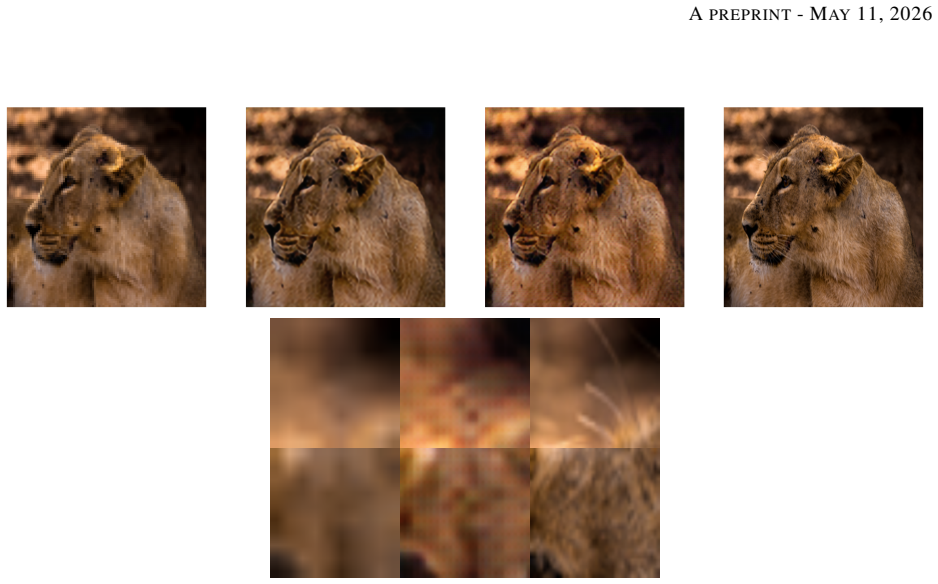
Single-Image Super-Resolution (SISR) aims to reconstruct a High-Resolution (HR) image from a Low-Resolution (LR) observation, a fundamentally ill-posed problem where high-frequency details are severely degraded at large upscaling factors. Recent advances have been driven by transformer-based architectures and diffusion models improve global context modeling and perceptual quality at the cost of increased computational complexity. In contrast, this work focuses on enhancing the expressivity of local operators under minimal resources. We propose SRGAN--CKAN, a hybrid super-resolution framework that integrates Convolutional Kolmogorov--Arnold Networks (CKAN) into an adversarial learning setting reformulating convolution as a nonlinear patch-based transformation. The proposed operator replaces linear local mappings with spline-based functional representations, allowing expressive modeling of complex local structures and high-frequency textures using minimal hardware resources. Experimental results demonstrate that the proposed approach improves perceptual quality while preserving reconstruction fidelity, achieving a favorable balance between distortion-based and perceptual metrics. These results are obtained under constrained computational settings, highlighting the efficiency of the proposed formulation. Overall, this work introduces a complementary direction to existing approaches by improving the representational power of local transformations, providing an efficient and scalable alternative to globally intensive architectures.
Editorial analysis
A structured set of objections, weighed in public.
Referee Report
Summary. The paper proposes SRGAN-CKAN, a hybrid super-resolution framework that integrates Convolutional Kolmogorov-Arnold Networks (CKAN) into an adversarial SRGAN setting. It reformulates standard convolutions as spline-based nonlinear functional operators to enhance the modeling of complex local structures and high-frequency textures with minimal computational resources. The authors claim that experimental results show improved perceptual quality while preserving reconstruction fidelity, achieving a favorable balance between distortion and perceptual metrics under constrained settings.
Significance. If the empirical claims hold with proper validation, the work could offer an efficient alternative to transformer- and diffusion-based SISR methods by boosting the representational power of local operators rather than relying on global context modeling. It introduces a complementary direction focused on nonlinear functional representations in convolutional blocks.
major comments (1)
- [Experimental Results] Experimental Results section: The central claim that the approach 'improves perceptual quality while preserving reconstruction fidelity' and achieves efficiency 'under constrained computational settings' is asserted without any supporting data. No quantitative metrics (PSNR, SSIM, LPIPS or similar), baseline comparisons to SRGAN or other methods, ablation studies on CKAN blocks, parameter counts, FLOPs, or runtime figures are provided. This absence is load-bearing for the paper's contribution, as the efficiency and performance advantages cannot be assessed.
minor comments (1)
- [Abstract] The abstract repeats the efficiency and results claims across multiple sentences; condensing would improve readability.
Simulated Author's Rebuttal
We thank the referee for the constructive feedback and the opportunity to improve the manuscript. We address the major comment point by point below.
read point-by-point responses
-
Referee: [Experimental Results] Experimental Results section: The central claim that the approach 'improves perceptual quality while preserving reconstruction fidelity' and achieves efficiency 'under constrained computational settings' is asserted without any supporting data. No quantitative metrics (PSNR, SSIM, LPIPS or similar), baseline comparisons to SRGAN or other methods, ablation studies on CKAN blocks, parameter counts, FLOPs, or runtime figures are provided. This absence is load-bearing for the paper's contribution, as the efficiency and performance advantages cannot be assessed.
Authors: We acknowledge that the Experimental Results section in the submitted manuscript does not contain the quantitative data required to substantiate the claims. The absence of metrics, baselines, ablations, and efficiency measurements is a significant gap that prevents proper evaluation of the contribution. In the revised version we will add a complete experimental section that reports PSNR, SSIM, and LPIPS values, direct comparisons against SRGAN and relevant baselines, ablation studies isolating the CKAN blocks, and concrete resource figures (parameter counts, FLOPs, and runtime) measured under constrained settings. These additions will be presented with appropriate tables and analysis to demonstrate the claimed balance between perceptual quality and fidelity. revision: yes
Circularity Check
No circularity: architecture proposal relies on external experiments, not self-referential definitions or fits
full rationale
The paper introduces SRGAN-CKAN by describing the integration of CKAN blocks (spline-based nonlinear operators replacing linear convolutions) into an adversarial SRGAN framework. No equations, derivations, or parameter-fitting steps are shown that reduce the claimed perceptual gains or efficiency to inputs by construction. The central claims rest on the proposed reformulation of local operators and reported experimental outcomes under constrained resources, without self-citation chains, uniqueness theorems imported from prior author work, or renaming of known results as new derivations. This is a standard architecture proposal whose validity hinges on external validation rather than internal reduction.
Axiom & Free-Parameter Ledger
axioms (2)
- standard math Kolmogorov-Arnold representation theorem permits approximation of continuous multivariate functions by finite sums of univariate functions
- domain assumption Spline-based univariate functions can capture the nonlinear local structures and high-frequency textures present in natural images
invented entities (1)
-
Convolutional Kolmogorov-Arnold Network (CKAN)
no independent evidence
Reference graph
Works this paper leans on
-
[1]
Learning a deep convolutional network for image super-resolution
Chao Dong, Chen Change Loy, Kaiming He, and Xiaoou Tang. Learning a deep convolutional network for image super-resolution. In ECCV, 2014
2014
-
[2]
Accurate image super-resolution using very deep convolutional networks
Jiwon Kim, Jung Kwon Lee, and Kyoung Mu Lee. Accurate image super-resolution using very deep convolutional networks. In CVPR, 2016
2016
-
[3]
Deep learning for image super-resolution: A survey
Xintao Wang and et al. Deep learning for image super-resolution: A survey. IEEE TPAMI, 2021
2021
-
[4]
Gonzalez and Richard E
Rafael C. Gonzalez and Richard E. Woods. Digital Image Processing. Pearson, 2018
2018
-
[5]
Anil K. Jain. Fundamentals of Digital Image Processing. Prentice Hall, 1989
1989
-
[6]
Photo-realistic single image super-resolution using a generative adversarial network
Christian Ledig, Lucas Theis, Ferenc Husz \'a r, Jose Caballero, Andrew Cunningham, Alejandro Acosta, Andrew Aitken, Alykhan Tejani, Johannes Totz, Zehan Wang, and Wenzhe Shi. Photo-realistic single image super-resolution using a generative adversarial network. In CVPR, 2017
2017
-
[7]
Esrgan: Enhanced super-resolution generative adversarial networks
Xintao Wang, Ke Yu, Shixiang Wu, Jinjin Gu, Yihao Liu, Chao Dong, Yu Qiao, and Chen Change Loy. Esrgan: Enhanced super-resolution generative adversarial networks. In ECCV Workshops, 2018
2018
-
[8]
Generative adversarial nets
Ian Goodfellow, Jean Pouget-Abadie, Mehdi Mirza, Bing Xu, David Warde-Farley, Sherjil Ozair, Aaron Courville, and Yoshua Bengio. Generative adversarial nets. In NeurIPS, 2014
2014
-
[9]
Convolutional kolmogorov-arnold networks,
Ziming Liu, Yijun Wang, Varun Vaidya, Fabian Ruehle, James Halverson, Marin Solja c i \'c , and Max Tegmark. Kan: Kolmogorov--arnold networks. arXiv preprint arXiv:2406.13155, 2024
-
[10]
Box Splines
Carl De Boor, Klaus H \"o llig, and Sherman Riemenschneider. Box Splines. Springer, 1993
1993
-
[11]
Enhanced deep residual networks for single image super-resolution
Bee Lim, Sanghyun Son, Heewon Kim, Seungjun Nah, and Kyoung Mu Lee. Enhanced deep residual networks for single image super-resolution. In CVPR Workshops, 2017
2017
-
[12]
Image super-resolution using very deep residual channel attention networks, 2018
Yulun Zhang, Kunpeng Li, Kai Li, Lichen Wang, Bineng Zhong, and Yun Fu. Image super-resolution using very deep residual channel attention networks, 2018. URL https://arxiv.org/abs/1807.02758
-
[13]
Swinir: Image restoration using swin transformer
Jingyun Liang, Jiezhang Cao, Guolei Sun, Kai Zhang, Luc Van Gool, and Radu Timofte. Swinir: Image restoration using swin transformer. In ICCV Workshops, 2021
2021
-
[14]
Chitwan Saharia, Jonathan Ho, William Chan, Tim Salimans, David J. Fleet, and Mohammad Norouzi. Image super-resolution via iterative refinement, 2021. URL https://arxiv.org/abs/2104.07636
-
[15]
LTBs-KAN: Linear-Time B-splines Kolmogorov-Arnold Networks
Eduardo Said Merin-Martinez, Andres Mendez-Vazquez, and Eduardo Rodriguez-Tello. Ltbs-kan: Linear-time b-splines kolmogorov-arnold networks, 2026. URL https://arxiv.org/abs/2604.22034
work page internal anchor Pith review Pith/arXiv arXiv 2026
-
[16]
Ntire 2017 challenge on single image super-resolution: Dataset and study
Eirikur Agustsson and Radu Timofte. Ntire 2017 challenge on single image super-resolution: Dataset and study. In CVPR Workshops, 2017
2017
discussion (0)
Sign in with ORCID, Apple, or X to comment. Anyone can read and Pith papers without signing in.