Recognition: unknown
Computational foundations of the human world
Pith reviewed 2026-05-09 16:46 UTC · model grok-4.3
The pith
The computational difficulty of collective decision-making imposes fundamental constraints on social organization.
A machine-rendered reading of the paper's core claim, the machinery that carries it, and where it could break.
Core claim
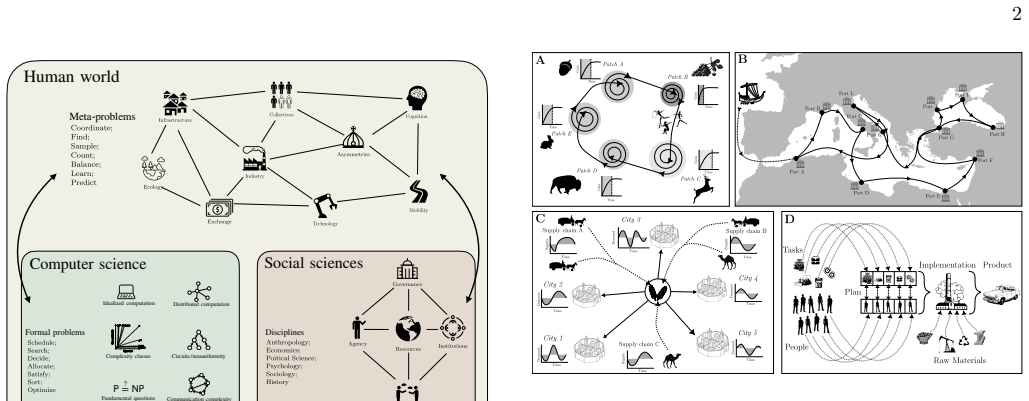
Human societies continuously transform scattered information into collective judgments and coordinated action. Importantly, the computational difficulty of collective decision-making, particularly the time and communication required to reach solutions, imposes fundamental constraints on social organization. Core phenomena that can be framed as computational include distributed consensus and coordinated action, societal restructuring with scale, hierarchical and modular structure, and externalized memory systems. Concepts from theoretical computer science, especially beyond Turing machines and worst-case complexity, provide insight into these phenomena and open research directions at the CS–s
What carries the argument
The computational difficulty of collective decision-making, measured by time and communication requirements, as a source of constraints on social organization.
If this is right
- Societies must develop hierarchies and modular structures to manage rising communication costs as they scale.
- Externalized memory systems become necessary once information volume exceeds individual capacity.
- Coordinated action is limited by the efficiency of distributed consensus mechanisms.
- Markets and governance institutions evolve to minimize the computational overhead of reaching collective judgments.
Where Pith is reading between the lines
- This framing could predict size thresholds at which societies must adopt new institutions to continue growing.
- It connects social organization to information-processing limits seen in other distributed systems.
- Quantitative comparisons of decision costs across small and large historical groups could test the constraints.
Load-bearing premise
That core social phenomena can be productively reframed as computational problems using tools from theoretical computer science without losing essential human or cultural elements.
What would settle it
Observation of a large society achieving complex coordination with decision time and communication costs that do not increase with group size would challenge the claim of fundamental constraints.
Figures
read the original abstract
Human societies continuously transform scattered information into collective judgments and coordinated action, whether through markets discovering prices, governments allocating resources, communities enforcing norms, or science converging on reliable claims. Importantly, the computational difficulty of collective decision-making, particularly the time and communication required to reach solutions, imposes fundamental constraints on social organization. While theoretical computer science offers formal tools for analyzing such problems, for instance, by analyzing resource requirements, including time and memory, surprisingly, there is no domain of social science that focuses on the nature of computation in the human world. This perspective argues that we now have the opportunity to deploy these computational frameworks to study human social organization, opening research directions at the intersection of computer science and social science. We highlight core social phenomena that can be framed as computational, including (i) distributed consensus and coordinated action, (ii) societal restructuring with scale, (iii) hierarchical and modular structure, and (iv) externalized memory systems. We identify several concepts from theoretical computer science that may provide insight into these phenomena, especially emphasizing more recently developed approaches beyond the paradigm of Turing~Machines and worst-case computational complexity.
Editorial analysis
A structured set of objections, weighed in public.
Referee Report
Summary. The manuscript is a perspective paper proposing a new interdisciplinary research program at the intersection of theoretical computer science and social science. It argues that collective decision-making in human societies is subject to fundamental computational constraints arising from time and communication costs, and that tools from TCS can be used to analyze core phenomena including distributed consensus and coordinated action, societal restructuring with scale, hierarchical and modular structure, and externalized memory systems. The authors note the absence of a dedicated domain focused on computation in the human world and highlight the potential of approaches beyond traditional Turing machines and worst-case complexity.
Significance. If the proposed program is pursued with concrete models, it could yield formal explanations for why certain social structures emerge or are limited at scale, complementing existing qualitative approaches in sociology and political science. The paper's strength lies in its clear framing of four phenomena as candidates for computational analysis and its forward-looking identification of an opportunity for cross-disciplinary work, though its impact will depend on subsequent development of specific reductions or bounds.
major comments (2)
- [Core social phenomena (paragraph listing (i)–(iv))] The section identifying the four core social phenomena states that they 'can be framed as computational' but provides no illustrative example, such as a communication-complexity lower bound for consensus or a scaling argument linking computational resources to societal restructuring. Without at least one such sketch, the claim that TCS tools will yield insight into these phenomena remains programmatic and difficult to assess for feasibility.
- [Concepts from theoretical computer science] The discussion of TCS concepts emphasizes 'more recently developed approaches beyond the paradigm of Turing Machines and worst-case computational complexity' yet does not connect any specific framework (e.g., communication complexity, local distributed algorithms, or parameterized complexity) to even one of the listed social phenomena. This omission weakens the argument that such tools are ready to be deployed.
minor comments (2)
- [Abstract and Introduction] The abstract asserts that 'surprisingly, there is no domain of social science that focuses on the nature of computation in the human world,' but the introduction would benefit from a short paragraph acknowledging adjacent fields such as computational social science or complex adaptive systems to clarify the precise novelty.
- [Core social phenomena, item (iv)] The term 'externalized memory systems' is introduced without a brief definition or example (e.g., writing, archives, or digital platforms), which may leave readers unfamiliar with the intended scope.
Simulated Author's Rebuttal
We thank the referee for the constructive feedback and the recommendation for minor revision. We address each major comment below, proposing targeted revisions that preserve the perspective character of the paper while making the proposed research program more concrete.
read point-by-point responses
-
Referee: [Core social phenomena (paragraph listing (i)–(iv))] The section identifying the four core social phenomena states that they 'can be framed as computational' but provides no illustrative example, such as a communication-complexity lower bound for consensus or a scaling argument linking computational resources to societal restructuring. Without at least one such sketch, the claim that TCS tools will yield insight into these phenomena remains programmatic and difficult to assess for feasibility.
Authors: We agree that an illustrative sketch would strengthen the argument. In revision we will insert a concise example for distributed consensus and coordinated action, noting that communication-complexity lower bounds (e.g., the Ω(n) bit lower bound for equality in the two-party setting, extended to multi-party settings) imply that achieving reliable consensus in large populations requires either substantial communication infrastructure or relaxed accuracy guarantees. This single paragraph will illustrate feasibility without turning the perspective into a technical paper. revision: yes
-
Referee: [Concepts from theoretical computer science] The discussion of TCS concepts emphasizes 'more recently developed approaches beyond the paradigm of Turing Machines and worst-case computational complexity' yet does not connect any specific framework (e.g., communication complexity, local distributed algorithms, or parameterized complexity) to even one of the listed social phenomena. This omission weakens the argument that such tools are ready to be deployed.
Authors: We accept the criticism. The revised manuscript will explicitly link communication complexity to distributed consensus and coordinated action, and local distributed algorithms to hierarchical and modular structure, using one-sentence references to existing results (e.g., LOCAL model lower bounds for symmetry breaking). These connections will be brief and will not expand the scope of the paper. revision: yes
Circularity Check
No significant circularity; perspective paper without derivations or load-bearing claims.
full rationale
This is a forward-looking perspective paper that motivates a research program by noting computational aspects of collective decision-making and listing four social phenomena that could be reframed using TCS tools. It supplies no equations, formal models, predictions, fitted parameters, or derived results. No load-bearing premise reduces to a self-definition, self-citation, or input by construction. The argument is self-contained as a proposal for future work rather than a claim whose validity depends on internal reductions.
Axiom & Free-Parameter Ledger
axioms (1)
- domain assumption Social phenomena can be productively framed as computational problems involving time and communication constraints
Reference graph
Works this paper leans on
-
[1]
small overlapping decision groups make specific decisions and share information,
that admits a polynomial time algorithm [170]. In games prone to coordination failure, such as Prisoner’s dilemma [171], the correlated equilibrium often includes outcomes that are strictly Pareto superior (more efficient, in the game-theoretic sense [172]) to all Nash equilibrium payoffs. The loss of this efficiency due to self-interested behavior is oft...
-
[2]
Parameterized complexity partitions problem classes into tractable subsets [192, 193]
introduces parameterized complexity to cognitive science. Parameterized complexity partitions problem classes into tractable subsets [192, 193]. They argue that human cognition doesn’t solve the full problem but identifies and operates within tractable partitions, e.g., via domain-specific simplifications. This work closely aligns with our Perspective, in...
-
[3]
Ball, The physical modelling of human social systems, Complexus1, 190 (2004)
P. Ball, The physical modelling of human social systems, Complexus1, 190 (2004)
2004
-
[4]
Castellano, S
C. Castellano, S. Fortunato, and V. Loreto, Statistical physics of social dynamics, Reviews of modern physics 81, 591 (2009)
2009
-
[5]
M. S. Granovetter, The strength of weak ties, American Journal of Sociology78, 1360–1380 (1973)
1973
-
[6]
Onnela, J
J.-P. Onnela, J. Saram¨ aki, J. Hyv¨ onen, G. Szab´ o, D. Lazer, K. Kaski, J. Kert´ esz, and A.-L. Barab´ asi, Structure and tie strengths in mobile communication networks, Proceedings of the National Academy of Sci- ences104, 7332–7336 (2007)
2007
-
[7]
Centola, The spread of behavior in an online social network experiment, Science329, 1194 (2010)
D. Centola, The spread of behavior in an online social network experiment, Science329, 1194 (2010). 11
2010
-
[8]
Gabaix, P
X. Gabaix, P. Gopikrishnan, V. Plerou, and H. E. Stan- ley, A theory of power-law distributions in financial mar- ket fluctuations, Nature423, 267 (2003)
2003
-
[9]
Plerou, P
V. Plerou, P. Gopikrishnan, and H. E. Stanley, Two- phase behaviour of financial markets, Nature421, 130 (2003)
2003
-
[10]
Fehr and S
E. Fehr and S. G¨ achter, Cooperation and punishment in public goods experiments, American Economic Review 90, 980 (2000)
2000
-
[11]
D. G. Rand, S. Arbesman, and N. A. Christakis, Dynamic social networks promote cooperation in ex- periments with humans, Proceedings of the National Academy of Sciences108, 19193 (2011)
2011
-
[12]
G. B. West, J. H. Brown, and B. J. Enquist, A general model for the origin of allometric scaling laws in biology, Science276, 122 (1997)
1997
-
[13]
Barabasi, The origin of bursts and heavy tails in human dynamics, Nature435, 207 (2005)
A.-L. Barabasi, The origin of bursts and heavy tails in human dynamics, Nature435, 207 (2005)
2005
-
[14]
L. M. A. Bettencourt, J. Lobo, D. Helbing, C. K¨ uhnert, and G. B. West, Growth, innovation, scaling, and the pace of life in cities, Proceedings of the National Academy of Sciences104, 7301 (2007)
2007
-
[15]
L. M. A. Bettencourt, The origins of scaling in cities, Science340, 1438 (2013)
2013
-
[16]
Turchin, T
P. Turchin, T. E. Currie, E. A. L. Turner, and S. Gavrilets, Quantitative historical analysis uncovers a single dimension of complexity that structures global variation in human social organization, Proceedings of the National Academy of Sciences115, E144 (2018)
2018
-
[17]
J. Shin, M. H. Price, D. H. Wolpert, H. Shimao, B. D. Tracey, and S. D. Contributors, Scale and information- processing thresholds in holocene social evolution, Na- ture Communications11, 1 (2020)
2020
-
[18]
Turchin, R
P. Turchin, R. Brennan, T. E. Currie, K. Feeney, P. Francois, D. Hoyer, J. G. Manning, A. Palmisano, P. Peregrine, E. A. L. Turner, and H. Whitehouse, Dis- entangling the evolutionary drivers of social complexity, Science Advances8, eabn3517 (2022)
2022
-
[19]
Gell-Mann, Regularities in human affairs, Cliody- namics2, 10.21237/C7clio21205 (2011)
M. Gell-Mann, Regularities in human affairs, Cliody- namics2, 10.21237/C7clio21205 (2011)
-
[20]
Rybski, S
D. Rybski, S. V. Buldyrev, S. Havlin, F. Liljeros, and H. A. Makse, Scaling laws of human interaction activity, Proceedings of the National Academy of Sciences106, 12640 (2009)
2009
-
[21]
D. H. Wolpert and K. Harper, The computational power of a human society: a new model of social evolution, Cliodynamics16, 69 (2025)
2025
-
[22]
D. H. Wolpert, J. Korbel, C. W. Lynn, F. Tasnim, J. A. Grochow, G. Karde¸ s, J. B. Aimone, V. Balasubrama- nian, E. D. Giuli, D. Doty, N. Freitas, M. Marsili, T. E. Ouldridge, A. W. Richa, P. Riechers, ´Edgar Rold´ an, B. Rubenstein, Z. Toroczkai, and J. Paradiso, Is stochas- tic thermodynamics the key to understanding the en- ergy costs of computation?, ...
2024
-
[23]
D. H. Wolpert and J. Korbel, What does it mean for a system to compute?, Journal of Physics: Complexity7, 015010 (2026)
2026
-
[24]
E. R. Brush, D. C. Krakauer, and J. C. Flack, Conflicts of interest improve collective computation of adaptive social structures, Science advances4, e1603311 (2018)
2018
-
[25]
M. J. Hamilton, Collective computation, information flow, and the emergence of hunter-gatherer small- worlds, Journal of Social Computing3, 18 (2022)
2022
-
[26]
K. J. Arrowet al.,Social choice and individual values, Vol. 2 (Wiley New York, 1964)
1964
-
[27]
Durkheim, The division of labor in society, inSocial Stratification, Class, Race, and Gender in Sociological Perspective, Second Edition(Routledge, 2019) pp
E. Durkheim, The division of labor in society, inSocial Stratification, Class, Race, and Gender in Sociological Perspective, Second Edition(Routledge, 2019) pp. 178– 183
2019
-
[28]
Sen, Social choice theory: A re-examination, Econo- metrica: journal of the Econometric Society45, 53 (1977)
A. Sen, Social choice theory: A re-examination, Econo- metrica: journal of the Econometric Society45, 53 (1977)
1977
-
[29]
E. D. Beinhocker,The Origin of Wealth: Evolution, Complexity, and the Radical Remaking of Economics (Harvard Business School Press, 2006)
2006
-
[30]
F. A. Hayek, The use of knowledge in society, The Amer- ican Economic Review35, 519 (1945)
1945
-
[31]
D. C. North, Institutions and economic growth: An historical introduction, World development17, 1319 (1989)
1989
-
[32]
D. C. North,Institutions, institutional change and eco- nomic performance(Cambridge university press, 1990)
1990
-
[33]
R. I. Dunbar and S. Shultz, Evolution in the social brain, science317, 1344 (2007)
2007
-
[34]
M. J. Hamilton, B. T. Milne, R. S. Walker, O. Burger, and J. H. Brown, The complex structure of hunter– gatherer social networks, Proceedings of the Royal So- ciety B: Biological Sciences274, 2195 (2007)
2007
-
[35]
Bowles,Microeconomics: behavior, institutions, and evolution(Princeton University Press, 2009)
S. Bowles,Microeconomics: behavior, institutions, and evolution(Princeton University Press, 2009)
2009
-
[36]
M. J. Hamilton, R. S. Walker, and B. Buchanan, Insti- tutional complexity emerges from socioecological com- plexity in small-scale human societies, Proceedings B 291, 20240246 (2024)
2024
-
[37]
T. A. Kohler, D. Bird, and D. H. Wolpert, Social scale and collective computation: Does information process- ing limit rate of growth in scale?, Journal of Social Com- puting3, 1 (2022)
2022
-
[38]
Moore and S
C. Moore and S. Mertens,The nature of computation (Oxford University Press, 2011)
2011
-
[39]
Arora and B
S. Arora and B. Barak,Computational complexity: a modern approach(Cambridge University Press, 2009)
2009
-
[40]
N. A. Lynch,Distributed algorithms(Elsevier, 1996)
1996
-
[41]
C. H. Papadimitriou, Computational complexity, inEn- cyclopedia of computer science(Van Nostrand Reinhold Co., 2003) pp. 260–265
2003
-
[42]
C. H. Papadimitriou and K. Steiglitz,Combinatorial op- timization: algorithms and complexity(Courier Corpo- ration, 2013)
2013
-
[43]
Boyd and P
R. Boyd and P. J. Richerson,Culture and the evolution- ary process(University of Chicago press, 1988)
1988
-
[44]
R. Boyd, P. J. Richerson, and J. Henrich, The cultural niche: Why social learning is essential for human adap- tation, Proceedings of the National Academy of Sciences 108, 10918 (2011)
2011
-
[45]
M. J. Hamilton, B. Buchanan, and R. S. Walker, More is different in cultural evolution, OSF Preprint (2025)
2025
-
[46]
Mokyr,A culture of growth: The origins of the mod- ern economy(Princeton University Press, 2016)
J. Mokyr,A culture of growth: The origins of the mod- ern economy(Princeton University Press, 2016)
2016
-
[47]
M. O. Jackson, Mechanism theory, Available at SSRN 2542983 10.2139/ssrn.2542983 (2014)
-
[48]
M. O. Jackson, A crash course in implementation the- ory, Social choice and welfare18, 655 (2001)
2001
-
[49]
Van Steen and A
M. Van Steen and A. S. Tanenbaum,Distributed systems (Maarten van Steen Leiden, The Netherlands, 2017)
2017
-
[50]
Krugman,The self organizing economy(John Wiley & Sons, 1996)
P. Krugman,The self organizing economy(John Wiley & Sons, 1996). 12
1996
-
[51]
Von Mises, Economic calculation in the socialist com- monwealth 1, inClassics in Austrian Economics, Vol- ume 3(Routledge, 2024) pp
L. Von Mises, Economic calculation in the socialist com- monwealth 1, inClassics in Austrian Economics, Vol- ume 3(Routledge, 2024) pp. 3–31
2024
-
[52]
Ysander and K
B.-C. Ysander and K. J. Arrow, The limits of organiza- tion, The Swedish Journal of Economics77, 275 (1975)
1975
-
[53]
J. C. Mitchell, Social networks, Annual Review of An- thropology3, 279 (1974)
1974
-
[54]
Marin and B
A. Marin and B. Wellman, Social network analysis: An introduction, The SAGE handbook of social network analysis11, 25 (2011)
2011
-
[55]
M. E. Newman and J. Park, Why social networks are different from other types of networks, Physical review E68, 036122 (2003)
2003
-
[56]
Toivonen, J.-P
R. Toivonen, J.-P. Onnela, J. Saram¨ aki, J. Hyv¨ onen, and K. Kaski, A model for social networks, Physica A: Statistical Mechanics and its Applications371, 851 (2006)
2006
-
[57]
Holme and B
P. Holme and B. J. Kim, Growing scale-free networks with tunable clustering, Physical review E65, 026107 (2002)
2002
-
[58]
D. J. Watts,Small worlds: the dynamics of networks between order and randomness(Princeton university press, 1999)
1999
-
[59]
D. J. Watts and S. H. Strogatz, Collective dynamics of ‘small-world’ networks, nature393, 440 (1998)
1998
-
[60]
Barab´ asi and R
A.-L. Barab´ asi and R. Albert, Emergence of scaling in random networks, science286, 509 (1999)
1999
-
[61]
Girvan and M
M. Girvan and M. E. Newman, Community structure in social and biological networks, Proceedings of the na- tional academy of sciences99, 7821 (2002)
2002
-
[62]
M. E. Newman and M. Girvan, Finding and evaluating community structure in networks, Physical review E69, 026113 (2004)
2004
-
[63]
Lancichinetti and S
A. Lancichinetti and S. Fortunato, Community detec- tion algorithms: a comparative analysis, Physical Re- view E—Statistical, Nonlinear, and Soft Matter Physics 80, 056117 (2009)
2009
-
[64]
Wellman, The community question: The intimate networks of east yorkers, American journal of Sociology 84, 1201 (1979)
B. Wellman, The community question: The intimate networks of east yorkers, American journal of Sociology 84, 1201 (1979)
1979
-
[65]
H. A. Simon, The architecture of complexity, inThe Roots of Logistics(Springer, 2012) pp. 335–361
2012
-
[66]
M. J. Hamilton, R. S. Walker, B. Buchanan, and D. S. Sandeford, Scaling human sociopolitical complex- ity, PloS one15, e0234615 (2020)
2020
-
[67]
Trusina, S
A. Trusina, S. Maslov, P. Minnhagen, and K. Sneppen, Hierarchy measures in complex networks, Physical re- view letters92, 178702 (2004)
2004
-
[68]
S. Eum, S. Arakawa, and M. Murata, A new approach for discovering and quantifying hierarchical structure of complex networks, inFourth International Conference on Autonomic and Autonomous Systems (ICAS’08) (IEEE, 2008) pp. 182–187
2008
-
[69]
Mones, L
E. Mones, L. Vicsek, and T. Vicsek, Hierarchy measure for complex networks, PloS one7, e33799 (2012)
2012
-
[70]
Krackhardt, Graph theoretical dimensions of infor- mal organizations, inComputational Organization The- ory(L
D. Krackhardt, Graph theoretical dimensions of infor- mal organizations, inComputational Organization The- ory(L. Erlbaum Associates Inc., USA, 1994) p. 89–111
1994
-
[71]
M. G. Everett and D. Krackhardt, A second look at krackhardt’s graph theoretical dimensions of informal organizations, Social Networks34, 159 (2012)
2012
-
[72]
Shizuka and D
D. Shizuka and D. B. McDonald, A social network per- spective on measurements of dominance hierarchies, An- imal Behaviour83, 925 (2012)
2012
-
[73]
Gupte, P
M. Gupte, P. Shankar, J. Li, S. Muthukrishnan, and L. Iftode, Finding hierarchy in directed online social networks, inProceedings of the 20th international con- ference on World wide web(2011) pp. 557–566
2011
-
[74]
Redhead and E
D. Redhead and E. A. Power, Social hierarchies and so- cial networks in humans, Philosophical Transactions of the Royal Society B: Biological Sciences377, 20200440 (2022)
2022
-
[75]
Shively, The evolution of dominance hierarchies in nonhuman primate society, inPower, dominance, and nonverbal behavior(Springer, 1985) pp
C. Shively, The evolution of dominance hierarchies in nonhuman primate society, inPower, dominance, and nonverbal behavior(Springer, 1985) pp. 67–87
1985
-
[76]
R. M. Sapolsky, The influence of social hierarchy on primate health, science308, 648 (2005)
2005
-
[77]
Boehm and C
C. Boehm and C. Boehm,Hierarchy in the forest: The evolution of egalitarian behavior(Harvard University Press, 2009)
2009
-
[78]
Perret, E
C. Perret, E. Hart, and S. T. Powers, From disorganized equality to efficient hierarchy: how group size drives the evolution of hierarchy in human societies, Proceedings of the Royal Society B287, 20200693 (2020)
2020
-
[79]
E. R. Service, Primitive social organization: An evolu- tionary perspective (1962)
1962
-
[80]
Earle,How Chiefs Come to Power(Stanford Univer- sity Press, Redwood City, 1997)
T. Earle,How Chiefs Come to Power(Stanford Univer- sity Press, Redwood City, 1997)
1997
discussion (0)
Sign in with ORCID, Apple, or X to comment. Anyone can read and Pith papers without signing in.